
NEW
Font size
 Worksheets
Levels of Basic Communication
Total questions: 49
Worksheet time: 25mins
What type of communication occurs between two people and is most common when talking with patients?
Interpersonal communication
Intrapersonal communication
Group communication
Mass communication
What is the term for communication that occurs within a large group of people, such as teaching or giving a presentation?
Public communication
Interpersonal communication
Intrapersonal communication
Group communication
What type of communication occurs within a group of people working toward the same goal, such as committees, research teams, or support groups?
Public communication
Mass communication
Interpersonal communication
Small Group communication
What does 'Credibility' mean in the context of verbal communication?
Trustworthiness and reliability of an individual.
The speed at which someone speaks.
The use of complex vocabulary.
The volume of a person's voice.
Health care professionals must be knowledgeable, consistent, honest, confident, and dependable to maintain what aspect of communication?
Credibility
Empathy
Confidentiality
Flexibility
What does 'Clarity & brevity' mean in verbal communication?
It means using complex words to impress others.
The shortest, simplest communication is usually the most effective
It refers to speaking as much as possible to convey your point.
It is about using technical jargon to sound professional.
What is the importance of 'Timing and relevance' in verbal communication?
Knowing when to begin communication so the receiver is more attentive to the message.
Using complex vocabulary to impress the receiver.
Speaking as quickly as possible to save time.
Ignoring the listener's feedback during the conversation.
What does 'Pacing' refer to in verbal communication?
The rate of speech can communicate different messages to the receiver.
The volume of speech used in a conversation.
The use of gestures while speaking.
The choice of words in a conversation.
Fill in the blank: ________ communication can often have a greater effect on a message than the words do.
Technical
Written
Nonverbal
Digital
Facial expressions can reveal feelings that can be easily ________ by clients. Fill in the blank.
welcomed
understood
ignored
misinterpred
Eye contact typically conveys interest and respect but varies with ________.
culture
age
weather
language
Lack of awareness of personal space can make clients perceive a threat and react ________.
passively
defensively
enthusiastically
indifferently
What is one-way communication?
Communication where there is no expectation of a reply or feedback
Communication where feedback is expected
Communication that always involves two people
Communication that is always written
Fill in the blank: An example of one-way communication is ___________.
An advertisement or notice on a board
A group discussion among friends
A phone call between two people
A classroom debate
Which of the following is an advantage of one-way communication?
It allows for immediate feedback
It is simple, quick, and cheap
It always provides clarification
It is always face-to-face
One-way communication allows for clarification or opportunity to correct inaccuracies.
True
False
Fill in the blank: One-way communication may cause __________ in the receiver.
frustration
happiness
clarity
motivation
Refer to the diagram of 'One Way Communication'. What are the three main components shown in the process?
Sender, Message, Receiver
Sender, Channel, Feedback
Receiver, Channel, Feedback
Sender, Noise, Feedback
In 'One Way Communication', who initiates the process?
Observer
Receiver
Sender
Listener
In 'One Way Communication', who receives the information?
Transmitter
Sender
Observer
Receiver
Which of the following best describes 'One Way Communication'?
A) Both sender and receiver exchange messages
B) Only the sender sends a message and the receiver receives it
C) The receiver sends feedback to the sender
D) None of the above
Two-way communication is more time-consuming because the receiver has the opportunity to give ______ and to question what has been said or written.
feedback
instructions
orders
punishment
In two-way communication, the receiver is invited to ______ to the process.
listen
contribute
interrupt
ignore
If the message is complex, two-way communication is far more ______.
effective
difficult
unnecessary
expensive
Both sender and receiver listen to each other, gather information and are willing to make changes to work together in ______.
harmony
conflict
competition
isolation
What method of communication are the two people using?
They are using sign language to communicate.
They are using walkie-talkies to communicate.
They are using tin can telephones to communicate
They are using smoke signals to communicate.
According to the guidelines for communication with patients, what type of language should be used when communicating with children?
Simple, straightforward language
Technical medical jargon
Complex and abstract language
Formal and legal terminology
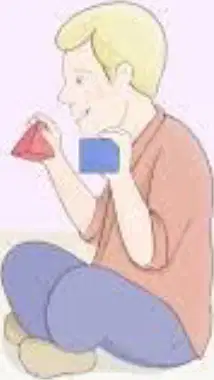
According to the guidelines for communication with patients, where should you be when communicating with a child?
At child's eye level
Standing above the child
Sitting far from the child
Behind the child
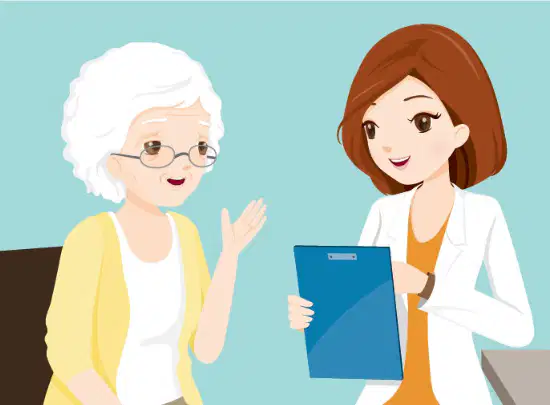
For older adults, what should you make sure is available to assist with communication?
Sports equipment
Colorful posters
Assistive devices (glasses, hearing aids)
Cooking utensils
For older adults, what should be minimized during communication?
Distractions
Gestures
Eye contact
Volume
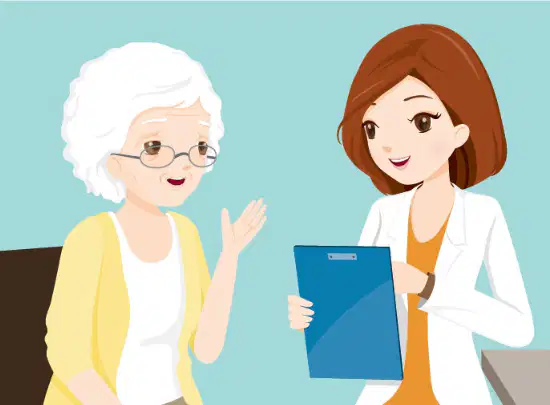
For older adults, what should you allow plenty of time for?
For the patient to watch television
For the patient to walk outside
For the patient to eat dessert
For the patient to respond
What does 'Silence' allow for in communication skills and techniques?
Meaningful reflection
Immediate response
Distraction from topic
Interrupting others
Active listening helps the professional to ______, observe, and understand what the patient communicates and provide feedback.
avoid
ignore
interrupt
hear
Asking appropriate questions, specifically open-ended questions, facilitates ______ responses and interactive discussion. It encourages the patient to explore feelings and thoughts and avoid yes or no answers.
spontaneous
delayed
scripted
limited
What is the technique called when you use the patient's exact words to clarify communication?
Paraphrasing
Reflecting
Summarizing
Restating
Which clarifying technique directs the focus back to the patient for them to examine their thoughts and feelings?
Restating
Reflecting
Paraphrasing
Giving information
Paraphrasing involves restating the patient's words in your own words to have the patient confirm what they have communicated.
True
False
Giving information means providing factual details that the patient may need in order to make a decision.
True
False
If appropriate, what can communicate caring and provide comfort?
Touch
Ignore
Yell
Avoid
What is cultural sensitivity? Fill in the blank: Cultural sensitivity is having knowledge about the _______ prevalent in your area of practice.
cultures
languages
technologies
climates
Which of the following is a barrier to culturally responsive care?
Language and perception of time differences
Teamwork
Advanced technology
Patient satisfaction
Fill in the blank: Ethnocentrism is the belief that one _______ is superior to others.
tradition
language
culture
religion
Fill in the blank: Prejudice is making _______ without having full information.
assumptions
decisions
promises
plans
Which of the following statements is true about eye movements in some cultures?
Eye contact is always seen as respectful
Some cultures view eye contact as an invasion of privacy or disrespect
Eye contact is never made
Eye contact is only made with elders
Sitting and looking at the client at the same eye level is considered _________
respectful
aggressive
distracted
uninterested
Non-Verbal Behavior in differing cultures: Western culture often values a strong ________ while in other cultures only specific people are allowed to touch.
nod
bow
handshake
salute
What should you always do before engaging in any physical contact with a patient?
Assume it is okay
Ask permission
Wait for the patient to initiate
Ignore cultural differences
The barriers to communication are misunderstandings, language/culture, and ______.
texting
active listening
poor listening skills
clear communication

