
 Worksheets
Wk 12 venous
Total questions: 98
Worksheet time: 1hrs 28mins
Venous disease is prominent in adults ranging from _% to _%, the highest prevalence is in Western countries
(a)
In the United States more than (a) % of adults are affected by chronic venous insufficiency and varicose veins
Chronic venous insufficiency can result in all of the following except:
Pain
Morbidity
Obesity
Decrease in work capabilities
Treating venous insufficiency can be done by using non-invasive and invasive methods
True
False
is a common disease caused by valvular dysfunction in the venous circulatory system that can result in varicose veins
(a)
About (a) % of the population suffers from CVD
recent estimates revealing __%-__% of the population has some degree of CVD according to the CEAP classification
(a)
The incidence of varicose veins has been estimated to be approximately (a) % of that population
Varicose veins (a) occur in the lower extremities and in superficial veins (great and small saphenous) because of their lack of muscular support when compared to deep veins
Before implementing serious treatments, reparative measures begin with a regimen of conservative management such as compression stockings and exercise routines
True
False
CVD: Symptomatic superficial insufficiency of veins greater than (a) mm in diameter that are also resistant to compression stocking therapy in individuals greater than 18 years of age is an indication for treatment
CVD most commonly occurs in:
GSV
CFV
FV
SSV
Perforator veins can be treated if they are greater than (a) mm in diameter with greater than 500 milliseconds of reflux, and the perforator runs beneath a healed or active venous ulcer
Throbbing discomfort
Burning pain
Pruritus (itching)
Leg swelling
Leg heaviness
Fatigue
Spontaneous bleeding from varicosities
(a)
Advanced venous disease may present as poorly healing (a)
Chronic venous disease may present with skin changes such as:
Hyperpigmentation of lower legs
Eczema
Corona phlebectactica
Lipodermatosclerosis
All of the above
ankle flare or malleolar flare) is a term that indicates petite sized veins appearing in a fan-shaped pattern in the medial or the lateral aspects of the foot next to the malleoli.
(a)
describes thickened bound skin involving the tissues
(a)
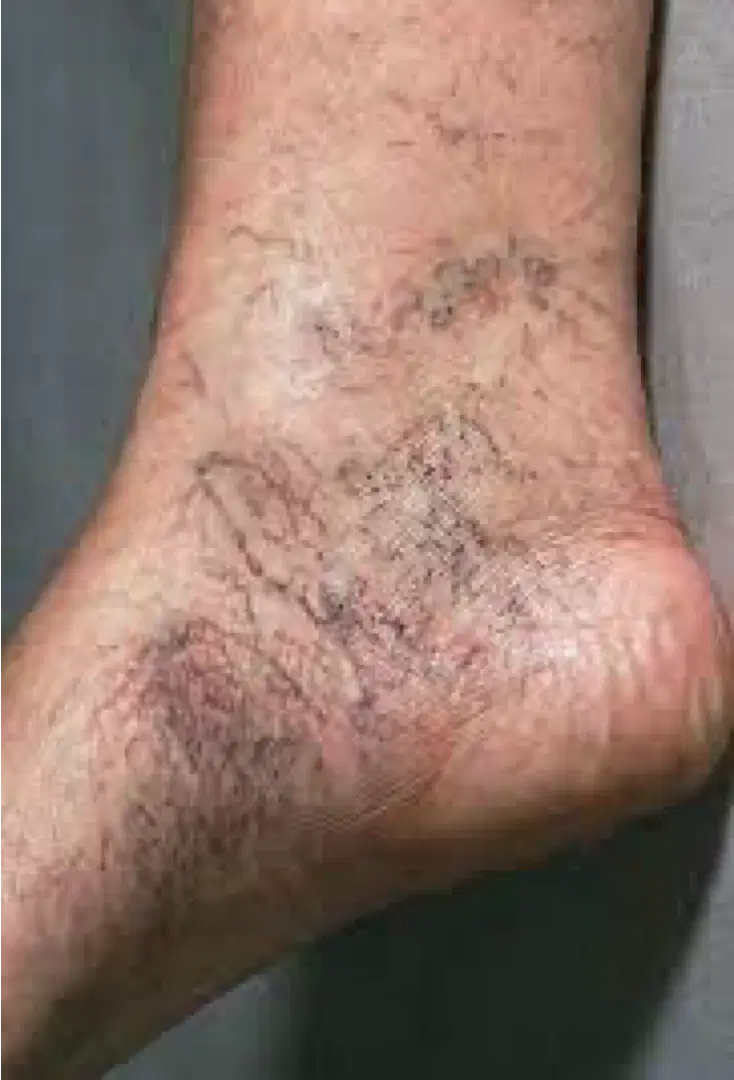
This shows
(a)
An incompetent superficial vein diameter of less than 2 mm.
History of extensive deep vein thrombosis (DVT) in the same leg.
Active superficial vein thrombosis in the vein to be treated
(a)
History of a prior surgical or endovenous treatment of the same leg.
Pregnancy.
Known malignancy
(a)
Overall poor health
Frailty
Immobility
Known bleeding or clotting disorder
(a)
was previously the most frequently employed therapeutic option in the treatment of great saphenous vein insufficiency
(a)
is “tying off” a varicose vein to stop blood from entering it.
(a)
Vein being removed from the body
(a)
How long does vein stripping usually take?
30 minutes
1 to 1 and 1/2 hours
2 to 2 and 1/2 hour
3 to 3 and 1/2 hour
General anesthesia is usually given for vein ligation/stripping
True
False
(a) anesthesia is a method of administering anesthetic agents through a vein to temporarily induce a loss of awareness or sensation
The administration of the drug(s) in a bolus (large volume) all at once.
A single, large dose of a drug.
Necessary when a patient needs a medication to immediately circulate in the bloodstream
(a)
Constant intravenous administration for a prolonged period of time (throughout a 24-hour period
(a)
Intermittent dosing is the administration of an intravenous infusion for less than or equal to (a) minutes

This shows
(a)
Varicose vein stripping and ligation is an effective way to treat varicose veins and some cases of CVI.
Works well even on severe cases, or very large varicose veins
(a)
The provider removes the affected vein during the surgery. There’s no risk of the varicose vein coming back.
Vein stripping and ligation is also an outpatient surgery, so you can go home the same day.
(a)
What are the risks or complications of varicose vein stripping and ligation?
Low risk
High risk
Allergic reaction to anesthesia.
Blood clot in the leg.
Infection at the site of the incisions.
Irritation of a nerve near the removed vein, which can cause numbness or pain.
Scarring at incision sites
(a)
Research into sclerosing the venous wall using (a) methods has shown considerable progress
There has been increasing progress in (a) technology, and numerous studies have been performed using different wavelengths and types of lasers
In (a) the Food and Drug Administration (FDA) approved lasers for thermal ablation of the saphenous vein using radiofrequency energy
the physician injects foam or liquid solution into the spider or varicose veins
(a)
The procedure causes the vein to collapse or disappear
(a)
Sclerotherapy is the (a) treatment for improving the appearance of varicose and spider veins on the legs
Patients with medium to severe Telangiectasias (spider veins or varicose veins) are the recommended candidates for cosmetic sclerotherapy
True
False
Minimally invasive
Little to no downtime
Destroys damaged veins that create a web-like appearance
(a)
Patients will typically notice improvements of spider veins after one sclerotherapy treatment.
For complete removal, patients generally require about two to four sclerotherapy treatment sessions.
(a)
The procedure does not require anesthesia.
Can be performed in the physician's office.
(a)
Number of sessions varies depending on the patient, the number of vessels needing treatment, and length of time the patient has had them.
A minimum of three sessions are recommended
(a)
The patient needs to wear compression stockings over the injection sites for 24 hours if the treated area is on the legs.
Wear medical support hose for the next two weeks
(a)
Avoid activities such as squatting or heavy lifting.
Minimal slight bruising or discoloration can be expected.
The vessel may take four to six weeks to disappear
(a)
If the procedure is performed for cosmetic treatment, it is not typically covered by insurance
True
False
If the spider veins are caused by an underlying condition, such as venous insufficiency, the spider vein treatment may be eligible for coverage by insurance payers
True
False
Vein treatment procedures are quoted on an individual basis depending on:
Level of difficulty
Location of desired treatment
true
false
is a minimally invasive procedure that uses heat to treat varicose veins. It targets large veins and uses a laser or high-frequency radio waves to create intense heat
(a)
Two common techniques of thermal ablation are
endovenous laser therapy (EVLT)
Endogenous laser therapy
radioabaltaion frequency
radiofrequency ablation (RFA)
Invasive methods include surgery and (a) techniques
Endovenous thermal ablation is (a) and is performed as an outpatient procedure with the use of local anesthesia
The procedure is performed solely with duplex ultrasound.
Trained ultrasound technologist
(a)
The distal portion of the vein is accessed through an opening in the skin where the guide wire and catheter are inserted and guided to the most proximal location of treatment.
Ultrasound guidance is used to determine if proper placement of the catheter was attained
(a)
Tumescent anesthesia (a diluted local anesthetic solution) is injected into the subcutaneous tissue, until it becomes firm and tense. This is usually administered to decrease discomfort. The vein is then emptied to maximize contact of the thermal device with the vein wall
(a)
The thermal device is turned on and the catheter is slowly pulled back toward the distal aspect of the vein, causing thermal damage and occlusion of the vein.
The wound is closed, and a compression stocking is placed over the treated leg before the patient is sent home.
(a)
No surgery
Immediate return to normal activities
Complete in 1 hour
Almost pain free
Local anesthesia
Covered by most insurances
No scalpels, cuts, or scars
(a)
Endovenous thermal ablation has (a) :
Wound infections
Pain
Hematoma formations
*Has a quicker return to normal activities

This shows
(a)
Walk for 10 minutes after procedure with compression hose on.
Wear compression hose for 7 days after the procedure.
The patient may have feelings of tightness.
Follow up in 3-7 days.
Avoid strenuous activities.
(a)
Costs vary depending on the number and size of veins to be treated
(a)
also known as RFA, is a treatment for varicose veins using radiofrequency energy to close off varicose veins.
(a)
Typically (a) is used to treat large, damaged, or inflamed veins
can be performed in an office setting under local anesthesia, allowing the patient to go home after the procedure
(a)
The patient must wear compression stockings during the healing process.
Most people experience symptom relief with RFA for varicose veins. If the treatment is not effective, the doctor may recommend another treatment option.
(a)
is a minimally invasive procedure that is utilized to treat superficial venous insufficiency that typically causes varicose veins and chronic venous disease
(a)
Review the indications for the radiofrequency ablation procedure for varicose veins.
Discuss the different types of techniques that are used for radiofrequency ablation procedures.
Potential complications
Summarize the importance of collaboration among the interprofessional team.
(a)
The commercially available radiofrequency catheters are built with a heating element at its tip that uses thermal energy to destroy the endothelium of the vein.
The length of the heating element is variable based on the manufacturer
(a)
The physician inserts a catheter into the affected vein through a small incision in the skin.
Radiofrequency energy is slowly sent through the catheter into the damaged part of the vein. The heat causes the diseased vein to die, and the blood flow will be diverted to nearby health veins
(a)
After a short period, the old vein will be absorbed into the surrounding tissue.
When the treatment is completed, the catheter will be removed and the physician will apply pressure to the insertion site to stop the bleeding
(a)

This shows
(a)
After RFA for varicose veins, the patient goes home following the treatment and usually recovers quickly.
The doctor instructs them to wear compression stockings for a week or more. They may also instruct the patient to elevate the leg after treatment to reduce the likelihood of bruising
(a)
Light walking will be encouraged during recovery, but intense exercise should be avoided.
A follow up duplex ultrasound will be scheduled during the recovery process to ensure the vein has closed
(a)
Medicare payment for radiofrequency ablation (RFA) varies based on location, procedure, and coverage
true
false
(a) of RFA include pain, bleeding, infection, nerve damage, and skin burns
Vein mapping
Vein access
Catheter placement
Infusion of perivenous anesthetics
(a)
is a treatment that involves injecting a large volume of a diluted anesthetic solution into the perivenous space of a vein
(a)
Rapid and smooth induction of anesthesia.
Little equipment requirement (syringes, needles, catheters), and easy administration of drugs.
(a)
Difficult retrieval of drug once administered
Less control of depth and duration of anesthesia
(a)
Overall, the rate of adverse effects has been reported to be as low as 4.4% to as high as 40%
true
false
However, (a) is the most common adverse effect that contributes to greater than 95% of the higher reported rates
The rates of bruising and thrombophlebitis are around (a) %
Access site infection rate is as low as __ to __%.
(a)
The rate of major adverse events such as nerve injury, pulmonary embolism, DVT, etc., is less than (a) %
In comparative studies, radiofrequency ablation has been shown to have the (a) rates of adverse events and complications
Chronic venous disease has a high prevalence.
However, it is under-recognized and therefore undertreated. Initial recognition begins at the level of the primary care physician or a primary care provider
True
False
Often lower extremity venous stasis changes are mistakenly treated for cellulitis or dermatologic conditions.
It is important to refer the patient to an appropriate vascular specialist where definitive evaluation can occur.
True
False
Vascular technologists trained in performing venous reflux studies should be involved in testing patients who present with chronic venous disease. It is particularly important to follow testing protocols as recommended by the Society of Vascular Surgery guidelines
True
False
It was found that EVLT and RFA are both highly efficacious (> (a) %).
(a) laser therapy seems to be slightly more successful than RFA in numerous studies but its significance is uncertain
Side effect profiles varied regarding postoperative pain and bruising because both were seen to be significantly less using (a)
Serious complications were found to be rare in both, with no significant difference in incidence
True
False
Recanalization rate was observed to be higher using (a) with uncertainty in significance among various studies. Quality of life improved after both procedures with no significant difference among the 2
Efficacy and recurrence rate seem to favor EVLT, whereas postoperative pain and bruising favor RFA.
True
False

