
 Worksheets
Quiz #13 - Chemical reactions
Total questions: 102
Worksheet time: 2hrs 38mins
Which example provides evidence of a chemical change?
Wood releases ash and smoke when burned.
Rock particles separate when soil is being sifted.
Boiling water bubbles when being heated.
Sugar is not visible when dissolved in water.
Mixing silver nitrate and sodium chloride in water will cause silver chloride to precipitate out of solution. In this example, the precipitate is silver chloride. Which example represents the formation of a precipitate?
Heat and light are produced when paper burns.
White chunks form when you add vinegar to milk or heavy cream.
Gas is released when vinegar and baking soda are mixed together.
A cut apple turns brown when left out in the open air.
When vinegar and baking soda are combined, bubbles and foam are produced.
What evidence demonstrates that a chemical change has occurred?
A color change occurs.
A gas is formed.
A solid is dissolved.
A precipitate is formed.

Which processes from the table can be used as evidence to identify the formation of a new substance?
Processes A, B, C, and D
Processes B, C, E, and F
Processes B, C, D, and F
Processes C, D, E, and F

Students performed investigations using water and three chemicals, baking soda, calcium chloride, and phenol red solution. The student observations are shown in the table.
Which investigations above provide supporting evidence that a new substance formed?
Investigations 1, 2, and 3
Investigations 1, 3, and 5
Investigations 2, 3, and 4
Investigations 3, 4, and 5
After an investigation, students were disposing of left over substances. One student poured all of the liquids down the sink drain. A few seconds later, a white cloud formed above the sink and the student’s eyes began to burn.
Which statement accurately describes what caused this occurrence?
The student did not wait two minutes in between pouring each liquid down the drain.
The student did not allow water to run in the sink after pouring each liquid down the drain.
A physical change occurred resulting in the formation of a new substance.
A chemical change occurred resulting in the formation of a new substance.

Students performed multiple investigations at different stations in the classroom. The data collected is listed in the table.
The observations from which investigations provide evidence that a new substance was formed?
Stations 1, 3, 4, and 5
Stations 2, 5, and 6
Stations 1, 3, and 4
Stations 1, 2, 3, and 4

Table salt is a compound made from two elements, sodium and chlorine.
Which statement best explains why the characteristics of table salt are so different from the characteristics of sodium and chlorine?
Salt is processed by the evaporation of seawater or mineral-rich spring water
Salt is processed from salt mines because pure sodium does not occur in na
When sodium and chlorine combine, a physical change occurs and a new substance is formed.
When sodium and chlorine combine, a chemical change occurs and a new substance is formed.

Students performed an investigation to see what would happen when sugar is exposed to heat. The students' observations are listed in the table.
Which students’ observations indicate that a new substance formed as a chemical change occurred?
Student A and Student C
Student B and Student C
Student A and Student D
Student B and Student D
Flour, sugar, cocoa, oil, and eggs are mixed together and placed in the oven to make brownies. When the brownies are removed from the oven, they no longer look like the original ingredients.
Which of the following describes why the ingredients changed?
A biological change occurred.
No change occurred.
A physical change occurred.
A chemical change occurred.

Students were investigating two clear solutions. Students added 2 mL of one solution to a beaker of the other solution. The result is pictured.
A student observed that the temperature of the beaker did not have any noticeable changes, however the mass of the substances in the beaker increased. A red precipitate formed where the substance was poured into the beaker. The precipitate separated from the solution and fell to the bottom of the beaker.Which observation provides the best evidence that a chemical change formed a new substance in the beaker?
A precipitate is formed.
The precipitate fell to the bottom.
The temperature did not change.
There is an increase in mass.
Two liquids are mixed together. Which of the following does NOT identify the formation of a new substance?
A gas is produced.
One liquid dissolves into the other.
The temperature changes.
A solid is formed.

Which column in the table includes only chemical changes?
A
B
C
D
During a science class investigation, a teacher places a small amount of sugar in a beaker and heats it over a candle. Which of the following would be the best evidence that a change in the chemical properties of the sugar has taken place?
The sugar gets hotter.
The sugar gets larger.
The sugar turns into a liquid.
The sugar turns black.
A student had a beaker with a small amount of baking soda. The student added a few drops of pickle juice to the baking soda and observed fizzing and bubbling. Based on observation, which of these can the student conclude?
A chemical reaction produced a solid.
No chemical reaction took place.
Only a physical change happened.
A chemical reaction produced a gas.
In a _______ change, a substance changes into a different substance
physical
chemical
Which of these is NOT a sign a chemical change has occurred?
color change
temperature change
bubble formation
cutting material
In a chemical reaction, bonds are broken and new bonds are formed that create new substances. The bonds that are broken are called what?
reactants
products
SELECT 2: Which of the following 2 are chemical reactions?
sugar dissolving in water
water turning into steam
burning wood
mixing baking soda and vinegar
tearing paper
SELECT ALL THAT APPLY: Why is it important that chemical equations are always balanced?
Matter cannot be created
Matter cannot be destroyed
Matter can only be rearranged
Matter doe
In a chemical equation, the products are found on the ______ side of the arrow
right
left
In a chemical equation, the reactants are found on the _____ of the arrow
right
left
An ending substance that is made during a chemical reaction
reactant
product
A starting substance that is part of a chemical reaction
Reactant
Product
A process in which atoms rearrange to form new substances
chemical reaction
chemical formula
science
Select the pair of words that correctly displays the general FORMAT for writing chemical equations
products --> reactants
products --> products
reactants--> products
reactants --> reactants
The ability to burn is known as---
Flammability
Combustion
Density
Exploding
Mass divided by volume is the formula for calculating----
Mass
Volume
Density
Matter
Reactivity (bubbling, fizzing) is a --- property.
Chemical
Physical


The melting point in degrees Celsius is---
100
32
0
212

H2 + O → H2O
H2 + O → H2O
What is the Law of Conservation of Mass?
It states that matter cannot be created or destroyed.
It states that energy cannot be created or destroyed.
It states that matter can be created or destroyed.
It states that sound can be created or destroyed.
Example: H2
N2+O2--> _NO
Mg + __HCl ---> MgCl2 + H2
Al + O2 → 2Al2O3

The volume of water is 50 ml.
Physical Property
Physical Change
Chemical Property
Chemical Change

Dissolving sugar into water
Physical Property
Physical Change
Chemical Property
Chemical Change

The lantern liquid fuel is very flammable.
Physical Property
Physical Change
Chemical Property
Chemical Change

The bicycle was left outside and it rusted.
Physical Property
Physical Change
Chemical Property
Chemical Change

The ice cube melted.
Physical Property
Physical Change
Chemical Property
Chemical Change

The iron cube is magnetic.
Physical Property
Physical Change
Chemical Property
Chemical Change

The bananas rotted and turned brown
Physical Property
Physical Change
Chemical Property
Chemical Change

The gemstone’s mass is 14 grams.
Physical Property
Physical Change
Chemical Property
Chemical Change

We chopped the wood into two pieces.
Physical Property
Physical Change
Chemical Property
Chemical Change

The chemical is toxic to humans.
Physical Property
Physical Change
Chemical Property
Chemical Change

Dry ice sublimates if dropped into the water.
Physical Property
Physical Change
Chemical Property
Chemical Change

vinegar & baking soda reacted to make sodium acetate
Physical Property
Physical Change
Chemical Property
Chemical Change

John ate the corn-dog and metabolized it into energy
Physical Property
Physical Change
Chemical Property
Chemical Change

The bowling ball has a density of 3 g/㎤
Physical Property
Physical Change
Chemical Property
Chemical Change

Grandma baked some delicious cookies
Physical Property
Physical Change
Chemical Property
Chemical Change

Sodium (Na) can bond with Chlorine (Cl)
Physical Property
Physical Change
Chemical Property
Chemical Change

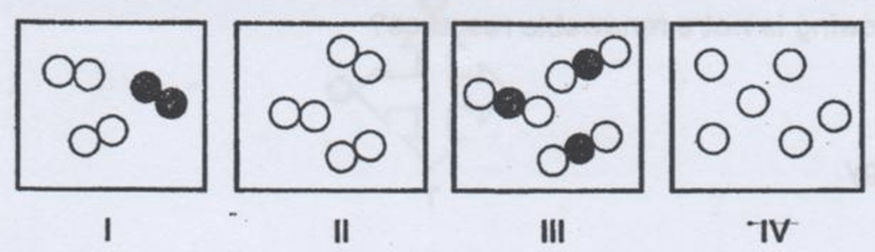
In the diagrams provided, the circles of different colors represent the atoms of different elements. Which diagram represents a mixture?
I
II
III
IV
Beatriz wants to make a mixture out of her bowl of blueberries. Which of the following would turn her bowl of blueberries into a mixture?
adding more blueberries to the bowl
adding raspberries to the bowl
cutting up the blueberries
mashing the blueberries

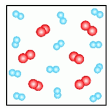

What is a substance made of two or more elements that are chemically combined called?
A. element
B. compound
C. mixture
D. solution
Is salt (NaCI) a compound or an element?
Compound
element
What is the definition of a compound?
The smallest part of any substance which can exist on its own
Two or more atoms chemically joined together (can be the same or can be different)
A simple substance in which all the atoms are identical
Two or more different elements chemically joined together
A substance that cannot be broken down into any other substance by ordinary chemical means is called
a molecule.
a mixture.
an element.
a compound.
Two or more physically combined substances form
a compound.
an acid.
an element.
a mixture.
What is an example of a mixture?
Table salt
Water
Oxygen
Air
A substance that contains only one type of atom is a(n)
compound
element
heterogeneous mixture
homogeneous mixture
A compound is made of ________ atoms.
big
similar
different


The smallest unit of an element is
a compound.
a molecule.
an atom.
a mixture.
The smallest unit of a compound is
an element.
a molecule.
an atom.
a mixture.
True or False: All molecules are compounds.
true
false
True or false: Air is a mixture.
true
false
Which of the following is a mixture?
oxygen
gold
sand
water
Matter is anything that has mass and takes up space.
true
false

