Wayground logo

Free Printable Worksheets

Font size

S
M
L
XL
Worksheets

8th Grade Science Fall Final Exam Review

Total questions: 121

Worksheet time: 4hrs 8mins

Name
Class
Date
1.

Water is made up of hydrogen and oxygen, two elements that were chemically combined. This makes water a(n)

a)

atom

b)

compound

c)

element

d)

mixture

2.

__ is a pure substance containing two or more kinds of atoms.

a)

Element

b)

compound

c)

mixture

d)

solution

3.

Which of the following are both solutions?

a)

Water and chicken noodle soup

b)

Baking powder and cornstarch

c)

milk and household bleach

d)

lemonade and soda pop

4.

One group is typically described as containing materials that are exvellent conductors of electricity, ductile and lustrous. Which of the following groups can be classified by thess characteristics?

a)

metals

b)

nonmetals

c)

elements

d)

compounds

5.

An element is a ___ that cannot be separated into simpler substances by physical or chemical means.

a)

pure substance

b)

mixture

c)

solution

d)

compound

6.

How many atoms are present in one molecule of glucose, C6H12O6

a)

3

b)

12

c)

24

d)

4

7.

Which of the following is a heterogenous mixture?

a)

neon

b)

soil

c)

steel

d)

salt water

8.

Which of the following is a homogeneous mixture?

a)

sand in a bottle

b)

lemonade

c)

Mercury

d)

salad

9.

A __ mixture is a mixture in which the composition is not uniform throughout the mixture.

a)

element

b)

homogenous

c)

heterogenous

d)

compound

10.

Which of the diagrams below represent a mixture?

a)

A

b)

B

c)

C

d)

D

11.

How many different types of atoms are there in the following molecule?

a)

7

b)

6

c)

3

d)

8

12.

How many atoms of Hydrogen are in H2O

a)

1

b)

2

c)

3

d)

more than 3

13.

How many different elements are present in H2COCH2

a)

5

b)

4

c)

3

d)

2

14.

Calculate the number of Oxygen atoms in Al(OH)3

a)

1

b)

2

c)

3

d)

4

15.

The ______ are numbers found on the lower right-hand side of an element symbol.

a)

Coefficient

b)

Exponent

c)

Multiplier

d)

Subscript

16.

Coefficients in chemical formulas...

a)

Multiply just the first atom

b)

Add to the subscripts at the end of the molecule

c)

Multiply elements without subscripts

d)

Multiply EVERYTHING!

17.

4CF2Cl2

a)

C = 4, F = 4, Cl = 2

b)

C = 1, F = 8, Cl = 8

c)

C = 4, F = 8, Cl = 8

d)

C = 1, F = 4, Cl = 8

18.

C3H5(NO3)3

a)

C = 3, H = 5, N = 3, O = 9

b)

C = 3, H = 5, N = 1, O = 9

c)

C = 9, H = 15, N = 3, O = 9

d)

C = 9, H = 15, N = 1, O = 3

19.

H2SO4

a)

H = 2, S = 4, O = 4

b)

H = 2, S = 1, O = 4

c)

H = 8, S = 4, O = 4

d)

H = 2, SO = 4

20.

How many different elements are present in this molecule?

3 NH4C2H3O2

a)

15

b)

36

c)

5

d)

4

21.

A ______ is a number written in front of a chemical formula.

a)

Coefficient

b)

Subscript

c)

Exponent

d)

Coordinator

22.

How many atoms of Hydrogen are in H2O

a)

1

b)

2

c)

3

d)

more than 3

23.

How many different elements are present in H2COCH2

a)

5

b)

4

c)

3

d)

2

24.

Calculate the number of Oxygen atoms in Al(OH)3

a)

1

b)

2

c)

3

d)

4

25.

The ______ are numbers found on the lower right-hand side of an element symbol.

a)

Coefficient

b)

Exponent

c)

Multiplier

d)

Subscript

26.

Coefficients in chemical formulas...

a)

Multiply just the first atom

b)

Add to the subscripts at the end of the molecule

c)

Multiply elements without subscripts

d)

Multiply EVERYTHING!

27.

4CF2Cl2

a)

C = 4, F = 4, Cl = 2

b)

C = 1, F = 8, Cl = 8

c)

C = 4, F = 8, Cl = 8

d)

C = 1, F = 4, Cl = 8

28.

C3H5(NO3)3

a)

C = 3, H = 5, N = 3, O = 9

b)

C = 3, H = 5, N = 1, O = 9

c)

C = 9, H = 15, N = 3, O = 9

d)

C = 9, H = 15, N = 1, O = 3

29.

H2SO4

a)

H = 2, S = 4, O = 4

b)

H = 2, S = 1, O = 4

c)

H = 8, S = 4, O = 4

d)

H = 2, SO = 4

30.

How many different elements are present in this molecule?

3 NH4C2H3O2

a)

15

b)

36

c)

5

d)

4

31.

A ______ is a number written in front of a chemical formula.

a)

Coefficient

b)

Subscript

c)

Exponent

d)

Coordinator

32.
What is the Law of Conservation of mass?
a)
Mass is created in a chemical reaction
b)
Mass is created in a physical change
c)
New chemicals formed from a chemical reaction have a larger overall mass than the original reactants
d)
Mass is never created or destroyed
33.
In a reaction A + B ----> C,  reactant A has 5g and product  C has 9g. How many grams does reactant B should have? 
a)
4g
b)
5g
c)
9g
d)
14g
34.
The number in front of a compound or element is a 
a)
Subscript
b)
Coefficient
c)
Superscript
d)
Charge
35.
The number to the lower side of an element is a 
a)
Subscript
b)
Superscript
c)
Coefficient
d)
Charge
36.
Matter can not be created nor destroyed: it can only be
a)
Destroyed a little bit
b)
Invisible
c)
Transformed, changed
d)
None of the above
37.
Which is Chemical Equation is Balanced?
a)
CH₄+O₂------CO₂+2H₂O
b)
H₂+O₂-----2H₂O₄
c)
4Al+3O₂-----2Al₂O₃
38.
Is this equation balanced or unbalanced? 
2Fe2O3 + 3C --> 4Fe + 3 CO2
a)
balanced
b)
unbalanced
39.
If a reaction starts with a total 75g of reactants it should produce 
a)
a total of 40g of products
b)
a total of 75g of products
c)
a total of 180 g of products
d)
None of the above
40.
In the reaction AB-----> A + B reactant AB has 12g and product B has 5g. How many grams should product A have?
a)
17g
b)
2g
c)
7g
d)
None of the above
41.
Bob puts 200 grams of ice into a pitcher with 900 grams of water. He gets distracted and comes back later to find that the ice has melted in the water. How many grams of water does Bob now have in the pitcher?
a)
200 g
b)
700 g
c)
1,100 g
42.

Surface tension is the property of water in which...

a)

water molecules at the surface tend to stick together.

b)

water spills easily.

c)

water tends to be see-through.

43.

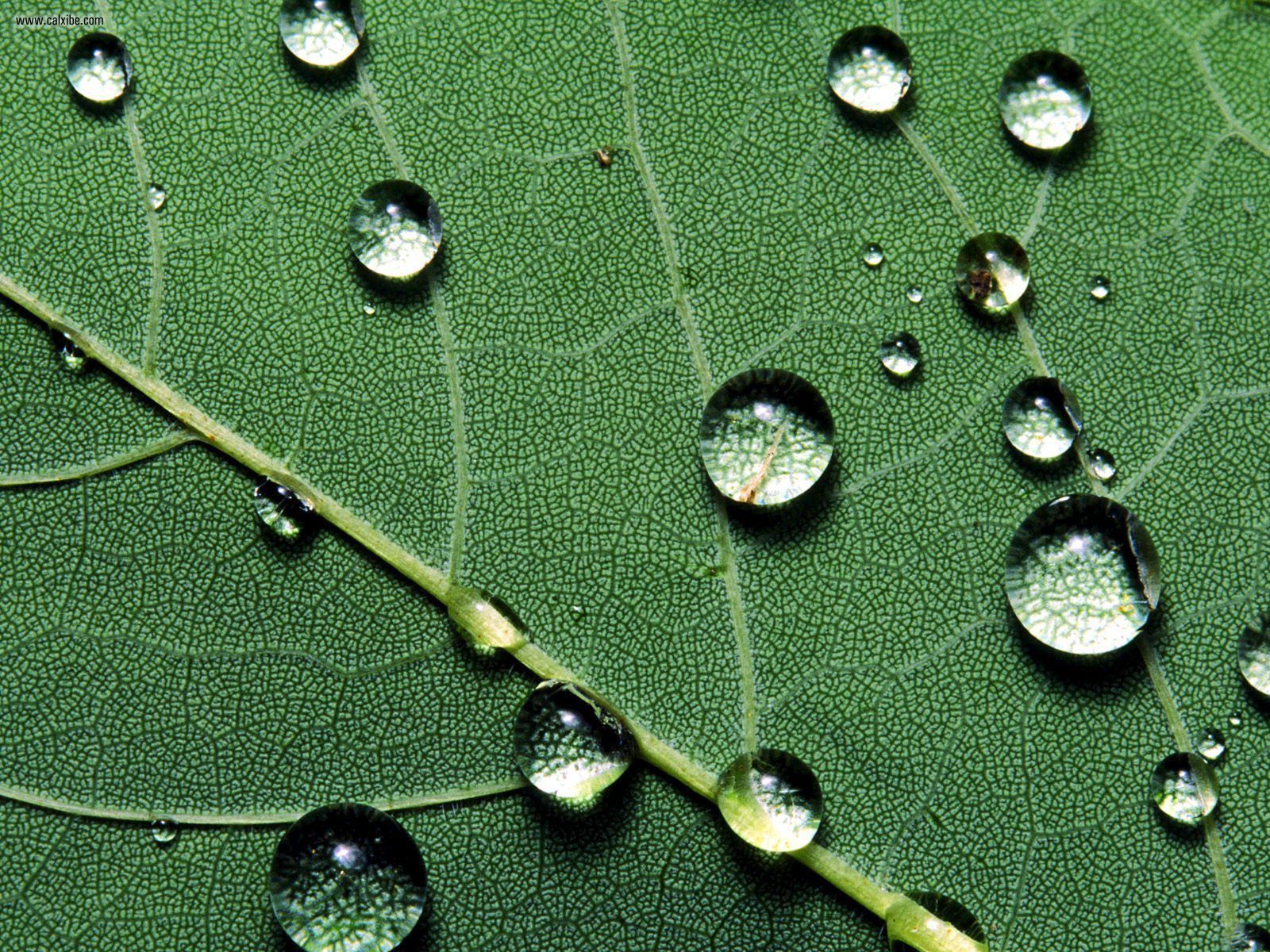
Refer to the picture of water sticking to a leaf; this is occurring because of:

a)

Adhesion

b)

Cohesion

44.

Describe COHESION.

a)

Water molecules attracted to other substances.

b)

Water molecules climbing upwards against the force of gravity.

c)

Water molecules dissolving many substances because of its polarity.

d)

Water molecules attracted to other water molecules.

45.
What two elements make up water?
a)
Helium and oxygen
b)
Hydrogen and oxygen
c)
helium and carbon
d)
oxygen and carbon
46.
What word describes when water is attracted to other substances?
a)
cohesion
b)
adhesion
c)
capillary action
d)
surface tension
47.
Attractions between water molecules are called
a)
Covalent bonds
b)
Ionic bonds
c)
Polar bonds
d)
Hydrogen bonds
48.
tendency of molecules of the same kind to stick to one another
a)
cohesion
b)
adhesion
c)
solution
d)
polar molecule
49.
Water droplets take a spherical shape (as pictured) because of ____________
a)
adhesion
b)
cohesion
c)
capillary action
d)
solubility
50.
Which characteristic of water will allow a paperclip to remain floating on water when the paperclip is gently placed on top of the water?
a)
adhesion
b)
surface tension
c)
solvent properties
d)
nonpolar
51.
What is adhesion?
a)
Water's ability to stick to itself
b)
Water's ability to stick to other substances
c)
The strength of the cohesion of all the water molecules combined
d)
Tape, glue and other adhesives
52.

Water's ability to stick to glass is

a)

adhesion

b)

cohesion

c)

surface tention

d)

capillary action

53.
What is the gaseous form of water called?
a)
Steam
b)
Water vapor
c)
Vapor
d)
Water mist
54.
The pH scale is a range from:
a)
1-7
b)
0-14
c)
1-14
d)
1-20
55.
A(n) ______ is a substance with a pH less than 7
a)
Acid
b)
Alkaline
c)
Base
d)
Buffer
56.
A(n) _______ is a substance with a pH greater than 7.
a)
Base
b)
Acid
c)
Buffer
d)
Water
57.
What is the only substance with a neutral pH of 7?
a)
Milk
b)
Orange Juice
c)
Water
d)
Blood
58.
Which solution releases H+ in solution?
a)
Base
b)
Acid
c)
Buffer
d)
Water
59.
This substance releases OH- into solution
a)
Acid
b)
Base
c)
Neutral
60.
A solution with a pH of 3.6 would be...
a)
Acid
b)
Base
c)
Neutral
d)
Acid and Base
61.
A solution with a pH of 8.6 would be...
a)
Acid
b)
Base
c)
Neutral
d)
Acid and Base
62.
Which is most acidic?
a)
Baking Soda
b)
Lemon Juice
c)
Black Coffee
d)
Milk
63.
Tastes Sour
a)
Acids
b)
Bases
c)
Salts
d)
All
64.
Tastes bitter.
a)
Acids
b)
Bases
c)
Salts
d)
All
65.
According to the pH range which substance is more acidic than lemon juice
a)
Hydrochloric acid
b)
cabbage
c)
milk
66.
Bleach is a strong base, what is the pH level of bleach?
a)
13
b)
14
c)
1
d)
2
67.
Feels slippery.
a)
Acids
b)
Bases
c)
All
68.
What law is best described by inertia?
a)
1st
b)
2nd
c)
3rd
d)
law of conservation of mass
69.
a)
1st
b)
2nd
c)
3rd
d)
law of motion
70.
Equal and Opposite
a)
1st
b)
2nd
c)
3rd
d)
speed 
71.
A magician pulls a tablecloth out from under dishes and glasses on a table without disturbing them.
a)
Newton's 1st Law
b)
Newton's 2nd Law
c)
Newton's 3rd Law
72.
A person not paying attention while skateboarding hits a rock. The skateboard stops...they don't.
a)
The Law of Inertia (1st law)
b)
The Law of Acceleration (2nd law)
c)
The Law of Conservation of Momentum
d)
Action Reaction Law (3rd law)
73.
What Unit do we Measure Force in? 
a)
Newtons
b)
Joules
c)
Force
d)
Kilograms
74.
With unbalanced forces, the object will move in the direction that the _______ force is being applied.
a)
larger 
b)
smaller 
c)
equal 
d)
less
75.
What is Newton's First Law
a)
F=ma
b)
Every action has an equal and opposite reaction
c)
An object at rest stays at rest, an object in motion stays in motion. 
d)
Friction 
76.
A person is pushed forward into their seatbelt when a car stops
a)
1st
b)
 2nd
c)
2 and 3
d)
3rd 
77.
Which type of force(s) will cause a change in an object's motion?
a)
gravity
b)
zero net force
c)
balanced forces
d)
unbalanced forces
78.
A 20 kg bike accelerates at 10 m/s2.  what was the force
a)
25 Newtons
b)
20 Newtons
c)
200 Newtons
d)
10 Newtons
79.
Newton's third law states that any action will have a(n) _______ and ______ reaction
a)
Equal and similar
b)
Equal and opposite
c)
Equal and different
d)
Greater and opposite
80.
8 N to the left , and 4 N to the right. Find the net force. Is this balanced 
a)
12 N Right  No
b)
4 N Left  No
c)
12 N Right  Yes
d)
4 N Left  Yes
81.
You hit a wall with a stick.  The equal but opposite reaction is _____
a)
the wall pushes against you
b)
the stick pushes against you
c)
you push against the stick
d)
the wall pushes against the stick
82.
What is Newton's First Law known as? The Law of
a)
Friction
b)
Mass
c)
Inertia
d)
Gravity
83.
What is the acceleration of an object traveling at a constant velocity?
a)
10 m/s2
b)
0 m/s2
c)
250 m/s2
d)
20 m/s2
84.
What are the appropriate units to describe acceleration?
a)
m/s
b)
m/s2
c)
cm
d)
there are no units associated with acceleration
85.

An object with a mass of 2.0 kg has a force of 4.0 newtons applied to it. What is the resulting acceleration of the object?

a)

2 m/s2

b)

8 m/s2

c)

0.5 m/s2

d)

6 m/s2

86.

Johnny has a mass of 75 kg. He sits on a desk. He is pushed with a force of 10 N. How quickly will he accelerate?

a)

0.75 m/s/s

b)

2 m/s/s

c)

7.5 m/s/s

d)

15 m/s/s

87.

Which transverse wave has the highest frequency?

a)

1

b)

2

c)

3

d)

4

88.
Carries energy from one place to another
a)
Waves
b)
Amplitude
c)
Frequency
d)
Crest
89.
The measurement of the distance the particles move from the resting point of the wave
a)
Wavelength
b)
Frequency
c)
Amplitude
d)
Crest
90.

The measurement of the length of a wave from one point of the wave to the next identical part of the wave (for example, top to top or bottom to bottom)

a)

Crest

b)

Amplitude

c)

Frequency

d)

Wavelength

91.

The number of waves that passes a certain point in a set period of time

a)

Frequency

b)

Amplitude

c)

Wavelength

d)

Amplength

92.
What kind of wave is pictured below?
a)
compressional wave
b)
transverse wave
c)
sound wave
d)
mechanical wave
93.
Which vocabulary term is used to identify the distance between points C & G?
a)
Amplitude
b)
Crest
c)
Frequency
d)
Wavelength
94.

Which vocabulary term is used to identify the distance between points C & E?

a)

Amplitude

b)

Crest

c)

Frequency

d)

Wavelength

95.
Top of the wave
a)
Wavelength
b)
Amplitude
c)
Trough
d)
Crest
96.
Bottom of the wave
a)
Crest
b)
Trough
c)
Frequency
d)
Wavelength
97.
The measurement from one point of the wave to the next identical part of the wave (for example, crest to crest or trough to trough)
a)
Crest
b)
Amplitude
c)
Frequency
d)
Wavelength
98.
The matter (solid, liquid, or gas) through which waves can travel
a)
Medium
b)
Object
c)
Transverse Wave
d)
Wavelength
99.

What are waves used for?

a)

Transferring Energy

b)

Storing Energy

c)

Moving Objects

d)

Removing Energy

100.

What is transferred in waves?

a)

Energy

b)

Objects

c)

Magic

d)

Light

101.

Which one is an example of a transverse wave

a)

Punching a bag

b)

Loud Music

c)

Sneezing

d)

Water Waves

102.

In a transverse wave, how do the particles move?

a)

They don't move

b)

Sideways

c)

Up and down

d)

In a square

103.

Which one shows the amplitude of a wave?

a)
b)
c)
104.

Which one shows the wavelength of a wave?

a)
b)
c)
105.
_______ carry the greatest amount of energy. 
a)
x-rays
b)
gamma rays
c)
infrared rays
d)
visible light
106.
The higher the frequency the ______ the energy. 
a)
higher
b)
lower
c)
neither, stays the same
107.
Put the visible light colors in order from longest wavelength to shortest wavelength
a)
Violet, Indigo, Blue, Green, Orange, Yellow, Red
b)
Red, Yellow, Green, Orange, Violet, Blue, Indigo
c)
Red, Orange, Yellow, Green, Blue, Indigo, Violet
d)
Yellow, Blue, Orange, Violet, Red
108.
_____ have the longest wavelengths and lowest frequencies of all electromagnetic waves.
a)
microwaves
b)
radio waves
c)
gamma rays
d)
ultraviolet
109.
The ________ of a photon of light is ________ proportional to it frequency and ________ proportional to its wavelength.
a)
amplitude, directly, inversely
b)
energy, inversely, directly
c)
energy, directly, inversely
d)
velocity, inversely, directly
110.
_____________________light is the only type of EM wave that we can see.
a)
Red
b)
Gamma
c)
Microwave
d)
Visible
111.

Which star stage does our sun belong to?

a)

Supergiant

b)

Giant

c)

Main Sequence

d)

White Dwarf

112.

Which type of star is the coldest?

a)

Yellow Star

b)

Red Star

c)

Orange Star

d)

Blue Star

113.

In the diagram given, what happens as we move from right to left?

a)

Stars get larger

b)

Stars get colder

c)

Stars get hotter

114.

Compared to the rest of the stars, our sun is considered...

a)

Extremely large and cooler

b)

Small with a medium temperature

c)

Medium size with medium temperature

115.

Blue stars are the _____________.

a)

hottest

b)

coolest

c)

smallest

d)

biggest

116.

What determines the color of a star?

a)

Size

b)

Temperature

c)

Composition

d)

They are all the same color

117.

As you move from the bottom to the top of the H-R diagram the __________ changes.

a)

Temperature

b)

Luminosity or Brightness

118.
As a whole, Giants are considered hotter than White Dwarfs.
a)
True
b)
False
119.
The category that contains the most stars is...
a)
Main Sequence
b)
Supergiants
c)
Giants
120.

What is found on the X-axis of an H-R diagram?

a)

Luminosity

(or brightness)

b)

Temperature

c)

Star Size

d)

Distance

121.

Which group is found in the bottom left corner of the H-R Diagram?

a)

Supergiants

b)

Giants

c)

Main Sequence

d)

White Dwarfs