
Font size
 Worksheets
Climate Change Review Study Guide
Total questions: 99
Worksheet time: 50mins
True/False: Select the correct option. Seasons are characterized by the position of the earth to the sun. In the summer solstice, the Southern Hemisphere is tilted toward the sun in June.
true
false
True/False: Select the correct option. While scientists have seen an increase in atmospheric carbon dioxide, to date there has been no evidence to support the relationship between the increase of carbon dioxide and global warming.
true
false
True/False: Select the correct option. The last 20 years have been cooler than previously because human activity has decreased.
true
false
True/False: Select the correct option. Hurricanes and other severe precipitation events have started becoming weaker and less intense as a result of climate change.
true
false
True/False: Select the correct option. A carbon atom can form up to three single covalent bonds with other atoms.
true
false
True/False: Select the correct option. Climate change can influence the ecosystem levels. However, these influences do not impact the communities of organisms.
true
false
True/False: Select the correct option. Burning fossil fuels releases O2 into the atmosphere.
true
false
Check all that apply: Choose all options that best complete the statement or answer the question. Thinking about the evidence of climate change presented in this chapter, select from the following those factors that have decreased as a result of climate change.
Humidity
Sea level
Sea ice
Snow coverage
Temperature of land
Check all that apply: Choose all options that best complete the statement or answer the question. Thinking about the evidence of climate change presented in this chapter, select from the following those factors that have decreased as a result of climate change.
Glaciers
Sea level
Temperature of land
Humidity
Check all that apply: Choose all options that best complete the statement or answer the question. From the list provided, select all sources of methane production.
The burning of fossil fuels
Livestock
Decomposition of organic material
Volcanic activity
Check all that apply: Choose all options that best complete the statement or answer the question. Of the following, which two characteristics define climate?
Temperature
Amount of precipitation
Tornado development
High sea levels
Check all that apply: Choose all options that best complete the statement or answer the question. From the list, select all that influence the average temperature of the planet.
Precipitation
Species becoming extinct
Volcanic eruptions
Cycling of the sun
Check all that apply: Choose all options that best complete the statement or answer the question. Select all of the following examples of extreme weather that are strongly attributed to global climate change.
An increase in the number of tornados
An increase in the severity of hurricanes
An increase in volcanic eruptions
An increase in extreme flooding events
An increase in severe droughts
Check all that apply: Choose all options that best complete the statement or answer the question. Select all of the following examples of extreme weather that are strongly attributed to global climate change.
Increase in heat waves
Increase in wildfires
Increase in hail storms
Increase in the number of hurricanes
Increase in cold waves
Check all that apply: Choose all options that best complete the statement or answer the question. Select all of the following examples of extreme weather that are strongly attributed to global climate change.
Increase in wildfires
Decrease in flooding
Increase in cold waves
Increase in hail storms
Check all that apply: Choose all options that best complete the statement or answer the question. There are two forms of geoengineering. They are ______ and ______.
carbon dioxide removal
solar radiation management
deforestation
wind harvesting
Check all that apply: Choose all options that best complete the statement or answer the question. Scientists are hopeful that there are solutions to climate change. What are the three things that are required to reduce the long-term impacts of climate change?
New forms of alternative energy
A positive change in personal choices
An increase consumption of livestock
Advances in supportive technologies
Check all that apply: Choose all options that best complete the statement or answer the question. Select all of the following that lower an individual's carbon footprint.
Eating foods that are grown faraway in other countries
Carpooling or taking public transportation
Eating a diet rich in beef and dairy
Heating through passive solar and geothermal energy
Check all that apply: Choose all options that best complete the statement or answer the question. Select all of the common sources of alternative and renewable energy.
Natural gas
Solar energy
Wind
Oil
Which of the following best describes the relationship between climate change and global warming?
The terms climate change and global warming can be used interchangeably because they mean the same thing.
The increase in temperature is one aspect of climate change and can result in the increased temperature of the planet, which is known as global warming.
Climate change is defined only by the changing of temperature, which can result in the increased temperature of the planet known as global warming.
Fires and volcanic activity are natural events that produce _____.
CO2
H2O
CH4
CFCs
Since the 1950s, there has been a steady increase in the levels of atmospheric CO2 as a result of
increased human activity.
an increase in naturally occurring forest fires.
increased volcanic activity.
Methane versus carbon dioxide are very important greenhouse gases. However, methane can retain and release about ____ times more heat than carbon dioxide.
10
30
75
100
Which of the following minor contributing greenhouse gases are produced from agricultural practices such as the use of burning of fossil fuels and used in fertilizers?
Methane
Chlorofluorocarbons
Nitrous oxides
Water vapor
According to the evidence of climate change, there has been an overall ______ in ocean and land temperature, and an overall ______ in ice formations.
increase; increase
increase; decrease
decrease; decrease
decrease; increase
Methane
is a greenhouse gas.
releases more heat than carbon dioxide.
is less common in the atmosphere than carbon dioxide.
All of the answer choices are correct.
The average global temperature has always measured higher than the average since the
1900s.
1920s.
1950s.
1980s.
Climate can best be described as
the average weather patterns in a given area over long periods of time.
the temperature and rainfall of a specific area over the course of a year.
how hot or cold a location is, based on its altitude.
Over the past several decades, the overall trend for earth's temperatures has been
increases in overall global temperatures at an accelerating rate, a phenomenon known as global warming.
cyclical periods of warming and cooling, known as global climate change.
a gentle trend towards colder winters and hotter summers, which averages out to be very little overall global temperature changes.
decreases in overall global temperatures at an accelerating rate, a phenomenon known as global cooling.
The greenhouse effect
decreases the amount of carbon dioxide in the air.
increases the amount of carbon dioxide in the air.
is caused by gases such as carbon dioxide trapping heat in the earth's atmosphere.
is due to gases forming a barrier around the earth and insulating the earth from the sun's rays.
How do greenhouse gases cause climate warming?
Infrared energy from space is absorbed by greenhouse gases in the upper atmosphere, which then re-emit the heat toward the surface of the earth, causing the climate to warm.
Greenhouse gases block solar energy from entering the lower level of the atmosphere.
Greenhouse gases prevent radiation of infrared energy back into space, trapping the heat near the earth's surface and causing the climate to warm.
Solar energy is absorbed by greenhouse gases in the upper atmosphere and re-emitted toward the earth's surface as heat, causing the climate to warm.
Which of the following is the most likely cause for the sudden sharp increase in atmospheric carbon dioxide levels?
Human activities, including the use of fossil fuels, changes in agricultural practices, and deforestation
Natural events, including fires and volcanic activity
Respiration from the earth's many living organisms
Normal fluctuations in the natural levels of carbon dioxide in the atmosphere
Which of the following are greenhouse gases?
Carbon dioxide and oxygen
Oxygen and methane
Methane and carbon dioxide
Nitrogen and carbon dioxide
How does climate change affect earth's oceans?
The pH level of the ocean will shift to a more acidic environment, leading to stress and the possible extinction of many species of shellfish and corals.
The pH level of the ocean will shift to a more basic environment, leading to a decrease in overall productivity.
As levels of carbon in the atmosphere increase, the amount of carbon in the ocean decreases proportionately.
Excess carbon in the atmosphere is absorbed by the ocean, which directly increases ocean temperature.
Why is ocean acidification problematic for some marine life?
It decreases the amount of carbonate in the oceans, making the creation of shells and other hard structures difficult for marine life.
The acidification causes metals to precipitate out of the water and deposit on the backs of aquatic organisms.
It decreases the availability of oxygen in the water for the respiration needs of aquatic organisms.
It decreases the stratification of water temperatures, so that marine organisms have smaller ranges in which to survive.
As global temperatures increase, which of the following scenarios are most likely to happen?
Sea surface temperatures and ocean heat content decrease.
Glaciers and snow coverage decrease.
Extreme weather events decrease.
Temperatures and humidity decrease.
Carbon sinks are reservoirs that hold large amounts of carbon. Which of the following are considered to be carbon sinks?
Oceans
Fossil fuels deep underground
The atmosphere
All of the answer choices are correct.
Which of the following acts as a source of carbon dioxide within the carbon cycle?
Respiration from humans and animals
Photosynthesis by plants
Fossil fuel formation
Sedimentation
_____ is a product of photosynthesis and is a carbon-based molecule that is the chief source of energy for most organisms.
Oxygen
Sucrose
Glucose
Carbon dioxide
Photosynthesis takes carbon in from the atmosphere and uses it to form ______, the energy source for all plants and animals to use in cellular respiration.
carbon dioxide
glucose
carbon monoxide
water
The light reactions of photosynthesis occur within the ______ of the chloroplast and the Calvin cycle reactions occur within the ______ of the chloroplast.
thylakoid; stroma
stroma; thylakoid
thylakoid; outer membrane
stroma; outer membrane
Which statement below best summarizes the overall purpose of the light-dependent reactions?
The light-dependent reactions capture the energy from the sun and transfer it to high-energy molecules.
The light-dependent reactions capture the energy from the sun and convert it to glucose.
The light-dependent reactions use energy to convert carbon dioxide into carbohydrate molecules.
The light-dependent reactions convert high-energy molecules into carbohydrates.
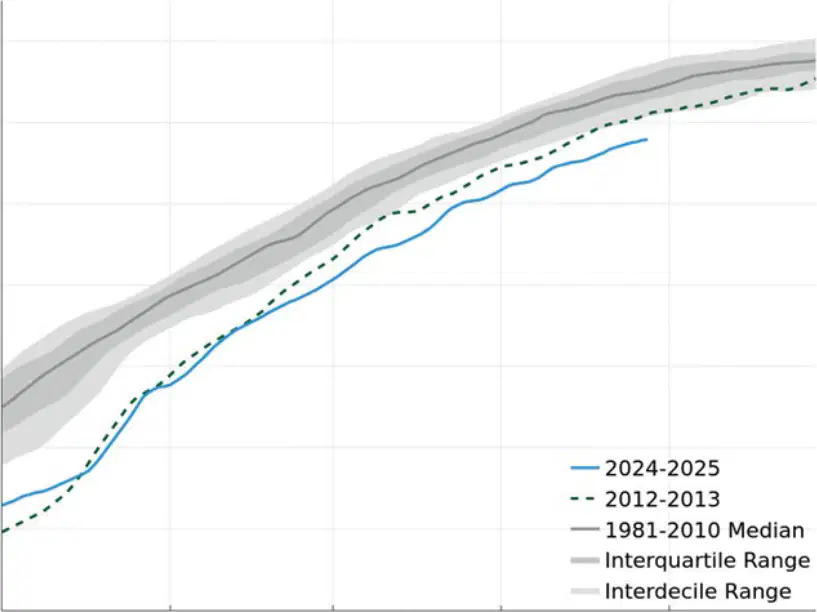
According to this figure, the extent of Arctic sea ice has ____ compared to the 1981–2010 median value.
decreased
increased
cycled up and down
remained consistent
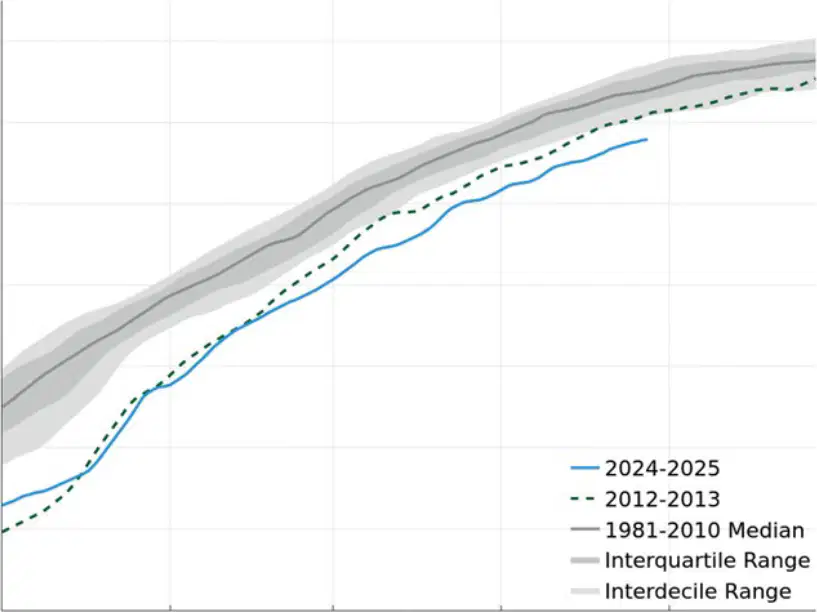
At the end of November of 2024, the extent of Arctic sea ice had decreased about ____ million square kilometers compared to the 1981–2010 median.
0.5
1.0
1.5
2.5
What is the main difference in the formation of coal vs. the formation of natural gas and oil?
Natural gas and oil formed mainly from deposits of plants and animals living in oceans and coal formed mainly from the remains of plants and animals in swampy anoxic environments.
Coal formed mainly from deposits of plants and animals living in oceans and natural gas and oil formed mainly from the remains of plants and animals in swampy anoxic environments.
Natural gas and oil require intense heat and pressure to form and coal only requires an anoxic environment.
Coal takes several million years to form and natural gas and oil take much less time, roughly several thousand years.
Because fossil fuels are the remains of once living organisms, they contain reservoirs of ______ that are released into the atmosphere when they are burned.
carbon
oxygen
nitrogen
phosphorus
As climate change continues, the prevalence of vector-borne disease has increased. Why is this?
As climates have warmed and winters have become less severe, the range of mosquitos and ticks has increased, bringing with them the diseases they carry.
Diseases are more contagious in warmer weather, so as climates have warmed, vector-borne diseases spread faster.
The bacteria and viruses that cause disease multiply more rapidly in warmer weather, so as climates have warmed, the pathogens that cause disease are more prevalent.
As climates have changed, habitats have changed. Organisms that carry disease have been displaced from their original habitats and have found new habitats, bringing the spread of disease with them.
How do invasive species impact ecosystems?
They occupy niches that other organisms traditionally occupy.
They outcompete other organisms for limited resources.
They are more capable of adapting to rapidly changing climates.
All of the answer choices are correct.
When it comes to the carbon footprint, because of its required usage of land, ______ is the most costly food source.
beef
chicken
lamb
vegetables
Which of the following would fall under the definition of an alternative energy?
Coal
Oil
Natural gas
Solar energy
If a scientist was studying methods to reduce the heating of Earth by reducing the amount of solar energy that reaches Earth, this scientist would be studying
solar radiation management.
carbon dioxide removal.
greenhouse gas management.
methane remediation.
What are the two most important insect vectors involved in the spread of bacterial and viral diseases?
Mosquitoes and ticks
House flies and ticks
Roaches and house flies
Fleas and mosquitoes
Hemlock trees support life of other organisms. Climate change has increased the rate of infection of Hemlocks with woolly adelgid. These insects kill the trees, which decreases the habitat of animals and other insects. This is an example of how climate change impacts the
individual level.
population level.
community level.
ecosystem level.
Which of the following have scientists shown to be the link between climate change and the survival rate of invasive species?
The ability to produce large amounts of offspring during one birth
The ability to resist toxins
The ability to adapt to changing environmental conditions
All of the answer choices are correct.
The decrease in the ocean's pH is called ocean acidification. What impact has this had on shellfish?
Their eggs are not fully developed.
Their shells are weak due to the lack of calcification.
Their offspring are misformed.
They have become more prone to diseases.
A biome is defined by its
average temperature and precipitation.
animals and forestry.
elevation and temperature.
animals and precipitation.
A(n) ______ represents the interactions of biological communities and the abiotic factors within the inhabited location.
ecosystem
organism
community
population
Which of the following is evidence that weather patterns have changed because of climate change?
An increase in average temperature
An increase in average precipitation in the central and northeast areas
A decrease in precipitation in the west and southeast areas
All of the answer choices are correct.
Which of the following best describes the effects climate change is having on tropical reef biomes?
The increase in water temperature disrupts the algae-coral symbiotic relationship, which results in death to the coral reefs.
The decrease in water temperature disrupts the algae-coral symbiotic relationship, which results in death to the algae.
The amount of water available for reef formation has diminished, which also kills the living coral reef beds.
The measure of the impact on climate change by a person or a company is known as their
carbon footprint.
geocycling.
carbon cycling.
carbon recycling.
Which of the following produces the greatest amount of carbon emissions and has the greatest impact on the human carbon footprint?
Driving cars powered by gasoline
Driving cars powered by electricity
Wind powered energy
Solar panel energy
Which of the following diets would contribute to the lowest carbon footprint?
Vegan (only eating vegetable-based foods)
Vegetarian (eating vegetables and eggs)
Omnivore (eating vegetables and meats)
Desertification is an example of a biome level change that is associated with climate change. Which of the following is associated with desertification?
Decreases in temperature
Increases in precipitation
Poor agricultural practices, including the overgrazing of cattle
Conversion of deserts to grasslands
Which of the following sources of alternative energy involves using uranium or other materials to split the nucleus of an atom?
Nuclear energy
Geothermal energy
Hydroelectric energy
Wind turbines
The carbon cycle includes
CaCO3 sedimentation in the ocean.
the decay of dead organisms and their waste.
photosynthesis and respiration.
All of the answer choices are correct.
Carbon cycles naturally between
geologic and atmospheric reservoirs.
geologic and atmospheric reservoirs and living organisms.
atmospheric reservoirs and living organisms.
geologic reservoirs and living organisms.
In the carbon cycle, the process of photosynthesis ______ atmospheric CO2, and cellular respiration ______ atmospheric CO2.
produces; consumes
produces; produces
consumes; produces
consumes; consumes
Which part of solar energy is important in photosynthesis?
The visible spectrum of light
Infrared wavelengths
X-rays
Sunlight consists of a wave and a particle. The particle is also known as a(an)
photon.
pigment.
spectrum.
wavelength.
What two products of the light reaction are used in the Calvin cycle?
O2 and ATP
ATP and NADPH
NADPH and CO2
O2 and CO2
Fossil fuels play a role in the carbon cycle
by containing the remains of organic material.
by releasing CO2 when it is burned.
by being a source of coal, oil, and natural gas.
All of the answer choices are correct.
Even though there are alternate energy sources, fossil fuels are used for approximately ______ of the United States energy needs.
22%
53%
84%
93%
Coal is a fossil fuel that results from pressure being exerted on plant and animal decay for millions of years. Oil and natural gas are also fossil fuels except they
formed from microscopic plants and animals living in oceans.
continue to be recharged at a rapid rate.
form much faster than coal.
do not require pressure to be exerted.
Fossil fuels are brought up from the bottom of the ocean by
the rotation of the Earth.
shifting of the Earth's crust.
the changing of the tides.
All of the answer choices are correct.
Which of the following processes contributes the greatest amount of CO2 to the atmosphere?
Photosynthesis
Cellular respiration
The burning of fossil fuels
Agriculture
Climate change influences individuals and species by
increasing the spread of diseases.
causing droughts and heat waves.
decreasing the amount of habitat available to animals.
All of the answer choices are correct.
Climate change has resulted in droughts and heat waves. What is the major consequence of droughts and heat waves to humans in the United States?
The increase in the spread of diseases and incidence of tornadoes
Downed power lines and increased algal growth
Disruption to agriculture and increased death rate
Increased precipitation and flooding
Evolution is a natural process that occurs over time. Evolution has been disrupted by climate change because the changes are occurring at such a rapid rate,
species are not able to adapt to the changes fast enough.
organisms die before they are born.
mutations occur within the gene pool.
the weaker organisms survive.
Why is solar energy considered to be a better option in mitigating climate change?
It releases far less carbon dioxide into the atmosphere compared to burning fossil fuels.
It absorbs the sun's rays, preventing them from heating up the earth.
It absorbs greenhouse gases, preventing them from causing heat to be trapped in the earth's atmosphere.
It removes carbon dioxide from the atmosphere as it travels to Earth's surface.
Which of the following is considered to be a "clean" energy source?
Geothermal energy
Nuclear power
Burning natural gas
Burning coal
Which of the following is true regarding the benefits of wind energy?
Considered to be a nonrenewable resource
Considered to be nonpolluting
Tend to be extremely cost-efficient and inexpensive to manufacture
All of the answer choices are correct.
Which of the following describes a disadvantage of nuclear energy, especially compared to other alternative energy sources?
Nuclear energy releases large amounts of carbon dioxide into the atmosphere.
Nuclear energy is not always safe because of the radioactivity involved.
Nuclear energy does not actually produce much energy.
Nuclear energy is not feasible on a large scale and tends to be more efficient for powering individual homes.
Which of the following sources of alternative energy involves using uranium or other materials to split the nucleus of an atom?
Nuclear energy
Geothermal energy
Hydroelectric energy
Wind turbines
In what way is new technology beneficial as we work to mitigate climate change?
Technologies that require large-scale implementation require more funding than may be available.
The long-term effects of some technological solutions may be unknown.
The public often needs to be convinced of long-term changes to their way of life.
Many technologies have the potential to reduce the impacts of the greenhouse effect and prevent climate change from getting any worse.
Which of the following examples best describes how geoengineering may help mitigate global climate change?
Developing ways to reflect portions of solar energy before they reach the earth, preventing it from contributing to the greenhouse effect
Genetically engineering plants to decrease their uptake of carbon dioxide, helping to allow carbon dioxide to be sequestered in the atmosphere
Genetically engineering plants to require more water for photosynthesis to occur
Developing ways to create carbon sources out of the soil and ocean so that carbon is cycled more rapidly
Agricultural crops are being genetically engineered to be more tolerant of climate change. Which of the following describes a change that would help crops be more tolerant of climate change?
Engineer crops to withstand extremely hot temperatures.
Engineer crops to be intolerant of colder temperature ranges.
Engineer crops that require extra water.
Engineer crops that are less nutritious.
What gas has been steadily increasing in atmospheric concentration and contributes greatly to the greenhouse effect due to its ability to absorb infrared energy?
Sulfur dioxide
Water vapor
CFC
CO2
In the Calvin Cycle reaction, how would you describe the regeneration of RuBP?
3CO2 molecules react with 3 RuBP molecules to form 6 3PG molecules
6 ATP molecules are dephosphorylated and 6 NADPH molecules are oxidized, which results in 6 BPG molecules
3 phosphates from 3 ATP molecules are added to 5 G3P molecules
In the Calvin Cycle reaction, how would you describe CO2 fixation?
3CO2 molecules react with 3 RuBP molecules to form 6 3PG molecules
6 ATP molecules are dephosphorylated and 6 NADPH molecules are oxidized, which results in 6 BPG molecules
3 phosphates from 3 ATP molecules are added to 5 G3P molecules
In the Calvin Cycle reaction, how would you describe CO2 reduction?
3CO2 molecules react with 3 RuBP molecules to form 6 3PG molecules
6 ATP molecules are dephosphorylated and 6 NADPH molecules are oxidized, which results in 6 BPG molecules
3 phosphates from 3 ATP molecules are added to 5 G3P molecules
What is the source for geothermal energy?
Underground heat generated by the Earth
Cellulose and hemicellulose molecules in biomass
Radioactive waste
Hydrogen ions ( H+ )
Fill in the blank: The average temperature of the planet has been increasing since the 1980s. This phenomenon is called ________.
global warming
the ozone hole
El Niño
urbanization
Fill in the blank: The term anthropogenic climate change is used to describe the ______-climate relationship.
human
animal
ocean
solar
Fill in the blank: Using plants to create “carbon sinks” to decrease the amount of atmospheric carbon is called ______ technology.
green
nuclear
digital
combustion
Fill in the blank: The phenomenon called ______ is due to the impact of climate change that is killing miles of coral reefs in the tropics.
coral bleaching
ocean acidification
upwelling
red tides
Fill in the blank: Carbon molecules can form long chains called ______.
polymers
ions
isotopes
crystals
Essay prompt converted to MCQ: Wind is an alternate energy source. Which option best states one pro and one con of using it instead of fossil fuels?
Produces no direct air pollution but is intermittent and depends on weather
Is always available and cheap to store but emits more greenhouse gases
Requires no land area but causes more acid rain than coal
Generates more steady baseload power than fossil fuels but releases mercury
Essay prompt converted to MCQ: How has the woolly adelgid invasion affected the trout population?
Trout numbers decline because loss of hemlock shade warms streams and degrades habitat
Trout numbers increase because needle drop adds nutrients that boost algae and food webs
Trout populations show no change because they do not rely on forested streambanks
Trout migrate to saltwater where they thrive away from affected forests
Essay prompt converted to MCQ: Hydrocarbons may contain functional groups to form organic molecules. Which pair lists two of the four major classes of organic molecules found in all living organisms?
carbohydrates and proteins
vitamins and minerals
steroids and trace metals
water and salts

