
Font size
 Worksheets
Introduction to Composite Materials
Total questions: 69
Worksheet time: 35mins
Which statement best defines a composite material?
A single-phase solid with uniform composition
A multiphase material combining constituents’ properties
A pure element refined to high purity percentage
A homogeneous alloy with identical grains
Why were composite materials developed for aerospace and transport applications?
To maximize electrical conductivity for wiring systems
To achieve low density with high strength and stiffness
To increase melting point for casting operations
To reduce cost by using recycled scrap materials
Which pair lists two important characteristics of composite materials?
High specific strength and specific stiffness
High electrical conductivity and high thermal expansion
Low strength at high temperature and easy corrosion
High density and low impact toughness
Which statement about properties of composite materials is MOST accurate?
They provide properties difficult to achieve with conventional materials
They have uniform phases with fully miscible constituents
They always increase electrical conductivity compared to metals
They invariably have higher density than ceramics
In structural design, what trade-off do composites help address compared with high-density materials?
Increasing strength without raising density excessively
Raising density to improve electrical conductivity
Reducing specific strength to lower stiffness values
Increasing thermal expansion to reduce impact strength
Which property combination is commonly improved in composites relative to conventional materials?
Lower corrosion resistance and higher oxidation rate
Higher impact toughness and thermal shock resistance
Greater electrical conductivity with higher thermal expansion
Lower specific strength with higher density
Which statement best describes the matrix phase in a composite?
It is discontinuous and forms isolated islands
It binds and surrounds the dispersed phase
It is always stronger than the reinforcement
It undergoes no chemical interaction
Which is NOT a primary function of the matrix in fiber composites?
Transmitting applied stress to fibers
Protecting fibers from surface damage
Preventing crack propagation between fibers
Carrying almost all of the applied load
The dispersed fiber phase in many materials is advantageous mainly because
large diameter fibers reduce flaws significantly
small diameter fibers increase tensile strength
random voids lower crack probability
coarse grains improve ductility
Which material is cited as a reinforcement medium due to high tensile strength?
Low carbon steel ribbons
Glass fiber whiskers
Pure aluminum foils
Polyethylene films
Which set lists examples of reinforcing media mentioned in the material?
Whiskers, glass fiber, aramid fiber
Copper rods, nylon threads, epoxy
Lead sheets, PVC fibers, rubber
Silicone gels, wax fibers, paper
On what two bases are composite materials classified?
Manufacturing method and cost
Reinforcing material and structure
Thermal stability and density
Electrical and magnetic properties
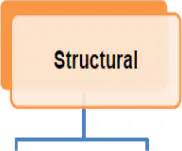
Which pair correctly matches classification with examples shown in the diagram?
Structural: laminates and sandwich panels
Particle-reinforced: continuous and aligned
Fiber-reinforced: large particles and dispersion
Structural: whiskers and carbon fibers
In particle-reinforced composites, the particles in the dispersed phase typically have
different dimensions along one axis
nearly the same size in all directions
variable diameter increasing with load
lamellar shape aligned with stress
Which statement about large particle composites is correct?
The matrix is harder and stiffer than particles
Particles primarily dissolve into the matrix
Particles restrain matrix movement under load
Particles mainly act as crack initiators
In large particle composites, load sharing occurs because the matrix
transfers some stress to particles
yields completely around inclusions
prevents any interface bonding
elastically isolates the reinforcement
For effective reinforcement by particles, which condition is most important?
Particles are large and clustered together
Particles are small and evenly distributed
Particles are elongated and highly oriented
Particles are porous and reactive
Which factor most influences the degree of reinforcement in large particle composites?
Strength of matrix–particle bonding
Color contrast between phases
Electrical conductivity of matrix
Magnetic susceptibility of particles
Which real-world example illustrates a particle-reinforced large particle composite?
Kevlar fibers in epoxy resin
Concrete with sand and gravel
Carbon fiber laminates
Foam core sandwich panel
Select all statements that are true for the functions of the matrix phase in fiber composites.
It binds fibers and distributes stress
It protects fibers from abrasion and chemicals
It serves as a barrier to crack propagation
It bears the majority of the applied load
Which statement best describes dispersion-strengthened composites?
Strengthening by atomic-scale dispersed particles
Strengthening by large embedded aggregates
Strengthening by continuous aligned fibers
Strengthening only by grain boundary pinning
Precipitation hardening primarily increases a metal alloy’s strength by
Forming fine second-phase particles
Dissolving precipitates completely
Eliminating all dislocations
Increasing grain size considerably
Which size range characterizes particles in dispersion-strengthened composites?
About 10 to 100 nm
About 1 to 5 µm
About 0.1 to 1 mm
About 100 to 500 µm
Why are small second-phase particles called precipitates important in precipitation hardening?
They impede dislocation motion
They increase vacancy diffusion
They promote grain coarsening
They reduce matrix bonding
Which definition correctly identifies fiber-reinforced composites?
Composites with dispersed phase as fibers
Composites with only particulate fillers
Composites with layered laminates only
Composites with purely monolithic phases
High specific strength and high specific modulus in fiber-reinforced composites are mainly achieved by using
Low-density fibers and matrices
High-density metal matrices
Only ceramic matrices always
Short whiskers exclusively
The mechanical behavior of a fiber-reinforced composite depends LEAST on which factor?
Color of the fibers used
Properties of the fibers
Fiber length relative to critical length
Efficiency of load transfer by matrix
Critical fiber length (lc) increases when which parameter decreases, assuming others constant?
Fiber-matrix bond strength (Tc)
Tensile strength of fiber (σf)
Fiber diameter (d)
Interfacial area fraction
Given lc = (σf d)/(2τc) in some texts, the role of σf and Tc (or τc) is best summarized as
Higher σf raises lc; higher Tc lowers lc
Higher σf lowers lc; higher Tc raises lc
Both σf and Tc raise lc together
Neither σf nor Tc affect lc
A fiber is considered continuous when its length is approximately how many times the critical length?
About fifteen times lc
About two times lc
About fifty times lc
About equal to lc
If fiber length is much less than critical fiber length, the fiber is termed
Discontinuous or short
Continuous or long
Wholly isotropic
Perfectly ductile
Which statement about continuous and aligned fiber composites is TRUE?
They are anisotropic with maximum strength along fibers
They are isotropic with equal strength in all directions
They reinforce mainly the transverse direction
They fail only at very high transverse stresses
To resist multidirectional stresses in aligned fiber laminates, engineers commonly
Stack layers with different orientations
Use only a single fiber direction
Avoid bonding layers together
Eliminate matrix to reduce weight
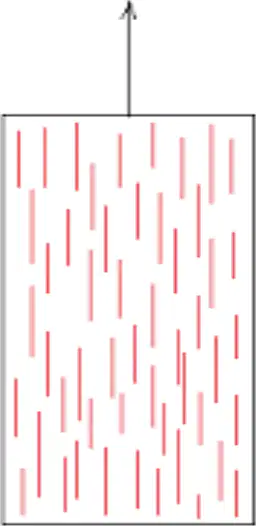
In aligned long-fiber composites, the weakest response typically occurs under
Transverse loading
Longitudinal loading
Pure shear along fibers
Hydrostatic compression
Which factor primarily reduces the reinforcement efficiency of discontinuous fibers compared to continuous fibers?
Short load transfer length limits stress
Higher fiber modulus reduces strain
Random matrix shrinkage improves bonding
Greater fiber continuity enhances shear
Which pair correctly lists the two categories of discontinuous fiber composites?
Aligned short fibers and randomly oriented
Continuous and aligned fibers only
Woven fibers and braided orientations
Metal matrix and ceramic matrix types
Among short fiber reinforcements, which is most widely used in commercial markets?
Chopped glass fibers are most common
Kevlar whiskers dominate all uses
Carbon nanotubes dominate markets
Aramid flakes replace most glass
Compared with their continuous aligned counterparts, discontinuous short fiber composites typically have which characteristics?
Lower modulus of elasticity values
Lower tensile strength values
Lower fabrication costs overall
Greater anisotropy in all directions
Which manufacturing techniques are commonly used for short fiber composite materials?
Compression molding and injection molding
Vacuum distillation and calcination
Powder sintering and carburizing
Electroplating and anodic oxidation
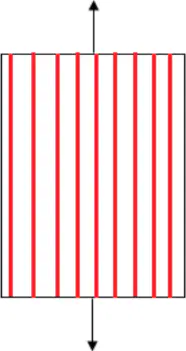
Identify the correct interpretation of the three diagrams: continuous and aligned fibers, discontinuous and aligned fibers, and discontinuous and randomly oriented fibers.
Left shows continuous alignment, middle shows short aligned, right shows random
Left shows random short fibers, middle shows woven cloth, right shows continuous
Left shows braided strands, middle shows continuous rods, right shows parallel whiskers
Left shows isotropic matrix, middle shows foamed core, right shows honeycomb
What defines a structural composite material in terms of property dependence?
Depends on constituents and geometrical design
Depends only on matrix chemistry alone
Depends solely on fiber tensile strength
Depends on curing temperature only
Which statement best describes laminar composites?
Two-dimensional sheets stacked with preferred directions
Three-dimensional foams with isotropic cells
Single layer films with random grain orientation
Bulk castings with equiaxed grain structures
In plywood, why are successive wood layers oriented at right angles to each other?
To develop varying strength with layers
To reduce density without strength
To align grains for maximum bending
To enable metal-to-wood bonding
Which materials can form laminar composites besides wood veneers?
Paper sheets bonded in layers
Woven glass fiber reinforced plastics
Molten metals cast into ingots
Foamed polymers without skins
The properties of laminar composites are governed by which combination?
Constituent properties and layer geometry
Ambient humidity during service only
Color pigments and surface finish
Adhesive brand used exclusively
Which application is typical for laminar composites like plywood?
False ceilings for diffused lighting
High-pressure gas cylinders liners
Catalyst supports in reactors
Electrolyte membranes for cells
What are the main structural elements of a sandwich panel?
Two strong face sheets and a lightweight core
Single thick plate with surface coating
Three identical dense metal plates
Two foils bonded without core
Which materials are commonly used for sandwich panel face sheets?
Titanium or steel sheets
Aluminium alloys or plywood
Foamed polystyrene blocks
Synthetic rubber membranes
What is the primary role of the core in a sandwich structure?
Separate faces and resist transverse loads
Provide surface hardness and wear
Carry in-plane membrane stresses
Supply electrical conductivity
In sandwich panels, which functions are mainly performed by the face sheets?
Bearing transverse bending stresses
Providing thermal insulation primarily
Allowing adhesive to flow evenly
Absorbing moisture from the core
How does increasing core thickness generally affect sandwich panel stiffness?
Stiffness increases with thicker core
Stiffness decreases monotonically
Stiffness remains exactly constant
Stiffness oscillates with thickness
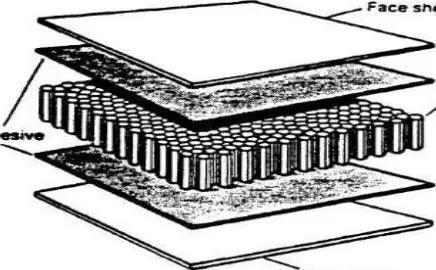
Which statement best describes a honeycomb core used in sandwich panels?
Interlocked hexagonal cells from thin foils
Random pores produced by gas bubbles
Solid plate with drilled circular holes
Loose fibers packed without bonding
Which reason best explains why discontinuous aligned short-fiber composites can still be useful despite lower efficiency?
They enable intricate shapes at lower cost
They always exceed continuous fiber strength
They eliminate need for matrix materials
They prohibit any anisotropy in parts
Which factor most directly explains why glass fibers can be economically used as reinforcement in plastics?
They are commonly available and fabricable
They melt at extremely low temperatures
They react strongly with polymer matrices
They require exotic manufacturing equipment
What characteristic mainly gives glass fiber reinforced plastics very high specific strength?
High strength fibers embedded in plastic
Large fiber diameters reducing stress
Strong chemical bonding with metals
Porous fibers increasing surface area
When combined with a plastic matrix, glass fibers exhibit chemical inertness. What is a practical consequence of this?
Use in various corrosive environments
Rapid degradation in humid conditions
Incompatibility with polymer resins
Requirement for protective coatings
Glass fiber reinforced composites can be produced by incorporating which type of reinforcement into a plastic matrix?
Continuous or discontinuous glass fibers
Only woven metallic meshes
Nanotubes with ceramic whiskers
Natural fibers like cotton yarns
Which polymer is commonly used as the matrix for glass fiber reinforced composites?
Polyesters are commonly used matrices
Epoxy is the exclusive matrix used
Only thermoplastic polyethylene
Phenolic is mandatory for strength
Up to what temperature are glass fiber reinforced composites commonly used according to the notes?
Up to about 200°C in service
Only below room temperature
Up to approximately 800°C
Beyond 1200°C continuously
Identify two common applications of sandwich panels mentioned.
Aircraft wings and fuselage skins
Building roofs and floors
Submarine reactor vessels
Dental implants
Why are glass fiber reinforced composites extensively used in transportation industries?
They reduce vehicle weight and boost efficiency
They increase density and ride stiffness
They generate heat for de-icing systems
They corrode faster than metals used
What is a cermet?
A composite of ceramic and metallic materials
A polymer reinforced with natural fibers
A metallic alloy with added carbon content
A ceramic single crystal with dopants
Which property combination is the design goal of a cermet?
Ceramic hardness with metal ductility
Low-temperature toughness and magnetism
Electrical conductivity with translucency
High porosity and rapid oxidation
Cermets are usually less than what fraction of metal by volume?
Less than 20% metal by volume
Exactly 50% metal by volume
More than 80% metal by volume
Nearly 100% metal by volume
Which is the most commonly used cermet described?
Cemented carbide with WC or TiC
Zirconia-toughened alumina
Silicon nitride with glassy phase
Carbon fiber reinforced polymer
What typical application is given for cemented carbides?
Cutting tools for hardened steels
Lightweight aircraft fuselage skins
High-voltage electrical insulators
Biomedical joint replacements
Which statement best describes the use of glass fiber reinforced resins across industries?
They are used in construction, electrical, transport, agriculture, consumer goods
They are limited to aerospace, defense, and nuclear plants
They are only applicable in household utensils
They are primarily used for food packaging
Why can automobile tyres be considered composite materials?
They have a rubber matrix with textile reinforcing fibers
They are single-phase vulcanized rubber compounds
They contain only metallic bead wires without matrix
They are ceramic coatings on metallic rims
Which composite is suitable for automotive brake linings according to the notes?
Asbestos reinforced phenolic resins
Pure aluminum matrix composites
Glass reinforced polypropylene only
Polycarbonate reinforced with nylon

