
 Worksheets
Properties and Behavior of Gases Quiz
Total questions: 100
Worksheet time: 50mins
Which of the following properties can be used to describe gases?
Pressure, volume, temperature, and amount of substance
Color, taste, and smell
Hardness, magnetism, and solubility
Shape, texture, and flexibility
Unlike liquids and solids, what do gases do when placed in a container?
Remain at the bottom of the container
Expand to fill their containers
Form a solid layer
Sink to the lowest point
Which statement best explains why gases are highly compressible compared to liquids and solids?
Gases have extremely low densities and particles are far apart
Gases have strong intermolecular forces
Gases are always at high temperatures
Gases are heavier than liquids and solids
If you mix two different gases together, what will happen?
They will form a heterogeneous mixture
They will not mix at all
They will form a homogeneous mixture
They will turn into a liquid
A scientist wants to measure the pressure exerted by a gas in a closed container. Which property of gases is being investigated?
The ability to expand to fill containers
The ability to exert pressure
The ability to form mixtures
The ability to be compressed
Which of the following best defines pressure?
The amount of force applied per unit area
The total force applied to an object
The speed at which force is applied
The volume of air in a given space
What is the formula for calculating pressure?
P = A / F
P = F / A
P = F × A
P = F + A
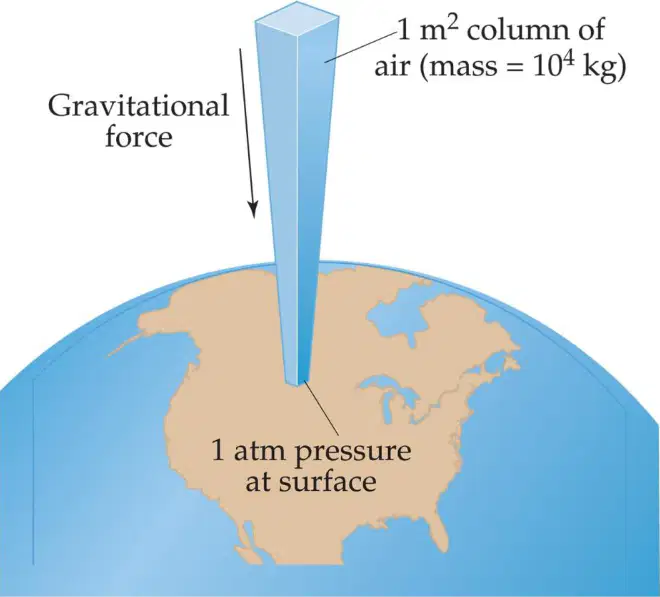
Atmospheric pressure is defined as:
The temperature of air per unit area
The weight of air per unit area
The speed of air per unit area
The density of air per unit area
Why does the actual atmospheric pressure at any location vary?
Because of the color of the sky
Due to weather condition and altitude
Because of the shape of the Earth
Due to the amount of sunlight
If the force applied to a surface increases but the area remains the same, what happens to the pressure?
Pressure decreases
Pressure remains the same
Pressure increases
Pressure becomes zero
What is the SI unit of pressure?
Pascal (Pa)
Newton (N)
Joule (J)
Watt (W)
1 Pascal (Pa) is equal to which of the following?
1 N/m²
1 N/cm²
1 N/mm²
1 N/km²
How many Pascals are there in 1 bar?
10⁵ Pa
10³ Pa
10² Pa
10⁶ Pa
If a pressure is measured as 100 kPa, how many bars is this equivalent to?
1 bar
10 bars
0.1 bar
100 bars
Explain why Pascal (Pa) is used as the SI unit for pressure and how it relates to force and area.
Pascal is used because it represents force per unit area, specifically 1 Newton per square meter.
Pascal is used because it represents energy per unit volume.
Pascal is used because it represents mass per unit area.
Pascal is used because it represents velocity per unit time.
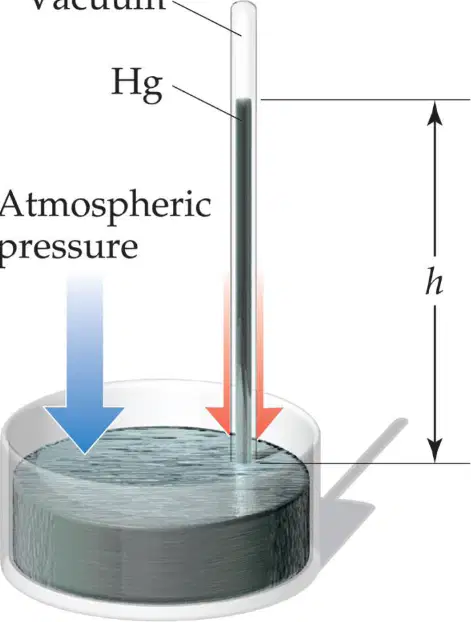
Which units are used to measure the difference in the heights of two connected columns of mercury?
mm Hg or torr
Pascal or bar
Newton or joule
Liter or mole
How many torr are equivalent to 1 atmosphere (atm)?
760 torr
100 torr
500 torr
1000 torr
If the difference in the heights (h) of two connected columns of mercury is measured in mm, which unit can be used to express this pressure?
mm Hg
kilogram
liter
ampere
A scientist measures the pressure in a laboratory and finds it to be 760 mm Hg. What is this pressure in atmospheres?
1.00 atm
0.76 atm
7.60 atm
76.0 atm
Explain why the units mm Hg and torr are considered equivalent when measuring pressure. Use evidence from the relationship between atmospheric pressure and the height of mercury columns.
Because 1 atm is defined as 760 mm Hg, which is also 760 torr
Because mm Hg measures mass and torr measures volume
Because both units are used for measuring temperature
Because torr is only used in chemistry and mm Hg in physics
What is the term used to describe normal atmospheric pressure at sea level?
Standard pressure
High pressure
Low pressure
Variable pressure
Which of the following is NOT equal to standard atmospheric pressure?
1.00 atm
760 mm Hg
101.325 kPa
500 mm Hg
If a scientist measures the atmospheric pressure at sea level and gets a value of 101.325 kPa, what other units could they use to express the same pressure?
1.00 atm or 760 mm Hg
2.00 atm or 500 mm Hg
0.50 atm or 200 mm Hg
1.50 atm or 900 mm Hg
Which law describes the pressure-volume relationship for a fixed quantity of gas at constant temperature?
Boyle’s Law
Charles’s Law
Avogadro’s Law
Dalton’s Law
According to Boyle’s Law, what happens to the volume of a fixed quantity of gas if the pressure increases, assuming temperature remains constant?
The volume decreases
The volume increases
The volume stays the same
The volume doubles
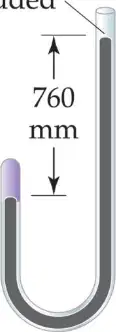
A sample of gas has a volume of 60 mL at atmospheric pressure. If the pressure is increased by adding mercury to the system, and the new pressure is 760 mm higher, what is the new volume of the gas?
30 mL
60 mL
90 mL
120 mL
Explain why the volume of a gas decreases when the pressure on it increases, according to Boyle’s Law.
Because the gas particles are forced closer together, reducing the space they occupy
Because the temperature of the gas increases
Because the gas changes into a liquid
Because the number of gas particles decreases
Which equation represents Boyle's Law?
PV = k
P + V = k
P/V = k
P - V = k
According to Boyle's Law, what happens to the volume of a gas if the pressure is decreased, assuming temperature is constant?
The volume increases
The volume decreases
The volume stays the same
The volume becomes zero
If a balloon has a volume of 3.00 L at a pressure of 1.50 atm, what will its volume be if the pressure is reduced to 0.50 atm at constant temperature?
9.00 L
1.00 L
4.50 L
0.50 L
What is the formula to calculate the new volume (V₂) of a gas when the pressure changes, according to Boyle's Law?
V₂ = (P₁V₁)/P₂
V₂ = P₁/P₂
V₂ = V₁/P₂
V₂ = P₂V₁/P₁
Which of the following is a constant in Boyle's Law equation?
Temperature
Volume
Pressure
Density
If the pressure on a gas is tripled at constant temperature, what happens to its volume according to Boyle's Law?
It becomes one-third of the original volume
It triples
It stays the same
It doubles
What does the symbol "P" represent in Boyle's Law?
Pressure
Power
Potential
Product
What does the symbol "V" represent in Boyle's Law?
Volume
Velocity
Voltage
Value
Which variable must remain constant for Boyle's Law to apply?
Temperature
Pressure
Volume
Mass
A gas occupies 5.00 L at 2.00 atm. What will its volume be at 1.00 atm, assuming temperature is constant?
10.00 L
2.50 L
5.00 L
1.00 L
A gas in a cylinder has a volume of 7.25 L and a pressure of 4.25 atm. What is the pressure of the gas if the volume is increased to 27.1 L at constant temperature?
1.14 atm
15.9 atm
7.25 atm
27.1 atm
According to Charles's Law, what happens to the volume of a fixed amount of gas at constant pressure when its absolute temperature increases?
The volume decreases
The volume remains the same
The volume is directly proportional to its absolute temperature
The volume becomes zero
Which of the following best describes the relationship between temperature and volume in Charles's Law?
Inverse relationship
No relationship
Direct relationship
Exponential relationship
A balloon filled with gas is kept at constant pressure. If the temperature of the gas is doubled, what will happen to the volume of the balloon according to Charles's Law?
The volume will be halved
The volume will double
The volume will remain unchanged
The volume will decrease to zero
Which law describes the relationship between the volume and temperature of a gas at constant pressure?
Boyle's Law
Charles's Law
Avogadro's Law
Dalton's Law
According to Charles's Law, what is the mathematical relationship between the volume (V) and temperature (T) of a gas at constant pressure?
V ∝ P
V ∝ T
V ∝ n
V ∝ 1/T
What is the formula to convert Celsius temperature to Kelvin?
K = °C + 100
K = °C + 273.15
K = °C × 2
K = °C - 273.15
A gas in a cylinder has a volume of 88.2 mL at 35°C. What will be the volume of the gas if the temperature is increased to 155°C at constant pressure? (Use Charles's Law: V₁/T₁ = V₂/T₂, and convert temperatures to Kelvin.)
176.4 mL
132.3 mL
110.2 mL
88.2 mL
What is the value of T₁ in Kelvin if the temperature is 35°C?
308.15 K
273.15 K
428.15 K
155.00 K
Which formula is used to relate the volume and temperature of a gas at constant pressure?
V₁/T₁ = V₂/T₂
V₁ + T₁ = V₂ + T₂
V₁ × T₁ = V₂ × T₂
V₁ - T₁ = V₂ - T₂
If V₁ = 88.2 mL, T₁ = 308.15 K, and T₂ = 428.15 K, what is the value of V₂?
123 mL
88.2 mL
308.15 mL
428.15 mL
A gas has a volume of 2.80 L at an unknown temperature and constant pressure. When the sample is cooled to 0.0°C in an ice bath, its volume is reduced to 2.57 L. What steps would you take to find the initial temperature of the gas?
Use the formula V₁/T₁ = V₂/T₂ and solve for T₁
Subtract the final volume from the initial volume
Add the initial and final temperatures
Multiply the initial volume by the final temperature
Which equation represents the Combined Boyle’s and Charles’s Gas Laws?
P1V1/T1 = P2V2/T2
P1V1 = P2V2
P1/T1 = P2/T2
V1/T1 = V2/T2
A gas in a cylinder originally had a volume of 4.39 L at 44°C and a pressure of 0.85 atm. If the pressure changes to 0.95 atm and the temperature to 15°C, what is the new volume of the gas? (Use the combined gas law)
3.57 L
4.39 L
2.85 L
5.12 L
If the temperature of a gas increases while the pressure remains constant, what happens to the volume according to the combined gas law?
The volume increases
The volume decreases
The volume stays the same
The volume doubles
Explain how you would use the combined gas law to solve for the final volume of a gas when given initial and final pressures and temperatures.
By substituting the known values into the equation and solving for the unknown volume
By adding all the values together
By multiplying the pressures and dividing by the temperatures
By using only the initial values
Which law states that the volume of a gas at constant temperature and pressure is directly proportional to the number of moles of the gas?
Avogadro’s Law
Boyle’s Law
Charles’s Law
Dalton’s Law
What is the mathematical expression for Avogadro’s Law?
V = kn
V = kT
P = kV
n = kP
According to Avogadro’s Law, if the number of moles of a gas increases at constant temperature and pressure, what happens to the volume?
The volume increases
The volume decreases
The volume stays the same
The volume becomes zero
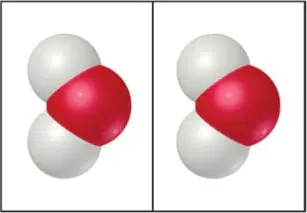
Based on the diagram, what is the ratio of hydrogen to oxygen to water vapor in the reaction shown?
2:1:2
1:2:2
2:2:1
1:1:2
If you have 3 moles of a gas at constant temperature and pressure, and the proportionality constant k is 22.4 L/mol, what is the volume of the gas?
67.2 L
44.8 L
22.4 L
6.72 L
Which equation represents Avogadro’s Equation mathematically?
V = k × n
V = k × T
V = k × P
V = k × m
If V₁/n₁ = V₂/n₂, what does this relationship describe?
Boyle’s Law
Avogadro’s Equation
Charles’s Law
Dalton’s Law
Given Avogadro’s Equation V₁/n₁ = V₂/n₂, if the number of moles of a gas doubles, what happens to the volume, assuming temperature and pressure are constant?
The volume halves
The volume remains the same
The volume doubles
The volume triples
Which chemical equation represents the reaction between nitrogen gas and hydrogen gas to produce ammonia?
N₂(g) + 3H₂(g) → 2NH₃(g)
N₂(g) + H₂(g) → NH₃(g)
2N₂(g) + 3H₂(g) → 2NH₃(g)
N₂(g) + 2H₂(g) → 2NH₃(g)
If 50 mL of N₂ reacts with 150 mL of H₂ at constant temperature and pressure, how many milliliters of NH₃ gas are produced?
250 mL
100 mL
200 mL
300 mL
What is the ratio of moles of N₂ to H₂ required to produce ammonia according to the reaction N₂(g) + 3H₂(g) → 2NH₃(g)?
1:3
2:3
1:2
3:2
Which formula is used to calculate the volume of product gas in the reaction shown?
V₂ = (V₁ × n₂) / n₁
V₂ = (V₁ × n₁) / n₂
V₂ = V₁ + n₂ - n₁
V₂ = V₁ × n₁ × n₂
Given V₁ = 500 mL, n₁ = 4, and n₂ = 2, what is the value of V₂ using the formula V₂ = (V₁ × n₂) / n₁?
250 mL
500 mL
125 mL
1000 mL
Explain why the volume of ammonia produced is less than the volume of nitrogen used in the reaction.
Because the stoichiometry of the reaction produces fewer moles of ammonia than nitrogen.
Because ammonia is a solid and occupies less volume.
Because nitrogen is consumed completely.
Because hydrogen is not involved in the reaction.
Which of the following is the balanced chemical equation for the reaction between hydrogen gas and chlorine gas to produce hydrogen chloride gas?
H₂(g) + Cl₂(g) → 2HCl(g)
H₂(g) + 2Cl₂(g) → 2HCl(g)
2H₂(g) + Cl₂(g) → 2HCl(g)
H₂(g) + Cl₂(g) → HCl(g)
If 1.0 L of H₂ gas reacts with 1.0 L of Cl₂ gas at constant temperature and pressure, how many liters of HCl gas will be produced?
2.0 L
1.0 L
0.5 L
3.0 L
Why is it important to keep temperature and pressure constant when measuring the volume of gases in a chemical reaction?
Because gas volumes change with temperature and pressure
Because it makes the reaction faster
Because it prevents the gases from mixing
Because it increases the yield of the product
Which law states that the volume of a gas is inversely proportional to its pressure?
Boyle's law
Charles's law
Avogadro's law
Dalton's law
According to Charles's law, the volume of a gas is directly proportional to which variable?
Temperature
Pressure
Number of moles
Density
Avogadro’s law relates the volume of a gas to which of the following?
Number of moles
Pressure
Temperature
Mass
If you combine Boyle’s law, Charles’s law, and Avogadro’s law, what do you obtain?
The Ideal-Gas Equation
The Law of Conservation of Mass
The Law of Definite Proportions
The Combined Gas Law
Explain how the relationships described by Boyle’s law, Charles’s law, and Avogadro’s law can be combined to form the ideal-gas equation.
By recognizing that volume is inversely proportional to pressure, directly proportional to temperature, and directly proportional to the number of moles, we can combine these relationships to derive the ideal-gas equation.
By adding the values of pressure, temperature, and number of moles together.
By multiplying the pressure and temperature only.
By ignoring the number of moles and focusing only on pressure and temperature.
Which equation is known as the ideal gas equation?
PV = nRT
E=mc2
F = ma
a2+b2=c2
In the ideal gas equation, what does the variable 'n' represent?
Number of moles
Pressure in atm
Volume in liters
Temperature in Kelvin
What is the value and unit of the ideal gas constant (R) in the ideal gas equation?
0.08206 L atm / mol K
9.8 m/s^2
6.022 x 10^23 mol^{-1}
1.0 atm
If you are given the pressure in atm, volume in liters, number of moles, and temperature in Kelvin, which equation would you use to find the missing variable for an ideal gas?
PV = nRT
F = ma
E = mc^2
V = IR
Suppose you have 2 moles of an ideal gas at a temperature of 300 K and a pressure of 1 atm. Using the ideal gas constant R = 0.08206 L atm / mol K, what is the volume of the gas?
49.236 L
24.6 L
0.08206 L
600 L
Which equation is used to relate pressure, volume, number of moles, and temperature for a gas?
PV = nRT
P = nVRT
PV = RT/n
P = VnT/R
If a basketball is inflated to a total pressure of 1.65 atm at 25°C and has a volume of 3.24 L, how many moles of gas are present? (Use R = 0.08206 L atm/mol K and T = 298 K)
0.291 mol
1.65 mol
3.24 mol
0.082 mol
A gas sample contains 1.30 mol at 22°C and occupies a volume of 3.24 L. Which variable would you solve for using the ideal gas law in this scenario?
Pressure
Volume
Number of moles
Temperature
You are given 2.30 mol of a gas at a pressure of 680 mmHg and a temperature of 50°C. Which variable are you asked to calculate?
Volume
Pressure
Number of moles
Temperature
Explain the steps you would take to calculate the pressure exerted by 1.30 mol of a gas at 22°C and a volume of 3.24 L using the ideal gas law.
Convert temperature to Kelvin, use PV = nRT, solve for P.
Use PV = nRT, solve for V, then convert temperature to Celsius.
Use PV = nRT, solve for n, then convert pressure to mmHg.
Convert volume to mL, use PV = nRT, solve for T.
What does STP stand for in chemistry?
Standard Temperature and Pressure
Standard Time and Pressure
Standard Temperature and Power
Standard Test Procedure
At STP, what is the standard temperature?
0°C
25°C
100°C
-273°C
Which of the following is NOT a standard pressure at STP?
500 mmHg
760 mmHg
1.0 atm
Both 760 mmHg and 1.0 atm
If a scientist wants to conduct an experiment at STP, what conditions should they set for temperature and pressure?
Temperature = 0°C; Pressure = 760 mmHg or 1.0 atm
Temperature = 25°C; Pressure = 1.0 atm
Temperature = 100°C; Pressure = 500 mmHg
Temperature = -273°C; Pressure = 2.0 atm
What is one application of the ideal gas equation?
Calculating the volume and moles from a balanced chemical equation
Determining the color of gases
Measuring the temperature of solids
Identifying the taste of liquids
Which of the following best describes reactions involving gases?
Calculating volume and grams of gas produced or consumed in a reaction
Measuring the density of liquids
Observing the melting point of solids
Determining the boiling point of water
Given the reaction: CO(g) + 2H₂(g) → CH₃OH(g), how many moles of H₂ are required to react with 2.0 mol of CO?
4.0 mol
1.0 mol
2.0 mol
3.0 mol
A student is given the reaction CO(g) + 2H₂(g) → CH₃OH(g). If they have 2.0 mol of CO gas, what steps should they follow to calculate the volume of H₂ gas needed at 400°C and 3.50 atm?
Use the ideal gas equation and stoichiometry to find the required volume
Measure the mass of CO directly
Use only the temperature to estimate the volume
Ignore the pressure in calculations
What is the balanced chemical equation for the formation of methanol from carbon monoxide and hydrogen?
CO(g) + 2H₂(g) → CH₃OH(g)
CO₂(g) + H₂(g) → CH₄(g)
CO(g) + H₂O(g) → CH₃OH(g)
CO(g) + 3H₂(g) → CH₄(g) + H₂O(g)
According to the balanced equation, what is the ratio of moles of H₂(g) to moles of CO(g)?
2:1
1:2
1:1
3:1
If you start with 2.0 mol of CO, how many moles of H₂ are required according to the balanced equation?
4.0 mol
2.0 mol
1.0 mol
3.0 mol
Which equation represents the ideal gas law?
PV = nRT
P = nRT/V
V = nRT/P
PV = RT/n
Using the ideal gas law, what is the volume (V) of 4.0 mol of gas at 3.50 atm and 673.15 K? (R = 0.08206 L atm/mol K)
63 L
32 L
100 L
8 L
If the pressure is increased while keeping the number of moles and temperature constant, what happens to the volume of the gas according to the ideal gas law?
It decreases
It increases
It stays the same
It doubles
What is the balanced chemical equation for the reaction described in the image?
CO(g) + 2H₂(g) → CH₃OH(g)
CO₂(g) + H₂(g) → CH₄(g)
CH₄(g) + O₂(g) → CO₂(g) + H₂O(g)
2CO(g) + 2H₂(g) → 2CH₃OH(g)

