
Font size
 Worksheets
Forensics Final Exam Review Questions
Total questions: 107
Worksheet time: 54mins
What is the proper method of transporting a microscope?
By the arm and base
By the eyepiece and stage
By the cord only
By holding the objective lenses
Which objective lens should you never use in conjunction with the coarse adjustment knob?
High-power objective lens
Low-power objective lens
Scanning objective lens
Oil immersion not attached
When using a microscope, how will a specimen appear compared to how it was placed under the microscope?
Upside down and flipped
Exactly the same orientation
Magnified but same orientation
Rotated 90 degrees only
Which statement correctly distinguishes an observation from a perception?
An observation is information gathered from the five senses, while a perception is the method of interpreting an observation.
An observation is a personal belief formed after thinking, while a perception is raw sensory data.
An observation always occurs after forming a perception.
Observation and perception are identical processes.
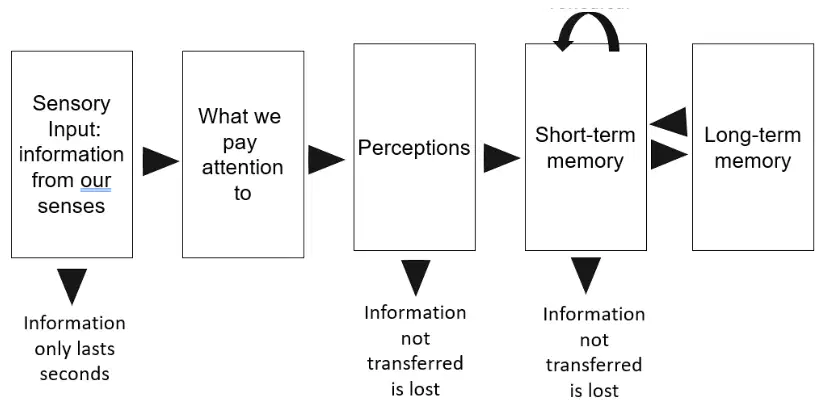
How does the brain take observations and process them? Based on the diagram showing a flow from Sensory input to What we pay attention to, to Perceptions, to Short-term memory (with a loop reinforcing itself), to Long-term memory, which sequence best represents the order of processing?
Sensory input → Attention → Perceptions → Short-term memory → Long-term memory
Perceptions → Sensory input → Attention → Long-term memory → Short-term memory
Attention → Sensory input → Short-term memory → Perceptions → Long-term memory
Sensory input → Perceptions → Attention → Long-term memory → Short-term memory
Which set lists the four lobes of the brain?
Frontal, parietal, temporal, occipital
Frontal, cerebellar, temporal, brainstem
Parietal, limbic, temporal, cerebellar
Occipital, hippocampal, frontal, medullary
What is deductive reasoning?
Deriving consequences from facts using a series of logical steps
Forming general rules from many specific observations
Relying on intuition without using evidence
Accepting a claim based on authority alone
Which of the following are criteria for being a good observer? Select all that apply.
Make a conscious effort to examine the environment.
Observe everything, slowly.
Make connections to observations.
Jump to conclusions quickly to save time.
Photograph and take notes.
What is an eyewitness?
A person who has seen someone, or something, related to a crime
A detective assigned to a case
A juror who hears testimony in court
A person who studies crime scenes in a lab only
What is eyewitness testimony?
When an eyewitness testifies in court about a crime
A written police report by investigators
A suspect’s confession
A judge’s summary of the case
What is the problem with trusting eyewitnesses at a crime scene?
Their recollection of events is not always accurate.
Eyewitnesses never agree with police reports.
Eyewitnesses cannot legally testify.
Memory is perfect if the witness took notes.
What do forensic sketch artists do?
Work with police to interview victims or witnesses to recreate a drawing that reflects the image of the perpetrator
Collect DNA samples from victims and suspects
Analyze fingerprints in a laboratory
Testify in court as the primary investigator
Which people might show up at a crime scene? Select all that apply.
First responders
Crime scene investigators
Medical examiners or coroners
Detectives
Specialists
Who founded the Innocence Project?
Barry Scheck and Peter Neufeld
Barry Scheck and Paul Ekman
Peter Neufeld and Oliver Sacks
Francis Crick and James Watson
What is the purpose of the Innocence Project?
To reexamine post-conviction cases and exonerate those who are wrongfully convicted
To provide defense attorneys to all suspects before arrest
To manage local crime scene units
To lobby for longer prison sentences
What piece of evidence does the Innocence Project use to help set innocent people free?
DNA
Handwriting samples
Shoe-print casts
Polygraph results
What percentage of wrongful conviction cases has the Innocence Project helped solve?
87%
57%
25%
98%
What is the name of the document that records who has entered and exited a crime scene?
Chain of custody form
Crime scene entry log
Evidence inventory sheet
Incident narrative report
Why is following the chain of custody important?
It speeds up laboratory testing times.
It documents who handled evidence and preserves its integrity.
It allows officers to discard duplicate evidence.
It determines the order of witness interviews.
Which actions are included among the seven steps of a crime scene investigation? Select all that apply.
Securing the scene
Separating witnesses
Photographing and sketching the scene
Conducting lab toxicology before collection
Searching, then securing and collecting evidence
Why should eyewitnesses be separated before they are interviewed?
To prevent them from influencing each other’s observations
To ensure they can compare stories for accuracy
To allow more efficient group questioning
To collect physical evidence from them first
How should wet evidence be collected?
Package immediately in plastic to retain moisture
Air-dry naturally before packaging
Freeze it first, then place in plastic
Apply heat to speed drying and then bag
How is small, dry evidence collected?
In a bindle
In a liquid-tight jar
With adhesive tape only
In a paper envelope without folds
When opening a sealed evidence bag that bears a signature on its label, how must the evidence be accessed?
Cut through the signed label to show it was opened
Peel the label back and reattach after opening
Open the package without breaking the original evidence label
Remove the label and place a new one after inspection
When a first responder secures a crime scene, what occurs?
Photos are taken before any barriers are placed
Barrier tape is used to establish a perimeter and officers are posted at entry points with a scene log
All potential witnesses are detained inside the perimeter
Evidence is collected prior to establishing a perimeter
What distinguishes circumstantial evidence from direct evidence?
Circumstantial requires laboratory testing; direct does not
Circumstantial implies a fact; direct is a firsthand observation
Circumstantial is physical; direct is digital
Circumstantial is inadmissible; direct is always admissible
Classify the evidence: Fingerprint left on a car door handle.
Direct
Circumstantial
Classify the evidence: A written confession signed by a suspect.
Direct
Circumstantial
Classify the evidence: A piece of gum left at a crime scene.
Direct
Circumstantial
Classify the evidence: A tape recording of a suspect admitting to a crime.
Direct
Circumstantial
What is a bindle?
A rigid container for sharp evidence
A paper packaging used for small or fragile evidence
A plastic pouch for wet evidence
A tamper-evident label for sealing bags
What is the difference between individual evidence and class evidence?
Individual narrows to a single person; class narrows only to a group
Individual is physical; class is biological
Individual is always DNA; class is always fingerprints
Individual is circumstantial; class is direct
Individual or class evidence: Skin cells (DNA) found under a victim’s fingernails.
Individual
Class
Individual or class evidence: Size 9 Nike shoe found beside a body.
Individual
Class
Individual or class evidence: 1990 Ford Explorer seen leaving an armed robbery.
Individual
Class
Individual or class evidence: Fingerprint left on a soda can at a crime scene.
Individual
Class
What is the difference between physical evidence and biological evidence?
Biological derives from plant, animal/human, or mineral sources; all other evidence is physical
Biological is always liquid; physical is always solid
Biological is digital; physical is trace
Biological is collected only at hospitals; physical is collected at scenes
Classify the evidence item: Jacket fiber (100% cotton). Choose the correct category.
Physical
Biological
Classify the evidence item: Bullet casing. Choose the correct category.
Physical
Biological
Classify the evidence item: Glass fragments. Choose the correct category.
Physical
Biological
Classify the evidence item: Ransom note. Choose the correct category.
Physical
Biological
During which two steps of CSI are evidence markers used? Select all that apply.
Securing the scene
Scanning the scene
Searching the scene
Sketching the scene
Processing/analyzing evidence
Why is Dr. Edmond Locard known as the father of forensics?
He created the first national fingerprint database
He established the first forensics laboratory
He wrote the first CSI field manual
He pioneered DNA profiling
What is the procedure for taking photographs at a crime scene?
A minimum of 3 angles at 3 distances
One overall shot followed by close-ups only
Only medium-range photos of each item
Video walkthrough only with no still photos
What type of photography is used in crime scene investigation?
Analog film
Polaroid instant
Digital
Infrared-only
According to the justice system, which criteria must photographs meet to be used in court? Select all that apply.
Accurately reflect the true condition of the scene without alteration
Any manipulations must be documented
They must have relevancy to the issues at hand
They must be taken by a sworn police officer
They must be in color
What must be included in a crime scene sketch? Select all that apply.
True North
Scale of distance
Date
Time
Location
Which are types of crime scene sketches? Select all that apply.
Overview
Elevation
Exploded/cross-projection
Panoramic composite
Oblique perspective
What is triangulation in a crime scene sketch?
Establishing a single baseline through the scene
Measuring the distance between the evidence and two fixed points
Using GPS to record the scene location only
Creating a three-dimensional laser scan
What is the difference between a primary crime scene and a secondary crime scene?
The primary scene is where evidence is processed; the secondary scene is where suspects are questioned
The primary scene is the initial location of the crime; the secondary scene is an additional location related to the crime but not the initial location
The primary scene is indoors; the secondary scene is outdoors
The primary scene involves victims; the secondary scene involves suspects only
What are the goals of the crime scene search? Select all that apply.
Recognize evidence
Document evidence
Collect evidence
Preserve evidence
Prosecute suspects
Which are recognized crime scene search patterns? Select all that apply.
Line/strip
Spiral
Grid
Zone/quadrant
Random walk
What is the importance of the Frye Standard?
It requires that scientific evidence be generally accepted by the scientific community to be admissible, promoting fairness and reliability
It prioritizes novel techniques regardless of acceptance
It mandates that only DNA evidence is admissible
It removes judges from admissibility decisions
How is the Daubert Standard different from the Frye Standard?
It excludes expert testimony entirely
It provides more flexibility to the admissibility of scientific evidence
It requires unanimous scientific consensus for evidence
It applies only to state courts
How has forensics changed over time?
Techniques have become more sophisticated by combining scientific principles with investigative work
The field has eliminated scientific methods in favor of eyewitness accounts
Evidence handling has become less standardized
Processing has returned to manual methods without technology
What are the first 10 amendments to the U.S. Constitution called?
The Preamble
The Federalist Papers
The Bill of Rights
The Articles of Confederation
What does Article 6 in the Bill of Rights ensure citizens of?
Protection from unreasonable searches
The right to bear arms
A fair and speedy trial by an impartial jury
Freedom of speech
Hair Analysis: What is the difference between the terms microscopic and macroscopic?
Microscopic requires a microscope; macroscopic can be seen with the naked eye
Microscopic is larger; macroscopic is smaller
Microscopic refers to color; macroscopic refers to shape
Microscopic is qualitative; macroscopic is quantitative
Hair Analysis: What is the protein that composes a strand of hair?
Keratin
Collagen
Elastin
Myosin
Hair Analysis: Which part of the hair must be present in order to collect DNA?
Cuticle
Medulla
Cortex
The follicle
Hair Analysis: If the follicle of the hair is not present, which classification of evidence is the hair considered?
Individual evidence
Class evidence
Trace evidence only when colored
Circumstantial evidence only
Hair Analysis: What is the top layer of skin called?
Dermis
Hypodermis
Epidermis
Stratum lucidum
Hair Analysis: What are the 3 parts of the hair shaft?
Cuticle, cortex, medulla
Root, follicle, tip
Shaft, bulb, papilla
Keratin, melanin, collagen
Hair Analysis: Which part of the hair shaft contains scales that can be seen under a microscope?
Cuticle
Cortex
Medulla
Follicle
Hair Analysis: What are the 6 types of hairs that can be found on humans?
Head, beard, body, pubic, underarm, eyelash/eyebrow
Head, chest, leg, arm, facial, pubic
Temporal, occipital, frontal, nasal, axillary, inguinal
Primary, secondary, tertiary, quaternary, vellus, terminal
Hair Analysis: Are all hairs the same? Explain.
Yes, all human hairs are identical
No, they differ from person to person and may vary across body regions
Yes, but only in color
They differ only under chemical tests, not visually
Hair Analysis: How might hair be collected at a crime scene? Select all that apply.
Plucking
Using forceps
Adhesive lifters or tape
Dissolving in water
Hair Analysis: What knowledge can forensic scientists gather about a hair found at a crime scene?
Only the exact age of the person
Hair color, texture, ethnicity or identity if the follicle is present
Only whether dye was used
Only the time since the hair was shed
Hair Analysis: Which famous political leader’s murder was solved due to hair analysis?
Julius Caesar
Napoleon Bonaparte
Abraham Lincoln
Mohandas Gandhi
Fiber Analysis: What is a fiber?
A large woven sheet of fabric
The smallest unit of a textile
A chemical used to dye cloth
A microscopic organism found in cloth
Fiber Analysis: How does Locard’s Principle of Exchange relate to fiber analysis?
Criminals leave fingerprints but not fibers
When a crime occurs, it is likely a fiber might be transferred that would lead to a suspect
Fibers only transfer in wet environments
Locard’s Principle applies only to DNA evidence
Fiber Analysis: How might fibers be collected at a crime scene? Select all that apply.
Plucking
Using adhesives or tape lifts
Vacuuming
Soaking items in bleach
Fiber Analysis: What is the difference between a natural fiber and a synthetic fiber?
Synthetic is manmade, while natural is found in nature
Natural is laboratory-made; synthetic grows on plants
Natural is always stronger than synthetic
Synthetic fibers cannot be dyed
Fiber Analysis: Give a few examples of natural fibers.
Wool
Cotton
Hemp
Nylon
Fiber Analysis: Give a few examples of synthetic fibers.
Nylon
Rayon
Acetate
Hemp
Fiber Analysis: What kind of evidence is a fiber considered?
Individual evidence
Class evidence
Direct testimonial evidence
Biological evidence only
Fiber Analysis: What kind of test can be conducted if several fibers are found at a crime scene?
DNA profiling
Burn analysis
pH testing
Gas chromatography for blood
Fingerprint Analysis: The center part of a loop or whorl is called the what?
Core
Delta
Ridge ending
Bifurcation
Fingerprint Analysis: The triangular pattern of a fingerprint is called the what?
Core
Delta
Island
Bridge
Fingerprint Analysis: What are the 3 patterns of fingerprints?
Loop, whorl, arch
Plain, tented, central pocket
Ridge, valley, pore
Ulnar, radial, composite
Fingerprint Analysis: Which type of fingerprint is most rare?
Loop
Whorl
Arch
Composite
Fingerprint Analysis: Why are fingerprints useful to Forensics scientists?
They can identify a suspect
They reveal a person’s diet
They determine a person’s age exactly
They indicate the time of death
Fingerprint Analysis: What is a patent fingerprint?
A latent print developed with powder
A visible print
A plastic impression in soft material
A partial print lacking a core
What is a latent fingerprint?
An invisible print
A print left in wet cement
A smeared print on paper
A fully inked rolled print
What is a plastic/impression fingerprint?
A 3D print
A print visible only under UV light
A print made with ink
A digitally scanned print
How do fingerprint examiners determine if two fingerprints area match?
They identify matches in minutiae patterns
They compare the overall hand size
They measure ridge color differences
They test chemical composition of sweat
Can fingerprints be altered or disguised? How?
Yes, by burning, acid, and gloves
No, they cannot be altered
Yes, by frequent washing with soap
Yes, by lotion to smooth ridges
What are several methods of making latent prints visible?
Glue fuming, chemical reactions, dusting, alternative light sources
Only photographing the surface
Pressing with paper towels
Heating the surface with open flame
What does DNA stand for?
Deoxyribonucleic acid
Deoxygenated nucleic agent
Dideoxy ribose amino
Deoxyribonuclear amino
Where is DNA located?
Nucleus
Mitochondria
Ribosomes
Cell wall
Why is DNA important to forensics?
It is individual evidence that can help find suspects and solve crimes
It replaces the need for any other type of evidence
It provides exact time of death
It identifies the motive for the crime
Which pairings correctly show how the four nitrogenous bases in DNA pair?
Adenine pairs with Thymine
Cytosine pairs with Guanine
Adenine pairs with Cytosine
Guanine pairs with Thymine
What can a DNA profile tell a forensic scientist?
Family relationships
Identity
Exact age
Future health predictions
Which scenario is a real-life example of a case in which DNA was used to convict someone?
A suspect’s DNA profile matched a crime scene sample
An eyewitness identified the suspect in a lineup
A tire tread matched a common brand
A suspect confessed without physical evidence
What are the 3 types of blood spatter?
Low velocity, medium velocity, high velocity
Passive, active, reactive
Circular, oval, irregular
Coagulated, diluted, saturated
What happens to the diameter of a blood drop as it falls from an increasing height?
Diameter increases
Diameter decreases
Diameter stays constant
It becomes square-shaped
What is the fastest speed that blood can travel?
100 ft/s
10 ft/s
250 ft/s
25 ft/s
What is the fastest speed that a gravitational drop can travel?
25 ft/sec
10 ft/sec
50 ft/sec
5 ft/sec
What test is used by Forensic scientist to test blood?
Presumptive blood test
Polygraph test
DNA methylation test
Gunshot residue test
What pattern will the typical fire make?
V
O
S
X
What are some reasons behind arson crimes?
Insurance fraud
Crime concealment
Entertainment
Revenge
How is arson evidence packaged differently from regular crime scene evidence?
It has to be packaged in glass containers
It must be placed in paper envelopes only
It is left unsealed to vent fumes
It is frozen immediately
What is ballistics?
The study of firearms
The study of blood types
The study of toxic chemicals
The study of fingerprints
How are firearms classified?
Long guns and hand guns
Revolvers and rifles only
Automatic and manual only
Rifled and smoothbore only
What is the name of the digital database that houses ballistic information?
IBIS/NIBIN
CODIS
AFIS
NCIC
How can a bullet found at a crime scene be useful to investigators?
The striations can be used to match crime scene evidence to firearms used in the crime
Its mass reveals the shooter’s identity
Its color indicates the manufacturer with certainty
It dissolves to reveal DNA
How can a casing found at a crime scene be useful to investigators?
The breechmarks and firing pin patterns can be used to identify weapons used
Its length reveals the barrel length
Its weight shows the caliber
It can determine the shooter’s height

