
 Worksheets
Blood Coagulation & GPCR
Total questions: 76
Worksheet time: 39mins
Which component of the GPCR signaling pathway is Ras?
Ligand
GPCR
G protein
Enzyme that catalyzes the following reaction: ATP <-> cAMP
secondary messenger
Which component of the GPCR signaling pathway is Adenylyl Cyclase?
Ligand
GPCR
GTPase activator protein (GAP)
Enzyme that catalyzes the following reaction: ATP <-> cAMP
Enzyme that catalyzes the following reaction: cAMP <-> 5'-AMP
Which component of the GPCR signaling pathway is Epinephrine?
GPCR
Ligand
G protein
secondary messenger
GTPase activator protein (GAP)
How does Protein Kinase A (PKA) modulate GPCR signaling?
phosphorylates other proteins
dephosphorylates proteins
degrades cAMP
synthesizes cAMP
cleaves a cytoplasmic portion the GPCR
Turning OFF a previously activated GPCR signaling pathway is/are attributed to which of the following option(s)?
Phosphorylation of the cytoplasmic domain of the GPCR leading to a decreased Kd value for GPCR : ligand binding
Decreased expression of GAP proteins
Decreased association between the α and β/γ subunits of the G protein
Intrinsic GTPase activity of the α subunit of the G protein
All of the above
Which of the following, if any, would cause an increase in sensitivity for a given signal transduction pathway?
A. Cleavage of the extracellular domain of a cell surface receptor, resulting in the following change in Kd value between the receptor and an agonist (a ligand that stimulates the pathway): 100 uM -> 1,000 uM
B. Cooperative binding in a receptor that dimerizes
C. An increase in endocytosis leading to a reduced # of receptors present at the cell membrane
D. Options A & B only
E. Options A, B, & C
What kind of messenger is Epinephrine?
primary
secondary
What kind of messenger is cAMP?
primary
secondary
Which option best describes a zymogen?
Zymogens are cleaved proteins that are "inactive"
Zymogens are "full-length" proteins that are "active"
Zymogens are "full-length" that are "inactive"
Zymogens are cleaved proteins that are "active"
Fibrinogen is ______; Fibrin is ______
full length & soluble; cleaved & insoluble
cleaved & soluble; full length & insoluble
full length & insoluble; cleaved & soluble
cleaved & insoluble; full length & soluble
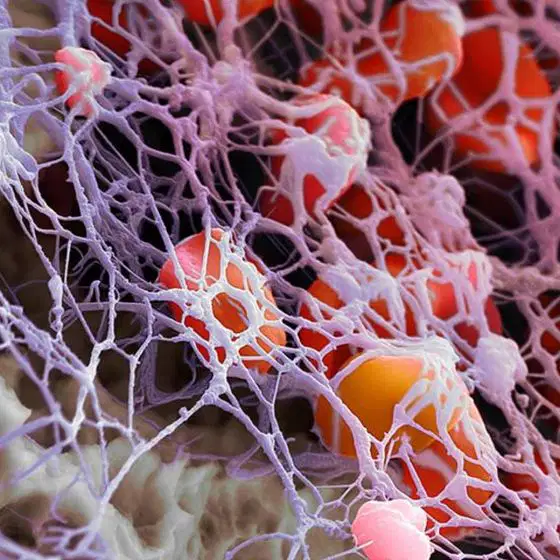
What is the mesh-like substance (i.e. looks like long strings) that is helping trap cells at the site of a blood clot?
prothrombin
thrombin
fibrinogen
fibrin
platelets
Factors VIIa and Thrombin play important roles in blood coagulation. Where are they normally found?
Inside the red blood cells
Inside the platelets
Extracellular space (i.e. plasma)
Which of the following activities of thrombin would lead to less blood coagulation?
Cleavage of F XIII->XIIIa
Cleavage of F XI->XIa
Decreased levels of ATIII
Decreased levels of TFPI
None of the answers
______ cleaves Fibrinogen into Fibrin.
Thrombin
Factor VIIIa
Protein C
Factor XIIIa
Plasmin
_______ cleaves fibrin polymers (after they have already formed) to smaller fragments, including D-dimers.
Thrombin
Plasmin
Factor VIIa
Protein C
Factor XIIIa
_______ is a zymogen.
Prothrombin
Factor VIIIa
Factor XIIIa
TFPI
_______ directly converts "soft" clot to "hard" blood clot?
Thrombin
Protein C
Factor XIIIa
Factor VIIa
Plasmin
When a snake bites a squirrel vs. an adult human, it leads to different effects on blood clotting. Which option best explains how the snake venom would effect the smaller organism, like a squirrel?
Lots of "mini" blood clots; blood remains liquid but unable to form specific blood clots
Massive blood clots; all blood solidifies and is no longer liquid
Which of the following options best describes the role of Vitamin K in blood coagulation?
Prevents association of Thrombin with ATIII
Promotes binding of Ca2+ to proteases
Promotes cell division of platelets
Recruits platelets to site of vascular injury
Promotes association of Thrombin with ATIII
Genetic screening indicates that a patient has a mutation in the gene that encodes for Protein C. The mutation destabilizes Protein C, resulting in its rapid degradation (i.e. lower overall protein levels). Would prescribing blood thinners be an appropriate treatment for this patient?
yes
no
Genetic screening indicates that a patient has a mutation in the gene for factor XIII (13). This mutation results in overall less XIII protein levels. Would prescribing blood thinners be an appropriate treatment for this patient?
yes
no
Upon analysis of a patient's blood sample, you discover that they have high levels of D-dimers. Would prescribing blood thinners be an appropriate treatment for this patient?
yes
no
Genetic screening indicates that a patient has a mutation in the gene that encodes for factor VII. The mutation prevents TFPI from binding to factor VII. Would prescribing blood thinners be an appropriate treatment for this patient?
yes
no
Genetic screening indicates that a patient has a mutation in the gene that encodes for Thrombin. The mutation results in the change of a single amino acid that greatly increases Thrombin's affinity for ATIII. Would prescribing blood thinners be an appropriate treatment for this patient?
yes
no
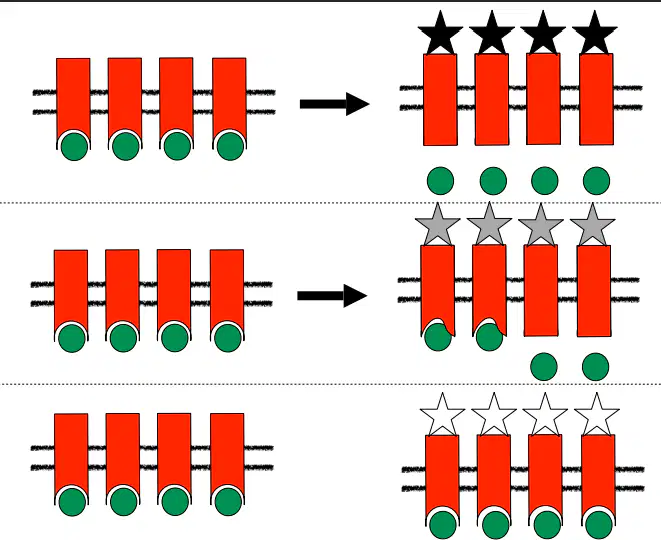
Ligand (stars) bind to GPCR (rectangle), embedded in a lipid bilayer, and an associated G protein (circle) in the cytosol. Which option best highlights the behavior of a ligand that is a full antagonist?
black
grey
white
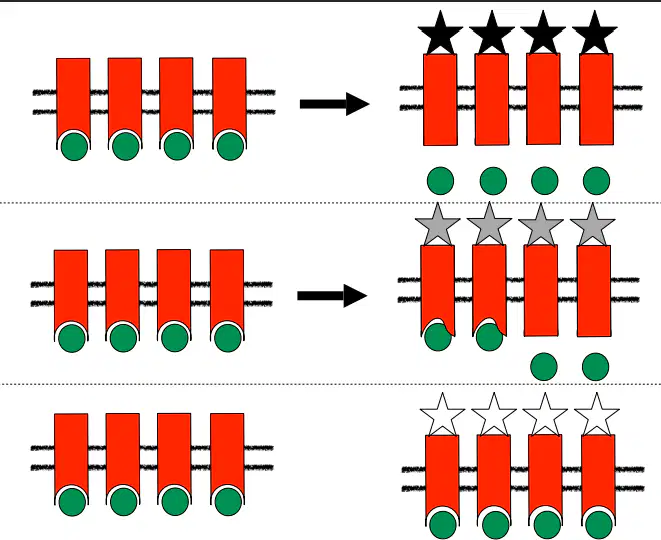
Which option best illustrates binding of Narcan to a GPCR?
black
grey
white
Interacts with βARK to facilitate receptor down-regulation
Gα
Gβγ
GPCR
Adenylyl Cyclase
PKA
Directly synthesizes a secondary messenger
Gα
Gβγ
GPCR
Adenylyl Cyclase
PKA
Interacts with effector proteins to inhibit or stimulate their activity
Gα
Gβγ
GPCR
Adenylyl Cyclase
PKA
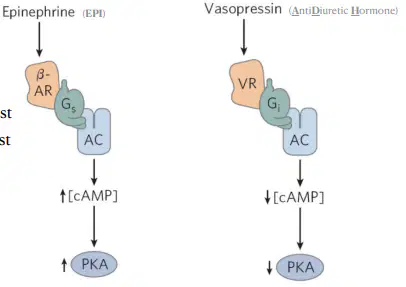
Epinephrine is a/an _______; when it binds to βAR, a G-protein then ______ the effector protein.
agonist; inhibits
agonist, stimulates
antagonist; inhibits
antagonist; stimulates
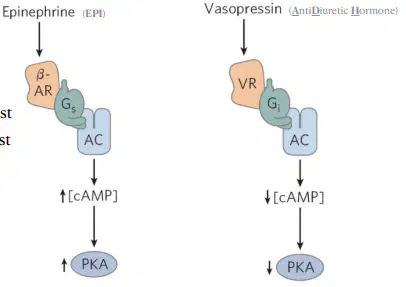
Vasopressin is a/an ______; when it binds to Vasopressin Receptor, a G-protein then ______ the effector protein.
agonist; inhibits
agonist; stimulates
antagonist; inhibits
antagonist; stimulates
Narcan binds to a receptor ________?
A. with a higher affinity than fentanyl
B. with a lower affinity than fentanyl
C. elicits a physiological response due to Gα dissociation from Gβγ
D. Options A & C
E. Options B & C
During activation of a GPCR pathway, ______ is bound to ______?
GTP, Gα
GTP, Gβγ
ATP, Gα
ATP, βγ
GDP, Gα
cAMP binds directly to the ______ subunit of PKA (protein Kinase A), leading to _____ PKA activity?
catalytic (C), increased
catalytic (C), decreased
regulatory (R), increased
catalytic (R), decreased
How does PKA modulate GPCR signaling?
synthesizes cAMP from ATP
degrades cAMP
proteolytically cleaves GPCR
phosphorylates other proteins
recruits βARK, leading to desensitization
True or False. Increased GEF activity results in increased GPCR signaling overall.
True
False
True or False. Increased GAP activity results in decreased GPCR, signaling overall.
True
False
True or False. The active form of Gα always results in increased secondary messenger levels.
True
False
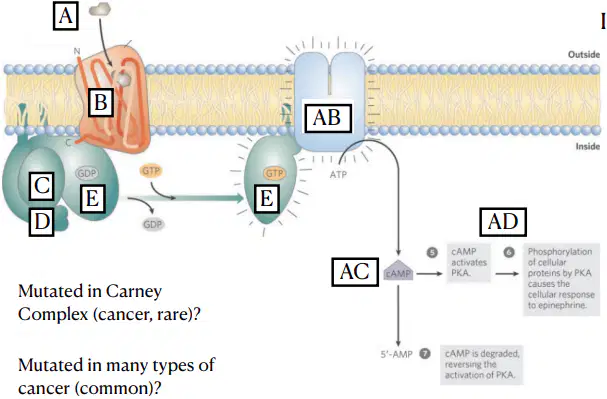
Which letter describes Ras?
A
B
C
D
E
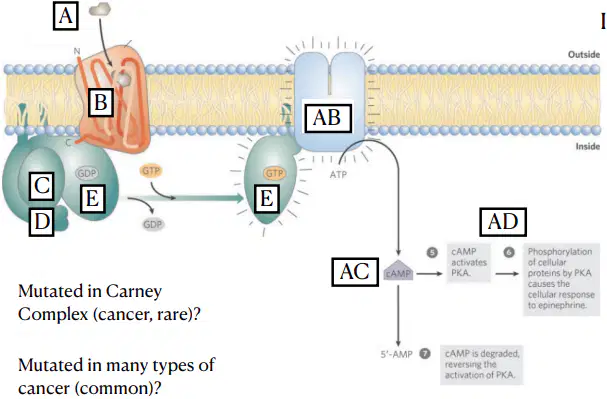
Which letter describes Mutated in Carney Complex?
B
E
AB
AD
AC
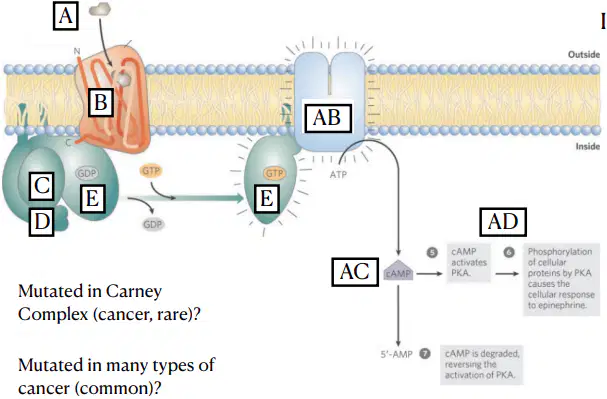
Which letter describes Rhodopsin?
A
B
C
D
E
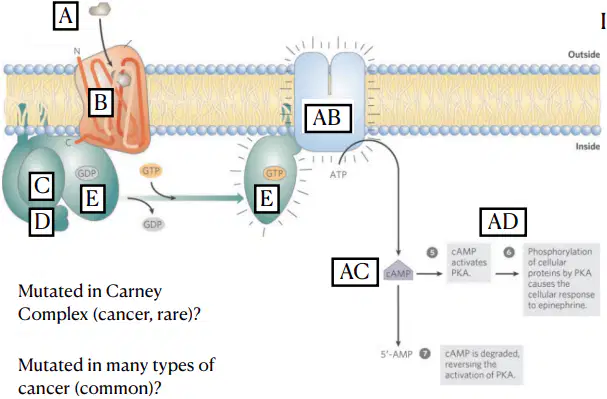
Which letter describes Adenylyl Cyclase?
AB
B
A
C
D

Which letter describes Epinephrine?
A
B
E
AC
AD
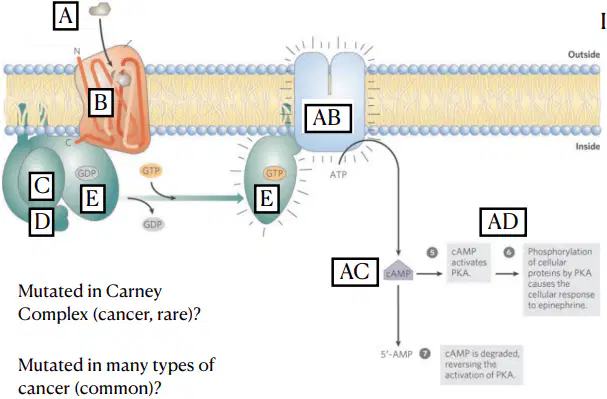
Which letter describes Fentanyl?
A
B
C
D
AB
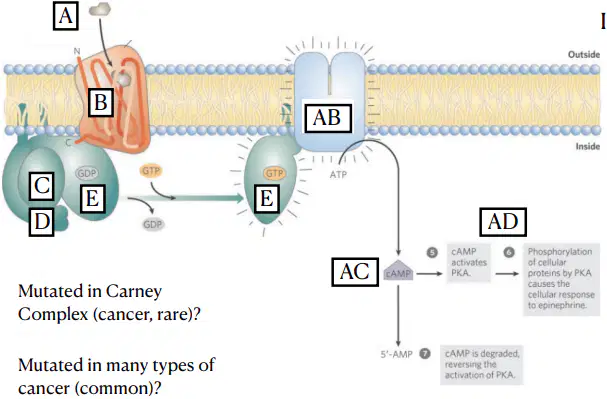
Which letter describes Phosphodiesterase (PDE)?
AC
AD
B
C
D
Which mutation described below in PKA would generally be correlated with increased morbidity associated with cancer due to prolonger GPCR signaling and subsequent cell growth?
Mutation in PKA catalytic subunit results in increased Km, decreased Vmax
Mutation in PKA catalytic subunit results in decreased Kd for interaction with PKA regulatory subunit
Mutation in PKA regulatory subunit that promotes its degradation
Mutation in PKA regulatory subunit that increases Kd for interactions with downstream substrates for cell response
None of the options, all of the options would be correlated with less cell proliferation
True or False. All Gα subunits bind to GTP or GDP and have GTPase activity.
True
False
True or False. All Gα subunits, when bound to GTP, activate effector proteins.
True
False
True or False. Most antagonists prevent physiological responses by binding to agonists and subsequently preventing the agonist from binding to GPCR's.
True
False
Which is a "natural" opioid?
Fentanyl
Naloxone
Buprenorphine
Morphine
Which is a "synthetic" opioid?
Fentanyl
Naloxone
Buprenorphine
Morphine
Binding of which of these to a GPCR would result in MINIMUM dissociation of Gα from G𝛽𝛾
Fentanyl
Naloxone
Buprenorphine
Morphine
Which is a partial agonist?
Fentanyl
Naloxone
Buprenorphine
Morphine
Which is an antagonist?
Fentanyl
Naloxone
Buprenorphine
Morphine
Which is an agonist?
Fentanyl
Naloxone
Buprenorphine
Morphine
Which is used to treat active opioid overdose?
Fentanyl
Naloxone
Buprenorphine
Morphine
Which is used to treat patients in remission (i.e. suffering from withdrawal symptoms)?
Fentanyl
Naloxone
Buprenorphine
Morphine
Which mutation(s) in Ras would be correlated with increased morbidity in cancer patients?
Gα, GTPase activity is increased
Gα, GTPase activity is decreased
Kd for Ras and AC is increased
Kd for Ras and AC is decreased
Which subunit of PKA binds to cAMP?
Regulatory subunit of PKA
Catalytic subunit of PKA
Both the regulatory and catalytic subunit
none of the options; cAMP binds to GPCR's
What does PKA do?
binds to epinephrine
phosphorylates downstream targets
palmitoylates G-proteins
synthesizes secondary messengers
promotes GTP dissociation from G proteins and association of GDP
Which of the following best characterizes the INACTIVE state of PKA?
GDP binds to the catalytic subunit of PKA
cAMP binds to catalytic subunit of PKA
cAMP binds to regulatory subunit of PKA
regulatory subunit of PKA binds to catalytic subunit of PKA
PKA exists in its "full-length" form (i.e. is not yet cleaved)
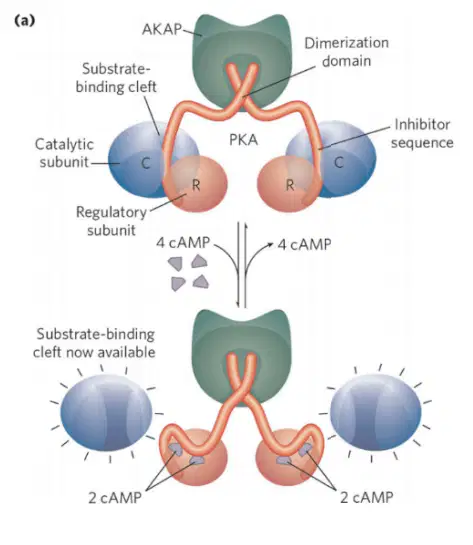
Which mutations would be associated with increased morbidity for patients with Carney syndrome?
Mutation in surface of R that binds C cleft, leading to increased Kd
Mutation in R that causes its unfolding and subsequent rapid degradation
Mutation that prevents cAMP binding
True or False. Ligand binding to all GPCR's results in more secondary messengers being synthesized.
True
False
Which types of mutations(s) in the gene(s) for PKA (R & C subunits) would be more correlated with cancer? Why?
PKA, regulatory subunit has increased affinity for catalytic subunit
PKA, regulatory subunit has decreased affinity for catalytic subunit
PKA, catalytic subunit has decreased Km, but no change in Vmax
PKA, catalytic has decreased Vmax and increased Km
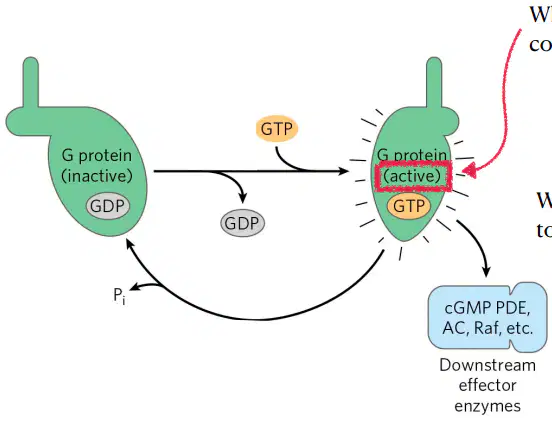
What does the word, "active" mean in the context of the G protein in this figure?
Increased GTPase activity
Increased binding to effectors
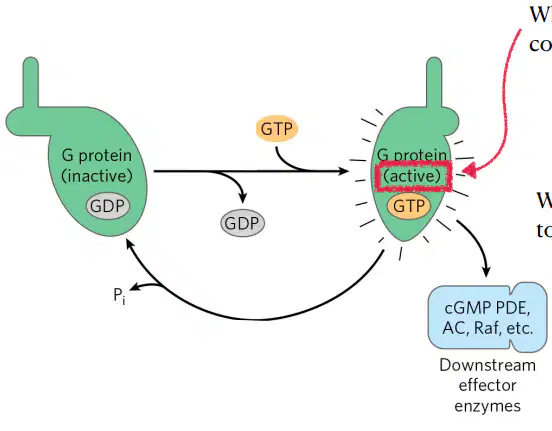
What causes a transition from the "inactive" to "active" form of the G protein?
Phosphorylation of G protein by
β-arrestin (β-AR)
Dephosphorylation of G proteins by β-arrestin (β-AR)
Binding of GDP to G protein
Binding of GTP to G protein
GAPs do which of the following?
Stimulate intrinsic GTPase activity of G proteins
Inhibit intrinsic GTPase activity of G proteins
Promote dissociation of GDP and association of GTP
Promote dissociation of GTP and association of GDP
None of the options
GAPs are ______ of some G protein enzymatic activity.
inhibitors, likely competitive
inhibitors, likely non-competitive, un-competitive, or mixed
inhibitors, likely irreversible
stimulators
none of the options
GAPs directly promote the _____ form _____ G proteins.
active, α
active, βγ
inactive, α
inactive, βγ
none; doesn't directly alter G protein activity
GAPs most directly do which of the following to duration of signaling?
increase duration of signaling initiated by ligand binding to GPCR
decrease duration of signaling initiated by ligand binding to GPCR
increase the diversity of ligands that bind to GPCRs on a cell
decrease the diversity of ligands that bind to GPCRs on a cell
none of the options
GAPs primarily impact _____ of GPCR signaling.
sensitivity
specificity
GEFs do which of the following?
stimulate intrinsic GTPase activity of G proteins
inhibit intrinsic GTPase activity of G proteins
Promote dissociation of GDP and association of GTP
Promote dissociation of GTP and association of GDP
none of the options
GEFs are _____ of some G protein enzymatic activity.
inhibitors, likely competitive
inhibitors, likely non-competitive, un-competitive, or mixed
inhibitors, likely irreversible
stimulators
none of the options
GEFs directly promote the _____ form of ______ G proteins.
active, α
active, βγ
inactive, α
inactive, βγ
none; doesn't directly alter G protein activity
Which binds to GPCR?
antagonist
agonist
both, antagonist and agonist
neither antagonist nor agonist
Which elicits a physiological response?
agonist
antagonist
both, antagonist and agonist
neither antagonist nor agonist

