
 Worksheets
HSPS 25/26 MidTerm Review
Total questions: 121
Worksheet time: 3hrs 59mins
Phase change going from Liquid to Solid...
Melting
Freezing
Condensation
Sublimation
Phase change going from a Gas to a Liquid...
Sublimation
Deposition
Ionization
Condensation
Phase change going from a Liquid to a Gas...
Vaporization
Deposition
Condensation
Melting
Phase change going from a Gas to a Plasma...
Melting
Vaporization
Ionization
Freezing
Phase change going from a Solid to a Gas...
Deposition
Sublimation
Condensation
Recombination
Phase change going from a Solid to a Liquid...
Freezing
Condensation
Melting
Sublimation
Phase change going from a Plasma to a Gas...
Ionization
Recombination
Condensation
Sublimation
Phase change going from a Gas to a Solid...
Deposition
Sublimation
Condensation
Vaporization
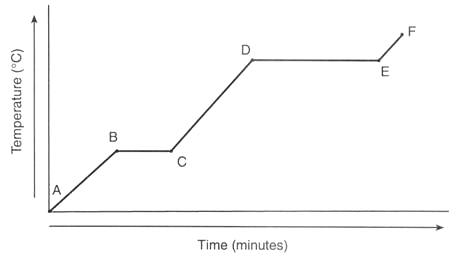
Is the substance gaining or losing energy?
Gaining
Losing
Are the particles moving faster or slower as time goes on?
Faster
Slower
What state/phase is the object likely from points A to B?
Solid
Liquid
Gas
Plasma
What is happening to the particles in the substance between points A and B?
Melting
Freezing
Speeding Up
Slowing Down
What is happening to the particles in the substance between points D and E?
Melting
Freezing
Vaporizing
Sublimating

Is the substance gaining or losing energy?
Gaining
Losing

Where on the graph are phase changes taking place?
1
2
3
4
5
What state/phase is the object likely from points A to B?
Solid
Liquid
Gas
Plasma
What is happening to the particles in the substance between points D and E?
Melting
Freezing
Vaporizing
Sublimating
Where on the graph are phase changes taking place?
1
2
3
4
5
Which statement is true?
Oranges contain Elastic Energy
Food contains Chemical Energy
Phone on the table doesn't contain Gravitational Energy
Radiator contains Nuclear Energy

What type(s) of energy does a fridge contain?
Sound Energy
Thermal Energy
Mechanical Energy
All of the above
Which is Potential Energy?
Radiant Energy
Mechanical Energy
Chemical Energy
Sound Energy
Heat Energy is called:
Radiant Energy
Chemical Energy
Thermal Energy
Mechanical Energy
Energy is found in many different forms, but it can be classified into two distinct categories: kinetic energy and ________________ energy.
electrial
potential
radiant
thermal
When a firecracker explodes, stored chemical energy turns into sound and light energy. What other type of energy is also released?
mechanical
potential
electrical
thermal
Potential energy is energy of position and is also sometimes called ______________ energy.
stored
chemical
radiant
elastic
Elastic Energy is
Kinetic Energy
Potential Energy

Identify the type of energy represented by the illustration.
thermal energy
chemical energy
nuclear energy
elastic energy
Energy is the ability to do work or cause changes.
True
False
Vibrations produce _______ energy.
chemical
sound
potential
light
Objects with a higher temperature have particles that are vibrating _______.
faster
slower
Pushing a filing cabinet across the room is an example of ________ energy.
light
thermal
chemical
mechanical
We receive ________ and heat energy from the Sun.
sound
mechanical
light
kinetic
Which of the following is an example of kinetic energy?
A rock at the top of a hill.
Water falling down a waterfall.
A pencil sitting on a desk.
A backpack on the ground.
______ energy is a type of energy that is released when bonds are broken.
Mechanical
Light
Chemical
Sound

The energy of electrons or electric charges
Chemical
Electric
Mechanical
Kinetic
I use electrical energy and convert it to thermal,what am I?
Fortnite
PC
TV
toaster

Christmas tree lights use what type of energy?
electrical
thermal
mechanical
Advantage or Disadvantage?
Nuclear energy is less harmful and polluting to the environment than other sources of energy.
Advantage
Disadvantage

Advantage or Disadvantage?
Nuclear waste is quite toxic and difficult to dispose of safely.
Advantage
Disadvantage

Advantage or Disadvantage?
Nuclear energy is not renewable, and we will eventually run out of uranium.
Advantage
Disadvantage
Advantage or Disadvantage?
Nuclear power is cheap to generate and is energy efficient.
Advantage
Disadvantage
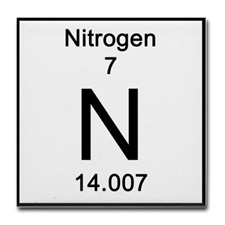


What does the 1.00794 stand for?
Hydrogen
atomic number
atomic mass
atomic explosion
What subatomic particles would you find in the nucleus of an atom?
Protons only
Protons and Neutrons
Neutrons and Electrons
Protons and Electrons
If an atom has 10 protons, 10 neutrons, and 10 electrons, what is the mass of the atom?
10
20
30


Which number here is the atomic number?
5
10.811
Metals (select all that apply)
are found on the right side of the periodic table.
are found on the left side of the periodic table.
are good conductors of heat and electricity.
are brittle.
are malleable and ductile.
Nonmetals (select all that apply)
are found on the right side of the periodic table.
are found on the left side of the periodic table.
are good conductors of heat and electricity.
are brittle.
can be solid, liquids, or gases at room temperature.

Which element is found in group 2, period 6?
Oxygen (O)
Barium (Ba)
Selenium (Se)
Carbon (C)
Which halogen is found in period 4?
Krypton (Kr)
Xenon (Xe)
Bromine (Br)
Iodine (I)
Which element has similar chemical properties as sodium but has 7 energy levels?
Francium (Fr)
Cesium (Cs)
Rubidium (Rb)
Potassium (K)
Elements that have the same number of energy levels are said to be in the same ______.
group
period
family
classification
A row on the Periodic Table of Elements
family
period
row
isotope
A grouping of elements based on similar chemical properties, arranged by columns in the periodic table; also known as a group
family
period
row
isotope
where are the metaloids found
far left, vertical
stair step/diagonal
far right horizontal
at the bottom
What is the name of group number 2?
transition metals
halogens
metaloids
alkaline earth metals
What is the name of group number 1?
halogens
noble gases
alkali metals
alkaline earth metals
In the modern periodic table, elements are arranged in order of ___.
atomic mass
increasing reactivity
increasing atomic number
decreasing atomic number
Why did Mendeleev leave spaces in the table he developed?
he knew more elements would be discovered
he did not know what belonged in those spaces
he wanted the table to look well-designed
he didn't know the names of all the elements
Based on chemical properties, iodine (I) belongs in the same group as ___.
Helium and Neon
Iron and Zinc
Hydrogen and Lithium
Bromine and Chlorine
What are 3 broad classes of elements?
metals, nonmetals, and metalloids
solids, liquids, and gases
small, medium, and large
helium, neon, and argon

The colors in the diagram indicate what?
metalloids -- elements that act like both metals and nonmetals
periods -- elements with electrons in the same level
chemical families -- elements with similar properties

The elements colored yellow are ---
metals
nonmetals
metalloids
periods

The elements colored blue are ---
metals
nonmetals
metalloids
groups
Which element is located in group 3, period 2?
magnesium
boron
scandium
lithium
Which of these elements is a metalloid in period 4?
carbon
titanium
potassium
arsenic
A student inflates a balloon with helium then places it in the freezer. The student should expect
the balloon's volume to increase
the balloon's volume to decrease
the balloon's moles to increase
the balloon's moles to decrease
If a hairspray can is heated, what can be expected of the pressure of the gas inside the can?
The pressure will increase
The pressure will decrease
The pressure will remain constant
The pressure will equalize
Draw your favorite food:)


What Gas Law does this graph represent?
Boyle's Law
Charles' Law
Avagadro's Law
Combined Gas Law
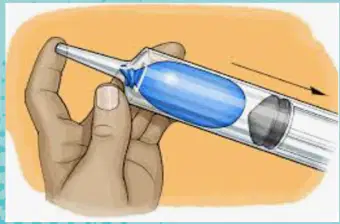
What is the relationship between Pressure and Volume according to Boyle's Law?
They do not have an affect on one another
They have an Inverse Relationship (when one goes up the other goes down)
They have a Direct Relationship (when one goes up the other goes up)
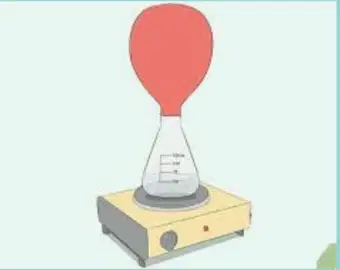
What is the relationship between Temperature and Volume according to Charles' Law?
They have no affect on one another
They have an Inverse Relationship (when one goes up the other goes down)
They have a Direct Relationship (when one goes up the other goes up)
In Boyle's Law, _______ and ________ change, while Temperature remains constant
(a)
In Charles' Law, ________ and Volume change while, ________ remains constant
(a)
How many grams are left after 1 half life?
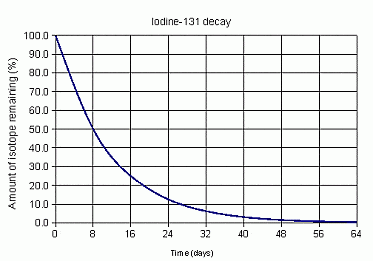
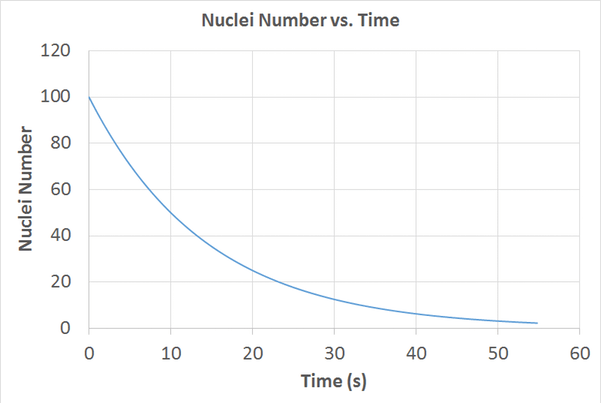
What is the Half life of this isotope?
5 seconds
10 seconds
15 seconds
20 seconds
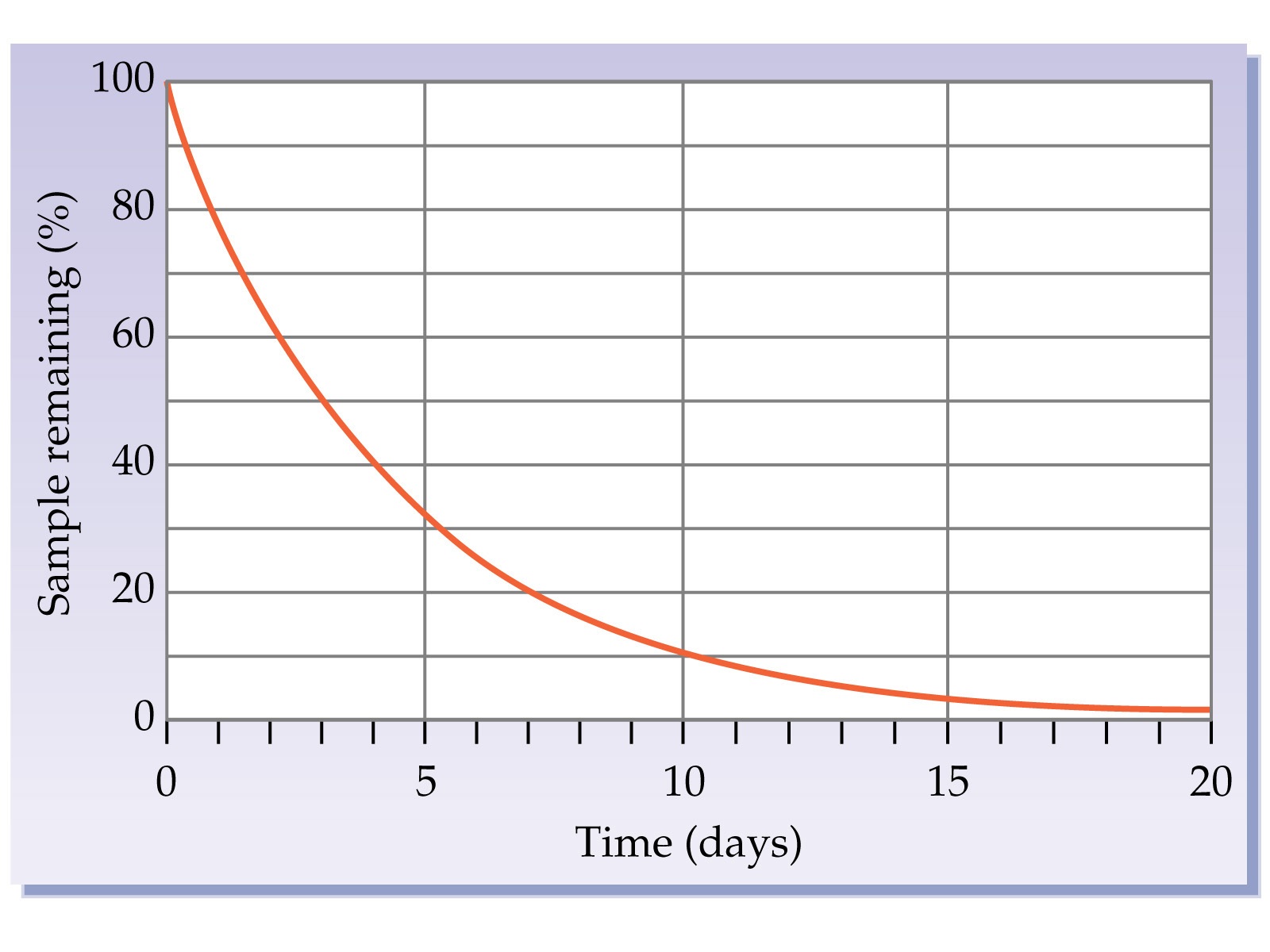
What is the Half Life of this isotope?
3 days
5 days
8 days
10 days
Radioactive carbon-14 is often useful in determining the absolute age of geologic samples because radioactive isotopes
decay at a regular rate
become less stable during decay
remain unchanged over time
stabilize after four half-lives
PCl5 + ___ H2O → ___ HCl + H3PO4
4, 5
1, 6
3, 8
2,2
_SnO2 +_H2-->_Sn +_H2O

Which is the correct Lewis dot structure for the molecule fluorine, F2?
A
B
C
D
Metals form __________, while nonmetals form __________.
Anions, cations
Cations, anions
How many electrons should argon have around its Lewis dot model?
5
6
7
8
Which type of bond is formed by the sharing of electrons?
Ionic
Covalent
Metallic
Which type of bond is present in the molecule LiBr?
Ionic
Covalent
Metallic
Which is the correct Lewis dot structure for ammonia, NH3?


Which Lewis Dot Model drawing correctly shows an O2 molecule?


How are ionic bonds formed?
transfer of electrons
sharing of electrons

Lewis dot diagrams for sodium (Na) and chlorine (Cl) are shown in the attached diagram. Which of the following best describes what will happen with these two elements forming a bond?
Sodium and chlorine will share their valence electrons
Sodium gains seven electrons and chlorine will gain one electron
Sodium will lose one electron and chlorine will gain one electron
Sodium will gain seven electrons and chlorine will lose one electron

Lewis dot diagrams are shown for lithium (Li) and chlorine (Cl) in the attached photo. If these atoms form a bond, what will happen to their electrons?
Lithium will gain one electron and chlorine will lose one electron.
Lithium will lose one electron and chlorine will gain one electron.
Lithium will gain seven electrons and chlorine will lose one electron.
Instead of transferring their electrons, lithium and chlorine will share their electrons so that both atoms may obtain a full valence shell.
What is the Lewis electron dot structure for the covalent compound sulfur dioxide (SO ₂)?


What is the correct Lewis electron-dot structure for the compound magnesium fluoride, (MgF₂)?


H2O has how many covalent bonds?
0
1
2
3

