Wayground logo

Free Printable Worksheets

Font size

S
M
L
XL
Worksheets

AQUATIC SCIENCE MID TERN REVIEW 2025

Total questions: 100

Worksheet time: 1hrs 4mins

Name
Class
Date
1.
Water freezes at what temperature ?
a)
0o F
b)
100o C
c)
32o C
d)
0o C
2.
Water boils at what temperature?
a)
132o  F
b)
212o C
c)
100o C
d)
None of the above
3.
What enables a water strider to stand on the water?
a)
Adhesion
b)
Cohesion
c)
Surface Tension
d)
None of the above
4.
What word describes when water is attracted to other substances?
a)
cohesion
b)
adhesion
c)
capillary action
d)
surface tension
5.
The attraction that causes water and other liquids to form drops on thin films (like wax paper) is called ________________. This is also water’s ability to be attracted to other water molecules.
a)
adhesion
b)
capillary action
c)
cohesion
d)
surface tension
6.
What do you call the land that water flows across, under, and through on its way to a body of water?
a)
Tributary
b)
River system
c)
Headwaters
d)
Watershed
7.
The flow of water from rain, snow melt, or other sources over land.
a)
runoff
b)
drainage
c)
watersheds
d)
aquifer
8.
An area of land where the surface water and ground water drain into a particular body of water.
a)
aquifer
b)
watershed
c)
subsidence
d)
divide
9.
Which of these is an example of precipitation?
a)
snow
b)
air
c)
clouds
d)
vapor
10.
Which best explains why runoff is important?
a)
It returns water to other locations on Earth
b)
It increases the chance of flooding
c)
It makes evaporation occur faster
d)
It increases condensation
11.
What is it called when plants give off water vapor as a waste product?
a)
condensation
b)
evaporation
c)
sublimation
d)
transpiration
12.
What is the water cycle?
a)
the 3 forms of water
b)
the movement of water on, above, or below the surface of the Earth
c)
when water melts
d)
when clouds form
13.
Which of the following statements is true?
a)
Water cannot be recycled.
b)
The Sun is the source of energy for the water cycle.
c)
Water is not a basic need of living things.
d)
The state of matter of water cannot change.
14.
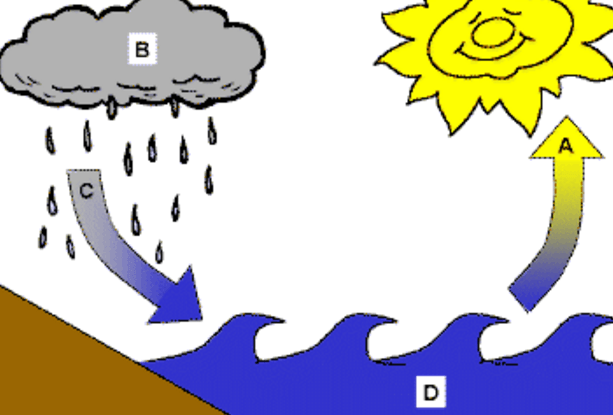
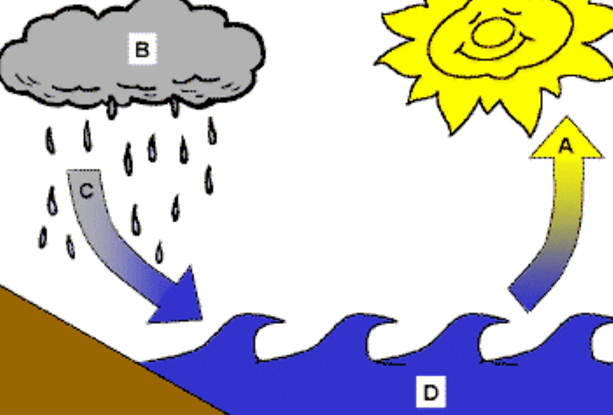
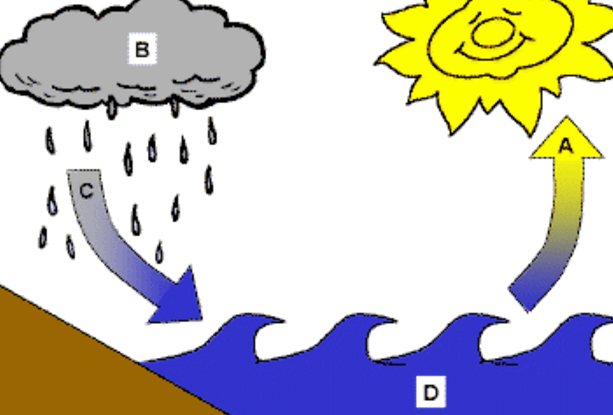
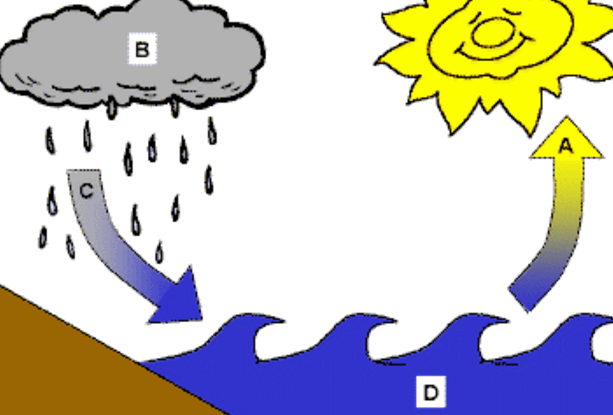
Letter B is representing what part of the water cycle? 
a)
Condenstation
b)
Evaporation
c)
Accumulation 
d)
Precipitation 
15.
Letter C is representing what part of the water cycle? 
a)
Condenstation
b)
Evaporation
c)
Accumulation 
d)
Precipitation 
16.
Letter D is representing what part of the water cycle? 
a)
Condenstation
b)
Evaporation
c)
Accumulation 
d)
Precipitation 
17.
Letter A is representing what part of the water cycle? 
a)
Condenstation
b)
Evaporation
c)
Accumulation 
d)
Precipitation 
18.
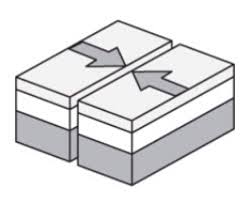
What is the name of the plate boundary that slides past each other?
a)
Divergent
b)
Convergent
c)
Transform
d)
Mr. C the Slide Man
19.
Name the boundary
a)
convergent boundary
b)
divergent boundary
c)
transform boundary
d)
sergent boundary
20.
The area around the pacific plate where boundaries form is called...
a)
death ring
b)
fire zone
c)
ring of fire
d)
zone of fire
21.
What was the name given to all the continents when they were joined as one super continent? 
a)
Supreme Continent
b)
Eurasia
c)
Plate tectonics
d)
Pangaea
22.
The theory of _______ states that Earth’s crust and upper mantle are broken into sections that are in constant, slow motion.
a)
plate tectonics
b)
continental drift
c)
seafloor spreading
d)
divergent boundaries
23.
Warm ocean currents generally come from
a)
The North Pole
b)
The South Pole
c)
The Equator
d)
Both A and B
24.
Cold ocean currents generally come from
a)
The North Pole 
b)
The South Pole
c)
The Equator
d)
Either Pole
25.
The Gulf stream carries _____________ water from the east coast of The United States to the West coast of Europe.
a)
Cold
b)
Warm 
c)
Freezing
d)
Fresh
26.
What name is given to large, destructive waves caused by underwater earthquakes and volcanoes?
a)
Spring tide
b)
Longshore current
c)
Tsunami
d)
Swell
27.
Upwelling is associated with
a)
a decrease in access to nutrients for phytoplankton
b)
cooler, nutrient-rich waters being pushed up from deeper ocean waters
c)
temperature gradients moving water from the equator to the poles
d)
an increase in human fatalities
28.
Ocean currents have an affect on which two things
a)
climate and weather
b)
temperature and density
c)
land and sea
d)
equator and poles
29.
This famous transform fault is located in the western United States creates significant earthquake activity for California
a)
New Madrid
b)
Denali Fault
c)
Ramapo Seismic Zone
d)
San Andreas
30.
Storm with sustained wind speeds of 74+ mph
a)
Thunder storm
b)
Tropical depression
c)
Tropical storm
d)
Hurricane
31.
What is usually the most damaging part of a hurricane?
a)
Eye
b)
Lightning
c)
Storm surge
d)
Hail
32.
A hurricane gets its energy from
a)
Warm ocean waters
b)
high air pressure
c)
winds along surface
d)
Sun
33.
Calmest winds of a hurricane
a)
Eye wall
b)
Eye
c)
Upper elevations
d)
Storm surge
34.
How many categories of hurricanes
a)
2
b)
3
c)
4
d)
5
35.
Where are the highest winds in the hurricane found?
a)
at the extreme outside, because they have to move faster the further they are from the middle
b)
in the center, called the eye of the hurricane
c)
in the storm surge of the hurricane
d)
in the eyewall of the hurricane
36.
What destroys a hurricane? 
a)
Strong vertical winds
b)
Cold water
c)
Movement over land
d)
All of the above
37.
Hurricane season goes from ______ 1st to _______ 30th
a)
June, October
b)
April, September
c)
June, November
d)
May, October
38.
What is the name of a hurricane in Asia?
a)
Cyclone
b)
Typhoon
c)
Bob
d)
Dennis
39.
Which of the following was the deadliest hurricane in recorded history?
a)
Hurricane Ike 2008
b)
Hurricane Harvey 2017
c)
Galveston Hurricane of 1900
d)
Hurricane Katrina 2005
40.
The hurricane that caused the most damages in the US in billions of dollars was
a)
Galveston Hurricane of 1900
b)
Hurricane Ike 2008 at 29 billion
c)
Hurricane Harvey 2017
d)
Hurricane Sandy 2012
41.
Zooxanthelle  are found in 
a)
Kelp
b)
Sand
c)
Coral
d)
Deep Sea Volcanoes
42.
Which level will contain plants?
a)
A
b)
B
c)
C
d)
D
43.
symbiotic relationship in which both organisms benefit
a)
competition
b)
Mutualism
c)
nitrogen fixation
d)
energy pyramid
44.
 A barnacle living on a whales skin..the whale is not harmed or affected
a)
commensalism
b)
mutualism
c)
parasitism
45.
An organism that lives by breaking apart dead organic matter into simpler parts is...
a)
scavenger
b)
consumer
c)
decomposer
d)
carnivore
46.
Autotrophs make up the _______ level in all ecosystems.
a)
First
b)
Second
c)
Third
d)
Fourth
47.
What is made of the skeletons of small animals?
a)
intertidal area
b)
coral reef
c)
estuary
d)
Sargasso Sea
48.
Where have organisms adapted to keep from being swept away?
a)
intertidal area
b)
coral reef
c)
estuary
d)
Sargasso Sea
49.
The ocean floor, some parts of which get no sunlight, is the 
a)
intertidal zone
b)
neritic zone
c)
oceanic zone
d)
benthic zone
50.
The place where the ocean meets the land is the
a)
intertidal zone
b)
neritic zone
c)
oceanic zone
d)
benthic zone
51.
The base of the ocean's food chains is formed by
a)
blue whales
b)
plankton
c)
coral reefs
d)
sargassums
52.
Which factors limit the productivity of a marine ecosystem?
a)
availability of light and nutrients
b)
availability of nutrients and fresh water
c)
availability of light and chemosynthetic organisms
d)
availability of photosynthetic organisms and fresh water
53.
Coral reefs provide
a)
shelter
b)
tourism
c)
protection from storms
d)
all the above
54.
What percent of all the plants and animals in the ocean live around coral reefs?
a)
25 percent
b)
30 percent
c)
50 percent
d)
10 percent
55.
Who causes the most damage to coral reefs?
a)
Whales
b)
Fish
c)
Boats
d)
Humans
56.
What is a tiny individual coral animal?
a)
Polyps
b)
Crevice
c)
Atolls
d)
Erosion
57.
In warm tropical ocean ecosystems, all other life forms depend on which of the following:
a)
Coral
b)
Shrimp
c)
Algae
d)
Bacteria
58.
How many years old can a very mature coral reef be?
a)
15 years old
b)
100 years old
c)
250 years old
d)
1000 years old
59.
What type of organism are corals?
a)
Plants
b)
Animals
c)
Bacteria
d)
Fungi
60.
Which coral-consuming organism has jaws so powerful it can bite through rock?
a)
Parrotfish
b)
King Crab
c)
Polyps
d)
Whale Sharks
61.
Arctic ecosystems are considered marine ecosystems because nearly all the_________ in this area comes from the ocean.
a)
Animals
b)
Food
c)
Snow
d)
Fresh water
62.
In Antartic ecosystems, all animals depend on which species in the food chain? 
a)
Penguins
b)
Polar bears
c)
Krill
d)
Leopard seals
63.

Sunlight and temperature are an examples of ___________ things in an ecosystem

a)

abiotic

b)

biotic

c)

neither

64.

The cleaner shrimp is eating dead food particles and parasites in this fishes mouth. This is the cleaner shrimps

a)

habitat

b)

niche

c)

job

65.

Organisms that cannot make their own food are called _________________

a)

autotrophs

b)

plants

c)

consumers

d)

none

66.

Living parts of an ecosystem are called _________________

a)

biotic

b)

abiotic

c)

neither

67.

Organisms that can make their own food are called ____________

a)

Producer

b)

Consumer

c)

Carnivore

d)

Herbivore

68.

What are benefits of wetlands?

a)

Filters/cleans water

b)

Is habitat for endangered species

c)

Prevent flooding

d)

All of the above

69.

Aquifers, swamps, rivers and marshes are all examples of:

a)

brackish water

b)

lentic systems

c)

freshwater habitats

d)

marine ecosystems

70.

Which of the following is NOT an example of a lentic system?

a)

marsh

b)

lake

c)

river

d)

pond

71.

What is an example of a "nekton"?

a)

Zooplankton

b)

A mollusk

c)

A fish

d)

A barnacle

72.

In which zone is life diverse and abundant?

a)

Littoral zone

b)

Benthic zone

c)

Eutrophic zone

d)

Plankton zone

73.
In a lotic system water is flowing.
a)
True
b)
False
74.

zone 1

a)

benthic

b)

photic

c)

profundal

d)

limnetic

e)

littoral

75.

zone 2

a)

benthic

b)

photic

c)

profundal

d)

limnetic

e)

littoral

76.

zone 5

a)

benthic

b)

photic

c)

profundal

d)

limnetic

e)

littoral

77.

rich in detritus; Scavengers and decomposers live in this zone

a)

benthic zone

b)

limnetic zone

c)

littoral zone

78.

A collection of organisms (living) and nonliving things in an area.

a)

community

b)

species

c)

ecosystem

79.

An individual living thing.

a)

organism

b)

community

c)

biome

80.

A collection of all the different populations (species, living things) that live in one area.

a)

biotic factor

b)

community

c)

biodiversity

81.

This mink skull is a

a)

abiotic factor

b)

biotic factor

82.

The vegetated buffer between streams and the nearby land is called the

a)

Profundal zone

b)

Riparian Zone

c)

Limnetic Zone

83.

The open, sunlit surface area away from the lake shore is which zone?

a)

benthic

b)

bathyal

c)

limnetic

84.

In lakes, the nutrient-rich water near the shore is part of the

a)

benthic zone

b)

littoral zone

c)

abyssal zone

85.

A group of organisms of the same species that live in the same area is called a(n)

a)

community

b)

population

c)

biome

d)

ecosystem

86.

Herbivores are which of the following?

a)

producers

b)

secondary consumers

c)

primary consumers

d)

decomposers

87.

Organisms that feed on dead or decaying mater are called

a)

herbivores

b)

carnivores

c)

omnivores

d)

detritivores

88.

What do all the biotic and abiotic factors in a given area make up?

a)

a community

b)

an ecosystem

c)

a population

89.

Which of the following provide most of the energy in ecosystems?

a)

carnivores

b)

producers

90.

Almost all autotrophs get their energy from

a)

sunlight

b)

decaying matter

c)

producers

91.

This cherry shrimp is a

a)

Decomposer

b)

Producer

c)

Primary Consumer

92.

The clownfish lives in a sea anemone. This is the fishes

a)

habitat

b)

niche 

c)

biosphere

93.

This is a

a)

ecosystem

b)

biosphere

94.

The various species of catfish feedoff mainly detritus off the bottoms of water systems. This is their

a)

niche

b)

habitat

95.

These Thai cave nagel fish live on waterfalls in caves. This is their

a)

niche

b)

habitat

96.

These water striders skating on water are

a)

neuston

b)

benthos

c)

periphyton

97.

This cling fish attached to a rock in this pond is an example of

a)

neuston

b)

periphyton

98.

This kuhli loach is a example of

a)

neuston

b)

benthos

c)

plankton

99.

This green anaconda is an example of a

a)

primary consumer

b)

secondary consumer

c)

tertiary consumer

100.

These Nile crocodiles are also considered

a)

producers

b)

secondary consumers

c)

apex predators