
 Worksheets
Geoscience Review for Exam Questions SM1 -- Dec 2025
Total questions: 125
Worksheet time: 1hrs 3mins
A gas has
a definite volume but no definite shape
a definite shape but no definite volume
no definite shape or definite volume
a definite volume and definite shape

In which of the substances in Figure 3-1 are the forces of attraction among the particles so weak that they can be ignored under ordinary conditions?
Substance A
Substance B
Substance C
all of the above
Forces of attraction limit the motion of particles most in
a solid
a liquid
a gas
both b and c
A hypothesis
can be completely proven
may be disproved by a single experiment
does not have to be tested to be accepted as probably correct
is a proven fact
Hypotheses may arise from
prior knowledge
logical inferences
informed, creative imagination
all of the above
A controlled experiment allows the scientist to isolate and test
a conclusion
a mass of information
several variables
a single variable
The ability to reproduce results is an important part of any
hypothesis
theory
law
experiment
A hypothesis
may be disproved by a single experiment
can be completely proven
does not have to be tested to be accepted as probably correct
is a proven fact
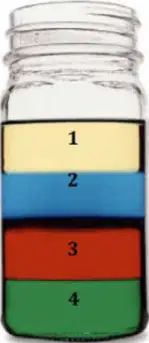
Put the liquids in order from most dense to least dense (refer to the jar image with four horizontal layers labeled 1 at the top through 4 at the bottom).
4,3,2,1
1,2,3,4
4,2,3,1
2,3,4,1
Why do objects sink or float
Because their densities are using gravity to pull down
Because their mass and volumes are equal
Because their densities are higher or lower compared to water
Because their densities are heavier or lighter
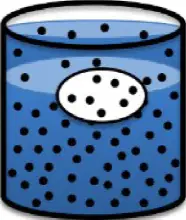
Which statement about the image of fresh water above salt water with an egg suspended between them is correct
the fresh water is more dense than the salt water
The egg is suspended in the middle between the fresh water and the salt water because it is less dense than the salt water, but more dense than the fresh water.
The egg has less volume than the salt water.
The egg is suspended in the middle between the fresh water and the salt water because it is less dense than the fresh water, but more dense than the salt water.
What is the formula for density
density=mass−volume
density=volumemass
density=mass×volume
density=mass+volume
A golf ball has greater density than a tennis ball because it
is lighter than the tennis ball
contains a different kind of matter than the tennis ball
contains more matter than the tennis ball
contains less matter than the tennis ball
What layers of Earth make up the lithosphere?
the crust and lower mantle
the crust and upper mantle
the continental crust and oceanic crust
the upper and lower mantle

What layer of Earth is labeled C in Figure 8-2?
the crust
the asthenosphere
the mantle
the lithosphere

What layer of Earth is labeled E in Figure 8-2?
the continental crust
the lithosphere
the oceanic crust
the mantle

What layer of Earth is labeled B in Figure 8-2?
the continental crust
the lithosphere
the oceanic crust
the mantle

What layer of Earth is labeled B in Figure 8-2?
the lithosphere
the mantle
the continental crust
the oceanic crust

What layer of Earth is labeled C in Figure 8-2?
the lithosphere
the crust
the asthenosphere
the mantle

What layer of Earth is labeled E in Figure 8-2?
the continental crust
the lithosphere
the mantle
the oceanic crust
Earth’s thin, rocky outer layer is its
core
mantle
outer core
crust
The Moho is
the boundary between the outer and inner core
boundary between the crust and the mantle
the material of which the mantle is composed
an area of the mantle that will not transmit seismic waves
Most of the information about Earth’s interior was obtained by studying
seismic waves
rocks of the ocean crust
meteorites
rocks in deep wells
Earth’s core is made of an alloy of
iron and nickel
copper and iron
zinc and magnesium
iron and zinc
Earth’s inner core is solid because of
the composition of its rock
its great diameter
extreme temperatures
immense pressure
The two layers that make up the lithosphere are the
upper mantle and lower mantle
oceanic crust and continental crust
inner core and outer core
crust and upper mantle
The three main layers of Earth’s interior are the
crust, core, and lithosphere
crust, mantle, and core
mantle, inner core, and outer core
crust, mantle, and asthenosphere
Molten rock beneath Earth’s surface is called
magma
tephra
lava
pyroclasts
The layer on which the tectonic plates move is the
lithosphere
asthenosphere
core
crust

In Figure 1-1, what layer of Earth’s geosphere is labeled A?
inner core
outer core
upper mantle
crust

In Figure 1-1, what layer of Earth’s geosphere is labeled C?
crust
upper mantle
lower mantle
outer core
What are the three main parts of the geosphere? (Remember inner and outer ______)
atmosphere, crust, core
crust, mantle, core
lithosphere, mantle, core
asthenosphere, lithosphere, atmosphere
The crust and uppermost mantle make up the rigid outer layer of Earth called the
geosphere
asthenosphere
lithosphere
lower mantle
Earth’s inner core is solid because of
its great diameter
immense pressure
the composition of its rock
extreme temperatures
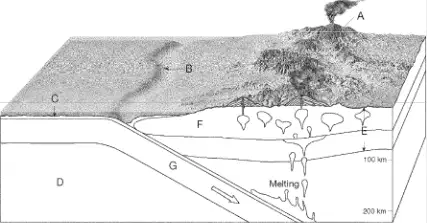
What type of plate boundary is illustrated in Figure 9-1?
convergent oceanic-continental boundary
divergent boundary
transform fault boundary
convergent oceanic-oceanic boundary
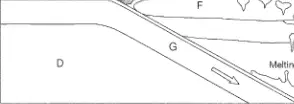
What process is illustrated by the area labeled G in Figure 9-1?
subduction
seafloor spreading
continental volcanism
rifting
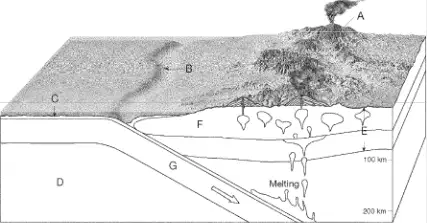
What feature is labeled B in Figure 9-1?
trench
volcanic island arc
continental volcanic arc
ocean ridge
What is a break in a rock mass along which movement occurs?
epicenter
earthquake
fault
fold
The supercontinent in the continental drift hypothesis was called
Panthalassa
Pangaea
Africa
Mesosaurus
Earth’s core is made of an alloy of
iron and nickel
zinc and magnesium
iron and zinc
copper and iron
The Himalayas in South Asia are an example of what type of plate boundary?
convergent continental-continental boundary
divergent boundary
transform fault boundary
convergent oceanic-continental boundary
Earth’s thin, rocky outer layer is its
crust
outer core
core
mantle
The hypothesis that the continents move slowly over Earth’s surface and once were joined into one supercontinent is called
subduction
plate tectonics
sea-floor spreading
continental drift
Why was Wegener’s hypothesis of continental drift originally rejected by geologists?
Wegener could not explain how the continents could move through the ocean floor.
Wegener’s data were incorrect.
Wegener did not have any data to support his hypothesis.
The continents of South America and Africa do not fit well together.
What kind of plate boundary occurs where two plates grind past each other without destroying or producing lithosphere?
transform fault boundary
divergent boundary
convergent boundary
transitional boundary
Wegener’s continental drift hypothesis stated that all the continents once joined together to form
three major supercontinents.
two major supercontinents and three smaller continents.
two major supercontinents.
one major supercontinent.
Evidence that Earth’s core has a high iron content comes from
the study of earthquake waves.
deep wells.
deep-sea drilling.
meteorites.
Deep ocean trenches are associated with
transform fault boundaries.
ocean ridge systems.
subduction zones.
rift zones.
New ocean crust is formed at
convergent boundaries.
divergent boundaries.
transform fault boundaries.
continental volcanic arcs.
The three main layers of Earth’s interior are the
crust, mantle, and asthenosphere.
crust, mantle, and core.
mantle, inner core, and outer core.
crust, core, and lithosphere.
At a transform fault boundary,
new oceanic crust is formed.
lithosphere is neither destroyed nor produced.
new continental crust is formed.
oceanic lithosphere is destroyed.
New ocean crust is formed along
trenches.
mid-ocean ridges.
subduction zones.
mountain belts.
Which of the following results when divergence occurs between two oceanic plates?
an ocean trench
seafloor spreading
a subduction zone
a volcanic island arc
The thermal convection that drives plate motion is caused by
seafloor spreading.
subduction.
an unequal distribution of heat.
gravity.
A fault is
the place on Earth’s surface where structures move during an earthquake.
another name for an earthquake.
a fracture in the Earth where movement has occurred.
a place on Earth where earthquakes cannot occur.
What type of boundary occurs where two plates move together, causing one plate to descend into the mantle beneath the other plate?
divergent boundary
transitional boundary
transform fault boundary
convergent boundary
Volcanic island arcs are associated with what type of plate boundary?
divergent boundary
convergent continental-continental boundary
convergent oceanic-continental boundary
convergent oceanic-oceanic boundary
An earthquake’s epicenter is
the place on the surface directly above the focus.
a spot halfway between the focus and the surface.
the spot below the focus.
any spot along the nearest fault.
When an earthquake occurs, energy radiates in all directions from its source, which is called the
epicenter
focus
fault
seismic center
During an earthquake, the ground surface
moves only in a horizontal direction.
moves only in a vertical direction.
can move in any direction.
does not move.
The adjustments of materials that follow a major earthquake often generate smaller earthquakes called
foreshocks.
surface waves.
aftershocks.
body waves.
Major earthquakes are sometimes preceded by smaller earthquakes called
aftershocks.
focus shocks.
surface waves.
foreshocks.
Which seismic waves travel most rapidly?
P waves
S waves
surface waves
tsunamis
Which seismic waves compress and expand rocks in the direction the waves travel?
P waves
S waves
surface waves
transverse waves
Which of the following is NOT a characteristic of S waves?
They travel more slowly than P waves.
They temporarily change the volume of material by compression and expansion.
They shake particles at right angles to the direction the waves travel.
They cannot be transmitted through water or air.
Overall, which seismic waves are the most destructive?
P waves
S waves
compression waves
surface waves
What is the minimum number of seismic stations that is needed to determine the location of an earthquake’s epicenter?
two
one
four
three
An Earthquake wave travel-time graph can be used to find the
focus of an earthquake.
strength of an earthquake.
damage caused by an earthquake.
distance to the epicenter of an earthquake.
The Richter scale is based on measurements of the ___ of a seismic wave.
speed
frequency
intensity
amplitude
The distance between a seismic station and the earthquake epicenter is determined from the
calculation of the earthquake magnitude.
intensity of the earthquake.
arrival times of P and S waves.
measurement of the amplitude of the surface wave.
An earthquake’s magnitude is a measure of the
size of seismic waves it produces.
amount of shaking it produces.
number of surface waves it produces.
damage it causes.
What instrument records seismic waves?
seismogram
seismograph
Richter scale
barometer
Which of the following affects the amount of destruction caused by earthquake vibrations?
the design of structures
the intensity and duration of the vibrations
the nature of the material on which structures are built
all of the above
Tsunamis are
often generated by movements of the ocean floor.
waves that are produced by tidal forces.
waves that cannot cause damage on land.
also known as tidal waves.
Earthquake waves are called _____.
seismic waves
convergent waves
divergent waves
wave amplitudes
Strike-slip faults are caused by ____ forces.
compression
shear
right angle
tension
A magma’s viscosity is directly related to its
depth
age
color
silica content
A lava flow with a surface of rough, jagged blocks and sharp, angular projections is called a(n)
pyroclastic flow
aa flow
pahoehoe flow
ash flow
Highly explosive volcanoes tend to have what type of magma?
magma with high silica, high viscosity, and higher gas content
magma with low silica, low viscosity, and lower gas content
magma with low silica, high viscosity, and lower gas content
magma with no silica, high viscosity, and no gas content
The particles produced in volcanic eruptions are called
laccoliths
calderas
pyroclastic material
volcanic stocks
Which of the following is NOT considered to be a pyroclastic material?
ash
lapilli
cinders
pahoehoe
What is the most abundant gas associated with volcanic activity?
chlorine
water vapor
sulfur oxide
carbon dioxide
What type of volcano is built almost entirely from ejected lava fragments?
cinder cone
composite cone
shield volcano
pahoehoe volcano
The broad, slightly dome-shaped volcanoes of Hawaii are
composite cone volcanoes
shield volcanoes
pyroclastic volcanoes
cinder cone volcanoes
Which of the following plays a major part in determining the form of a volcano?
elevation above sea level
local soil type
magma composition
nearness of other volcanoes
The most explosive volcanic eruptions are associated with what type of volcano?
cinder cones
shield volcanoes
composite cones
fissure eruptions
A caldera is a
type of volcanic eruption
type of volcano
large depression in a volcano
very large volcanic bomb
The volcanic landform that is formed when the more resistant volcanic pipe remains after most of the cone has been eroded is called a
lahar
caldera
volcanic vent
volcanic neck
Crater Lake in Oregon was produced when
a lava dam blocked a river.
a large explosion blew out the side of a large volcano.
the summit of a volcano collapsed.
a lava flow erupted from a volcano.
How are intrusive igneous bodies classified?
by their size
by their shape
by their relationship to the surrounding rock layers above
all of the above
Magma forms when solid rock in the crust and upper mantle
melts
vaporizes
crystallizes
cools
Which of the following factors affects the melting point of rock?
composition of the material
water content
pressure of the surrounding rock
all of the above
Most shield volcanoes have grown from the ocean floor to form
islands
dikes
tectonic plates
canyons
The volcanic landforms at divergent ocean plate boundaries are
oceanic ridges
volcanic island arcs
continental volcanic arcs
ocean trenches
Most of the active volcanoes on Earth are located in a belt known as the
circum-Atlantic belt
Ring of Fire
Ring of Lava
East African Rift Valley
Most intraplate volcanic activity occurs where
oceanic plates diverge.
hot magma descends into the mantle under a plate.
hot mantle plumes rise toward the surface within a plate.
oceanic and continental plates converge.
The area where magma collects inside a volcano before an eruption is called
a crater.
a caldera.
a vent.
a magma chamber.
What causes the magma inside a volcano to rise toward the surface?
It is a thick liquid, denser than the surrounding rock.
It does not contain dissolved gases.
It is less dense than the surrounding rock.
It is cooler than the surrounding rock.
What determines whether a volcano erupts quietly or explosively?
the size of the volcano
the age of the volcano
the characteristics of the magma
the magnitude of nearby earthquakes
Volcanoes that erupt quietly have what type of magma?
very hot, low-silica magma
high-silica magma
hot, high-silica magma
low temperature magma
Composite volcanoes are produced by
quiet eruptions of lava.
explosive eruptions of lava and ash.
explosive eruptions of ash and cinders.
quiet eruptions that alternate with explosive eruptions.
Which of the following is NOT one of the eight most common elements in Earth's continental crust?
carbon
silicon
oxygen
aluminum
The most abundant element in Earth's continental crust (by weight) is
oxygen
silicon
calcium
iron
What are the building blocks of minerals?
rocks
elements
isotopes
electrons
Which of the following is NOT a characteristic of minerals?
crystalline structure
formed by inorganic processes
definite chemical composition
either liquid or solid
What is a naturally occurring, inorganic solid with an orderly crystalline structure and a definite chemical composition?
a mineral
an element
an isotope
a compound
Why is ice in a glacier considered to be a mineral, but water from a glacier is not?
Water is not naturally occurring.
Water does not have a chemical composition.
Ice is not naturally occurring.
Ice is a solid, but water is not.
The process of mineral formation from magma is called
evaporation
precipitation
crystallization
melting
Mineral formation caused by high pressures and high temperatures would most likely occur in which of the following environments?
a lava flow
the ocean
a cave
deep within Earth
Minerals are classified by
color
composition
size
density
A mineral that contains carbon, oxygen, and the metallic element magnesium would be classified as a(n)
silicate
oxide
carbonate
sulfate
The building block of the silicate minerals is called the
silicon-oxygen tetrahedron.
aluminum-oxygen tetrahedron.
silicon-oxygen triangle.
silicon-aluminum triangle.
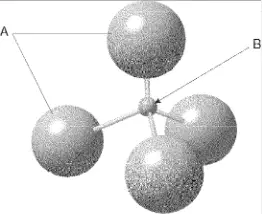
Minerals with the silicon-oxygen structure, shown in Figure 2-1, are classified into what group?
sulfates
oxides
carbonates
silicates
All minerals in the sulfate and sulfide groups contain what element?
silicon
sulfur
oxygen
carbon
The most common mineral group in Earth's crust is the
oxides
carbonates
sulfides
silicates
To which mineral group does orthoclase feldspar ( KAlSi3O8 ) belong?
the oxides
the carbonates
the silicates
the halides
Which of the following properties is generally the least useful in identifying minerals?
hardness
streak
cleavage
color
The appearance or quality of light reflected from the surface of a mineral is called
streak
color
cleavage
luster
The resistance of a mineral to being scratched is called
streak
fracture
hardness
cleavage
The color of the powdered form of a mineral is called
cleavage
streak
luster
fracture
Mohs scale is used to determine what property of minerals?
cleavage
density
hardness
luster
The tendency of minerals to break along smooth flat surfaces is called
fracture
cleavage
streak
crystal form
What is the uneven breakage of a mineral called?
fracture
cleavage
crystal form
hardness
What is the density of a mineral?
the ratio of a mineral's mass to its volume
the ratio of a mineral's height to its weight
a mineral's mass
a mineral's volume
How could you determine if a sample of gold is pure?
Compare the sample's density with that of pure gold.
Compare the sample's color with that of pure gold.
Determine whether the sample is magnetic.
Determine whether the sample will fizz in contact with hydrochloric acid.

