
 Worksheets
Bio Sem Test Part 1
Total questions: 149
Worksheet time: 1hrs 15mins
Flammable materials, like alcohol, should never be dispensed or used near
an open door.
an open flame.
another student.
a sink.
If a laboratory fire erupts, immediately
notify your instructor.
run for the fire extinguisher.
throw water on the fire.
open the windows.
Approved eye protection devices (such as goggles) are worn in the laboratory
to improve your vision.
to avoid eye strain.
only if you don’t have corrective glasses.
any time chemicals, heat or glassware are used.
If you wear contact lenses in the school laboratory,
take them out before starting the lab.
you do not have to wear protective goggles.
advise your science instructor that you wear contact lenses.
keep the information to yourself.
If you do not understand a direction or part of a lab procedure, you should
figure it out as you do the lab.
try several methods until something works.
ask the instructor before proceeding.
skip it and go on to the next part.
After completing an experiment, all chemical wastes should be
left at your lab station for the next class.
disposed of according to your instructor’s directions.
dumped in the sink.
taken home.
If a lab experiment is not completed, you should
discuss the issue with your instructor.
sneak in after school and work alone.
come in during lunch and finish while eating lunch.
make up some results.
You are heating a substance in a test tube. Always point the open end of the tube
toward yourself.
toward your lab partner.
toward another classmate.
away from all people.
You are heating a piece of glass and now want to pick it up. You should
use a rag or paper towels.
pick up the end that looks cooler.
use tongs.
pour cold water on it.
You have been injured in the laboratory (cut, burn, etc.). First you should
visit the school nurse after class.
see a doctor after school.
tell the science instructor at once.
apply first aid yourself.
When gathering glassware and equipment for an experiment, you should
read all directions carefully to know what equipment is necessary.
examine all glassware to check for chips or cracks.
clean any glassware that appears dirty.
all of the above.
You want to place a piece of glass tubing into a rubber stopper after the tubing has been fire polished and cooled. This is best done by
lubricating the tubing with water or glycerin.
using a towel or cotton gloves for protection.
twisting the tubing and stopper carefully.
all of the above.
Personal eyeglasses provide as much protection as
a face shield.
safety glasses.
splashproof chemical goggles.
none of the above.
Long hair in the laboratory must be
cut short.
held away from the experiment with one hand.
always neatly groomed.
tied back or kept entirely out of the way with a hair band, hairpins, or other confining device.
In a laboratory, the following should not be worn
loose clothing.
dangling jewelry.
sandals.
all of the above.
The following footwear is best in the laboratory
sandals.
open-toed shoes.
closed-toed shoes.
shoes appropriate for the weather.
Horseplay or practical jokes in the laboratory are
always against the rules.
okay.
not dangerous.
okay if you are working alone.
If a piece of equipment is not working properly, stop, turn it off, and tell
the custodian.
your lab partner.
your best friend in the class.
the science instructor.
If an acid is splashed on your skin, wash at once with
soap.
oil.
weak base.
plenty of water.
When you finish working with chemicals, biological specimens, and other lab substances, always
treat your hands with skin lotion.
wash your hands thoroughly with soap and water.
wipe your hands on a towel.
wipe your hands on your clothes.

The diagram instruction says: Draw a diagram of your science room and label the locations of safety equipment. Which items must be labeled according to the instruction? Select all that apply.
Fire Blanket
Fire Extinguisher(s)
Exits
Eyewash Station
Emergency Shower
Hot glass looks the same as cold glass.
True
False
All chemicals in the lab are to be considered dangerous.
True
False
Return all unused chemicals to their original containers.
True
False
Work areas should be kept clean and tidy.
True
False
Pipets are used to measure and dispense small amounts of liquids. You should draw the liquid into the pipet using your mouth.
True
False
Laboratory work can be started immediately upon entering the laboratory even if the instructor is not yet present.
True
False
Never remove chemicals or other equipment from the laboratory.
True
False
Chipped or cracked glassware is okay to use.
True
False
Read all procedures thoroughly before entering the laboratory.
True
False
All unauthorized experiments are prohibited.
True
False
You are allowed to enter the chemical preparation/storage area any time you need to get an item.
True
False
Laboratory aprons should be worn during all lab activities.
True
False
It’s okay to pick up broken glass with your bare hands as long as the glass is placed in the trash.
True
False
Never leave a lit burner unattended.
True
False
Multiple Choice. Identify the choice that best completes the statement or answers the question. Which of the following is NOT a goal of science?
to investigate and understand the natural world
to explain events in the natural world
to establish a collection of unchanging truths
to use derived explanations to make useful predictions
Multiple Choice. Identify the choice that best completes the statement or answers the question. Science differs from other disciplines, such as history and the arts, because science relies on
facts.
testing explanations.
observations.
theories.
Multiple Choice. Identify the choice that best completes the statement or answers the question. The work of scientists usually begins with
testing a hypothesis.
careful observations.
creating experiments.
drawing conclusions.
Multiple Choice. Identify the choice that best completes the statement or answers the question. Information gathered from observing a plant grow 3 cm over a two-week period is called
inferences.
variables.
hypotheses.
data.
Multiple Choice. Identify the choice that best completes the statement or answers the question. Based on your observations, you suggest that the presence of water could accelerate the growth of bread mold. This is
a conclusion.
a hypothesis.
an experiment.
an analysis.
Multiple Choice. Identify the choice that best completes the statement or answers the question. A scientific hypothesis
can be based on personal beliefs or opinions.
can be tested by experiments or observations.
does not have to be tested to be accepted as correct.
is a proven fact with much evidence to support it.
Multiple Choice. Identify the choice that best completes the statement or answers the question. During a controlled experiment, a scientist isolates and tests
a conclusion.
a mass of information.
a control group.
a single variable.
Multiple Choice. Identify the choice that best completes the statement or answers the question. What does a reviewer do during peer-review?
Focus on mistakes in spelling.
Change data to support results.
Check for mistakes and bias.
Repeat the experiments in the article.
Multiple Choice. Identify the choice that best completes the statement or answers the question. How do scientific theories compare to hypotheses?
Theories are the same as hypotheses.
Theories unify a broad range of observations and hypotheses.
Hypotheses combine the ideas of several theories to explain events.
Hypotheses are the dominant view among scientists.
Multiple Choice. Identify the choice that best completes the statement or answers the question. A well-tested explanation that explains a lot of observations is
a hypothesis.
an inference.
a theory.
a controlled experiment.
Multiple Choice. Identify the choice that best completes the statement or answers the question. Which of the following is NOT a characteristic of all living things?
growth and development
ability to move
response to the environment
ability to reproduce
Multiple Choice. Identify the choice that best completes the statement or answers the question. Which of the following characteristics of living things best explains why some North American birds fly south for the winter?
Living things respond to their environment.
Living things maintain internal balance.
Living things are made up of units called cells.
Living things are based on a universal genetic code.
Multiple Choice. Identify the choice that best completes the statement or answers the question. Cells in multicellular organisms have many different sizes and shapes. These differences in cells is called cell specialization. Cell specialization allows cells to
reproduce.
perform different functions.
respond to their environment.
be less complex.
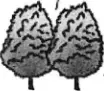
Multiple Choice. Identify the choice that best completes the statement or answers the question. Figure 1–1 illustrates which characteristic of living things?
Living things grow and develop
Living things are made up of cells.
Living things need material and energy.
Living things reproduce.
Multiple Choice. Identify the choice that best completes the statement or answers the question. The process by which organisms keep everything inside their bodies stable is called
homeostasis.
evolution.
metabolism.
photosynthesis.
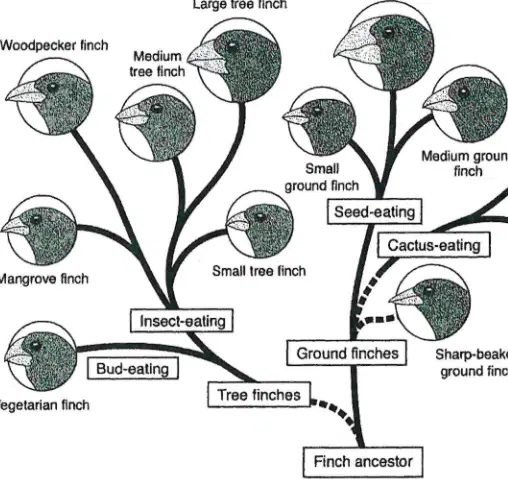
Multiple Choice. Identify the choice that best completes the statement or answers the question. Figure 1–2 shows that tree finches and ground finches are descended from a common ancestor. This example represents which big idea in biology?
interdependence in nature
growth, development, and reproduction
homeostasis
evolution
Multiple Choice. Identify the choice that best completes the statement or answers the question. A scientist working in which area of biology is MOST likely to study DNA?
information and heredity
cellular basis of life
matter and energy
interdependence in nature
Multiple Choice. Identify the choice that best completes the statement or answers the question. What are the smallest objects that biologists study?
cells
body organs
molecules
organisms
Multiple Choice. Identify the choice that best completes the statement or answers the question. The basic unit of length in the metric system is the
gram.
liter.
yard.
meter.
Multiple Choice. Identify the choice that best completes the statement or answers the question. How many meters are in 2.4 km?
240
2,400
24,000
240,000
Multiple Choice. Identify the choice that best completes the statement or answers the question. The standard or English system of measurement uses units such as yards, miles, quarts, and gallons. The metric system uses units such as meters, kilometers, milliliters, and liters. Why is the metric system easier to use than the English system?
Metric units are easier to measure than English units.
The metric system is based on multiples of 10.
The metric system is used by everyone in the world.
Metric units are smaller than English units.
Multiple Choice. Identify the choice that best completes the statement or answers the question. Constructing a graph is an example of which one of the following?
forming a hypothesis
organizing data
making a prediction
observations
Multiple Choice. Identify the choice that best completes the statement or answers the question. The ability of the microscope to show the image very clearly is called:
enlargement
resolution
magnification
clarification
Multiple Choice. Identify the choice that best completes the statement or answers the question. The type of organism consists of a group of cells, but there is no relationship between the cells.
unicellular
multicellular
colonial
specialized
Multiple Choice. Identify the choice that best completes the statement or answers the question. A short segment of DNA that contains instructions for the development of a single trait in an organism is known as a:
DNA loop
gene
membrane
asexual reproduction
Multiple Choice. Identify the choice that best completes the statement or answers the question. Prior to the 17th century, some scientists believed that life could arise from non-living objects. This is known as:
asexual reproduction
biogenesis
differentiation
spontaneous generation
Multiple Choice. Identify the choice that best completes the statement or answers the question. If a student is using a microscope with a 6X ocular and a 10X objective, a 20X objective, and a 40X objective, what is the HIGHEST magnification he can get?
48x
60x
240x
400x
Multiple Choice—Identify the choice that best completes the statement or answers the question. Atoms are composed of
protons with a positive charge.
neutrons with no charge.
electrons with a negative charge.
All of the above
Multiple Choice—Identify the choice that best completes the statement or answers the question. The smallest particle of carbon that can retain the chemical properties of carbon is
a carbon molecule.
a carbon macromolecule.
a carbon atom.
the nucleus of a carbon atom.
Multiple Choice—Identify the choice that best completes the statement or answers the question. A substance that is composed of only one type of atom is called a(n)
nucleus.
cell.
element.
molecule.
Multiple Choice—Identify the choice that best completes the statement or answers the question. All matter in the universe is composed of
cells.
molecules.
atoms.
carbon.
Multiple Choice—Identify the choice that best completes the statement or answers the question. The electrons of an atom
are found in the nucleus along with the protons.
orbit the nucleus in various energy levels.
have a positive charge.
are attracted to the positive charge of protons.
Multiple Choice—Identify the choice that best completes the statement or answers the question. Atoms that have gained energy
have gained energy.
lose protons and neutrons that move farther apart.
lose neutrons from the nucleus.
have electrons that move to higher energy levels.
Multiple Choice—Identify the choice that best completes the statement or answers the question. Because carbon has four electrons in its outer energy level,
it can form bonds with carbon atoms only.
these atoms are naturally chemically stable.
it can react with up to four other atoms.
it cannot react with up to four other atoms.
Multiple Choice—Identify the choice that best completes the statement or answers the question. An atom that has gained or lost electrons is called a(n)
molecule.
nucleon.
ion.
element.
Refer to the graph above showing Amount of energy on the vertical axis and reaction progress with three curves labeled Reaction 1, Reaction 2, and Reaction 3 starting from X; Reaction 1 and Reaction 2 end at Z with higher energy than X, and Reaction 3 ends at Y with lower energy than X. Reaction 1 in the graph
is an energy-storing reaction.
requires a greater activation energy than reaction 2.
may use the same initial reactant condition needed to form product Y.
All of the above
Refer to the graph above showing Amount of energy on the vertical axis and reaction progress with three curves labeled Reaction 1, Reaction 2, and Reaction 3 starting from X; Reaction 1 and Reaction 2 end at Z with higher energy than X, and Reaction 3 ends at Y with lower energy than X. Reaction 3 in the graph
probably occurred in the presence of a catalyst.
requires a greater activation energy than reaction 2.
is the same as reaction 1, but faster.
takes longer than reaction 2.
Refer to the graph above showing Amount of energy on the vertical axis and reaction progress with three curves labeled Reaction 1, Reaction 2, and Reaction 3 starting from X; Reaction 1 and Reaction 2 end at Z with higher energy than X, and Reaction 3 ends at Y with lower energy than X. Which of these statements regarding the graph is true?
Reaction 2 occurs faster than reaction 3 because reaction 2 requires more energy than reaction 3.
The difference in the graphs shown for reaction 2 and reaction 3 is due to a difference in the activation energy needed for these reactions.
Reactant X contains more energy at the beginning of the reaction than product Z has after the reaction.
All of the above
Enzymes
are able to heat up molecules so that they can react.
provide CO2 for chemical reactions.
are biological catalysts.
absorb excess heat so that reactions occur at low temperatures.
A solution with a pH of 11 is
acidic.
alkaline.
neutral.
a buffer.
Acidic solutions have a pH that is
less than 7.
between 0 and 14.
a negative number.
more than 7.
A water molecule is polar because its hydrogen and oxygen atoms
both lose electrons.
become ions.
both gain electrons.
do not share the electrons equally.
Polar molecules such as water have
no negative or positive poles.
both negative and positive poles.
only a negative pole.
only a positive pole.
Water is a polar molecule because
it contains two hydrogen atoms for each oxygen atom.
it has a charge.
different parts of the molecule have slightly different charges.
it does not have a charge.
Water molecules break up other polar substances
such as salts.
because of salts.
because of the uneven charge distribution that exists in water molecules, thus freeing ions in these substances for use by the body.
All of the above
All organic compounds contain the element
C.
N.
Ca.
Na.
Which of the following is a carbohydrate?
DNA
insulin
wax
sucrose
Which organic molecule below is classified as a carbohydrate?
amino acid
CH2 chain
nucleotide
sugar
Animals store glucose in the form of
cellulose.
glycogen.
wax.
lipids.
Polysaccharides are
carbohydrates.
lipids.
proteins.
unsaturated fats.
All of the following are examples of carbohydrates except
sugar.
cellulose.
steroids.
glycogen.
Amino acids are monomers of
disaccharides.
proteins.
nucleotides.
steroids.
Which organic molecule below is most closely related to proteins?
amino acids
CH2 chains
nucleotides
sugars
Refer to the illustration above of Molecule 1 (a ringed sugar structure) and Molecule 2 (a long chain with many hydrogens). Molecules like molecule 2 are found in
carbohydrates.
lipids.
nucleic acids.
proteins.
Lipids are
polar molecules.
similar to water molecules.
protein molecules.
nonpolar molecules.
All of the following are examples of lipids except
saturated fats.
starch.
cholesterol.
earwax.
Lipids are soluble in
water.
salt water.
oil.
All of the above
Nucleic acids include
chlorophyll and retinal.
DNA and RNA.
lipids and sugars.
glucose and glycogen.
Energy is released when the bond between
carbon atoms in ATP is broken.
ribose and adenine in ATP is broken.
phosphate groups in ATP is broken.
two ATP molecules is broken.
Without enzymes, the chemical reactions in the body would
happen too fast.
occur at much the same rate as they do with enzymes.
require a different pH.
occur too slowly to support life processes.
Carbon atoms can bond together to form all of the following except
ring structures.
inorganic structures.
straight chain structures.
branched structures.
The development of an embryonic stem cell into a nerve, muscle, skin, or blood cell is called
homeostasis
metabolism
differentiation
evolution
Which of the following makes up a molecule of water?
one atom of hydrogen and one atom of oxygen
one atom of sodium and one atom of oxygen
one atom of hydrogen and one atom of chlorine
two atoms of hydrogen and one atom of oxygen
A covalent bond is formed as the result of
transferring electrons.
sharing electrons.
transferring protons.
sharing protons.
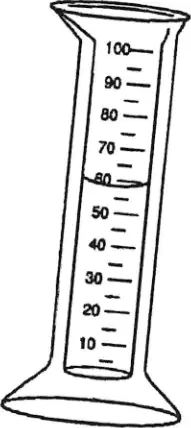
Which property of water causes the curved surface shown in Figure 2–1?
pH
cohesion
adhesion
heat capacity
Water molecules are polar, with the
oxygen side being slightly positive and the hydrogen side being slightly negative.
oxygen and hydrogen sides being slightly positive.
oxygen and hydrogen sides being slightly negative.
oxygen side being slightly negative and the hydrogen side being slightly positive.
In a water molecule, shared electrons spend more time around the oxygen atom than the hydrogen atoms. As a result, the oxygen atom is
slightly negative.
very negative.
slightly positive.
very positive.
A solution is
a combination of isotopes.
a chemical reaction.
a mixture in which the substances are evenly spread out.
a mixture in which undissolved substances do not settle out.
If you stir salt into boiling water, you produce a
mixture called a suspension.
mixture called a solution.
solution and suspension.
mixture only.
When salt is dissolved in water, water is the
reactant.
solution.
solute.
solvent.
If the pH of stomach acid and of oven cleaner were measured,
both would be below 7.
both would be above 7.
the pH of stomach acid would be below 7, but the pH of oven cleaner would be below 7.
the pH of stomach acid would be below 7, but the pH of oven cleaner would be above 7.
A map of eastern North America, showing the pH of rainfall in the various states, indicates that the pH of rain in New York State varies from 4.22 to 4.40. According to these figures, the most acidic rainfall in New York State has a pH of
4.22.
4.30.
4.35.
4.40.
A substance with a pH of 6 is called
an acid.
a base.
water.
a suspension.
Solutions that have more OH− than H+ ions are
reactants.
acids.
bases.
enzymes.
When hydrogen and oxygen combine to form water, water is
a product.
a reactant.
an enzyme.
a catalyst.
Identify the reactant(s) in the chemical reaction, CO2 + H2O → H2CO3.
CO2, H2O, and H2CO3
CO2 and H2O
H2CO3
CO2
The energy needed to get a reaction started is the
adhesion energy.
activation energy.
cohesion energy.
chemical energy.
Which of the following statements about enzymes is NOT true?
Enzymes work best at a specified pH.
All enzymes have the same shape as their substrates.
Enzymes are proteins.
The shape of an enzyme allows it to do its job.
Which of the following statements is true about catalysts?
Catalysts slow down the rate of chemical reactions.
All catalysts are enzymes.
Catalysts are used up during a chemical reaction.
Catalysts lower the activation energy of a chemical reaction.
Enzymes affect the reactions in living cells by changing the
products of the reaction.
speed of the reaction.
temperature of the reaction.
pH of the reaction.
Which of the following is NOT a goal of science?
to investigate and understand the natural world
to explain events in the natural world
to establish a collection of unchanging truths
to use derived explanations to make useful predictions
Which of the following is NOT a characteristic of all living things?
growth and development
ability to move
response to the environment
ability to reproduce
Which of the following characteristics of living things best explains why some North American birds fly south for the winter?
Living things respond to their environment.
Living things maintain internal balance.
Living things are made up of units called cells.
Living things are based on a universal genetic code.
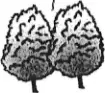
Figure 1-1 illustrates which characteristic of living things?
Living things grow and develop.
Living things are made up of cells.
Living things need material and energy.
Living things reproduce.
The process by which organisms keep everything inside their bodies within certain limits is called
homeostasis.
evolution.
metabolism.
photosynthesis.
What are the smallest objects that biologists study?
cells
body organs
molecules
organisms
The three particles that make up atoms are
protons, neutrons, and isotopes.
neutrons, isotopes, and electrons.
positives, negatives, and neutrals.
protons, neutrons, and electrons.
While preparing a cell culture, a scientist places a colony of bacteria into distilled water and stirs it up. This mixture of water and living cells would best be called
a solution.
a suspension.
a buffer.
an adhesion.
The branch of biology dealing with interactions among organisms and between organisms and their environment is called
economy.
modeling.
recycling.
ecology.
Which of the following descriptions about the organization of an ecosystem is correct?
Communities make up species, which make up populations.
Populations make up species, which make up populations.
Species make up communities, which make up populations.
Species make up populations, which make up communities.
The simplest grouping of more than one kind of organism in the biosphere is
a population.
a community.
an ecosystem.
a species.
The lowest level of environmental complexity that includes living and nonliving factors is the
biome.
community.
ecosystem.
biosphere.
Plants are
primary producers.
primary consumers.
herbivores.
omnivores.
The algae at the beginning of the food chain in Figure 3-1 are
primary consumers.
decomposers.
primary producers.
heterotrophs.
How do most primary producers make their own food?
by using light energy to make carbohydrates
by using chemical energy to make carbohydrates
by changing water into carbon dioxide
by breaking down remains to make carbon dioxide
Which of the following organisms does NOT require sunlight to live?
chemosynthetic bacteria
algae
trees
photosynthetic bacteria
In what way are herbivores and carnivores alike?
They both use photosynthesis to make their own food.
They both obtain energy by consuming other organisms.
They both directly consume producers.
They both are considered to be autotrophs.
The total amount of living tissue within a given trophic level is called the
organic mass
trophic mass
energy mass
biomass
A model of the complex feeding interactions among organisms in a community from producers to decomposers is called a
food web
ecosystem
food chain
population
What animals eat both producers and consumers?
herbivores
omnivores
chemotrophs
autotrophs
What is the term for each step in the transfer of energy and matter within a food web?
energy path
food chain
trophic level
food pyramid
A bird stalks, kills, and then eats an insect. Based on its behavior, which pair of ecological terms describes the bird?
herbivore, decomposer
producer, heterotroph
carnivore, consumer
autotroph, herbivore
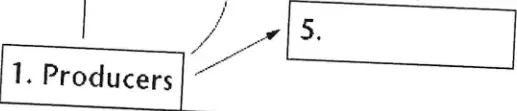
What goes in Box 5 of the food web in Figure 3–2?
herbivores
scavengers
carnivores
decomposers
Only 10 percent of the energy stored in an organism can be passed on to the next trophic level. Of the remaining energy, some is used for the organism’s life processes, and the rest is
used in reproduction
stored as body tissue
stored as fat
eliminated as heat
Matter can recycle through the biosphere because
matter does not change into new compounds.
matter is assembled into chemical compounds.
biological systems do not use up matter, they transform it.
biological systems use only carbon, oxygen, hydrogen, and nitrogen.
The repeated movement of water between Earth’s surface and the atmosphere is called
the water cycle
the condensation cycle
precipitation
evaporation
Carbon cycles through the biosphere in all of the following processes EXCEPT
photosynthesis
transpiration
burning of fossil fuels
decomposition of plants and animals
Nitrogen fixation is carried out primarily by
humans
plants
bacteria
consumers
The movements of energy and nutrients through living systems are different because
energy flows in one direction, and nutrients recycle.
energy is limited in the biosphere, and nutrients are always available.
nutrients flow in one direction, and energy recycles.
energy forms chemical compounds, and nutrients are lost as heat.
Animals that get energy by eating the carcasses of other animals that have been killed by predators or have died of natural causes are called
scavengers
omnivores
heterotrophs
detritivores
Which of the following is true about phosphorus?
Phosphorus is found primarily in the atmosphere.
Phosphorus is an important component of RNA and DNA.
Phosphorus can be "fixed" by lightning.
Phosphorus is released into the air when animals exhale carbon dioxide.
Each of the following is an abiotic factor in the environment EXCEPT
plant life
soil type
rainfall
temperature
Which is a biotic factor that affects the size of a population in a specific ecosystem?
average temperature of the ecosystem
type of soil in the ecosystem
number and kinds of predators in the ecosystem
concentration of oxygen in the ecosystem
What is at the base of all ecological pyramids?
consumers
decomposers
producers
scavengers

