
 Worksheets
POE Exam Review - 2025
Total questions: 90
Worksheet time: 3hrs 37mins
The fixed point around which a lever rotates is know as the
wheel.
fulcrum.
input force.
output force.
Which of the following is NOT an example of the simple machine know as a screw?
lid of a jar
turning on and off a faucet
a drill bit
a screw driver
How can simple machines make work easier?
by decreasing the force needed to complete the task
by increasing the friction between the machine and the object
by adding more work on the object than originally applied
by removing the force of gravity on the object
Which simple machine would be the MOST efficient for lifting an object 30 meters off the ground?
pulley
screw
wedge
lever
Which machine could be considered to be a type of inclined plane?
wheel and axle
lever
screw
pulley
A doorknob is a simple machine made up of 2 circular objects of different sizes. When turning a doorknob, what type of simple machine is being used?
inclined plane
wheel and axle
wedge
pulley
Workers push a heavy box up an inclined plane and onto a moving truck. Which best explains why these workers use an inclined plane?
It makes their work easier because it requires less effort.
It decreases the amount of work they have to do.
It increases the amount of friction necessary to do the task.
It makes the box weigh less.
A house uses a roof to carry away large amounts of rain efficiently. A roof composed of 2 attached inclined planes would be considered which type of simple machine?
wedge
screw
ramp
lever
Using the back of a hammer makes it much easier to remove a nail from a wooden board. What kind of simple machine would the hammer be classified as if you are using it for this purpose?
Wedge
Lever
Pullye
Inclined Plane

Identify the simple machine in the picture.
Wheel and axle
Inclined plane
Lever
Wedge

Identify the simple machine in the picture.
Inclined plane
Wedge
Pulley
Screw

Identify the simple machine in the picture.
Inclined plane
Wedge
Lever
Screw

A door knob would be an example of which type of simple machine?
Pulley
Wheel and axle
Screw
Inclined plane

A crane would be an example of which type of simple machine?
Wedge
Wheel and axle
Pulley
Lever

A simple machine makes work easier by doing which of the following?
Increasing the distance through which force is applied.
Changing the direction of applied force.
Multiplying the force of the energy applied.
All of the above.

Compound machines consist of two or more simple machines combined together to make work easier and increase the mechanical advantage. What two simple machines are used in a corkscrew?
Pulley and a wedge
Wedge and a screw
Lever and an inclined plane
Screw and a lever
A teacher applies a force to a wall and becomes exhausted.
Using a lever, Joe is able to lift a 10,000 N car off of the ground with a force of 1000 N. What is the mechanical advantage of the lever (MA=Output Force/Input Force)?
1
10
100
1000

An effort of 450 newtons is applied to this pulley. What is the force of the load that will be lifted?
450
600
750
900

How much effort is required to lift the 300 newton load?
50
60
75
90

What is the mechanical advantage of this pulley?
1
2
3
4


A 36 tooth driving gear (connected to the motor) is moving a 12 tooth driven gear. What is the gear ratio?... It has a speed advantage.
3:1
1:3
3:3
1:1

A 12 Tooth driving gear (connected to the motor) is connected to a 36 tooth driven gear. What is the gear ratio and mechanical advantage?
3 : 1 Torque Advantage
3 : 1 Speed Advantage
no Mechanical Advantage
1 : 3 Torque Advantage

What's the ratio?
Make sure ratio is reduced
5 : 7
84 : 60
60 : 84
7 : 5
What is the gear ratio with a driving gear with 40 teeth and a driven gear with 8 teeth?
Make sure ratio is reduced to lowest terms
8 : 40
1 : 5
5 : 1
40 : 8

Oscillatory motion involves circular paths.
True
False
Sometimes
Only in specific cases
Circular motion occurs in a straight path.
True
False
Sometimes
Depends on the speed
Example of circular motion
Child on a merry-go-round
Car driving in a straight line
Bird flying in the sky
Train moving on a straight track
Example of oscillatory motion
Swinging pendulum
Rolling ball
Sliding box
Spinning top
Linear motion is movement in a straight line.
True
False
Sometimes
Only in one dimension
Linear motion example
Train on a straight track
Car turning a corner
Bicycle going uphill
Ball rolling down a hill
Difference between linear and circular motion
Linear motion is along a straight path, circular motion is along a circular path.
Linear motion occurs in a circular path, while circular motion occurs in a straight path.
Linear motion involves acceleration, while circular motion does not.
Linear motion is faster than circular motion.
Motion of a fan blade
Linear motion
Circular motion
Rotational motion
Oscillatory motion


What types of motion are seen here?
linear and reciprocating
oscillating and reciprocating
oscillating and rotary
reciprocating and linear
which device uses an oscilating motion


Swinging on a playground swing is a good example of:
Linear Motion
Rotary Motion
Oscillating Motion
Reciprocating Motion
Choose the graph that represents constant linear motion


Is the first step in the design process. Includes the problem being identified, validated, and justified. The design requirements are determined and the design brief is created.
research solutions
generate concepts
define the problem
present solution
construct/test prototype

This step in Design process includes researching past solutions and brainstorming possible new solutions. You come up with lots of ideas and then pick one.
generate concepts
develop solution
define the problem
present solution
evaluate solution

This step in Design process includes creating a detailed design solution and detailed technical drawings.
present solution
define the problem
construct and test a prototype
evaluate solutions
develop solution

This step in Design process includes building the a testable prototype. Then testing it for performance/ usability/ durability, collecting the data, analyzing the date and creating a test report of the findings.
construct and test a prototype
generate concepts
present solution
define the problem
iterate the solution

This step in Design process includes evaluating the solution's effectiveness, reflecting on design, making recommendation for improvements of the design, and revising design documents.
develop solution
evaluate solution
define the problem
present the solution
generate concepts

This is the last step in the Design process and is when the project portfolio is shared usually during a formal presentation.
present solution
construct/test prototype
generate concepts
Justifiable
Brainstorm
After building a paper airplane, you throw it and it immediately crashes. You realize that there is a major flaw in your design. What should be the next step?
destroy the old airplane and start from scratch
change the design and test it again
use a different color paper

Which step of the design process would you build the prototype?
Construct and Test the Solution
Present Solution
Define the Problem
Generate Concepts

Which step of the design process would you determine if the product solved the problem?
Define the Problem
Design Solution
Present Solution
Evaluate the Solution

This is a ______________ drawing.
multiview
photographic
pictorial
technical
Which views most commonly get drawn for multiview drawings?
front, rear, right
front, top, left
front, top, right
front, top, right, left, rear, bottom
Which type of projection is used to create multiview drawings?
orthographic
photographic
pictorial
technical
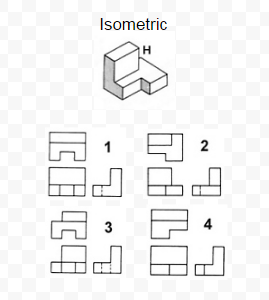
Which orthographic projection represents the correct views for the isometric sketch?
1
2
3
4
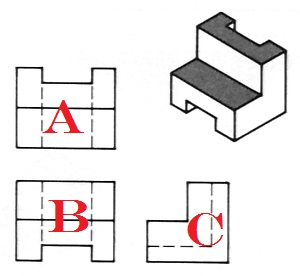
What view would go in position B of a multiview sketch?
Top
Front
Right side

Which diagram below shows the right view of this object?


What color represents the front view?
Blue
Green
Yellow
Can't tell from this angle
What color represents the top view?
Blue
Green
Yellow
Can't tell from this angle
What color represents the right view?
Blue
Green
Yellow
Can't tell from this angle

Which view best represents the top?
A
B
C
Can't tell from this angle
Which view best represents the right?
A
B
C
Can't tell from this angle

What is view A called?
Front View
Top View
Right View
Isometric View
Which of the following is an example of an Autonomous Robot?
Roomba
Mars Rover
Industrial Robot Arm
Drone

