
 Worksheets
water electrolyte
Total questions: 72
Worksheet time: 36mins
Which statement best describes the chemical composition of water?
Equal atoms hydrogen and oxygen together
One atom hydrogen and two atoms oxygen
Two atoms hydrogen and one atom oxygen
Three atoms oxygen bound to hydrogen
Under optimal conditions, how long can a human typically survive without water?
About one month with minimal hydration
About fourteen days with limited intake
About two days without any fluids
About seven days without drinking water
Which property correctly characterizes water as a fluid?
Cloudy, sweet, and aromatic liquid
Opaque, bitter, and pungent liquid
Colored, flavorful, and scented liquid
Clear, tasteless, and odorless liquid
A young child develops severe diarrhea. What is the primary immediate risk related to water balance?
Slow enhancement of temperature control
Immediate increase in blood volume
Rapid loss of water and electrolytes
Gradual gain of cellular water
Which scenario most likely leads to fatal outcomes in a short time due to dehydration?
Sweating stops entirely during rest
Mild, gradual deficit develops
Stable intake exceeds daily needs
Rapid losses of body water occur
Which statement best explains why water is essential despite providing no food energy?
It stores glycogen for rapid metabolic fuel
It transports oxygen as the main blood gas
It enables nutrient reactions necessary for body use
It acts as the primary source of body heat

What proportion of a healthy adult’s body is typically water?
About 70% to 80% of body weight
About 35% to 45% of body weight
About 20% to 30% of body weight
About 50% to 60% of body weight

Which role describes water as a biological medium?
It replaces electrolytes during dehydration
It is the main energy-yielding nutrient
It catalyzes all enzyme reactions directly
It provides the environment for nutrient function
Electrolytes contribute to which physiological process highlighted in the material?
Insulin synthesis in pancreatic beta cells
DNA replication and repair accuracy
Muscle contractions and neuromuscular activity
Keratin formation in epidermal tissue
Sodium plays a key role in regulating which parameter through fluid balance?
Core body temperature during fever
Blood pressure via extracellular volume
Basal metabolic rate in resting state
Lung ventilation rate at rest
A patient loses significant extracellular fluid after severe sweating. Which immediate risk is most directly linked to altered sodium balance?
Hypoglycemia from insulin overproduction
Hypotension due to reduced vascular volume
Hyperthermia from impaired heat radiation
Anemia caused by reduced red cell synthesis
In an average lean adult, which compartment contains the largest proportion of total body fluid? Refer to the diagram showing ICF and ECF proportions.
Interstitial fluid eighty percent of extracellular fluid
Intracellular fluid two-thirds of total body fluid
Extracellular fluid one-third of total body fluid
Plasma twenty percent of extracellular fluid
Which statement best distinguishes interstitial fluid from plasma within the extracellular compartment? Use the diagram with tissue cells and a blood capillary.
Interstitial fluid surrounds tissue cells outside capillaries
Plasma directly bathes tissue cells in capillary beds
Plasma occupies spaces between cells in connective tissue
Interstitial fluid is inside red blood cells only
Approximately what fraction of extracellular fluid is plasma in the illustrated breakdown?
About eighty percent of extracellular fluid
About fifty percent of extracellular fluid
About twenty percent of extracellular fluid
About ten percent of extracellular fluid
Which choice correctly matches where most body water is stored according to the infographic stating 65% inside cells and 35% outside cells?
Mostly in the gastrointestinal lumen compartments
Mostly inside cells as intracellular water
Evenly split between intracellular and extracellular
Mostly outside cells as extracellular water
The male figure shows 60% of body mass as fluids. Which inference is most supported when compared with the female figure at 55% fluids?
Males universally have more plasma proteins than females
On average, males have a higher total body water percentage
Females have greater intracellular fluid fraction than males
Sex differences eliminate extracellular fluid entirely in females
If total body fluid is reduced by dehydration, which compartment typically loses volume first due to water movement across capillary walls? Consider the ECF breakdown shown.
Interstitial fluid around tissues
Intracellular fluid within cells
Plasma within blood vessels
Transcellular fluid within synovial cavities
A patient has edema in peripheral tissues. Which compartment has increased volume based on the diagram of ECF components?
Interstitial compartment surrounding cells
Plasma compartment within vessels
Intracellular compartment inside cells
Transcellular compartment within cerebrospinal fluid
Which description aligns with water moving constantly between compartments, as shown in the figures?
Only plasma exchanges water with gastrointestinal contents
Interstitial and plasma are isolated without movement
ECF and ICF exchange water across cell membranes
Water is locked in ICF without exchange
Which tissue type contains a higher proportion of water in the human body?
Lean tissue with higher fluid content
Adipose tissue with low metabolic activity
Bone tissue with dense mineral matrix
Connective tissue with collagen fibers
Which statement best explains typical gender differences in total body water?
Males have more lean tissue and more fluid
Males have more fat tissue and less fluid
Females have more fat tissue and less fluid
Females have more lean tissue and more fluid
How does aging generally affect total body water?
Lean mass increases, raising body fluid
Electrolytes accumulate, raising body fluid
Lean tissue is lost, reducing body fluid
Fat mass decreases, increasing body fluid
Which is a major transportation role of body water described?
Conveys oxygen, nutrients, and hormones
Synthesizes essential amino acids
Generates ATP in mitochondria
Stores glycogen in muscle tissues
Which function directly contributes to maintaining osmotic pressure homeostasis?
Regulation of body temperature by sweating
Protection of spinal cord and brain tissues
Control of balance between water and electrolytes
Provision of building material for protoplasm
Which pairing best matches a protective role of body water?
Buffers heat transfer within skin layers
Cushions spinal cord and brain tissues
Neutralizes gastric acid in the stomach
Seals epithelial barriers from pathogens
Which statement correctly characterizes water balance in the body?
Water intake should exceed output daily
Electrolyte intake always equals water intake
Intake and output must be in balance
Fluid balance unrelated to electrolyte balance
Which organ primarily regulates the amount of water excreted or conserved in the body?
Lungs manage oxygen and carbon dioxide exchange
Liver controls bile and glucose storage
Pancreas secretes insulin and digestive enzymes
Kidney adjusts urine volume and solute balance
A rise in plasma sodium concentration most directly triggers which response?
Rapid decrease in renal sodium reabsorption
Suppression of thirst sensation centrally
Activation of thirst mechanism in hypothalamus
Immediate increase in aldosterone secretion only
Aldosterone’s key role in fluid balance is best described as:
Blocking antidiuretic hormone action in nephrons
Decreasing renal sodium reabsorption and water loss
Stimulating atrial natriuretic peptide release
Increasing renal sodium reabsorption and water retention
Which hormone primarily reduces water loss by increasing collecting duct permeability to water?
Erythropoietin from renal interstitium
Atrial natriuretic peptide from atria
Antidiuretic hormone from posterior pituitary
Aldosterone from adrenal cortex
Atrial natriuretic peptide (ANP) has what principal effect on renal handling of water?
Stimulates aldosterone synthesis and sodium uptake
Suppresses thirst and salt appetite directly
Promotes water loss and increased urine volume
Promotes water retention and concentrated urine
Which combination best explains why someone eating very salty food will likely need more water?
Higher sodium increases osmolarity and thirst
Lower sodium raises ADH and thirst drive
Lower osmolarity stimulates ANP secretion
Higher potassium decreases aldosterone rapidly
During vigorous exercise on a hot, humid day, water needs increase primarily because:
Evaporative cooling is minimal and sweat accumulates
Sweat losses rise and body temperature regulation demands
Renal filtration stops and urine output ceases
Aldosterone immediately shuts down sodium excretion
Which statement best differentiates ADH and ANP actions on urine volume?
Both increase urine volume substantially
ADH decreases urine volume, ANP increases it
ADH increases urine volume, ANP decreases it
Neither affects urine volume measurably
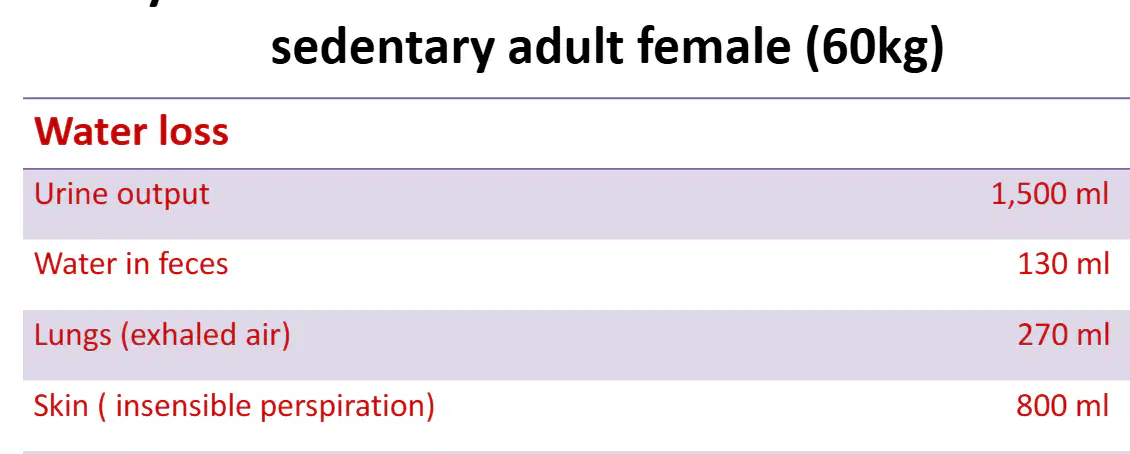
Which pathway accounts for the largest daily water loss in a sedentary adult?
Exhalation from lungs air
Water contained in feces
Evaporation from skin surface
Urine output through kidneys
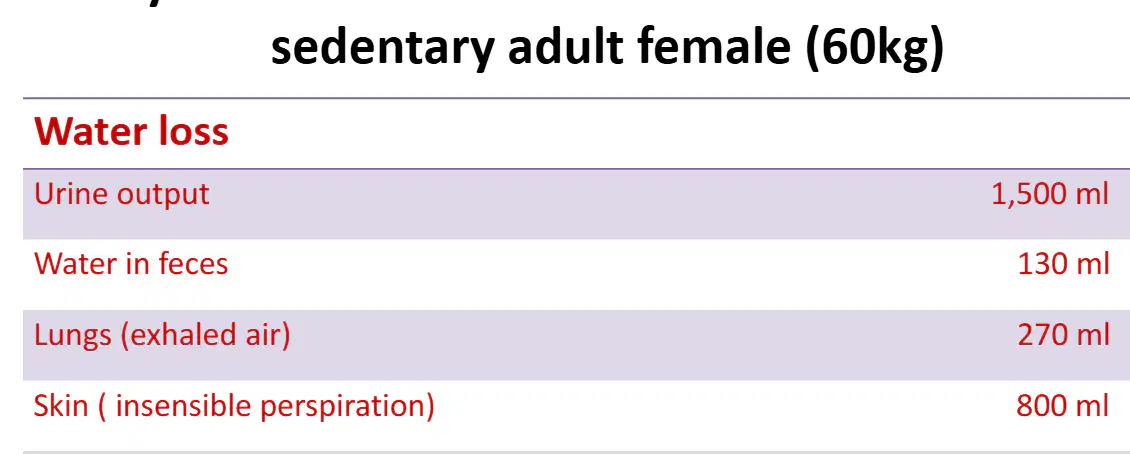
Approximately how much water is lost daily via insensible perspiration from the skin?
About 270 milliliters
About 800 milliliters
About 130 milliliters
About 1,500 milliliters
Which statement best describes metabolic water in daily intake?
Water reabsorbed in renal tubules
Water stored in adipose tissues
Water absorbed from intestinal lumen
Water produced by cellular metabolism
A sedentary adult female loses 2,700 ml in total per day. Which intake distribution balances this loss?
Fluids 2,000 ml; food 500 ml; metabolic 200 ml
Fluids 2,700 ml; food 0 ml; metabolic 0 ml
Fluids 1,500 ml; food 800 ml; metabolic 400 ml
Fluids 2,200 ml; food 350 ml; metabolic 150 ml
Which pathway is correctly matched with the form of water loss?
Lungs—condensed droplets
Skin—measurable sweat only
Kidneys—urine output
Feces—solid-only content
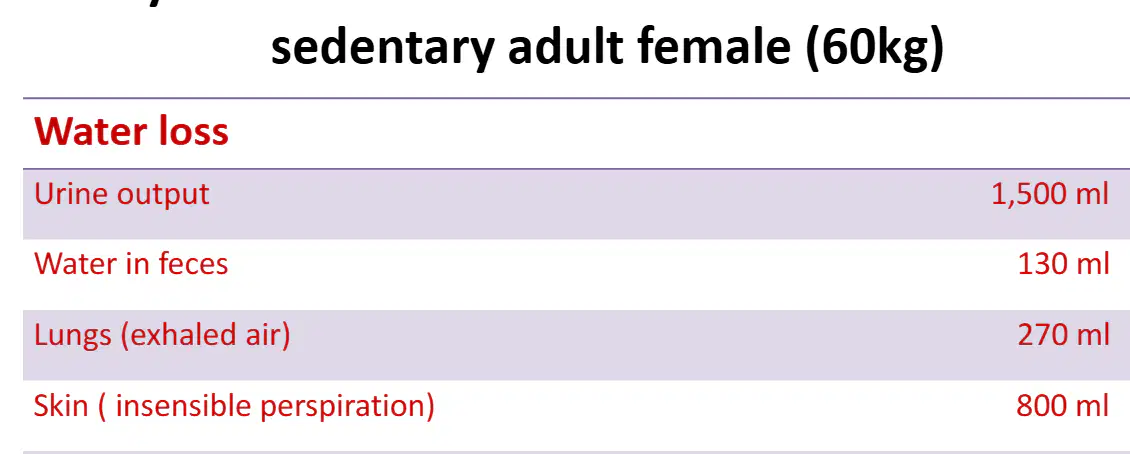
If lung water loss increases from 270 ml to 400 ml without changing other pathways, how much additional intake is needed to maintain balance?
No additional intake
An extra 400 milliliters
An extra 270 milliliters
An extra 130 milliliters
Which statement best defines an electrolyte in the context of body fluids?
Substance that conducts electric current in solution
Compound that only dissolves without forming ions
Substance that prevents any current in solution
Molecule that carries charge only in solid state
When an electrolyte dissolves in water, what typically happens at the particle level?
Molecules dissociate into positively or negatively charged ions
Molecules form larger neutral aggregates
Ions lose charge and become neutral molecules
Particles align to block electric conduction
Which list contains common electrolytes found in many solutions?
Acids, bases, and salts
Proteins, peptides, and enzymes
Lipids, waxes, and steroids
Sugars, starches, and cellulose
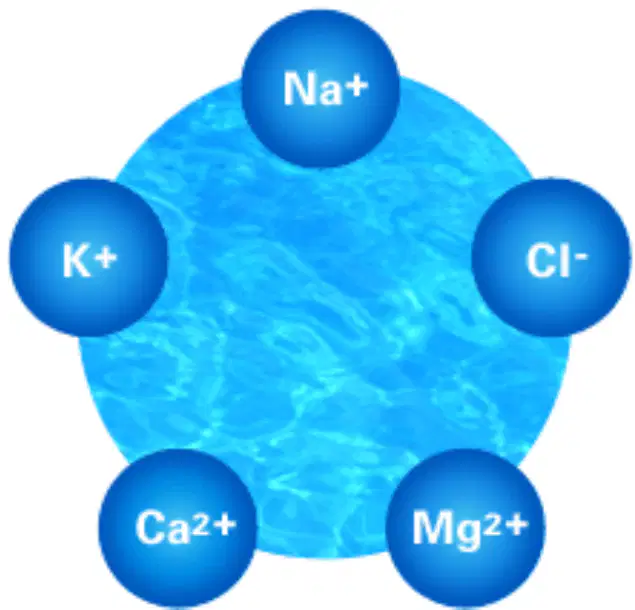
Identify the correct pairing of symbol and ion name seen in body fluid diagrams.
Na+ is sodium ion
Cl− is calcium ion
Mg2+ is potassium ion
K+ is chloride ion
A solution that contains substances capable of conducting electricity is best termed what?
Neutral suspension
Electrolyte solution
Insulating medium
Nonpolar solvent
Which pair lists electrolytes that carry a positive charge in body fluids?
Sodium and potassium
Chloride and phosphorus
Bicarbonate and sulfate
Magnesium and chloride
What electrical charge is typically associated with chloride in physiological solutions?
Positive charge
Variable charge
Negative charge
Neutral charge
Select the correct symbol and charge for potassium as found in cells.
K0
K−
K2+
K+
Which statement best distinguishes cations from anions in biological systems?
Anions are uncharged molecules
Anions always have multiple charges
Cations are negatively charged ions
Cations are positively charged ions
A nerve impulse depends on electrolytes generating current across membranes. Which combination directly supports this process?
Binding of Ca2+ to Cl−
Conversion of P− to neutral P
Reduction of sulfate to bicarbonate
Movement of Na+ and K+
Which set correctly matches an electrolyte to its symbol and typical charge?
Sodium: Na−
Magnesium: Mg0
Phosphorus: P+
Calcium: Ca2+
Which electrolyte primarily contributes to nerve impulse conduction and muscle contraction while maintaining blood volume homeostasis?
Sodium in extracellular fluids
Chloride forming gastric acid
Potassium transporting glucose
Calcium building bone matrix
Loss of hydrochloric acid in the stomach is most directly associated with a deficiency of which electrolyte?
Sodium depletion syndrome
Potassium loss condition
Chloride deficiency state
Magnesium insufficiency
Hypokalemia is best described as a deficiency of which electrolyte and is linked to irregular heartbeat and apathy?
Potassium in body cells
Calcium in bone tissue
Sodium in blood plasma
Chloride in gastric juice
Which electrolyte acts as the major negative ion in extracellular fluids and supports nerve impulse conduction?
Bicarbonate cation in tissues
Sodium cation inside cells
Chloride anion outside cells
Potassium anion in plasma
A patient presents with muscle cramps, nausea, vomiting, dizziness, and risk of shock. Which electrolyte imbalance is most consistent with these symptoms?
Calcium deficiency cramps
Potassium overdose signs
Chloride excess condition
Sodium deficiency symptoms
Which electrolyte is the principal positive ion in extracellular fluids and assists with glucose transport into cells?
Sodium balancing acids
Potassium as major cation
Calcium mediating coagulation
Chloride forming HCl
Impaired formation of hydrochloric acid in the stomach would most likely result from inadequate levels of:
Potassium aiding transport
Sodium maintaining volume
Chloride as gastric source
Phosphate buffering acids
Which function aligns with sodium’s role in acid-base balance and nerve impulse conduction?
Maintaining blood volume
Forming stomach acid
Generating bone matrix
Transporting glucose
Irregular heartbeat in a patient with low serum potassium most directly reflects disruption of:
Bone mineral deposition
Extracellular anion balance
Gastric acid secretion
Cardiac electrical conduction
Which pairing correctly matches electrolyte to deficiency symptom set?
Sodium—cramps, nausea, dizziness
Chloride—hypokalemia, apathy
Potassium—loss of gastric acid
Calcium—convulsions, HCl loss
Which brain structure serves as the primary regulator of core body temperature?
Cerebellum coordination network
Thalamus homeostasis center
Hypothalamus thermoregulatory center
Medulla vasomotor nucleus
What is the typical human core body temperature in Celsius?
35° C approximately
36.5° C approximately
37° C approximately
38.5° C approximately
One degree Celsius corresponds to how many degrees Fahrenheit?
2.2 degrees Fahrenheit
1.8 degrees Fahrenheit
1.6 degrees Fahrenheit
1.0 degrees Fahrenheit
If a patient’s core temperature rises from 37° C to 38° C, by how many degrees Fahrenheit has it increased?
About 3.6° F increase
About 2.4° F increase
About 1.8° F increase
About 1.0° F increase
Which statement best explains how humans maintain body temperature?
Only heat loss to the skin determines temperature
Hypothalamus balances heat produced and exchanged
Temperature depends solely on metabolic rate
Environmental heat fully dictates core temperature
Which combination most increases heat stress for someone exercising outdoors?
Cool breeze, low humidity, indirect sunlight
High air temperature, high humidity, direct sun
Low air temperature, low humidity, cloudy shade
Moderate temperature, low humidity, indoor gym
During exercise, what primary mechanism removes body heat when the environment is hot?
Radiation to cooler surroundings
Convection by still air layers
Evaporation of sweat from skin
Conduction to cold surfaces
Which statement best describes radiation, conduction, and convection in body heat loss?
They are neural reflexes adjusting blood flow
They are hormonal signals controlling sweating
They are physical processes transferring heat
They are chemical reactions producing heat
Why can body temperature usually stay regulated during intense exercise?
Muscle heat production is negligible
Sweating is prevented in high humidity
Heat loss mechanisms activate effectively
Blood flow decreases to the skin
In high humidity, why is heat stress more likely during exercise?
Conduction to air increases substantially
Convection currents become stronger
Sweat evaporation becomes less efficient
Humidity enhances radiation from the skin
A runner moves from shade into direct sunlight on a humid day. Which change most contributes to added heat load?
Reduced conduction to cooler ground
Decreased metabolic heat production
Increased radiant heat absorption
Enhanced evaporative cooling efficiency

