
 Worksheets
Pre-test SEM1 grade8
Total questions: 90
Worksheet time: 45mins
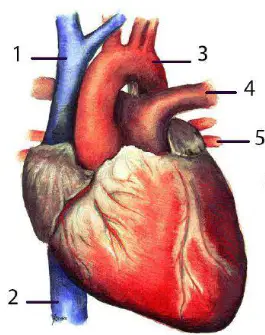
Using the word bank Aorta, Superior vena cava, Inferior vena cava, Right atrium, Pulmonary artery, Pulmonary vein, Right ventricle, Left ventricle, Left atrium: Which structure carries blood from the lungs back to the heart?
Pulmonary artery
Pulmonary vein
Aorta
Superior vena cava
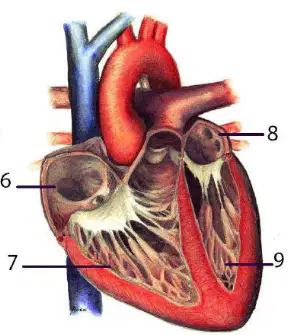
Using the same word bank: Which chamber pumps oxygen-rich blood into the aorta?
Right ventricle
Left ventricle
Right atrium
Left atrium
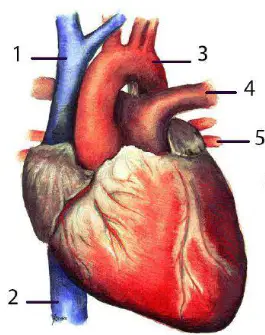
Using the same word bank: Which vessel receives oxygen-rich blood leaving the left ventricle?
Pulmonary artery
Pulmonary vein
Aorta
Inferior vena cava
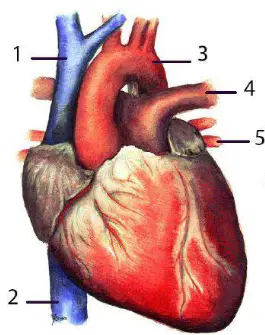
Using the same word bank: Which vessel returns deoxygenated blood to the right atrium from the upper body?
Inferior vena cava
Superior vena cava
Pulmonary vein
Aorta
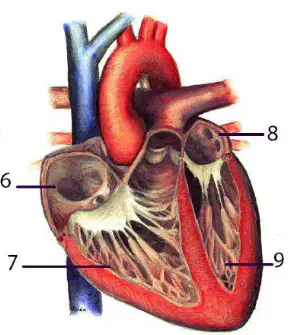
Using the same word bank: Which chamber first receives blood from the vena cavae?
Left atrium
Right atrium
Left ventricle
Right ventricle
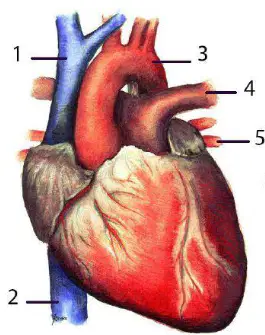
Write the numbers that contain oxygen-rich blood: Convert to a single-select question. Which set lists only structures that carry oxygen-rich blood in the heart?
Pulmonary artery, Right atrium, Right ventricle
Aorta, Pulmonary vein, Left atrium, Left ventricle
Superior vena cava, Inferior vena cava, Right ventricle
Right atrium, Pulmonary artery, Superior vena cava
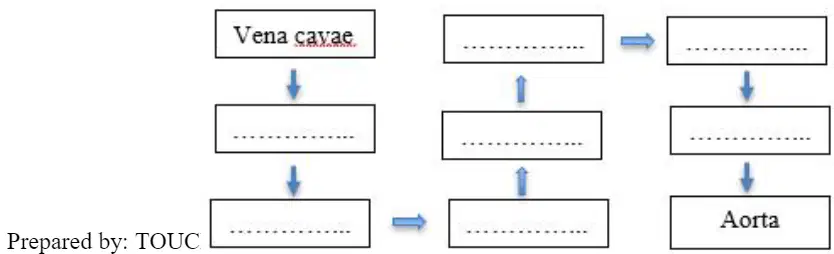
Make an events chain concept map to show pulmonary circulation beginning at the right atrium and ending at the aorta: What is the correct next step after the right atrium in pulmonary circulation?
Left ventricle
Right ventricle
Pulmonary vein
Aorta
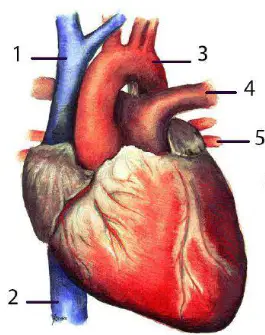
In pulmonary circulation beginning at the right atrium and ending at the aorta, which vessel carries blood from the heart to the lungs?
Pulmonary artery
Pulmonary vein
Aorta
Superior vena cava
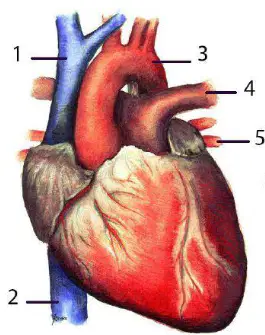
In pulmonary circulation beginning at the right atrium and ending at the aorta, oxygenated blood returns to the heart through which vessel?
Pulmonary artery
Inferior vena cava
Pulmonary vein
Superior vena cava
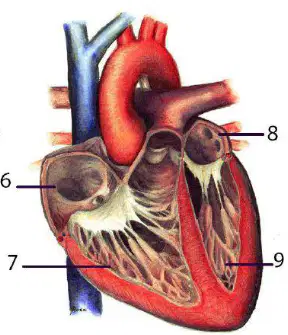
In pulmonary circulation beginning at the right atrium and ending at the aorta, which chamber receives oxygenated blood from the lungs?
Right atrium
Left atrium
Right ventricle
Left ventricle
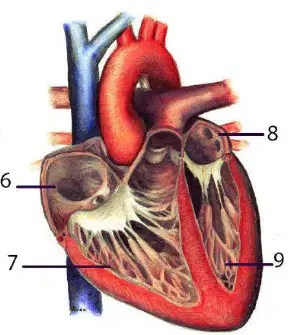
In pulmonary circulation beginning at the right atrium and ending at the aorta, which chamber pumps oxygenated blood into the systemic circulation via the aorta?
Right ventricle
Left ventricle
Right atrium
Left atrium
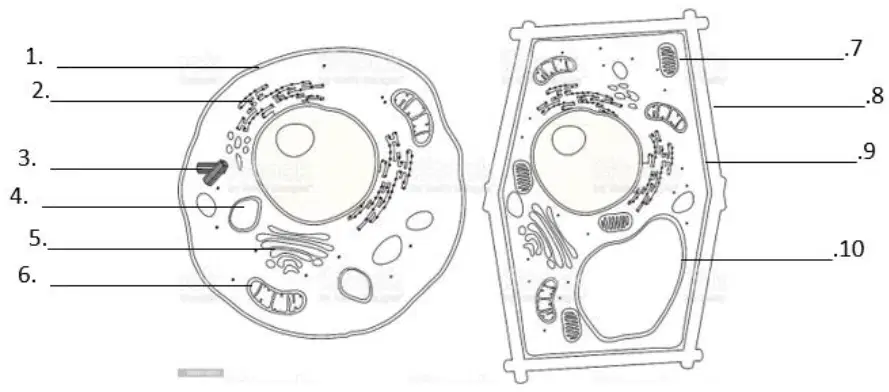
In the plant cell diagram, which numbered part is the large central vacuole?
7
8
9
10
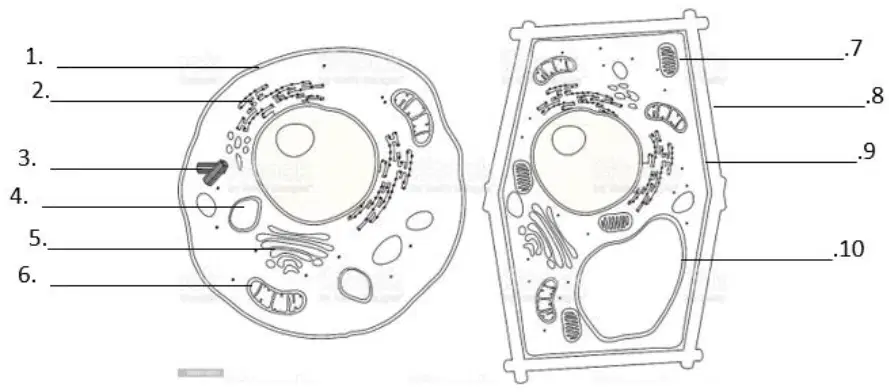
In the plant cell diagram, which numbered part indicates the nucleus?
7
8
9
10
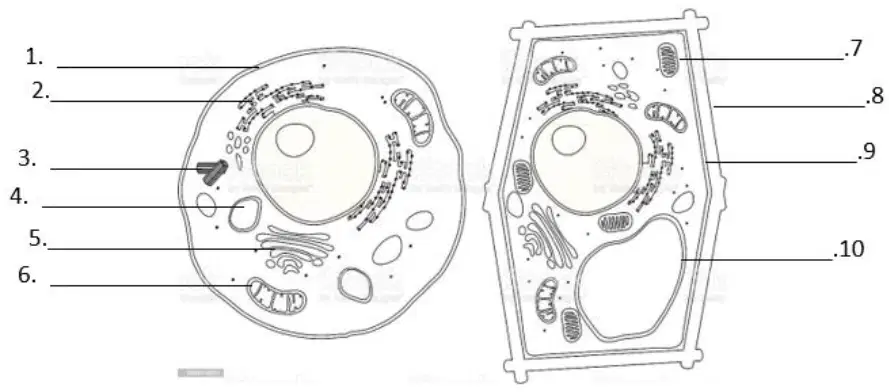
In the animal cell diagram, which numbered part indicates the nucleus?
1
2
3
4
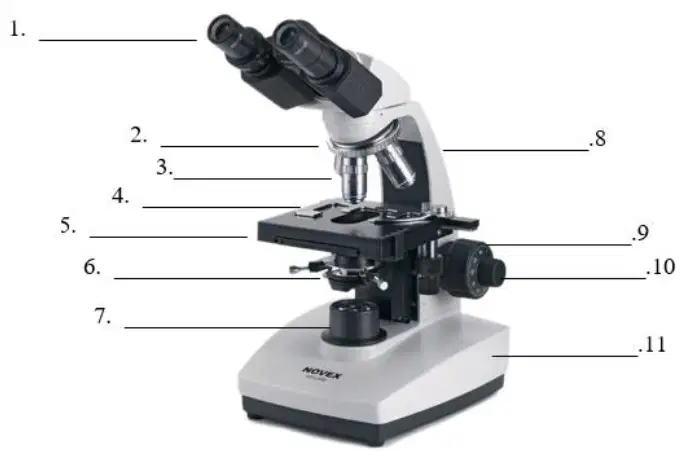
On the microscope diagram, which numbered part is the eyepiece (ocular lens)?
1
4
5
7
On the microscope diagram, which numbered part is the coarse focus knob?
6
10
3
5
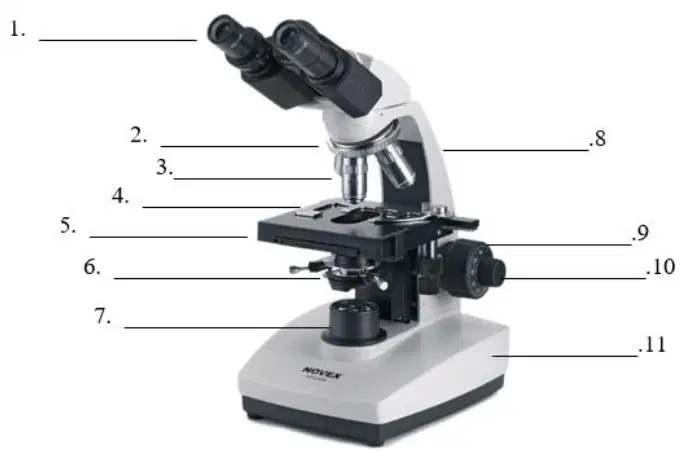
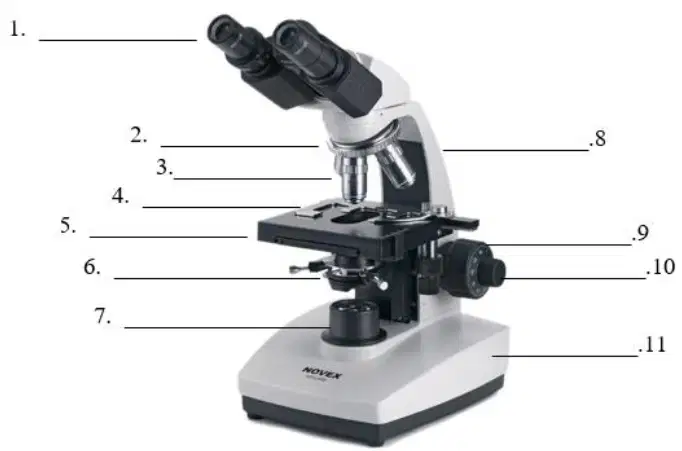
On the microscope diagram, which numbered part is the fine focus knob?
6
10
7
2
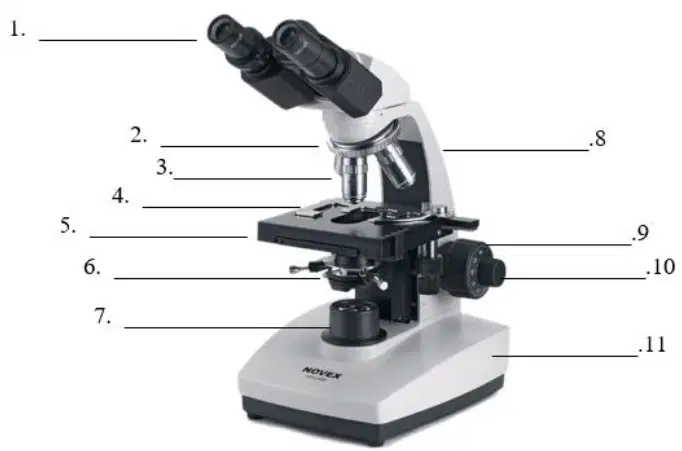
On the microscope diagram, which numbered part is the stage?
5
3
9
11
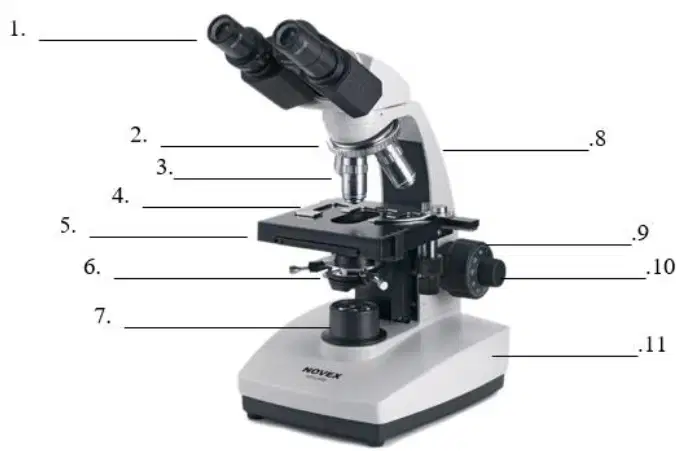
On the microscope diagram, which numbered parts are objective lenses? Select all that apply.
2
3
8
11
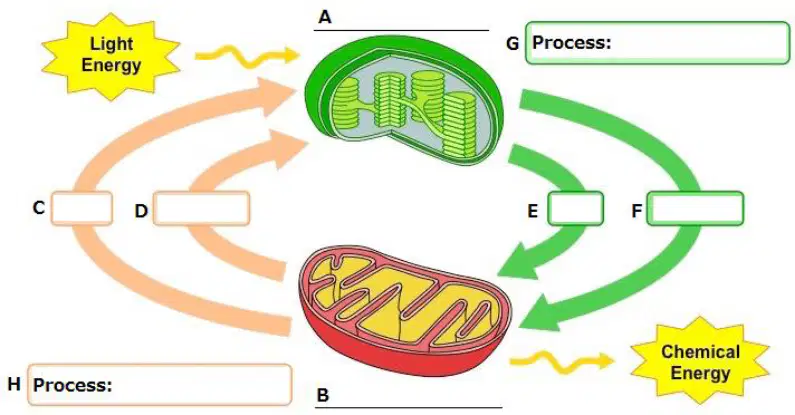
What does the green-and-red organelle diagram mention about?
Cell division
Photosynthesis and cellular respiration
DNA replication
Protein synthesis
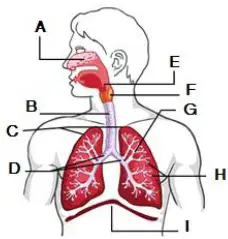
In the respiratory system diagram, which letter labels the trachea?
C
G
H
I
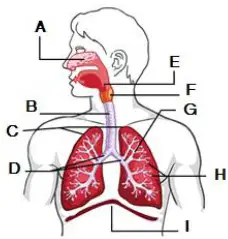
In the respiratory system diagram, which letter labels the lungs?
D
H
A
I
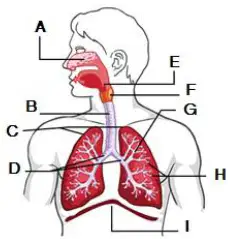
In the respiratory system diagram, which letter labels the diaphragm?
I
E
G
B
Match A with B: Hemoglobin corresponds to which definition?
Biggest artery that carries oxygen-rich blood to all parts of the body
Protein that destroys or neutralizes the foreign substances or any antigen
Protein that has the ability to connect with O2 and CO2
Wave of pressure that rises and falls in the arterial wall
The flow of blood from the heart to the lungs and back to the heart
Match A with B: Antibody corresponds to which definition?
Protein that destroys or neutralizes the foreign substances or any antigen
Biggest artery that carries oxygen-rich blood to all parts of the body
Wave of pressure that rises and falls in the arterial wall
The flow of blood from the heart to the lungs and back to the heart
Match A with B: Pulse corresponds to which definition?
Wave of pressure that rises and falls in the arterial wall
Pressure exerted by blood on the arterial wall
Biggest artery that carries oxygen-rich blood to all parts of the body
Protein that has the ability to connect with O2 and CO2
Match A with B: Pulmonary circulation corresponds to which definition?
The flow of blood from the heart to the lungs and back to the heart
Wave of pressure that rises and falls in the arterial wall
Pressure exerted by blood on the arterial wall
The flow of blood from heart to heart itself
Match A with B: Aorta corresponds to which definition?
Biggest artery that carries oxygen-rich blood to all parts of the body
Protein that destroys or neutralizes foreign substances
The flow of blood from the heart to the lungs and back to the heart
Wave of pressure that rises and falls in the arterial wall

Wave of blood pressure rises and falls in your arteries: Which term matches the phrase?
Blood pressure
Pulse
Capillaries
Atherosclerosis

Pressure exerted by the flow of blood through the vessels of the body: Which term matches the phrase?
Blood pressure
Pulse
Veins
Arteries

Fight bacteria, viruses, and other foreign substances that constantly try to invade your body: Which term matches the phrase?
Platelets
Plasma
White blood cells
Capillaries

Blood vessels that move blood to the heart: Which term matches the phrase?
Arteries
Veins
Capillaries
Atherosclerosis

Irregularly shaped cell fragments that help clot blood: Which term matches the phrase?
White blood cells
Platelets
Plasma
Veins
High blood pressure disorder: Which term matches the phrase?
Pulse
Hypertension
Capillaries
Atherosclerosis
Blood vessels that move blood away from the heart: Which term matches the phrase?
Arteries
Veins
Capillaries
Pulse
Liquid part of blood that consists mostly of water: Which term matches the phrase?
Platelets
White blood cells
Plasma
Pulse
Condition of fatty deposits on the inner wall of arteries: Which term matches the phrase?
Hypertension
Atherosclerosis
Pulse
Blood pressure
Microscopic blood vessels that connect arteries and veins: Which term matches the phrase?
Capillaries
Arteries
Veins
Pulse
Amount of heat necessary to raise the temperature of 1 kg of water 1 °C: Which term or number matches the phrase?
(3) calorie
(1) Nutrition
(10) pulse
(12) blood pressure
Foods that contain the same type of nutrient: Which term or number matches the phrase?
(5) food group
(6) serving size
(2) nutrients
(9) food pyramid
Process of giving or getting the right type of food for good health and growth: Which term or number matches the phrase?
(2) nutrients
(1) Nutrition
(9) food pyramid
(6) serving size
Amount of foods you need daily from each food group: Which term or number matches the phrase?
(6) serving size
(9) food pyramid
(5) food group
(3) calorie
They are required only in small amount, which is fewer than 20 mg a day: Which term or number matches the phrase?
(11) major mineral
(4) trace mineral
(2) nutrients
(8) white blood cells
They are required in large amount, which is more than 250 mg a day: Which term or number matches the phrase?
(11) major mineral
(4) trace mineral
(2) nutrients
(8) white blood cells
Substances in foods that provide energy and materials for cell development, growth, and repair: Which term or number matches the phrase?
(2) nutrients
(1) Nutrition
(3) calorie
(9) food pyramid
The force exerted by blood to the wall of blood vessels when the heart beats: Which term or number matches the phrase?
(12) blood pressure
(10) pulse
(13) artery
(14) vein
The wave of pressure that rises and falls in the arteries: Which term or number matches the phrase?
(12) blood pressure
(10) pulse
(13) artery
(14) vein
They have hemoglobin to carry O2 to body tissues and take back CO2 to be removed by the lungs: Which term or number matches the phrase?
(8) white blood cells
(7) red blood cells
(13) artery
(14) vein
Amount of heat necessary to raise the temperature of 1 kg of water 1 °C: Which term from the list matches the phrase?
Nutrition
Calorie
Unsaturated fats
Water-soluble vitamins
Fat-soluble vitamins
They are usually liquid at room temperature: Which term from the list matches the phrase?
Nutrition
Calorie
Unsaturated fats
Water-soluble vitamins
Fat-soluble vitamins
They can be stored in the body in fatty tissue: Which term from the list matches the phrase?
Nutrition
Calorie
Unsaturated fats
Water-soluble vitamins
Fat-soluble vitamins
They are excreted by the body and need to be replenished every day: Which term from the list matches the phrase?
Nutrition
Calorie
Unsaturated fats
Water-soluble vitamins
Fat-soluble vitamins
Process of giving or getting the right type of food for good health and growth: Which term from the list matches the phrase?
Nutrition
Calorie
Unsaturated fats
Water-soluble vitamins
Fat-soluble vitamins
Tick (✓) in the box of a best answer. What were the results of the Miller–Urey experiment?
Present-day cells
Oceanlike liquid
Amino acids
Answer B and C
Tick (✓) in the box of a best answer. Whose experiment mistakenly proves the theory of spontaneous generation?
John Needham
Lazzaro Spallanzani
Louis Pasteur
Miller and Urey
Tick (✓) in the box of a best answer. Which power of objective lens do we use first to capture the image of a specimen under a microscope?
4x
10x
40x
100x
Tick (✓) in the box of a best answer. Which of the following contains hereditary material of living organisms?
Chromosome
Amino acid
Chloroplast
Mitochondrion
Tick (✓) in the box of a best answer. What substances were used by Miller–Urey in their experiment?
Present-day cells
Oceanlike liquid
Amino acids
Mixture of gases
Tick (✓) in the box of a best answer. Whose experiment disproves the theory of spontaneous generation?
John Needham
Lazzaro Spallanzani
Louis Pasteur
Miller and Urey
Tick (✓) in the box of a best answer. Whose experiment tested the hypothesis of Alexander I. Oparin?
John Needham
Lazzaro Spallanzani
Louis Pasteur
Miller and Urey
Tick (✓) in the box of a best answer. Which of the following controls most cell’s activity?
Chloroplast
Protein
Nucleus
Mitochondrion
Tick (✓) in the box of a best answer. Which of the following is the movement of the chest that brings air into the lungs and removes waste gases?
Breathing
Circulation
Respiration
Inhalation
Tick (✓) in the box of a best answer. Where in the lungs does the exchange of gas take place?
Alveoli
Lungs
Trachea
Nasal cavity
Tick (✓) in the box of a best answer. How is breathing induced?
Breathing is partly the result of the changing in volume of the lungs and air pressure within them.
Depending on the amount of oxygen present in your blood.
The contraction of the diaphragm.
Tick (✓) in the box of a best answer. What make plants gain their weight?
Sunlight
Water
Carbon dioxide
Answer A, B, and C
Tick (✓) in the box of a best answer. What are the vitamins that dissolve easily in water?
Vit. A, B, C
Vit. B, C
Vit. C, D, E
Vit. A, D, E, K
Tick (✓) in the box of a best answer. What are the vitamins that dissolve only in fats?
Vit. A, B, C
Vit. B, C
Vit. C, D, E
Vit. A, D, E, K
Tick (✓) in the box of a best answer. What are the minerals that function as nerve impulse conduction?
Sodium and Potassium
Calcium and Phosphorus
Irons and Copper
Copper and Iodine

IV. Fill in blank using the appropriate word in the box below. The exchange of ________ and carbon dioxide takes place between the alveoli and ________.
blood
capillaries
oxygen
one cell

IV. Fill in blank using the appropriate word in the box below. The exchange of oxygen and carbon dioxide takes place between the alveoli and ________.
blood
capillaries
oxygen
one cell

IV. Fill in blank using the appropriate word in the box below. This easily happens because the walls of the ________ are each only ________ thick.
blood
capillaries
oxygen
one cell
IV. Fill in blank using the appropriate word in the box below. This easily happens because the walls of the alveoli and the are each only ________ thick.
blood
capillaries
oxygen
one cell

IV. Fill in blank using the appropriate word in the box below. Oxygen moves through the cell membranes of the alveoli and then through the cell membrane of the capillaries into the ________.
blood
capillaries
oxygen
one cell
III. Answer the following questions. What was the first ancestor of life on Earth, and when did they appear?
Single-celled prokaryotes about 3.5 billion years ago
Multicellular plants about 600 million years ago
Dinoflagellates about 2.0 billion years ago
Mammals about 65 million years ago
III. Answer the following questions. Why was Oparin’s hypothesis about the origins of life important to Miller and Urey?
It proposed that early Earth’s atmosphere could form organic molecules, guiding the gas mixture used in their experiment.
It proved that living cells spontaneously appear from nonliving matter.
It showed that modern oceans contain all amino acids used by cells.
It explained how multicellular organisms evolved from bacteria.
III. Answer the following questions. What are the three main parts of the cell?
Cell membrane, cytoplasm, nucleus
Cell wall, chloroplast, vacuole
Chromosome, ribosome, mitochondrion
Flagellum, cilia, lysosome
III. Answer the following questions. What is the difference between onion cell and elodea cell?
Elodea cells contain visible chloroplasts while onion bulb cells generally do not
Onion cells have cell walls while elodea cells do not
Elodea cells are animal cells; onion cells are plant cells
Onion cells perform photosynthesis; elodea cells do not
III. Answer the following questions. What is an advantage of having air enter through the nostril?
Air is filtered, warmed, and moistened before reaching the lungs
Air bypasses the trachea and directly enters the alveoli
It increases the concentration of carbon dioxide in inhaled air
It prevents any microorganisms from entering the body
III. Answer the following questions. What are the functions of the respiratory system?
Bring oxygen into the body and remove carbon dioxide
Pump blood through arteries and veins
Digest food and absorb nutrients
Store minerals in bones
III. Answer the following questions. How many cells does each bacterium have? How about you?
A bacterium has one cell; a human has many trillions of cells
A bacterium has many cells; a human has one cell
Both bacteria and humans have the same number of cells
A bacterium has no cells; a human has a few cells
III. Answer the following questions. When was the cell discovered, by who, and how?
In 1665 by Robert Hooke using a microscope to observe cork
In 1543 by Copernicus using a telescope
In 1882 by Koch using petri dishes
In 1953 by Watson and Crick using X-ray diffraction
III. Answer the following questions. Suppose your teacher gave you a slide of an unknown cell. How would you tell whether the cell was from an animal or from a plant?
Look for a cell wall and chloroplasts to identify a plant cell
Check for a nucleus; animal cells lack nuclei
Measure the size; plant cells are always smaller
Only animal cells have mitochondria
III. Answer the following questions. What process is used by white blood cells to engulf bacteria?
Phagocytosis
Diffusion
Osmosis
Photosynthesis
III. Answer the following questions. What was the first ancestor of all lives on Earth—was it unicellular or multicellular?
Unicellular organisms
Multicellular organisms
Only viruses
Only fungi
III. Answer the following questions. What is a cell, and why are cells important?
The basic unit of life; they carry out essential functions of organisms
A small organ in the body; it stores fat
A type of tissue that forms bones; it gives structure
A chemical that controls breathing; it changes air pressure
III. Answer the following questions. What are the four functions of blood?
Transport substances, regulate temperature, defend against disease, and clot wounds
Conduct nerve impulses, store minerals, produce hormones, and digest food
Increase bone density, control muscle movement, filter air, and absorb nutrients
Make proteins, break down fats, release energy, and form cartilage
III. Answer the following questions. Compare between the three types of blood circulation.
Systemic circulates blood to the body, pulmonary to the lungs, and coronary to the heart muscle
Systemic is within the heart, pulmonary within the brain, coronary within the kidneys
Pulmonary delivers nutrients to tissues, systemic exchanges gases in the lungs, coronary digests food
Coronary moves blood to the liver, pulmonary to the stomach, systemic to the skin
III. Answer the following questions. What are the four main functions of blood?
Carry gases and nutrients, remove wastes, protect against infection, and help clotting
Make bones stronger, produce electricity, regulate plant growth, and store water
Create new organs, maintain cell walls, digest fats, and control light absorption
Provide oxygen only, store calcium only, produce energy only, and break down carbohydrates only
III. Answer the following questions. Why are nutrition facts found on all packaged foods important?
They inform consumers about nutrient content to help make healthy choices
They are required to advertise the brand’s logo
They prevent food from spoiling
They eliminate the need to cook food
III. Answer the following questions. Why can saturated fats cause diseases?
They raise LDL cholesterol, increasing the risk of heart disease
They increase lung capacity and improve breathing
They neutralize stomach acid and prevent ulcers
They strengthen bones by adding calcium

