
Font size
 Worksheets
Mid unit Quiz Earth's Spheres an Water cycle
Total questions: 96
Worksheet time: 57mins
Which list correctly names Earth's four main spheres?
Atmosphere, hydrosphere, lithosphere, biosphere
Stratosphere, cryosphere, ionosphere, geosphere
Mantle, core, crust, exosphere
Magnetosphere, troposphere, mesosphere, thermosphere
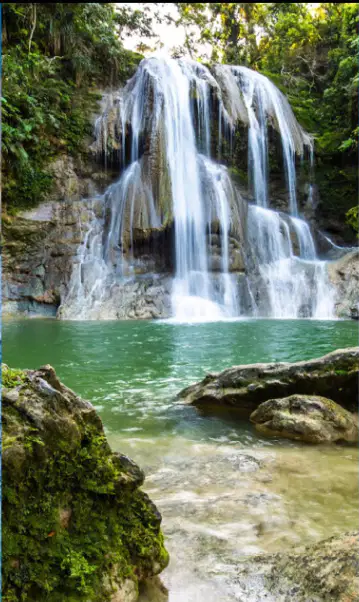
A waterfall best represents which Earth sphere shown in the images?
Biosphere, because penguins live there
Lithosphere, because rocks form cliffs
Atmosphere, because air surrounds it
Hydrosphere, because it is moving water
Which statement best defines a system in Earth science?
A single object acting alone without inputs
A set of interacting parts forming a whole
A random group of unrelated materials
A label used only for living organisms
If volcanic ash enters the air and blocks sunlight, which sphere interaction is described?
Lithosphere affecting atmosphere and biosphere
Hydrosphere affecting lithosphere only
Biosphere affecting lithosphere only
Atmosphere affecting hydrosphere only
Which Earth sphere includes rock, soil, and minerals?
Atmosphere: gases around Earth
Geosphere: solid Earth materials
Biosphere: plants and animals
Hydrosphere: liquid and frozen water
What does the lithosphere consist of?
Entire mantle and outer core
Hydrosphere and atmosphere
Crust and upper mantle
Lower mantle and inner core
Which list correctly orders the main internal layers from surface to center?
Mantle, crust, core
Crust, mantle, core
Core, mantle, crust
Crust, core, mantle
A mountain range is best classified as part of which sphere?
Biosphere: forests and animals
Geosphere: landforms and rock
Hydrosphere: rivers and ice
Atmosphere: clouds and wind
The prefix geo comes from Greek. What does it mean?
Water and ice
Earth and ground
Sky and weather
Life and organisms
A student claims the lithosphere is made of the whole mantle. Which evidence-based correction is most accurate?
It includes crust and upper mantle layers
It includes only the lower mantle region
It includes atmosphere and crust combined
It includes core and mantle together
Which statement best defines the biosphere?
The layer of gases around Earth
The sum of all living things on Earth
All rocks and minerals in Earth’s crust
The collection of Earth’s water bodies
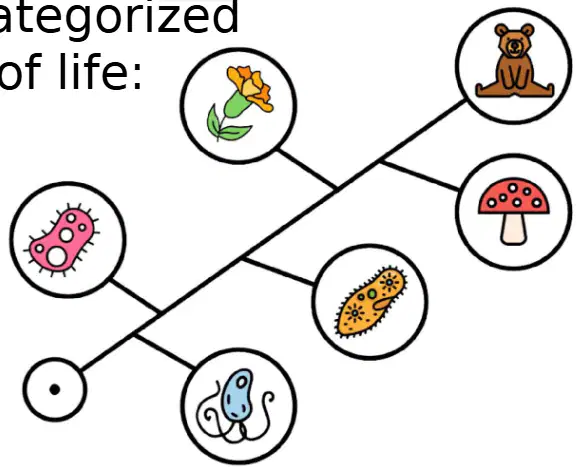
Which list correctly names kingdoms of life shown in the diagram?
Producers, Consumers, Decomposers, Plants, Animals, Microbes
Mammals, Reptiles, Insects, Fish, Birds, Amphibians
Animalia, Plantae, Fungi, Protista, Archaea, Bacteria
Trees, Flowers, Mushrooms, Algae, Viruses, Worms
What does the prefix bio mean in scientific words like biology?
Earth
Water
Life
Cells
About how long has the biosphere existed?
4.5 billion years
3.5 billion years
2.5 billion years
1.5 billion years

The earliest lifeforms on Earth were prokaryotes. Which description fits prokaryotes?
Animal cells with complex nuclei
Many-celled organisms needing oxygen
Single-celled organisms surviving without oxygen
Plant cells making food by sunlight
Which two groups include prokaryotes from early Earth?
Protista and Plantae
Fungi and Protista
Animalia and Plantae
Bacteria and Archaea
Which statement best describes biodiversity?
The count of species in one pond
The number of animals in forests
The total mass of living organisms
The total variety of all life on Earth
A video title reads “4.5 Billion Years in 24 Hours.” What idea does this suggest about Earth’s history?
Humans lived for all 24 hours
Earth’s history can be scaled to a day
Earth formed in one day of real time
The biosphere is only 24 hours old
Which statement best defines the hydrosphere?
All water located only in oceans
All water found on, under, or above Earth
Water found only in the atmosphere
Only freshwater in lakes and rivers
In which state of matter is water when forming glaciers and icecaps?
Gas state like vapor
Liquid state like rivers
Solid state like ice
Plasma state like lightning
Most of Earth’s water is which type?
Freshwater mostly in rivers
Atmospheric water vapor
Saltwater mainly in oceans
Groundwater beneath soils
Which source holds most of Earth’s freshwater?
Soil moisture near farms
Glaciers and icecaps masses
Wetlands and plants storage
Rivers and streams systems
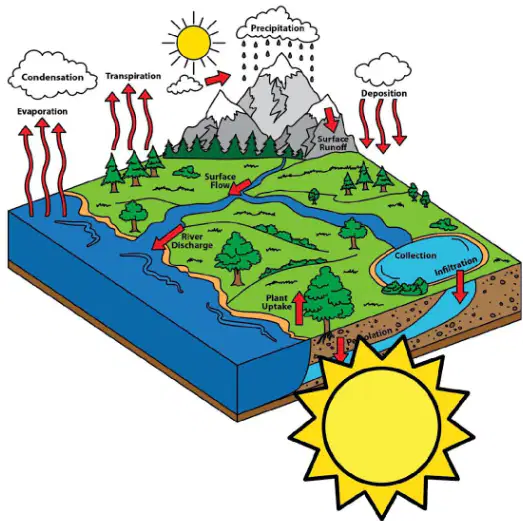
Which process changes liquid water to gas in the water cycle?
Precipitation falling rain
Evaporation warming water
Condensation forming clouds
Infiltration entering ground
Less than 1% of Earth’s water is accessible and drinkable. What does accessible mean here?
Found deep in mantle
Easy to reach for use
Locked in solid rock
Only present as vapor
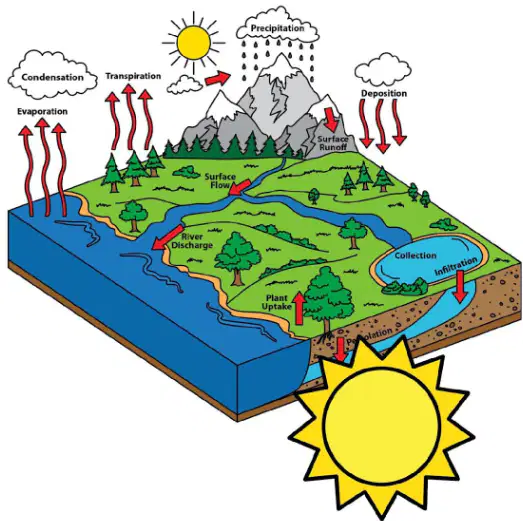
What mainly powers the water cycle by causing temperature changes?
Human-made machines
The gravitational pull
The sun’s radiant energy
Earth’s core heat energy
Which list correctly matches water with a location in the hydrosphere?
Solid—steam above lakes
Solid—glaciers on land
Liquid—atmosphere cloud gas
Gas—oceans surface area
During condensation in the atmosphere, water changes from
Solid to liquid water
Liquid to gas vapor
Liquid to solid crystals
Gas to liquid droplets
A town relies on a lake for drinking water. Why might conserving lake water be important?
Most accessible water is in oceans
Most atmosphere is solid ice
Most freshwater is in glaciers
Most saltwater is in rivers
Which statement best describes the cryosphere?
It is Earth’s moving air currents
It is Earth’s underground rock layer
It is Earth’s warm ocean water
It is Earth’s frozen solid water
Glaciers and polar ice caps belong to which Earth sphere?
Geosphere mountain rocks
Biosphere living plants
Atmosphere wind systems
Cryosphere component group
Many scientists include the cryosphere within another sphere. Which relationship is most accurate?
Cryosphere is part of the atmosphere
Cryosphere is part of the geosphere
Cryosphere is part of the biosphere
Cryosphere is part of the hydrosphere
The word root cryo comes from Greek. What does it mean in this science context?
Molten rock or heat
Icy water or cold
Living cells or life
Moving wind or air
Which gas makes up the largest percentage of Earth's atmosphere?
Nitrogen at about seventy-eight percent
Argon at about nine-tenths percent
Oxygen at about twenty-one percent
Carbon dioxide at about one percent
What is the best description of the atmosphere?
Gases or air that surround Earth
Molten metal surrounding Earth's core
Liquid water surrounding Earth's land
Solid rock layers above Earth's crust
Which list correctly shows the five main atmospheric layers from lowest to highest?
Mesosphere, Troposphere, Exosphere, Stratosphere, Thermosphere
Stratosphere, Troposphere, Thermosphere, Mesosphere, Exosphere
Troposphere, Mesosphere, Stratosphere, Exosphere, Thermosphere
Troposphere, Stratosphere, Mesosphere, Thermosphere, Exosphere
In which atmospheric layer does weather occur?
Troposphere closest to Earth’s surface
Mesosphere where meteors burn up
Thermosphere containing auroras
Stratosphere just above the ozone layer
Which percentage is closest to the amount of oxygen in Earth's atmosphere?
About ten percent
About nine-tenths percent
About twenty-one percent
About seventy-eight percent
Layers of the atmosphere are divided primarily based on which factor?
Air pressure changes with altitude
Cloud cover changes with altitude
Temperature changes with altitude
Wind speed changes with altitude
A weather balloon is most often found in which layer shown in the diagrams?
Exosphere farthest from Earth
Mesosphere above the stratosphere
Stratosphere above the troposphere
Troposphere near ground level
Which statement best explains why passenger planes usually cruise in the lower stratosphere or upper troposphere?
Strong storms occur there constantly
Ozone absorbs all sunlight there
Air is thinner and winds are stable
Temperatures are warmest there
Which layer contains most satellites and the International Space Station?
Stratosphere around fourteen to fifty kilometers
Exosphere around six hundred to ten thousand kilometers
Thermosphere around eighty-five to six hundred kilometers
Mesosphere around fifty to eighty-five kilometers
Which component is part of the small “other gases” portion of air shown in the pie chart?
Nitrogen around seventy-eight percent
Water vapor around thirty percent
Oxygen around twenty-one percent
Argon around zero point nine percent
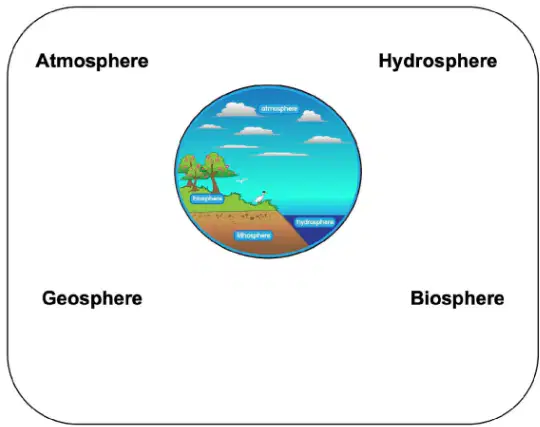
Which object belongs to the atmosphere in the nature scene illustration?
Clouds above the hills
Grass near the shore
Pebbles on the path
Fish in the lake
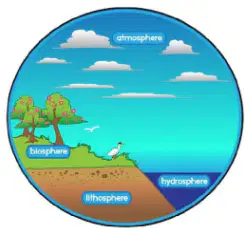
A student lists lake, stream, and water vapor. Which sphere are these items part of?
Biosphere components
Hydrosphere components
Atmosphere components
Geosphere components
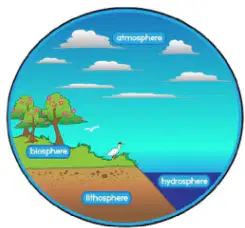
You observe a mountain, soil, and a volcano in a scene. What reasoning best supports placing them in the same sphere category?
They are bodies of liquid water
They are solid Earth materials
They are living organisms
They are forms of moving air
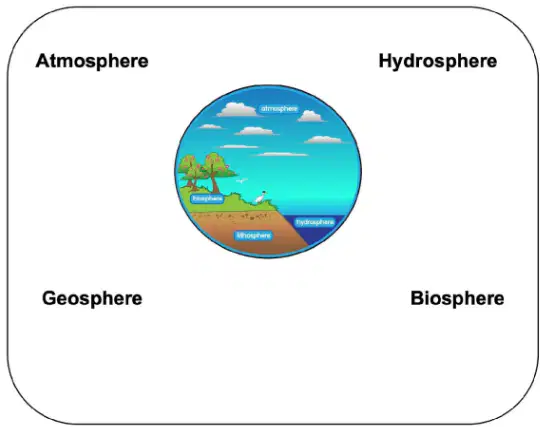
During the activity, you must write objects you see next to the correct sphere. Which plan will help you organize your observations?
Scan the scene and sort items by sphere
List everything randomly then decide later
Focus only on one sphere and ignore others
Choose items based on favorite colors
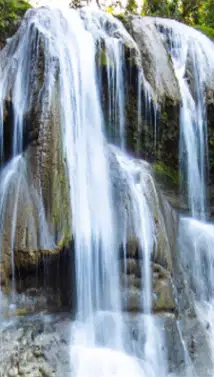
In the waterfall scene, which sphere is represented by the flowing water?
Biosphere component forming wet rocks
Atmosphere component creating clouds
Hydrosphere component moving as stream
Lithosphere component flowing downhill
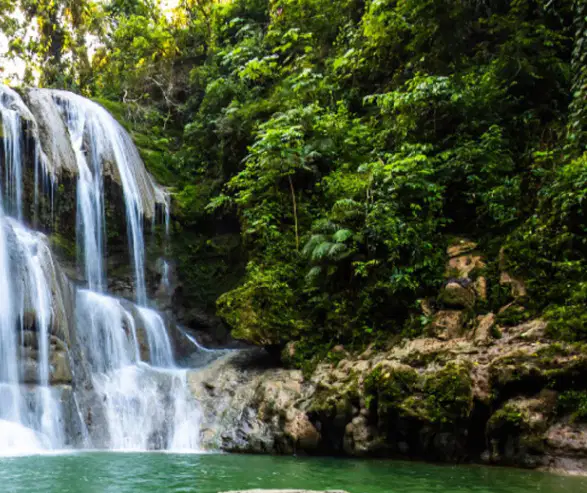
Which feature in the waterfall scene best represents the lithosphere?
Green leaves covering branches
Solid rocks surrounding the pool
Falling rain above the trees
Mist forming near the water
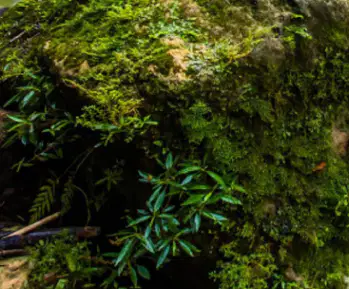
In the waterfall scene, moss growing on rocks belongs to which sphere?
Atmosphere processes near the cliff
Lithosphere minerals in stones
Biosphere organisms on surfaces
Hydrosphere sediments in pools

Which interaction between spheres is most visible in the waterfall scene?
Air currents eroding cloud layers
Sunlight forming metal deposits
Lightning charging tree trunks
Water shaping rock surfaces
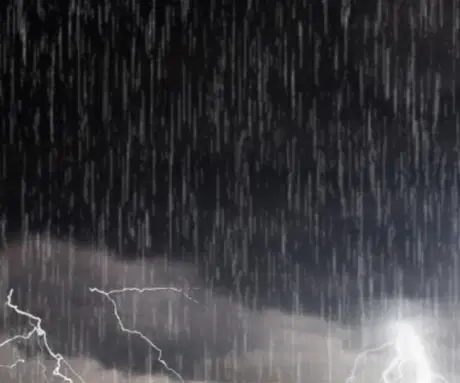
In the thunderstorm scene, falling rain mainly involves which sphere?
Hydrosphere precipitation from clouds
Cryosphere melting of glaciers
Lithosphere storage of minerals
Biosphere control of plant growth
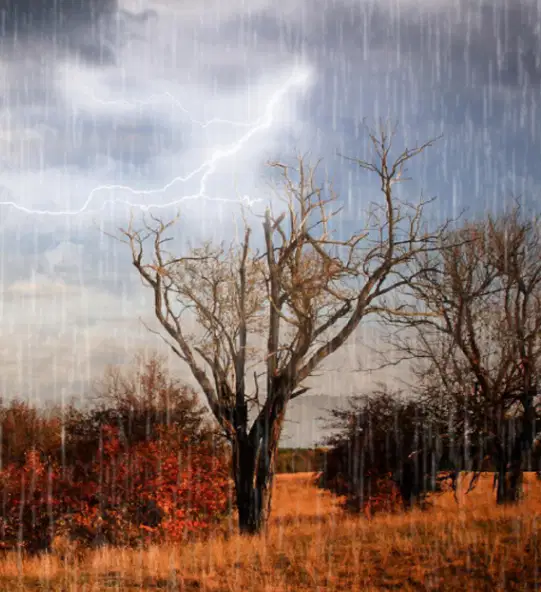
Lightning in the storm scene is part of the atmosphere. Which effect on another sphere is most direct?
Freezing lakes into solid ice
Creating new mountain landforms
Producing coral colonies in water
Burning or damaging nearby trees

Wet soil forming puddles in the storm scene shows interaction between which spheres?
Biosphere and cryosphere together
Magnetosphere and biosphere together
Atmosphere and exosphere together
Hydrosphere and lithosphere together
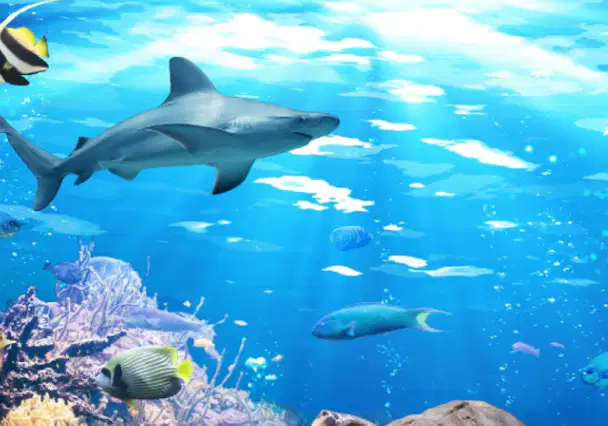
In the ocean reef scene, fish and sea turtles are part of which sphere?
Atmosphere surrounding the planet
Biosphere of living organisms
Hydrosphere in liquid water mass
Lithosphere beneath seabed rocks
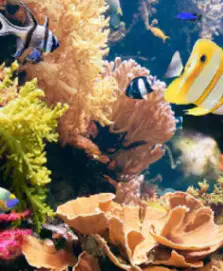
Coral structures in the reef scene mostly belong to the biosphere. Which statement explains why?
They are wind-formed sand ridges
They are frozen sea-ice formations
They are living colonies of tiny animals
They are gas bubbles in seawater

Sunlight beams entering the ocean in the reef scene show the atmosphere affecting which sphere most directly?
Lithosphere deep under the crust
Hydrosphere where light penetrates water
Biosphere only on land habitats
Cryosphere frozen at polar caps
Which example best shows all four spheres interacting across the three scenes?
Rain grows trees on bare rocks
Water and air move floating icebergs
Lightning forms caves in dry deserts
Ocean animals breathe oxygen in water
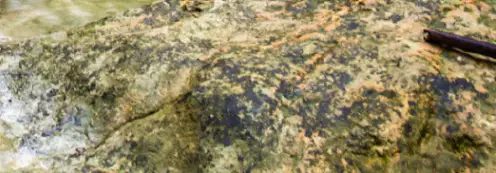
A student says the waterfall rocks are part of the hydrosphere because they are wet. What correction should be made?
Wet rocks are cryosphere components
Wet rocks are atmosphere components
Wet rocks belong to the biosphere always
Wet rocks are lithosphere components
Which Earth sphere includes rocks, soil, and landforms like mountains?
Biosphere with living things
Lithosphere with solid Earth
Hydrosphere with water bodies
Atmosphere with gases and clouds

In the island volcano scene, which two spheres interact when ash clouds rise from the crater?
Biosphere and hydrosphere
Atmosphere and cryosphere
Hydrosphere and biosphere
Lithosphere and atmosphere
Which process best shows the hydrosphere affecting the geosphere?
Magma heats air above vents
Plants release oxygen to the air
Rainwater erodes rock and soil
Wind forms sand dunes on beaches
Which statement correctly describes the biosphere?
It is only the ocean waters
It is only the air and clouds
It contains all forms of life
It includes all nonliving rocks
When plants release water vapor through transpiration, which spheres are interacting?
Biosphere and atmosphere
Lithosphere and hydrosphere
Atmosphere and geosphere
Cryosphere and biosphere
A heavy rainstorm leads to increased river flow that carries sediment downstream. What feedback could this create on coastal habitats?
Less sediment nourishes beaches
Sediment removes all marine life
No change to coastal systems
More sediment builds wetlands
Which example shows a two-way interaction between spheres?
Air warms rocks without effects
Water dissolves minerals in soil
Plants exist without using water
Ocean waves ignore coastal land

Volcanic eruptions can cool global temperatures for months. Which sphere change causes this cooling?
More ash in the atmosphere blocks sunlight
More magma in the geosphere adds heat
More fish in the biosphere eat plankton
More rain in the hydrosphere clears skies
What is the primary energy source that drives the Earth’s water cycle between the atmosphere, oceans, and land?
Wind
Sunlight
Ocean currents
Rotation of Earth
What two main factors determine an area’s climate?
Landforms and ocean currents
Bodies of water and landforms
Temperature and precipitation
Mountains and large cities
__________ occurs when water flows over the surface of land.
Runoff
Condensation
Precipitation
Transpiration
The __________ is the where gases form a blanket around the Earth.
Biosphere
Atmosphere
Hydrosphere
Lithosphere-----
The four stages of the water cycle are...
Precipitation, evaporation, condensation, & transpiration
Precipitation, heat energy, atoms released into the air, & atmosphere
Atmosphere, lithosphere, biosphere, & evaporation
Evaporation, condensation, atomic energy, thermal energy
Gravity is the force that...
is why humans can walk on sidewalks
keeps water on the ground
is the reason cows cannot fly
keeps water moving in the water cycle
Transpiration is the
process by which grass grows in the summer months
process by which plants absorb water through their roots and then release it through the pores on their leaves
process by which water evaporates into the air through animals
process by which salt water is purified
Evaporation is...
the process in which water turns into a solid
the process by which the sun turns water into air
the process by which water changes from a liquid state into a gas
the process by which clouds form
Condensation is...
the process in which water vapor cools and becomes a liquid
the process by which water turns into a gas
the process by which the sun heats water and it turns into gas
the process by which clouds convert water into precipitation
precipitation is...
rain, snow, clouds, condensation
sand, dirt, mud, rain
rain, snow, ice, hail
hail, snow, sun, runoff
As water turns into water vapor and rises, it cools and becomes... pick the answer that shows the two forms of the water cycle
evaporation -- transpiration
transpiration -- evaporation
precipitation -- condensation
evaporation -- condensation
Hydrosphere is the...
The gas around earth
The air above earth
The land on earth
Water on earth
Biosphere is the
the earth's water
the global ecosystem composed of living and non-living organisms
the hard layer of earth on the surface
the air surrounding earth
Approximately what percentage of the Earth's freshwater is easily available to humans?
1%
3%
71%
97%
Which is the following is true?
The amount of water on Earth is constantly changing
There is more fresh water than salt water
There is more fresh water in lakes and rivers than stored in underground deposits (aquifers)
The amount of water on Earth remains constant
Which of the following consist of the largest volume of freshwater?
lakes
rivers
groundwater (aquifers)
ice caps and glaciers

Which of the following is illustrated by 5?
evaporation
infiltration
runoff
transpiration

Which of the following is illustrated by 3?
condensation
infiltration
evaporation
precipitation

Which of the following is illustrated by 4?
condensation
percolation
evaporation
precipitation

Which of the following is illustrated by 2?
evaporation
precipitation
condensation
infiltration
What is the driving force of the water cycle?
water vapor
clouds
rain
sun's energy
____________ occurs when water vapor cools and changes into liquid water droplets that form clouds in the atmosphere.
evaporation
condensation
infiltration
precipitation
_________occurs when liquid water from the Earth's surface and from living organisms changes into water vapor
percolation
condensation
evaporation
precipitation
How much of the Earth's surface is covered in water?
2%
71%
3%
97%
Water vapor is a product of transpiration. Which of the following produces water vapor through transpiration?
oceans
lakes
plants
rivers
How much of the Earth's water is freshwater?
97%
50%
3%
1%
______ is the movement of water into the ground due to the pull of gravity
runoff
infiltration
groundwater
precipitation
________is water that flows across land and collects in rivers, streams, and eventually the ocean
runoff
infiltration
condensation
evaporation
Approximately what percentage of the Earth's freshwater is easily available to humans?
1%
3%
71%
97%
Which is the following is true?
The amount of water on Earth is constantly changing
There is more fresh water than salt water
There is more fresh water in lakes and rivers than stored in underground deposits (aquifers)
The amount of water on Earth remains constant

