
 Worksheets
11 Feedforward- Formulas, Units Key Facts !
Total questions: 108
Worksheet time: 1hrs 15mins
Average velocity is best described by which expression?
Change in displacement divided by change in time
Total path length divided by total time
Change in speed divided by change in time
Final displacement minus initial velocity
Acceleration can be calculated using which formula?
Distance divided by speed
Change in velocity divided by change in time
Force multiplied by time
Velocity divided by displacement
Which relation gives the net force on a mass m?
Force equals mass times acceleration
Force equals mass times velocity
Force equals momentum over time
Force equals work divided by distance
Weight W of an object near Earth is given by which expression?
Weight equals force times perpendicular distance
Weight equals mass divided by acceleration due to gravity
Weight equals density times volume
Weight equals mass times gravitational field strength
Moment of a force about a pivot equals which quantity?
Mass times acceleration at the pivot
Work done divided by time at the pivot
Force times perpendicular distance from pivot
Force divided by area at the pivot
A spring obeying Hooke’s law requires which force to extend it by x?
Force equals change in momentum over time
Force equals mass times velocity squared
Force equals weight minus gravitational field strength
Force equals spring constant times extension
Which expression defines momentum p of a moving body?
Momentum equals mass times velocity
Momentum equals force times distance
Momentum equals weight times height
Momentum equals energy transformed over time
Impulse delivered by a constant force over time Δt equals what?
Force times time equals change in momentum
Force divided by time equals momentum
Mass times acceleration equals impulse
Work done equals impulse times distance
Work done W by a force moving through distance d equals which product?
Pressure multiplied by area
Force multiplied by distance
Momentum multiplied by velocity
Energy transformed divided by time
Which formula gives kinetic energy Ek of a body with mass m and speed v?
Mass times velocity divided by two
Mass times velocity squared times two
Half times mass divided by velocity squared
Half times mass times velocity squared
Gravitational potential energy increase when raising mass m by height Δh in field g is:
Mass times velocity times change in height
Mass times g times change in height
Mass times g divided by change in height
Half mass times g times height squared
Power P is defined as which quantity in energy terms?
Energy transformed divided by time
Force multiplied by velocity
Work done multiplied by time
Energy transformed multiplied by distance
Density ρ of a material is defined by which ratio?
Weight divided by area
Mass times gravitational field strength
Mass divided by volume
Force divided by distance
Pressure p on a surface is calculated as which ratio?
Weight divided by volume
Force divided by area
Energy divided by time
Density times velocity
Convert a temperature from Celsius θ to Kelvin T. Which relation is correct?
Kelvin equals Celsius times 273
Kelvin equals Celsius plus 273
Kelvin equals 273 minus Celsius
Kelvin equals Celsius minus 273
Thermal energy transferred ΔE when mass m warms by ΔT with specific heat capacity c equals:
Mass times specific heat capacity times temperature change
Specific heat capacity divided by mass times ΔT
Mass plus c plus ΔT multiplied
Mass times temperature change divided by c
Which relation ties wave speed v to frequency f and wavelength λ?
Wave speed equals frequency divided by wavelength
Wave speed equals frequency minus wavelength
Wave speed equals wavelength divided by frequency
Wave speed equals frequency times wavelength
At the critical angle for total internal reflection, which holds for refractive index n?
Sine of critical angle equals refractive index squared
Sine of critical angle equals one over refractive index
Sine of critical angle equals refractive index
Sine of critical angle equals one times refractive index
The refractive index n between two media can be expressed as:
Sine incident angle divided by sine refracted angle
Sine refracted angle divided by sine incident angle
Cosine incident angle divided by sine refracted angle
Tangent incident angle divided by sine refracted angle
Snell’s law for refraction between air and a material with refractive index n, angle of incidence i and refraction r is:
n=sin(r)/sin(I)
n=sin(i)/sin(r)
n=r/i
n=i/r
Refractive index n of a medium relates to light speeds in a vacuum c and in medium v by?
n = c-v
n=v/c
n=c/v
n=c+v
Potential difference V across a component relates to current I, charge Q and resistance R by:
V=QR
V=I/R
V=R/I
V=IR
Energy transformed E in an electrical component over time t is:
Resistance times current times time
Current times voltage times time
Current divided by voltage times time
Voltage minus current times time
Total resistance Rtotal for series resistors is found how?
Sum of individual resistances in series
Product of resistances in series
Difference of resistances in series
Sum of reciprocals in series
For two resistors used as a potential divider, what equals the ratio R1/R2?
Ratio of powers P1 over P2
Ratio of currents I1 over I2
Ratio of voltages V1 over V2
Ratio of energies E1 over E2
In a parallel network, which statement about total resistance RT is correct. resistors in parallel are R1 and R2?
RT=R1+R2
RT=R1=R2
1/RT=1/R1+1/R2
RT=1/R1+1/R2
What is the SI unit for length?
volt
pascal
second
metre
Which quantity has the unit newton metres Nm?
Power
Pressure
Moment
Energy
Select all quantities measured in joules.
Moment
Power
Work
Energy
What is the unit symbol for temperature in Kelvin?
K
°C
Pa
J
Which quantity uses coulomb (C) as its unit?
charge
current
voltage
resistance
Match each unit to its correct unit symbol.
kilogram
kg
metre
m
second
s
ampere
A
Which option lists correct units for velocity?
metres per second
metres per kilogram
newtons per second
joules per second
What is the unit symbol for power?
N
J
W
Pa
Select the correct unit for density.
newtons per cubic metre
kilograms per metre
kilograms per cubic metre
joules per cubic metre
Which symbol represents wavelength?
λ
V
v
f
Which symbol represents frequency?
λ
V
v
f
Which symbol represents wave speed?
λ
V
v
f
Match each electrical quantity to its unit.
current
ampere
voltage
volt
resistance
ohm
charge
coulomb
Which unit symbol corresponds to frequency?
Nm
N
Hz
kg
Acceleration is measured in which units?
joules per second
newtons per metre
metres per second squared
metres per second
Specific heat capacity uses which unit?
N m
kg m⁻³
J s⁻¹
J kg⁻¹ °C⁻¹
Which formula represents the relationship between work done W, force F, and distance d?
W equals F minus d
W equals F plus d
W equals F times d
W equals F divided by d
What is the unit of measurement for electric charge?
Watt
Volt
Ohm
Coulomb
SI unit for mass?
kilograms
grams
pounds
metres
SI unit for force?
Joules
Watts
Newtons
Yoda
SI unit for time?
seconds
minutes
hours
days
SI unit for energy
Joules
Watts
Newtons
meters
Formula for kinetic energy, where mass m, velocity v, Workdone W, time t, Force F, distance d and height change h
KE = mgh
KE = 21 mv2
KE = Fd
KE = W/t
Formula for gravitational potential energy, where mass m, velocity v, Workdone W, time t, Force F, distance d and height change h is?
GPE = mgh
GPE = 21 mv2
GKE = Fd
GPE = W/t
SI unit for power
Watts
Joules
Newtons
Meters
Formula for power
P = W/t
P = E/t
P = W*t
P = E*t

What does the W in this equation stand for?
watt
work
weight
width

What are we looking for in this equation?
power
weight
width
time

What does F in this equation stand for?
first
final velocity
force
Select the correct formula for Kinetic Energy Ek:
Ek=½mg²
Ek=½mv²
Ek=2mv²
Ek=½gv²
Select the correct formula for acceleration a
a=(v-g)/t
a=t/(v-u)
a=(v-u)/t
a=(v-t)/u
Select the correct formula:
F=m·a
F=m·t
F=t·a
F=d·a
What is constant in a gas if the temperature is always the same:
V/P
P/V
P·T
P·V
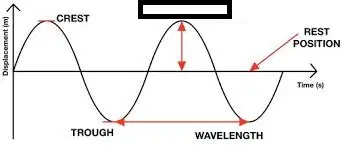
Which label is missing in the box?
trough
crest
wavelength
amplitude
Select the correct formula for an echo:
v=d/t
v=2d/t
v=2t/d
v=2d·t
Four wires are made of the same metal. Which wire has the greatest resistance?
a 100 cm long wire with a diameter of 3.0 mm
a 100 cm long wire with a diameter of 6.0 mm
a 10 cm long wire with a diameter of 3.0 mm
a 10 cm long wire with a diameter of 6.0 mm

A student uses four ammeters P, Q, R and S to measure the current in different parts of the circuit shown. Which two ammeters read the largest current?
P and Q
P and R
R and Q
R and S
Several cells are connected in series, as shown. What is the combined electromotive force (e.m.f.) of the cells?
the average of the e.m.f.s of the separate cells
the e.m.f. of one of the cells
the product of the e.m.f.s of the cells
the sum of the e.m.f.s of the cells
In which unit is potential different measured?
ampere
Ohm
Volt
Watt
There is a current of 5.0A in a resistor. The potential difference (p.d.) across the resistor is 24V. How much energy is transferred in the resistor in 1.0 minute?
5.0 J
120 J
290 J
7200 J
Which statement correctly describes the effects of placing a heavy load in a car?
It is easier to accelerate the car and easier to bring the car to rest.
It is easier to accelerate the car but more difficult to bring the car to rest.
It is more difficult to accelerate the car and more difficult to bring the car to rest.
It is more difficult to accelerate the car but easier to bring the car to rest.
A mass of 6.0 kg rests on the surface of a planet. On this planet, g = 20 N/kg.
What is the weight of the object?
0.30 N
0.60 N
60 N
120 N
Two forces P and Q act on an object. Which diagram shows the resultant of these two forces?


A fire alarm is not loud enough and the pitch is too low. An engineer adjusts the alarm so that it produces a louder note of a higher pitch.
What effect does this have on the amplitude A and on the frequency F of the sound?
A: larger | F: greater
A: larger | F: smaller
A: smaller | F: greater
A: smaller | F: smaller
Two beams of light are both the same colour of red. One beam is travelling through air. The other beam is travelling through water. Each beam has a different brightness.
Which quantity is the same for both sets of waves?
Amplitude
Frequency
Speed
Wavelength

The diagram shows how a ray of light refracts when going from air to Perspex. The critical angle of Perspex is c. Which expression is correct?
sin x /sin z = sin c
sin z / sin x = sin c
sin w / sin y = sin c
sin y / sin w = sin c

The letter F is reflected in a mirror. What does the optical image look like?


Which diagram shows what happens when a ray of white light passes through a prism?


Light travels in a vacuum and then enters a glass block. The speed of the light in the glass block is 2.0 x 10^8 m/s.
Which statement about the speed of light is correct?
The speed in a vacuum is 1.5 times the speed in the glass.
The speed in the glass is the same as the speed in a vacuum.
The speed in the glass is 1.5 times the speed in a vacuum.
The speed in the glass is 1.0 x 10^8 times the speed in a vacuum.

6 cm
10 cm
26 cm
30 cm
Which statement gives a complete description of any object that is in equilibrium?
There are no forces acting.
There is no resultant force.
There is no resultant force and no resultant turning effect.
There is no resultant turning effect.
What is the unit of the moment of a force?
N
N/kg
N/m
Nm

80 N
100 N
180 N
225 N
A liquid is evaporating. The liquid is not boiling.
Which statement about the liquid is correct at an instant in time?
Any molecule can escape, and from any part of the liquid.
Any molecule can escape, but only from the liquid's surface.
Only molecules with enough energy can escape, and only from the liquid's surface.
Only molecules with enough energy can escape, but from any part of the liquid.
Which equation can be used to calculate the pressure at a depth h beneath the surface of a liquid?
p= ρgh
p=ghρ
p=hρg
p=hρg1
A fixed mass of gas is trapped in a container. The temperature of the gas is increased but the volume of the gas is kept constant.
How does this change affect the kinetic energy of the molecules and the pressure on the walls of the container?
Kinetic Energy: increases | Pressure: increases
Kinetic Energy: stays the same | Pressure: increases
Kinetic Energy: increases | Pressure: decreases
Kinetic Energy: decreases | Pressure: increases
An object is 20 cm below the surface of a liquid. The density of the liquid is 1200 kg/m3. Use g = 10 ms-2
What is the pressure on the object due to the liquid?
600 Pa
2400 Pa
60000 Pa
240000 Pa
Which statement about the evaporation of a liquid is correct?
The least energetic molecules escape from the surface and the temperature of the liquid decreases.
The least energetic molecules escape from the surface and the temperature of the liquid increases.
The most energetic molecules escape from the surface and the temperature of the liquid decreases.
The most energetic molecules escape from the surface and the temperature of the liquid increases.
Which energy resource has the Sun as its only source of energy?
geothermal
nuclear
oil
tidal
Which of the following energy resources is renewable?
oil
solar
coal
nuclear
Which of the following energy resources relies on fuel being consumed?
wind
waves
nuclear fission
hydroelectricity
Which of the following energy resources relies on fuel being consumed?
wind
waves
nuclear fission
hydroelectricity
What are boiling points?
the temperature at which a liquid turns into a gas
the temperature at which a liquid turns into a solid
the temperature at which a gas turns into a liquid
the temperature at which a solid turns into a liquid
What is Brownian motion?
the movement of small particles suspended in a liquid or gas
an electrical device made of two different metals
when a wave spreads out as it travels through a gap or past the edge of an object
electricity is generated when a coil moves near a magnet
What happens when particles are heated?
they gain kinetic energy and vibrate
they dance aggressively
they become dormant
they decay
What is temperature?
energy being transferred in waves
the total kinetic energy of all particles
energy being transferred from a hotter place to a colder place
the average kinetic energy of individual particles
What is specific heat capacity?
how much heat energy a material can hold
how much a material can hold
how much energy required per unit mass to increase the temperature
the energy needed to boil or melt a material
Which of the following is a great conductor?
Glass
Silver
Polystyrene
Rubber
What is convection?
transfer of heat energy without the movement of the material itself
energy transferred by an electric current
transferring energy by means of a force
transfer of heat energy through a material with the movement of the material itself
Which of the following is the best reflector?
Matt black
Shiny white
Matt white
Shiny black
What happens when the amplitude increases?
The pitch increases
The volume increases
The pitch decreases
The volume decreases
What are sounds above 20,000 Hz called?
Infrared
Ultrasound
Ultraviolet
Infrasound
What word matches this description?: A region of a sound wave where the particles are pushed together.
Refraction
Compression
Rarefaction
Dispersion
Which of the following statements best describes a transverse wave?
a wave that vibrates at right angles to the direction of energy transfer
a wave that vibrates parallel to the direction of energy transfer
a sound wave
a wave that crosses other wavefronts
Which of the following statements best describes a longitudinal wave?
a wave that vibrates at right angles to the direction of energy transfer
a wave that vibrates parallel to the direction of energy transfer
a light wave
a wave that crosses other wavefronts
Which of the following is a type of longitudinal wave?
microwave
radio wave
sound wave
Mexican wave
A wave has a time period of 0.2 s. What is the frequency of the wave?
0.2 Hz
5 Hz
0.2 s
5 s
A cyclist rotates the pedals of his bike twice in 1 second. What is the frequency at which he is turning?
2 Hz
1 Hz
0.5 Hz
20 Hz
The wave machine at a swimming pool oscillates at a frequency of 0.25 Hz. What is the time period of the wave?
25 seconds
0.25 seconds
4 seconds
40 seconds
A dolphin sends out a call to another dolphin at a frequency of 130 Hz. The speed of sound in water is 1400 m/s. What is the wavelength of the wave?
11 m
0.1 m
182 m
101 m
Which of the following statements is true about sound waves?
They can travel through a vacuum.
They require a medium to propagate.
They are longitudinal waves.
They travel faster in air than in water.
What is the unit of measurement for electric current?
Volt
Ohm
Ampere
Watt

