
 Worksheets
Page 1
Total questions: 150
Worksheet time: 1hrs 15mins
Which radiation has the least ionizing power and greatest penetrating ability?
alpha particles
beta particles
gamma emissions
positron emissions
An element that is very reactive metal likely has which atomic number characteristic?
a transition metal atomic number
a noble gas atomic number
a halogen atomic number
an alkali metal atomic number
Which Lewis electron-dot diagram represents a nitrogen atom in the ground state?
N with 5 valence electrons
N with 4 dots total
N with 2 valence electrons
N with 6 paired electrons
Which list contains only chemical compounds?
H2, Ne, NaCl
H2, N2, O2
CO2, H2O, NH3
MgO, NaCl, O2
Iodine-131 has a half-life of 8.021 days. What fraction of an original sample remains unchanged after 24.063 days?
1/4 of the original
1/8 of the original
1/2 of the original
1/3 of the original
Which statement best describes the charges and counts of protons and electrons in a neutral atom?
opposite charges and unequal numbers
opposite charges and equal numbers
same charge and equal numbers
same charge and unequal numbers
The bright-line spectrum of an element is produced when excited-state electrons do what?
absorb energy and move higher
release energy and move higher
release energy and move lower
absorb energy and move lower
Magnesium and calcium have similar chemical properties because atoms in their ground states have which configuration?
two electrons in the outermost shell
equal numbers of protons and neutrons
two electrons in the first shell
equal numbers of protons and electrons
Which statement explains why alpha particles have low penetrating power compared with beta and gamma radiation?
They are neutral and very light
They are doubly charged and relatively massive
They are photons with high energy
They have single negative charge and small mass
How many half-lives have elapsed after 24.063 days for iodine-131 with a half-life of 8.021 days, and what fraction remains?
four half-lives; 1/16 remains
three half-lives; 1/8 remains
two half-lives; 1/4 remains
one half-life; 1/2 remains
Which properties of an object will determine if the object will sink or float in water?
material and color
material and shape
length and color
length and shape
What is the total number of electrons in a Cr3+ ion?
27
24
18
21
In the morning, a student observed a puddle of water on the school playground. At the end of the day, the puddle was gone. Which process most likely caused the puddle to disappear?
erosion
deposition
condensation
evaporation
The discovery of the electron as a subatomic particle was a result of
collision theory
kinetic molecular theory
the gold-foil experiment
experiments with cathode ray tubes
Two gaseous forms of oxygen are diatomic oxygen, O2, and ozone, O3. These two forms of oxygen have
the same molecular structure and the same properties
the same molecular structure and different properties
different molecular structures and the same properties
different molecular structures and different properties
How many joules of heat are absorbed to raise the temperature of 435 grams of water at 1 atm from 25°C to its boiling point, 100°C?
7.4 × 10^7 J
2.5 × 10^7 J
1.4 × 10^5 J
4.5×10⁴ J
Which phrase describes two atoms that contain the same number of protons but a different number of neutrons?
ions of the same element
nuclides of different elements
isotopes of the same element
a mixture of different elements
Using equal masses of reactants, which statement describes the relative amounts of energy released during a chemical reaction and a nuclear reaction?
The chemical and nuclear reactions release equal amounts of energy.
The nuclear reaction releases half the amount of energy of the chemical reaction.
The chemical reaction releases more energy than the nuclear reaction.
The nuclear reaction releases more energy than the chemical reaction.
Based on Table S, which general trend is observed as the elements in Group 17 are considered in order of increasing atomic number from fluorine to iodine?
increase in boiling point
increase in first ionization energy
decrease in density
decrease in melting point
Which evidence best supports that a potassium ion (K+) has the same electron configuration as a noble gas?
Potassium loses one electron, leaving a full second shell
Potassium gains one electron to match neon
Potassium has 19 protons, qualifying it as noble
Potassium shares electrons to become stable with chlorine
Which sample can be classified as a substance?
Seawater from the shoreline
Topsoil from a garden bed
Argon gas in a sealed cylinder
Air mixture in the troposphere
Which formula represents an isotope of 16 8 O?
16 7 O
15 7 O
16 9 O
18 8 O
When the nucleus of neon-19 decays, which particle is emitted?
4 2 He
0 -1 e
0 +1 e
1 0 n
Which numerical setup correctly determines the atomic mass of boron from its two naturally occurring isotopes and abundances?
(10.01 u)(19.9) + (11.01 u)(80.1) divided by 100
(10.01 u)(0.199) + (11.01 u)(0.801)
10.01 u + 11.01 u over 2
19.9% + 80.1% over 2
In analyzing chemical properties for sustainable road treatment, which factor is most directly related to predicting compound behavior in freezing conditions?
Reference table atomic masses only
Color of the compound in solid form
Molecular charge distributions in solutions
Lab data of proton counts per element
For winter road treatment, why is hydrogen sulfide (H2S) not suitable as a de-icing salt compared to sodium chloride (NaCl)?
H2S is denser than NaCl at room temperature
H2S has a higher melting point than NaCl
H2S has more neutrons than NaCl
H2S is a covalent gas, NaCl is an ionic solid
Which statement about isotopes is correct when comparing B-10 and B-11?
They have different atomic numbers and identical masses
They have the same atomic number but different mass numbers
They have equal mass numbers but different charges
They are different elements with the same electrons
What property makes argon useful for classifying as a substance in the context of samples like air, soil, and seawater?
It is a pure element with consistent composition
It dissolves salts uniformly in water
It forms compounds that vary in soil
It reacts vigorously with oxygen gas
Which reasoning supports matching K+ to the electron configuration of argon rather than neon?
K loses two electrons to reach 2-8-7
K shares electrons to reach 2-8-7
K gains two electrons to reach 2-8-8-2
K loses one electron to reach 2-8-8
Uranium-238 undergoes a series of spontaneous decays in Earth’s crust. Which nuclide is produced directly after uranium-238 in this decay chain?
thorium-234
lead-206
polonium-218
radon-222
Radon-222 decays to polonium-218. Which statement correctly describes the half-life of radon-222?
It is 3.04 hours
It is 3.04 days
It is 3.04 seconds
It is 3.04 minutes
Eventually, a stable nuclide is formed after alpha decay steps in the uranium-238 series. Which stable nuclide is produced?
polonium-206
mercury-206
lead-207
lead-206
Complete the nuclear equation for the decay that produces Pb-206 by choosing the missing nuclide: ____ → 4He + 20682Pb
20284Po
21084Po
21080Hg
20280Hg
Which phrase describes a factor that determines the physical state of a molecular substance?
arrangement of the molecules
decay mode of the molecules
solubility of the molecules
conductivity of the molecules
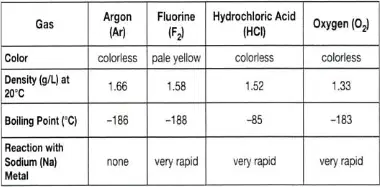
A scientist tested a colorless gas with density at 20°C between 1.30 and 1.60 g/L and a boiling point near −190 to −180°C. The gas reacted with sodium metal very rapidly. Which identity is most likely?
oxygen (O2)
argon (Ar)
fluorine (F2)
hydrochloric acid (HCl)
Why does alpha decay decrease both mass number and atomic number of a nuclide?
Alpha particle increases neutron count
Alpha particle carries two protons
Alpha particle removes only electrons
Alpha particle carries two neutrons
Which observation best distinguishes argon from oxygen among colorless gases at room temperature?
argon has acidic behavior in water
argon has greater electrical conductivity
argon has higher solubility in water
argon is nonreactive with sodium
If radon-222 has a half-life of 3.04 minutes, how much of a 100 g sample remains after approximately 9.12 minutes?
50.0 grams
25.0 grams
12.5 grams
33.3 grams
In a decay series, the term “spontaneous decay” most directly implies which characteristic of the process?
It occurs without external trigger
It requires continuous heating
It depends on molecular state
It is controlled by catalysts
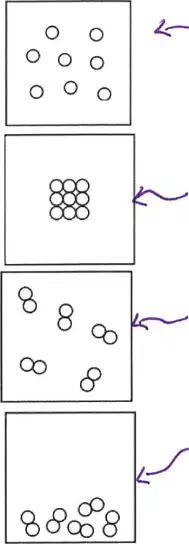
Which particle diagram best represents neon gas at 35 K and 1.0 atm? The key shows each circle is one atom of neon. Pick the diagram with widely spaced single atoms.
Clusters of atoms with short range order
Widely spaced single atoms randomly distributed
Closely packed spheres in a fixed array
Pairs of atoms moving together throughout
Which proposal came earliest in developing the modern atomic model?
Electrons in atoms have wavelike properties
Atoms contain internal structure with negative particles
Atoms are mostly empty space with a dense nucleus
Atoms are hard, indivisible spheres of different sizes
Which statement describes a chemical property of an element?
Melts at 933 K under standard pressure
Reddish appearance when freshly polished
Has a density of 0.89 g/cm³ at room temperature
Reacts with hydrogen sulfide to form a compound
A large sample of solid calcium sulfate is crushed into smaller pieces. Which pair of physical properties remains the same for both samples?
Mass and volume stay unchanged
Solubility and density stay unchanged
Mass and density stay unchanged
Solubility and volume stay unchanged
Determining the age of a wooden beam from a sunken ship is an example of a beneficial use of what?
Homogeneous mixtures in sediments
Lewis structures of organic compounds
Polyatomic ions in seawater
Radioactive nuclides for dating
Which element is a brittle solid with low electrical conductivity at STP?
Sulfur
Sodium
Aluminum
Argon
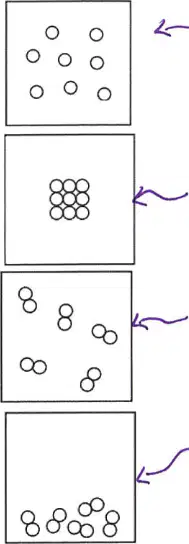
Why is neon represented by single, separate atoms in a gas diagram rather than diatomic pairs?
Neon is a noble gas that is monatomic
Neon bonds to itself weakly in liquid state
Neon becomes ionic under standard conditions
Neon forms stable diatomic molecules at low temperature
Which change indicates a physical property rather than a chemical property?
Copper forms green patina over time
Silver tarnishes with hydrogen sulfide
Aluminum melting at high temperature
Potassium reacts violently with water
When a sample is subdivided, which type of property remains constant regardless of sample size?
Intensive properties like density
Extensive properties like energy content
Extensive properties like volume
Extensive properties like mass
Radiocarbon dating of wood relies primarily on measuring what?
The solubility of carbon compounds in water
The melting point shift due to impurities
The density change of carbon over time
The ratio of C-14 to C-12 in the sample
Diamond and graphite are two forms of solid carbon. These two forms of carbon have what relationship between crystal structures and properties?
different crystal structures and the same properties
different crystal structures and different properties
the same crystal structure and the same properties
the same crystal structure and different properties
What is the amount of heat absorbed when the temperature of 75 grams of water increases from 20.0°C to 35°C? Use q = mcΔT and c = 4.18 J/g·°C.
11 000 J
4700 J
6300 J
1100 J
Compared to the charge of a proton, the charge of an electron has which magnitude and sign?
the same magnitude and the opposite sign
a greater magnitude and the same sign
a greater magnitude and the opposite sign
the same magnitude and the same sign
Which ion in the ground state has the same electron configuration as an atom of neon in the ground state?
Cl⁻
F⁻
Li⁺
K⁺
Which Group 15 element is classified as a metal?
P
Bi
N
As
Which statement describes the relationship between two electrons in an atom of magnesium in the ground state?
An electron in the second shell has the same amount of energy as an electron in the third shell.
An electron in the first shell has a greater amount of energy than an electron in the second shell.
An electron in the first shell has the same amount of energy as an electron in the second shell.
An electron in the third shell has a greater amount of energy than an electron in the second shell.
The difference in which property allows the separation of a sample of water and sand by using filter paper and a funnel?
boiling point
melting point
sample volume
particle size
What is the number of electrons in an atom of scandium?
45
66
24
21
Which electron configuration represents the electrons in an atom of sodium in the ground state at STP?
2-7-7
2-8-6
2-7-2
2-8-1
A student claims that electrons in different shells of the same atom always have the same energy. Which evidence-based correction should be made to this claim?
Electrons in higher shells have greater energy than lower shells.
Electrons in the second and third shells have equal energy.
Electrons in all shells have identical energy levels.
Electrons in the first shell have greater energy than second shell.
Which notations represent atoms that have the same number of protons but different numbers of neutrons?
Ga-70 and Ge-73
H-3 and He-3
S-32 and S-32
Cl-35 and Cl-37
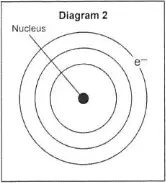
In the diagrams of a hydrogen atom, which option best describes diagram 2 showing the electron farther from the nucleus?
an atom of hydrogen in the ground state
an atom of hydrogen in an excited state
a negative ion of hydrogen
a positive ion of hydrogen
Which description of the atom aligns with conclusions from the gold foil experiment conducted in the early 1900s?
Atoms are small, dense, indivisible spheres.
Atoms are composed of protons, electrons, and neutrons.
Atoms have small, dense, positively charged nuclei.
Atoms have electrons with wavelike properties.
An atom in the ground state has two electrons in its first shell and six electrons in its second shell. What is the total number of protons in the nucleus of this atom?
5
8
2
7
Which electron configuration represents the electrons in a neon atom in an excited state?
2-6-1
2-7-1
2-8
2-7
Which electron configuration represents the electrons of an atom in an excited state?
2-8-8-1
2-8-9-2
2-8-2
2-7-3
As elements in Period 2 of the Periodic Table are considered from left to right, which property generally decreases?
atomic radius
electronegativity
ionization energy
nuclear charge
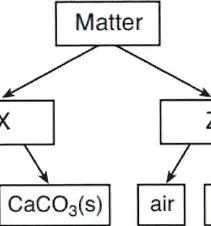
Given the classification diagram of matter with X containing Fe(s) and CaCO3(s), and Z containing air and NaCl(aq), which types do X and Z represent?
X is mixture, and Z is substance.
X is substance, and Z is mixture.
X is element, and Z is compound.
X is compound, and Z is element.
Which statement explains why the gold foil experiment implied a concentrated positive charge in atoms?
Some alpha particles were deflected at large angles.
Electrons were found evenly spread in the atom.
Neutrons caused minor scattering effects.
Alpha particles all passed straight through the foil.
For a neutral atom with electron configuration 2-8-1, what is the atomic number?
9
10
11
12
Which sequence shows a correct historical development toward the modern atomic model?
Empty space then orbitals then hard sphere
Hard sphere then orbitals then empty space
Hard sphere then empty space then orbitals
Empty space then hard sphere then orbitals
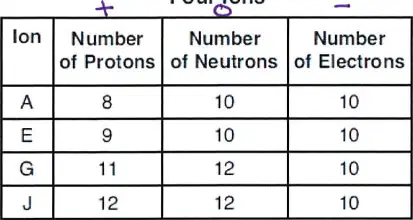
The table lists protons, neutrons, and electrons for ions A, E, G, and J. Which ion has a charge of −2?
A with 8p,10n,10e
E with 9p,10n,10e
G with 11p,12n,10e
J with 12p,12n,10e
Which element has chemical properties most similar to sodium because it has the same number of valence electrons?
Magnesium in Group 2 metal
Phosphorus in Group 15 nonmetal
Oxygen in Group 16 nonmetal
Rubidium in Group 1 alkali metal
Which substance can be broken down by a chemical change because it is a compound?
Ethane, a covalent compound
Krypton, a noble gas element
Manganese, a transition element
Cobalt, a metallic element
Which symbol represents a particle that has a total of 10 electrons?
N3+ with 4e cation
N with 7e neutral
Al neutral with 13e
Al3+ with 10e cation
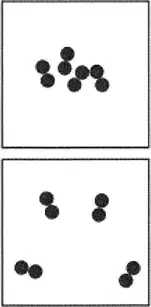
Which particle diagram best represents oxygen gas at STP as a diatomic molecule?
Separate single O atoms
Cluster of many unpaired atoms
Paired atoms in twos evenly spaced
Mixed single and paired atoms
In all atoms of bismuth, the number of electrons must equal which quantity when neutral?
Difference between neutrons and protons
Number of neutrons in the nucleus
Sum of neutrons and protons
Number of protons in the nucleus
An ion with 11 protons and 10 electrons has which overall charge and is an ion of which element?
−1 charge, sodium
+1 charge, sodium
+1 charge, magnesium
−1 charge, magnesium
Which statement best explains why rubidium reacts similarly to sodium?
Same mass number, similar nuclei
Same period, equal atomic radii
Same density, metallic bonding
Same group, one valence electron
Which change could break ethane into simpler substances?
Chemical reaction like combustion
Phase change like condensation
Mechanical change like grinding
Physical change like melting
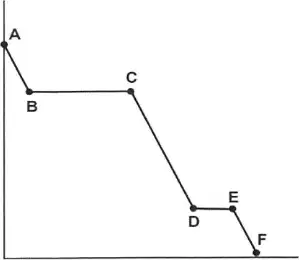
Given the cooling curve for a substance, during which intervals is the potential energy decreasing while the average kinetic energy remains constant?
BC and DE
EF and AB
EF and DE
BC and AB
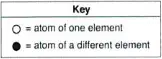
Which two particle diagrams represent two different phases of the same compound only?
B and D
A and C
B and C
A and B

Which element reacts in a manner most similar to oxygen based on its placement in the periodic table portion shown?
fluorine
sulfur
neon
phosphorus
Which formula represents chromium(III) oxide?
CrO3
Cr3O
Cr2O3
Cr3O2
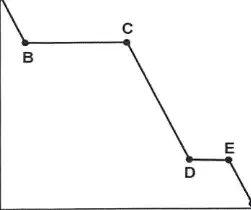
On a cooling curve, what does a flat (horizontal) segment indicate?
Temperature rising steadily
Instantaneous freezing point
Decrease in kinetic energy only
Phase change at constant temperature
When converting chromium(III) oxide to its empirical formula, what charge balance is applied between Cr3+ and O2−?
One Cr3+ with one O2−
Two Cr3+ with one O2−
Two Cr3+ with three O2−
Three Cr3+ with two O2−
Elements in the same group of the periodic table most likely share which property?
Exactly equal atomic masses
Similar valence electron patterns
Same number of protons and neutrons
Identical atomic numbers

In particle diagrams of different phases of the same compound, which feature stays the same across phases?
Arrangement rigidity
Spacing between particles
Type of atoms present
Number of particles shown
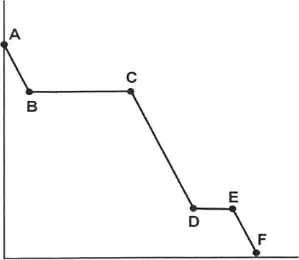
During the segment BC on a cooling curve, the average kinetic energy of particles typically does what?
Increases rapidly
Remains constant
Decreases to zero
Oscillates unpredictably
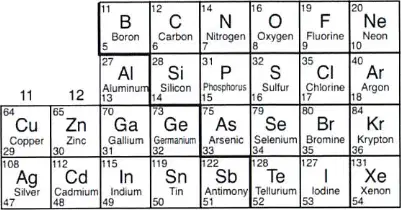
Which nonmetal, placed directly below oxygen in the periodic table shown, would display the most similar chemical reactivity?
Neon in Group 18
Phosphorus in Group 15
Fluorine in Group 17
Sulfur in Group 16
What is the correct formula for iron(II) oxide?
FeO2
Fe2O
Fe2O3
FeO
Which Lewis electron-dot diagram best represents potassium iodide?
K: :I:
K+ :I: :I:
K: I
K: :I: :I:
What is the IUPAC name for ZnO?
zinc oxide
zinc oxalate
zinc peroxide
zinc hydroxide
How many atoms are present in one formula unit of Ca3(PO4)2?
5
8
13
10
What is the correct formula for lead(IV) oxide?
Pb4O
Pb2O
PbO4
PbO2
Which pair is most likely to form an ionic bond by transfer of valence electrons?
O and Se
O and Sr
O and H
O and P
Which is the correct name for CuS?
copper(I) sulfate
copper(I) sulfide
copper(II) sulfate
copper(II) sulfide
A 50.0 g sample of a molecular compound requires heat to completely melt at its melting point. The heat of fusion is 127 J/g. What amount of heat is needed?
254 J
50.0 J
6350 J
127 J
Which statement explains why FeO is the formula for iron(II) oxide?
O2− requires two Fe2+ ions
Fe3+ balances O2− in 1:1 ratio
Fe2+ requires two O2− ions
Fe2+ balances O2− in 1:1 ratio
Counting subscripts, how many oxygen atoms are in Ca3(PO4)2?
8
4
6
2
Equation 1 shows 58Fe bombarded by a neutron to become 59Fe. What process is represented in this step?
Alpha emission from iron
Electron capture by a nucleus
Positron emission from iron
Neutron capture in a nucleus
Equation 2 converts 59Fe to 59Co + e−. Which decay type is shown?
Beta minus emission from iron
Gamma emission without charge
Alpha emission from iron
Beta plus emission from iron
In nuclear terms, why is Equation 2 called a transmutation reaction?
It compresses the nucleus uniformly
It changes one element to another
It heats the sample without change
It rearranges electrons only
Co-60 has a half-life of 5.271 years. After 15.813 years, what fraction of the original sample remains undecayed?
One quarter of the original
Three eighths of the original
One half of the original
One eighth of the original
In the fission equation for 235U + n producing Kr, Ba, and 3n, what major output besides particles is shown?
Purely thermal neutrons
Significant energy release
Strong magnetic fields
Stable gamma-free photons
Barium-141 from the fission chain has a half-life of 18.3 minutes and decays by beta emission. What particle is emitted in beta minus decay?
A high-energy photon
An alpha particle
A positron from the nucleus
An electron from the nucleus
Which statement best describes nuclear fission in power plants as shown?
Protons fuse into a single nucleus
Electrons combine to form neutrons
A light nucleus absorbs gamma rays
A heavy nucleus splits into smaller nuclei
In the depicted reaction series, what role do incident neutrons play?
They reduce mass without reactions
They cool the reactor core
They neutralize electron charge
They initiate nuclear transformations
Based on standard decay data tables, what is a common decay mode for 235U?
Alpha decay of the nucleus
Spontaneous positron capture
Beta plus decay of the nucleus
Gamma-only de-excitation
During beta minus transmutation of 59Fe to 59Co, what change occurs in the nucleus?
A neutron converts into a proton
A proton converts into a neutron
Two protons are ejected
Mass number decreases by two
In beta decay of Ba-141 to La, which particle is emitted to conserve charge and mass numbers?
Alpha particle from nucleus
Beta-minus electron emitted
Gamma photon release
Positron emission
Neutron ejection
Which equality must hold on both sides of a nuclear equation during decay?
Half-life values equal
Total binding energy equal
Electron counts equal
Sum of atomic numbers equal
Neutron counts equal
Which Period 2 element requires the least energy to remove a loosely held electron from a gaseous atom in its ground state?
Lithium, lowest ionization
Boron, small radius
Carbon, mid-row trend
Fluorine, highest affinity
Neon, full octet
Across a period, how does first ionization energy generally change from left to right?
Decreases due to added shells
Drops sharply at noble gases
Increases due to stronger Z_eff
Stays constant across row
Oscillates unpredictably
Calcium has a greater atomic radius than magnesium in the ground state primarily because calcium has what?
Fewer electron-electron repulsions
More compact 3p orbitals
Greater electronegativity
Lower nuclear charge
More filled shells overall
Elements beryllium through barium are placed in Group 2. What classification do these elements share?
Transition metals group
Alkali earth metals group
Noble gas inert group
Lanthanide series group
Halogen reactive group
Which statement best explains why Li has a lower first ionization energy than Be?
Li has a larger radius and weaker attraction
Li has more protons and stronger pull
Be has fewer shielding electrons
Be has higher electron affinity value
Li has filled subshell stability
When balancing nuclear equations, what two quantities must be conserved?
Electron affinity and electronegativity
Charge density and spin
Half-life and decay constant
Isotope abundance and energy
Mass number and atomic number
Which particle is produced alongside the beta-minus electron to conserve lepton number?
Tau neutrino emitted
Muon neutrino emitted
Proton produced
Electron neutrino emitted
Photon produced
Moving down Group 2 from Mg to Ca, which trend is most accurate?
Atomic radius increases overall
Ionization energy increases overall
Electronegativity increases overall
Shielding decreases overall
Effective nuclear charge increases overall
A 64.0 g sample of a liquid with heat of fusion 148 J/g solidifies at its freezing point. What heat is released?
9.47×10^2 J released
9.47×10^3 J released
1.48×10^3 J released
1.48×10^4 J released
On a cooling curve, which section most likely represents the phase change from liquid to solid?
Horizontal plateau segment
Steep rising segment
Gentle upward slope
Sudden downward spike
At 1 atm, a molecular substance starts at 97°C and cools for 10 minutes. What property determines energy release during freezing?
Specific heat capacity
Thermal conductivity
Heat of fusion per gram
Heat of vaporization
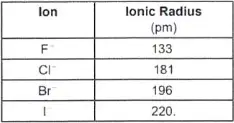
Which statement best explains why halide ions (Group 17) have larger radii than their neutral atoms?
Stronger nuclear charge
Fewer occupied energy levels
More proton attraction
More electron–electron repulsion

Which ion in Group 17 has the smallest ionic radius according to the table?
Br− at 196 pm
I− at 220 pm
F− at 133 pm
Cl− at 181 pm
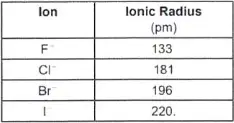
What trend is shown for ionic radius down Group 17 (F− to I−)?
Fluctuates without pattern
Decreases down the group
Increases down the group
Remains nearly constant
If 32.0 g of the same substance freezes, how much heat is released?
2.37×10^3 J released
9.47×10^3 J released
1.48×10^3 J released
4.74×10^3 J released
During the plateau on the cooling curve, the temperature remains constant. What process is occurring?
Phase change with latent heat
Decrease in pressure of the system
Rapid heat loss without change
Increase in kinetic energy
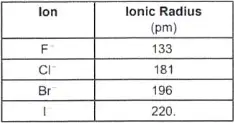
Compared to Cl−, which statement about Br− radius is correct?
Br− varies with temperature
Br− has a larger radius
Br− has a smaller radius
Br− and Cl− are equal
Which calculation correctly uses q = mHf for the 64.0 g sample?
q = (64.0 g)(148 J/g)
q = (64.0 g)(97 J/g)
q = (64.0 g)(148 J/kg)
q = (64.0 kg)(148 J/g)
Which trend in atomic radius is observed for halogens when ordered by increasing atomic number from fluorine to iodine?
The radius fluctuates randomly
The radius decreases steadily
The radius increases steadily
The radius remains constant
A neutral atom of oxygen-18 contains how many electrons relative to its number of protons?
Variable electrons depending on isotope
Equal electrons and protons
More electrons than protons
Fewer electrons than protons
Which statement correctly compares water containing oxygen-16 to water containing oxygen-18 during evaporation?
Oxygen-16 water evaporates slightly faster
Both evaporate at identical rates
Evaporation depends only on temperature
Oxygen-18 water evaporates slightly faster
The three naturally occurring isotopes of oxygen have which set of mass numbers?
18, 19, 20
16, 17, 18
12, 14, 16
14, 15, 16
Which relationship correctly defines the number of neutrons in an atom?
Neutrons equal electrons plus protons
Neutrons equal atomic number minus mass number
Neutrons equal mass number minus atomic number
Neutrons equal mass number plus atomic number
Americium-241 has atomic number 95. How many neutrons are in a neutral atom of Am-241?
146 protons
241 neutrons
146 neutrons
95 neutrons

Which radioactive isotope is listed as being used for anemia diagnosis?
Fe-59
I-131
U-238
Am-241

Which isotope in the table is associated with dating geological formations?
Fe-59
I-131
U-238
Am-241

Which pair correctly matches the isotope with its listed use for smoke detectors?
Am-241—smoke detectors
U-238—smoke detectors
I-131—smoke detectors
Fe-59—smoke detectors
Across the halogens from fluorine to iodine, which explanation best supports the observed increase in atomic radius?
Covalent radii collapse at high mass
More electron shells are added
Protons are removed from the nucleus
Electron shielding decreases substantially
Which statement best compares the penetrating power of alpha and beta particles?
Neither alpha nor beta particles can penetrate paper
Alpha and beta particles have equal penetrating ability
Beta particles penetrate more than alpha particles
Alpha particles penetrate more than beta particles
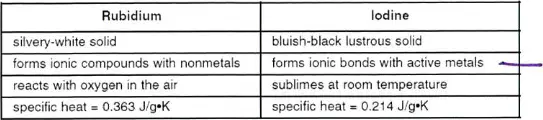
Rubidium is silvery-white solid, while iodine is bluish-black lustrous solid. What type of property is this description?
Chemical property of elements
Physical property of elements
Nuclear property of isotopes
Electrostatic property of ions
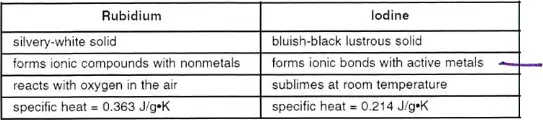
According to the properties listed, which is a chemical property of iodine?
Specific heat equals 0.214 J/gK
Bluish-black lustrous solid
Forms ionic bonds with active metals
Sublimes at room temperature
Bk-249 has a half-life of 320 days and decays by beta emission with gamma rays. What does beta emission do to the atomic number?
Decreases atomic number by 2
Increases atomic number by 1
Decreases atomic number by 1
Leaves atomic number unchanged
In the synthesis reaction, Ca-48 + Bk-249 → Uus-293 + 4₁⁰n. What is conserved across the nuclear equation?
Only the number of neutrons is conserved
Both mass number and charge are conserved
Mass number only is conserved
Atomic number only is conserved
Which statement correctly describes gamma rays mentioned with Bk-249 decay?
Gamma rays always change atomic number
Gamma rays have large mass
Gamma rays are high-energy photons
Gamma rays are charged particles

Complete the alpha decay: 294₁₁₇Uus → 4₂He + _____. What is the missing product?
290₁₁₅Up
290₁₁₆Up
290₁₁₇Uus
292₁₁₅Up
Which change occurs to a nucleus during alpha decay?
Neutron number increases by two
Atomic number increases by one
Atomic number decreases by two
Mass number increases by four

Rubidium reacts with oxygen in the air. This behavior is classified as which property?
Electromagnetic property of rubidium
Nuclear property of rubidium
Chemical property of rubidium
Physical property of rubidium

Iodine sublimates at room temperature. What does this mean?
Solid iodine dissolves in water
Solid iodine becomes gas directly
Iodine gas condenses to liquid
Liquid iodine freezes to solid
A radioisotope has a half-life of 320 days. What fraction of the original sample remains after 960 days?
One-eighth of the original sample
One-fourth of the original sample
One-sixteenth of the original sample
One-half of the original sample

