wayground logo

Free Printable Worksheets

Font size

S
M
L
XL
Worksheets

Joey's Chemistry Midterm review

Total questions: 148

Worksheet time: 12hrs 20mins

Name
Class
Date
1.
If a piece of matter changes shape, what happens to its mass?
a)
It increases
b)
It decreases
c)
it changes randomly
d)
it stays the same
2.
What is mass?
a)
the force of an object caused by gravity
b)
the amount of space something takes up
c)
the amount of matter in an object
d)
how fast something is moving
3.
What is the formula for density?
a)
density = mass x volume
b)
density = mass / volume
c)
density = mass + volume
d)
density = mass - volume
4.

During a phase change the mass of the substance undergoing the phase change

a)

does not change.

b)

increases.

c)

decreases.

d)

turns into unicorn sparkles.

5.

During a phase change the mass of the substance undergoing the phase change

a)

does not change.

b)

increases.

c)

decreases.

d)

turns into unicorn sparkles.

6.

What is the name of group number 1?

a)

halogens

b)

noble gases

c)

alkali metals

d)

alkaline earth metals

7.

What is the name of group number 2?

a)

transition metals

b)

halogens

c)

metaloids

d)

alkaline earth metals

8.

What group number are the halogens found?

a)

18 (8A)

b)

1

c)

2

d)

17 (7A)

9.

Periodic law states that the elements are arranged according to their atomic ________ so that elements with similar chemical properties are in the same ________ and properties repeat periodically.

a)

numbers, rows

b)

masses, rows

c)

masses, column

d)

numbers, column

10.

A grouping of elements based on similar chemical properties, arranged by columns in the periodic table; also known as a group

a)

family

b)

period

c)

row

d)

isotope

11.

A row on the Periodic Table of Elements

a)

family

b)

period

c)

row

d)

isotope

12.
__________ would have some characteristics of metals and some characteristics of nonmetals.
a)
Gold
b)
Sodium
c)
Arsenic
d)
Bismuth
13.

Metals (select all that apply)

a)

are found on the right side of the periodic table.

b)

are found on the left side of the periodic table.

c)

are good conductors of heat and electricity.

d)

are brittle.

e)

are malleable and ductile.

14.

Nonmetals (select all that apply)

a)

are found on the right side of the periodic table.

b)

are found on the left side of the periodic table.

c)

are good conductors of heat and electricity.

d)

are brittle.

e)

can be solid, liquids, or gases at room temperature.

15.

Which element is found in group 2, period 6?

a)

Oxygen (O)

b)

Barium (Ba)

c)

Selenium (Se)

d)

Carbon (C)

16.

Which element has similar chemical properties as sodium but has 7 energy levels?

a)

Francium (Fr)

b)

Cesium (Cs)

c)

Rubidium (Rb)

d)

Potassium (K)

17.

Elements that have the same number of energy levels are said to be in the same ______.

a)

group

b)

period

c)

family

d)

classification

18.

Silver

a)

S

b)

Ag

c)

Au

d)

Sn

19.

Neon

a)

No

b)

Na

c)

Ne

d)

Ni

20.

Sodium

a)

Ne

b)

S

c)

Na

d)

Mg

21.

Sulfur

a)

S

b)

Sn

c)

Na

d)

Sr

22.

Fluorine

a)

Fl

b)

Ra

c)

Fr

d)

F

23.

Copper

a)

Cu

b)

C

c)

Cr

d)

Co

24.

Pb

a)

Plutonium

b)

Lead

c)

Platinum

d)

Radon

25.

Zn

a)

Magnesium

b)

Silver

c)

Zerconium

d)

Zinc

26.

K

a)

Tungsten

b)

Fluoride

c)

Krypton

d)

Potassium

27.
A substance that contains only one type of atom is a(n)
a)
compound
b)
element
c)
heterogeneous mixture
d)
homogeneous mixture
28.
Which of these is a pure substance?
a)
bread
b)
table salt
c)
garden soil
d)
sea water
29.
Which of the following are pure substances?
a)
solutions
b)
compounds
c)
homogeneous mixtures
d)
colloids
30.
Two classifications of a pure substance are
a)
homogeneous and heterogeneous
b)
atoms and elements
c)
elements and compounds
d)
solutions and colloids
31.

What is Quantitative Data?

a)

Consist of attributes, labels, or nonnumerical entries.

b)

Consist of numerical measurements or counts.

c)

Consist of a subset of the population.

32.

Classify the observation as qualitative or quantitative: five minutes

a)

qualitative

b)

quantitative

33.

Classify the observation as qualitative or quantitative: smooth surface

a)

qualitative

b)

quantitative

34.
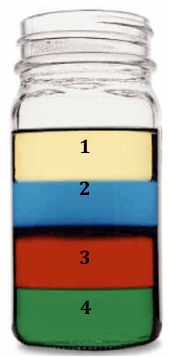
Put the liquids in order from most dense to least dense?
a)
4, 3, 2, 1
b)
1, 2, 3, 4
c)
3, 4, 2, 1, 
d)
4, 3, 1, 2
35.
Frank has an eraser. It has a mass of 4g, and a volume of 2cm3. What is its density?
a)
8 g/cm3
b)
2 g/cm3
c)
1/2 g/cm3
d)
24 g/cm3
36.

How close a measurement is to the true value is called..

a)

Accuracy

b)

Precision

c)

Significant

d)

Estimate

37.
When a measurement is repeatable and consistent it is said to have...
a)
High precision
b)
Low precision
c)
High accuracy
d)
Low accuracy
38.
This bullseye demonstrates...
a)
High Accuracy & High Precision
b)
High Accuracy & Low Precision
c)
Low Accuracy & High Precision
d)
Low Accuracy & Low Precision
39.
The attendance for the basketball game was estimated to be 15,000 people but 12,500 people attended. What was the percent error?
a)
16.67%
b)
20%
c)
2500%
d)
80%
40.

The students measured length during a science experiment, they got 12 cm. But the actual measurement was 14.25 cm. What was the percent error?

a)

15.79%

b)

18.75%

c)

2.25%

d)

18%

41.

What is the main difference between a physical change and a chemical change?

a)

Physical changes alter the composition whereas chemical changes alter the appearance of a substance

b)

Physical changes describe the appearance of a substance whereas chemical changes describe qualities only observed with a reaction.

c)

Physical changes describe qualities only observed with a reaction whereas chemical changes describe the appearance of a substance.

d)

Physical changes alter the appearance whereas chemical changes alter the composition of a substance.

42.

Calcium (Ca) is in group 2 on the Periodic Table. What does this tell you about this element?

a)

It is not reactive with water.

b)

It has 2 valence electrons.

c)

It has 2 protons in its nucleus.

d)

It has 2 energy levels/shells in its electron cloud.

43.

Which of the following elements would have similar chemical properties to the element Oxygen (O)?

a)

Nitrogen (N)

b)

Chlorine (Cl)

c)

Neon (Ne)

d)

Sulfur (S)

44.

The atomic number of an element is determined by which of the following?

a)

Number of electrons

b)

Number of neutrons

c)

Number of protons

d)

Number of protons and neutrons

45.

Which of the following elements would have the same number of energy levels/shells as the element Sodium (Na)?

a)

Magnesium (Mg)

b)

Lithium (Li)

c)

Potassium (K)

d)

Oxygen (O)

46.

The nucleus of an atom contains which of the following subatomic particles?

a)

Electrons

b)

Protons

c)

Neutrons

47.

An object will sink when placed into a liquid if it is

a)

The same temperature

b)

Heated to a warmer temperature

c)

Less dense than the liquid

d)

More dense than the liquid

48.

Which scientist developed the atomic theory, saying elements are composed of atoms, atoms of the same element are identical, atoms can change when chemically mixed with other elements?

a)

JJ Thomson

b)

Ernest Rutherford

c)

John Dalton

d)

James Chadwick

49.

JJ Thomson's theory was nicknamed _______.

a)

Billiard Ball Theory or sphere

b)

Solar System Theory

c)

Electron Cloud

d)

Plum Pudding or Chocolate Chip

50.
He developed the planetary model of the atom.
a)
Rutherford
b)
Bohr
c)
Chadwick
d)
Dalton
51.
What did Thomson discover?
a)
electron
b)
proton
c)
neutron
d)
electron cloud
52.
The Gold Foil experiment was done by __________.
a)
Chadwick
b)
Bohr
c)
Rutherford
d)
Thomson
53.

The scientist responsible for "discovering" the nucleus and saying the atom is mostly empty space is:

a)

Bohr

b)

Rutherford

c)

Schroedinger

d)

Einstein

54.
What was wrong with Dalton's model of the atom?
a)
He said the atom had a dense, positive center.
b)
He said the atom was made of positive matter surrounding negative particles.
c)
He said atoms cannot be subdivided, created or destroyed.
d)
He said e- follow specific paths.
55.
Which is the current model of the atom?
a)
plum pudding model
b)
solar system model
c)
electron cloud
d)
solid sphere
56.
"Everything is composed of atoms" was first stated by:
a)
Democritis
b)
Dalton
c)
Rutherford
d)
Einstein
57.

What was wrong with Bohr's model of the atom?

a)

He said the atom had a dense, positive center.

b)

He said the atom was made of positive matter surrounding negative particles.

c)

He said atoms cannot be subdivided, created or destroyed.

d)

He said electrons follow specific paths, and you can tell where the electrons are

58.

The nucleus of an atom contains which subatomic particles?

a)

protons and electrons

b)

protons and neutrons

c)

electrons and neutrons

d)

protons, electrons, and neutrons

59.

Typically in an atom, which two subatomic particles are equal in number?

a)

protons and neutrons

b)

all subatomic particles are equal in number

c)

neutrons and electrons

d)

protons and electrons

60.

Which subatomic particle does the RED(+) circle represent?

a)

proton

b)

neutron

c)

electron

d)

nucleus

61.
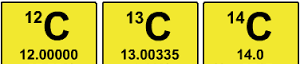
What do these isotopes of carbon all have in common?
a)
neutrons & mass number
b)
atomic number and neutrons
c)
atomic number and electrons
d)
protons, atomic number, and mass number
62.
How many neutrons does the isotope of lithium have?
a)
8
b)
3
c)
4
d)
5
63.
In a correctly written symbol what would be located in the "A" position?
a)
number of neutrons
b)
atomic number
c)
number of electrons 
d)
mass number
64.
Isotopes are atoms of the same element with different #’s of __________ & therefore different __________.
a)
n0 ;  atomic #’s
b)
p+ ; atomic #’s
c)
e- ; atomic masses
d)
n0 ; atomic masses
65.
24.1% of all the isotopes of a an element have a mass of 75.23 amu, 48.7% have a mass of 74.61 amu, and 27.2% have a mass of 75.20 amu.
What is the average mass of this element?
a)
74.92 amu
b)
24.97 amu
c)
75.01 amu
d)
74.51 amu
66.
If X is the symbol for an element, which of the following two symbols represent    isotopes of the same element?     I. 7735X  II. 7733X  III. 8137X  IV. 8135 X
a)
I and II
b)
III and IV
c)
I and IV
d)
I and III
67.
How many neutrons does the isotope of lithium have?
a)
8
b)
3
c)
4
d)
5
68.

Which element has 2 valence electrons in its 2nd energy level?

a)

beryllium

b)

helium

c)

magnesium

d)

calcium

e)

carbon

69.

Which of the following elements has the 3rd energy level as its outermost level of electrons?

a)

gallium

b)

lithium

c)

potassium

d)

neon

e)

oxygen

70.

According to the shell model of the atom, which of the following elements has a full outer energy level of electrons?

a)

krypton

b)

strontium

c)

iodine

d)

sodium

71.

Which of the following elements has 5 valence electrons?

a)

boron

b)

phosphorus

c)

magnesium

d)

chlorine

72.
What atom matches this electron configuration?
1s2s2p3s2
a)
Neon
b)
Magnesium
c)
Aluminum
d)
Potassium
73.
How many p orbitals are there in a sublevel?
a)
2
b)
1
c)
4
d)
3
74.
How many d orbitals are there in a given sublevel?
a)
1
b)
3
c)
5
d)
7
75.
How many electrons can the d sublevel hold?
a)
8
b)
10
c)
2
d)
4
76.
Which is the electron configuration for an oxygen atom?
a)
1s22s22p63s23p64s2
b)
1s22s22p4
c)
1s22s22p6
d)
1s22s22p63s23p6
77.
What does Pauli exclusion principle state ?
a)
states that each electron occupies the lowest energy orbital available
b)
states that a maximum of two electrons can occupy a single atomic orbital, but if only if the electros have opposite spins
c)
states that single electrons electrons with the same spin must occupy each-energy orbital before additional electrons with opposite spins can occupy the same orbitals
78.
What does Hund's rule states ?
a)
states that single electrons electrons with the same spin must occupy each-energy orbital before additional electrons with opposite spins can occupy the same orbitals
b)
states that each electron occupies the lowest energy orbital available
c)
states that a maximum of two electrons can occupy a single atomic orbital, but if only if the electros have opposite spins
79.

The lowest energy state of an atom

a)

excited state

b)

ground state

c)

frequency

d)

wavelength

80.

Which rule says orbitals are filled from lowest energy to highest?

a)

Aufbau's principle

b)

Hund's principle

c)

Pauli exclusion principle

d)

Law of conservation of mass

81.

Write the electronic configuration of calcium atom.

a)

1s2 2s2 2p6 3s2 3p6 4s2 3d9

b)

1s22s22p63s23p64s2

c)

1s22s22p63s23p6

82.

What is this element?

1s2 2s2 2p6 3s2 3p6 4s2 3d5

a)

magnesium

b)

iron

c)

manganese

d)

chromium

83.
This "rule" of Quantum Chemistry states that it is impossible to know both the position and velocity of an electron at the same time.
a)
Hund's Rule
b)
Heisenberg Uncertainty Principle
c)
Aufbau Principle
d)
Pauli Exclusion Principle
84.
This "rule" of Quantum Chemistry states that no 2 electrons in an atom can be in the exact same state...each electron in an atom can be described by a unique set of quantum numbers.
a)
Hund's Rule
b)
Heisenberg Uncertainty Principle
c)
Aufbau Principle
d)
Pauli Exclusion Principle
85.

How many electrons can the 3rd energy level hold?

a)

1

b)

18

c)

16

d)

2

86.

Each element on the periodic table can be identified by its

a)

classification as a solid, liquid or gas.

b)

location on the table.

c)

ability to react to form compounds.

d)

unique spectral "fingerprint."

87.
Light is emitted when electrons ...
a)
jump from high to low 
b)
jump from low to high 
c)
either of these
d)
none of these
88.

Line emission spectra is produced from atoms when

a)

electrons release energy as they move to their excited state.

b)

electrons absorb energy as they move to their excited state.

c)

electrons release energy as they return to the ground state.

d)

electrons absorb energy as they return to the ground state.

89.
For an electron to change from ground state to an excited stated it must...
a)
Absorb energy
b)
Release energy
90.
A tiny particle of light or electromagnetic radiation.
a)
photon
b)
photography
c)
photosynthesis
d)
biology
91.
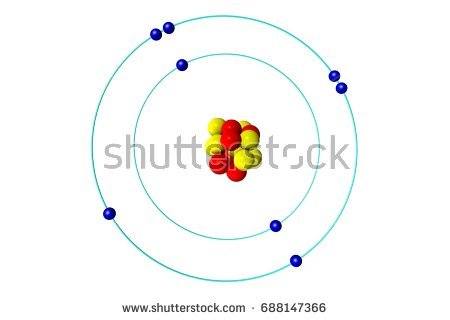
Which element is pictured?
a)
neon
b)
fluorine
c)
magnesium
d)
argon
92.
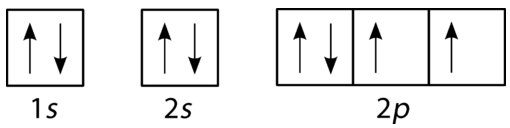
What is incorrect about this orbital diagram?
a)
Both arrows in the 2p box should be pointing up
b)
There is nothing incorrect with this diagram
c)
In the there should only be 1 orbital in the first 2p box and one in the 2nd 2p box
d)
All the arrows should be pointing up.
93.
This orbital diagram represents:  
a)
C
b)
B
c)
N
d)
O
94.

This is a Bohr Diagram of Aluminum. How many valence electrons does Aluminum have?

a)

3

b)

4

c)

5

95.
This could be the dot diagram of 
a)
Ne
b)
Si
c)
Al
d)
Be
96.
Electronegativity is...
a)
how good an atom is at attracting electrons
b)
the ability of an atom to lose electrons
c)
the energy required to remove an electron from a specific atom
d)
how easy it is to make friends. 
97.
Which of the following is the least electronegative element?
a)
oxygen
b)
potassium
c)
fluorine
d)
nitrogen
98.
What elements have zero electronegativity?
a)
metals
b)
nonmetals
c)
metalloids
d)
noble gases
99.
What elements generally make an ionic bond?
a)
metal and nonmetal
b)
2 nonmetals
c)
metal
d)
none of the above
100.
What elements generally make a covalent bond?
a)
metal and nonmetal
b)
2 nonmetals
c)
metal
d)
none of the above
101.
In chemical compounds, covalent bonds form when
a)
the electronegativity difference between two atoms is very large.
b)
electrons are completely transferred between two metals.
c)
pairs of electrons are shared between two nonmetal atoms.
d)
two nonmetal atoms are attracted to each other by opposite charges.
102.
Using electronegativities, what type of bond is formed by Co and F.
a)
ionic
b)
polar covalent
c)
non-polar covalent
103.
What happens when an atom loses an electron?
a)
It becomes Negatively Charged
b)
It remains neutral because the proton also leaves.
c)
It becomes Positively Charged
d)
It stays the same.
104.
The number of _____ is most important in determining how an atoms will bond. 
a)
Neutrons
b)
Protons
c)
Valence Electrons
d)
Electron sin the innermost shell
105.
If an oxygen atom has 8 protons (+) and 10 electrons (-), what is it's charge?
a)
O10-
b)
O8+
c)
O2-
d)
O10+
106.
High Melting & Boiling Points
a)
Ionic
b)
Covalent
107.

Which category of elements usually form negative ions?

a)

metals

b)

nonmetals

c)

metalloids

d)

noble gases

108.

CaCl2 is an example of what type of bond?

a)

Covalent

b)

Metallic

c)

Ionic

109.

What is the ionic formula for a bond between Calcium and Phosphorus?

a)

Ca2P3

b)

Ca3P2

c)

Ca2P5

d)

P5Ca2

110.

What is the chemical formula for Lithium Nitride?

a)

Li3N

b)

LiN3

c)

NLi3

d)

N3Li

111.

Which is the correct Lewis Structure for oxygen?

a)
b)
c)
d)
112.

Why do atoms bond?

a)

They typically don't bond

b)

To add or take away energy levels

c)

To have a full valance shell.

d)

To have a full inner shell

113.

Molecules:

a)

have covalent bonds and are always polar

b)

have covalent bonds and are always non-polar

c)

have covalent bonds and can be polar or non-polar

d)

have ionic bonds and are always polar

114.

The following properties are all characteristics of ionic compounds EXCEPT

a)

solid at room temperature

b)

soft

c)

crystal lattice structure

d)

conduct electricity when dissolved in water

115.

Which types of elements become cations?

a)

non-metals

b)

metals

c)

metalloids

116.
Nonmetals tend to 
a)
gain electrons
b)
lose electrons
117.

Ionic bonds could be best described as:

a)

A bond formed when 2 atoms share electrons

b)

A firm handshake

c)

An electrostatic attraction between oppositely charged ions

d)

An electrostatic attraction between anions

118.

What set of elements is most likely to form a covalent compound?

a)

Na and O

b)

Na and K

c)

O and C

119.

Which set of elements is most likely to form an ionic compound?

a)

Na and O

b)

C and O

c)

Na and K

120.

Molten or dissolved compound conducts electricity.

a)

ionic compound

b)

covalent compound

121.

Which of the following describes covalent bonds?

a)

Bonds form because of opposite charges

b)

electrons are shared to fill outer electron shells

c)

Electrons are transferred between atoms

d)

Covalent bonds are magical

122.

Which of the following is a molecular compound?

a)

CaO

b)

NaCl

c)

MgCl2

d)

CH4

123.

In metallic bonds electrons are:

a)

shared

b)

move around the nuclei randomly

c)

transferred

124.

Malleability and ductility are characteristics of compounds with

a)

covalent bonds

b)

metallic bonds

c)

ionic bonds

d)

alloy bonds

125.

Why are metals good conductors?

a)

they have mobile electrons

b)

they have mobile atoms

c)

they have crystal structures that can rearrange

d)

they have mobile protons

126.

In metals, the valence electrons are

a)

attached to the most positive ions

b)

shared by all of the atoms

c)

are bonded to the least electronegative element

d)

shiny

127.

What is the formula for sodium bromide?

a)

NaBr

b)

NaBr2

c)

Na2Br

d)

SoBr

128.

What is the formula for copper (II) sulfide?

a)

CuS

b)

Cu₂S

c)

CuS₂

d)

CuSO₃

129.

What's the formula for iron (II) nitride?

a)

Fe3N2

b)

Fe2N3

c)

Fe2NO2

d)

FeN

130.
A nuclear reaction where a nucleus splits into two smaller nuclei is... 
a)
Fission
b)
Fusion
c)
Gamma decay
d)
Beta decay
131.
What happens when the number of protons in an atom changes? 
a)
The number of electrons changes too 
b)
Usually nothing happens, unless the atom is radioactive 
c)
The atomic nucleus explodes
d)
It becomes a completely different atom, with different properties 
132.
In what part of an atom can protons be found? 
a)
Inside the electrons
b)
Inside the neutrons 
c)
Inside the atomic nucleus 
d)
 Inside the electron shells
133.
What element is the ?
a)
Ag-115
b)
Cd-115
c)
Pd-115
d)
Not Listed
134.
Which type of nuclear radiation is being emitted here?
a)
alpha
b)
beta
c)
gamma
d)
none
135.
Balance the following equation:
146C --> 0-1e + ________
a)
145B
b)
146C
c)
147N
d)
42He
136.
Two or more nuclei combine to form one larger nucleus in the process of nuclear _____.
a)
Fusion
b)
Fission
c)
Tracing
d)
Decay
137.
This is an example of...
a)
Fission  reaction
b)
Fusion reaction
c)
Decomposition reaction
d)
Combustion
138.
When nuclei decay, massive amounts of __________ is released.
a)
energy
b)
jello
c)
protons
d)
neutrons
139.
What type of reaction is this?
a)
alpha
b)
beta
c)
gamma
d)
quiet
140.
Has the highest penetrating power.  Can penetrate our body.  Even several cm thick of lead or several meters thick of concrete cannot stop all of it.
a)
Alpha
b)
Beta
c)
Gamma
141.
Has the lowest penetrating power.  Can only penetrate 0.05 mm into the body and can be stopped by a piece of paper or clothing.
a)
Alpha
b)
Beta
c)
Gamma
142.
If a sulfur atom has 16 protons, 16 electrons, and 16 neutrons, its atomic mass is:
a)
16
b)
32
c)
48
d)
64
143.

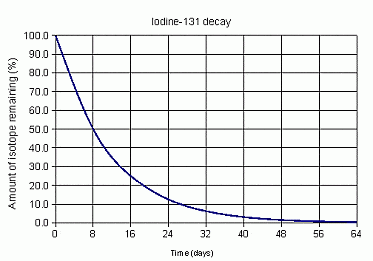
After the third half-life, what fraction of the original sample is left?
a)
1/2
b)
1/3
c)
1/16
d)
1/8
144.
If 10 mg of iodine 131 is given to a patient, how much is left after 24 days? The half-life of iodine-131 is 8 days.
a)
1.25mg
b)
1.25g
c)
10g
d)
10mg
145.
The half-life of strontium-90 is 25 years. How much strontium-90 will remain after 100 years if the initial amount is 4.0 g?
a)
3.0g
b)
0.25mg
c)
0.3g
d)
0.25g
146.
If the half-life of uranium-232 is 70 years, how many half-lives will it take for 10 g of it to be reduced to 1.25 g?
a)
1 half-life
b)
2 half-lives
c)
3 half-lives
d)
4 half-lives
147.
What is the half-life of iodine-131?
a)
32 days
b)
8 days
c)
16 days
d)
24 days
148.
Isotopes are atoms of the same element with different #’s of __________ & therefore different __________.
a)
n0 ;  atomic #’s
b)
p+ ; atomic #’s
c)
e- ; atomic masses
d)
n0 ; atomic masses