
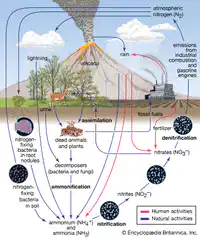
Biogeochemical Cycles

Flashcard
•
Science
•
9th - 12th Grade
•
Practice Problem
•
Hard

Wayground Content
FREE Resource
Student preview

17 questions
Show all answers
1.
FLASHCARD QUESTION
Front
____________ cycles connect biological, geological and chemical aspects of organisms in a biosphere

Back
Biogeochemical
2.
FLASHCARD QUESTION
Front
What type of organism converts nitrogen into a usable form for plants?
Back
bacteria
3.
FLASHCARD QUESTION
Front
Which statement is true of the biogeochemical cycle?
Back
All statements are true.
4.
FLASHCARD QUESTION
Front
Which of the following statements is true?
- Rocks are not a part of the biogeochemical cycle of phosphorus.
- Humans cannot impact the biogeochemical cycles of elements.
- Human activities can impact the biogeochemical cycle of phosphorus. When fertilizers are manufactured and applied on land, they can speed up the phosphorus cycle.
- Bacteria are not a part of the biogeochemical cycle of phosphorus.
Back
Human activities can impact the biogeochemical cycle of phosphorus. When fertilizers are manufactured and applied on land, they can speed up the phosphorus cycle.
5.
FLASHCARD QUESTION
Front
Biogeochemical cycle
Back
The movement of elements through organisms and the environment
6.
FLASHCARD QUESTION
Front
When water is used for irrigation, only about one-half can be used again. Much of this water is lost for use on land because it _____________ back into the air.
Back
evaporates
7.
FLASHCARD QUESTION
Front
What two processes fuel the carbon cycle?
Back
cellular respiration and photosynthesis
Access all questions and much more by creating a free account
Create resources
Host any resource
Get auto-graded reports

Continue with Google

Continue with Email

Continue with Classlink

Continue with Clever
or continue with

Microsoft
%20(1).png)
Apple

Others
Already have an account?



