Search Header Logo
  1. Resource Library
  2. Science
  3. Chemistry
  4. Diffusion
  5. Diffusion Rate
diffusion rate

diffusion rate

Assessment

Presentation

Science

8th - 10th Grade

Practice Problem

Hard

Created by

Zafer Yildiz

Used 23+ times

FREE Resource

24 Slides • 28 Questions

1

diffusion rate
Slide image

2

Slide image

3

Slide image

4

Slide image

5

Slide image

6

Multiple Choice

Question image

Aqueous lead(II) nitrate and aqueous potassium iodide are added to a dish containing water as shown. A yellow precipitate forms after a few minutes.

Which process occurs before the precipitate forms?

1

diffusion

2

distillation

3

fermentation

4

filtration

7

Multiple Choice

Diffusion is the movement of particles in a substance..

1

from an area of low concentration

to an area of high concentration

2

from an area of high concentration

to an area of low concentration

3

from an area of high concentration

to an area of no concentration.

4

from an area of no concentration

to an area of high concentration.

8

Multiple Choice

What process causes smelly gases to spread around a room on

their own?

1

difraction

2

diffusion

3

refraction

9

Multiple Choice

Question image

The shirt is left to soak in a bowl of water.Which process causes the red colour to spread?

1

diffusion

2

evaporating

3

melting

4

concentration

10

11

Slide image


12

Slide image

13

Multiple Choice

look at the pictures and choose in which diagrams the movement of particles is into the box

1
2
3

14

Multiple Choice

Diffusion is where particles move from a ________ to ___________concentration and requires no energy to do

this

1

low to high

2

high to low

15

Slide image

16

Slide image

17

Slide image

18

Effect of temerature

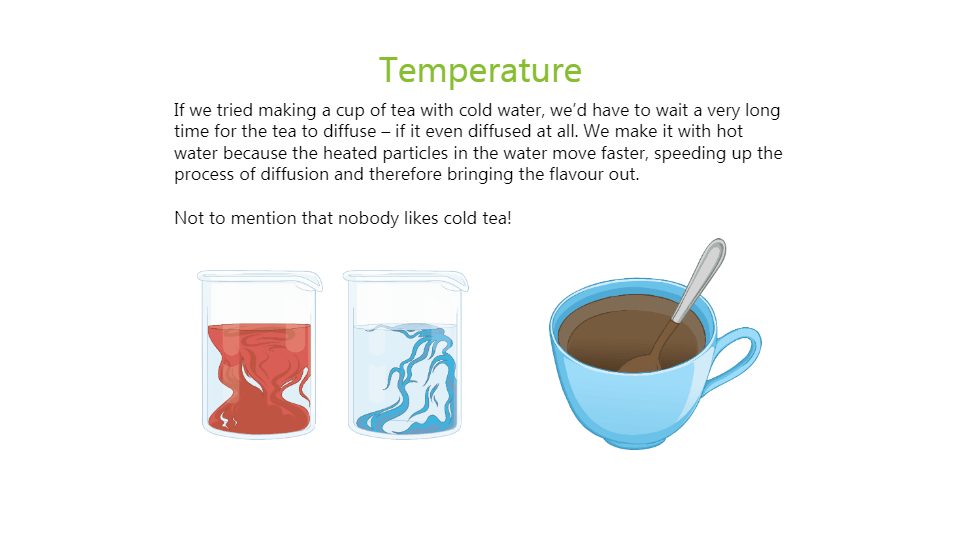
Temperature: at higher temperatures the particles 

have more kinetic energy and move quicker.

19

20

21

22

23

Slide image

24

Multiple Choice

diffusion depends on the temperature. the higher the temperature, the ____________ the diffusion is.

1

faster

2

slower

25

particle size and diffusion

Size of the particle: bigger particles are heavier and 

take longer to move and so diffuse. 

26

27

Multiple Choice

diffusion depends on particle size. the larger the particle size, the ________ the diffusion is.

1

faster

2

slower

28

Multiple Choice

diffusion depends on concentration difference. if there is large concentration difference, the diffusion is __________

1

fast

2

slow

29

30

Multiple Choice

Question image

A student investigated the diffusion of ammonia gas, NH3, and hydrogen chloride gas, HCI.

Two sets of apparatus were set up as shown at room temperature and pressure.The damp red litmus paper in apparatus 1 changed colour after 30 seconds.

How long does it take for the damp blue litmus paper to change colour in apparatus 2?

1

64 second

2

30 second

3

21 second

4

The blue litmus paper would not change colour.

31

Slide image

32

Multiple Select

diffusion can happen in _________ as

the particles are free to move about.

1

solids

2

liquids

3

gases

33

Multiple Choice

A coloured liquid vaporises easily at room temperature. Some of the liquid is placed at the bottom

of a sealed gas jar.

Which diagram shows the appearance of the jar after several hours?

1
2
3
4

34

Multiple Choice

When there is no wind, the scent of flowers can be detected more easily on a warm evening than on a cold evening.

This is because the molecules of the scent ............................. than in colder conditions.

Which words correctly complete gaps 1 and 2?

1

condense nearer to the flowers

2

condense further from the flowers

3

diffuse nearer to the flowers

4

diffuse further from the flowers

35

Multiple Choice

Question image

Oxides of nitrogen from car exhausts can spread through the atmosphere.This occurs because gas molecules move from a region of ...... 1...... concentration to a region of

...... 2 ...... concentration by a process called 3

Which words correctly complete the gaps?

1

1.high 2.low 3.diffusion

2

1.high 2.low 3.evaporation

3

1.low 2. high 3. diffusion

4

1.low 2.high 3.evaporation

36

Multiple Choice

Question image

The diagram shows how the molecules in the exhaust gases diffuse into the air. Which statement describes what happens to these molecules next?

1

The molecules fall to the ground because they are heavier than air molecules.

2

The molecules go back together as they cool.

3

The molecules spread further into the air.

4

The molecules stay where they are.

37

Multiple Choice

Question image

Mineral wool soaked in aqueous ammonia is placed in the apparatus shown.After five minutes, the damp red litmus paper turned blue.

Which process led to this change?

1

crystallisation

2

diffusion

3

distillation

4

sublimation

38

Multiple Choice

Question image

A gas is released at point X in the apparatus shown. Which gas turns the damp Universal Indicator paper red most quickly?
moleculer mass comparison: Cl2> SO2 >HCl >HF

1

hydrogen fluoride, HF

2

B chlorine, Cl2

3

C hydrogen chloride, HCI

4

D sulfur dioxide, S02

39

Multiple Choice

Question image

Ammonia gas is reacted with hydrogen chloride gas using the apparatus shown.

Solid ammonium chloride is produced.

Which statement explains why the solid ammonium chloride is formed nearer to the hydrogen chloride?

1

A Ammonia solution is a base and hydrogen chloride solution is an acid.

2

B Ammonia molecules diffuse more slowly than hydrogen chloride molecules. because ammonia is lighter

3

C Hydrogen chloride has a greater molecular mass than ammonia. therefore they move slower

4

D Hydrogen chloride moves by Brownian motion.

40

Multiple Choice

Question image

Hydrogen chloride gas, HCI, reacts with ammonia gas, NH3, to form solid ammonium chloride.

The apparatus is set up as shown.

After a few minutes, solid ammonium chloride forms where the two gases meet.

The experiment is repeated using hydrogen bromide, HBr, in place of hydrogen chloride.

How far along the tube does the solid ammonium bromide form?

HBr is heavier that HCl

1
2
3
4

41

Multiple Choice

Oxygen and fluorine are gaseous elements next to each other in the Periodic Table.

Under the same conditions of temperature and pressure, oxygen diffuses ...... 1...... than fluorine

because its ...... 2 ...... is less than that of fluorine.

Which words correctly complete gaps 1 and 2?

1

faster ; molecular mass

2

faster ; reactivity

3

slower ; molecular mass

4

slower ; reactivity

42

Multiple Choice

Which statement explains why ammonia gas,NH3, diffuses at a faster rate than hydrogen chloride gas, HCl?

1

Ammonia expands to occupy all of the space available.

2

Ammonia has a smaller relative molecular mass than hydrogen chloride.

3

Ammonia is an alkali and hydrogen chloride is an acid.

4

Ammonia molecules diffuse in all directions at the same time.

43

Multiple Choice

Question image

The apparatus shown is set up. After 20 minutes a white ring of ammonium chloride is seen at position Y. Which statement about the molecules of ammonia and hydrogen chloride is correct?

Mr: molecular mass

1

Molecules in ammonia have a larger

Mr than molecules of hydrogen chloride and so they move more slowly.

2

Molecules in ammonia have a larger Mr than molecules of hydrogen chloride and so they move more quickly.

3

Molecules in ammonia have a smaller Mr than molecules of hydrogen chloride and so they move more slowly.

4

Molecules in ammonia have a smaller

Mr than molecules of hydrogen chloride and so they move more quickly

44

Multiple Choice

Question image

The apparatus shown is set up. After 20 minutes a white ring of ammonium chloride is seen at position Y. Which statement about the molecules of ammonia and hydrogen chloride is correct?

Mr: molecular mass

1

Molecules in ammonia have a larger

Mr than molecules of hydrogen chloride and so they move more slowly.

2

Molecules in ammonia have a larger Mr than molecules of hydrogen chloride and so they move more quickly.

3

Molecules in ammonia have a smaller Mr than molecules of hydrogen chloride and so they move more slowly.

4

Molecules in ammonia have a smaller

Mr than molecules of hydrogen chloride and so they move more quickly

45

Multiple Choice

Samples of four gases are released in a room at the same time.

The gases are carbon dioxide, C02, hydrogen chloride, HCI, hydrogen sulfide, H2S, and nitrogen dioxide, N02. Which gas diffuses fastest?


Moleculer masses:

CO2: 44 a.m.u

HCl: 36,5 a.m.u

H2S: 34 a.m.u

NO2: 46 a.m.u

1

carbon dioxide

2

hydrogen chloride

3

hydrogen sulfide

4

nitrogen dioxide

46

Multiple Choice

A gas is released at point Q in the apparatus shown. Which gas changes the colour of the damp Universal Indicator paper most quickly?

molecular masses:

hydrogen:2

ammonia: 17

carbon dioxide: 44

chlorine: 71

1

ammonia

2

carbon dioxide

3

chlorine

4

hydrogen

47

Brownian motion

  • Robert Brown was a scientist who 

    noticed the random movement of pollen  grains under his microscope.

  • It wasn’t the pollen grains 

    themselves that were 

    moving, but liquid or gas 

    molecules colliding with the 

    pollen and making it move!

Slide image

48

brownian motion

The random movement of 

particles is known as 

Brownian motion.


when a big heavy particle collides with a lighter air particle, it causes it to move off in a different direction

Slide image

49

50

Multiple Choice

Which of the following does NOT describe Brownian motion?

1
2
3
4

51

Multiple Choice

A student makes an observation using a microscope. He observed some particles which were moving in a zig-zag way. What particles could these NOT be?

1

Smoke particles in air

2

Dust particles in a room

3

Pollen grains in water

4

Molecules in a solid bar of steel

52

Multiple Choice

1. Which key term describes the random movement of particles?

1

a) Diffusion

2

b) Osmosis

3

c) Brownian Motion

4

d) Absolute zero �

diffusion rate

Slide image

Show answer

Auto Play

Slide 1 / 52

SLIDE