Search Header Logo
Semester 1 Exam Review

Semester 1 Exam Review

Assessment

Presentation

Science

10th Grade

Medium

Created by

John Oglesby

Used 1+ times

FREE Resource

48 Slides • 69 Questions

1

Review for Sem. 1 Exam

Some text here about the topic of discussion

2

​What's on the exam?

  • Metric System - 5 Questions (3 pts each)

  • Energy - 5 Questions (3 pts each)

  • Simple Machines - 5 Questions (3 pts each)

  • Waves - 5 Questions (4 pts each)

  • Thermal Energy - 5 Questions (3 pts each)

  • Essay Questions - 2 Questions (5 pts each)

​27 Questions Total - 100 pts

3

Metric System Review

Some text here about the topic of discussion

4

Base Units

  • Volume = Liters = L

  • Mass = Grams = g

  • Length = meters = m

media

5

Prefixes

  • The Metric system is based on multiples of tens.

media

6

Remember

  • “King Henry Doesn’t (Usually) Drink Chocolate Milk”

media

7

Multiple Select

Which units below are NOT part of the metric system? Check all that apply.

1

Inches

2

Feet

3

Meters

4

Grams

8

Multiple Select

Which units are the BASE units in the metric system? Check all that apply.

1

Meters

2

Liters

3

Grams

4

Inches

5

Miles

9

Multiple Choice

The metric unit of measurement for length is ____________________. 
1

Liter

2

Meter

3

gram

4

inch

10

Multiple Choice

The metric unit of measurement for weight or mass is ________________.
1

Gram

2

Liter

3

Pound

4

Meter

11

Multiple Choice

The metric unit of measurement for capacity or volume is ________________.
1

Gram

2

Meter

3

Liter

4

Ounce

12

Converting Units

  • Changing a Metric Units to another Metric Unit

  • Moving BIG unit to small Multiply

  • Moving small to BIG Divide

media

13

Multiple Choice

42 L = ? mL

1

4,200

2

.0042

3

4.20

4

42,000

14

Multiple Choice

3 cm = ? mm

1

30

2

300

3

3000

4

0.3

15

Multiple Choice

75.2 cm = ? m

1

0.752

2

7.52

3

75.2

4

752

16

Multiple Choice

Convert:

3 kg = ? g

1

3

2

30

3

300

4

3,000

17

Multiple Choice

6,000 mL = ? L

1

60

2

600

3

6

4

6,000

18

Multiple Choice

What is 3 litres in ml?

1

30

2

300

3

3000

4

0.3

19

Multiple Choice

What is 0.9km in meters?

1

0.9

2

9

3

90

4

900

20

Energy Review

Some text here about the topic of discussion

21

​Potential Energy

The energy you possess by virtue of height above the ground

GPE = mgh

22

Multiple Choice

what is acceleration due to gravity for earth?

1

9.81m/s2

2

1.34m/s2

3

10m/s2

4

8.91m/s2

23

Multiple Choice

what 3 factors effect gravitational potential energy

1

- Mass (m)

-Weight (N)

- speed (m/s)

2

- Mass (N)

- Height (km)

- Acceleration due to gravity (g)

3

- Mass (kg)

- Height (m)

- Acceleration due to gravity (g)

4

- Mass

- Height

- Acceleration due to gravity

24

Multiple Choice

An object with a mass of 10 kg is at a point 20 m above the ground. What is the gravitational potential energy of the object?

1

200 J

2

1960 J

3

2 J

4

1000 J

25

Multiple Choice

__________ energy is stored energy.

1

Potential

2

Kinetic

3

Force

4

Gravity

26

Multiple Choice

A 20 kg box is lifted 6 m above the ground. How much GPE does it have?

1

120 J

2

200 J

3

1176 J

4

60 J

27

Multiple Choice

Which of the following statements about a skier skiing down a steep slope is true?

1

His kinetic energy decreases and his potential energy increases

2

His potential energy decreases and his kinetic energy increases

3

His chemical energy increases

4

Both his potential and kinetic energy increases

28

Multiple Choice

Which of the following statements is implied by the law of conservation of energy?

1

Energy is static and unchanging.

2

Energy only ever transforms or transfers.

3

Energy will eventually run out.

4

None of these.

29

Multiple Choice

Question image

A 6kg cat misjudges a jump and falls 5 meters. How much gravitational potential energy does the cat have? (The cat is fine by the way.)

1

294 J

2

180000 J

3

1225 J

4

3920000 J

30

​Kinetic Energy

The energy of motion

  1. KE = 1/2 mv2

  2. An object has KE whenever it is moving

Some text here about the topic of discussion

31

Multiple Choice

A scientific law stating that energy cannot be created or destroyed.

1

The Law of Potential Energy

2

The Law of Kinetic Energy

3

The Law of Conservation of Energy

32

Multiple Choice

If a 4 kg cat is running at 3 m/s what is its kinetic energy?

1

18 J

2

18

3

12

4

12 J

33

Multiple Choice

The faster an object moves, the ________ kinetic energy it has. 

1

more

2

less

34

Multiple Choice

Which has a greater impact on KE?

1

mass

2

speed

35

Multiple Choice

Question image

A 50kg (100lb) person is running at 7m/s (about 16 mph). How much kinetic energy do they have?

1

1225 J

2

180000 J

3

294 J

4

3920000 J

36

Multiple Choice

What is the unit of measure

ment for KE

1

Newton

2

Watt

3

Joule

37

Multiple Choice

Question image

A 1 kg bird flies south at 4 m/s. What is its KE?

1

2 m/s

2

8 J

3

2 J

4

4 J

38

Multiple Choice

According to the law of conservation of energy, the total amount of energy in the universe ____.

1

remains constant

2

changes constantly

3

increases

4

decreases

39

Simple Machines - Review

Some text here about the topic of discussion

40

SIMPLE MACHINES

a device that increases or changes the direction of a force

41

Levers

Levers are probably the most common simple machine.


The fulcrum is the point in which a lever rests (pivots);

The load is what you are trying to move;

Effort is the force you apply.

media

42

First Class Levers

The fulcrum is between the effort and the load.

media

43

Second Class Levers

The load is between the effort and the fulcrum.

media

44

Third Class Levers

The effort is between the fulcrum and the load.

media

45

Leavers and Loads

A lever might be able to...


decrease the effort required to move a load;

change the direction that a load moves;

increase the distance that load moves;

Increase the speed with which a load moves.

media

46

Multiple Choice

WHAT ARE THE 3 MAIN PARTS OF A LEVER?
1

FOOT, EFFORT, REPORT

2

FULCRUM, STRUCTURE, EFFORT

3

FULCRUM, EFFORT, LOAD

47

Multiple Choice

Question image
Simple machines make the work we have to do easier, but it is still the same amount of work.
1

TRUE

2

FALSE

48

Multiple Choice

Question image

Which part is the 'load'?

1

Arrow

2

Yellow box

3

Blue triangle

49

Fill in the Blank

The ______________ is the point at which a lever pivots

50

Multiple Choice

Question image

At what distance should a 2N load placed from the pivot so that the see saw won't move?

1

0.2m

2

0.5m

3

0.45m

4

0.42m

51

Multiple Choice

Question image

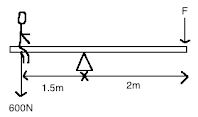
A boy of weight 600N sits on the see-saw as shown at a distance of 1.5m from the pivot. What is the force F required at the other end to balance the see-saw?

1

450 N

2

350 N

3

4.5 N

4

200 N

52

Multiple Choice

Question image

A ramp is an example of a(n) _______.

1

inclined plane

2

fulcrum

3

force

4

lever

53

Multiple Choice

What is the unit of measurement for work?
1

Newtons

2

Joules 

3

Watts

4

Meters

54

Multiple Choice

Question image
What type of simple machine is shown here?
1

Pulley

2

Wheel and Axle

3

Lever

4

Wedge

55

Multiple Choice

The device used to raise a flag up a flag pole is an example of a 
1

wheel and axle 

2

lever

3

inclined plane 

4

pulley 

56

Mechanical advantage of simple Machines

By Ms. Taylor

57

Mechanical Advantage

What is it?

  • ​A Ratio of Forces

  • ​MA = Output Force / Input Force

A machine that has a MA above 1, means that the force out is greater than the force you put in.​

Some text here about the topic of discussion

58

Mechanical Advantage, MA

How to interpret MA

  • ​A machine that gives a MA 1 only causes a change in direction.

  • ​A machine that gives a MA less than 1 usually increases the distance over which the work is done.

  • ​A machine that gives a MA greater than 1 usually increases the output force (less force needed)

Some text here about the topic of discussion

59

Multiple Choice

The amount that input is magnified by a simple machine is known as the :

1

mechanical advantage

2

output force

3

resistance

4

none of these

60

Multiple Choice

The Mechanical Advantage (MA) of a simple machine makes work

1

Easier

2

Harder

3

No difference to the work done

4

None Of the above

61

Multiple Choice

What is effort (input) force?

1

the force one exerts on a machine

2

the force which an effort force must overcome in order to do work on an object via a simple machine.

3

the force the machine exerts on a object

4

the output work times the input distance

62

media

63

media
  • Straight, slanted surface

  • Does not decrease amount of work needed but increases the distance.

  • Same work is done but over a

greater distance.​

  • longer ramp, more MA

  • MA=length/height of ramp​

Inclined plane

64

Multiple Select

Is a staircase an inclined plane?

1

yes

2

no

65

​Examples of a 1st Class Lever

media
media

66

​Examples of a 2nd Class Lever

media

67

​Examples of a 3rd Class Lever

media
media

68

Waves - Review

Some text here about the topic of discussion

69

media

70

Multiple Choice

Longitudinal Compression waves move in the direction of the wave.(They are parallel to the direction of the wave)

1

True

2

False

71

Multiple Choice

A wave that has the vibration perpendicular to the direction of the wave is called:

1

Longitudnal Wave

2

Transverse Wave

72

media

73

media

74

Multiple Choice

Question image

What is B?

1

crest

2

trough

3

rarefaction

4

compression

75

Multiple Choice

Question image

What is A?

1

crest

2

trough

3

rarefaction

4

compression

76

media

77

Multiple Choice

Question image

What does point C represent?

1

Crest

2

Trough

3

Amplitude

4

Wavelength

78

Multiple Select

Question image

The wavelength can be measured from ( check all that apply)

1

Distance from Crest to Crest

2

Distance from Crest to Trough

3

Distance from Trough toTrough

4

Distance from Crest to midpoint

79

Multiple Choice

Question image

What does point A represent?

1

Crest

2

Trough

3

Amplitude

4

Wavelength

80

Multiple Choice

Question image

What does the arrow in the Wave represent?

1

Crest

2

Trough

3

Amplitude

4

Wavelength

81

Multiple Choice

Question image

If the amplitude increases, the energy of the wave:

1

Increases

2

Decreases

3

Stays the same

82

Multiple Choice

Any material that a wave travels through is called a ____________________.
1

vibration

2

compression

3

medium

4

crest

83

Multiple Choice

The frequency of a wave is measured in

1

meters

2

hertz

3

periods

4

eras

5

meters per second

84

Multiple Choice

The distance between 2 corresponding parts of a wave  (example- crest to crest) is its

1

trough

2

frequency

3

amplitude

4

wavelength

85

Multiple Choice

Question image

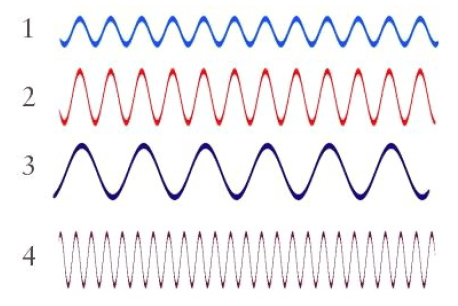
Which wave in the diagram has the greatest frequency?

1

1

2

2

3

3

4

4

86

Multiple Choice

Question image

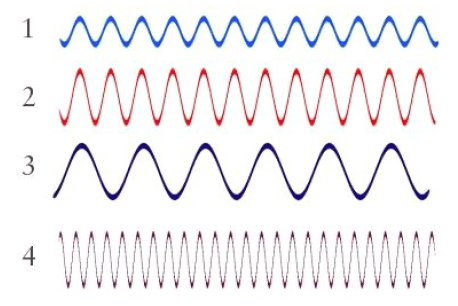
Which wave in the diagram has the longest wavelength?

1

1

2

2

3

3

4

4

87

Multiple Choice

Question image

You can't hear sounds in outer space because there is no

1

medium

2

light

3

energy

4

heat

88

Thermal Energy

Review

Some text here about the topic of discussion

89

Thermal Energy

The flow of energy from hot to cold.

The atoms(molecules) of something hot are moving faster than those of something cold.

Temperature is the measure of the speed of those particles and is equal to the avg kinetic energy of all the particles in a sample.

Subject | Subject

Some text here about the topic of discussion

90

Thermal Energy Transfer

Conduction → Transfer of thermal energy by collisions between particles in matter. Occurs in solids, liquids, & gases. Metals are the best conductors.


Convection → Transfer of thermal energy in a fluid by the movement of warmer and cooler fluid from place to place. Occurs in liquids & gases.


Radiation → Transfer of energy by electromagnetic waves. Occurs in gases only.


91

Conduction

Transfer of thermal energy that occurs in solids, liquids, and gases when two substances of different temperatures touch.


media

92

Convection

Heat transfer caused by the rising of hotter, less dense fluids and the falling of cooler, more dense fluids.

media

93

Radiation

The transfer of energy by the movement of electromagnetic waves or subatomic particles.

media

94

Conductor

A substance that allows the flow of electrical charge or transfers thermal energy through matter.

media

95

Insulator

A material that does not conduct heat or electric current

media

96

Multiple Choice

Heat is the transfer of _____ from one object to another due to a difference in temperature.

1

Time

2

Force

3

Energy

4

Velocity

97

Multiple Choice

Question image

The man's hand will immediately receive heat from the metal as the candle gradually warms it. That is called____?

1

Conduction

2

Convection

3

Radiation

98

Multiple Choice

Question image

"Metals" are the best____?

1

Insulators of heat

2

Conductors of heat

3

Conductors of light

4

Insulators of electricity

99

Multiple Choice

How does heat move?

1

from a warmer to a cooler object

2

from a cooler to a warmer object

3

toward a hot object

4

away from a cold object

100

Multiple Choice

Energy transmitted by electromagnetic waves

1

conduction

2

convection

3

radiation

101

Multiple Choice

Question image

When you touch hot sand, heat is transferred by _________ to your skin.

1

conduction

2

convection

3

radiation

102

Multiple Choice

Question image
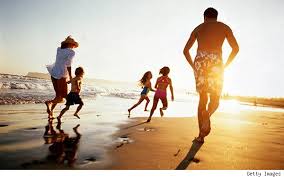
The sun shines down on this family as the play on the beach.
1

conduction

2

convection

3

radiation

103

​So, What is TEMPERATURE?

media

104

​Temperature - The average kinetic energy of all the molecules of the sample

media

105

​What are the temperature scales based on?

Celcius & Fahrenheit are based on the freezing pt and boiling point of water.

Kelvin is based on absolute zero. At absolute zero atoms have zero kinetic energy.

106

°C = 5∕9 (°F - 32)

°F = 9∕5 °C + 32

Celcius / Fahrenheit Conversion

107

Convert 40 deg C to F

°​F = 9/5 °C + 32

= 9(40)/5 + 32

= 104 F

108

Fill in the Blank

Convert 20 deg C to Fahrenheit

°C = 95°F + 32\degree C\ =\ \frac{9}{5}\degree F\ +\ 32  

109

​Let's convert 68 deg F to Celcius

⁰C = 5/9 (⁰F - 32)

⁰C = 5/9 (68 - 32)

⁰​C = 5/9 (36)

⁰​C = 20⁰F

​Remember to do what is in the parenthases first

110

media

Temperature scale conversion

To convert a temperature from Celsius to Kelvin, just add 273
to the Celsius temperature.

For example, 10 °C equals 283 Kelvin.

111

media

C to F

Converting between Celsius and Fahrenheit is more
complicated.

Celsius Fahrenheit: (°C × 1.8) + 32 = °F

Fahrenheit Celsius: (°F - 32) ÷ 1.8 = °C

112

Multiple Choice

80 C = F

1

176

2

44.4

3

12.4

4

144

113

Multiple Choice

76 F = C

1

44

2

24.4

3

12

4

349

114

media

Absolute Zero

The lowest temperature that is theoretically possible, at which
the motion of particles that constitutes heat would be
minimal.

It is zero on the Kelvin scale, equivalent to –273.15°C or
–459.67°F.

115

Multiple Choice

Anna pours herself some room-temperature soda from a bottle and adds four ice cubes. In a few minutes the ice cubes are smaller and the soda is much colder. Which of the following best explains the change in temperature of the soda?

1

Heat flowed from the soda to the ice cube and caused it to partially melt.

2

Coldness flowed from the ice cube to the soda, making the soda colder.

3

The cold water from the melting ice went into the soda, replacing the warmer water that was in the soda.

4

The water from the melting ice makes the soda more dilute, and the lower concentration makes the temperature lower.

116

Multiple Choice

1. David drinks a glass of water in his kitchen. The water is at room temperature, and David decides to make it colder by adding ice. Which of the following describes why the ice cubes will melt?

1

Liquid water is reacting with solid water to absorb

energy.

2

Water is evaporating from the surface of the water.

3

Slow-moving molecules move out of the ice.

4

Heat from the water moves into the ice.

117

Temperature Conversions

   F⁰ to C⁰


C = 5/9(F⁰-32)


Ex. 75⁰ F⁰ is what in C


C ⁰= 5/9(75-32)

C⁰ = 24⁰

note order of operation ( parenthesis first!)

Review for Sem. 1 Exam

Some text here about the topic of discussion

Show answer

Auto Play

Slide 1 / 117

SLIDE