Search Header Logo
SS Bio Unit 2 Lesson

SS Bio Unit 2 Lesson

Assessment

Presentation

Science

9th - 12th Grade

Hard

NGSS
HS-LS1-6, HS-PS1-1, HS-LS1-1

+4

Standards-aligned

Created by

Beth VanOstrand

Used 1+ times

FREE Resource

14 Slides • 15 Questions

1

Chemistry of Biology - Module 2 Test Review

2

​Lesson 1 Matter

​Atoms consist of:

  • Protons

  • Neutrons

  • Electrons​

media

3

media

Types of elements include:

  • Hydrogen (H)

  • Carbon (C)

  • Oxygen (O)​

Some text here about the topic of discussion.

Elements are pure substances made up of only one kind of atom.

4

Elements....

can fo​rm covalent and ionic bonds.

Subject | Subject

Some text here about the topic of discussion

media
media

5

media

These are substances with unique properties that are formed when elements combine.

Some text here about the topic of discussion.

Compounds

6

Fill in the Blanks

Type answer...

7

Open Ended

Describe the difference between ionic bonds and covalent bonds.

8

Lesson 2: Carbohydrates, Lipids, and Nucleic Acids

9

Carbohydrates

Made from carbon and hydrogen (sacchrides)

  • Goal = Store quick-release energy

  • Come from plants

media

10

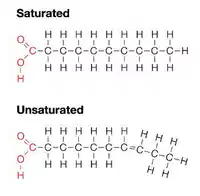
Lipids/Fats

Lipids are made from Fatty Acids

  • Saturated Fats = Bad for the body

  • Unsaturated Fats = Better for the body

Fats and Water do NOT mix!

media

11

Lipids/Fats

Lipids have many roles in the body

  • Long term energy

  • Protect organs

  • Warmth

media

12

Nucleic Acids

Code to ALL Life!

  • DNA = deoxyribonucleic acid

  • Nucleotides code for specific molecules to be made

media

13

Multiple Choice

Question image
What type of carbohydrate is this?
1

polysaccharide

2

disaccharide

3

monosaccharide

4

it isn't a carbohydrate

14

Multiple Choice

What is not a type of carbohydrate?
1

Fat

2

Fiber

3

Starch

4

Sugar

15

Multiple Choice

Which has more energy, 1.0 g of carbohydrate or 1.0 g of lipid?
1

Carbohydrate

2

Lipid

16

Multiple Choice

All organic compounds contain the element
1

carbon

2

nitrogen

3

phosphorus

4

sulfur

17

Multiple Choice

Question image
The monomer, building block, of DNA and RNA; made up of a sugar, phosphate, and nitrogenous base
1

Amino Acid

2

Fatty Acid

3

Nucleotide

4

Monosaccharide

18

Multiple Choice

The characteristic that all lipids have in common is----
1

made of lots of double bonds

2

acidic when mixed with water

3

no high energy content

4

do not dissolve in water

19

Lesson 3: Proteins, Enzymes, and Water

20

Proteins

Made from Nucleic Acids

  • Amino Acid chains fold and make different proteins.

  • Proteins make up most of your body

  • Shape = Protein function

media

21

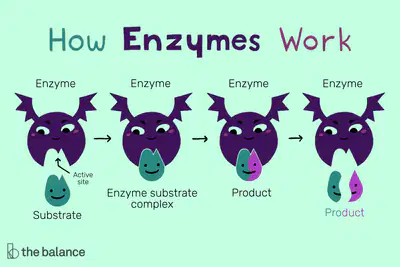
Enzymes

Help to speed up chemical reactions in the body

  • Lowers the energy needed

media

22

media
  • Water is a polar molecule

  • Its properties contribute to Earth's suitability for life.

Some text here about the topic of discussion.

About WATER...

23

Multiple Choice

What is the monomer or building block of proteins?

1

glucose

2

nucleotides

3

amino acids

4

lipids

24

Multiple Choice

What is another name for a protein?

1

fat

2

sugar

3

amino acid

4

polypeptide

25

Multiple Select

Enzymes

1

fats

2

proteins

3

catalysts

4

dogalysts

5

lower activation energy

26

Multiple Choice

Each enzyme only has 1 substrate that will fit its active site.  What is this called?
1

reusablility

2

denaturation

3

specificity

4

fragility

27

Multiple Choice

What will most likely happen if an appropriate enzyme is added to a chemical reaction? 
1

The reaction rate will increase.

2

The equilibrium of the reaction will be maintained. 

3

The reaction rate will decrease.

4

The reaction will stop. 

28

Multiple Choice

Question image
Attractions between the negative Oxygen atom of one water molecule and the positive Hydrogen atom of another water molecule are called
1

Covalent bonds

2

Ionic bonds

3

Polar bonds

4

Hydrogen bonds

29

Multiple Choice

Water is a universal solvent because it...
1

It can be found anywhere

2

It freezes when it gets cold

3

floats when frozen

4

Dissolves most substances

Chemistry of Biology - Module 2 Test Review

Show answer

Auto Play

Slide 1 / 29

SLIDE