Search Header Logo
Quarter 4 Assessment Practice

Quarter 4 Assessment Practice

Assessment

Presentation

Biology

10th Grade

Medium

Phylogenetic tree

Standards-aligned

Created by

Kerry Dabbs

Used 1+ times

FREE Resource

50 Slides • 61 Questions

1

Multiple Choice

I found a fossil of a fish in what is now a cow pasture. How is that possible?
1
Somebody put the fossil there.
2
The wind moved the fossil there over time.
3
The cow pasture used to be underwater.
4
It would not be possible to find a fossil of a fish in a cow pasture.

2

Multiple Choice

Question image
If a tree fossil is found in the middle of a desert, what can you infer about the past environment of the area?
1
It used to be a forest
2
It was always a desert
3
It used to be at the bottom of the ocean
4
It used to be covered in ice and snow

3

Multiple Choice

What can we learn when we compare fossils to other animals that live today?
1
we can learn more about the environment it lived in
2
we can learn more about the current environment
3
we can learn about the animal's family

4

media

Embryology, the study of the development of the anatomy of an organism to its adult form.

Provides evidence of a common ancestor due to the relatedness between now widely divergent groups of organisms.

The longer they are similar in development the more related.

Embryology

5

Multiple Choice

Question image

​ Which organism is most closely related to rabbit judging by embryology?​ ​ ​

1
Salamander
2
Tortoise
3
Cow
4
Chicken

6

Multiple Choice

Structures that are inherited from a recent common ancestor and are similar in structure are homologous structures.

1

True

2

False

7

Kingdoms

By Aguado Angelica

8

Multiple Choice

Question image
The 8 levels of classification, most broad to most specific.
1

Domain, Genus, Family, Order, Class, Phylum, Kingdom, Species

2

Domain, Species, Kingdom, Genus, Phylum, Family, Class, Order

3

Domain, Kingdom, Phylum, Class, Order, Family, Genus, Species

4

Order, Kingdom, Species, Domain, Phylum, Family, Class, Genus

9

media

10

media

11

Multiple Select

Question image

8B: The classification of four trees are shown in the table. Which two trees are the most closely related? Select two answers.

1

Taiwan beech

2

Taiwan catkin yew

3

Japanese maple

4

Lodgepole pine

12

media

13

media

​using cilia

14

media

15

media

16

Multiple Choice

Question image

What does amoeba use for locomotion?

1

cilia

2

flagellum

3

pseudopods

4

feet

17

Multiple Choice

Question image

What is the whip-like tail in a euglena?

1

cillia

2

flagella

3

pseudopod

18

Multiple Select

A paramecium uses its cilia for

1

sleeping

2

cleaning

3

getting food

4

moving

19

media

20

Multiple Choice

What do we call animals that have backbones?

1
vertebrates
2

endoskeletals

3

bony

21

media

22

Multiple Choice

Which animal is invertebrate?

1

A snake

2

A chicken

3

A penguin

4

A grasshopper

23

Multiple Choice

What is the major difference between vertebrates and invertebrates?

1

Vertebrates have a backbone and invertebrates do not.

2

Invertebrates live in water and vertebrates do not.

3

Invertebrates have a backbone and vertebrates do not.

4

Invertebrates are smaller than vertebrates.

24

Phylogenetic Trees

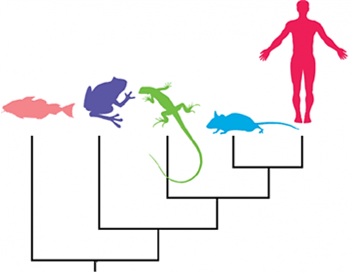
  • Phylogenetic tree: a diagram used to predict evolutionary relationships among groups of organisms.

  • Branch points show a new species diverging from the common ancestor.

media

25

media

26

Multiple Choice

Question image

According to the tree, which primates share the most recent common ancestor with humans?

1

gorillas

2

chimpanzees

3

bonobos and chimpanzees

4

bonobos and gorillas

27

Multiple Choice

Question image

According to the cladogram, which organisms have roundworms as a common ancestor?

1

mollusks and flatworms

2

sponges and chordates

3

flatworms, sponges, and cnidarians

4

mollusks, echinoderms, chordates, and annelids

28

Multiple Choice

Question image

According to this phylogenetic tree, which creature is the least related out of all pictured?

1

Fish

2

Frog

3

Salamander

4

Human

29

Multiple Choice

Question image

Which two groups of organisms have the MOST genetic DIFFERENCES?

1

rotifers and nematodes

2

mollusks and annelids

3

mollusks and arthropods

4

echinoderms and chordates

30

Multiple Choice

Question image

Which organism's DNA will differ the most from the bird?

1

Rodents

2

Raufinned fish

3

Sharks

4

Amphibians

31

Multiple Choice

Question image

Which location on the phylogenic tree identifies characteristics shared by species B,C,D,E,F

1

Location 1

2

Location 2

3

Location 3

4

Location 4

32

media

33

Multiple Choice

Question image

What type of symmetry does the organism have?

1

Asymmetrical

2

Radial

3

Bilateral

34

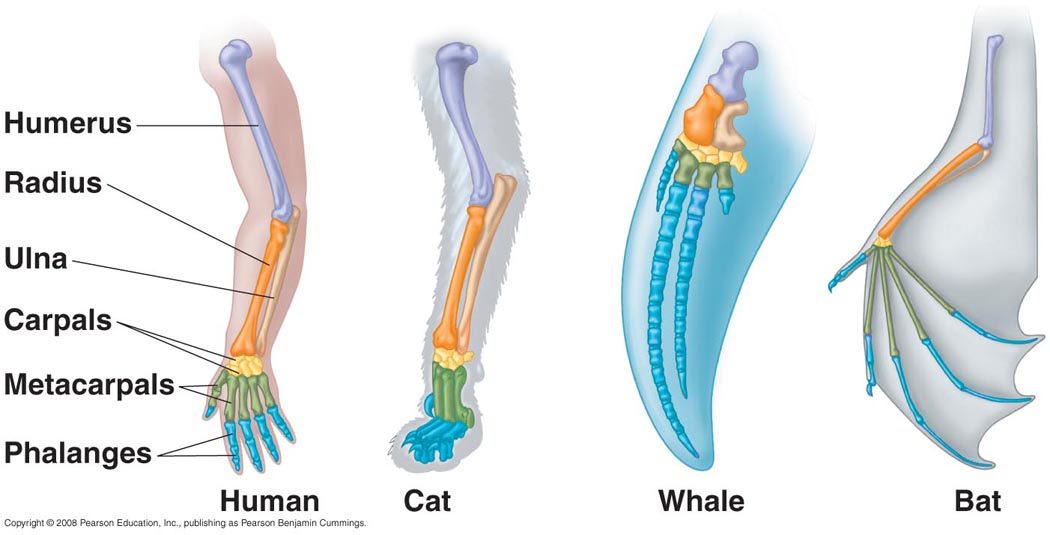
Homologous Structures

Organs or skeletal elements of animals and organisms, that due to their similarity, suggest a connection to a common ancestor. This is important because scientists can use this as evidence of evolution.

media

35

Multiple Choice

Question image

Structures with the same parts but have different functions, suggesting that organisms with a backbone share common ancestry is called…

1

Not related

2

Not homologous

3

Homologous

4

Young in origin

36

Multiple Choice

Structures that are inherited from a common ancestor are homologous.
1
True
2
False

37

Multiple Choice

What is the most important aspect of homologous structures?

1

sharing ancestors

2

similar structure

3

position of bones

4

all of the above

38

Multiple Choice

Question image

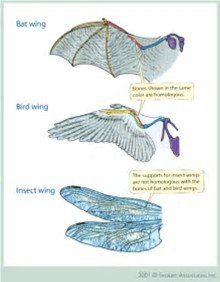
Structures that have the same function but evolved independently DO NOT SHOW EVIDENCE OF A COMMON ANCESTOR. They are called

1

homologous

2

analogous

3

vestigial

4

embryological

39

Multiple Choice

Question image

Which of the following structures are the images an example of?

1

Homologous

2

Vesitigial

3

Analogous

40

Multiple Choice

Analogous structures show recent common ancestry.

1

True

2

False

41

Multiple Choice

An anatomical feature that no longer has a purpose in an organism

1

Homologous structure

2

Analogous structure

3

Vestigial structure

4

None of the above

42

Multiple Choice

Question image

Whales all have a reduced pelvic girdle (pelvis) where limbs previously attached but are no longer needed. What type of structure is this?

1

homologous

2

analogous

3

vestigial

43

Fossils

By looking at the rock layers you can determine the time an animal lived.

media

44

media
media

OLDEST LAYER is at the BOTTOM
And the YOUNGEST at the TOP
unless there has been a
disturbance or the rocks have
been interrupted

LAW of Superposition

45

media

Layers of rock and sediment build up
overtime. Because of this the strata
creates a physical timeline.

Comparing the age of rocks and fossils to
other rocks and fossils bases upon its
position is called relative dating.

Relative Dating -
Rock Layers

media

46

Multiple Choice

Question image

Which type of fossil is oldest formed in the sedimentary rock?

1

Mammals

2

Trilobites

3

Fishes

4

Dinosaurs

5

Amphibians

47

Multiple Choice

Question image

Which statement is true...

1

A is the oldest rock layer

2

A is younger that B, but older that D

3

D is older that all of the other layers

4

All layers are the same age

48

media

Radioactive dating determines the exact ages of rocks and fossils by looking at tiny particles called ISOTOPES.

Some ISOTOPES decay over time and by measuring the amount of decayed ISOTOPES in a sample we can measure how long it has been around for.

Radioactive Dating

media

49

media

Half-lives

When 1/2 of the ISOTOPES have decayed, this is known as a half life.

​All, radioactive, elements have a specific decay rate unique to that element.

media

50

Multiple Choice

Question image

Carbon 14 has a half life of 5,730 years. If there is 50% of it left, how old is the sample?

1

5,730

2

11,460

3

2,685

4

17,190

51

media

52

media

53

media

54

media

55

Multiple Choice

A disease wipes out most of the rabbit population in a forest. What type of limiting factor would this be?

1

density-independent

2

density dependent

56

Multiple Choice

Question image

A student is analyzing data to find the carrying capacity of a deer population.

When did the deer population first reach its carrying capacity?

1

3 months

2

4.5 months

3

5 months

4

6.5 months

57

Multiple Choice

When there is a drought and there is limited water, the water would

1

cause exponential growth

2

be a limiting factor

58

Multiple Choice

Copepods are tiny aquatic organisms used as a food source for fish in the wild or in aquariums.

If copepods are placed in a new aquarium that lacks copepod predators, which graph represents the population change after the addition of copepod predators?

1
2
3
4

59

Energy Transformation

The higher up you go, the less energy is available.

media

60

Trophic levels

Count from the bottom up

media

61

Multiple Choice

How much energy is passed along every trophic level increase?

1

50%

2

25%

3

100%

4

10%

62

Multiple Choice

A gopher has gained 200 Kcal from eating grass all day. A snake comes along and eats that gopher, gaining a portion of those Kcal. A hawk swoops down and eats the snake; how many trophic levels have we moved up?

1

2

2

3

3

4

4

5

63

Multiple Choice

As you go up a food chain, food web or energy pyramid, energy

1

increases

2

decreases

64

Producers and Consumers

Plants are producers (autotrophs)

Animals are consumers (heterotrophs)

media

65

Consumers

  • Herbivores - eat just plants

  • Omnivores - eat plants and animals

  • Carnivores - eat just animals

media

66

Multiple Choice

Question image
An illustration and a dichotomous key are given. What is the correct classification for this organism?
1
Class Insecta
2
Order Amblygygi
3
Order Araneae
4
Order Scorpiones

67

Multiple Choice

When using a dichotomous key to identify organisms, what do we look at?
1
physical features
2
weather patterns
3
environment
4
diet

68

Multiple Choice

Mice eat seeds, nuts and berries they belong in which TROPHIC level on an energy pyramid?

1

Level 1: Producers

2

Level 2: Primary consumers

3

Level 3: Secondary consumers

4

Level 4: Tertiary consumers

69

Multiple Choice

Question image

Squirrels eat nuts, seeds and berries. They are

1

herbivores

2

omnivores

3

carnivores

70

Food Webs and Energy Pyramid Review

media

71

Multiple Choice

The source of energy for all ecosystems is

1

producers

2

the sun

3

water

4

consumers

72

media

73

Multiple Select

Mark all the organisms that are considered producers

1
2
3
4
5

74

media

75

media

76

media

77

Multiple Choice

Mushrooms often grow around dead plants such as decomposing trees. They break down these dead organisms and put energy that stores in the plant back into the ground for other plants to use. What type of consumer are mushrooms?

1

carnivore

2

omnivore

3

herbivore

4

decomposer

78

media

Ecological succession is the orderly process of change in the species composition or makeup in an ecological community over time.

79

media

Primary Succession

Starts with bare rock


Primary succession describes the process of
colonization by plants of previously uninhabited
land.

80

media
media

Primary Succession

Primary
succession
occurs when
a new island
is formed, a
new lake is
formed or a
volcano
erupts

Mount St. Helems erupted in
1980 exposing bare rock.

81

media

Primary Succession

Primary succession is a very slow process,
because there is no soil.

Soil is formed from weathering ( breakdown
of the rock) and the mixing of organic
material from living organisms.

82

Multiple Choice

​ Starting with bare rock is a characteristic of _______​ succession

1
primary
2
secondary
3
tertiary

83

Multiple Select

Which of the following are examples of Primary Succession? Select all that apply.

1

A new mountain being formed from tectonic uplift

2

A new volcanic island formed over a Pacific Ocean hotspot

3

A volcano erupts exposing bare rock in the top of the volcano.

4

A forest recovering from a wildfire

84

media
media

Primary Succession

• The first organisms to

inhabit this new land are
called pioneer species.

• These species work to

create a more hospitable
environment for other
species.

• Pioneer species in

primary succession are
are lichens, mosses and
small annuals.

85

Multiple Choice

The type of plants in an ecosystem affects the__

1

type of animals that can live there

2

amount of rainfall

3

local weather

4

rock substrate

5

amount of sunlight available

86

Multiple Select

Th first plants to grow after a volcano will be the ones that create the new soil. They are called "pioneer species" and include examples like:

1

lichen

2

pine trees

3

moss

4

willow trees

87

media

Secondary Succession

• This occurs when an existing ecosystem is

disturbed.

• Ex. land after a fire, flood or clearing

for agricultural lands.

• During this stage, the original ecosystem

is replaced by new species.

88

media
media

Secondary Succession

89

media

Secondary Succession

  • Pioneer species include small annuals ( grasses and other small plants).

  • Pioneer species are replaced by taller, bush /shrub sized plants

  • Replaced by bush sized woody
    shrubs

  • Replaced by small trees, then larger trees until a climax community is established.

90

Multiple Select

In which of the following scenarios would secondary succession occur? Select all that apply.

1

A forest after a forest fire

2

A newly formed volcanic island

3

A farmer clears and plows a field

4

A desert covered with cacti

91

Multiple Choice

The presence of __ differentiates primary and secondary succession. lower case

1
soil
2

animals

3

water

4

p

92

media
media

Climax Community

This is the
end result of
the
succession
process is a
stable, mature
ecosystem.

93

Multiple Choice

Secondary succession happens much faster than primary succession because ______ is already present

1
soil
2

water

3

plant life

4

animal life

94

Multiple Choice

Question image

The top row of pictures represents ___

1

primary succession

2

secondary succession

3

pioneer plants

4

climax community

95

media

96

Let´s study kingdoms

General characteristics

97

media

98

ARCHAEBACTERIA

  • Oldest kingdom

  • Unicellular

  • Prokaryotic

  • Survive in extreme environments: salty, acidic, hot.

  • Include aerobic (require oxygen) and anaerobic (do not require oxygen) species.

  • Halophyles are examples of this type of species.

media

99

BACTERIA

  • Unicellular organisms .

  • Makes up most of the bacteria in the world .

  • Produce many antibiotics .

  • Used to make yogurt (good bacteria).

  • Example: sterptobacilli and bacillus cereus.

media

100

Multiple Choice

Question image

Which layer is older?

1

Layer 2 (yellow)

2

Layer 6 (blue)

101

FUNGI

  • Multicellular

  • Heterotrophs

  • Eukaryotic

  • Decomposers

  • Do not perform photosynthesis-no chlorophyll

media

102

PROTISTA

  • Unicellular or multicellular

  • Live in water and soil

  • Can perform autotrophic and heterotrophic nutrition.

  • Divided into algae and protozoan (Euglena, paranmecio, amoeba).

  • Eukaryotic

media

103

Animalia

  • Eukaryotic

  • Largest kingdom

  • Heterotrophic nutrition

  • Multicellular

media

104

Plantae

  • Eukaryotic

  • Make their own food through photosynthesis

  • Second largest kingdom

  • Multicellular

  • Divided into vascular and non-vascular

media

105

Multiple Choice

Question image

Term given to describe the 2 name naming system is:

1

dichotmous key

2

binomial nomenclature

3

2 scientific names

4

binomial key

106

Multiple Choice

Question image

Which kingdom do humans belong to?

1

Plantae

2

Fungi

3

Animalia

4

Protista

107

Multiple Choice

One of the following is NOT a kingdom.

1

Virus

2

Animals

3

Plants

4

Archaea

108

Multiple Choice

What are the 6 kingdoms?

1

phylum, class, Order, Family, Genus, Species

2

Humans, Plants, Protists, Archaea, Fungi, Bacteria

3

Trees, Animals, Protists, Archaea, Fungi, Bacteria

4

Plants, Animals, Protists, Archaea, Fungi, Bacteria

109

Multiple Choice

I have cell walls
I am an autotroph
I am multicellular
What am I?
1
Plant
2
Animal
3
Eubacteria
4
Unicorn

110

Multiple Choice

I have no cell walls
I am eukaryotic
I reproduce sexually
I am multicellular
What kingdom do I belong to?
1
Plantae
2
Animalia
3
Protista
4
Fungi

111

Multiple Choice

I am unicellular
I am prokaryotic
I am found in extreme ecosystems
What kingdom do I belong to?

1
Kingdom Plantae
2
Kingdom Animalia
3
Kingdom Archaebacteria
I found a fossil of a fish in what is now a cow pasture. How is that possible?
1
Somebody put the fossil there.
2
The wind moved the fossil there over time.
3
The cow pasture used to be underwater.
4
It would not be possible to find a fossil of a fish in a cow pasture.

Show answer

Auto Play

Slide 1 / 111

MULTIPLE CHOICE