Search Header Logo
  1. Resource Library
  2. Science
  3. Biology
  4. Chemistry Of Life
  5. Chemistry Of Life
Chemistry of Life

Chemistry of Life

Assessment

Presentation

Science

9th - 12th Grade

Easy

NGSS
MS-ESS1-1, MS-ESS2-4, MS-PS1-1

+6

Standards-aligned

Created by

Teresa Schlueter

Used 5+ times

FREE Resource

20 Slides • 16 Questions

1

media

2

media

3

media

4

media

5

media

6

media

7

media

8

media

9

Multiple Choice

What are the vertical columns on the periodic called?

1

groups

2

periods

3

nonmetals

4

metals

5

metalloids

10

Multiple Choice

What are the horizontal rows on the periodic table called?

1

periods

2

groups

3

metals

4

nonmetals

5

metalloids

11

Multiple Select

What does the number of proton tell us?

1

electrons

2

atomic number

3

atomic mass

4

neutrons

12

Multiple Choice

How do you calculate the number of neutrons? *

1

Mass = Atomic number - Neutrons

2

Mass - Atomic number = Neutrons

3

Atomic number = Neutrons

13

media

14

media

15

media

16

media

17

Multiple Choice

Question image
The chemical compound of water is
1
HO
2
H2O
3
H3O
4
HO2

18

Multiple Choice

Question image
What is water made of?
1
Water
2
Liquid
3
Hydrogen and oxygen
4
Blue 

19

Multiple Choice

Question image
molecule in which opposite ends have opposite electric charges
1
cohesion
2
polar molecule
3
hydrogen bond
4
solution

20

media

21

media

22

media

23

media

24

media

25

media

26

media

27

Multiple Choice

Question image

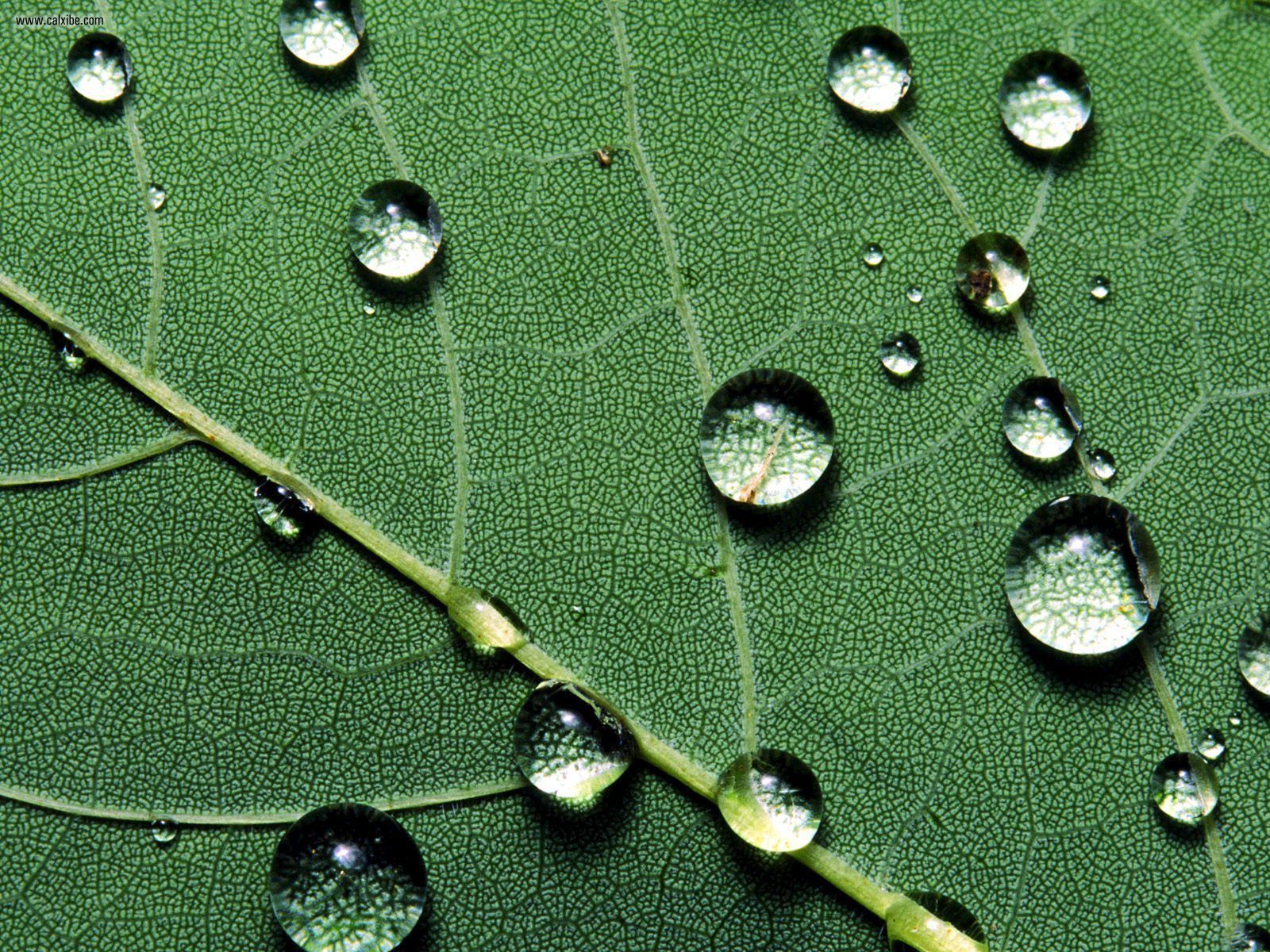
Refer to the picture of water sticking to a leaf; this is occurring because of:

1

Adhesion

2

Cohesion

28

Multiple Choice

Question image
Attractions between water molecules are called
1
Covalent bonds
2
Ionic bonds
3
Polar bonds
4
Hydrogen bonds

29

Multiple Choice

Question image
tendency of molecules of the same kind to stick to one another
1
cohesion
2
adhesion
3
solution
4
polar molecule

30

Multiple Choice

Which end of the water molecule has a slightly positive charge?
1
the oxygen end
2
the hydrogen end
3
both ends are slightly positive
4
neither end is positive

31

Multiple Choice

Question image
Why does water move from the roots to the leaves of plants through the plants' tiny tubes?
1
specific heat 
2

capillary action

3

atoms

4
density

32

Multiple Choice

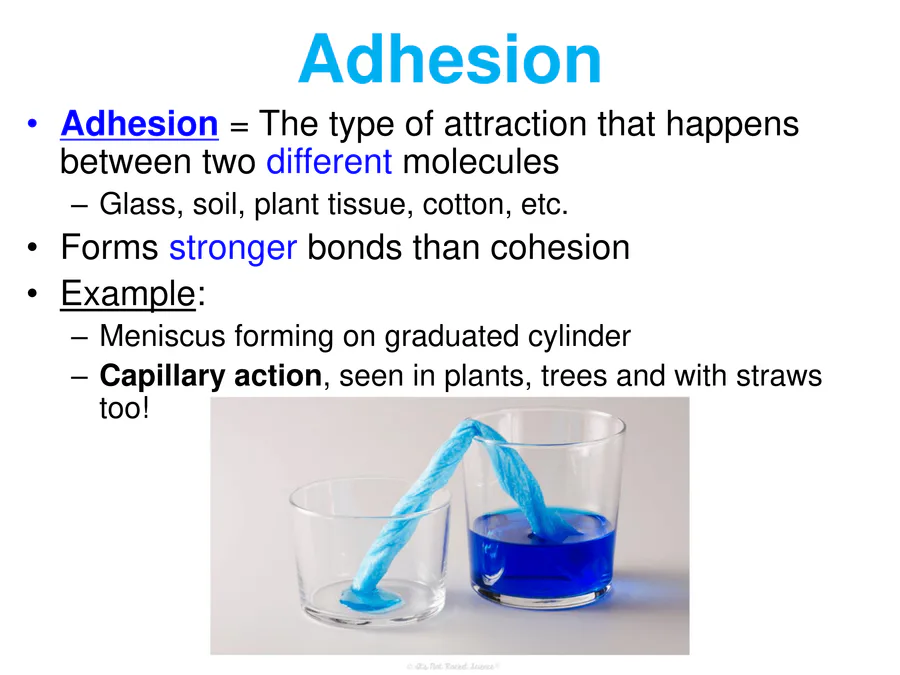
The property where water can pull itself up tubes or through spaces in paper or fabrics.
1
adhesion
2
capillary action
3
cohesion
4
universal solvent

33

Multiple Choice

Question image
Which of the following is LEAST likely to dissolve in water?
1
nonpolar fats and oils
2
polar sugar molecules
3
salt made of a positive sodium ion and a negative chloride ion
4
all of the substances will dissolve easily in water

34

Multiple Choice

Water is a universal solvent because it...
1
It can be found anywhere
2
It freezes when it gets cold
3
floats when frozen
4
Dissolves most substances

35

Multiple Choice

A solvent is...
1
substance into which the solute dissolves
2
a compound being dissolved
3
a substance that does not dissolve
4
None of the above

36

media
media

Show answer

Auto Play

Slide 1 / 36

SLIDE