

2025 Cell Transport ORG PPT

Presentation
•
Biology
•
9th Grade
•
Practice Problem
•
Hard

Belinda Gay
FREE Resource
30 Slides • 84 Questions
1

2
Open Ended
Why is understanding cellular transport important for studying cell biology?
3
Open Ended
Describe the difference between passive and active transport in cellular transport.
4
Multiple Choice
Which of the following is a type of passive transport in cells?
Simple diffusion
Endocytosis
Na/K pump
Phagocytosis
5
Multiple Choice
Which of the following is a type of passive transport in cellular transport?
Simple diffusion
Na/K pump
Endocytosis
Phagocytosis
6
Multiple Choice
Why is cellular transport important for the survival of cells?
It helps cells obtain nutrients and remove waste
It allows cells to divide
It helps cells produce energy only
It allows cells to communicate with each other
7
Open Ended
Why is cellular transport important for the survival of cells?
8

9

10
Multiple Choice
Which of the following is NOT a function of the cell membrane?
Forms a boundary between inside and outside of the cell
Regulates the transport of materials into and out of the cell
Produces energy for the cell
Helps maintain homeostasis by controlling entry and exit of substances
11
Multiple Choice
Which of the following is a primary function of the cell membrane?
It forms a boundary between the inside and outside of the cell
It produces energy for the cell
It stores genetic information
It synthesizes proteins
12
Multiple Choice
Which of the following is a primary function of the cell membrane?
Regulating the transport of materials into and out of the cell
Producing energy for the cell
Storing genetic information
Synthesizing proteins
13

14
Multiple Select
Which of the following molecules are components of the cell membrane according to the Fluid Mosaic Model?
Proteins
Carbohydrates
Cholesterol
Nucleic acids
15
Open Ended
Explain how the structure of the cell membrane allows it to regulate the transport of materials into and out of the cell.
16
Multiple Select
Which of the following molecules are components of the cell membrane according to the Fluid Mosaic Model?
Proteins
Carbohydrates
Cholesterol
Nucleic acids
17

18
Open Ended
Explain why the cell membrane is described as a 'fluid mosaic model.'
19
Multiple Select
According to the fluid mosaic model, which of the following statements are correct?
The membrane is made of many different molecules
Molecules in the membrane are constantly moving
The membrane is made only of phospholipids
Proteins are embedded in the membrane
20
Open Ended
Explain why the cell membrane is described as a 'fluid mosaic model.'
21

22
Fill in the Blanks
The double layer of phospholipids that makes up the cell membrane is called the
Type answer...
23
Fill in the Blanks
The double layer of phospholipids that makes up the cell membrane is called the
Type answer...
24
Fill in the Blanks
The cell membrane is primarily composed of a double layer of
Type answer...
25

26
Multiple Choice
Which part of a phospholipid is hydrophilic?
Phosphate head
Fatty acid tail
Both head and tail
Neither head nor tail
27
Multiple Choice
Which part of a phospholipid is hydrophilic and which part is hydrophobic?
Phosphate head is hydrophilic, fatty acid tails are hydrophobic
Phosphate head is hydrophobic, fatty acid tails are hydrophilic
Both head and tails are hydrophilic
Both head and tails are hydrophobic
28
Multiple Choice
Which part of a phospholipid is hydrophilic?
Phosphate head
Fatty acid tail
Cholesterol
Protein
29

30
Multiple Choice
What property of the phospholipid bilayer makes it impermeable to polar molecules?
Hydrophilic heads face outward
Hydrophobic tails face inward
Presence of cholesterol
Proteins embedded in the membrane
31
Open Ended
Describe how the arrangement of phospholipids in the bilayer affects the permeability of the cell membrane to polar molecules.
32
Multiple Choice
What property does the phospholipid bilayer have regarding polar molecules?
It is impermeable to polar molecules
It allows all polar molecules to pass freely
It dissolves polar molecules
It only allows water to pass through
33

34
Multiple Choice
Which of the following is NOT a type of lipid listed in the image?
Fatty acids
Steroids
Proteins
Glycolipids
35
Multiple Choice
Which of the following is NOT a type of lipid mentioned in the image?
Fatty acids
Steroids
Proteins
Glycolipids
36
Multiple Choice
Which of the following is NOT a type of lipid listed in the image?
Fatty acids
Steroids
Proteins
Glycolipids
37

38

39
Multiple Choice
Which of the following components are found in the cell membrane as shown in the diagram?
Phospholipids
Glycolipids
Cholesterol
All of the above
40
Multiple Select
Which of the following are components of the cell membrane as shown in the diagram?
Phospholipids
Glycoproteins
Cholesterol
DNA
41
Open Ended
Explain the role of cholesterol in the cell membrane structure based on the images provided.
42
Open Ended
Explain the role of phospholipids and cholesterol in the structure of the cell membrane.
43
Open Ended
Explain the role of phospholipids and cholesterol in the structure and function of the cell membrane.
44
Multiple Select
Which of the following are components of the cell membrane as shown in the images?
Phospholipids
Glycolipids
Cholesterol
Nucleic acids
45

46
Fill in the Blanks
Transmembrane proteins are permanently
Type answer...
47
Fill in the Blanks
Transmembrane proteins are permanently
Type answer...
48
Fill in the Blanks
Transmembrane proteins are also known as
Type answer...
49

50
Multiple Select
Select all the correct functions of integral (transmembrane) proteins in the cell membrane.
Create channels for large or polar molecules
Anchor the cell in place
Store genetic information
Cell recognition
51
Open Ended
What are two main functions of integral (transmembrane) proteins in the cell membrane?
52
Multiple Choice
What is the main function of integral proteins in the cell membrane?
Store genetic information
Create channels for molecules to pass
Produce energy
Synthesize carbohydrates
53

54
Open Ended
Describe the difference in location and interaction with the bilayer between peripheral and integral membrane proteins.
55
Fill in the Blanks
Peripheral proteins are usually found on the ___ or ___ surface of the lipid bilayer and are considered ___.
Type answer...
56
Multiple Choice
Where are peripheral proteins located in the cell membrane?
Embedded within the lipid bilayer
Only on the inner or outer surface of the bilayer
Inside the nucleus
Attached to DNA
57

58
Multiple Choice
Which of the following is NOT a function of peripheral proteins in the cell membrane?
Acting as receptors
Catalyzing reactions as enzymes
Forming the main lipid bilayer
Providing cytoskeletal support
59
Multiple Choice
Which of the following is NOT a function of peripheral proteins in the cell membrane?
Acting as receptors
Catalyzing reactions as enzymes
Forming the cytoskeleton
Transporting molecules across the membrane
60
Multiple Choice
Which of the following is NOT a function of peripheral proteins in the cell membrane?
Acting as receptors
Catalyzing reactions as enzymes
Providing structural support as cytoskeletons
Transporting ions across the membrane
61

62
Open Ended
Describe the different roles that proteins play in the function of the cell membrane.
63
Open Ended
Describe two different roles that proteins play in the cell membrane, as illustrated in the diagrams.
64
Multiple Select
Which of the following are crucial functions of membrane proteins as shown in the diagrams?
Structural support
Recognition
Communication
Energy storage
65

66
Fill in the Blanks
Cholesterol helps to maintain membrane
Type answer...
67
Multiple Select
Which of the following are functions of cholesterol in the cell membrane?
Keeps the membrane fluid
Acts as a receptor
Strengthens the cell membrane
Serves as a cell marker
68
Fill in the Blanks
Cholesterol helps to
Type answer...
69

70
Fill in the Blanks
Cholesterol
Type answer...
71
Multiple Select
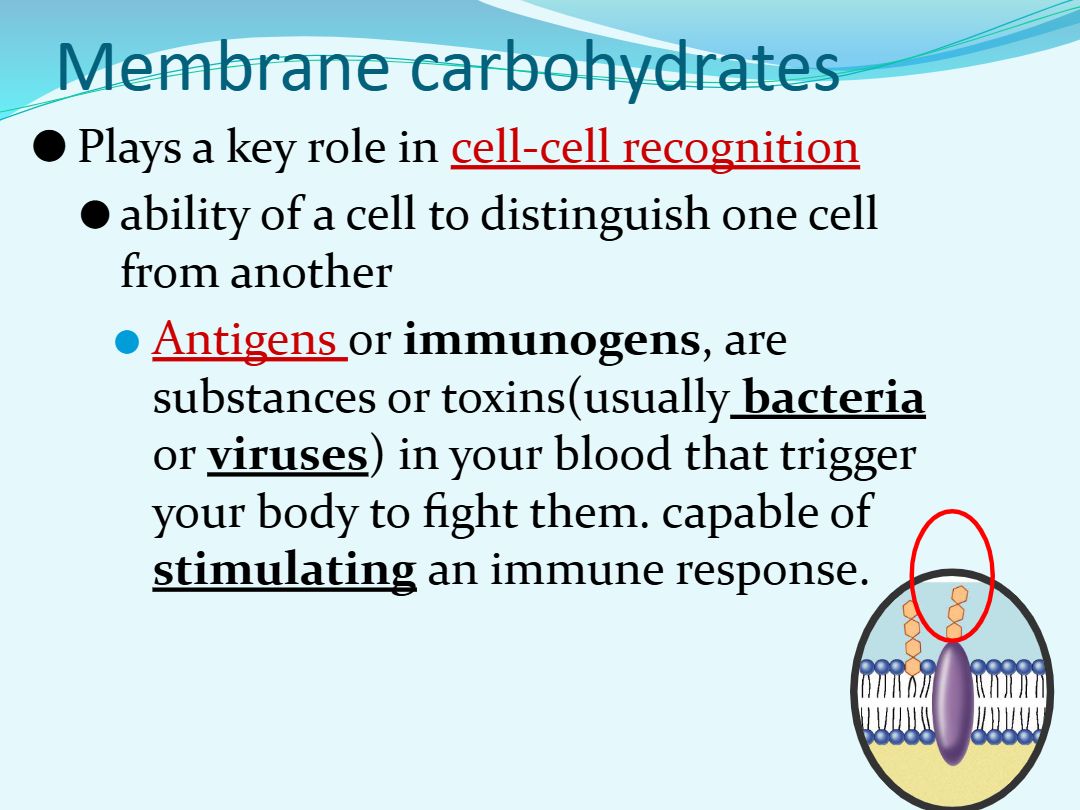
Which of the following statements about glycolipids and glycoproteins in the cell membrane is/are correct?
They serve as cell markers for identification.
They are only found on the cytoplasmic side of the membrane.
They are attached to lipids and proteins.
They are responsible for strengthening the cell membrane.
72
Multiple Choice
What is the main job of carbohydrates attached to lipids and proteins in the cell membrane?
Transporting molecules
Serving as cell markers for identification
Providing energy
Maintaining membrane fluidity
73
74
Multiple Choice
What is the primary function of carbohydrates attached to glycolipids and glycoproteins in the cell membrane?
Energy storage
Cell identification
Transport of molecules
Structural support
75

76
Fill in the Blanks
Antibodies are also called
Type answer...
77
Multiple Select
Based on the images, which of the following statements about antibodies is/are correct?
Antibodies are also called immunoglobulins.
Antibodies are carbohydrates that bind antigens.
Antibodies neutralize antigens or make the immune system aware of their presence.
Antibodies are important in organ and tissue development.
78
Open Ended
Explain how membrane carbohydrates contribute to the immune response.
79
Open Ended
Explain how membrane carbohydrates contribute to the immune response, based on the information provided.
80
Open Ended
Explain how membrane carbohydrates contribute to the immune response, based on the information provided.
81

82
Multiple Choice
Which of the following is NOT a component of the cell membrane as shown in the diagram?
Integral proteins
Phospholipids
Mitochondria
Carbohydrate portion of glycoprotein
83
Multiple Choice
Which of the following is NOT a component of the cell membrane as shown in the diagram?
Integral proteins
Carbohydrate portion of glycoprotein
Mitochondria
Phospholipids
84
Multiple Choice
Which of the following is NOT a component of the cell membrane as shown in the diagram?
Integral proteins
Phospholipids
Mitochondria
Carbohydrate portion of glycoprotein
85

86

87
Open Ended
Name the circled structures.
88

89

90
Fill in the Blanks
Fill in the blank: The cell membrane helps to maintain
Type answer...
91
Fill in the Blanks
Fill in the blank: The movement of water through a selectively permeable membrane is called
Type answer...
92
Multiple Choice
Which of the following statements about passive and active transport is correct?
Passive transport requires energy, while active transport does not.
Active transport moves substances down their concentration gradient.
Passive transport moves substances without using energy, while active transport requires ATP.
Both passive and active transport require the use of transport proteins.
93
Open Ended
Explain how the structure of the cell membrane contributes to its selective permeability.
94
Open Ended
Explain how the structure of the cell membrane contributes to its selective permeability.
95
Open Ended
Explain how the structure of the cell membrane contributes to its selective permeability.
96

97
Multiple Choice
Which process involves the fusion of a vesicle with the plasma membrane to release its contents outside the cell?
Endocytosis
Exocytosis
Osmosis
Facilitated diffusion
98
Open Ended
Describe the difference between phagocytosis and pinocytosis as types of endocytosis.
99
Open Ended
Compare and contrast passive and active transport in terms of energy usage and direction of movement across the cell membrane.
100
Open Ended
Compare and contrast passive and active transport in terms of energy requirement and direction of movement across the membrane.
101
Multiple Select
Which of the following are examples of active transport mechanisms in cells?
Facilitated diffusion
Osmosis
Na/K pump
Endocytosis
102
Multiple Select
Which of the following are types of passive transport across the cell membrane?
Simple diffusion
Facilitated diffusion
Osmosis
Endocytosis
103
Multiple Select
Which of the following are types of passive transport across the cell membrane?
Simple diffusion
Facilitated diffusion
Osmosis
Exocytosis
104
Fill in the Blanks
Fill in the blank: The movement of water through a selectively permeable membrane is called
Type answer...
105

106

107

108

109
Open Ended
Reflecting on what you learned about cellular transport, what questions do you still have or what would you like to know more about?
110
Open Ended
How do you think the different types of cellular transport contribute to the overall function of the cell membrane?
111
Open Ended
Reflecting on today's lesson about cellular transport, what is one question you still have or something you would like to learn more about?
112
Multiple Choice
Which of the following is NOT a type of passive transport in cellular transport?
Simple diffusion
Facilitated diffusion
Osmosis
Na/K pump
113
Multiple Choice
Which of the following is NOT a type of passive transport in cellular transport?
Simple Diffusion
Facilitated Diffusion
Osmosis
Na/K pump
114
Multiple Choice
Which of the following is an example of active transport in cellular movement?
Simple diffusion
Facilitated diffusion
Osmosis
Na/K pump
Show answer
Auto Play
Slide 1 / 114
SLIDE
Similar Resources on Wayground

102 questions
G.8.TRANSPORT IN PLANTS..(2021)
Presentation
•
8th - 9th Grade
107 questions
National 5 Biology Scientific Literacy Skills
Presentation
•
10th - 11th Grade
112 questions
contries all
Presentation
•
8th Grade
106 questions
LT B1 L8 Vocabulary PPT
Presentation
•
10th Grade
111 questions
Ecology
Presentation
•
9th Grade
104 questions
Leadership
Presentation
•
8th Grade
101 questions
DIVISION OF INTEGERS
Presentation
•
9th - 10th Grade
Popular Resources on Wayground
10 questions
How much do you know about our Portrait of an Eagle?

Quiz
•
10th Grade
10 questions
Fast Food Slogans
Quiz
•
6th - 8th Grade
21 questions
Continents and Oceans
Quiz
•
6th Grade
20 questions
Parts of Speech
Quiz
•
5th Grade
16 questions
Subject & Predicate
Quiz
•
5th Grade
25 questions
Multiplication Facts
Quiz
•
5th Grade
12 questions
Map Skills
Quiz
•
3rd Grade
22 questions
Continents and Oceans
Quiz
•
5th Grade
Discover more resources for Biology
20 questions
Characteristics of Life
Quiz
•
9th - 10th Grade
10 questions
Exploring the 4 Major Macromolecules and Their Functions

Interactive video
•
9th - 12th Grade
20 questions
Cell Transport
Quiz
•
9th - 12th Grade
25 questions
photosynthesis and cellular respiration
Quiz
•
9th Grade
16 questions
Population Ecology
Quiz
•
9th - 12th Grade
20 questions
Cell Organelles
Quiz
•
9th Grade
18 questions
Water Properties
Quiz
•
9th Grade
36 questions
U3 Review Cell Cycle and Specialization Quiz
Quiz
•
9th Grade