
States of Matter and Intermolecular Forces
Authored by Rochelle Mables
Science
10th Grade
NGSS covered
Used 1+ times


AI Actions
Add similar questions
Adjust reading levels
Convert to real-world scenario
Translate activity
More...
Content View
Student View
23 questions
Show all answers
1.
MULTIPLE CHOICE QUESTION
30 sec • 1 pt
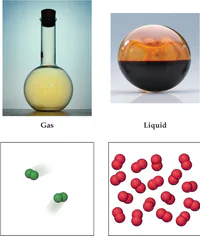
Which statement best distinguishes gases from liquids and solids in terms of particle motion and spacing?
Particles closely packed and randomly oriented, changing neighbors
Particles far apart with complete freedom of motion
Particles slightly separated but mostly touching at rest
Particles closely packed with fixed positions in an array
Tags
NGSS.MS-PS1-4
2.
MATCH QUESTION
30 sec • 1 pt

Identify the correct pairing between state of matter and a characteristic property.
Assumes container’s shape partially
Solid
Retains own shape and volume
Gas
Expands to fill container
Liquid
Tags
NGSS.HS-PS3-4
3.
MULTIPLE CHOICE QUESTION
30 sec • 1 pt
Which two factors directly determine how close particles are and how they move, setting the state of matter?
Charge and polarity
Color and density
Mass and volume
Temperature and pressure
Tags
NGSS.MS-PS1-4
4.
MULTIPLE SELECT QUESTION
30 sec • 1 pt
Select all properties that typically describe liquids.
Diffusion occurs extremely slowly within the phase
Virtually incompressible under normal conditions
Assumes both volume and shape of its container
Flows readily but does not expand to fill container
5.
MULTIPLE CHOICE QUESTION
30 sec • 1 pt
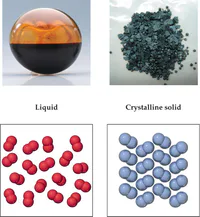
As the strength of intermolecular attractions increases along the arrow, how do the states of matter change?
From gas to liquid to crystalline solid
From solid to gas to liquid
From liquid to gas to crystalline solid
From crystalline solid to gas to liquid
Tags
NGSS.MS-PS1-4
6.
MULTIPLE CHOICE QUESTION
30 sec • 1 pt
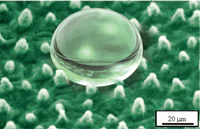
Which statement about condensed phases is accurate?
Liquids and solids have particles perpetually touching
Gases have particles perpetually touching
Condensed phases mean particles are widely separated
Condensed phases are gases and plasmas together
Tags
NGSS.HS-PS1-3
7.
MULTIPLE CHOICE QUESTION
30 sec • 1 pt
Choose the correct description of diffusion speed across states.
Rapid in gases, slow in liquids, extremely slow in solids
Equal in gases, liquids, and solids overall
Slow in gases, rapid in liquids, moderate in solids
Rapid in solids, slow in gases, moderate in liquids
Access all questions and much more by creating a free account
Create resources
Host any resource
Get auto-graded reports

Continue with Google

Continue with Email

Continue with Microsoft
or continue with

%20(1).png)
Apple

Others
By signing up, you agree to our Terms of Service & Privacy Policy
Already have an account?


