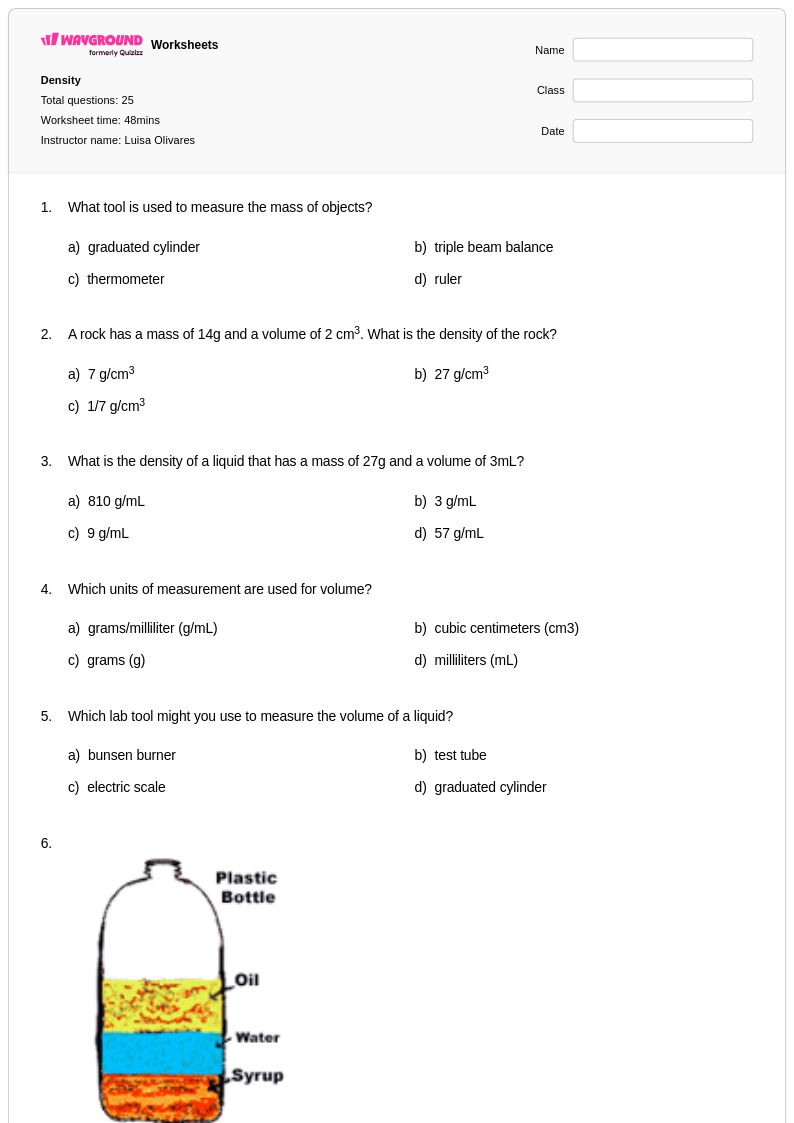
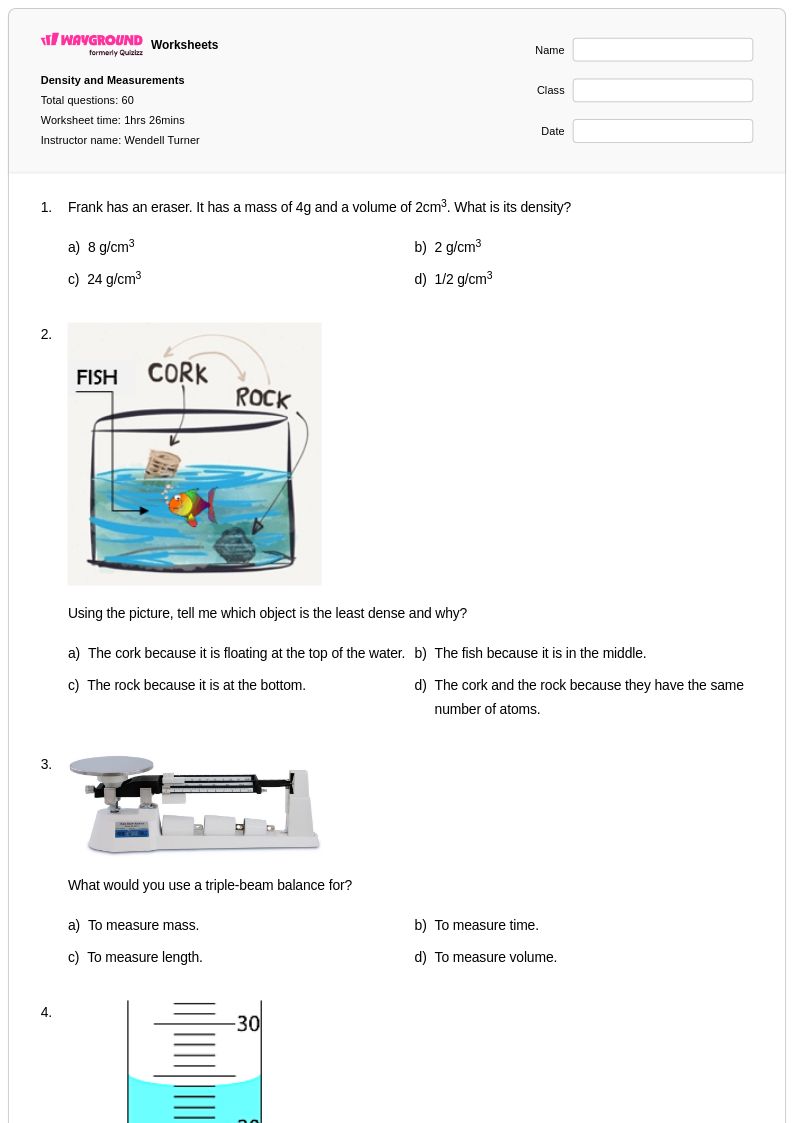
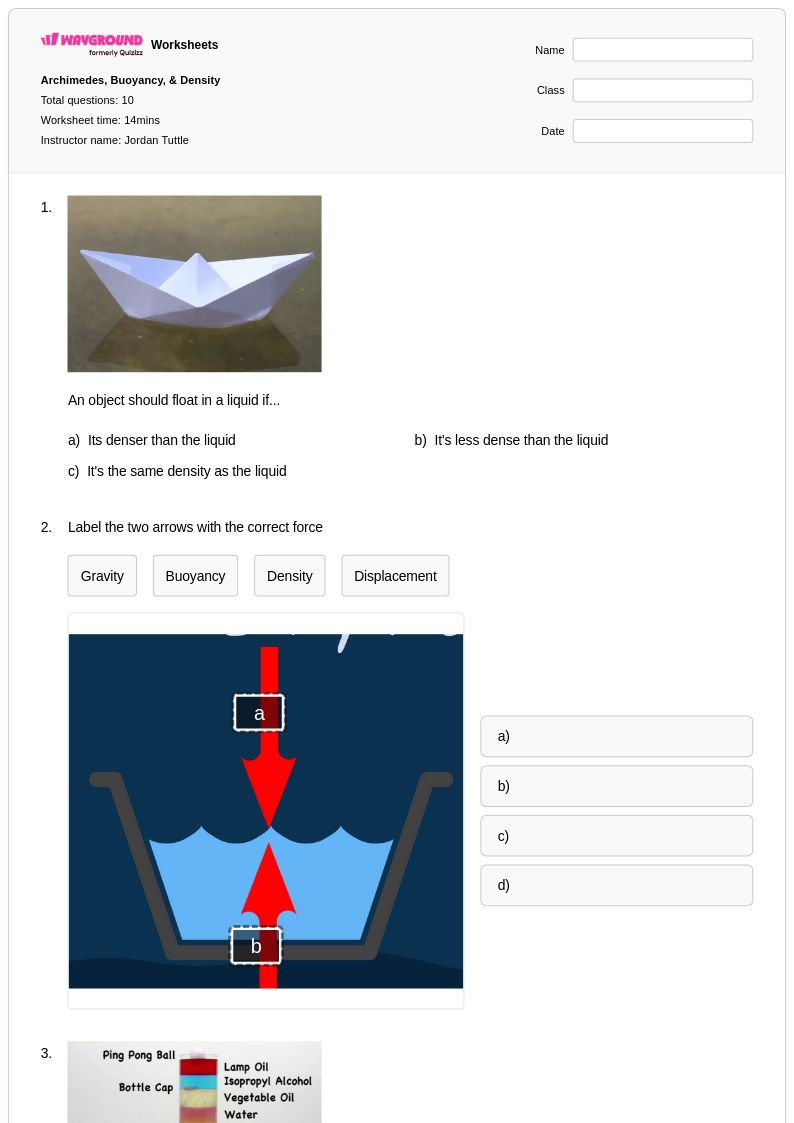
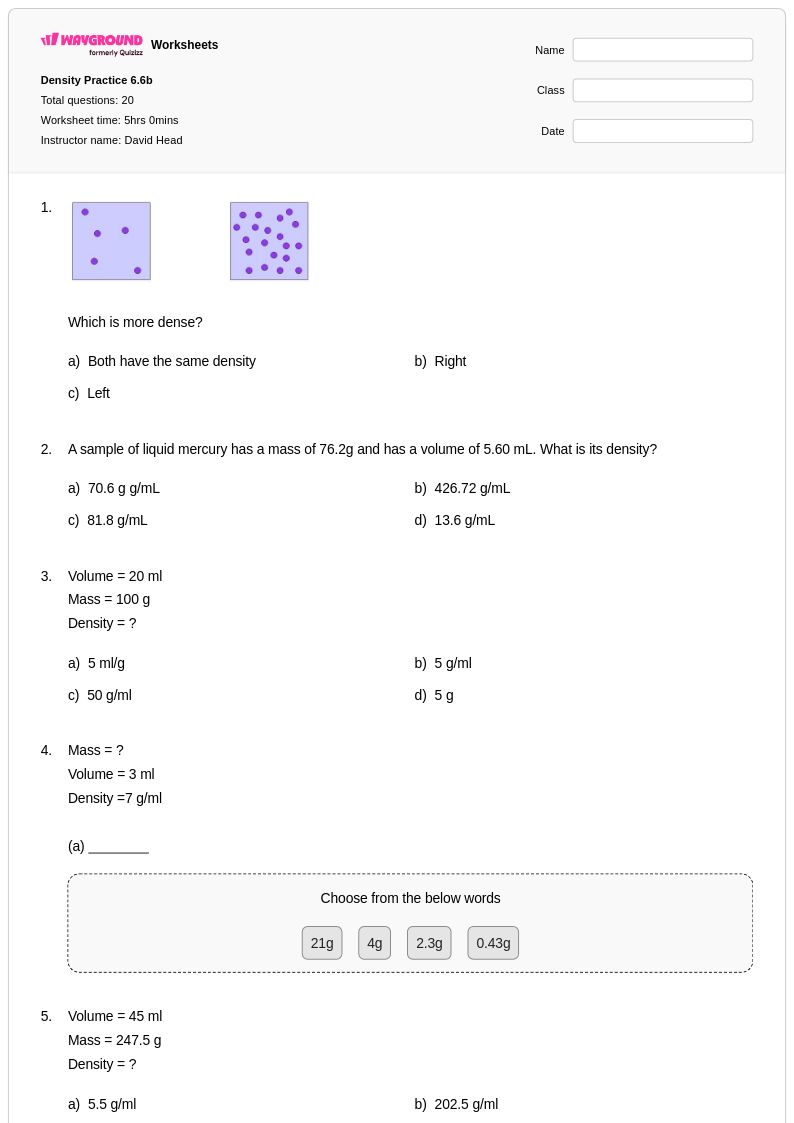
Explore Wayground's comprehensive collection of density worksheets featuring free printables and practice problems with answer keys to help students master fundamental physics concepts through hands-on calculations and real-world applications.
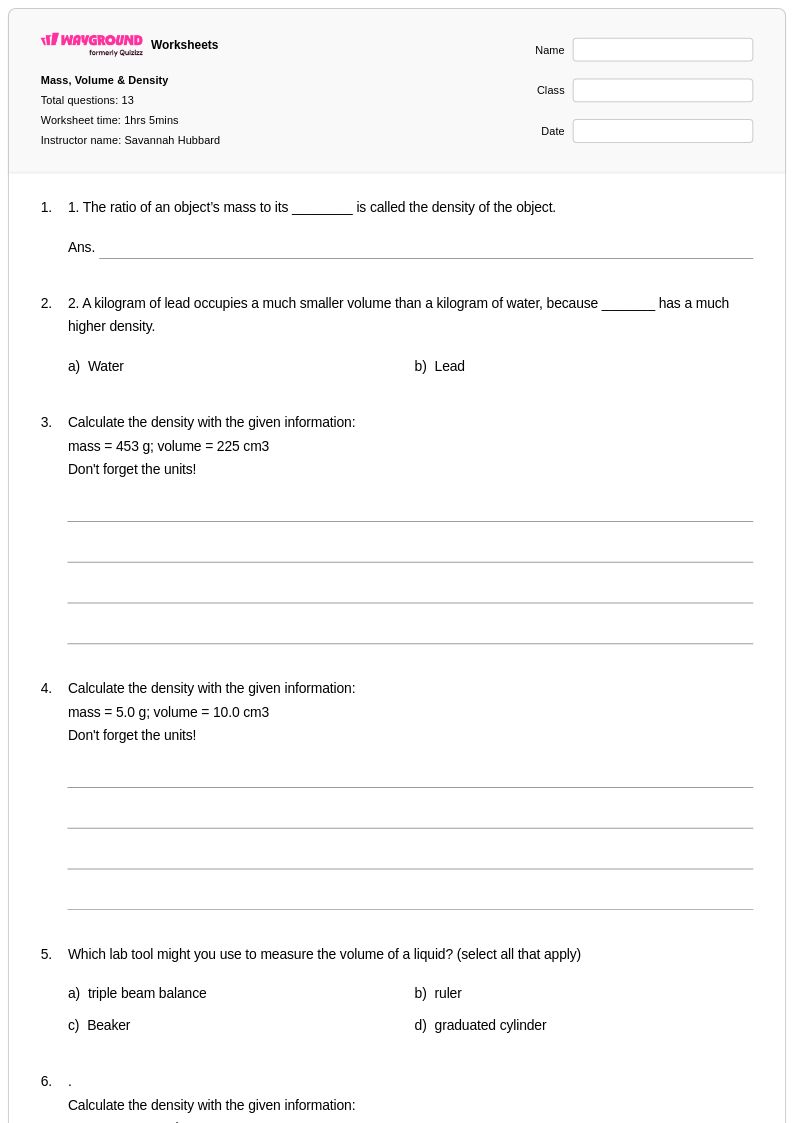
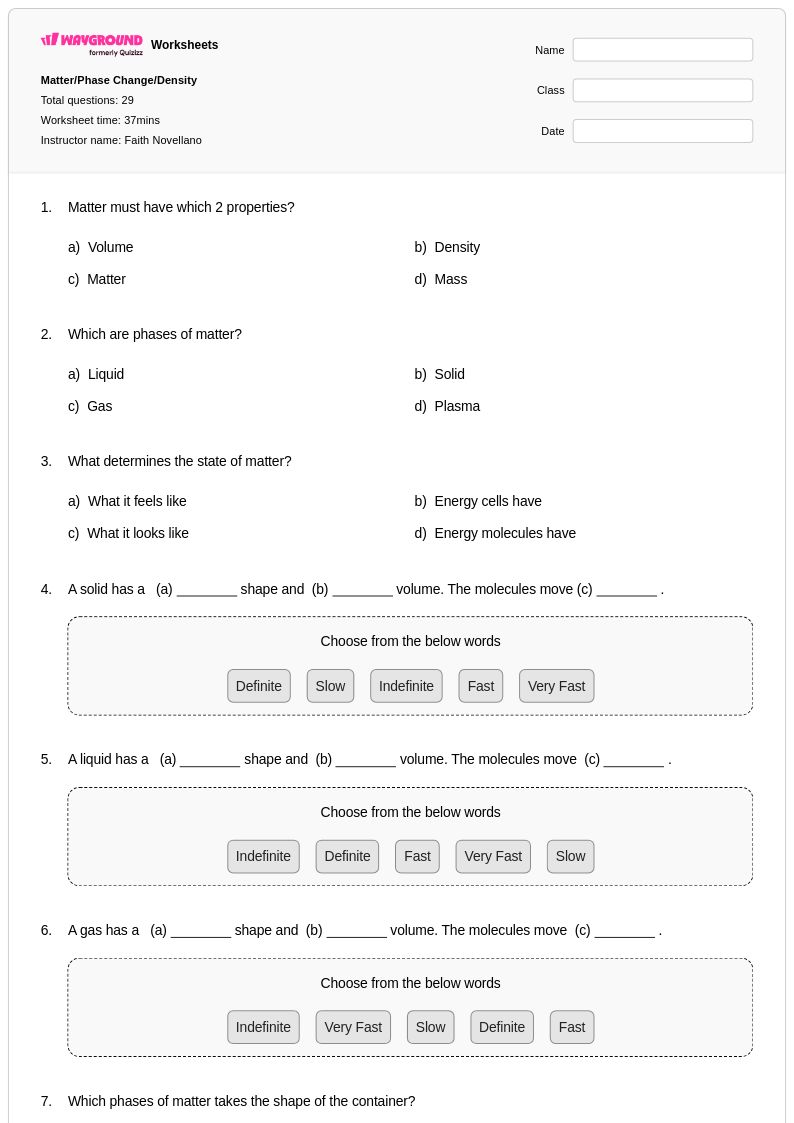
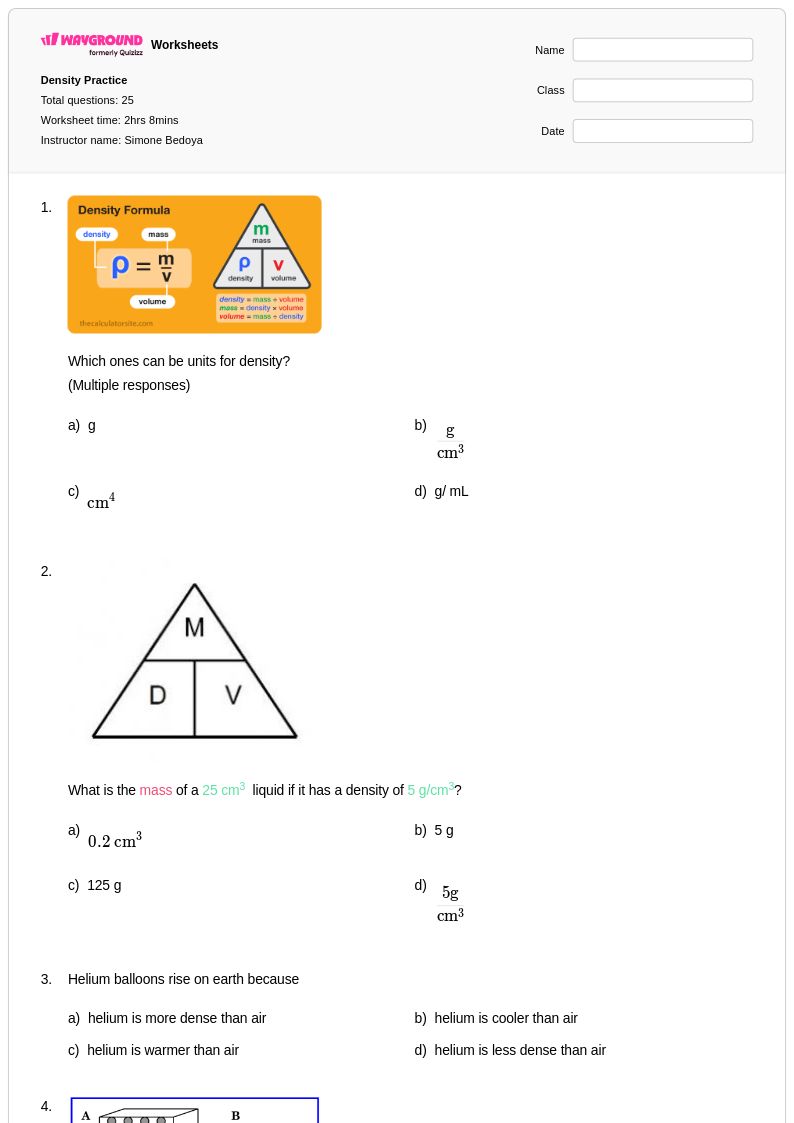
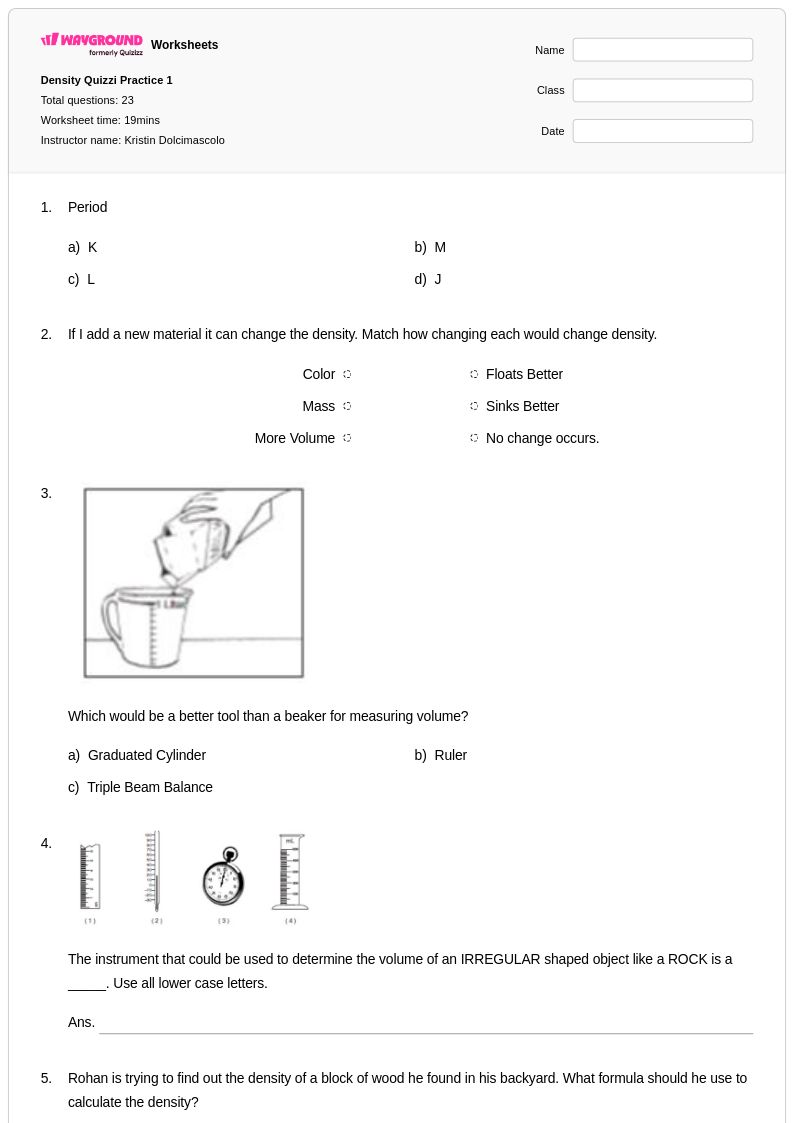
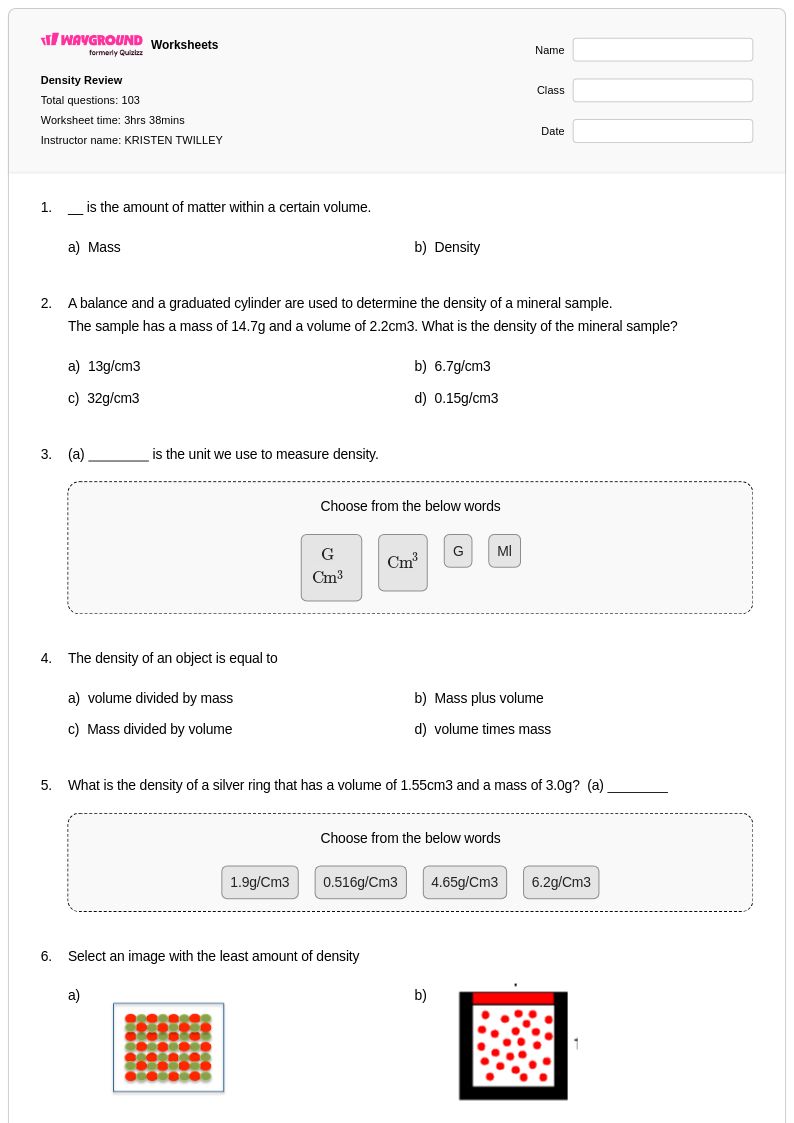
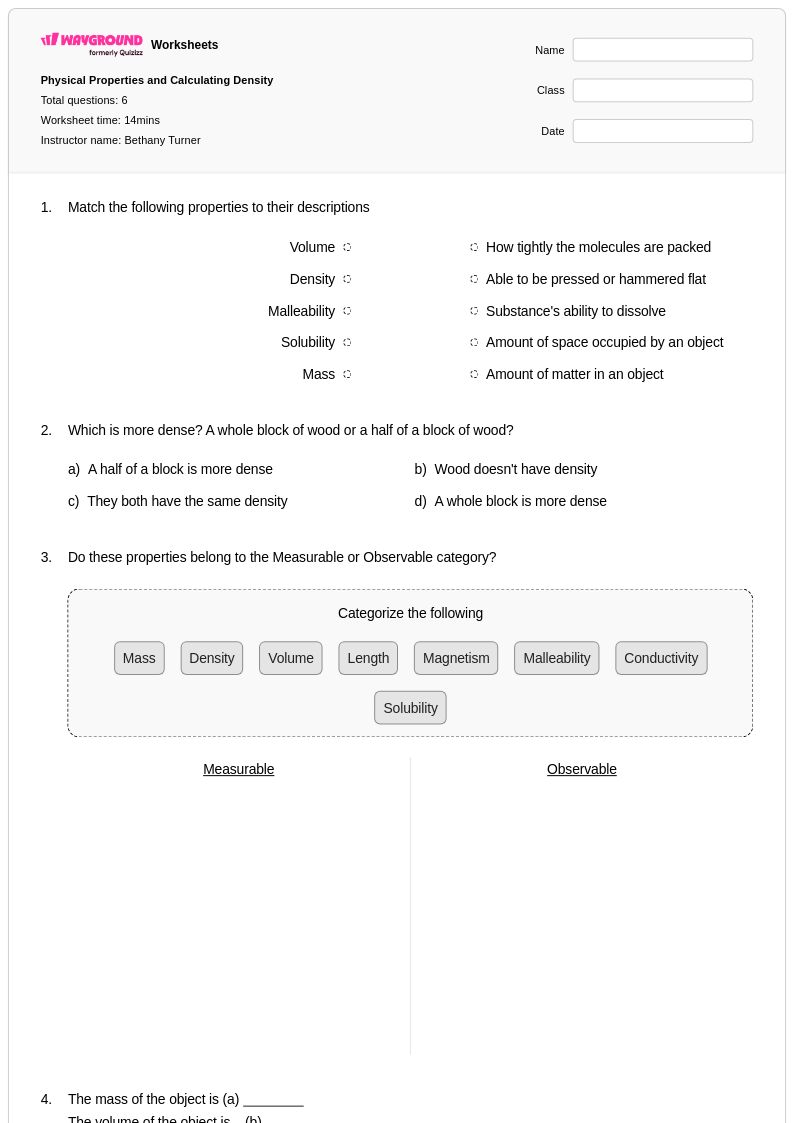
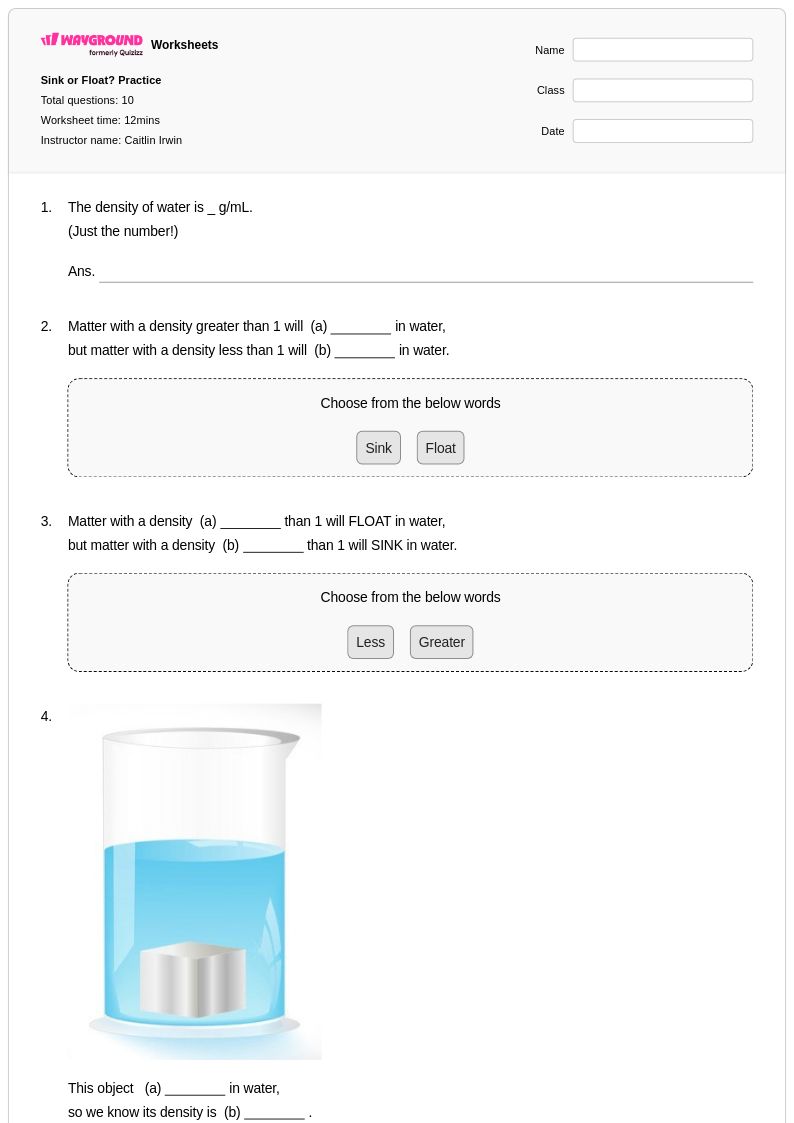
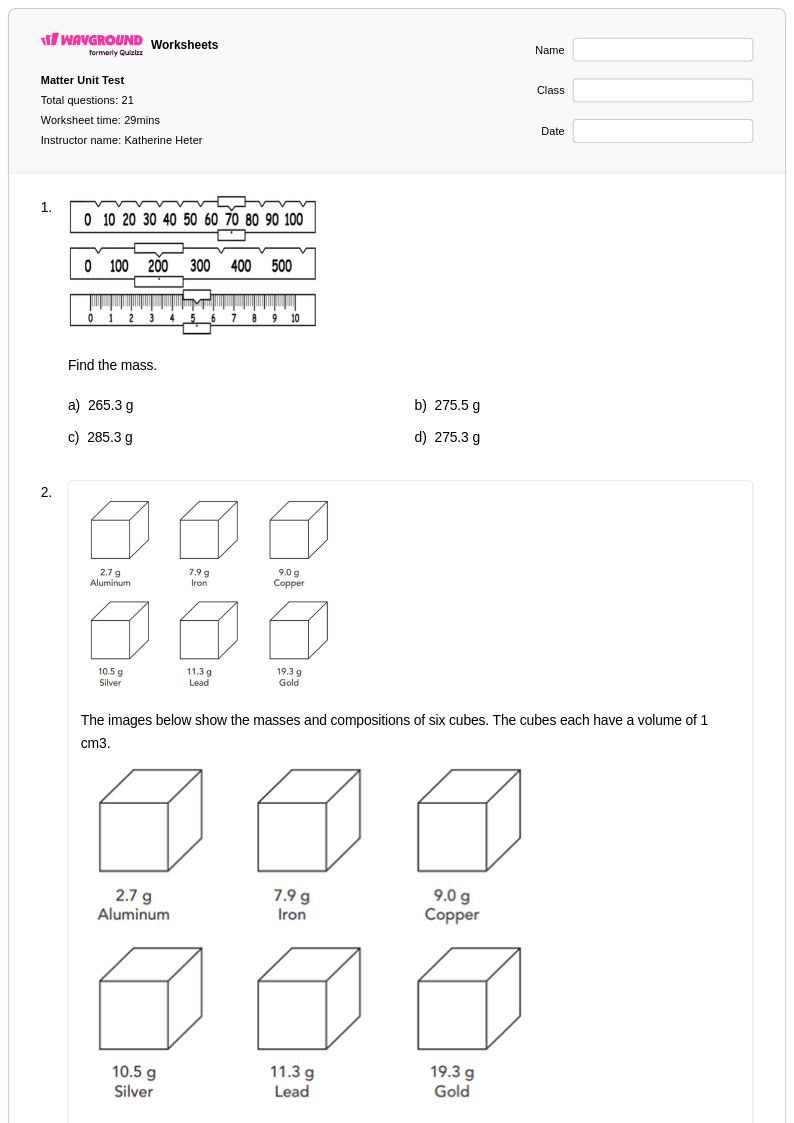
Density worksheets through Wayground (formerly Quizizz) provide comprehensive educational resources that help students master this fundamental physics concept through systematic practice and application. These carefully designed materials guide learners through essential density calculations, including determining mass-to-volume ratios, solving for unknown variables in the density formula, and applying density principles to real-world scenarios involving floating, sinking, and material identification. Students strengthen critical analytical skills while working through practice problems that range from basic computational exercises to complex multi-step applications, with each worksheet featuring detailed answer keys that support both independent study and classroom instruction. The collection includes free printable pdf resources that cover density measurements across different states of matter, comparative density analysis, and experimental data interpretation, ensuring students develop both conceptual understanding and practical problem-solving abilities.
Wayground (formerly Quizizz) empowers educators with an extensive library of millions of teacher-created density resources that streamline lesson planning and enhance student learning outcomes. The platform's robust search and filtering capabilities allow teachers to quickly locate worksheets aligned with specific physics standards, whether they need introductory density concepts or advanced applications involving irregular objects and fluid mechanics. Differentiation tools enable instructors to customize worksheet difficulty levels and problem types to meet diverse learning needs, supporting both remediation for struggling students and enrichment opportunities for advanced learners. Available in both printable and digital formats including downloadable pdfs, these density worksheets integrate seamlessly into any physics curriculum, providing flexible options for in-class practice, homework assignments, laboratory follow-up activities, and assessment preparation that reinforce mastery of this essential physics principle.
FAQs
How do I teach density to middle or high school students?
Start by grounding students in the formula D = m/v before moving to application. Use concrete examples like comparing a brick and a foam block of the same size to build intuition, then transition to numerical problems involving mass-to-volume ratios. Connecting density to real-world phenomena like floating, sinking, and material identification helps students see why the concept matters beyond the formula.
What kinds of practice problems help students get better at density calculations?
Effective density practice should progress from single-variable solve problems (finding density when mass and volume are given) to multi-step problems where students must isolate mass or volume as the unknown. Including problems that involve different states of matter, irregular objects, and comparative density analysis builds the full range of skills students need. Experimental data interpretation problems are especially useful for reinforcing both calculation accuracy and conceptual reasoning.
What mistakes do students commonly make when solving density problems?
The most common error is misidentifying which variable is unknown and algebraically rearranging the formula incorrectly — for example, dividing mass by density instead of volume by mass. Students also frequently confuse units, mixing grams with kilograms or milliliters with liters, which produces wrong answers even when the setup is correct. A third common misconception is assuming that a heavier object always sinks, rather than understanding that density relative to the surrounding fluid determines buoyancy.
How do I differentiate density worksheets for students at different skill levels?
For struggling students, start with scaffolded problems that provide the formula and label each variable clearly, limiting cognitive load to one unknown at a time. Advanced learners can be challenged with multi-step problems involving irregular object displacement or fluid mechanics scenarios. On Wayground, teachers can also apply individual accommodations such as reduced answer choices or read-aloud support for specific students, while the rest of the class works through standard problem sets.
How can I use Wayground's density worksheets in my classroom?
Wayground's density worksheets are available as printable PDFs for traditional classroom use and in digital formats for technology-integrated instruction. Teachers can assign them as in-class practice, homework, or laboratory follow-up activities, and can also host them as a live quiz directly on Wayground. Each worksheet includes a detailed answer key, making them practical for both independent student work and teacher-led review sessions.
How do density worksheets support lab activities in a physics class?
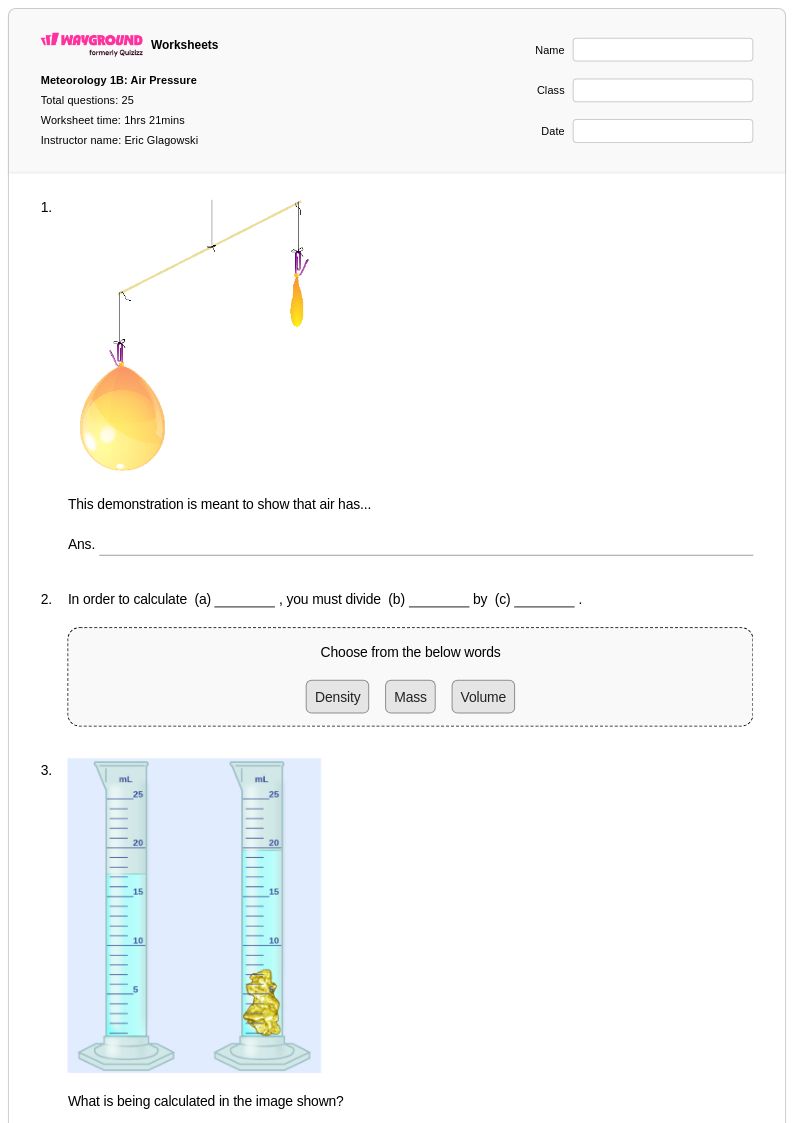
Density worksheets that include experimental data interpretation problems are ideal as pre-lab primers or post-lab reinforcement. Students can apply data collected from displacement experiments to the density formula, bridging hands-on measurement with analytical calculation. This connection between lab work and worksheet practice strengthens both procedural accuracy and conceptual understanding of why density is a reliable property for identifying materials.