Free Printable Distance on a Number Line Worksheets for Year 1
Year 1 distance on a number line worksheets from Wayground help students master spatial number relationships through engaging printables and practice problems with complete answer keys.
Explore printable Distance on a Number Line worksheets for Year 1
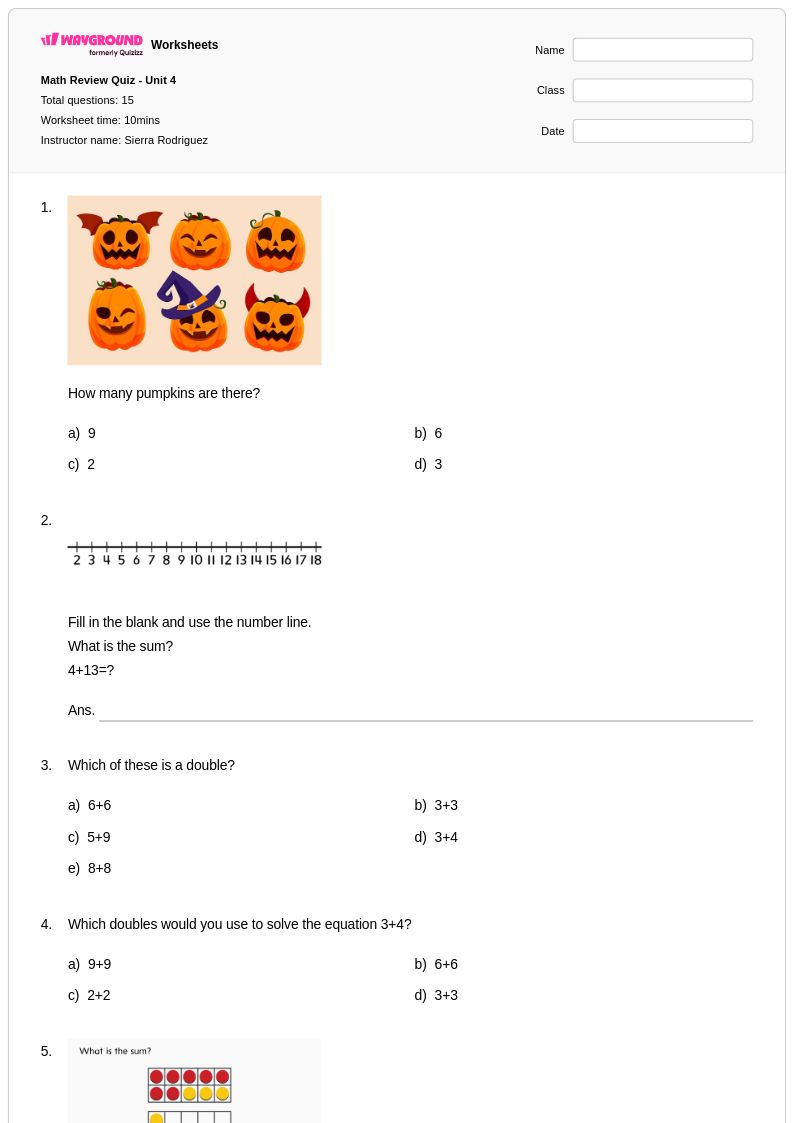
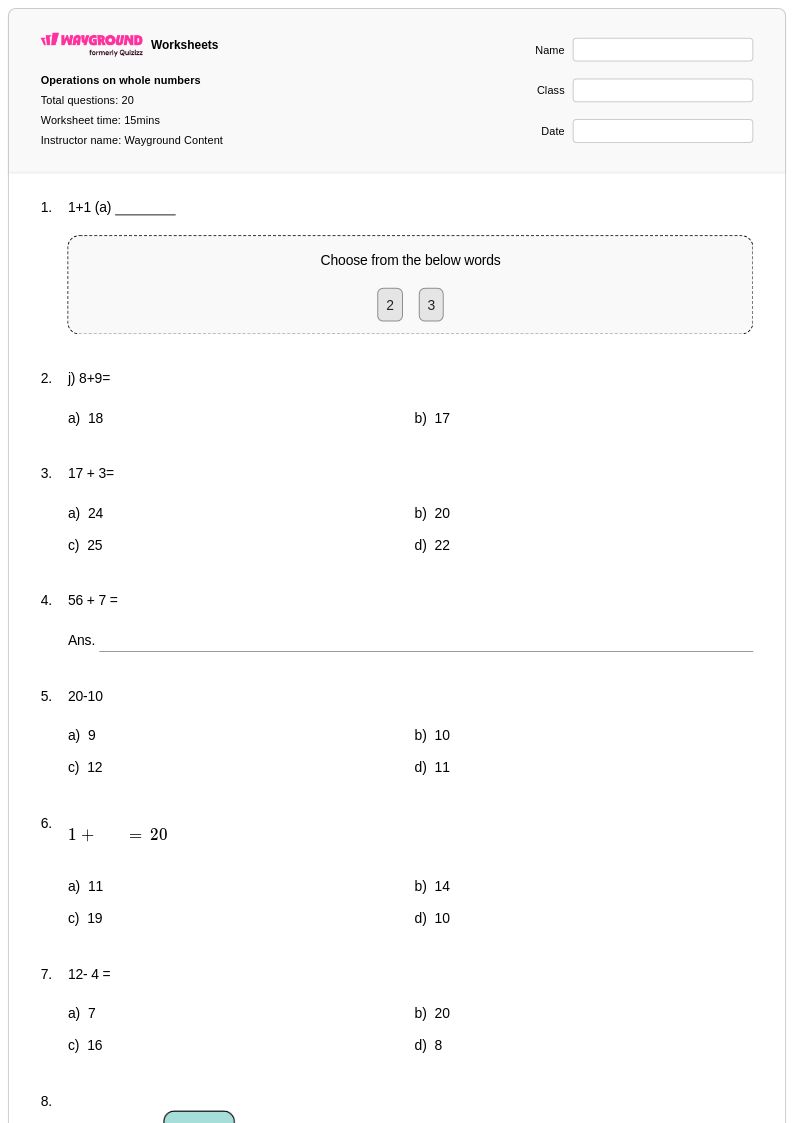
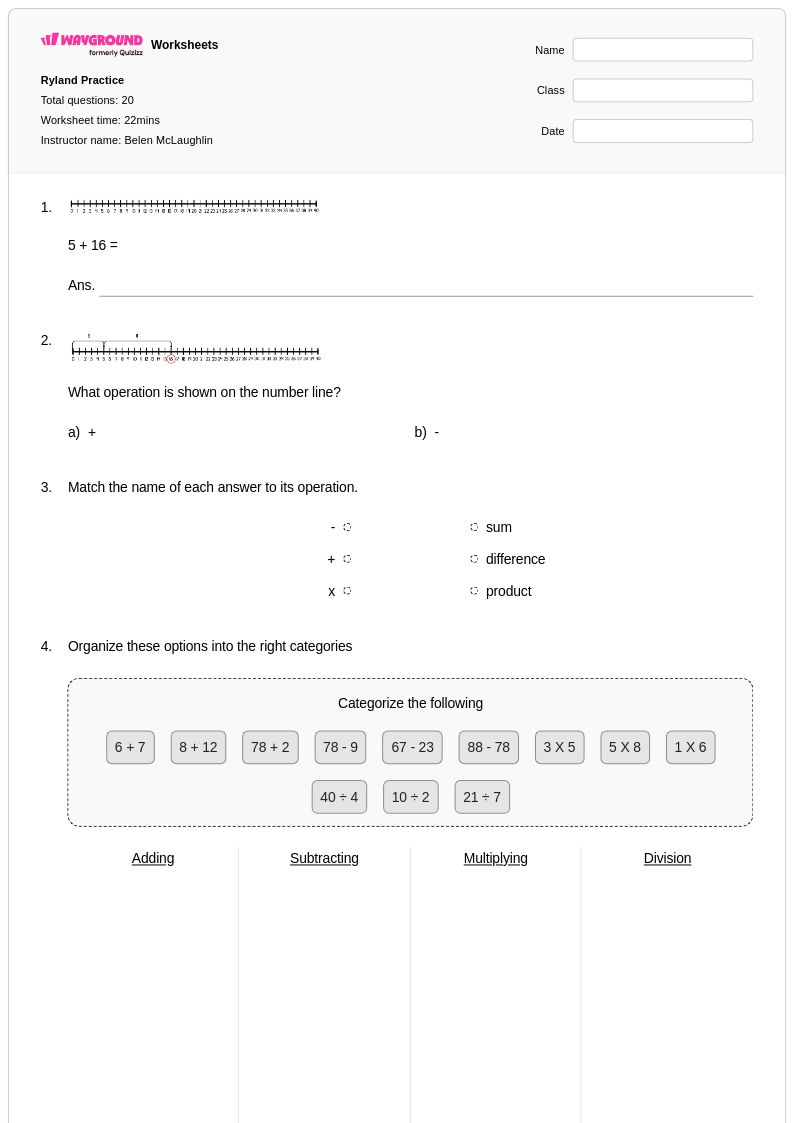
Distance on a number line worksheets for Year 1 students available through Wayground provide essential foundational practice for developing spatial number relationships and early measurement concepts. These carefully designed printables help young learners understand how numbers are positioned relative to each other on a horizontal line, strengthening their ability to visualize numerical distance and sequence. Students work through practice problems that involve counting spaces between numbers, identifying which numbers are closer or farther apart, and developing intuitive understanding of numerical intervals. Each worksheet collection includes a comprehensive answer key and is available in convenient PDF format, allowing teachers to seamlessly integrate these free resources into their mathematics instruction while building crucial number sense skills.
Wayground's extensive library of teacher-created distance on number line worksheets offers educators powerful tools for differentiated instruction and targeted skill development. With millions of resources available, teachers can easily search and filter materials to find worksheets that align with their specific curriculum standards and student needs. The platform's flexible customization options enable educators to modify existing worksheets or create variations that support remediation for struggling learners or provide enrichment challenges for advanced students. Available in both printable PDF format and interactive digital versions, these resources support diverse classroom environments and learning preferences, making lesson planning more efficient while ensuring consistent skill practice across different instructional settings.
FAQs
How do I teach distance on a number line to first graders?
First graders are ready to connect number line jumps to addition and subtraction, so frame distance as a counting-on or counting-back problem. Start with a number line from 0 to 20 and have students place two numbers, then count the spaces between them. Once that's solid, show them that the distance from 4 to 9 is the same as 9 minus 4 — this bridges the visual model to the arithmetic they're learning simultaneously.
What exercises help first graders practice number line distance?
Three problem types cover the core skill well: counting spaces between two given numbers, finding a missing endpoint when the starting number and distance are given, and comparing two pairs of numbers to determine which are farther apart. Keeping numbers within 0–20 and mixing problems that go left-to-right with a few that go right-to-left builds flexibility without overwhelming students at this stage.
What errors do first graders commonly make with number line distance?
The off-by-one error is the most persistent: students count the starting number as '1' instead of counting the first space as '1,' arriving at an answer one too high. A quick fix is to have students place a finger on the starting number and say 'zero,' then count each hop. The second common error is losing track of direction — students sometimes count backward when the larger number is on the left, which is worth addressing explicitly.
How do I use these Grade 1 number line worksheets on Wayground?
You can assign any worksheet as a digital quiz on Wayground for immediate scoring, or print the PDF for paper practice — both formats include a complete answer key. For printed submissions, the Wayground for Teachers app lets you scan student work to grade it without manually re-entering every answer, which saves time when you're working through a full class set.
How does Grade 1 number line distance fit into the Common Core progression?
Common Core expects first graders to use a number line as a tool for understanding addition and subtraction within 20. Finding the distance between two points is the subtraction direction of that work — students are essentially solving 'how many do I count on to get from here to there?' This lays the groundwork for Grade 2, where students extend the number line to 100 and begin measuring length, which is formally defined as the distance between two points.
How can I differentiate number line distance practice for my Grade 1 class?
For students who need more support, Wayground's dyslexia-friendly font and larger font size options make the number line and numerals easier to read on the printed worksheet. For students working ahead, look for worksheet variations that introduce distances beyond 20 or ask students to generate their own pairs of numbers with a given distance. In digital mode, the Reduced Answer Choices accommodation can simplify multiple-choice problems for students who need to focus on the distance concept without being overwhelmed by options.