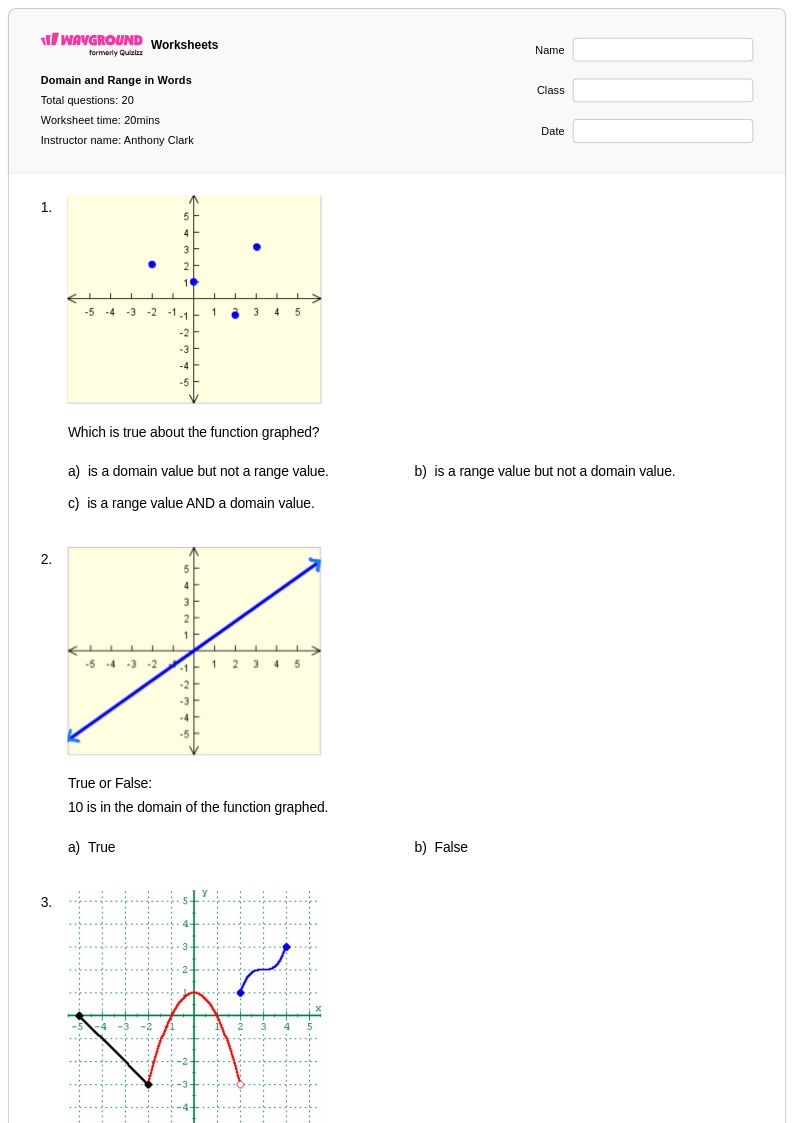
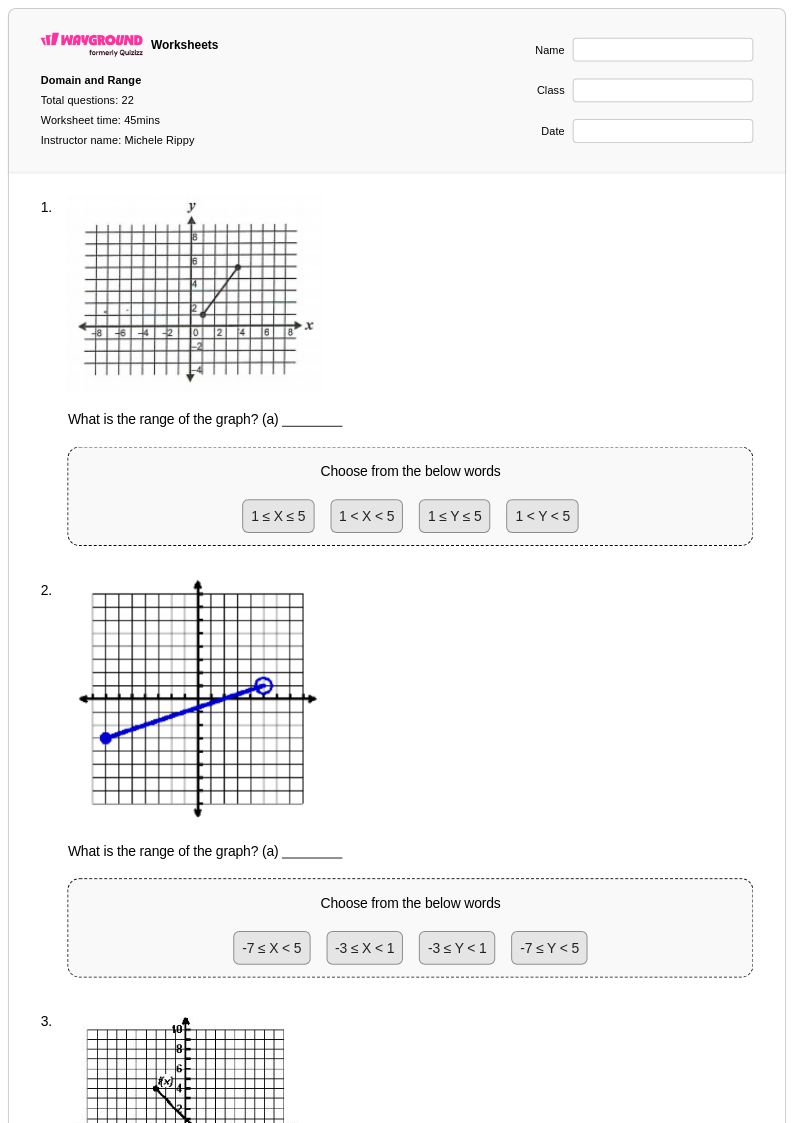
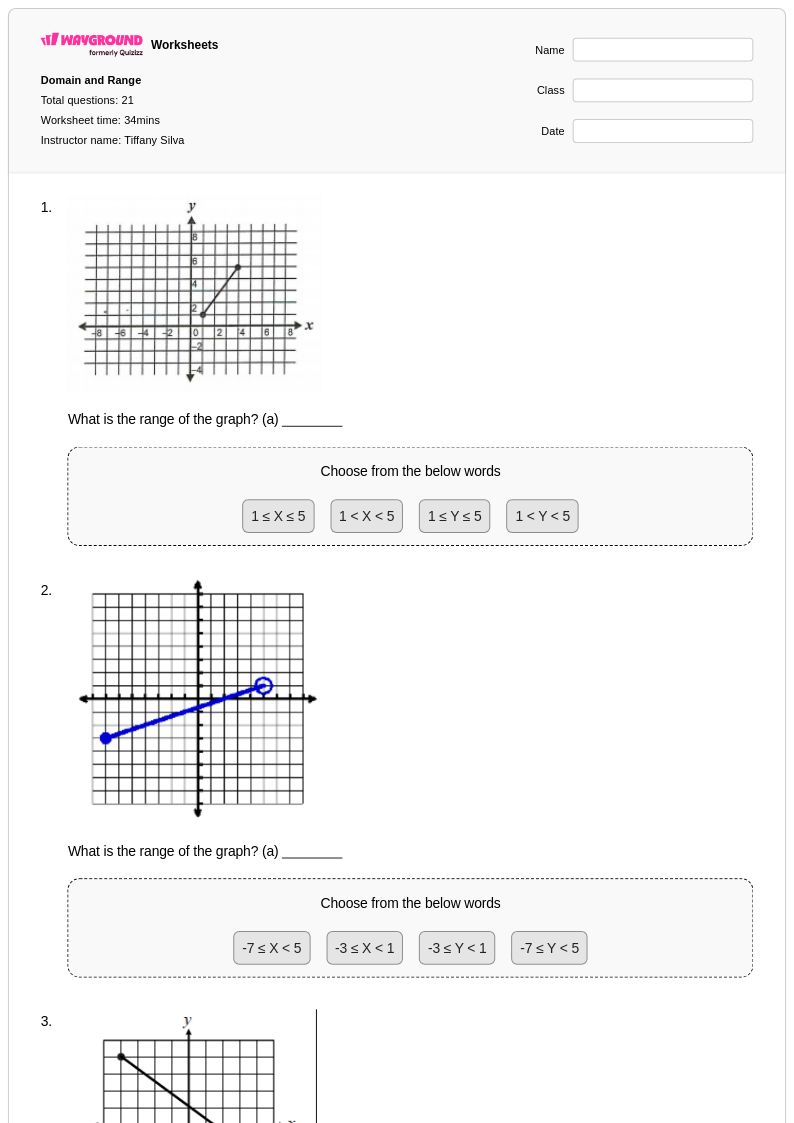
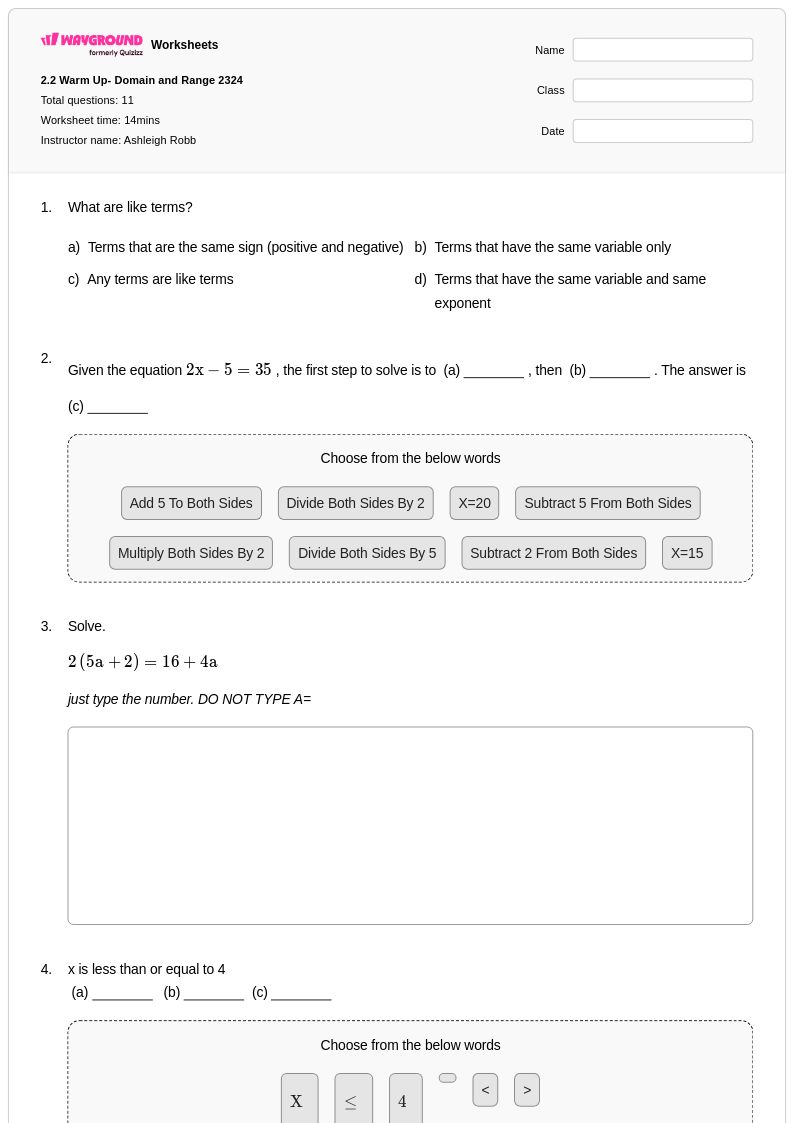
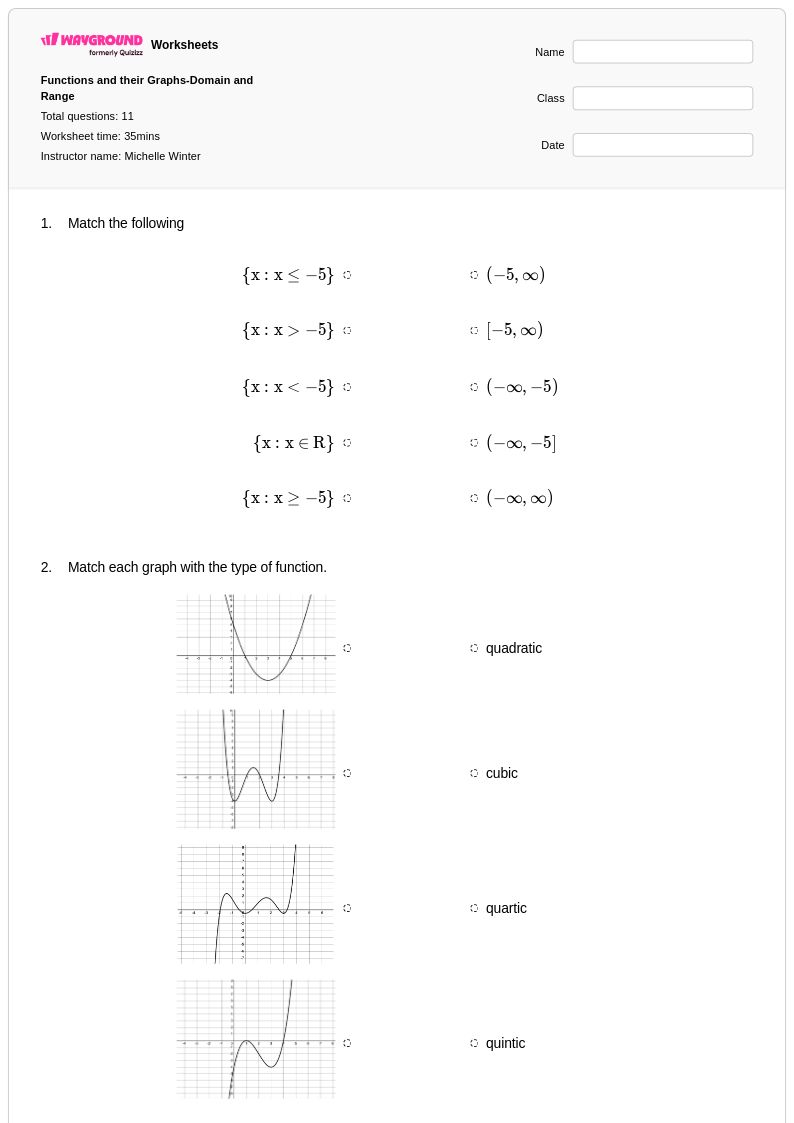
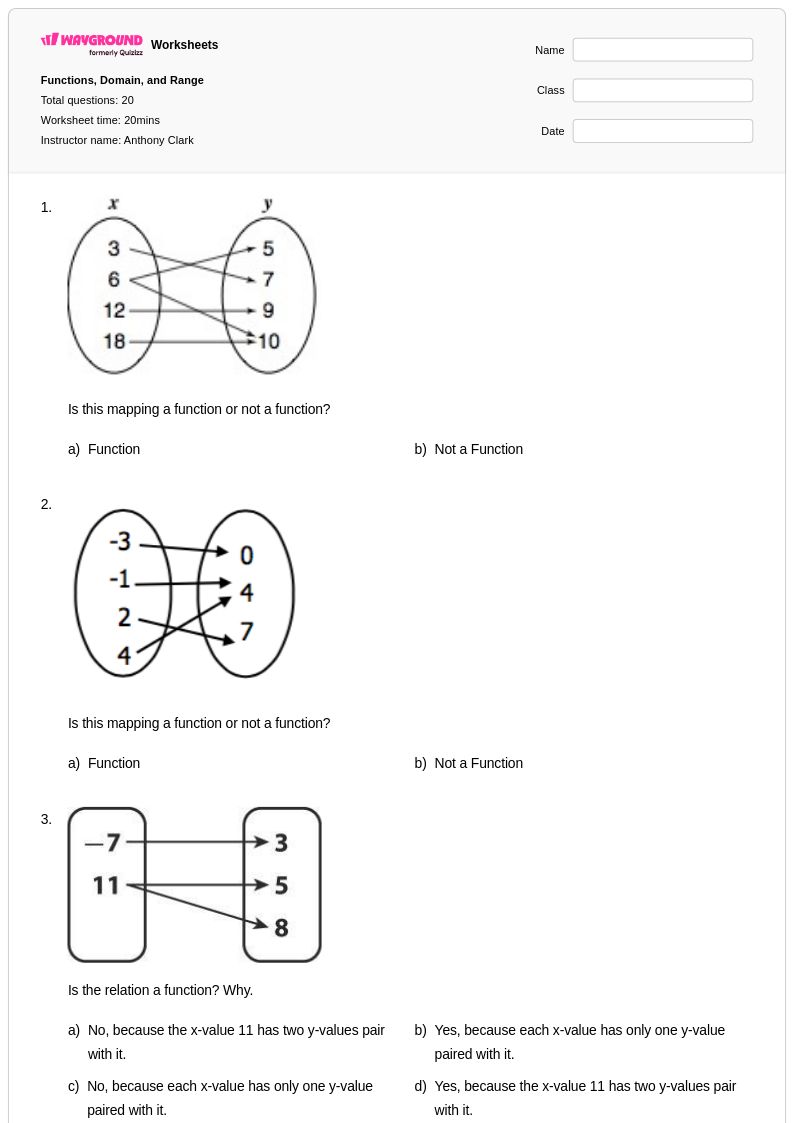
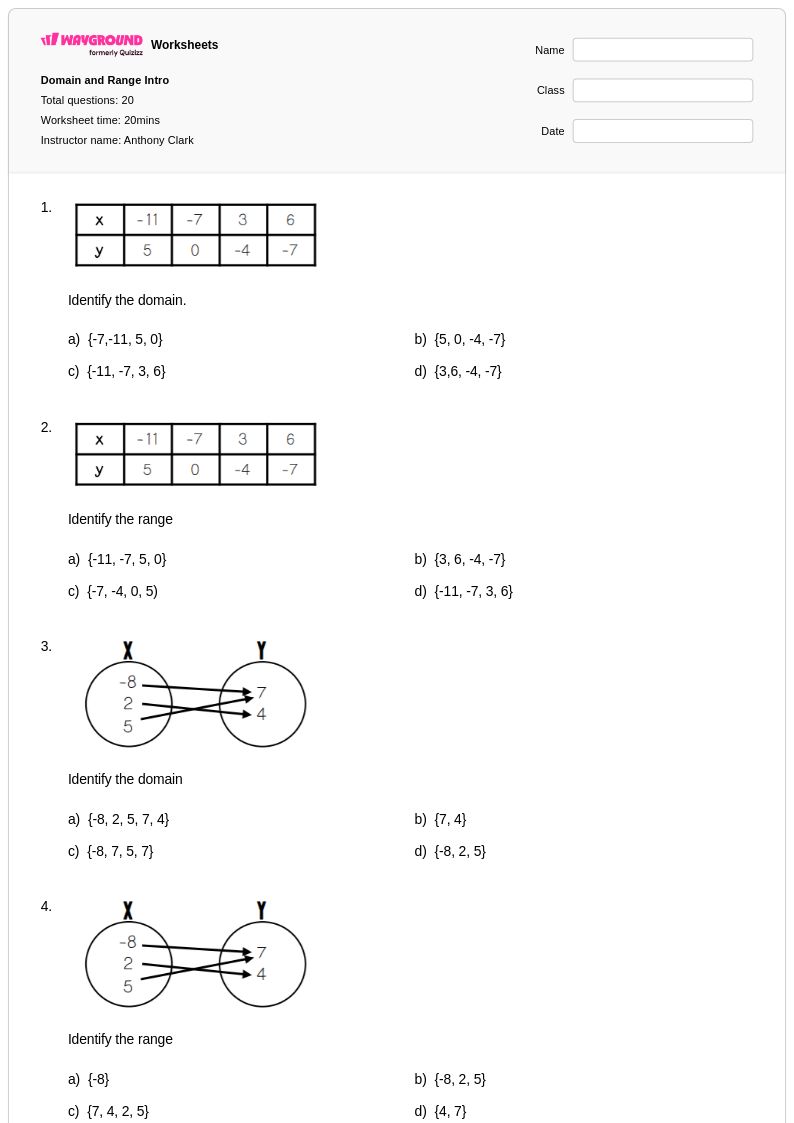
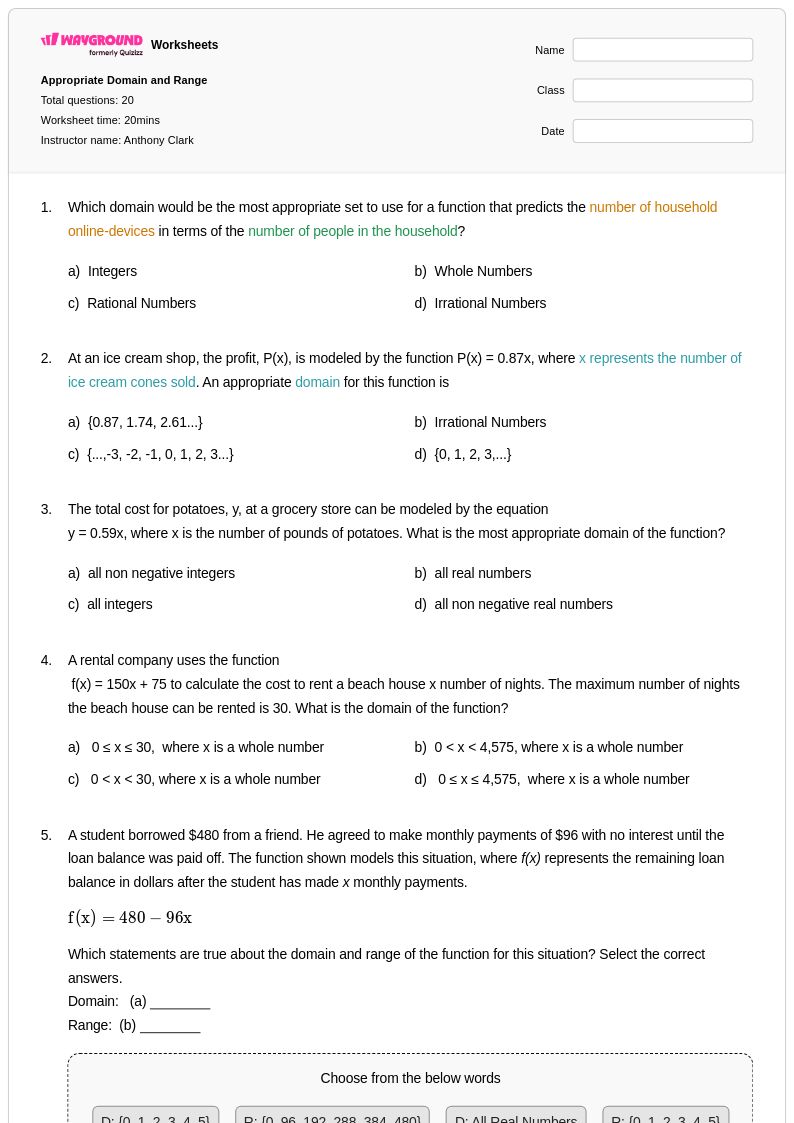
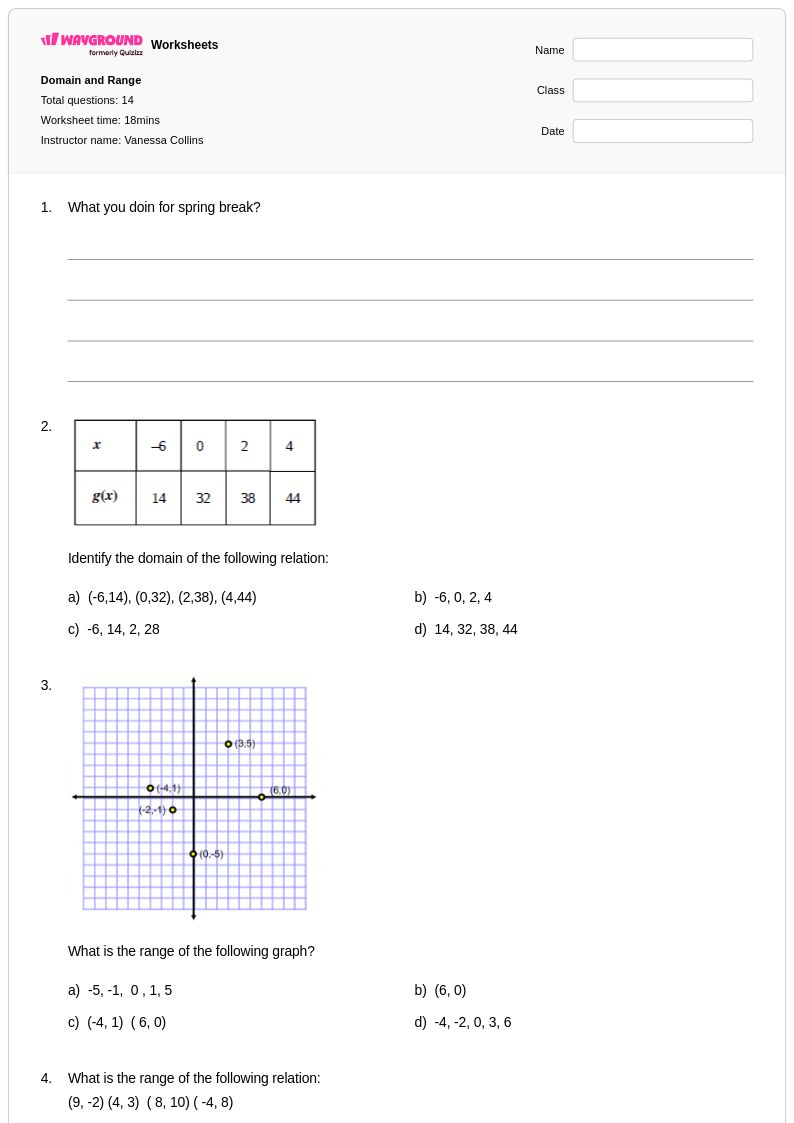
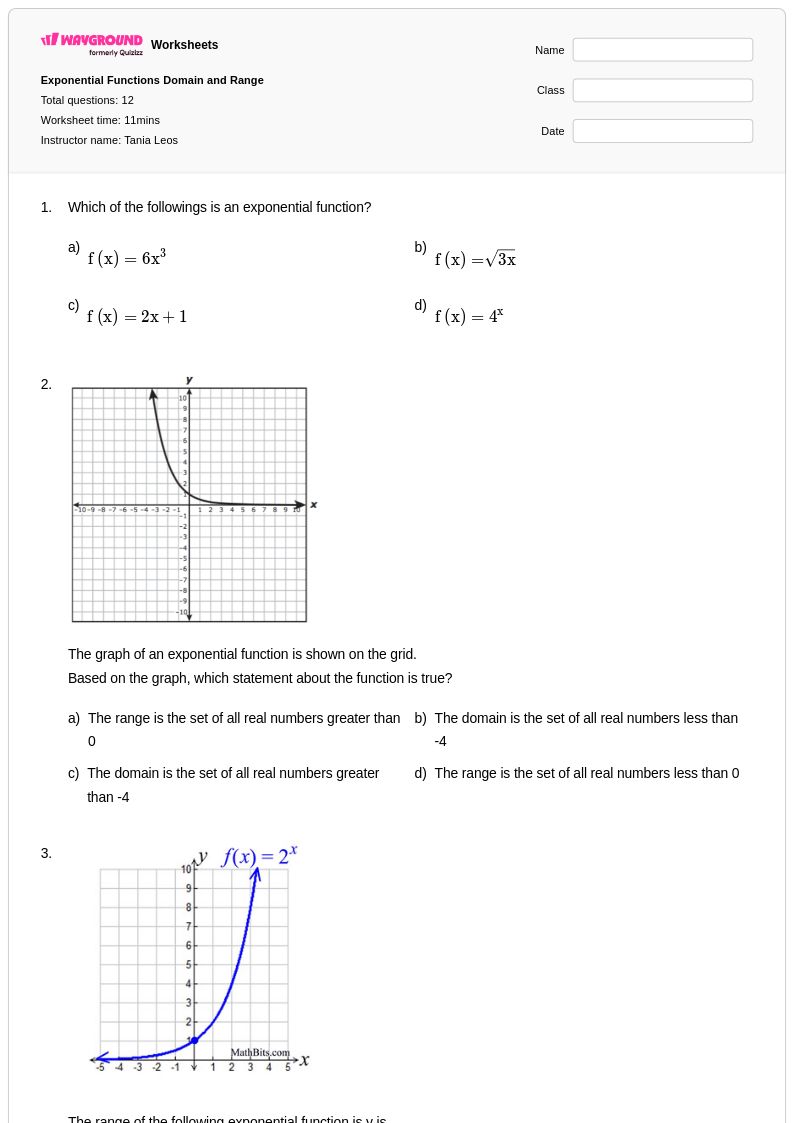
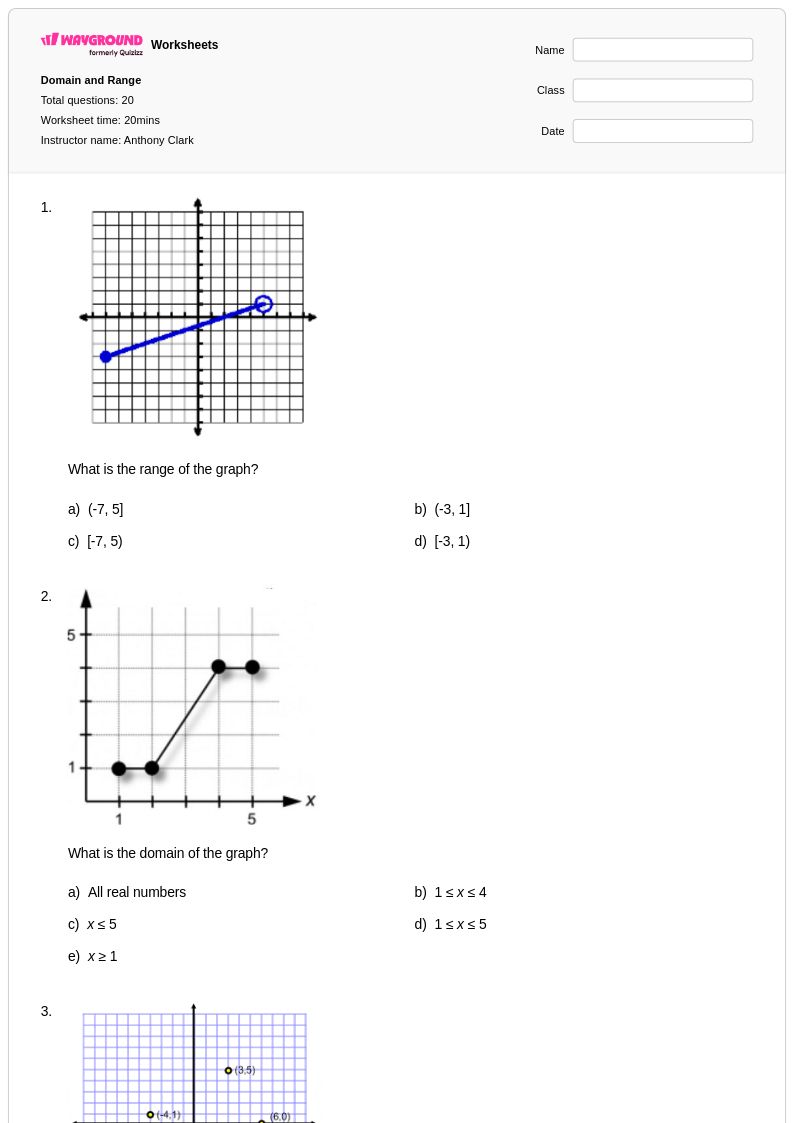
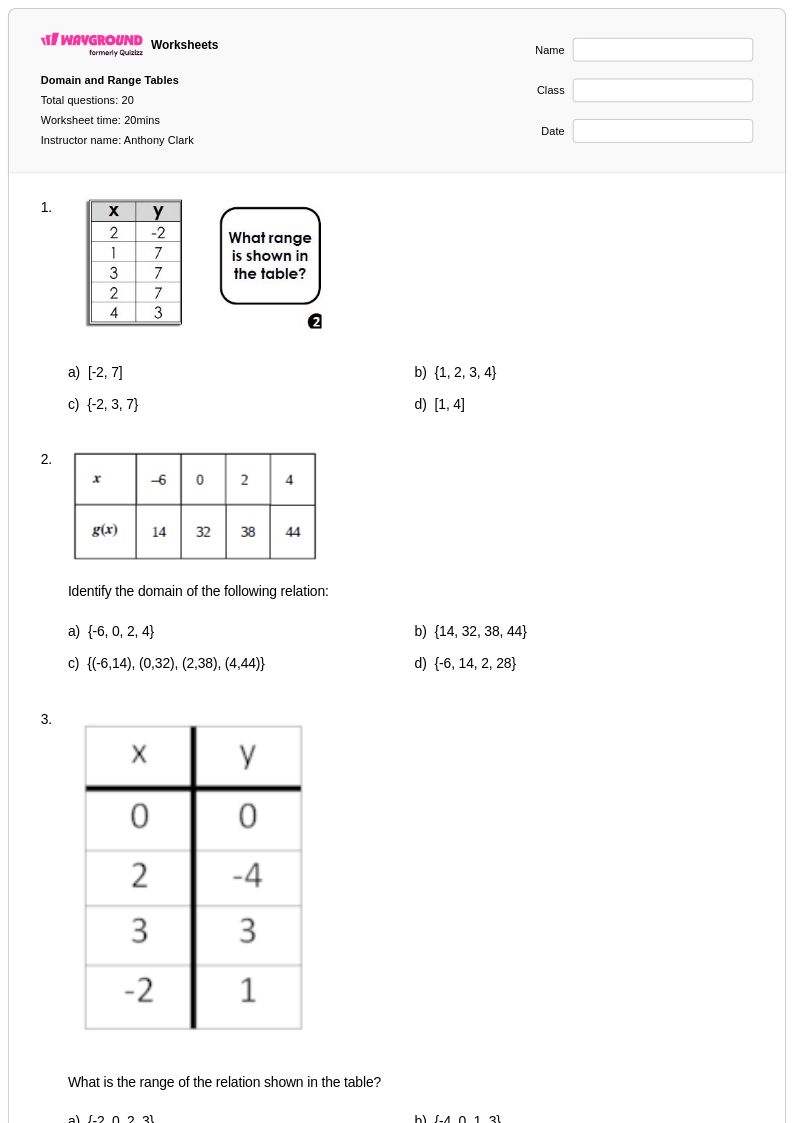
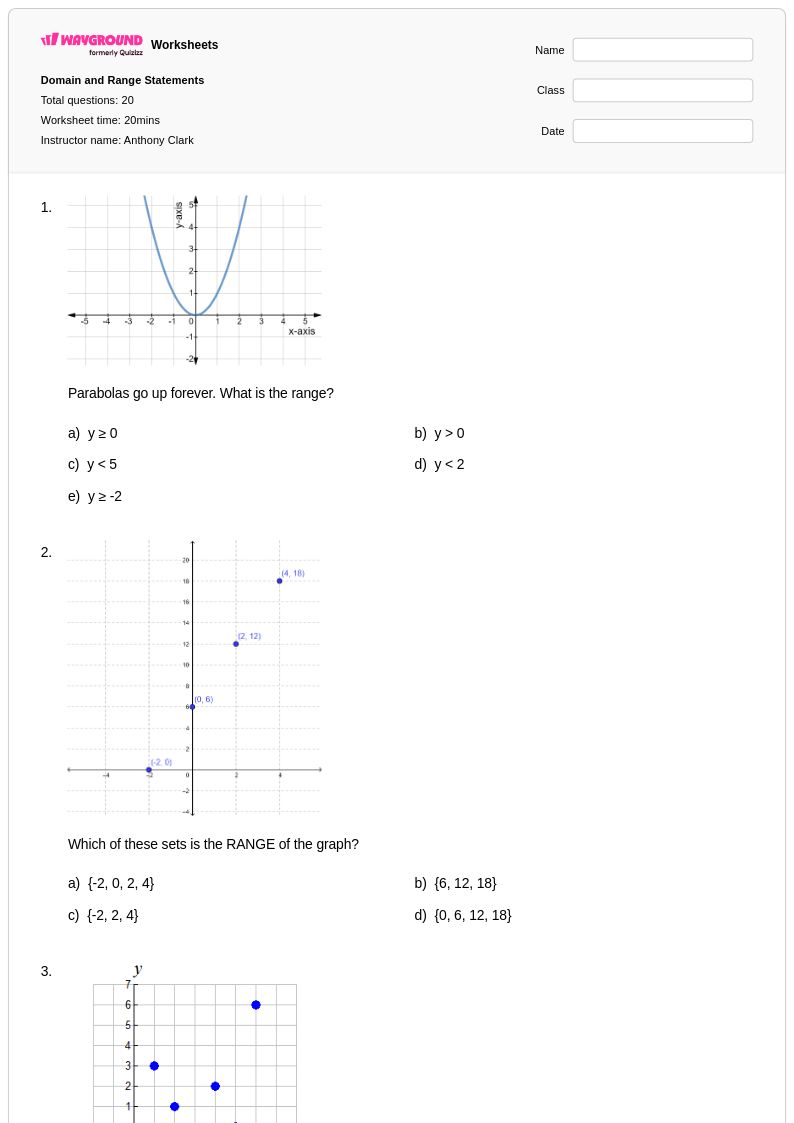
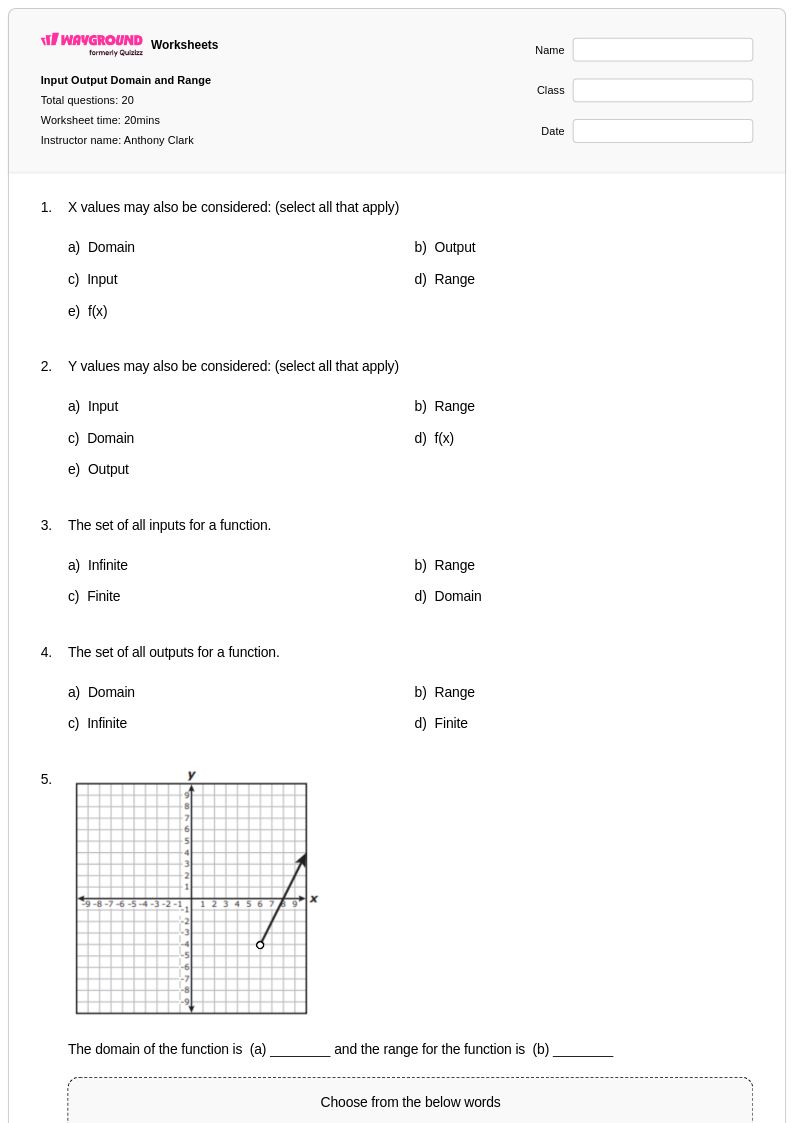
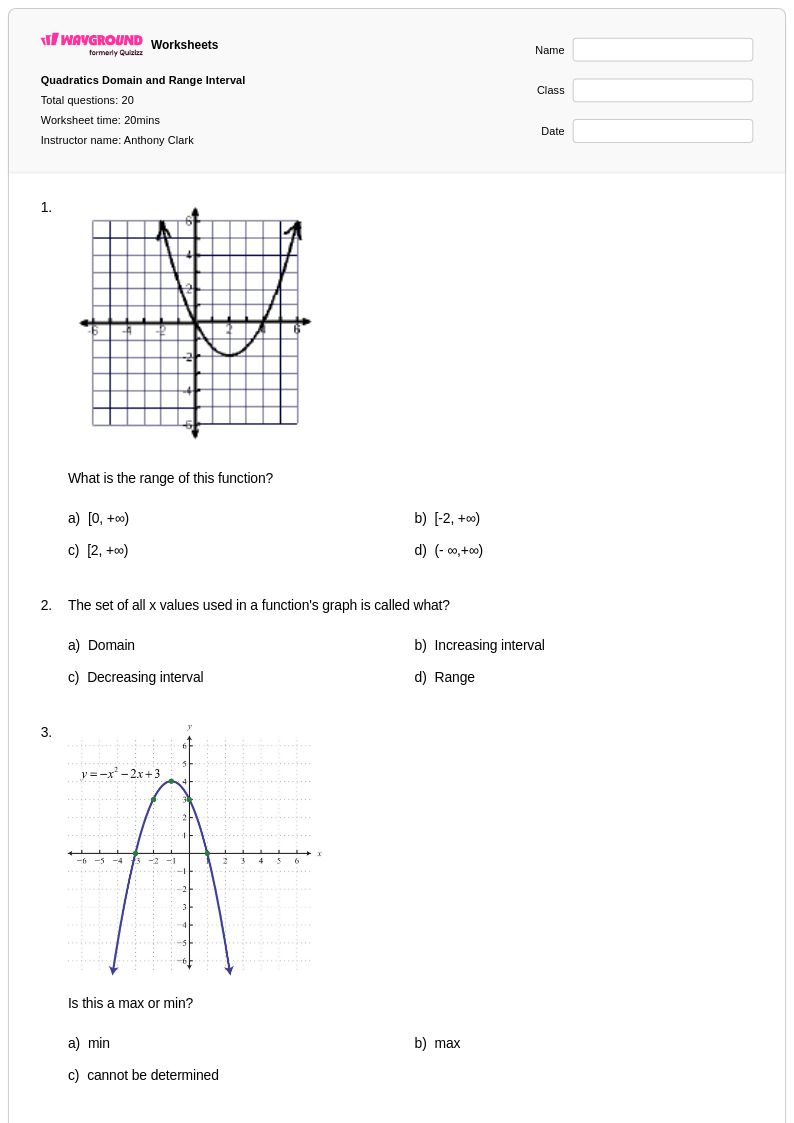
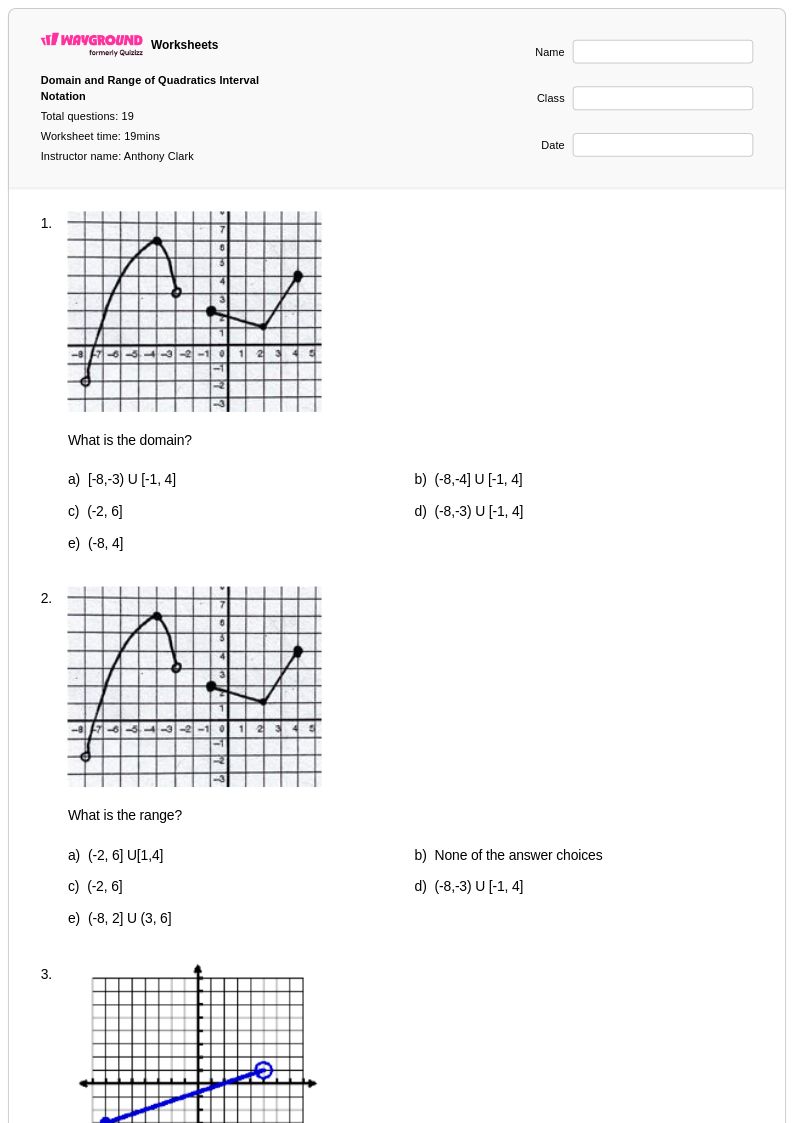
Explore Wayground's free domain and range worksheets with printable PDFs featuring comprehensive practice problems and answer keys to help students master identifying input and output values of mathematical functions.
Domain and range worksheets available through Wayground (formerly Quizizz) provide comprehensive practice with one of the most fundamental concepts in functions operations, helping students master the critical skill of identifying input and output values for mathematical relationships. These expertly designed resources strengthen students' ability to analyze functions graphically, algebraically, and through data tables, building the conceptual foundation necessary for advanced mathematical reasoning. The collection includes diverse practice problems that progress from basic identification exercises to complex real-world applications, with each worksheet featuring detailed answer keys that support both independent study and classroom instruction. Teachers can access these free printables in convenient PDF format, making it simple to distribute targeted practice materials that address specific learning objectives and skill gaps.
Wayground's extensive mathematics worksheet library draws from millions of teacher-created resources, offering unparalleled variety and quality in domain and range practice materials that align with educational standards across different learning levels. The platform's sophisticated search and filtering capabilities enable educators to quickly locate worksheets that match their specific instructional needs, whether for introductory skill building, remediation support, or advanced enrichment activities. These versatile resources are available in both printable and digital formats, allowing teachers to seamlessly integrate domain and range practice into any learning environment while utilizing built-in differentiation tools to customize difficulty levels and problem types. The comprehensive collection supports effective lesson planning by providing ready-to-use materials that can be deployed for warm-up activities, focused skill practice, assessment preparation, or independent study assignments.
FAQs
How do I teach domain and range to students?
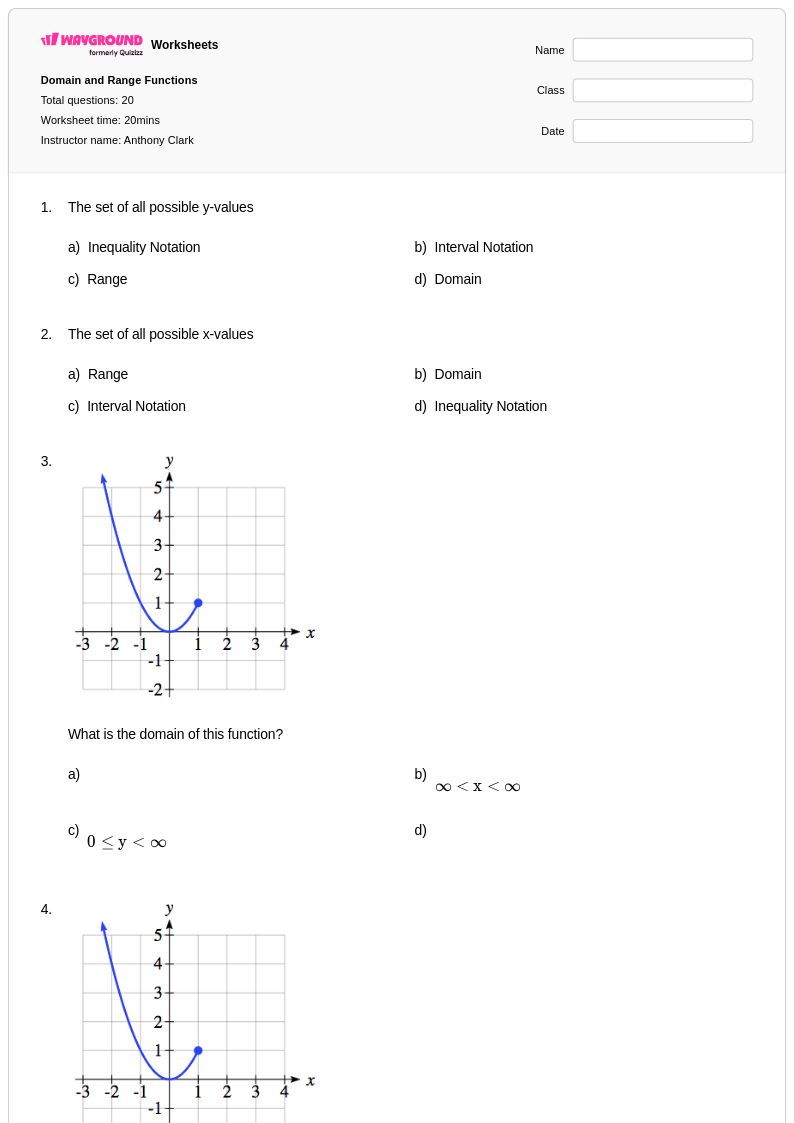
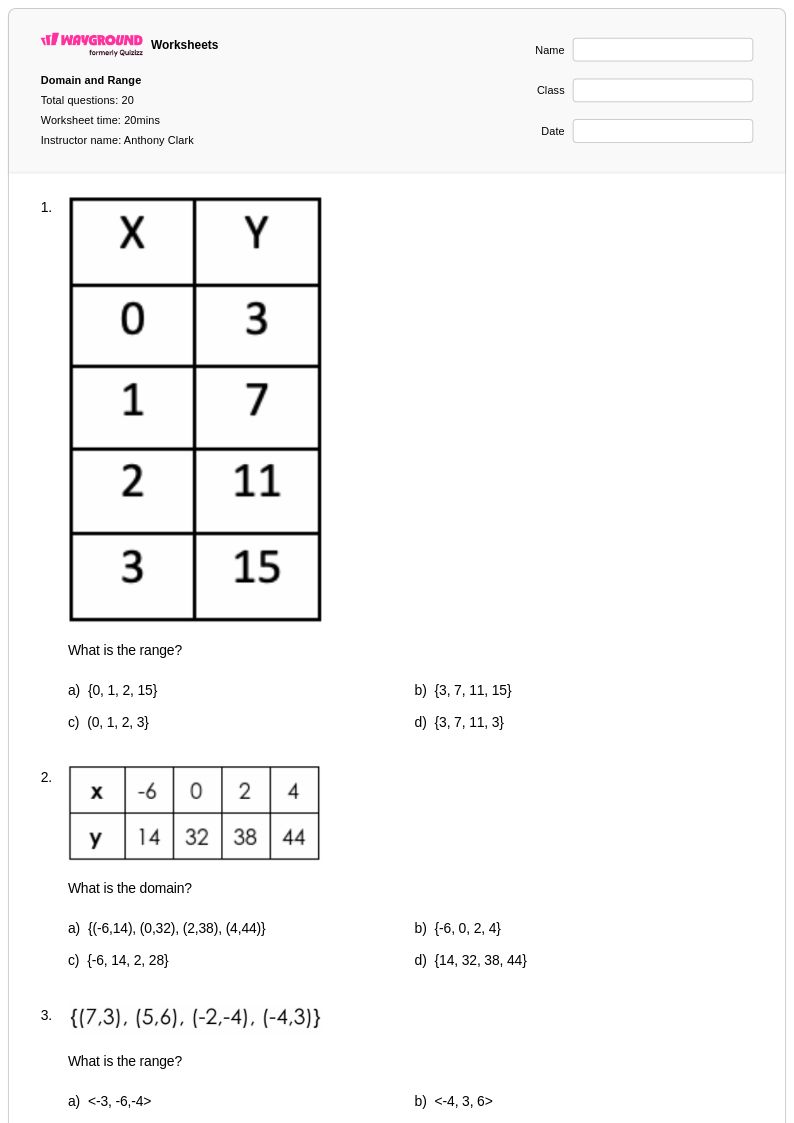
Start with the input/output framing before introducing formal vocabulary: given a table of values, ask students which column lists what goes in and which lists what comes out. Once that intuition is solid, connect it to graphs by asking which x-values the curve actually covers (domain) and which y-values it reaches (range). Move to algebraic expressions last, after students can read domain and range visually. The conceptual sequence — tables → graphs → algebra — prevents students from memorizing procedures without understanding what they're finding.
What exercises help students practice domain and range?
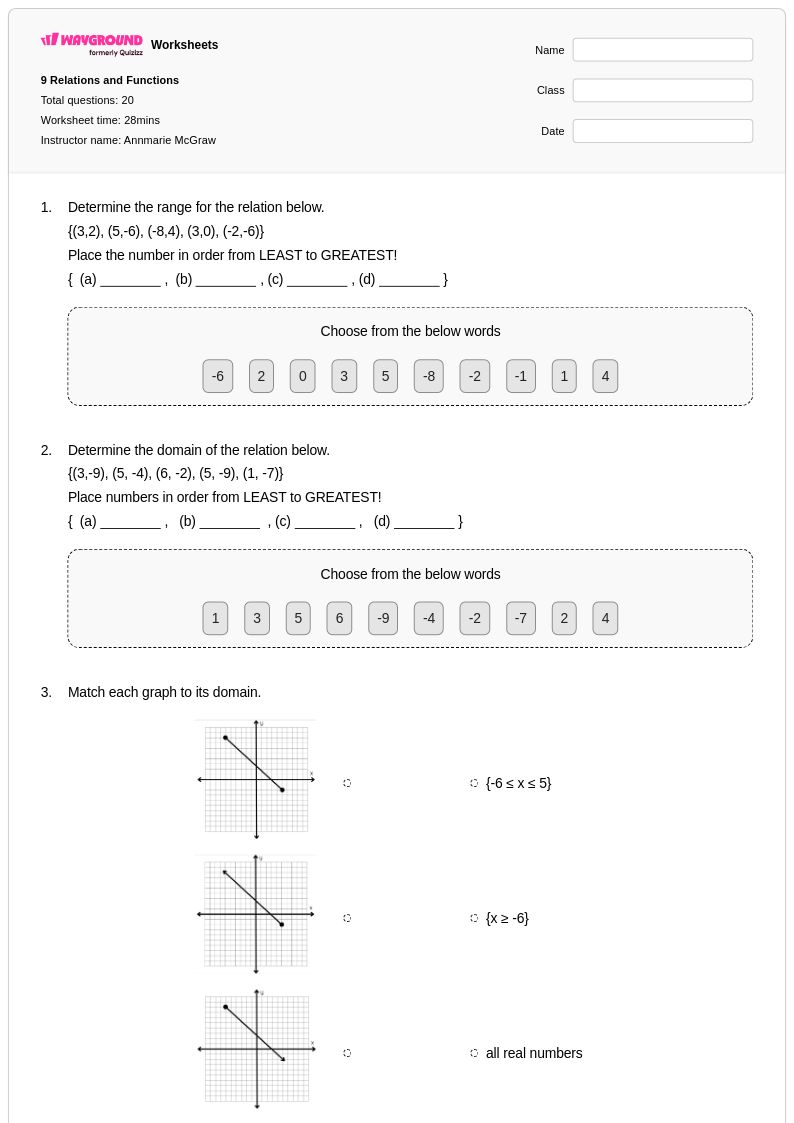
The most effective practice mixes representations: reading domain and range from a graph, extracting them from a table of ordered pairs, and determining them from a simple equation. Discrete function problems (finite sets of points) are good entry-level exercises; continuous functions with restrictions push students further. Wayground's domain and range worksheets span this range, progressing from basic identification to real-world applications, so you can assign problems that match exactly where your class is.
What mistakes do students commonly make with domain and range?
Three errors come up repeatedly. First, students swap domain and range — they identify the y-values as the domain because they list outputs first. Second, when reading a graph, they report individual points rather than the full interval the function spans. Third, they forget to check for restrictions in algebraic expressions, such as values that cause division by zero or a negative under a square root. Targeted practice that asks students to explain their reasoning — not just write an answer — catches all three.
How do I use Wayground's domain and range worksheets in my class?
Each worksheet is available as a printable PDF and as a digital quiz hosted on Wayground, so you can use the same problems in either format. For digital sessions, students complete the quiz online and results come back to you immediately. For paper practice, print the PDF and grade submissions using the Wayground for Teachers app, which lets you scan or capture student work. Every worksheet includes a complete answer key either way.
Is domain and range aligned to Common Core standards?
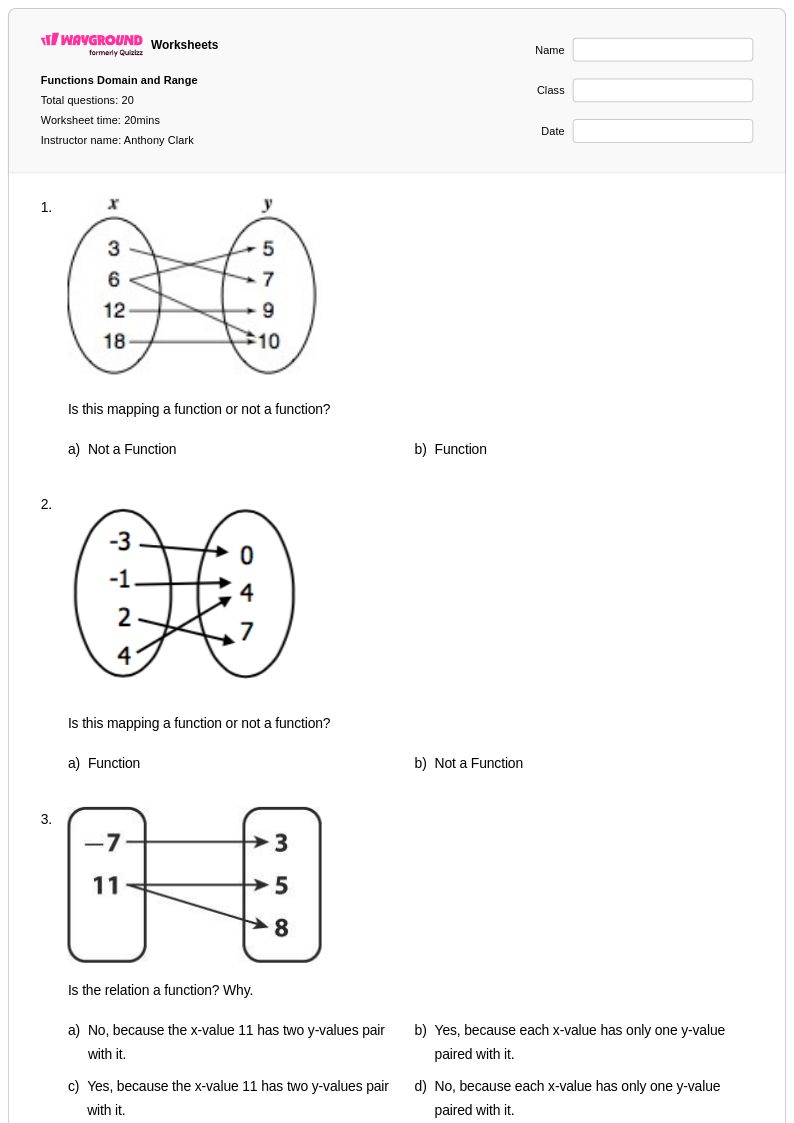
Yes. Common Core introduces the formal concept of a function in Grade 8, where students learn to define a function as a rule that assigns exactly one output to each input — and identifying domain and range is central to that definition. In high school, Common Core extends this to interpreting domain in context (for example, restricting a domain because negative time has no meaning in a real-world problem) and analyzing domain and range for linear, quadratic, and exponential functions. Wayground's collection covers both the foundational Grade 8 work and the more analytical high school applications.
How can I differentiate domain and range practice for mixed-ability classes?
For students who need more support, Wayground's Read Aloud accommodation reads question text aloud, which helps when the challenge is language rather than math, and reduced answer choices lower the cognitive load on multiple-choice items. For accessibility, you can generate an alternate version of the same worksheet with a dyslexia-friendly font or larger text in a few clicks. Advanced students can be assigned problems involving continuous functions and algebraic restrictions while the rest of the class works on discrete examples — all from the same worksheet collection.
What grade level is domain and range taught?
Domain and range is formally introduced in Grade 8 under Common Core, tied to the definition of a function. It deepens significantly in Grade 9 and through high school algebra and precalculus, where students work with interval notation and analyze restrictions across multiple function types. Some curricula introduce informal input/output language as early as Grade 6.