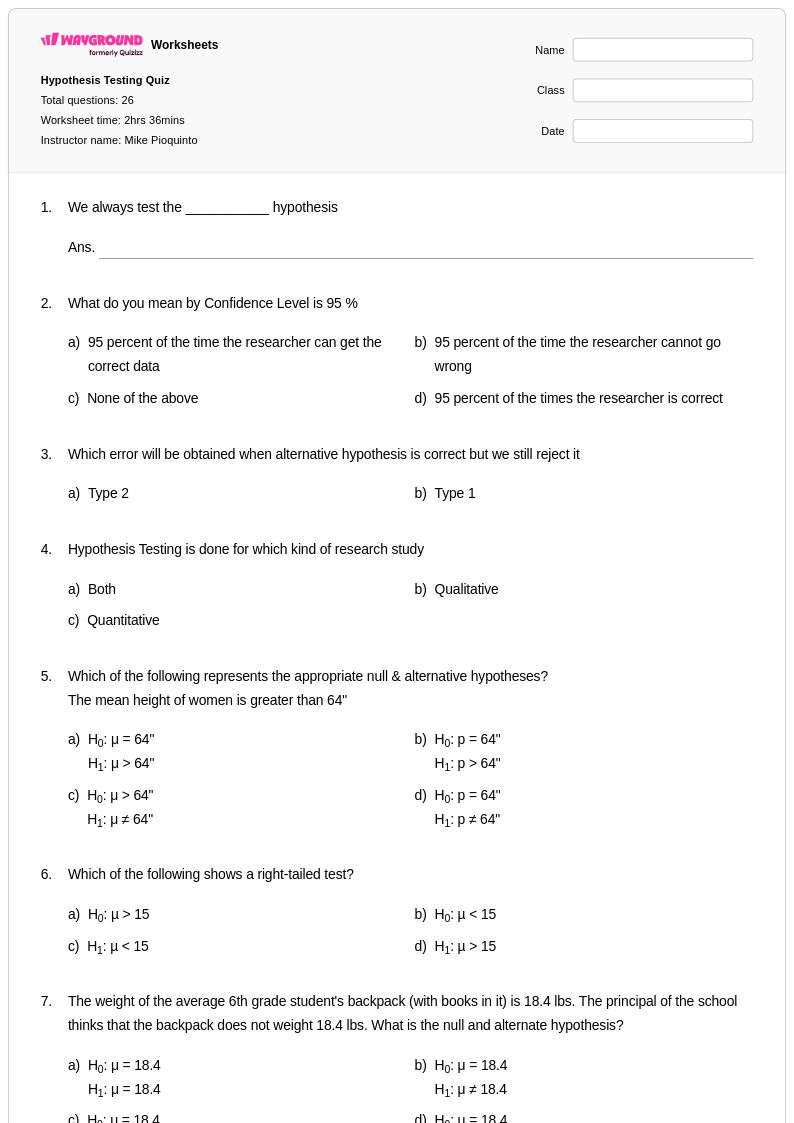
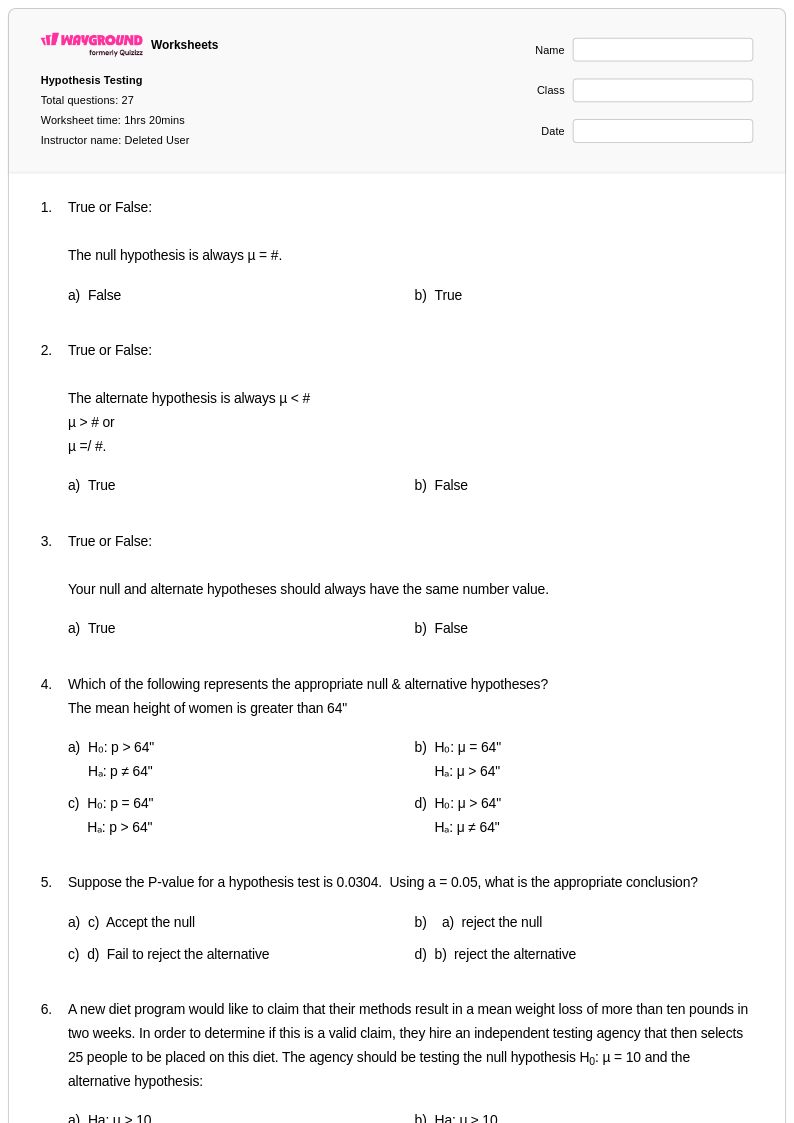
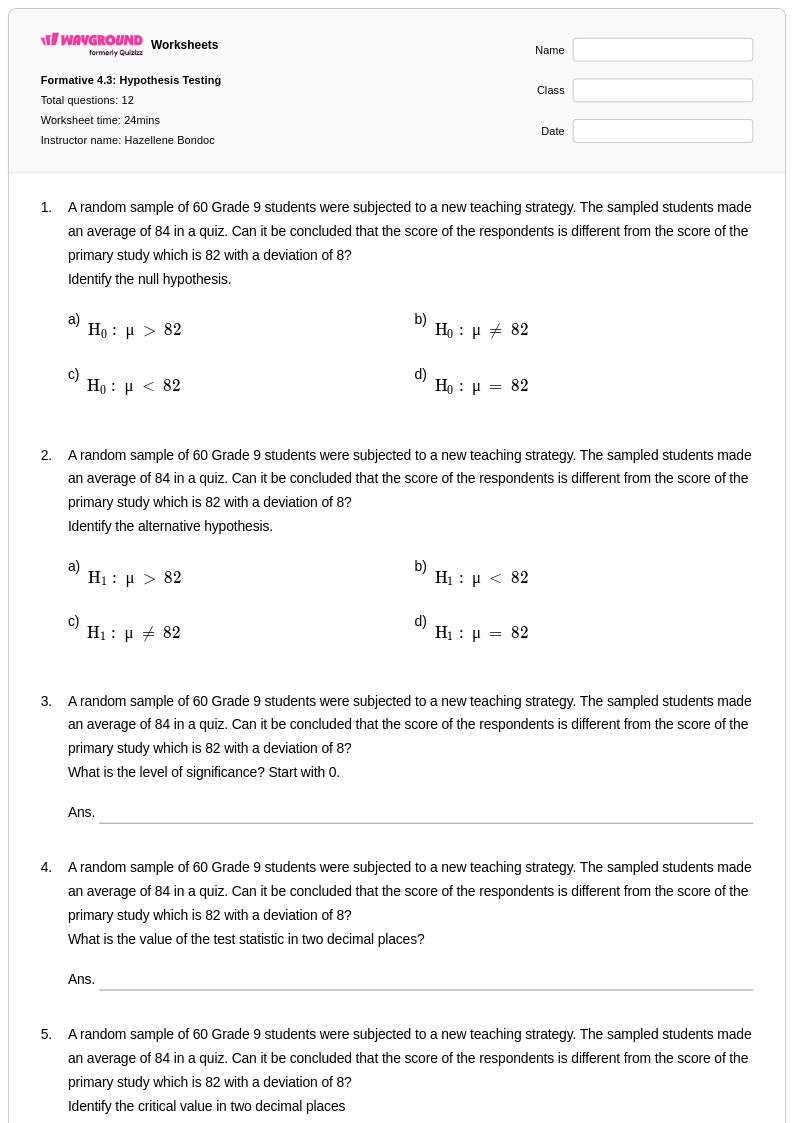
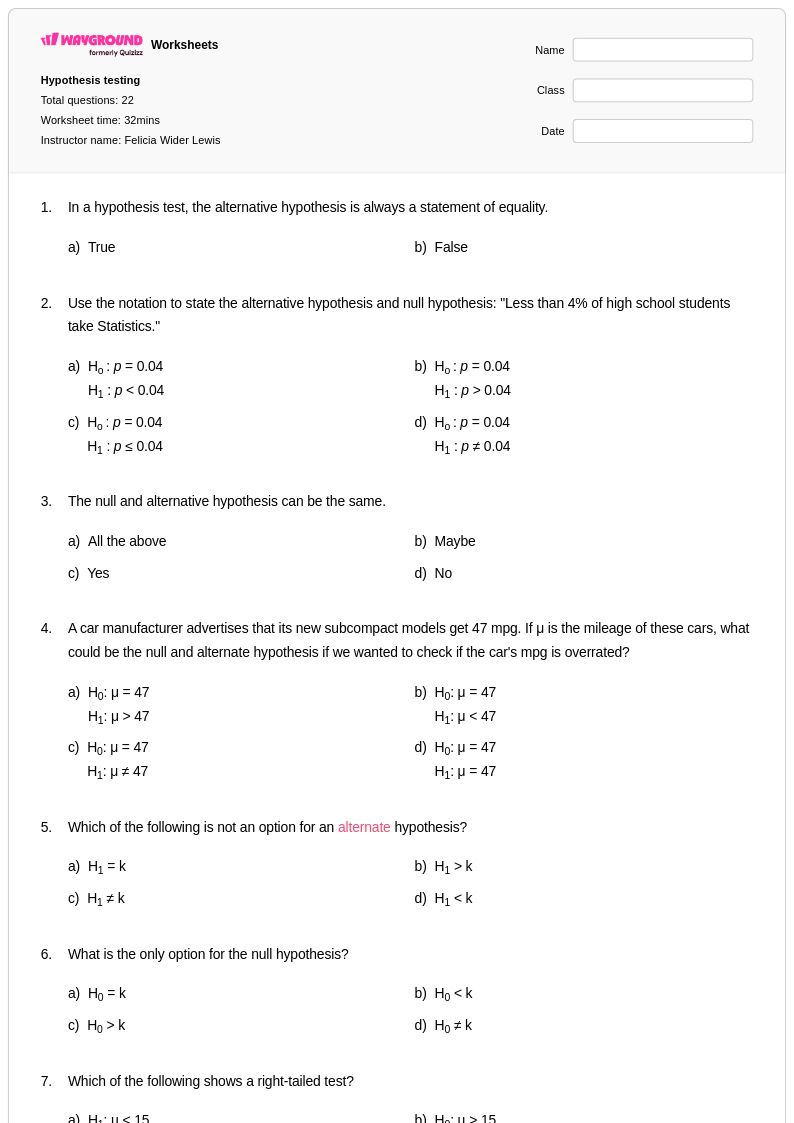
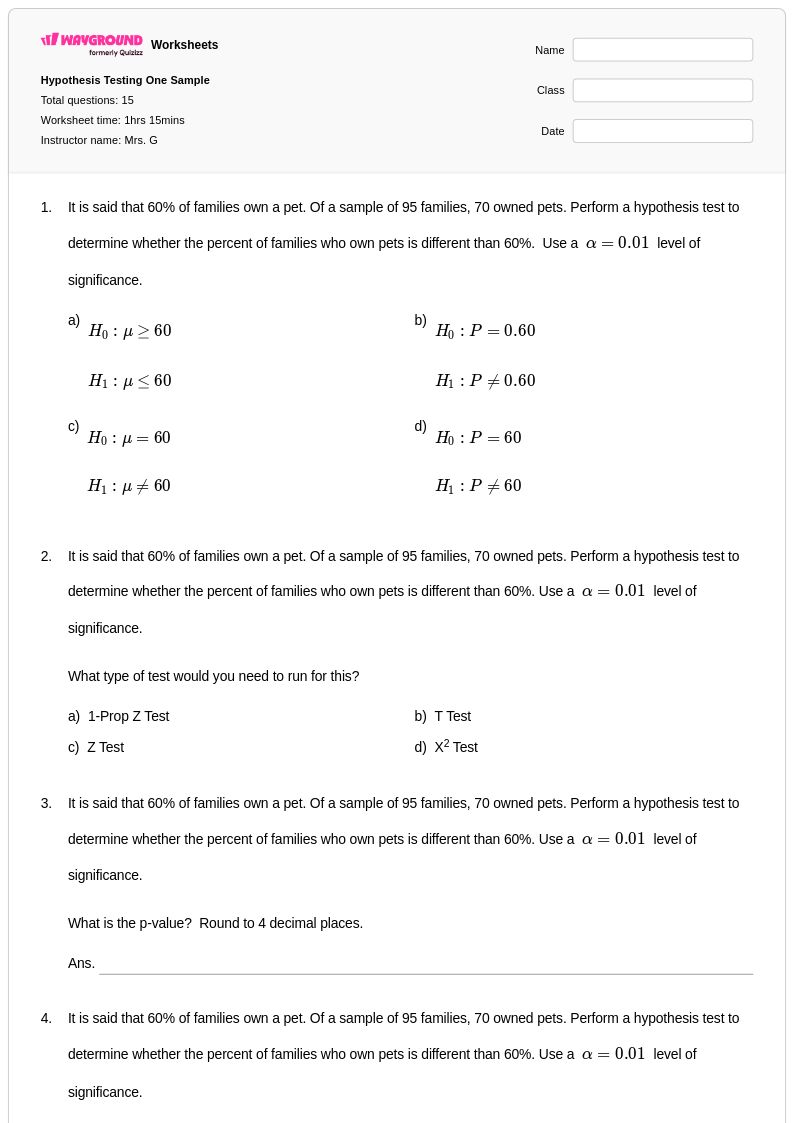
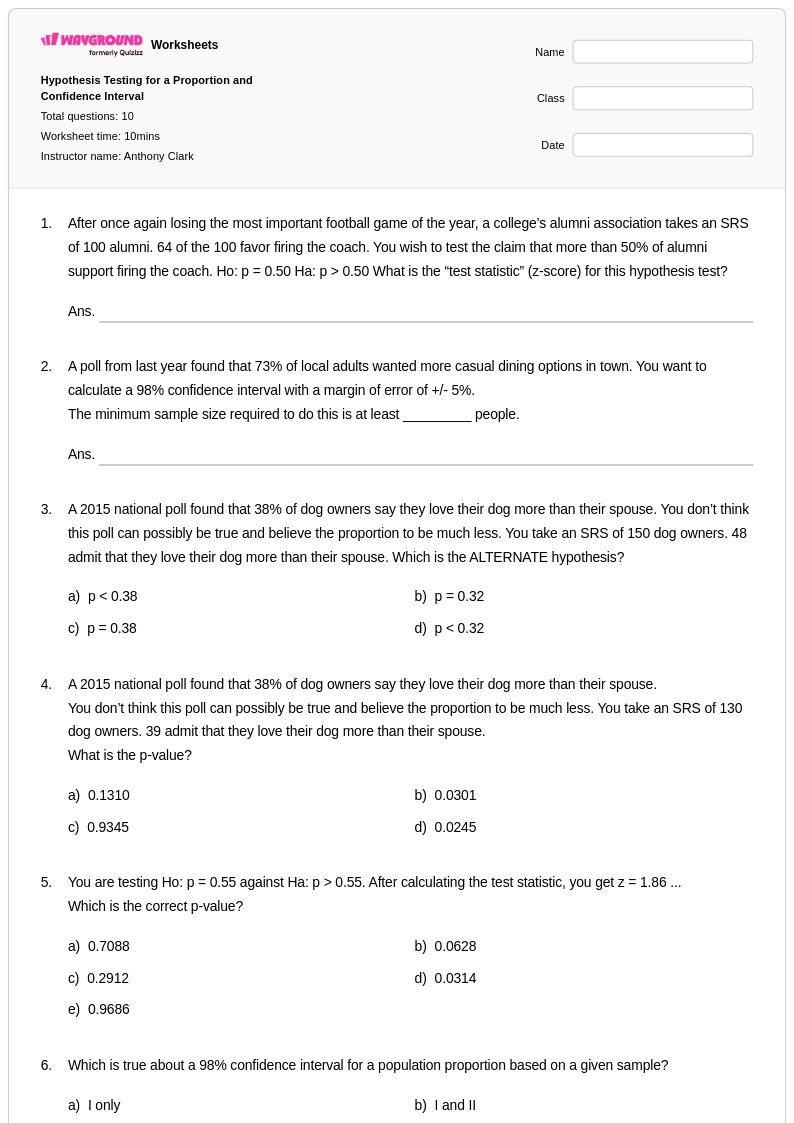
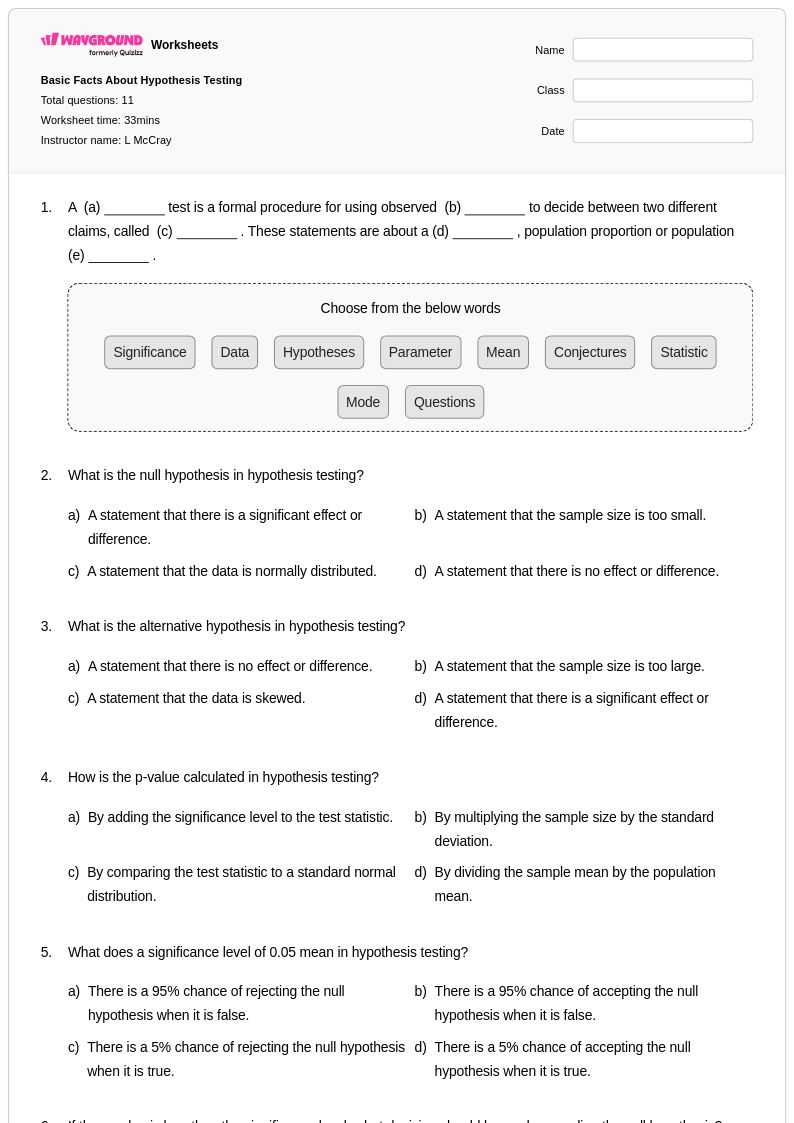
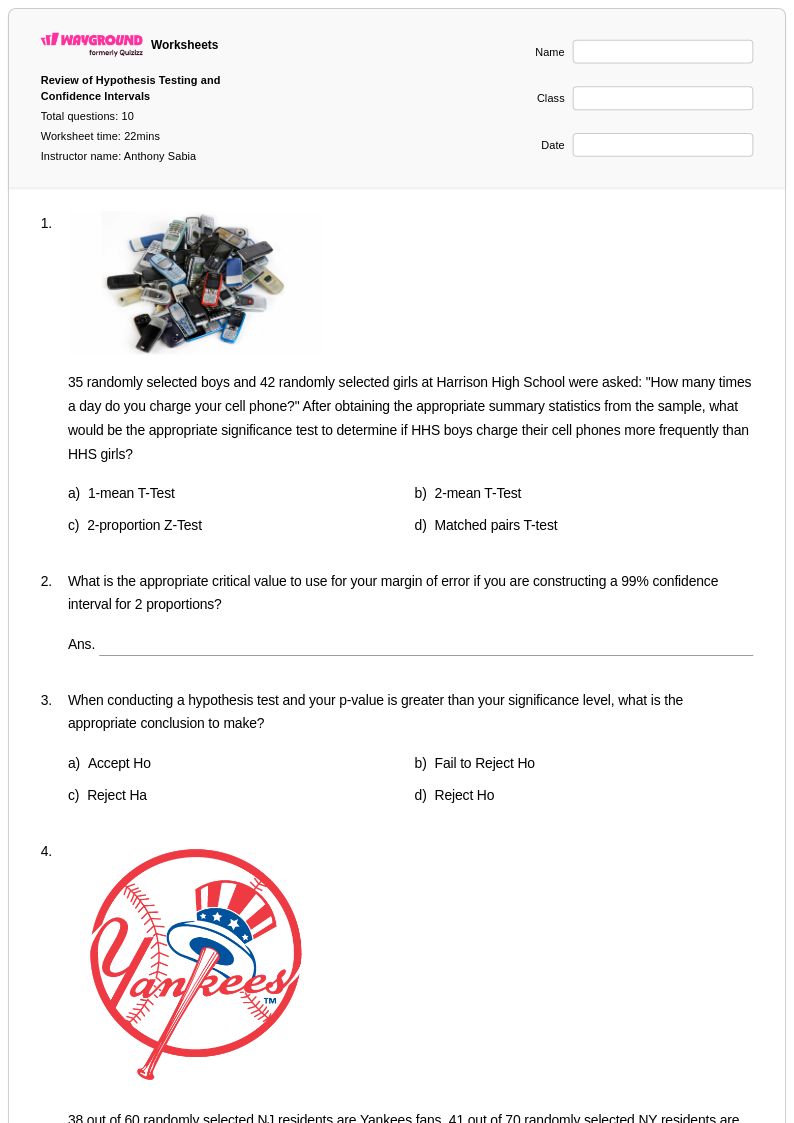
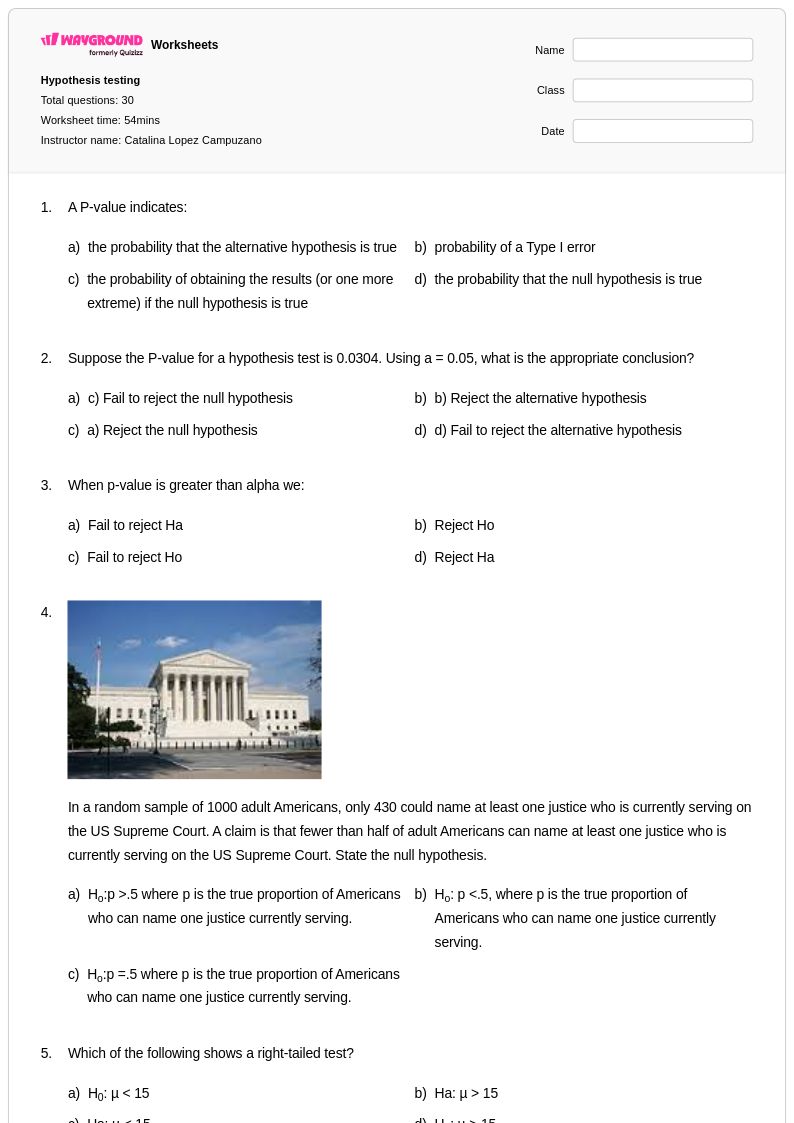
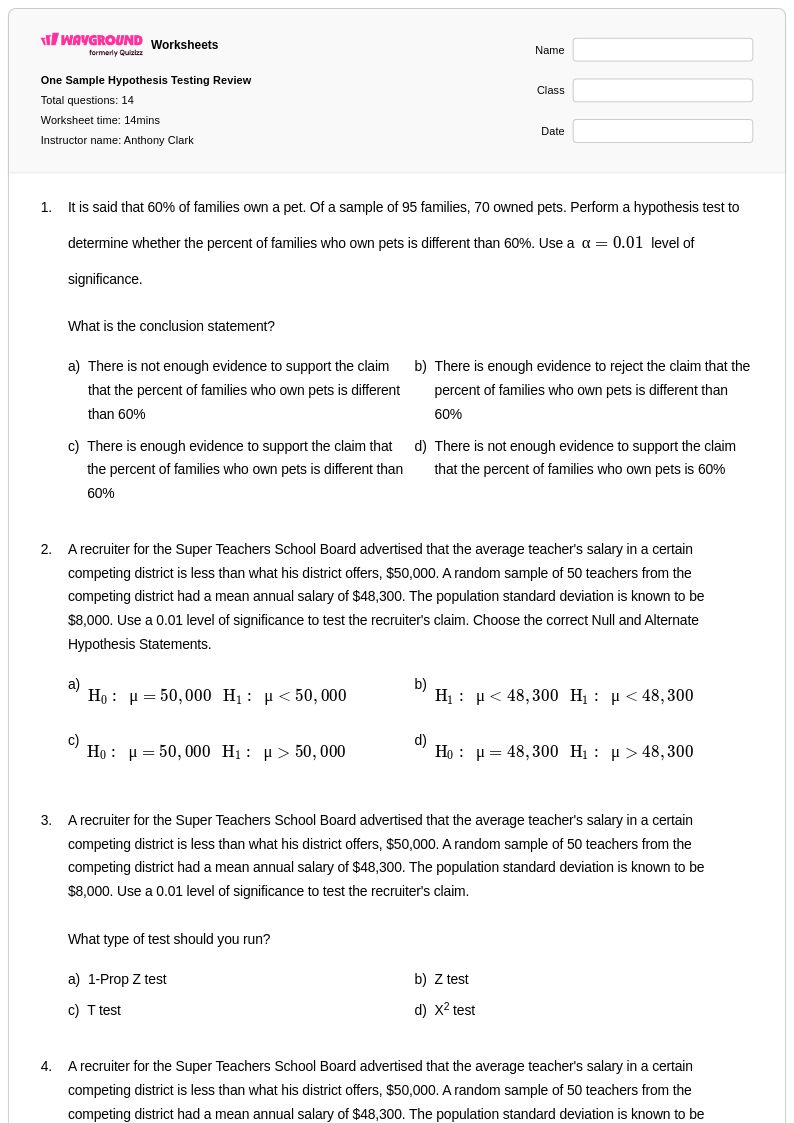
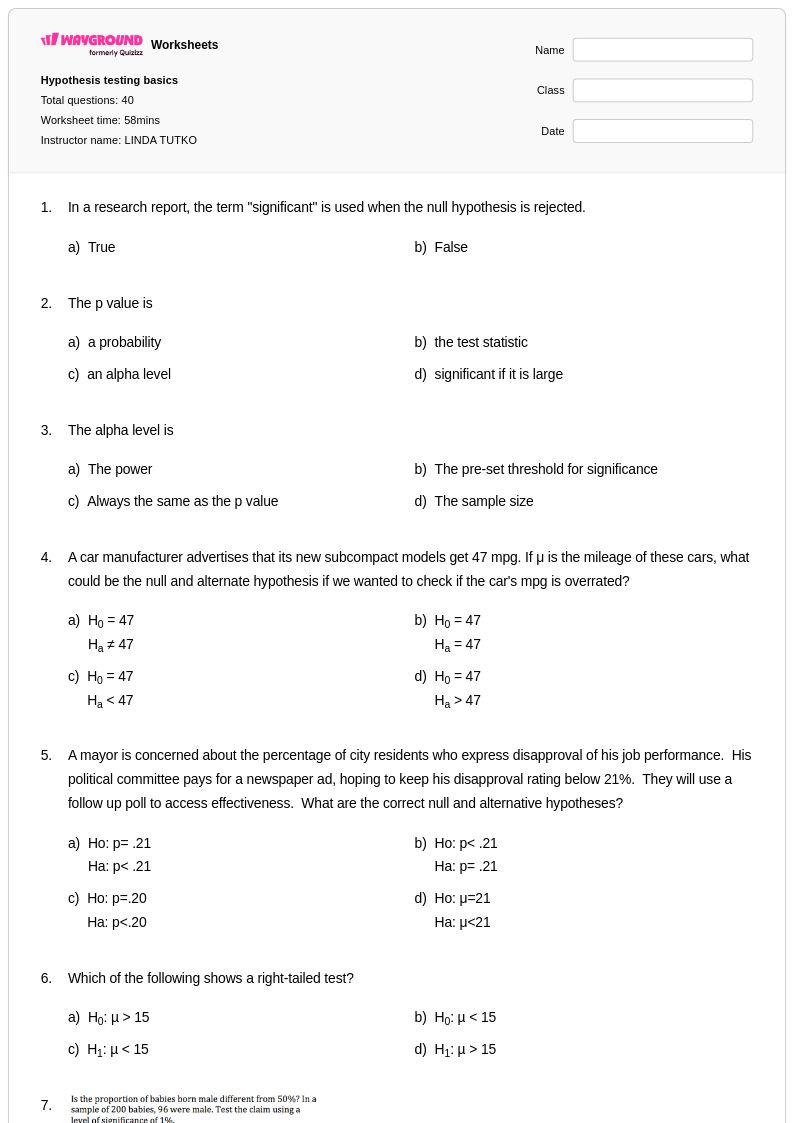
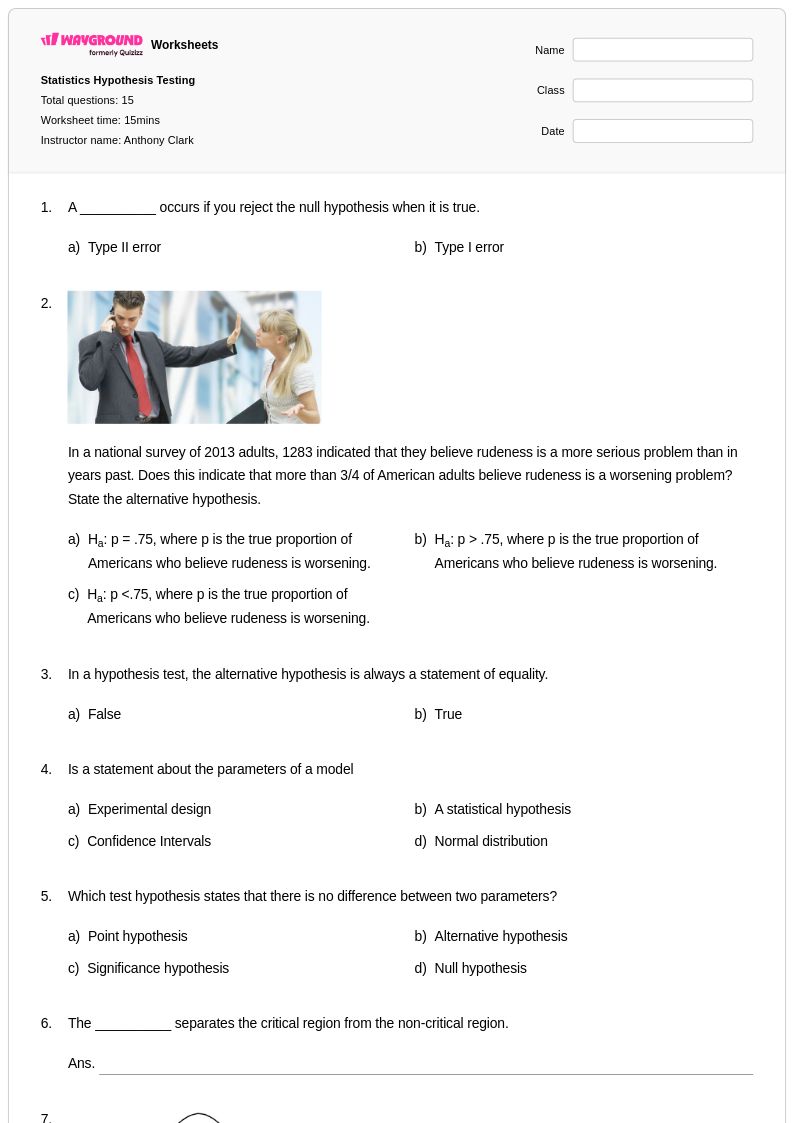
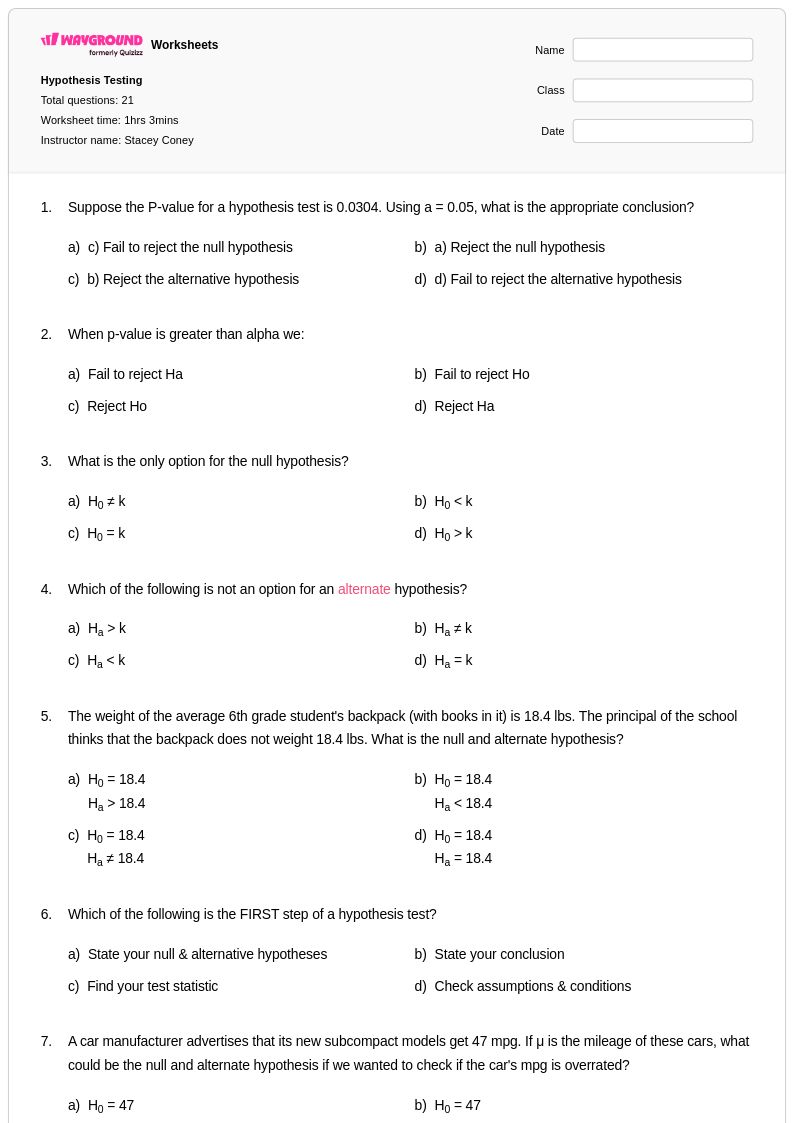
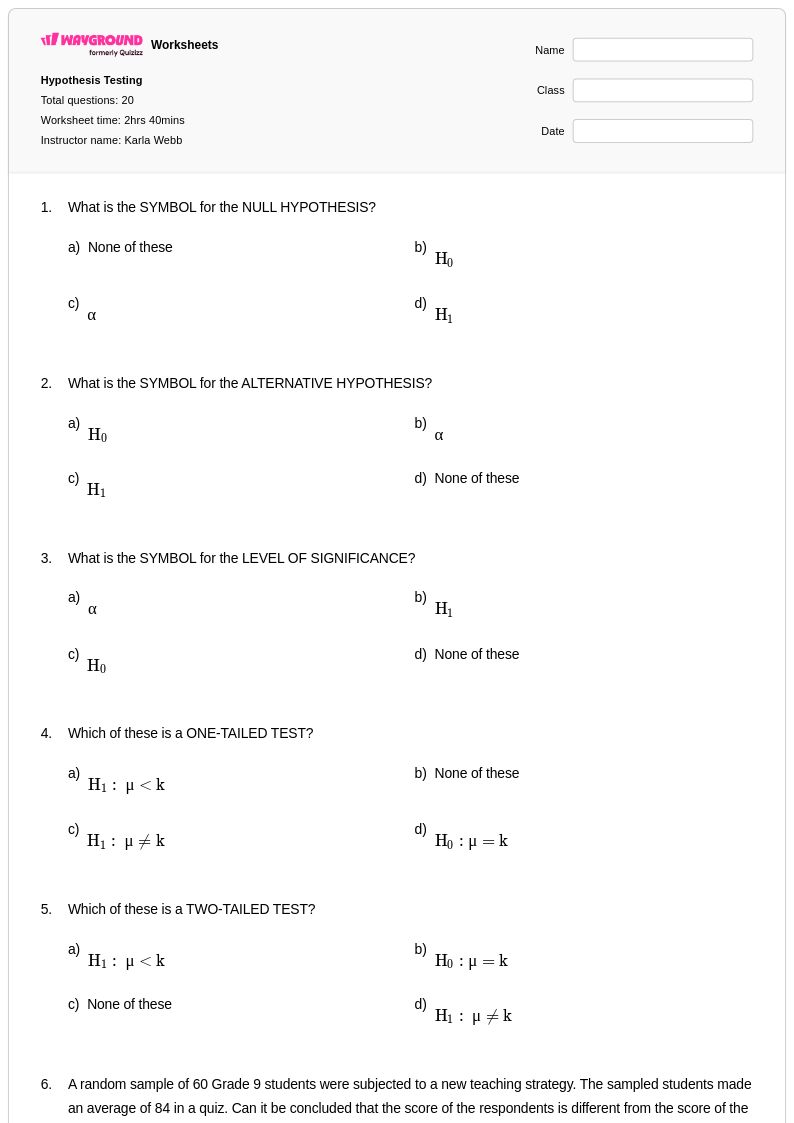
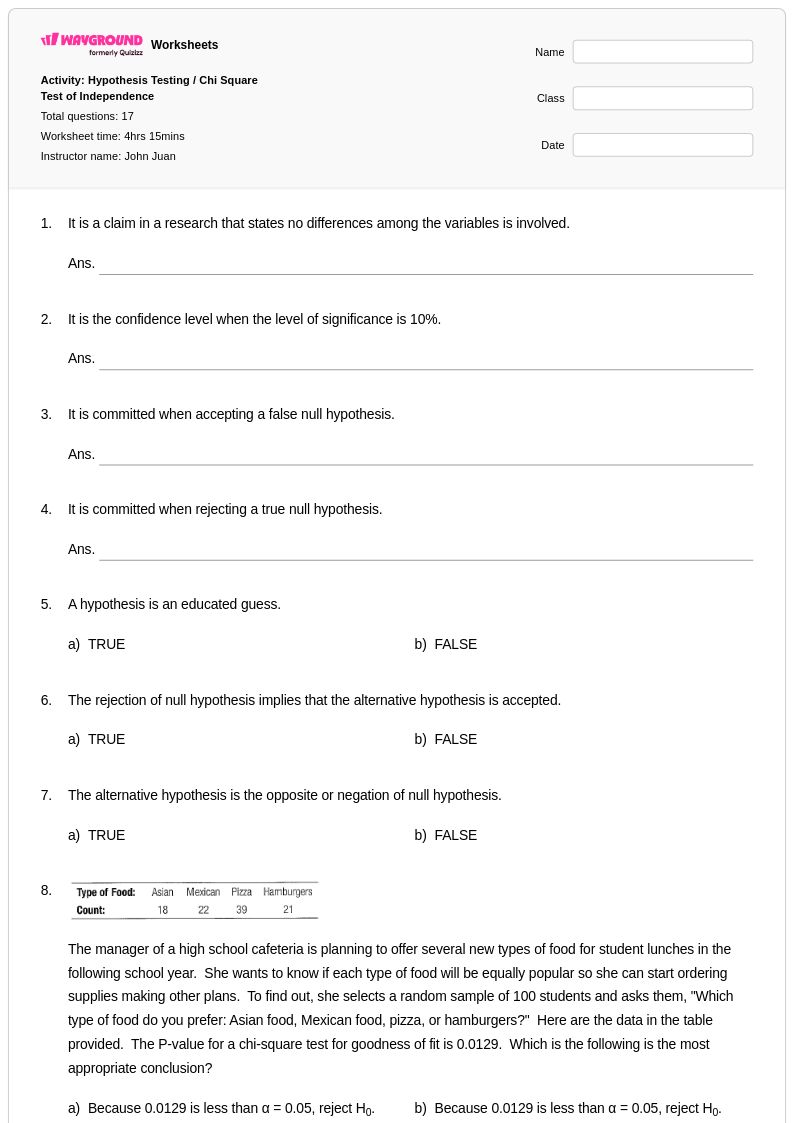
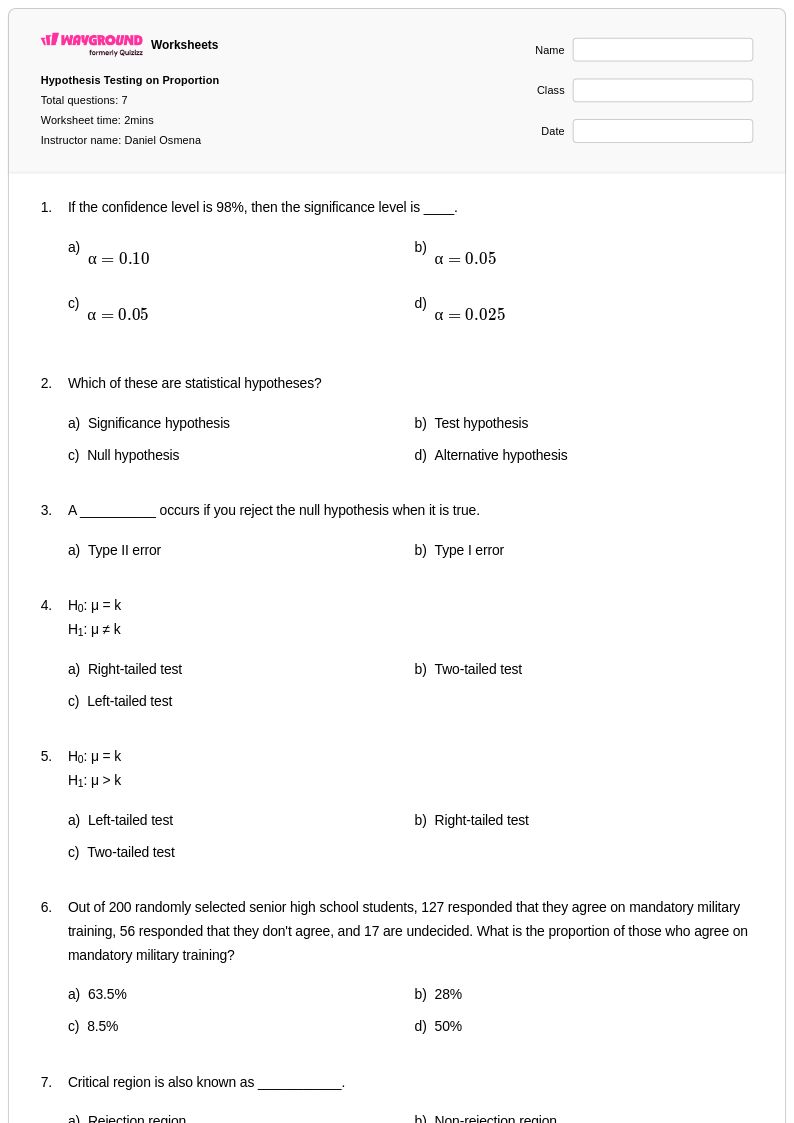
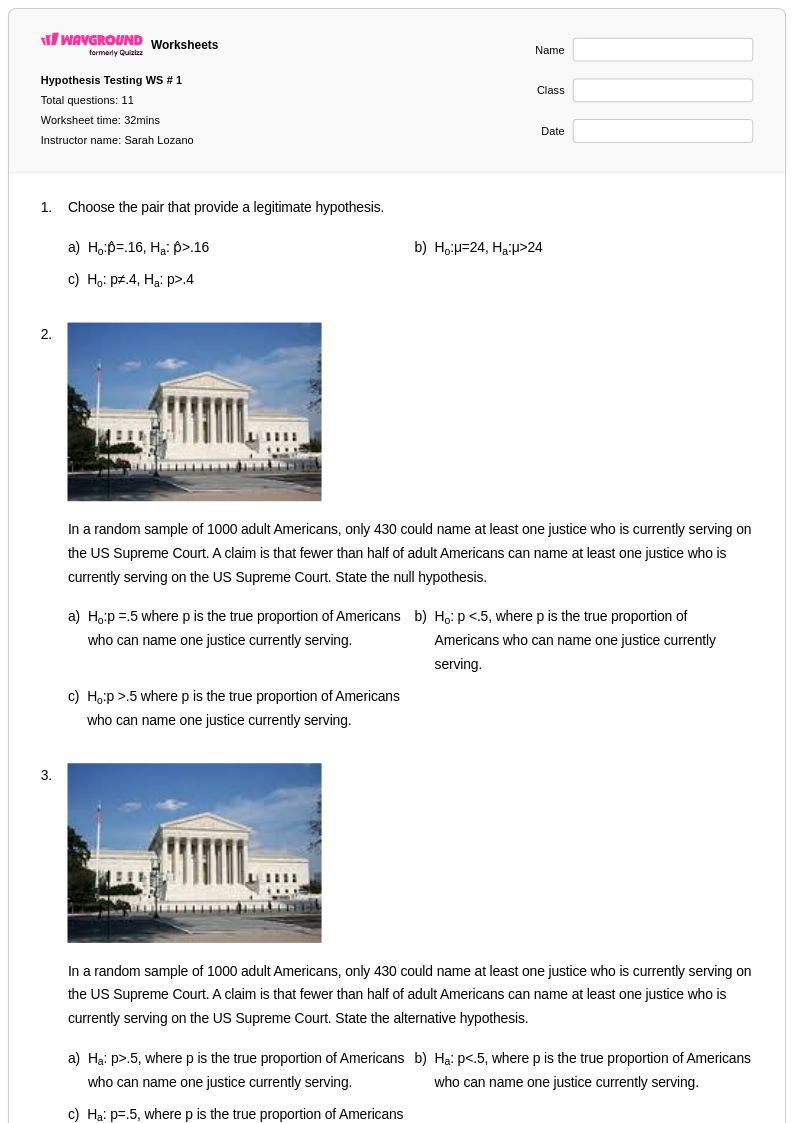
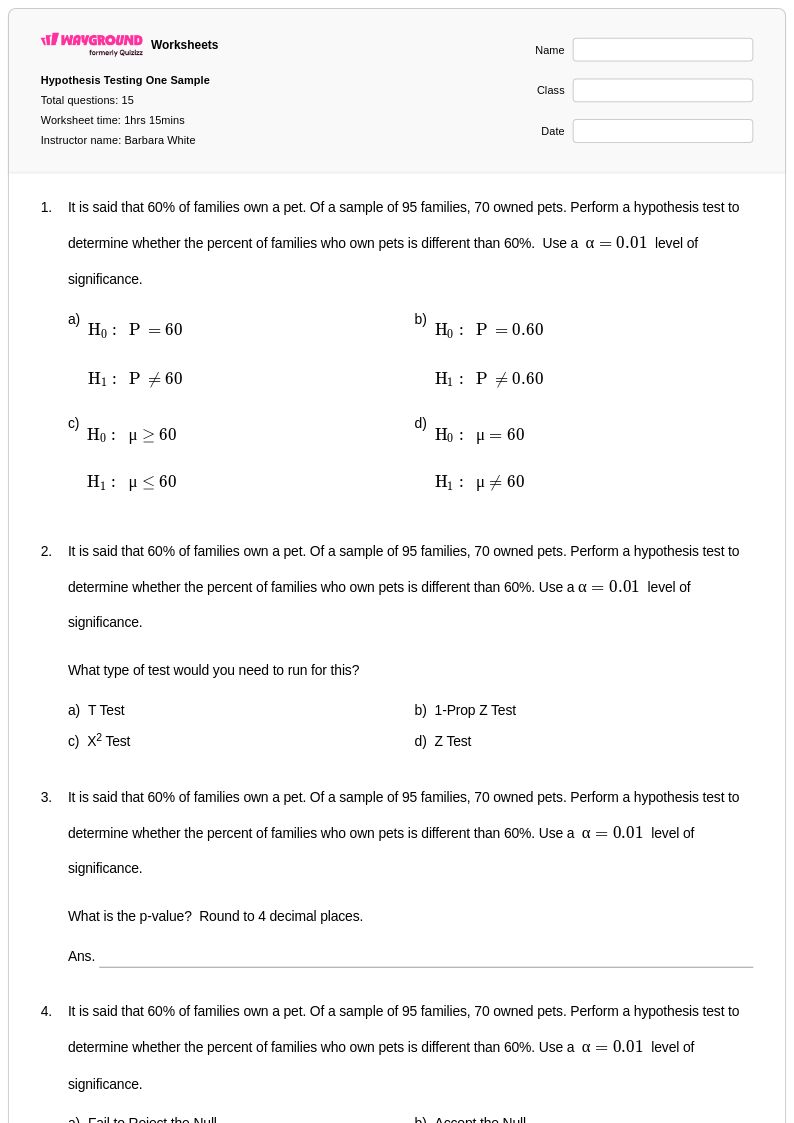
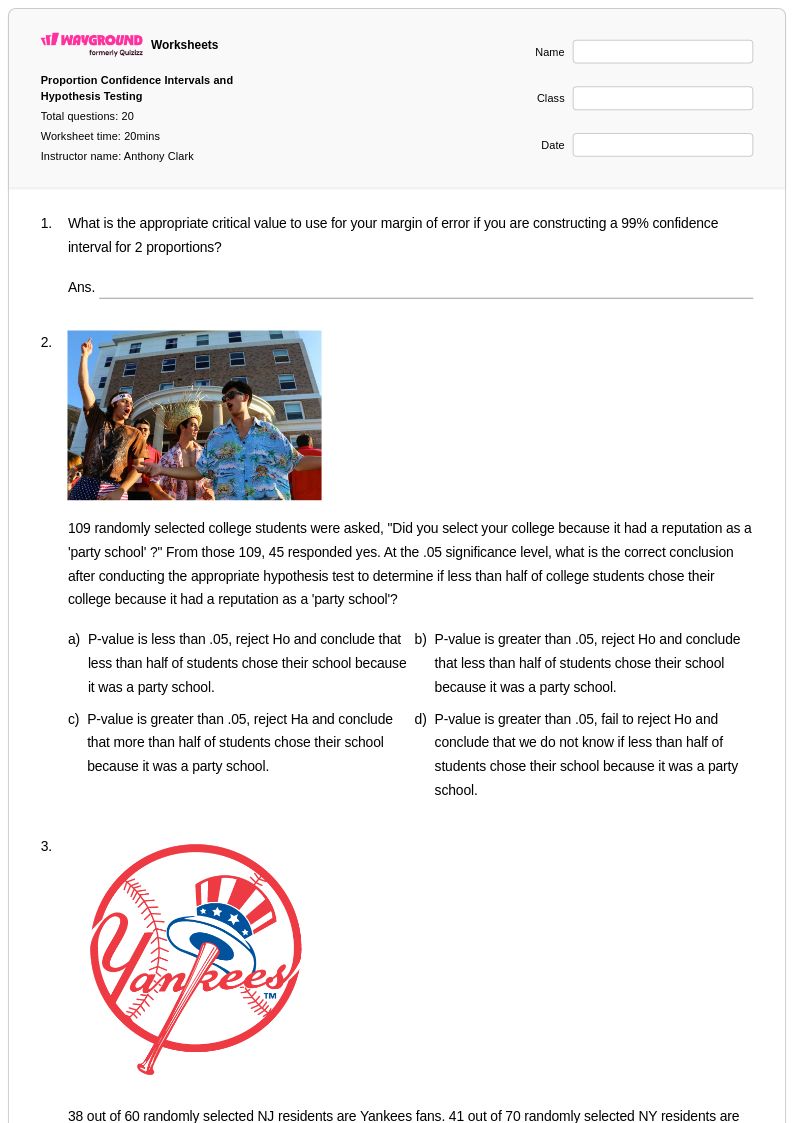
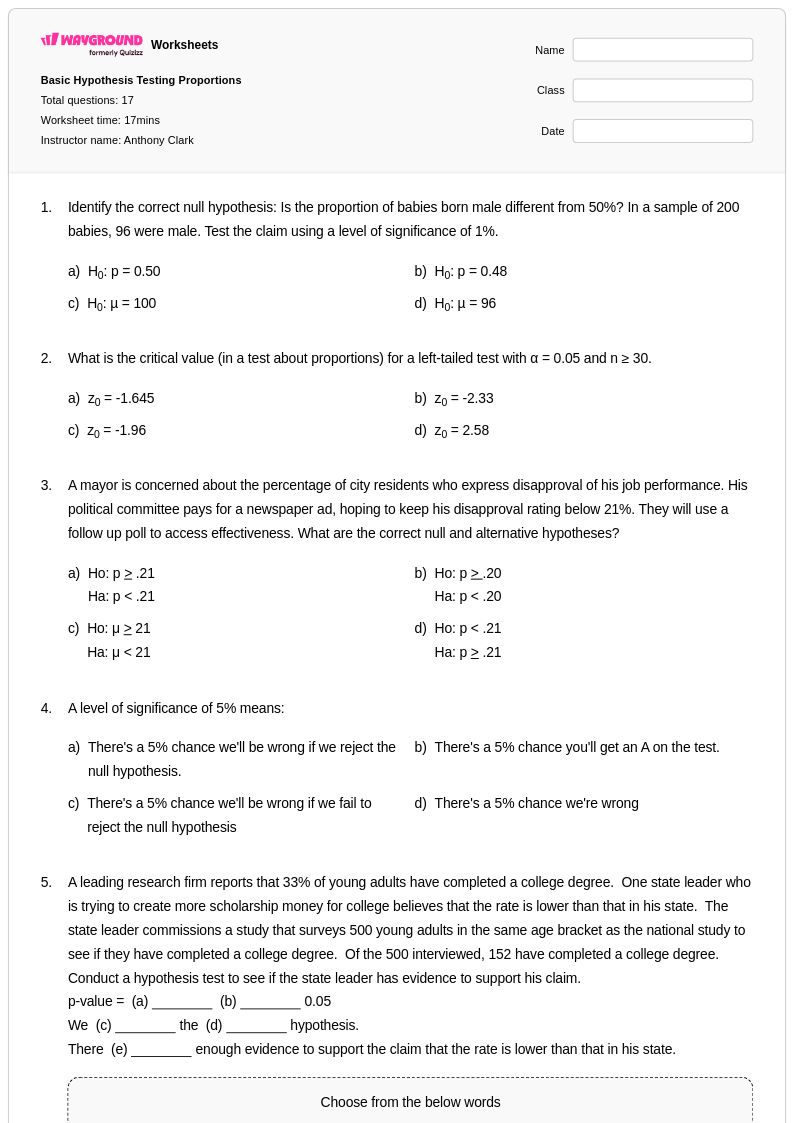
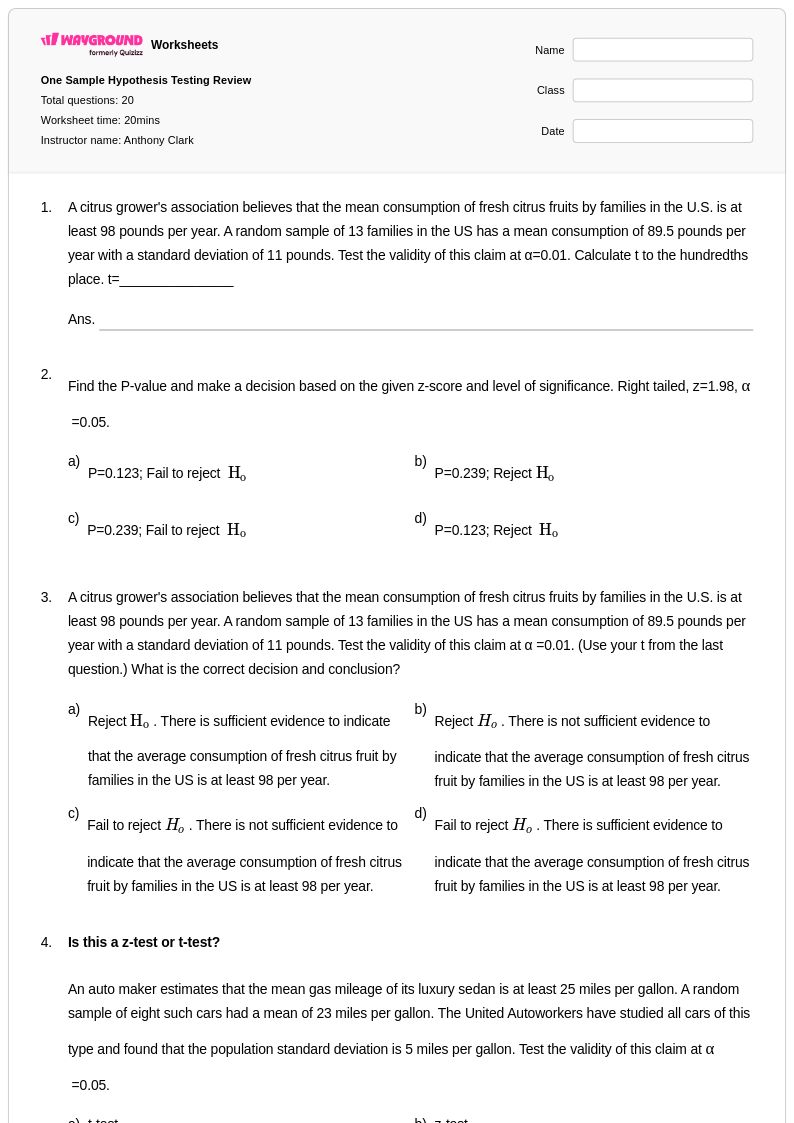
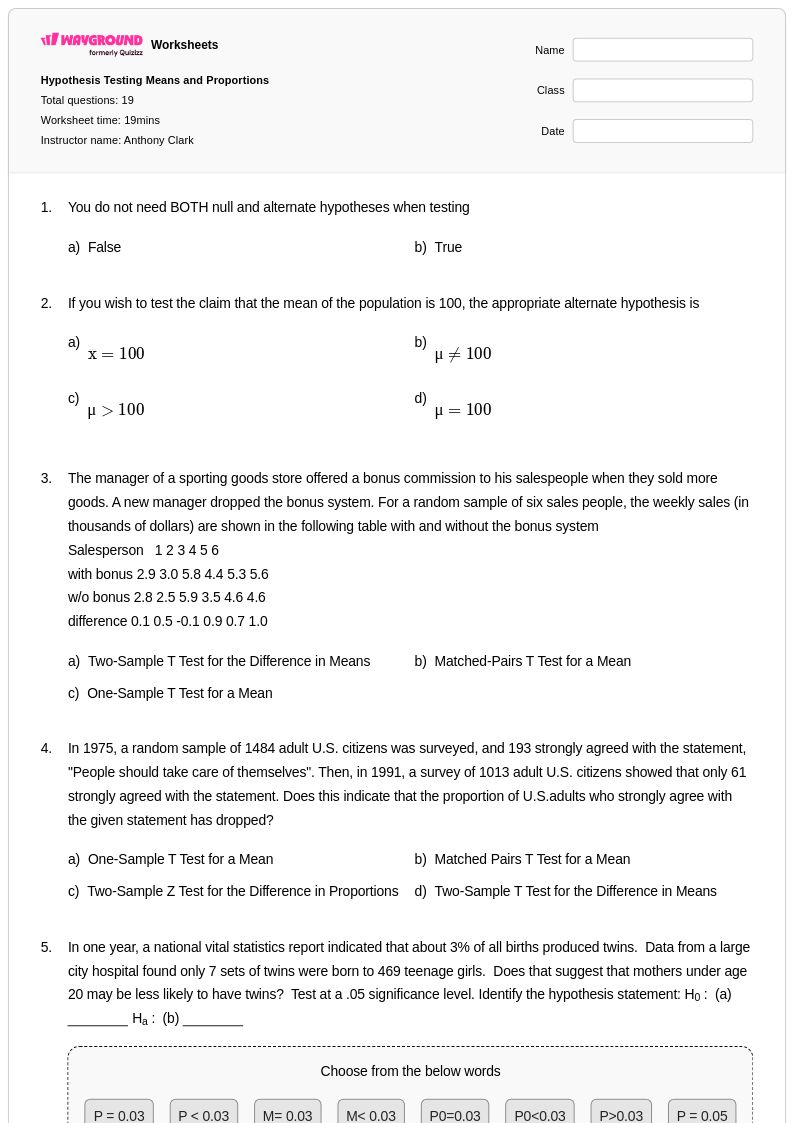
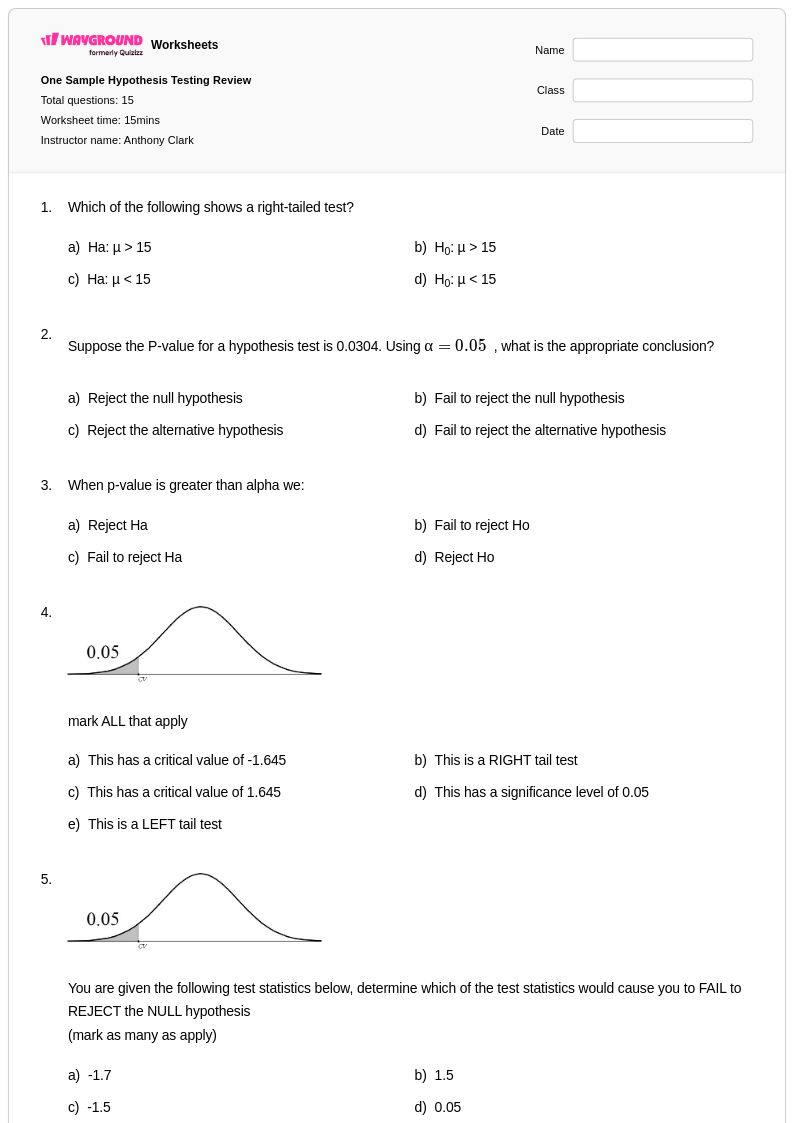
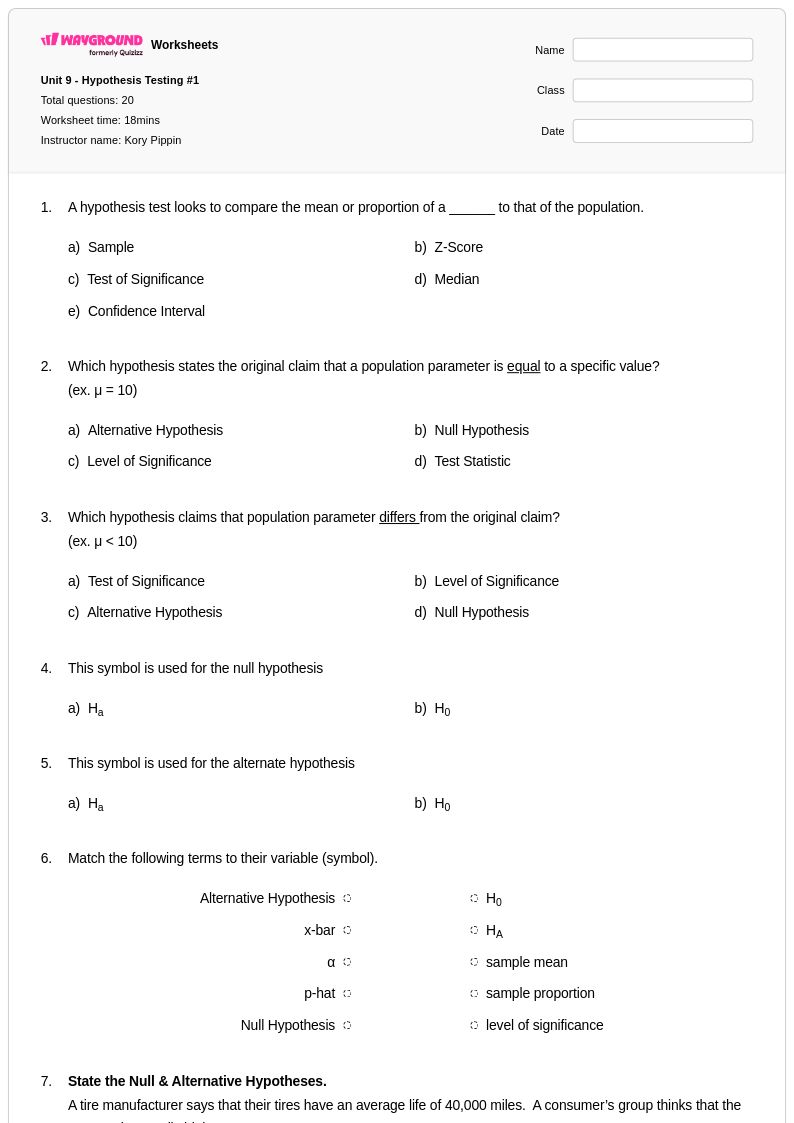
Free hypothesis testing worksheets and printables help students master statistical analysis through practice problems covering null hypotheses, p-values, and significance testing with complete answer keys.
Hypothesis testing worksheets available through Wayground (formerly Quizizz) provide comprehensive coverage of this fundamental statistical concept, helping students master the systematic process of evaluating claims about population parameters. These expertly designed practice problems guide learners through each critical step of hypothesis testing, from formulating null and alternative hypotheses to calculating test statistics, determining p-values, and drawing appropriate conclusions. The worksheet collection strengthens essential skills including identifying appropriate statistical tests for different scenarios, understanding Type I and Type II errors, interpreting confidence intervals, and applying hypothesis testing to real-world data analysis situations. Each printable resource includes detailed answer keys that explain the reasoning behind statistical decisions, while the free pdf formats ensure easy access for both classroom instruction and independent study.
Wayground (formerly Quizizz) supports mathematics educators with an extensive library of millions of teacher-created hypothesis testing worksheets that can be easily located through robust search and filtering capabilities. The platform's differentiation tools allow instructors to customize content difficulty levels and problem types to match diverse learning needs, while standards alignment features ensure worksheets support curriculum objectives across different educational frameworks. Teachers can seamlessly integrate these resources into lesson planning for initial concept introduction, targeted remediation for struggling students, or enrichment activities for advanced learners seeking deeper statistical analysis challenges. The flexible availability of materials in both printable and digital pdf formats accommodates various teaching environments and learning preferences, enabling educators to provide consistent skill practice whether students are working in traditional classrooms or remote learning settings.
FAQs
How do I teach the steps of hypothesis testing?
Introduce hypothesis testing as a formal process for evaluating a claim. A helpful framework is the four-step process: 1) State the null (H₀) and alternative (Hₐ) hypotheses. 2) Plan the test by choosing the correct procedure and significance level. 3) Calculate the test statistic and find the p-value. 4) Conclude by comparing the p-value to the significance level and interpreting the result in context.
What are the most common student mistakes in hypothesis testing?
Students often struggle with correctly formulating the null and alternative hypotheses, especially for one-tailed vs. two-tailed tests. Another common error is misinterpreting the p-value; many incorrectly believe it represents the probability that the null hypothesis is true. Finally, students frequently confuse Type I and Type II errors.
What kinds of exercises help students practice hypothesis testing?
Effective practice includes a mix of problem types. Start with exercises that require students to simply write the null and alternative hypotheses for a given scenario. Then, provide problems with data sets where they must perform the full four-step process. Including real-world contexts, like medical trials or quality control, helps students connect the statistical procedure to practical applications.
How does hypothesis testing fit into the high school math curriculum?
In curricula aligned with the Common Core State Standards (CCSS), hypothesis testing is a capstone concept in statistics and probability. It builds directly on students' understanding of random sampling, probability distributions, and statistical inference. Mastering hypothesis testing prepares students for AP Statistics and introductory college-level statistics courses by teaching them to use data to make and justify decisions.
How can I use this Wayground worksheet with my class?
This worksheet can be assigned as a printable PDF for in-class practice or as a digital activity on the Wayground platform. The printable version is great for hands-on work and supports schools aiming to reduce student screen time. Every worksheet includes a complete answer key, which you can use for efficient grading. For paper submissions, you can use the Wayground for Teachers app to quickly scan and grade student work.
How can I differentiate hypothesis testing practice for my students?
For students who need support, use Wayground's features to provide accommodations like Read Aloud for complex word problems or reduced answer choices on questions about interpreting results. For a scaffolded approach, you can create alternate versions of the worksheet with a dyslexia-friendly font or wider spacing to improve readability for different learners.