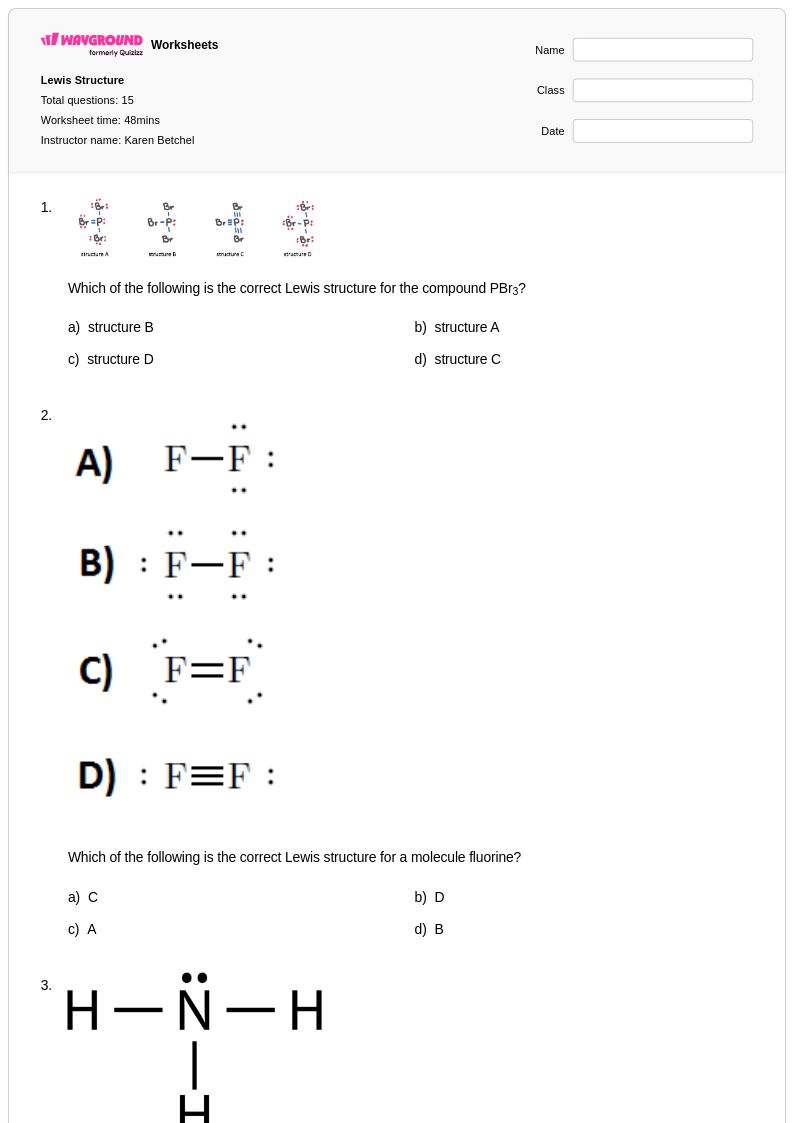
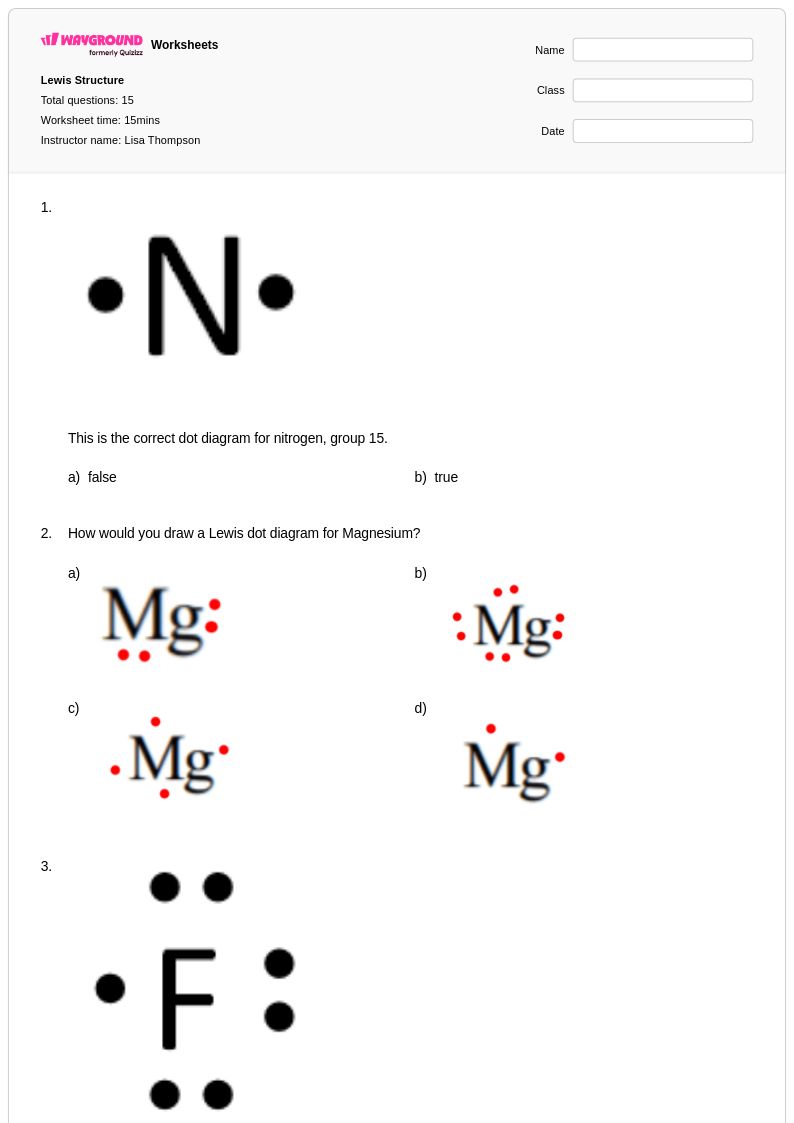
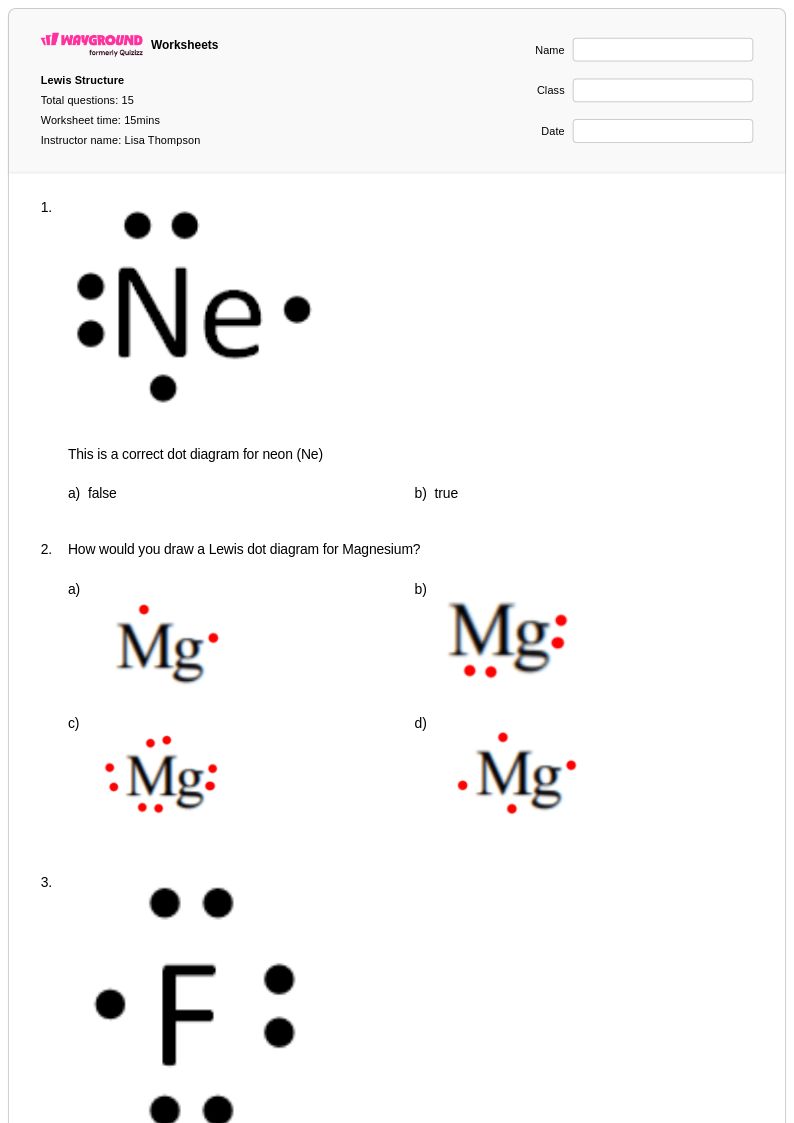
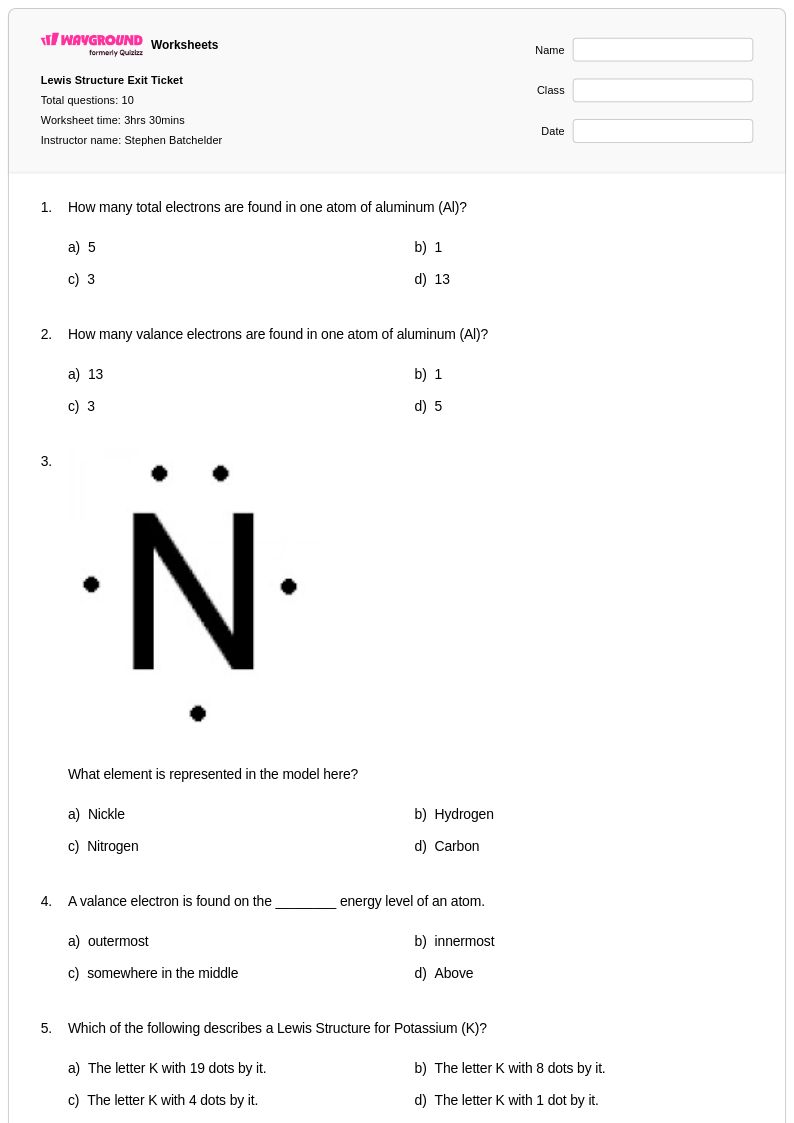
Free Printable Lewis Structure Worksheets for Year 10
Enhance Year 10 chemistry skills with Wayground's free Lewis Structure worksheets and printables, featuring practice problems and answer keys to help students master molecular diagrams and electron dot structures.
Explore printable Lewis Structure worksheets for Year 10
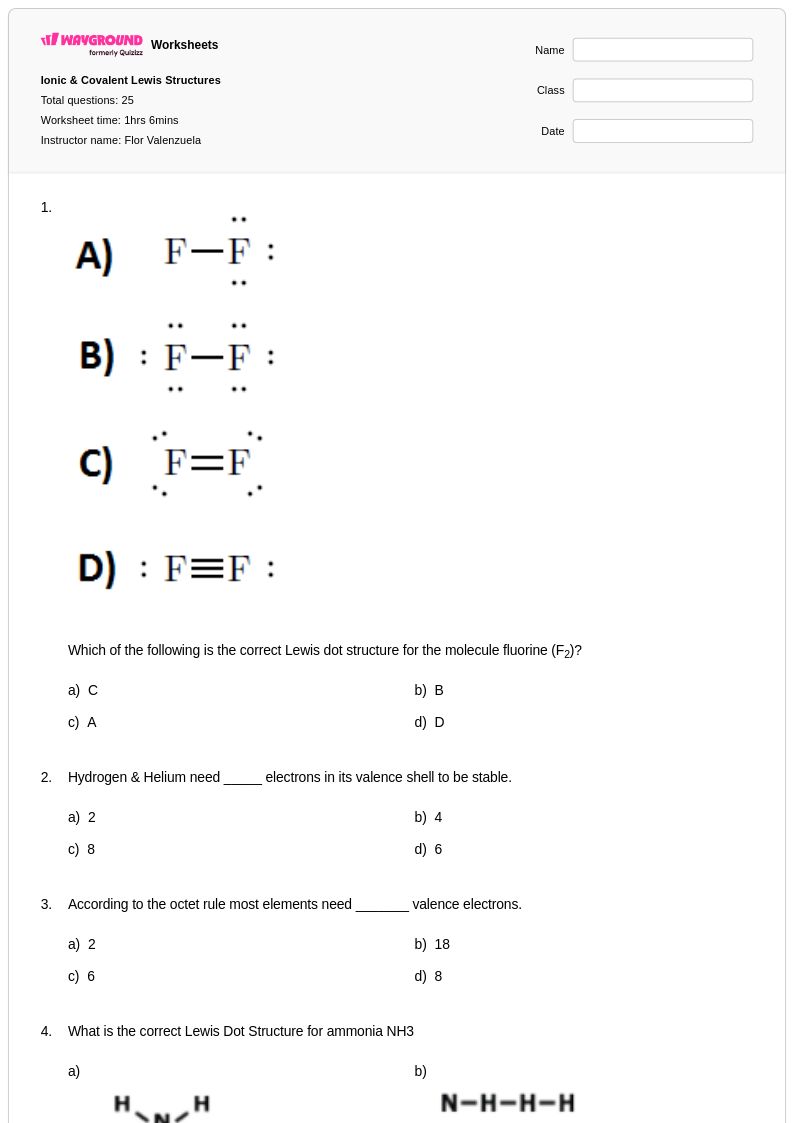
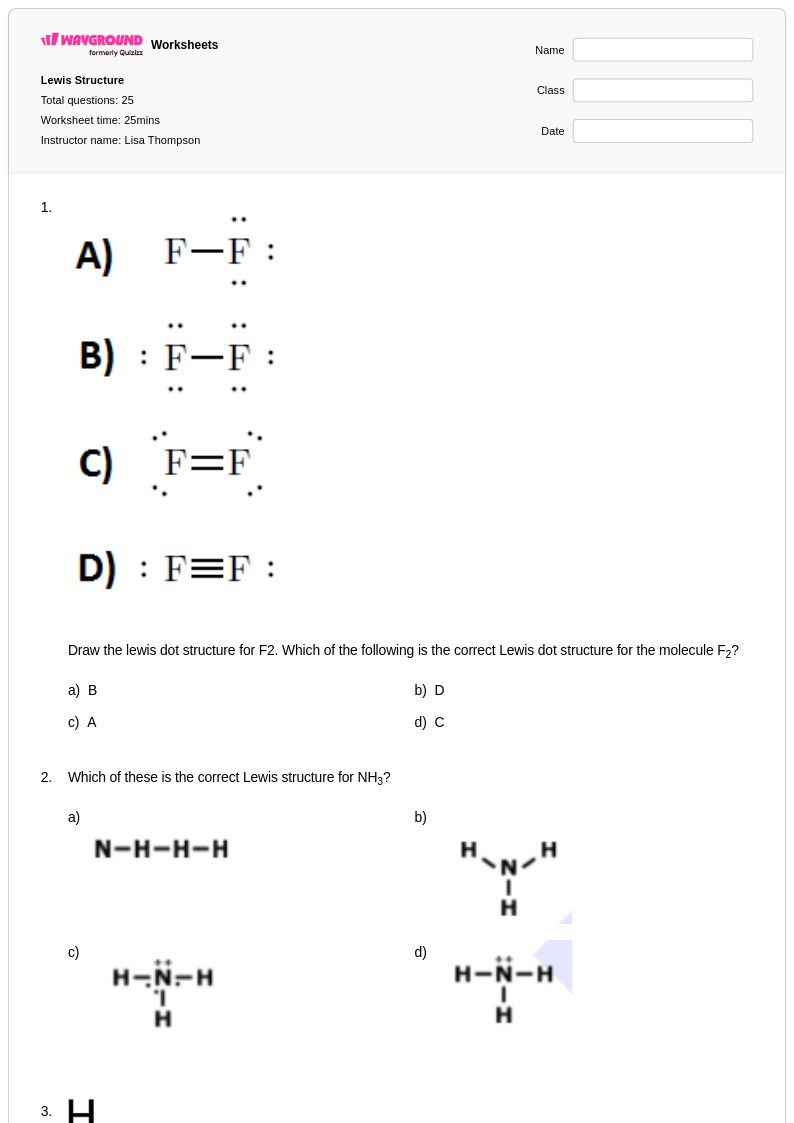
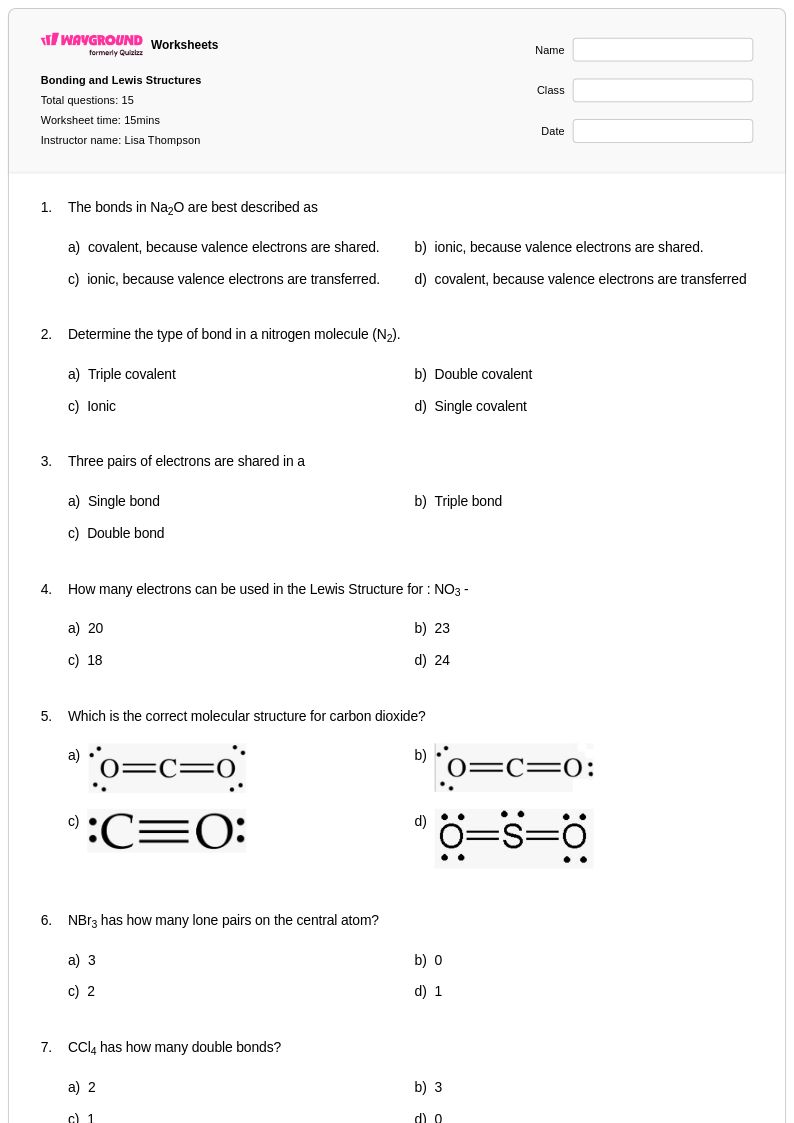
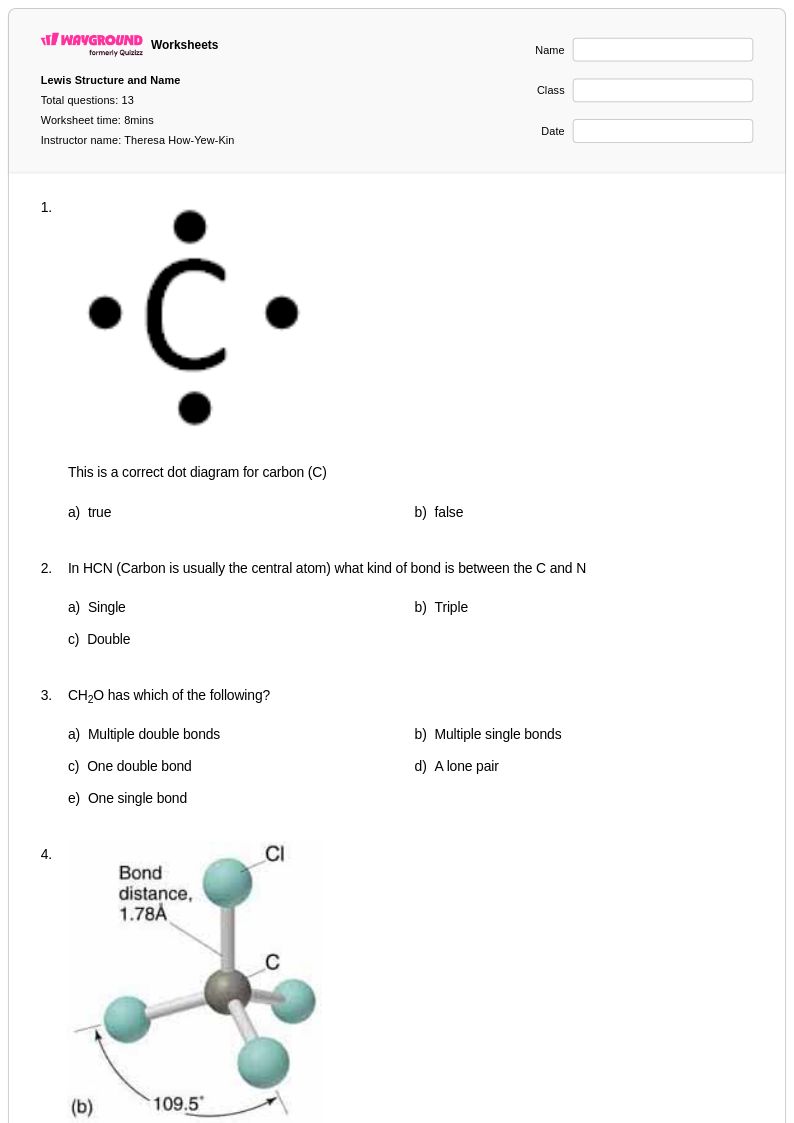
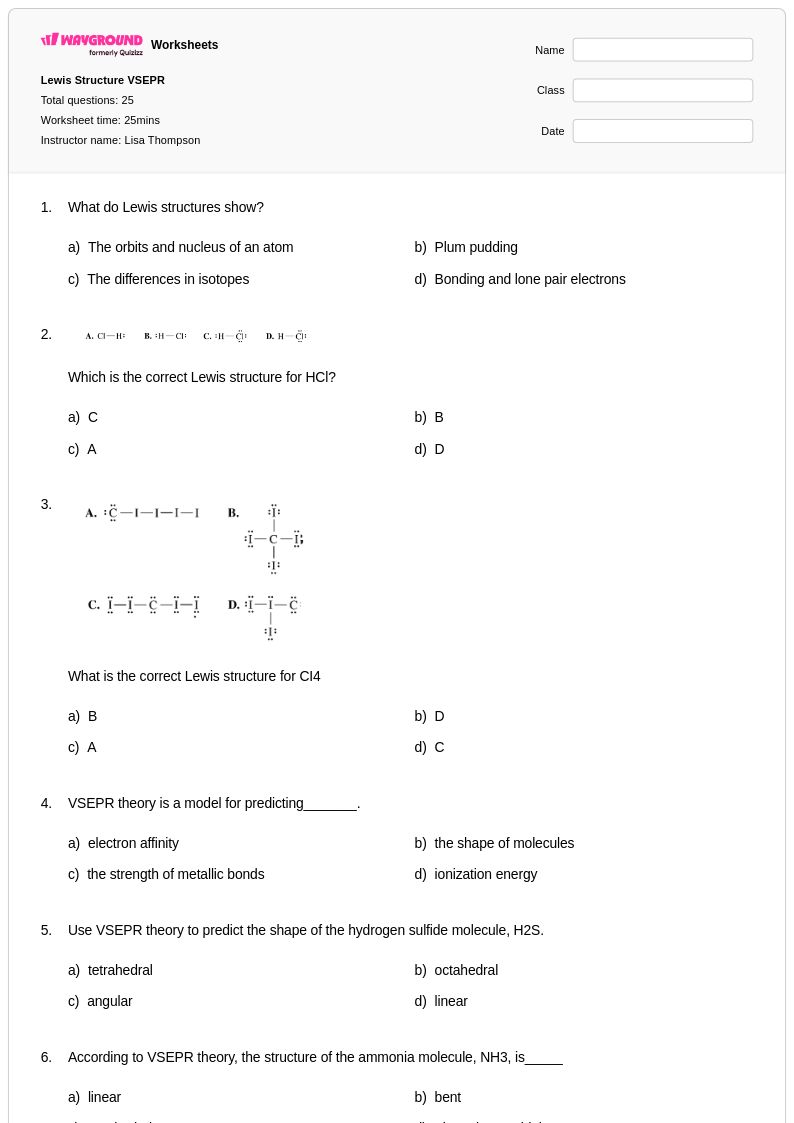
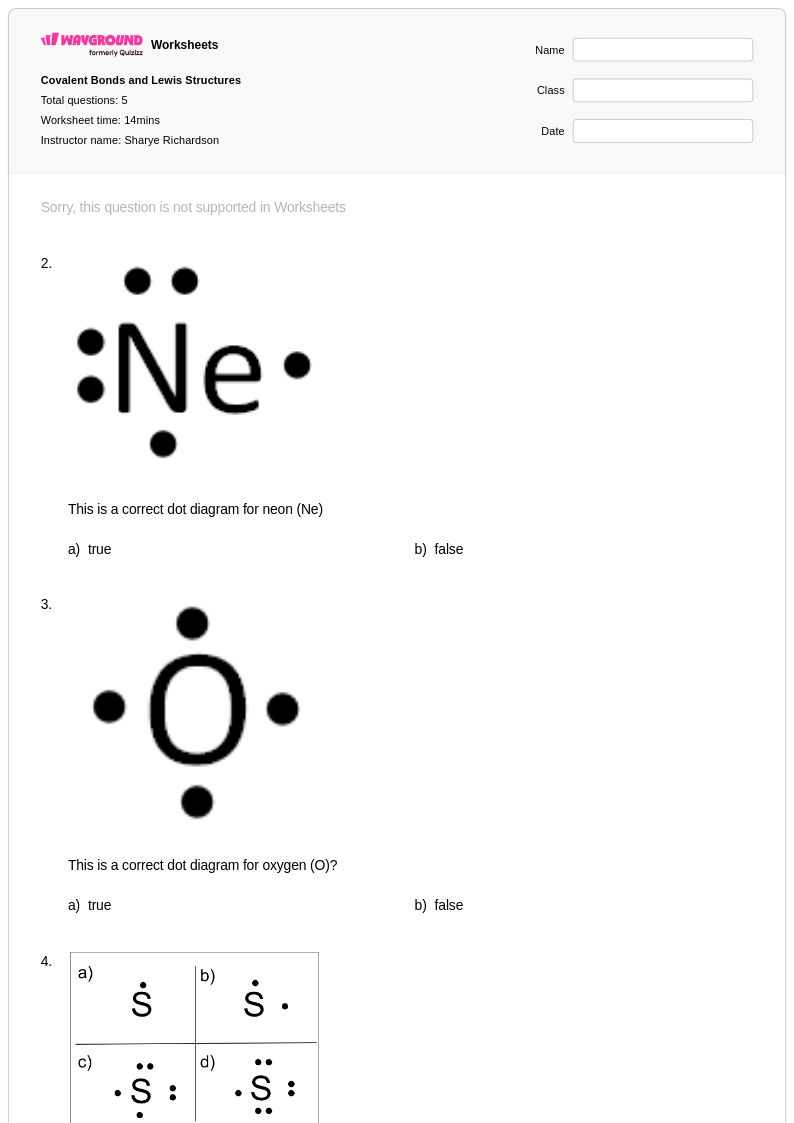
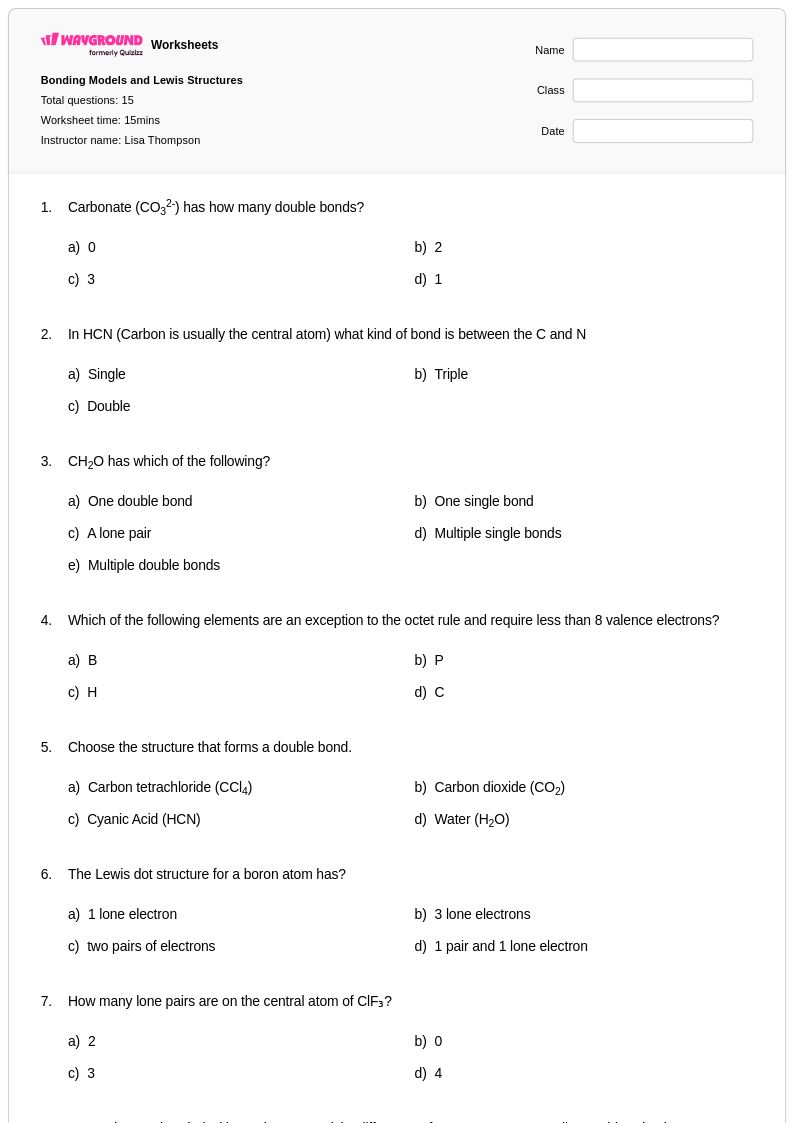
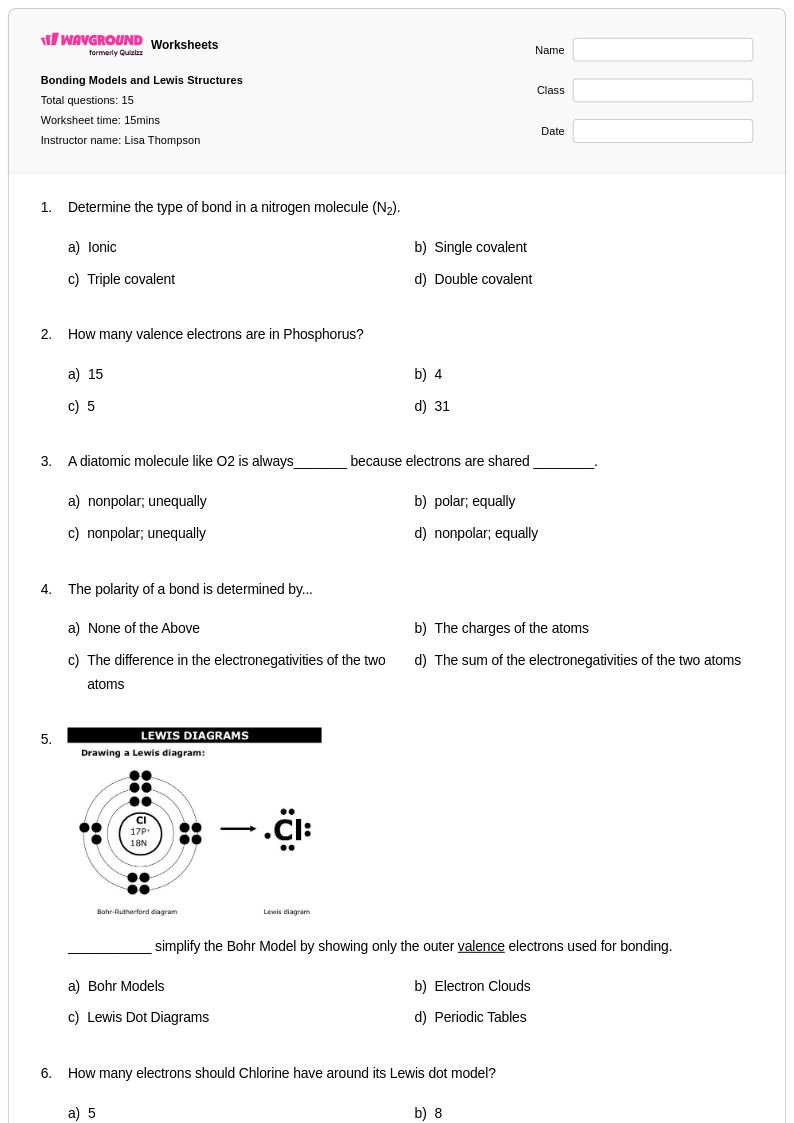
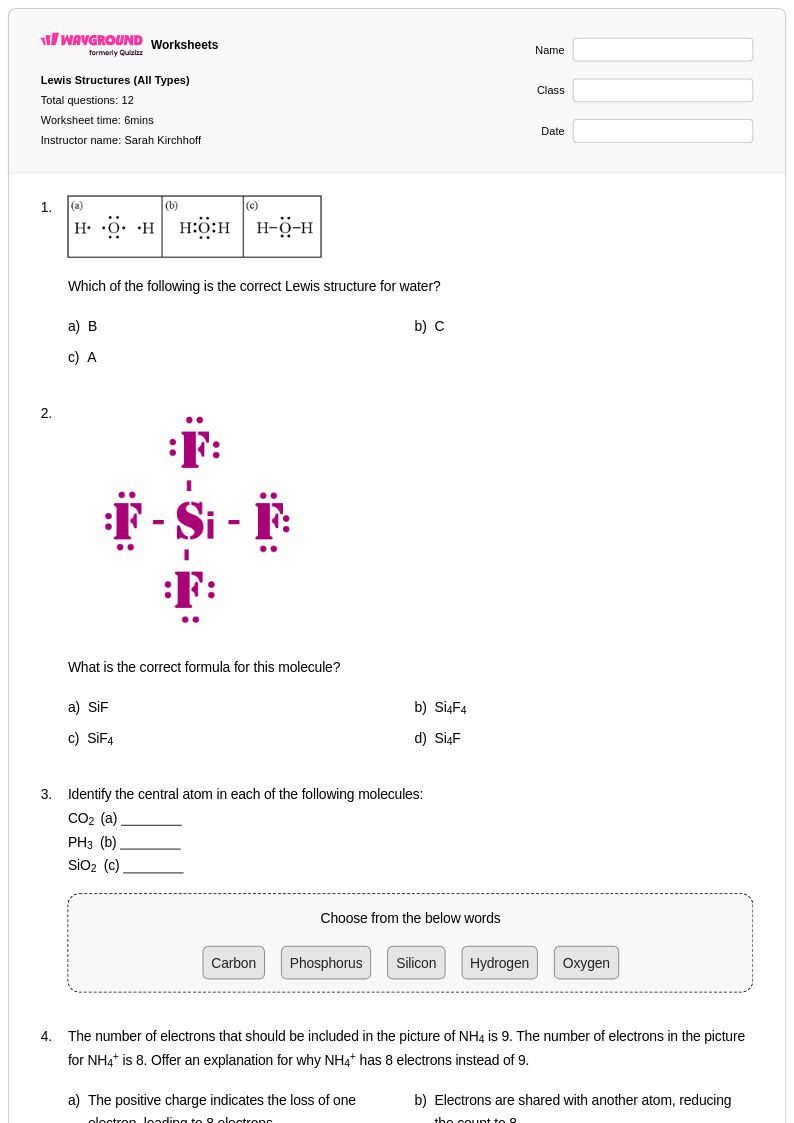
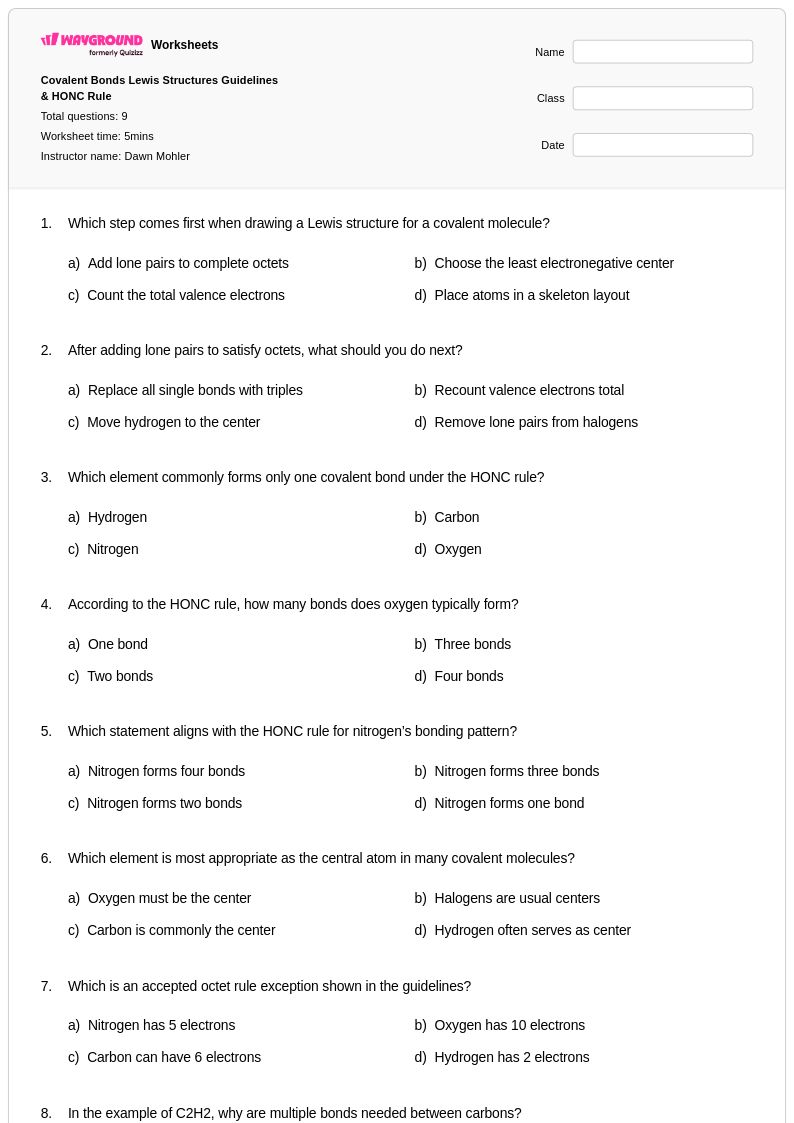
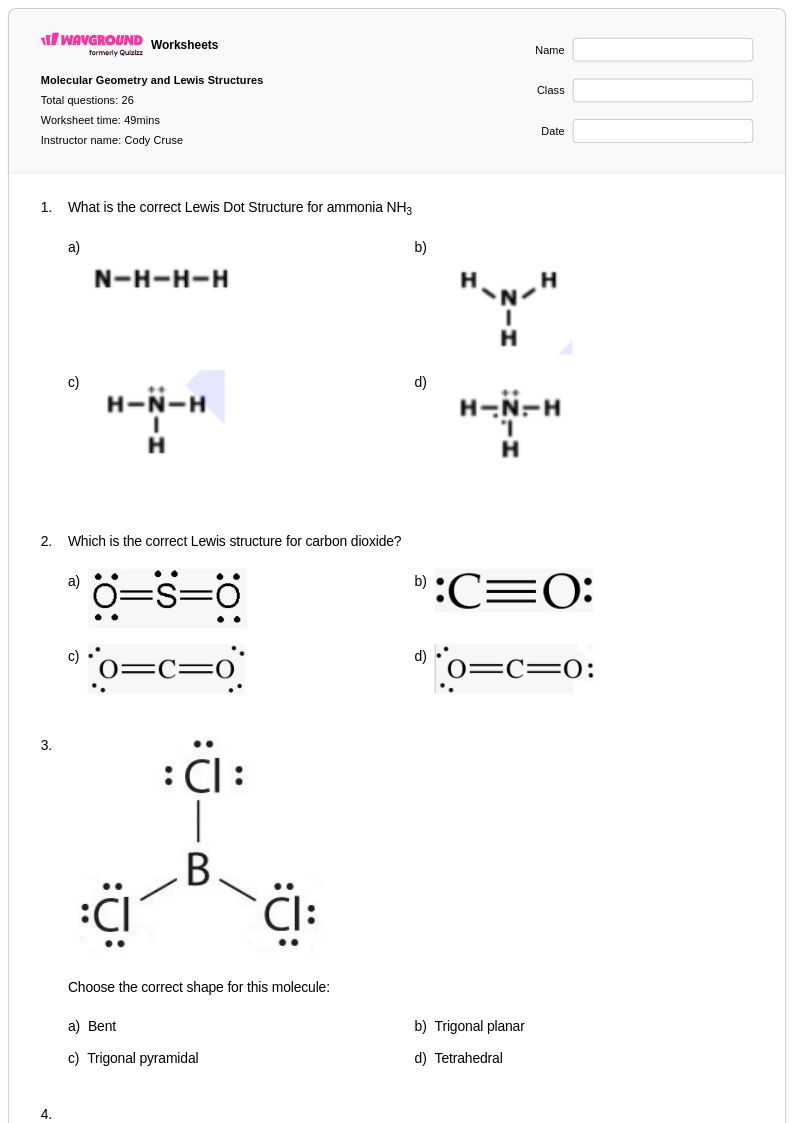
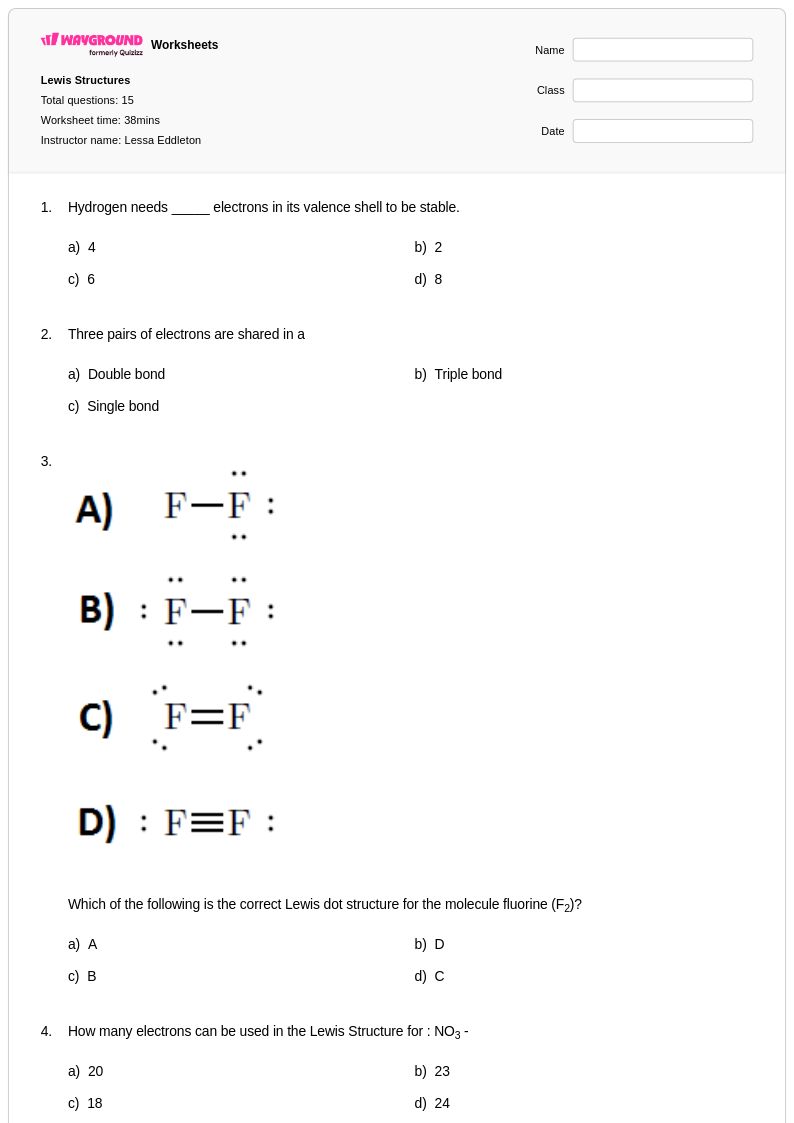
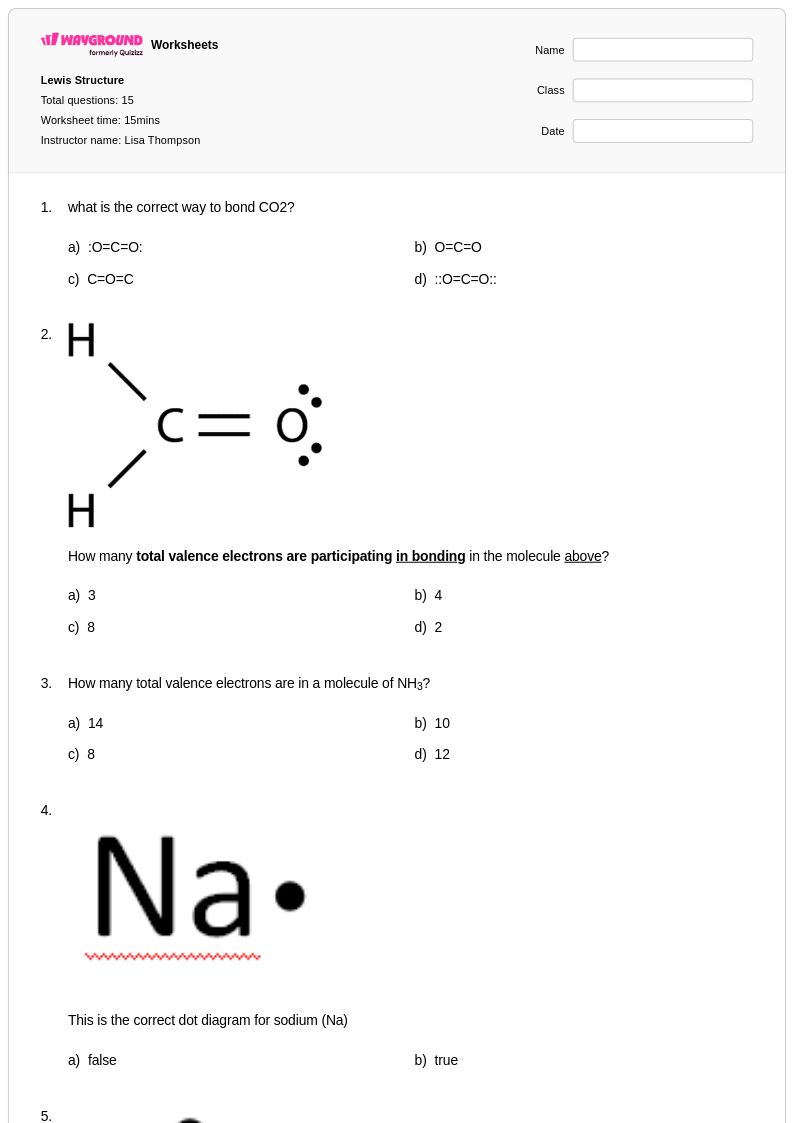
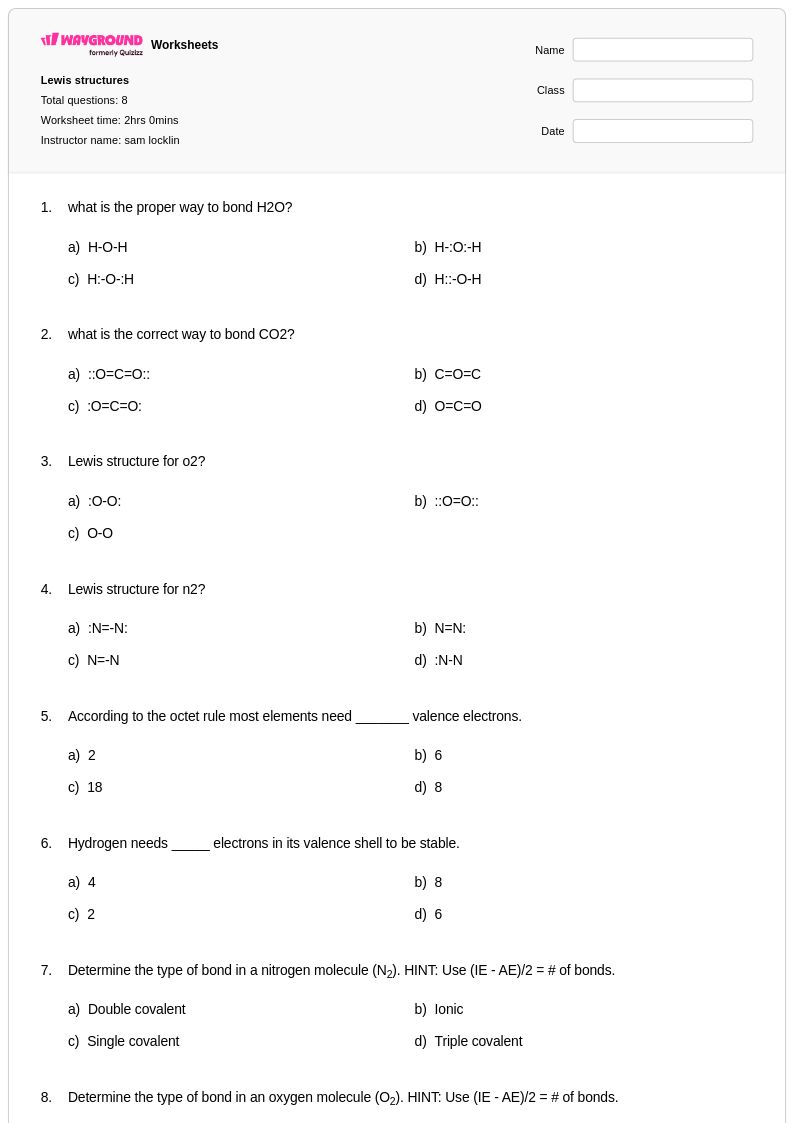
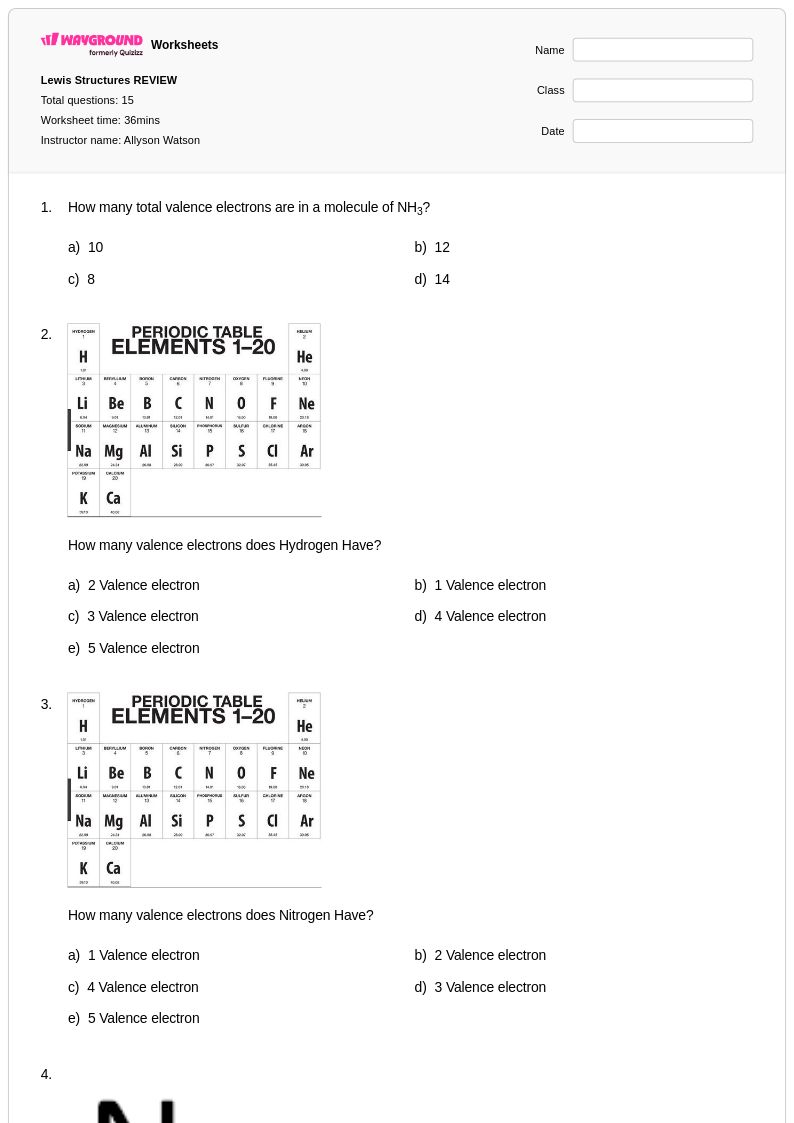
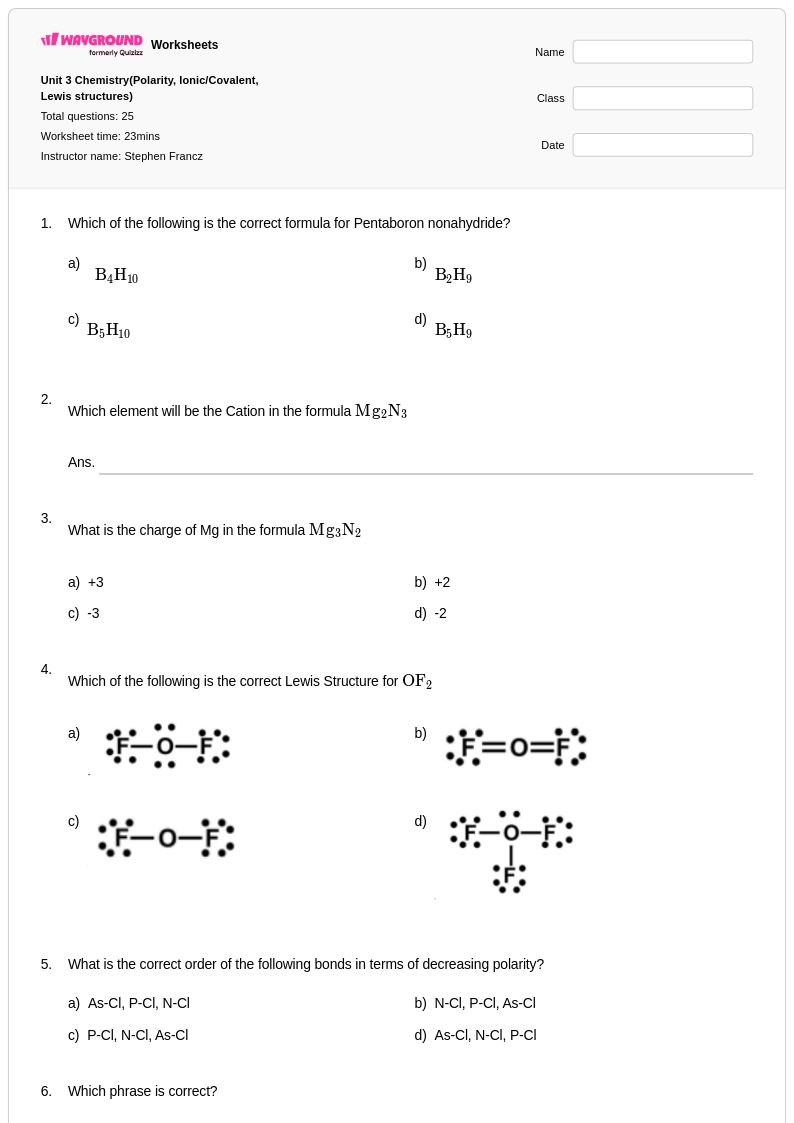
Year 10 Lewis structure worksheets available through Wayground (formerly Quizizz) provide comprehensive practice in drawing and interpreting molecular representations that show how atoms bond and share electrons in chemical compounds. These expertly designed worksheets strengthen essential chemistry skills including determining valence electrons, applying the octet rule, identifying formal charges, and predicting molecular geometry based on electron pair arrangements. Students work through systematic practice problems that progress from simple diatomic molecules to complex polyatomic ions and resonance structures, with each worksheet featuring detailed answer keys that explain step-by-step problem-solving approaches. The free printable resources cover fundamental concepts such as single, double, and triple bonds, lone pair identification, and exceptions to standard bonding patterns, ensuring students develop mastery in this critical foundation of chemical bonding theory through targeted pdf worksheets and structured practice exercises.
Wayground (formerly Quizizz) supports chemistry educators with millions of teacher-created Lewis structure resources that feature advanced search and filtering capabilities, allowing instructors to quickly locate materials aligned with specific learning standards and grade-level expectations. The platform's differentiation tools enable teachers to customize worksheet difficulty levels, modify problem sets for individual student needs, and create targeted practice sessions for remediation or enrichment purposes. These comprehensive worksheet collections are available in both printable and digital formats, including downloadable pdf versions that facilitate flexible classroom implementation and independent study sessions. Teachers can efficiently plan lessons, assess student understanding, and provide additional skill practice by leveraging the platform's extensive database of Lewis structure problems, complete solutions, and pedagogically sound instructional materials that address diverse learning objectives within Year 10 chemistry curricula.
FAQs
How do I teach Lewis structures to high school chemistry students?
Start by building fluency in valence electron counting before introducing dot notation, since students who can't reliably count electrons will struggle with every structure they attempt. From there, progress systematically: single bonds first, then lone pairs, then double and triple bonds, then polyatomic ions with formal charge. Using a consistent step-by-step process — count, connect, distribute, check — gives students a repeatable routine rather than a guessing strategy.
What practice problems help students get better at drawing Lewis structures?
Effective practice sequences start with simple diatomic molecules like Cl₂ and HF, then advance to molecules with lone pairs like H₂O and NH₃, then introduce double and triple bonds, and finally tackle polyatomic ions and resonance structures. Mixing problem types within a single practice session helps students learn to identify what kind of structure they're dealing with before they begin drawing. Worksheets that include step-by-step answer keys are especially valuable here, since students can audit their own reasoning process rather than just checking a final answer.
What mistakes do students commonly make when drawing Lewis structures?
The most frequent error is miscounting valence electrons, either by forgetting to add electrons for negative ions or subtract for positive ones. Students also commonly place all electrons as lone pairs before attempting to satisfy the octet rule through bonding, which leads to incorrect structures with too many lone pairs and too few bonds. A third common error is applying the octet rule rigidly to elements like sulfur and phosphorus, which can accommodate expanded octets — formal charge calculations help students recognize when an expanded octet is actually the more accurate representation.
How do I use Lewis structure worksheets in my chemistry class?
Lewis structure worksheets on Wayground are available as printable PDFs for traditional classroom use and in digital formats for technology-integrated environments, including the option to host them as a quiz directly on Wayground. Print versions work well for guided practice or independent seat work, while digital formats allow students to complete problems on devices with immediate feedback. Both formats include complete answer keys, so the same worksheet can serve as a practice tool, a self-check activity, or a formative assessment depending on how you deploy it.
How do I differentiate Lewis structure practice for students at different levels?
For struggling students, begin with highly scaffolded problems that provide the total valence electron count and ask only for placement, reducing the number of simultaneous decisions required. For advanced learners, introduce resonance structures, formal charge optimization, and molecular polarity prediction as extensions. On Wayground, teachers can also apply accommodations such as read aloud, extended time, and reduced answer choices at the individual student level, so differentiation can happen within a single shared assignment without signaling differences to the class.
How does understanding Lewis structures help students with molecular geometry and VSEPR theory?
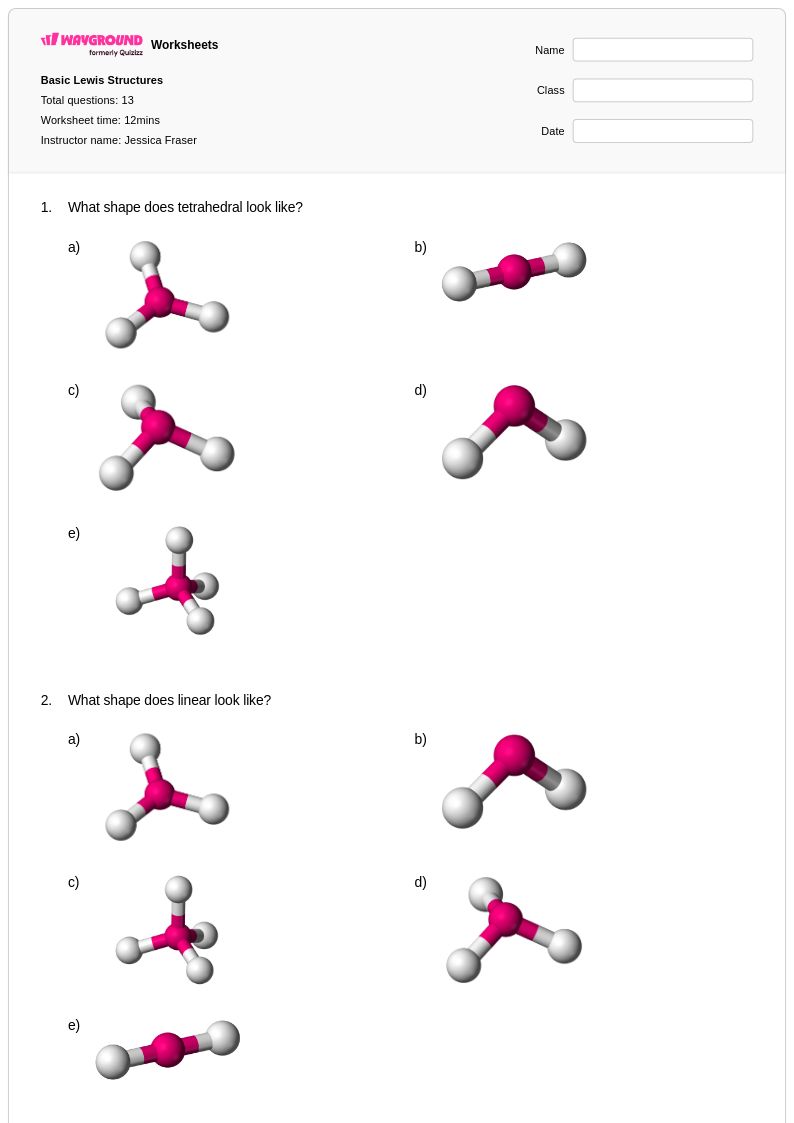
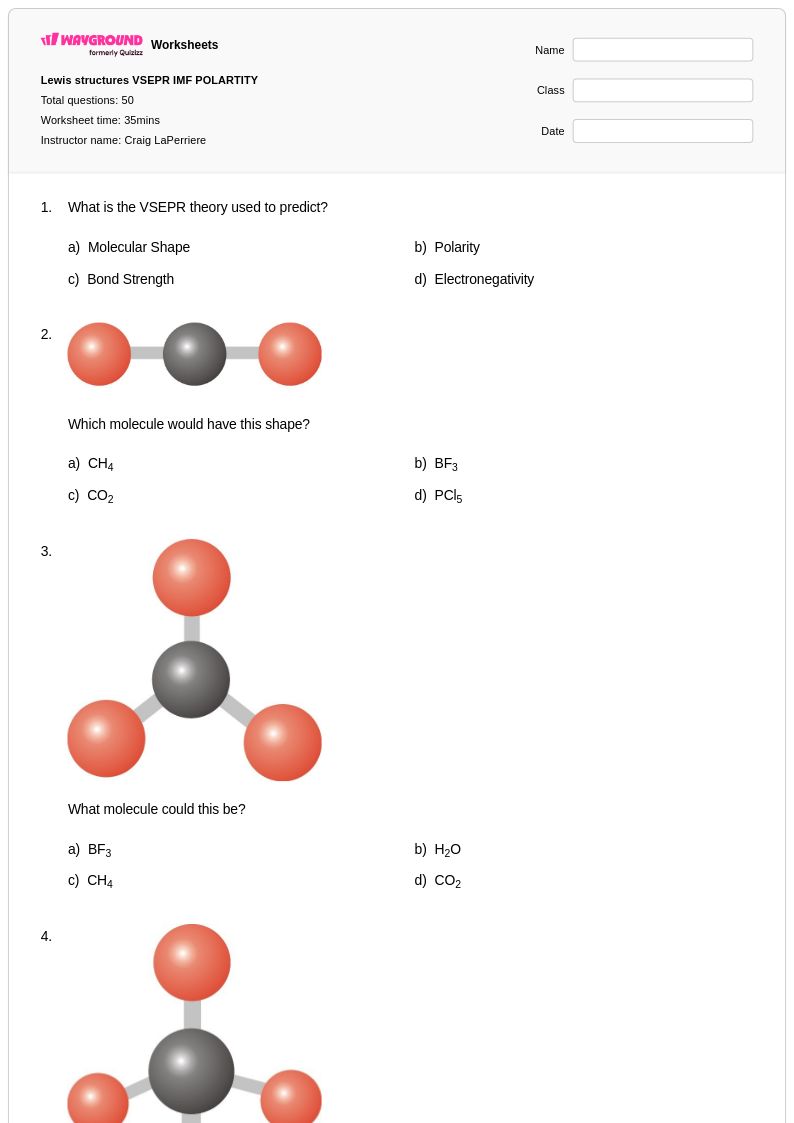
Lewis structures are the prerequisite for VSEPR theory — students cannot predict molecular geometry without first correctly identifying the number of bonding pairs and lone pairs around the central atom. A correct Lewis structure tells students whether a molecule like water is bent or linear, and why, by making the electron arrangement visible. This is why errors in Lewis structures cascade directly into errors in geometry prediction, polarity assignments, and later into intermolecular forces, making structural accuracy foundational to the rest of a bonding unit.