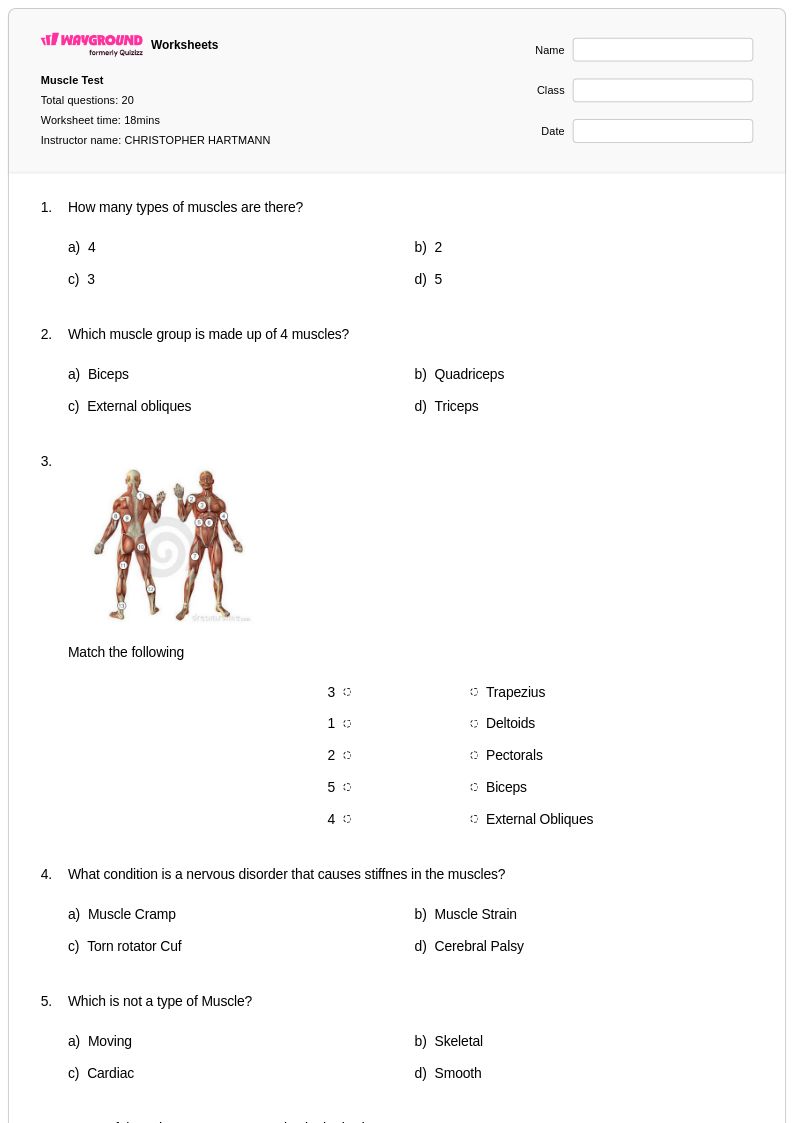
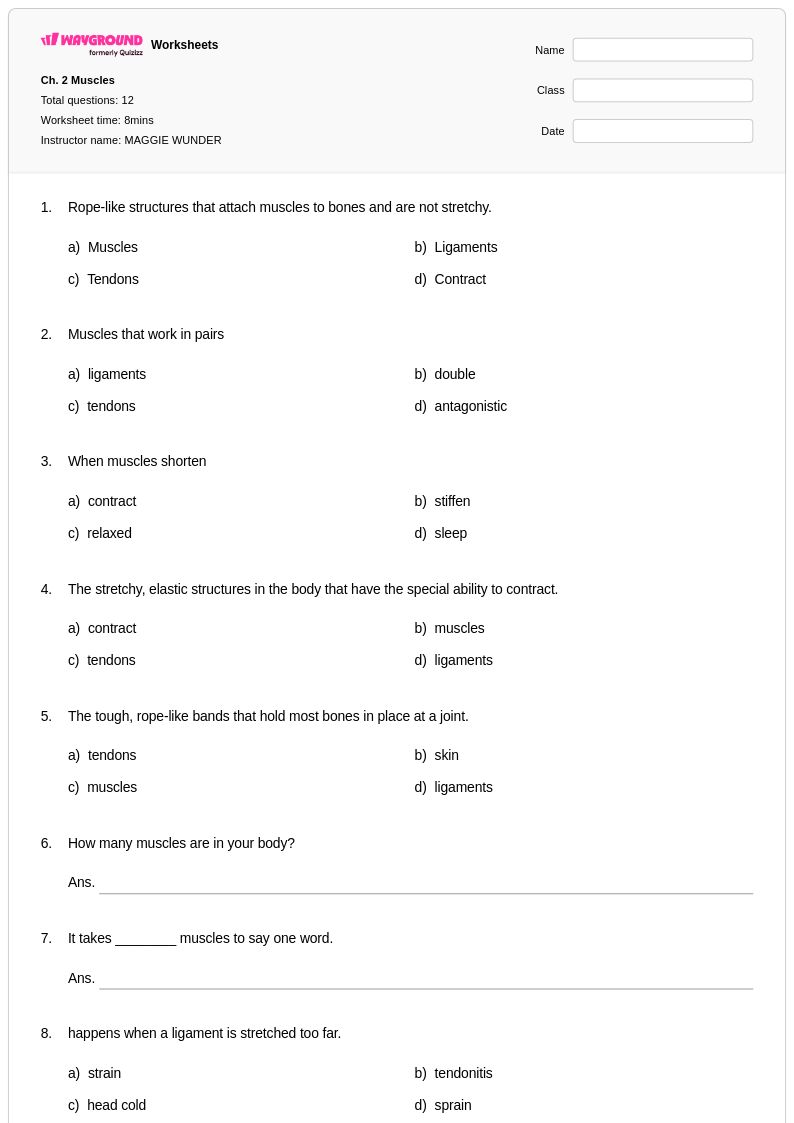
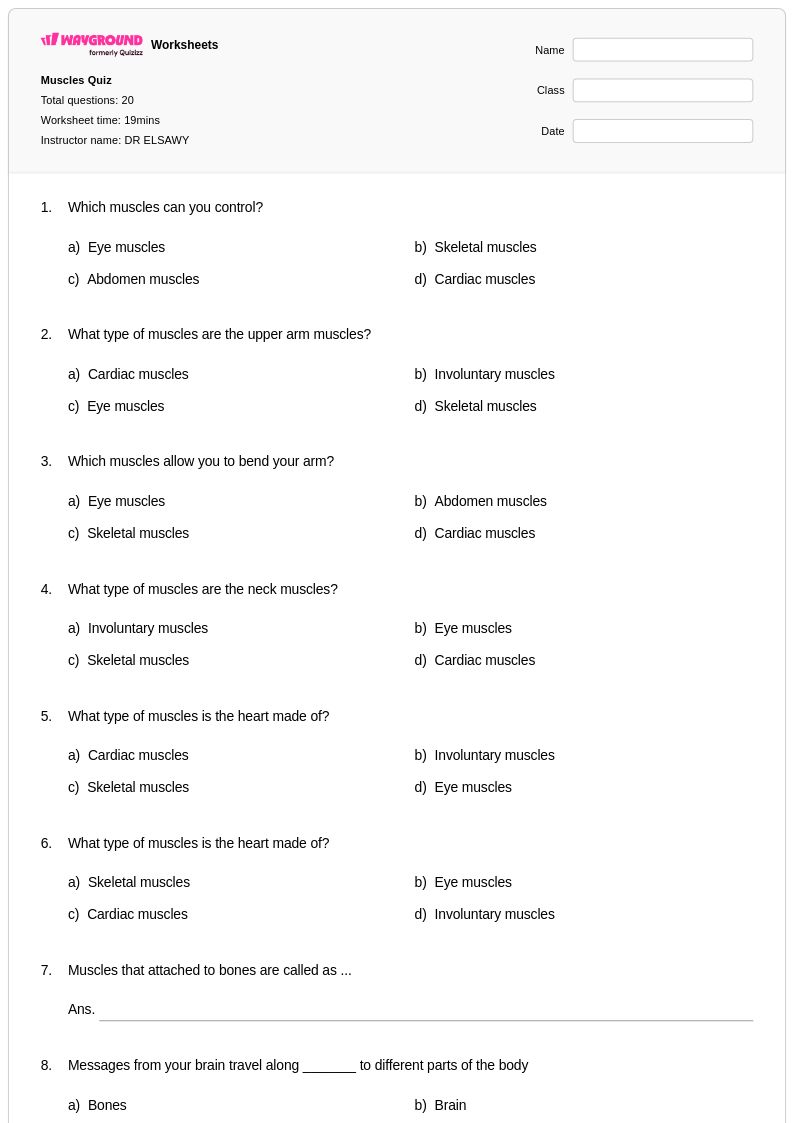
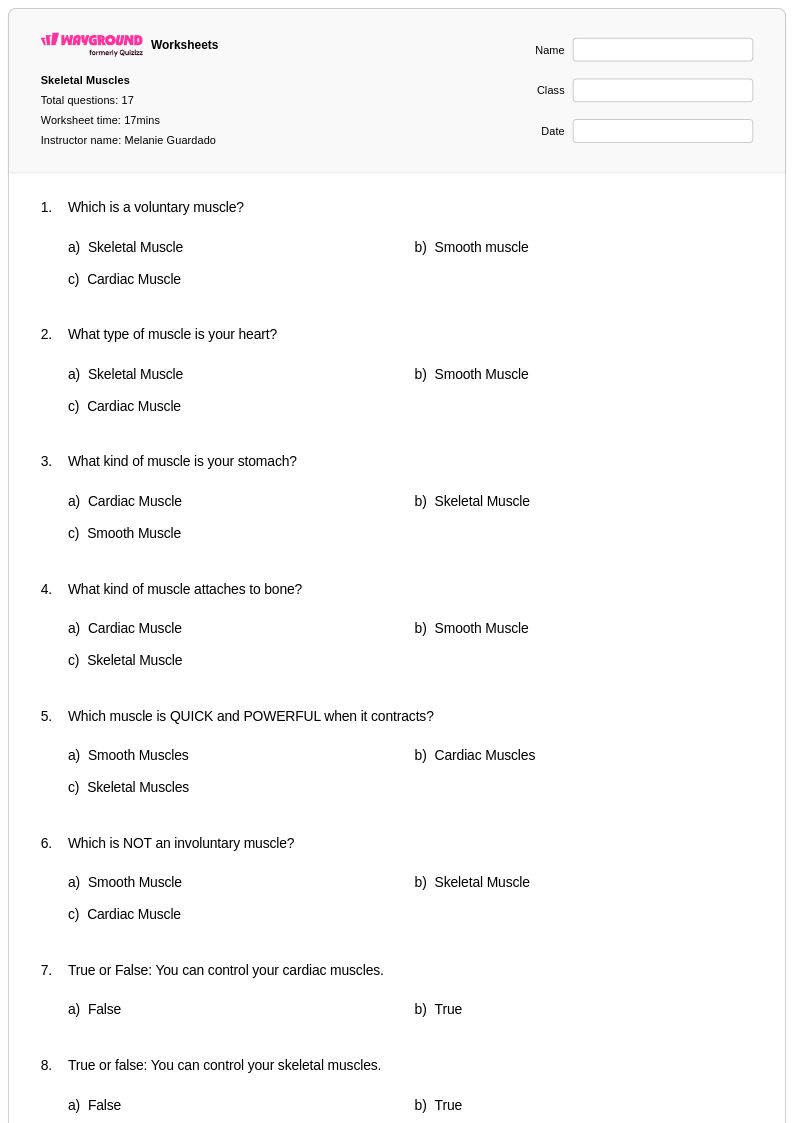
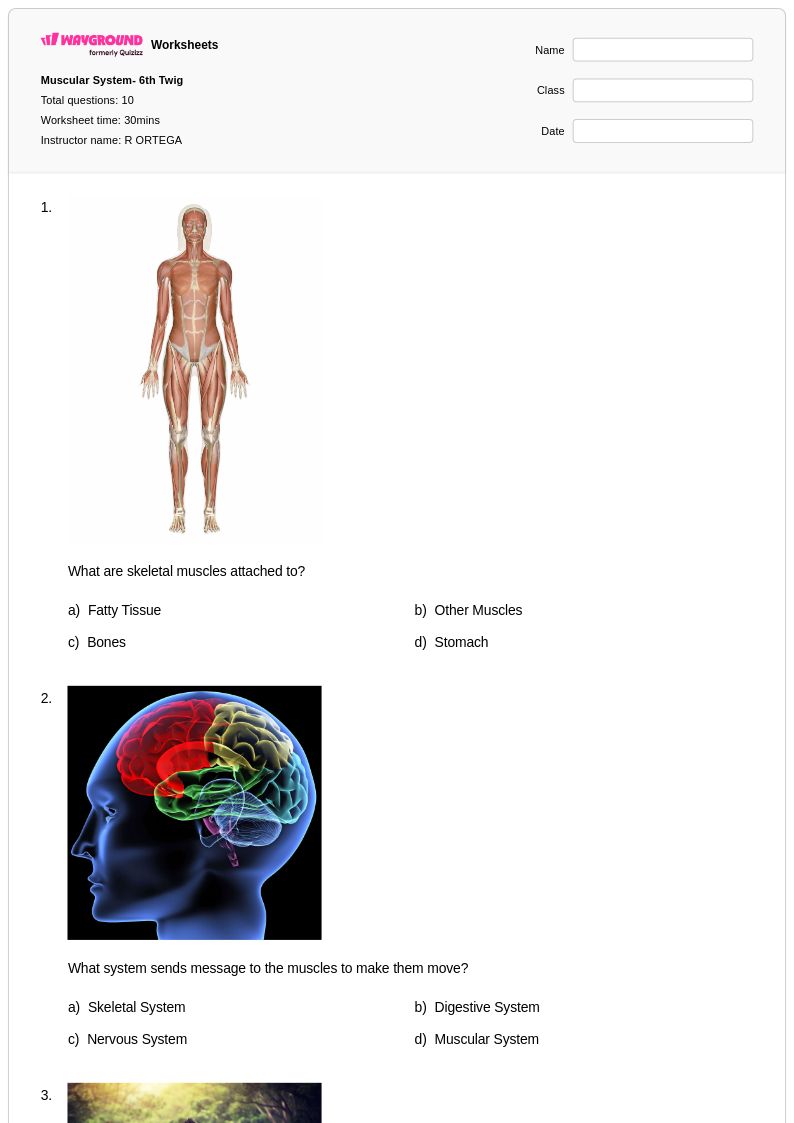
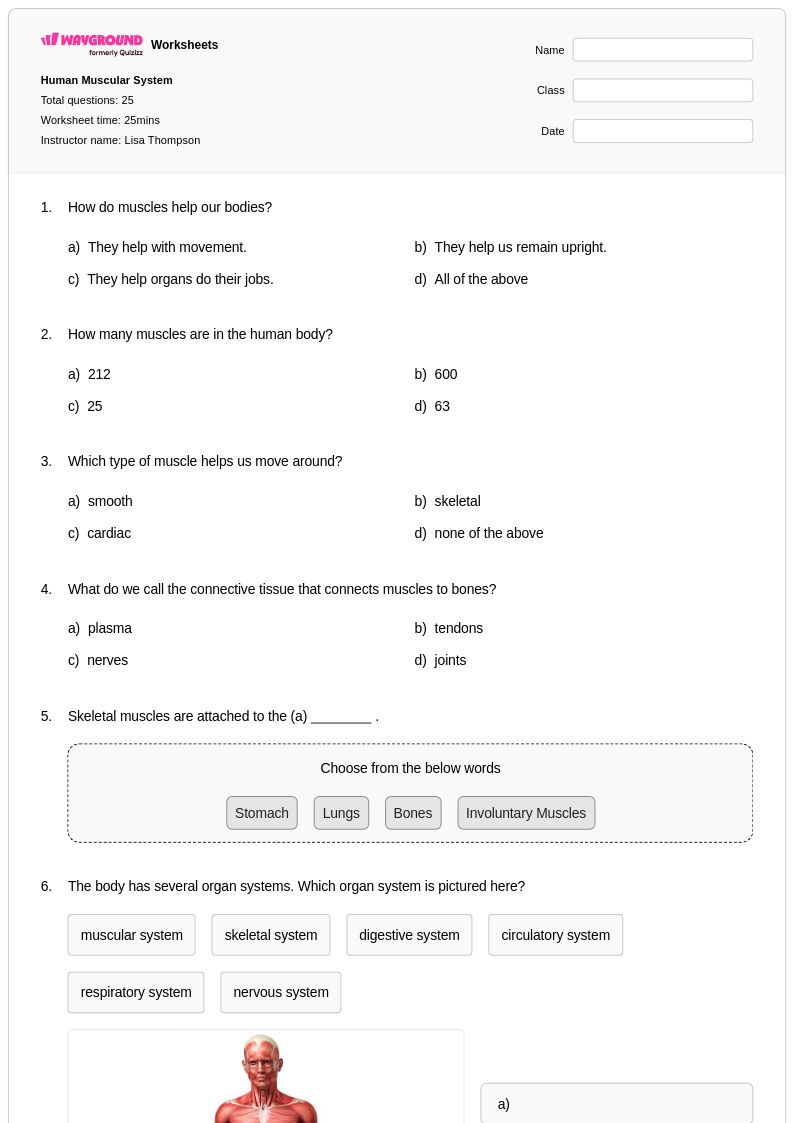
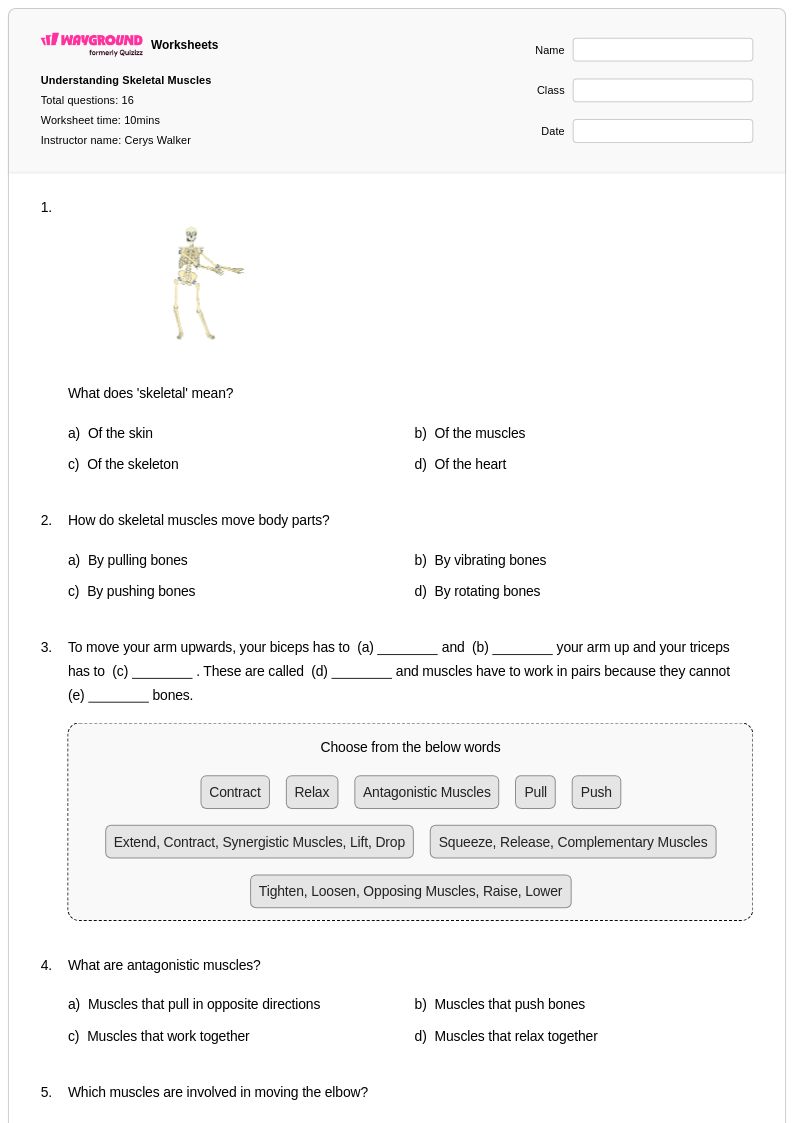
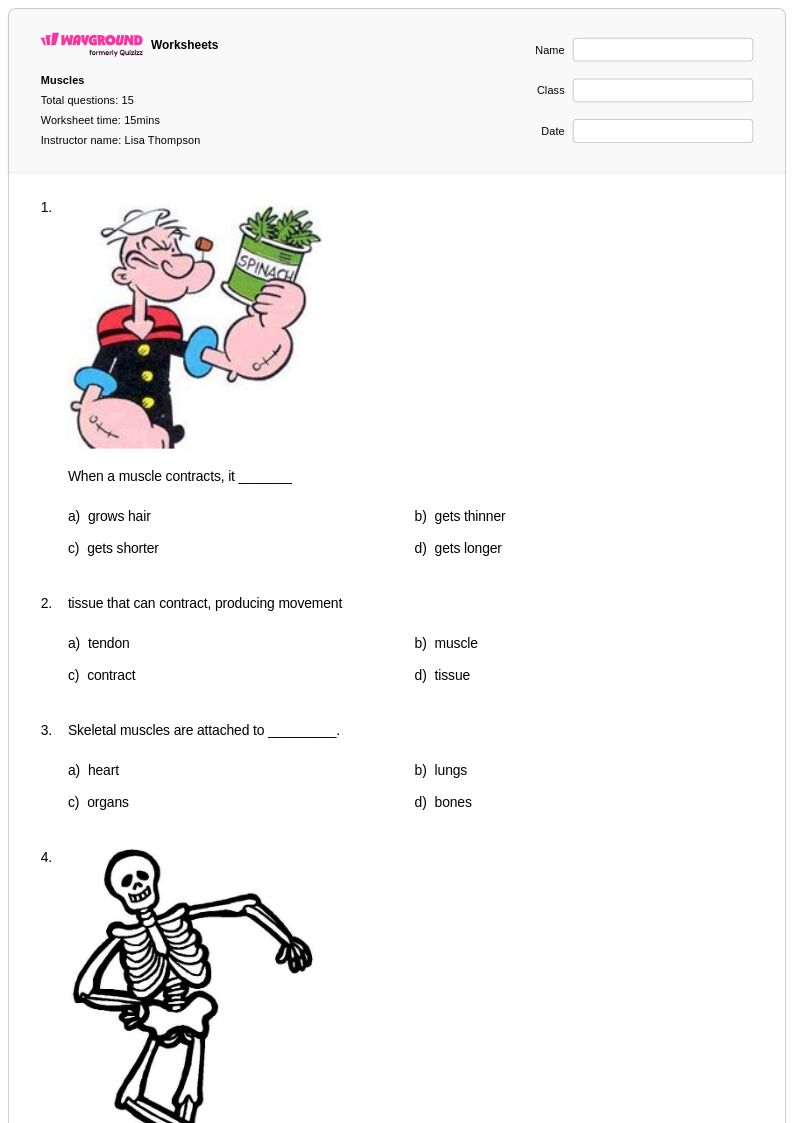
Explore free Year 6 muscles worksheets and printables from Wayground that help students learn muscle types, functions, and anatomy through engaging practice problems with comprehensive answer keys.
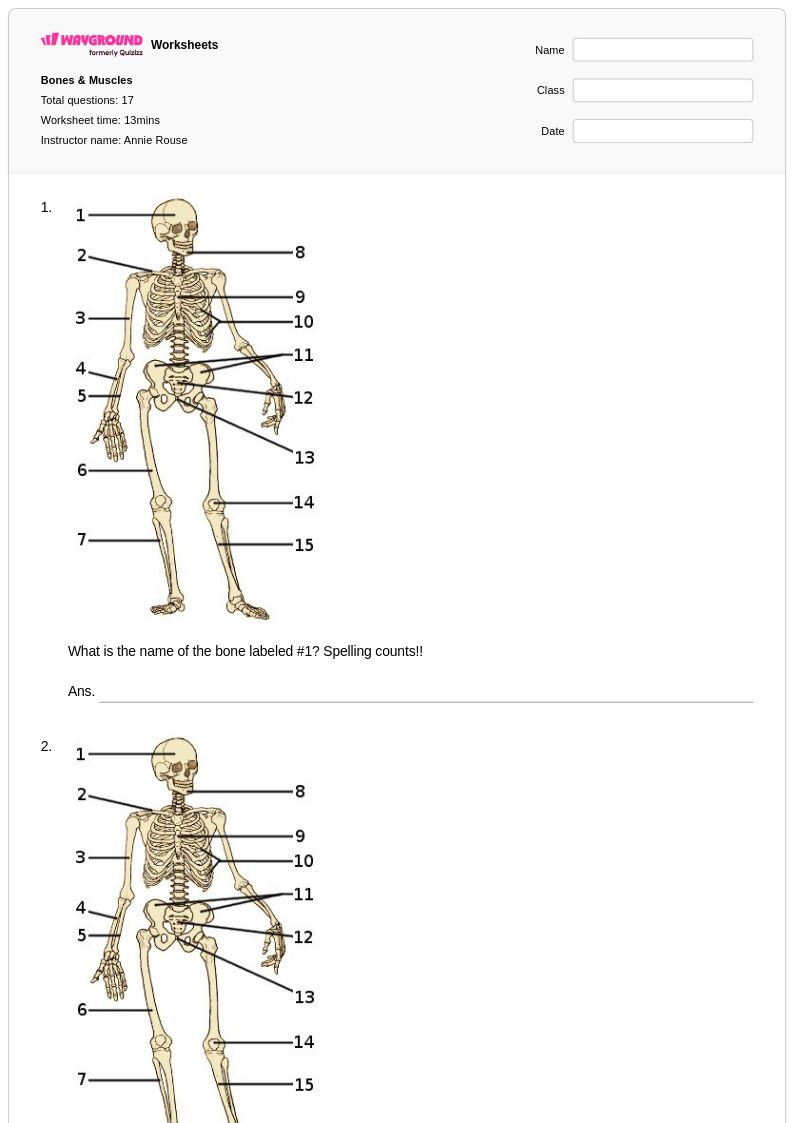
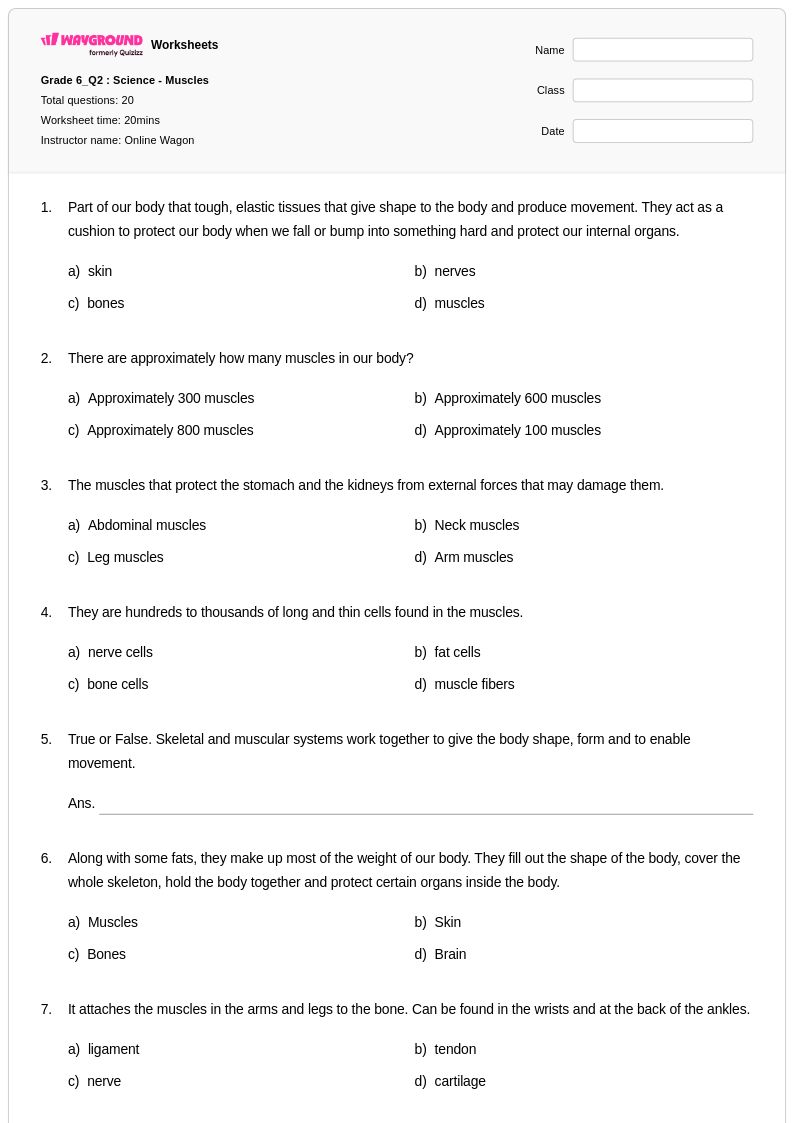
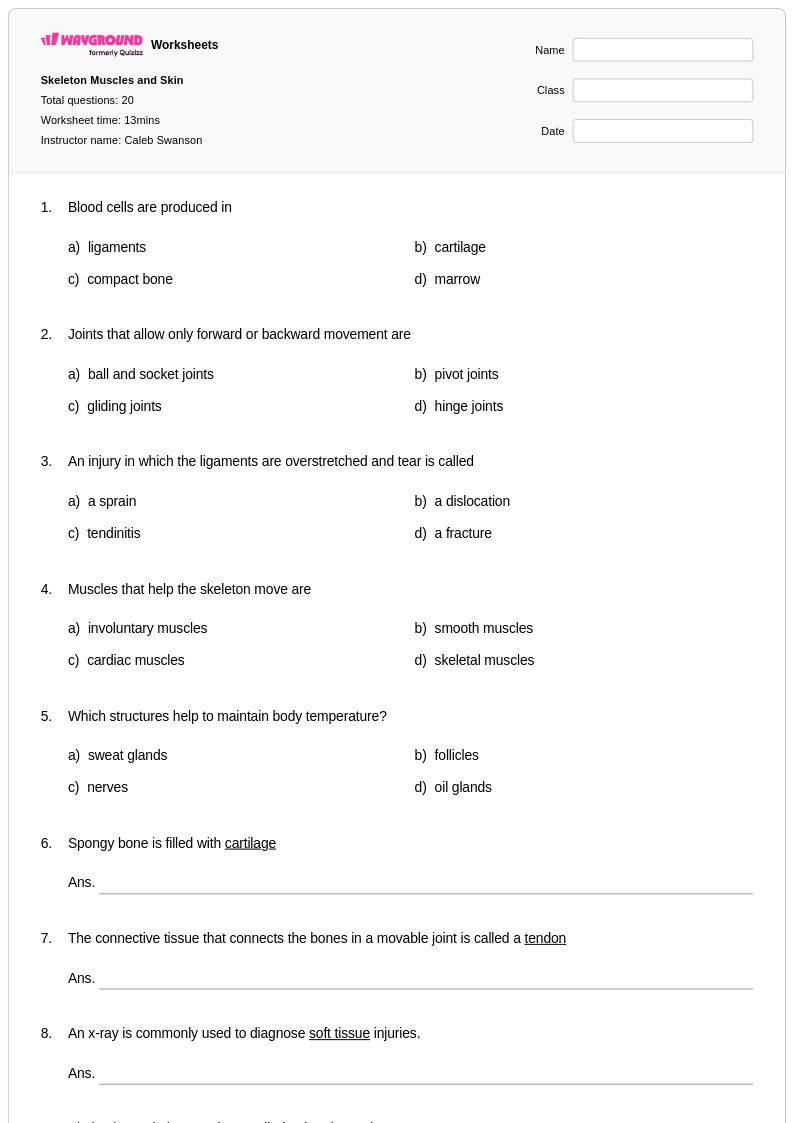
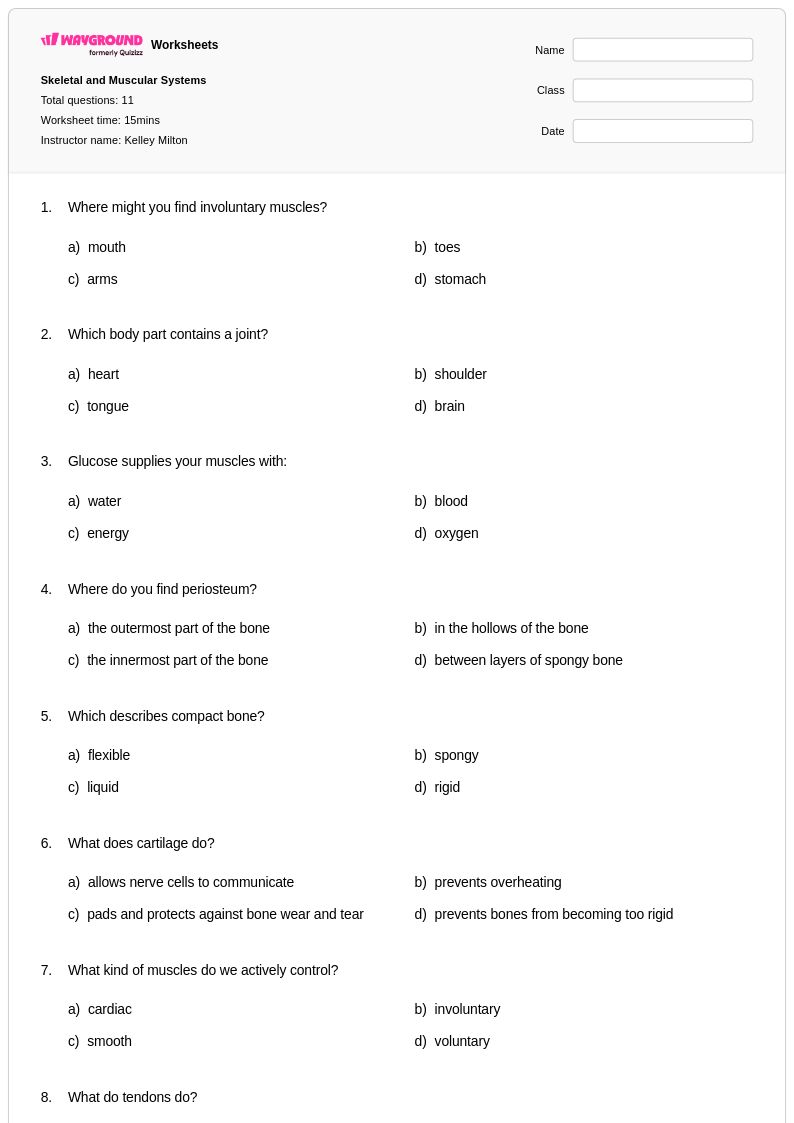
Year 6 muscles worksheets available through Wayground provide comprehensive coverage of the muscular system, helping students understand muscle types, functions, and their role in human movement and body mechanics. These educational resources strengthen critical thinking skills as students explore skeletal, smooth, and cardiac muscles through detailed diagrams, labeling exercises, and analysis of muscle contractions. The collection includes practice problems that challenge students to identify major muscle groups, understand how muscles work in pairs, and connect muscle function to everyday activities like walking, breathing, and digestion. Each worksheet comes with a complete answer key, making them valuable tools for both independent study and classroom instruction, while the free printable format ensures accessibility for all learning environments.
Wayground supports educators with millions of teacher-created muscle worksheet resources that can be easily searched and filtered by specific learning objectives, difficulty levels, and curriculum standards alignment. Teachers benefit from robust differentiation tools that allow customization of content complexity, ensuring appropriate challenge levels for diverse learners while addressing individual student needs in both remediation and enrichment contexts. The platform's flexible format options include downloadable pdf files for traditional paper-based learning and interactive digital versions that can be seamlessly integrated into online instruction. These comprehensive filtering and customization capabilities streamline lesson planning by enabling teachers to quickly locate age-appropriate materials that reinforce muscle system concepts through varied practice opportunities, from basic identification tasks to complex analytical problems that deepen scientific understanding.
FAQs
How do I teach the three types of muscle tissue to students?
Start by distinguishing the three muscle types structurally and functionally: skeletal muscle is striated and voluntary, cardiac muscle is striated and involuntary, and smooth muscle is non-striated and involuntary. Use labeled diagrams to show how fiber arrangement differs across types, and connect each type to a specific body location and function — for example, smooth muscle in the digestive tract versus skeletal muscle in the bicep. Having students complete identification and classification activities immediately after instruction reinforces the distinctions before misconceptions set in.
What exercises help students practice muscle anatomy and function?
Effective practice tasks include labeling diagrams of major muscle groups, matching muscles to their functions or antagonist pairs, and sequencing the steps of the sliding filament model of contraction. Students also benefit from analyzing scenarios — such as what happens during a bicep curl at the level of actin and myosin — which pushes beyond memorization into applied understanding. Worksheets that combine vocabulary reinforcement with short-answer analysis questions help students build both recall and conceptual depth.
What mistakes do students commonly make when learning about muscle contraction?
One of the most common errors is confusing the roles of actin and myosin — students often mix up which filament moves and which remains stationary during the sliding filament mechanism. Another frequent misconception is believing muscles push as well as pull; students need repeated exposure to the concept that skeletal muscles only contract and that movement in both directions requires antagonistic muscle pairs. Students also frequently conflate cardiac and smooth muscle as identical because both are involuntary, so explicit comparison is essential.
How do I use Wayground's muscles worksheets in my classroom?
Wayground's muscles worksheets are available as printable PDFs for traditional classroom use and in digital formats for technology-integrated environments, making them flexible for in-class activities, homework, or independent study. Teachers can also host digital versions as a quiz directly on Wayground, which allows for real-time participation and automatic scoring. Each worksheet includes a complete answer key, reducing prep time and making it easy to use for instruction, remediation, or enrichment.
How can I differentiate muscles worksheets for students at different skill levels?
For struggling learners, scaffolded worksheets that provide a word bank, partially completed diagrams, or reduced answer choices help lower the cognitive load while keeping students engaged with the core content. Advanced students benefit from open-ended analysis tasks, such as explaining the biochemical energy requirements of sustained muscle contraction or comparing muscle fatigue across fiber types. On Wayground, teachers can apply individual accommodations — including reduced answer choices, extended time, and read-aloud support — to specific students without affecting the experience of the rest of the class.
How does muscle fiber structure relate to muscle function, and how do I make this concrete for students?
Muscle fiber structure directly determines contractile capacity: the arrangement of myofibrils, the density of mitochondria, and the ratio of slow-twitch to fast-twitch fibers all influence endurance versus power output. Making this concrete means connecting structure to real-world function — for example, postural muscles in the back are rich in slow-twitch fibers because they sustain contraction over long periods, while the gastrocnemius has more fast-twitch fibers for explosive movement. Worksheets that ask students to predict fiber type composition based on a muscle's function are particularly effective at building this structural-functional reasoning.