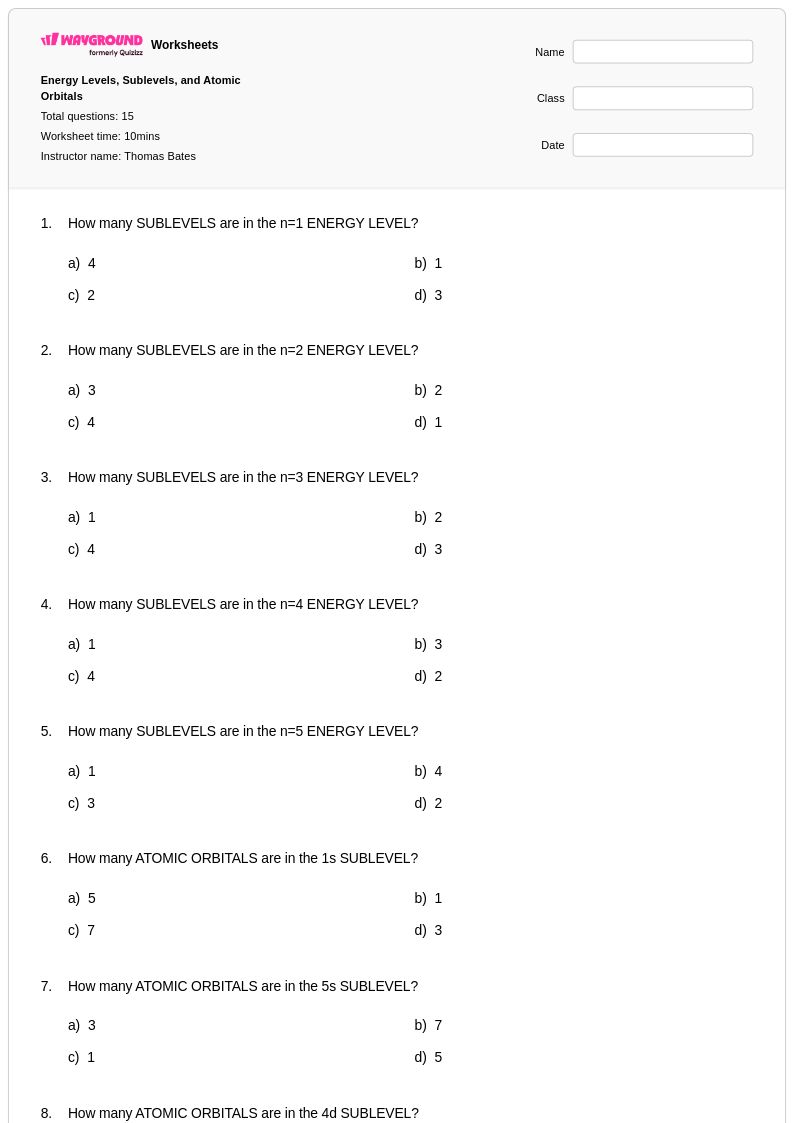
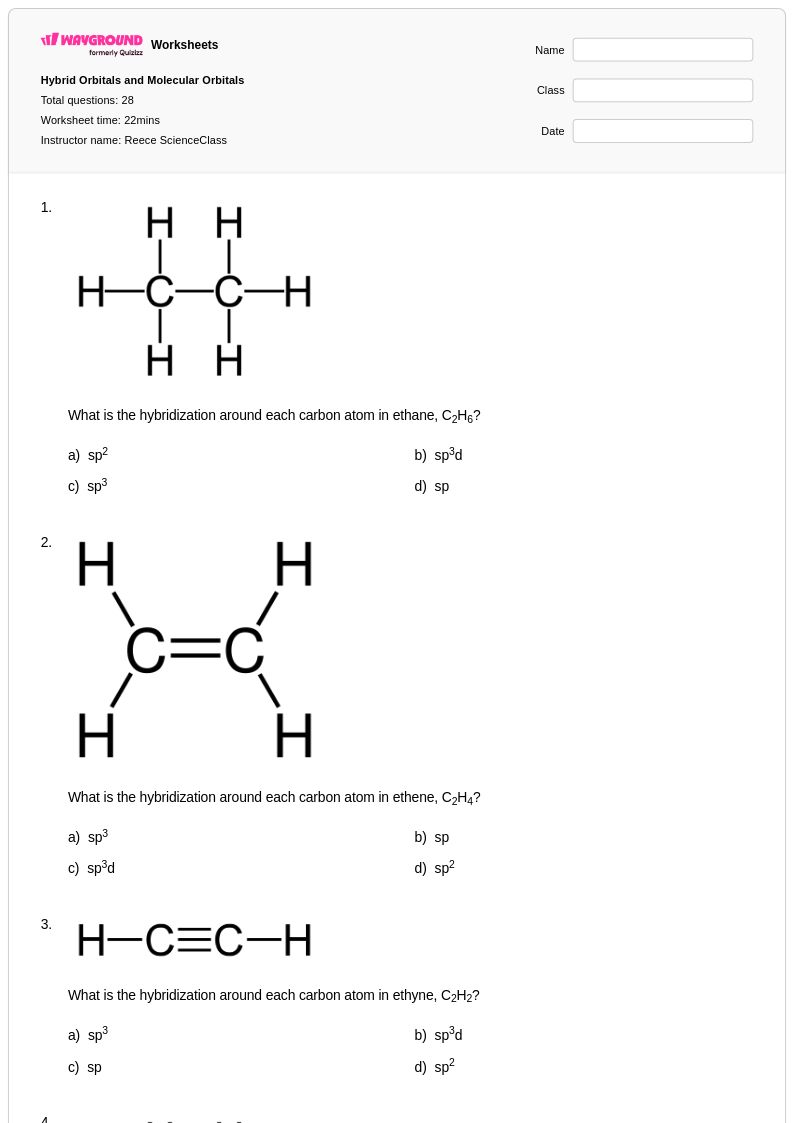
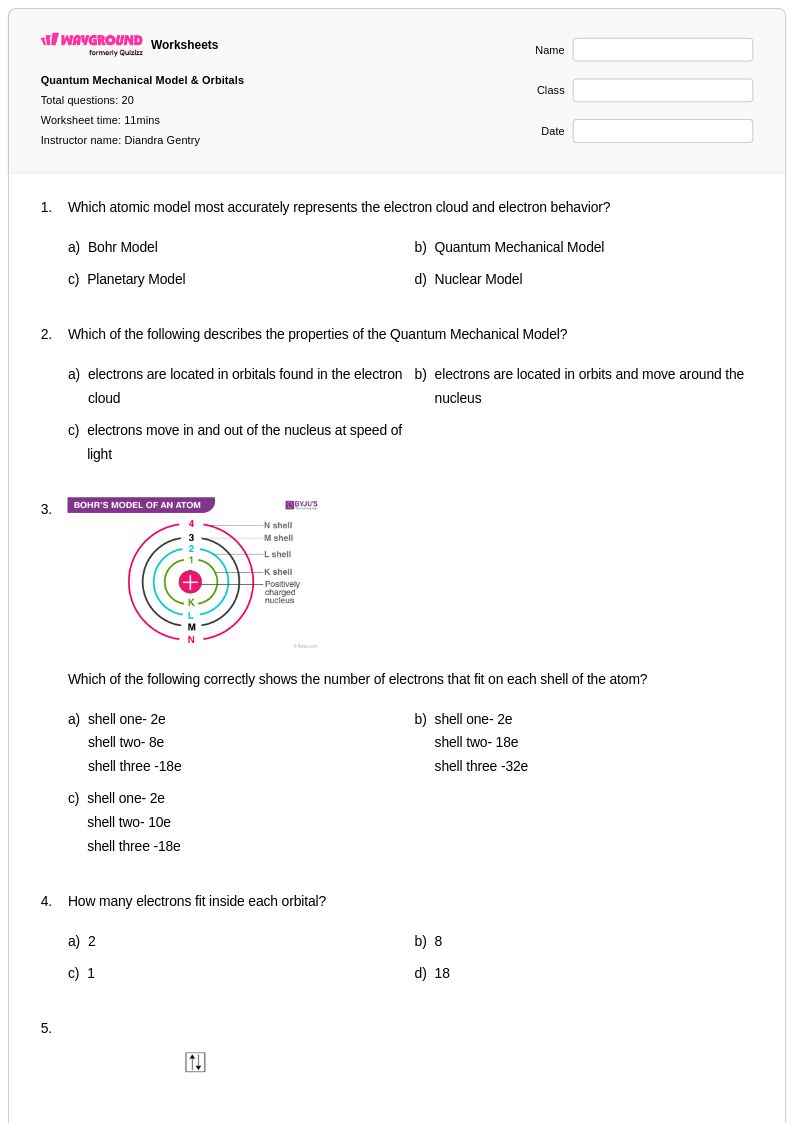
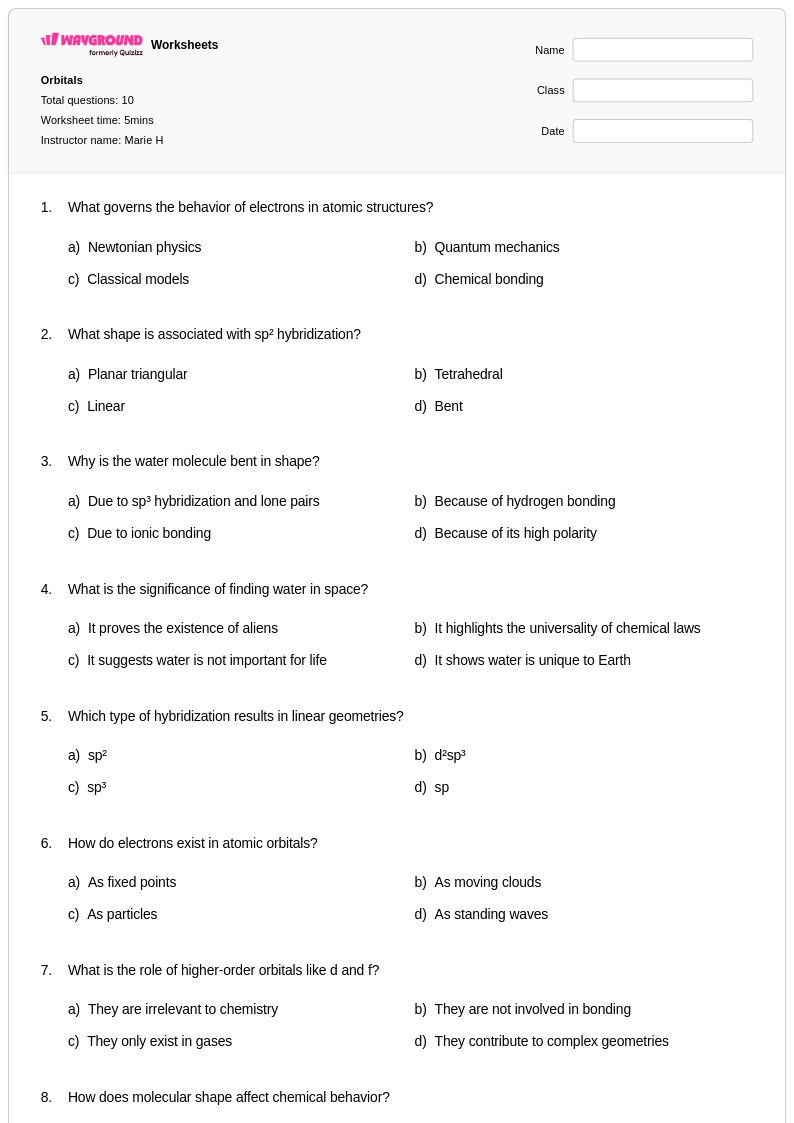
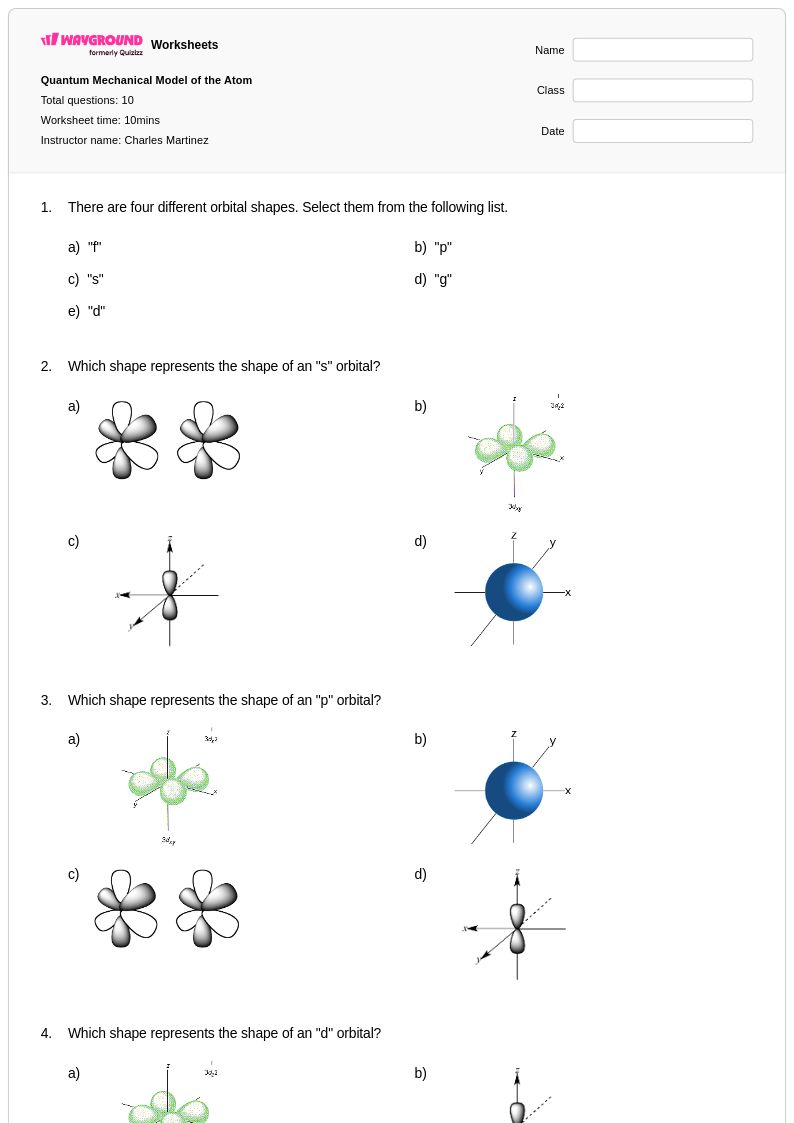
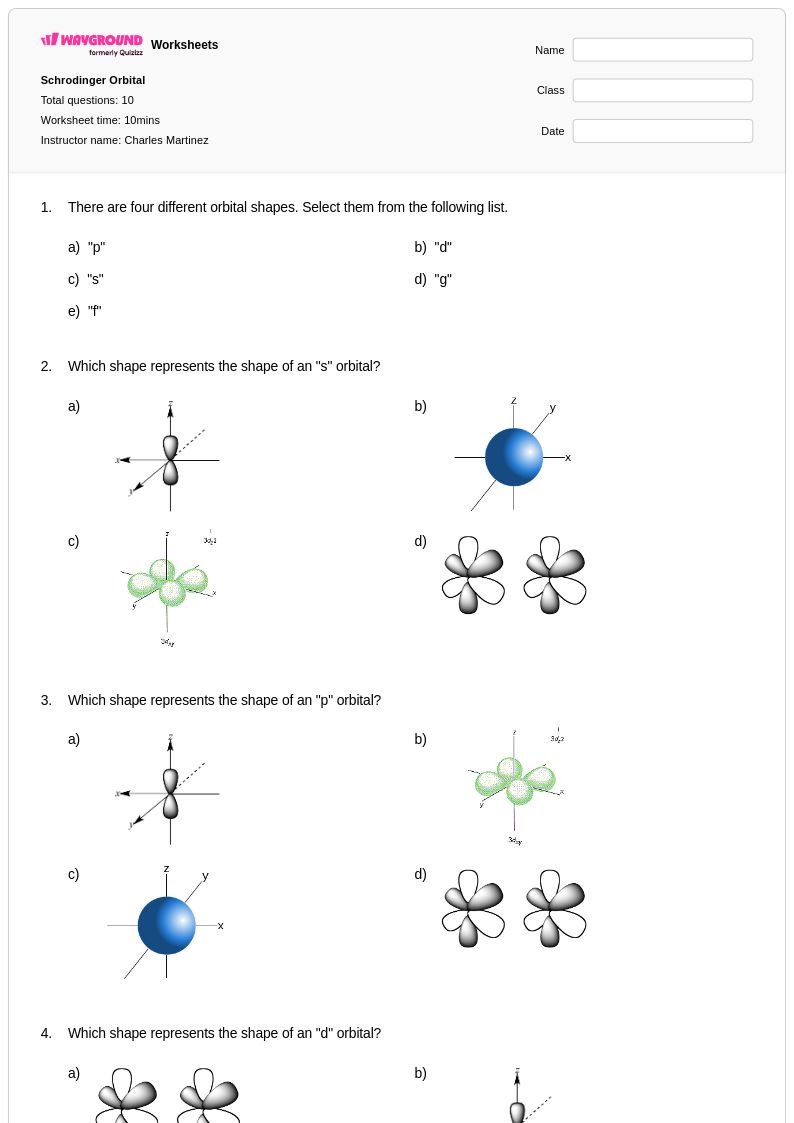
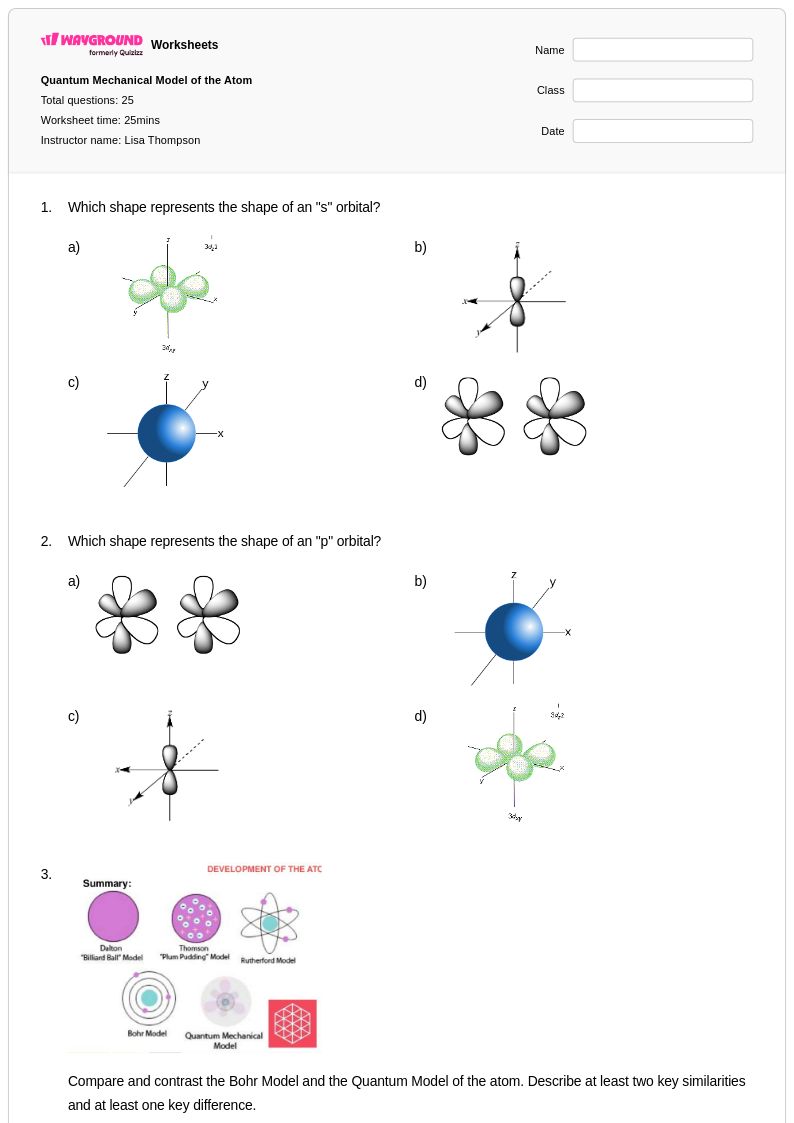
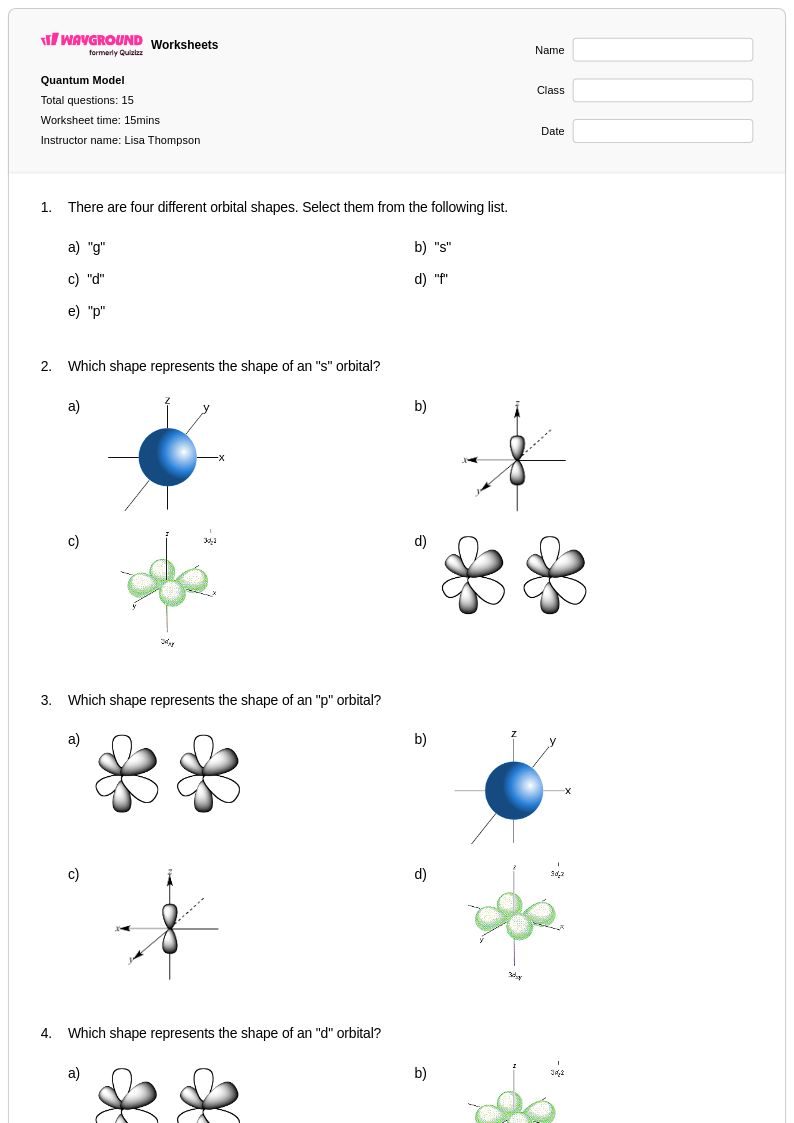
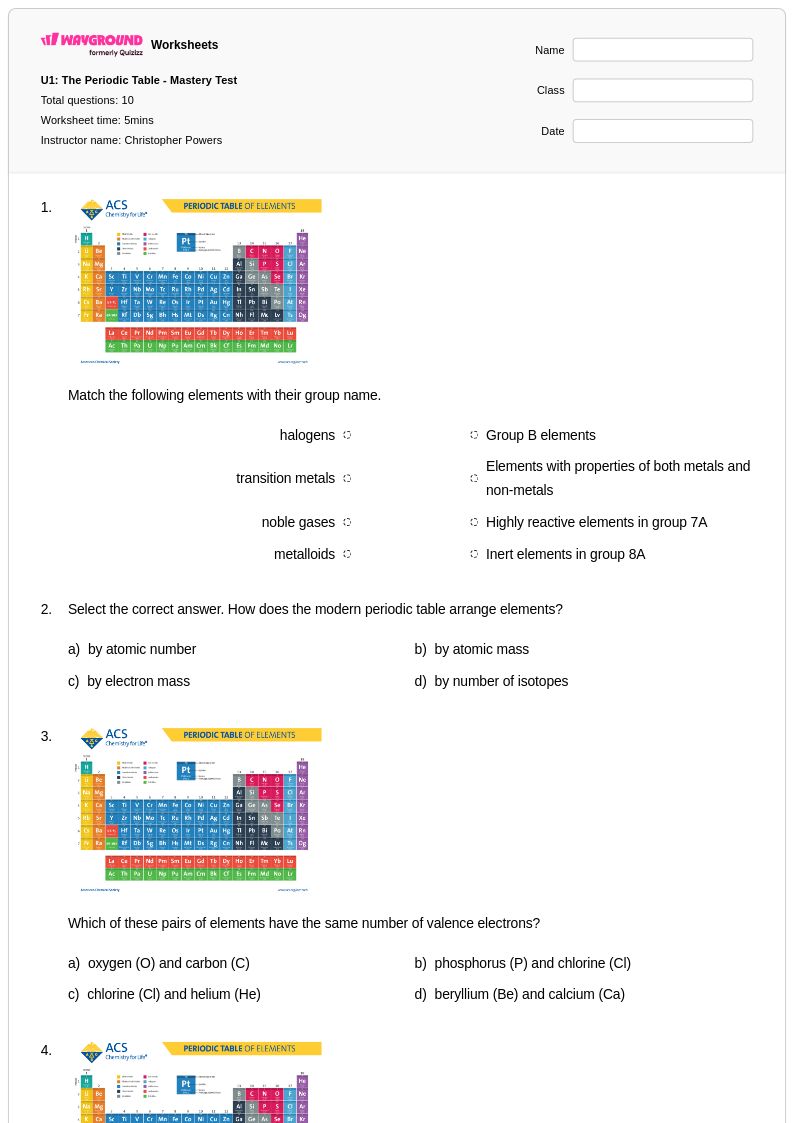
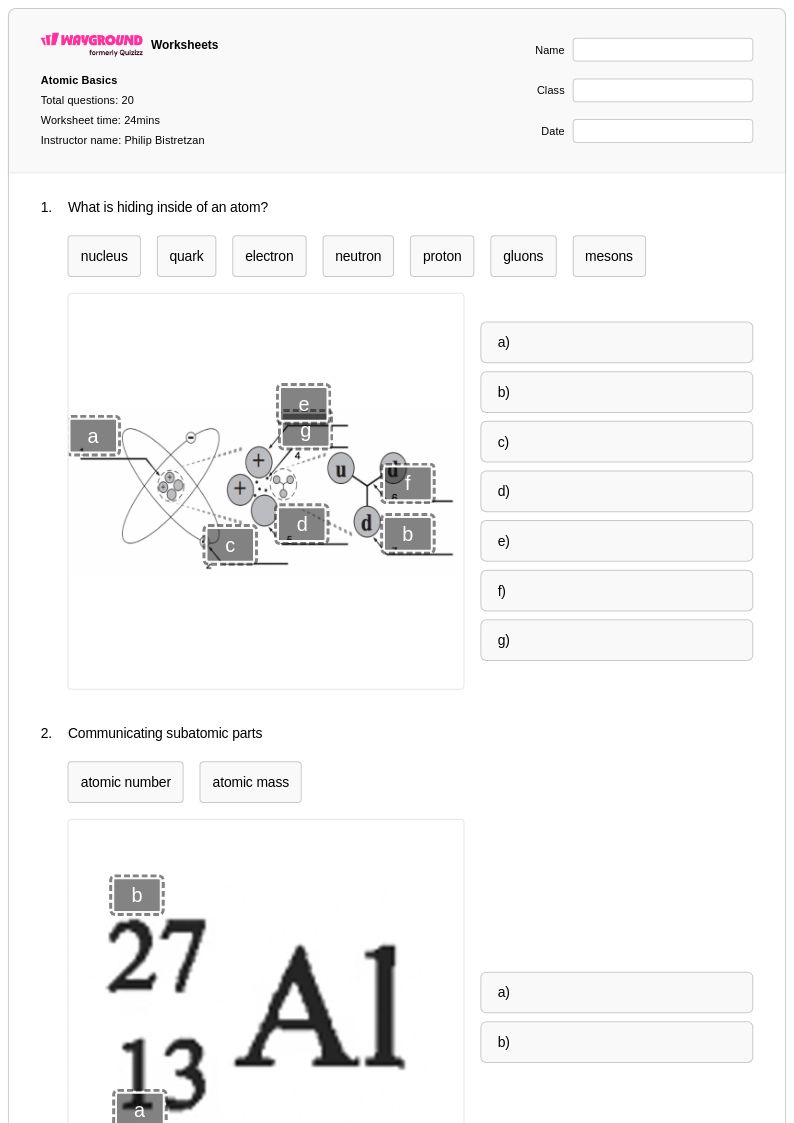
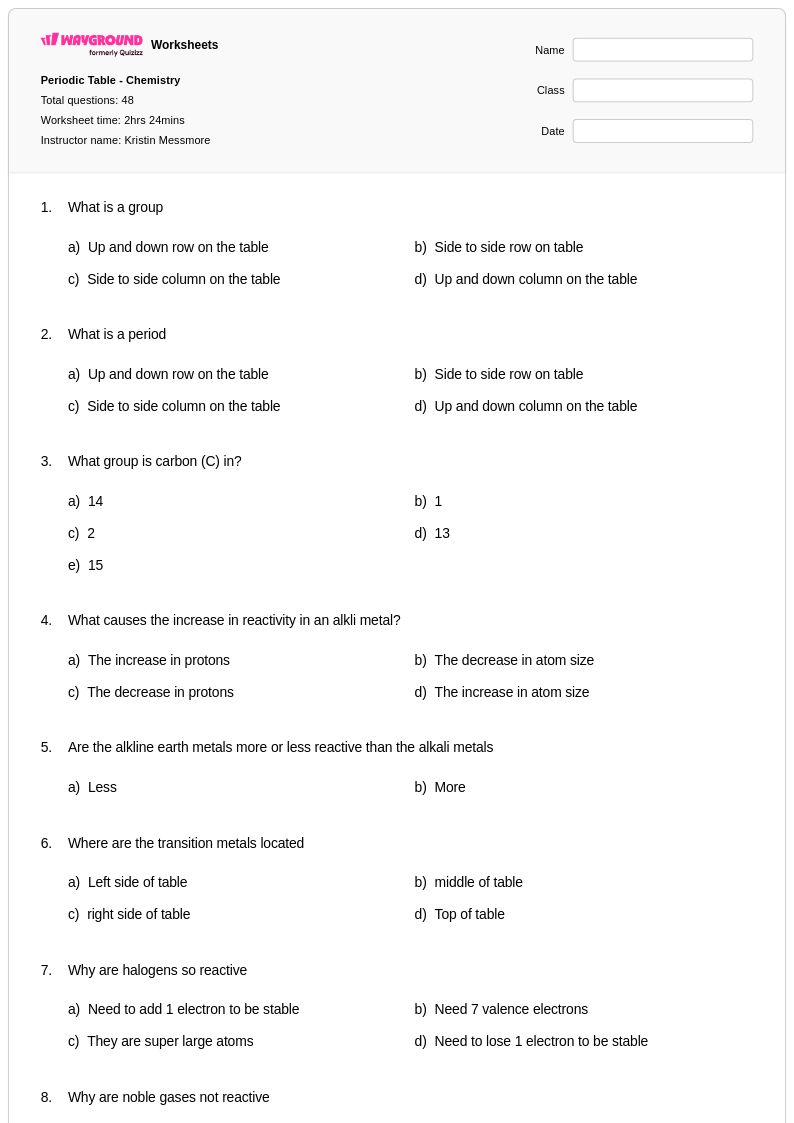
Explore Year 9 orbitals worksheets and printables from Wayground that help students master electron configurations, orbital shapes, and quantum mechanics through engaging practice problems with complete answer keys.
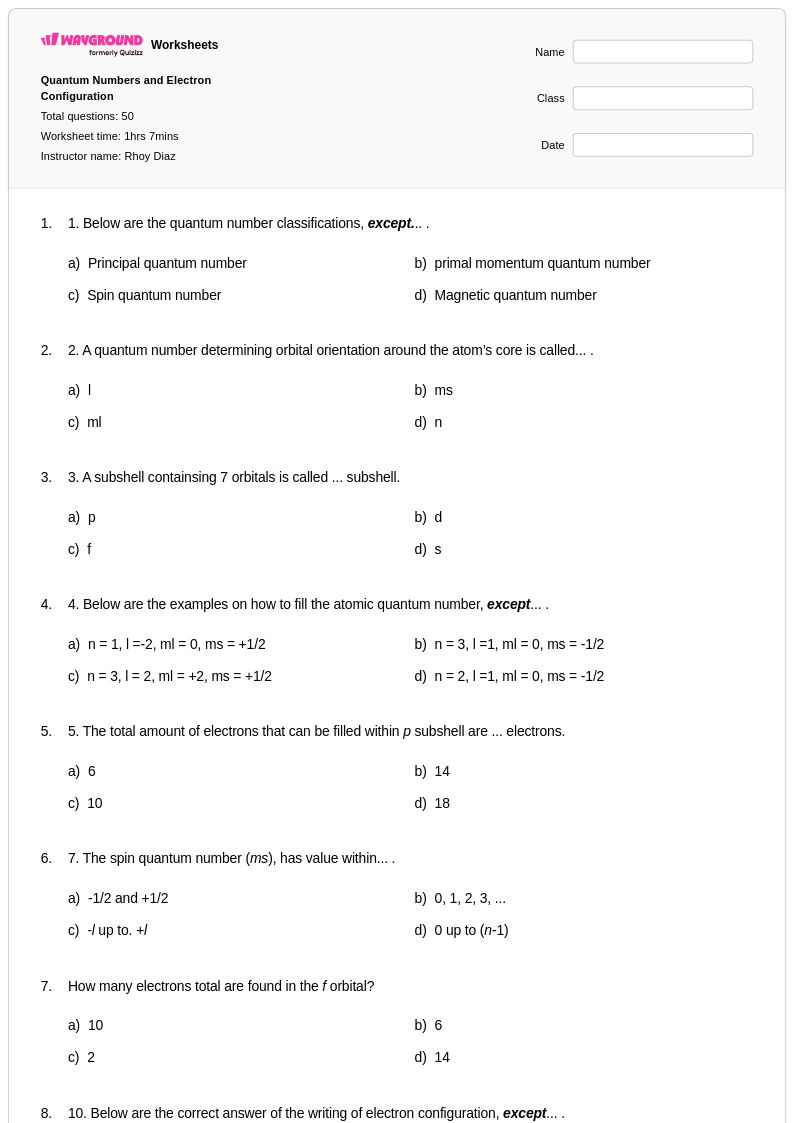
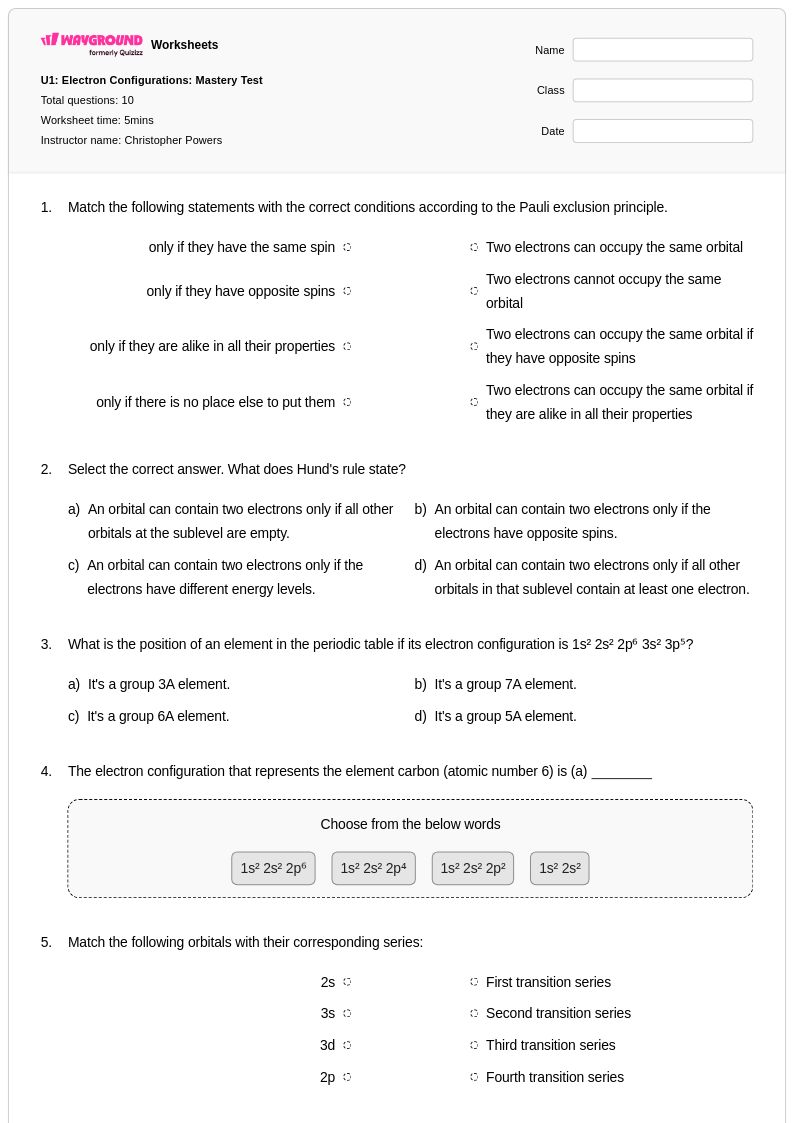
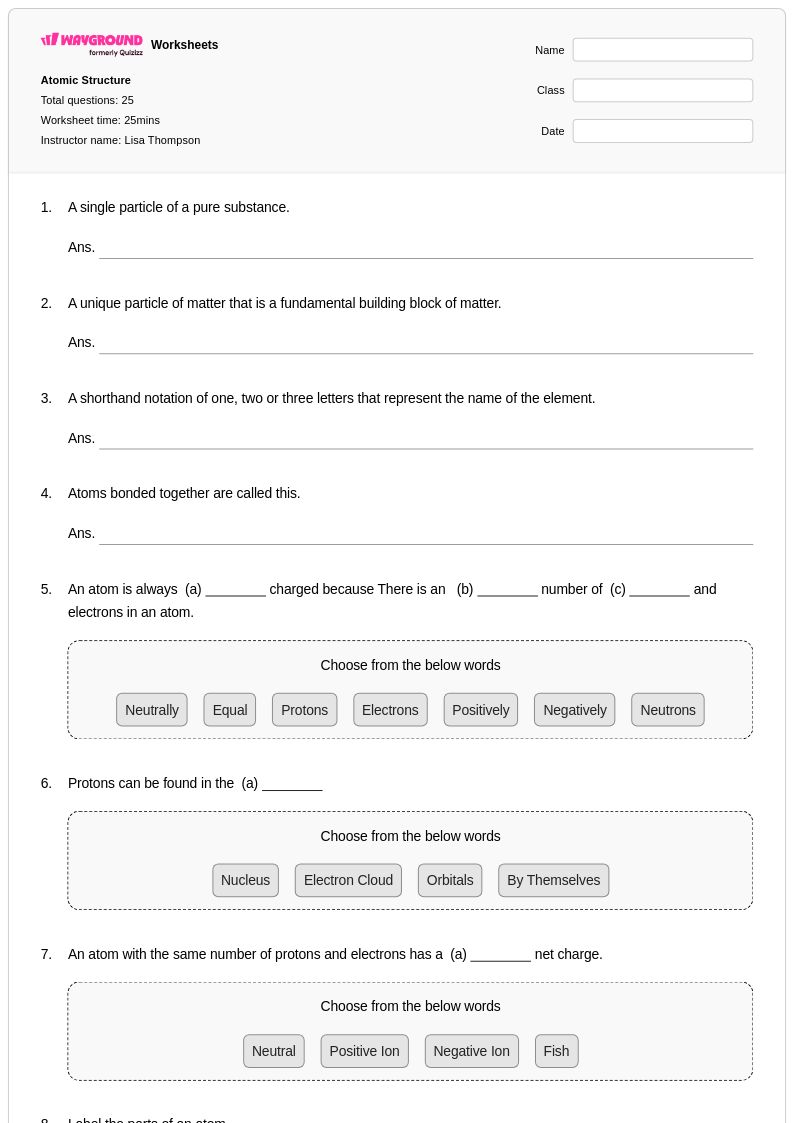
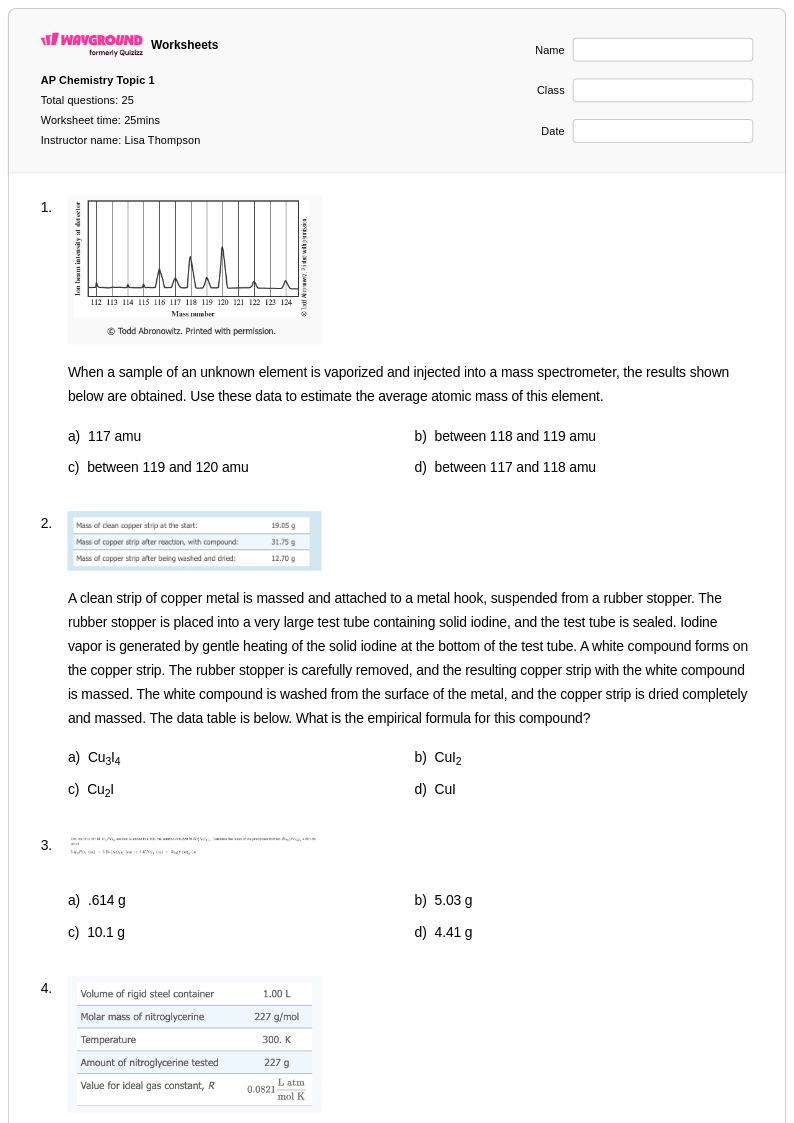
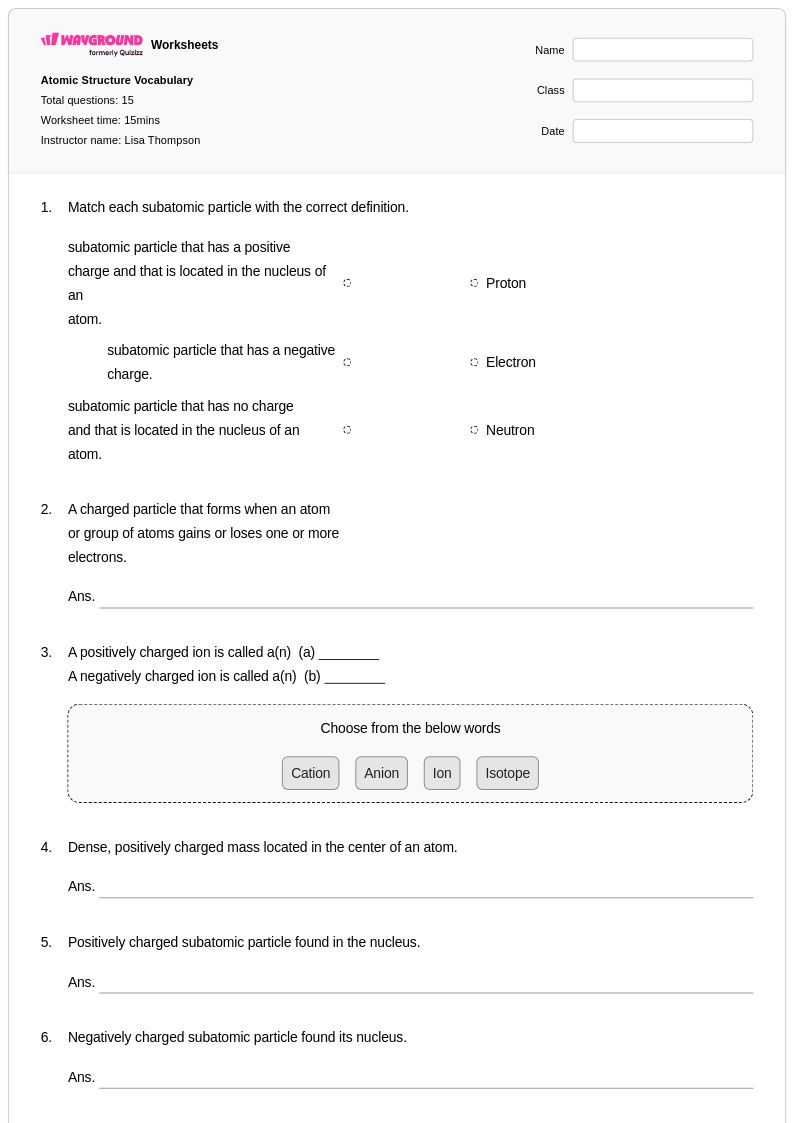
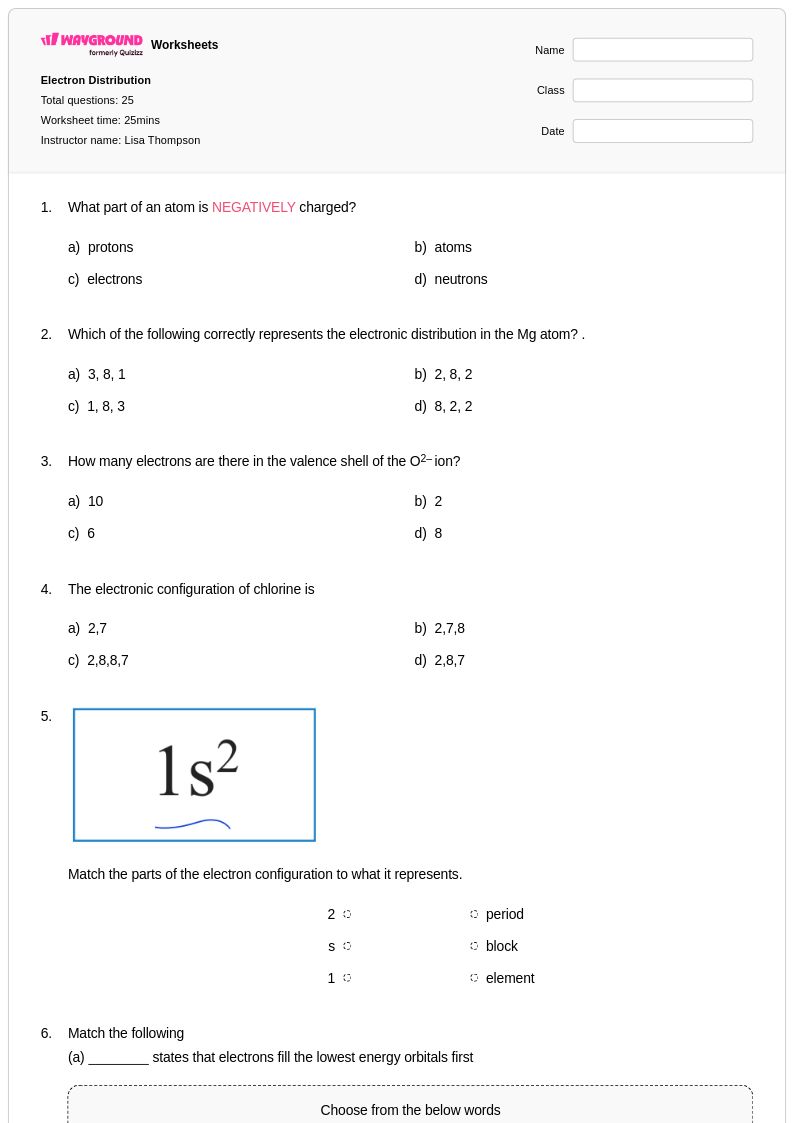
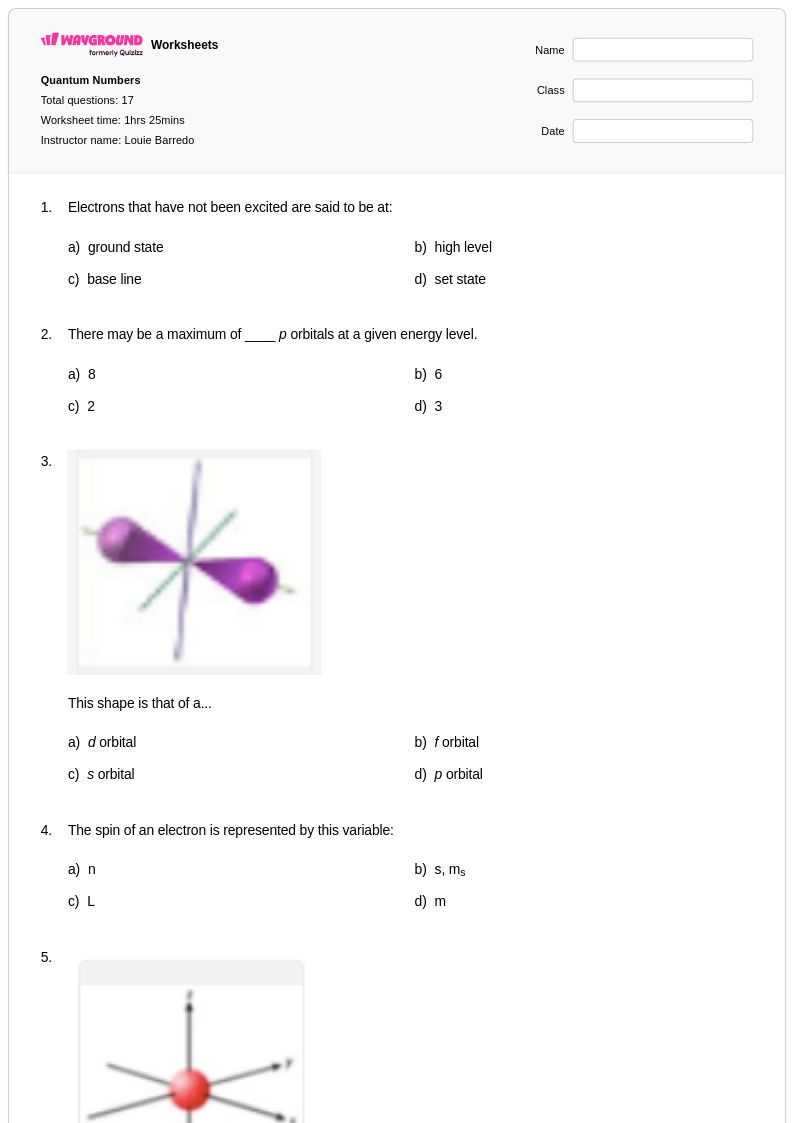
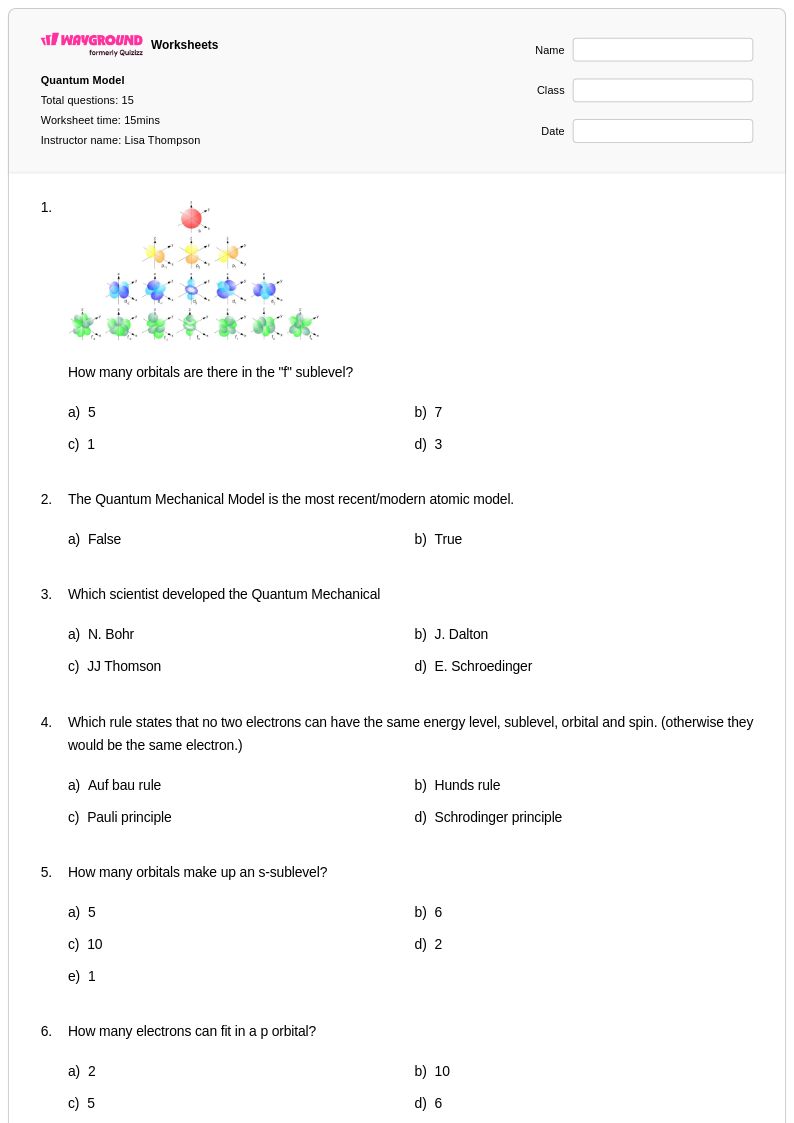
Orbital theory worksheets for Year 9 students available through Wayground (formerly Quizizz) provide comprehensive practice materials that guide students through the fundamental concepts of electron arrangement in atoms. These educational resources systematically introduce students to s, p, d, and f orbitals, helping them visualize three-dimensional electron probability regions and understand how electrons occupy specific energy levels around the nucleus. The worksheets strengthen critical chemistry skills including orbital shape recognition, electron configuration writing, and quantum number assignments through carefully structured practice problems that progress from basic orbital identification to complex multi-electron atom configurations. Students benefit from immediate feedback through integrated answer keys, while teachers appreciate the availability of these resources as free printables in convenient pdf formats that support both classroom instruction and independent study.
Wayground (formerly Quizizz) empowers educators with an extensive collection of millions of teacher-created orbital worksheets that address the diverse learning needs of Year 9 chemistry students. The platform's robust search and filtering capabilities enable teachers to quickly locate materials aligned with specific chemistry standards and learning objectives, while built-in differentiation tools allow for seamless customization based on individual student readiness levels and learning preferences. These orbital worksheet collections are available in both printable and digital formats, including downloadable pdfs, making them versatile resources for traditional classroom settings, hybrid learning environments, and remote instruction scenarios. Teachers leverage these comprehensive materials for lesson planning, targeted remediation of misconceptions about electron behavior, enrichment activities for advanced learners, and ongoing skill practice that reinforces orbital theory concepts throughout the academic year.
FAQs
How do I teach atomic orbitals to chemistry students?
Start by grounding students in the Bohr model before transitioning to the quantum mechanical model, emphasizing that orbitals represent probability regions rather than fixed electron paths. Use visual aids to contrast the spherical shape of s orbitals with the dumbbell shape of p orbitals and the more complex geometries of d and f orbitals. Connecting orbital shapes to electron configuration rules — Aufbau principle, Hund's rule, and the Pauli exclusion principle — helps students build a coherent mental framework before moving into hybridization and bonding theory.
What are the most common mistakes students make when learning about orbitals?
One of the most frequent errors is confusing orbitals with orbits, leading students to treat electrons as particles following defined circular paths rather than existing in probabilistic regions of space. Students also commonly misapply Hund's rule by pairing electrons in the same subshell before filling each orbital singly. A third persistent misconception is treating orbital hybridization as a physical transformation rather than a mathematical model used to explain observed molecular geometries.
What practice problems help students master electron configuration and orbital notation?
Effective practice should progress from writing ground-state electron configurations for main-group elements to drawing orbital box diagrams that require applying Hund's rule and the Pauli exclusion principle simultaneously. Students benefit from problems that require identifying valence electrons from configurations and predicting ion configurations by adding or removing electrons. Including exceptions like chromium and copper in practice sets is important for preparing students to handle the nuances of d-orbital filling.
How can I help students visualize the three-dimensional shapes of atomic orbitals?
Three-dimensional orbital shapes are notoriously difficult for students to internalize from two-dimensional diagrams alone, so pairing worksheet practice with physical models or interactive molecular visualization software is highly effective. When using worksheets, ask students to label the nodal planes of p orbitals and the lobes of d orbitals explicitly, which forces active engagement with spatial geometry rather than passive copying. Connecting orbital shape to bonding outcomes — such as why p orbital overlap produces pi bonds — gives the geometry functional meaning that aids retention.
How do I use orbitals worksheets from Wayground in my chemistry class?
Wayground's orbitals worksheets are available as printable PDFs, making them easy to distribute for in-class practice, homework, or exam review, and they are also available in digital formats suited for technology-integrated classrooms. You can host any worksheet directly as a quiz on Wayground, enabling real-time student responses and immediate feedback without additional setup. Each worksheet includes a complete answer key, so teachers can use them for self-paced independent study or assign them as formative checks before moving into hybridization and molecular orbital theory.
How do I differentiate orbitals instruction for students at different proficiency levels?
For students still building foundational understanding, focus practice on s and p orbital shapes, basic electron configuration, and reading orbital diagrams before introducing d and f subshells. Advanced students can be challenged with molecular orbital theory, orbital overlap diagrams, and hybridization problems involving sp3d and sp3d2 geometries. On Wayground, teachers can customize existing worksheets to adjust problem complexity and apply accommodations such as reduced answer choices or read-aloud support for individual students who need additional scaffolding.