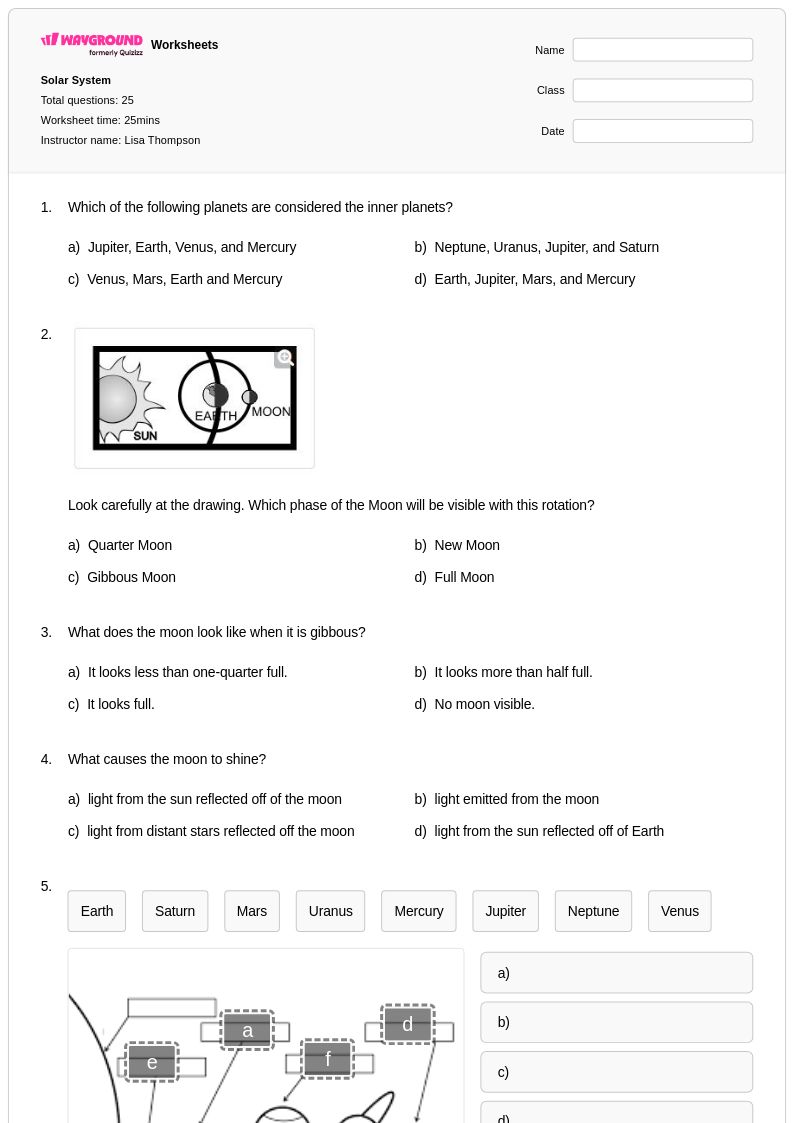
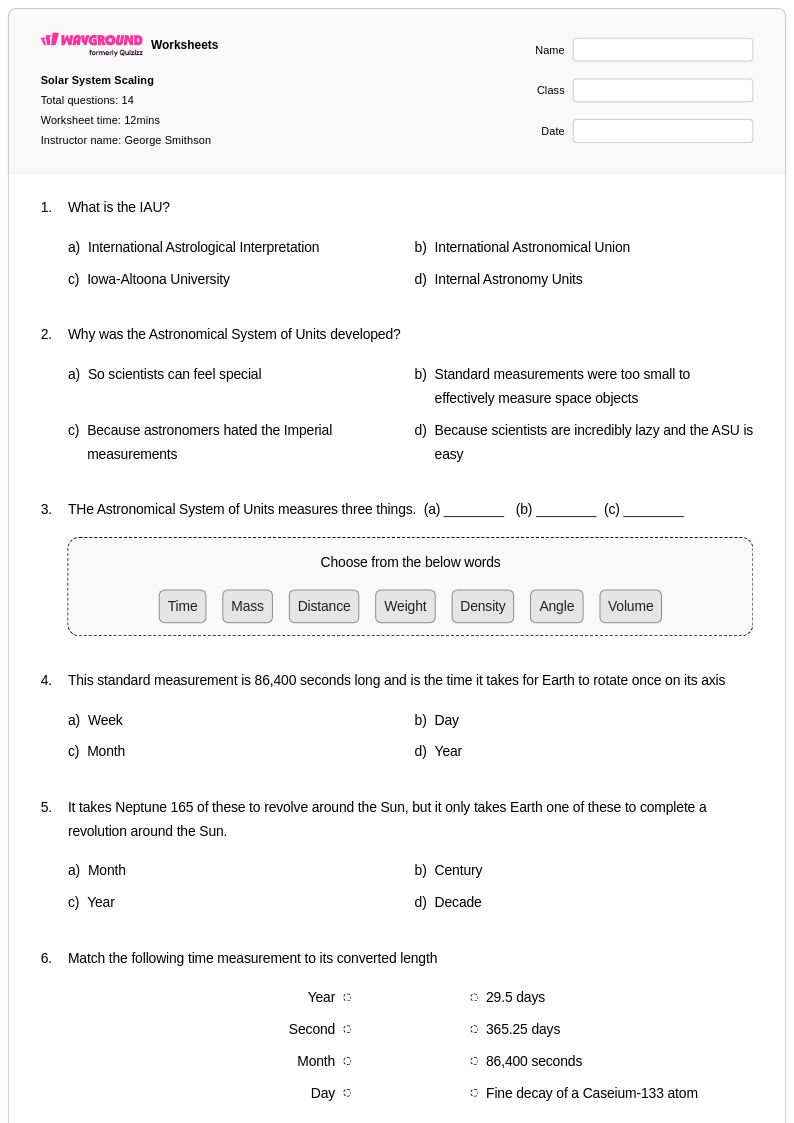
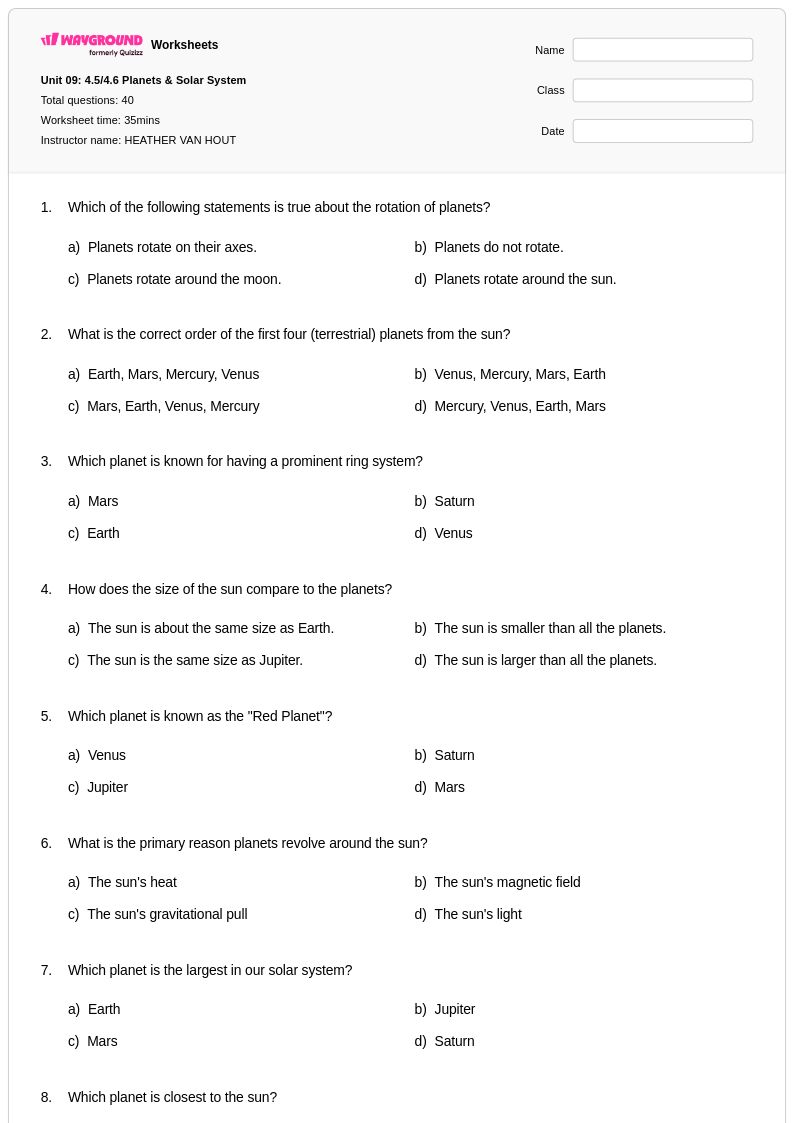
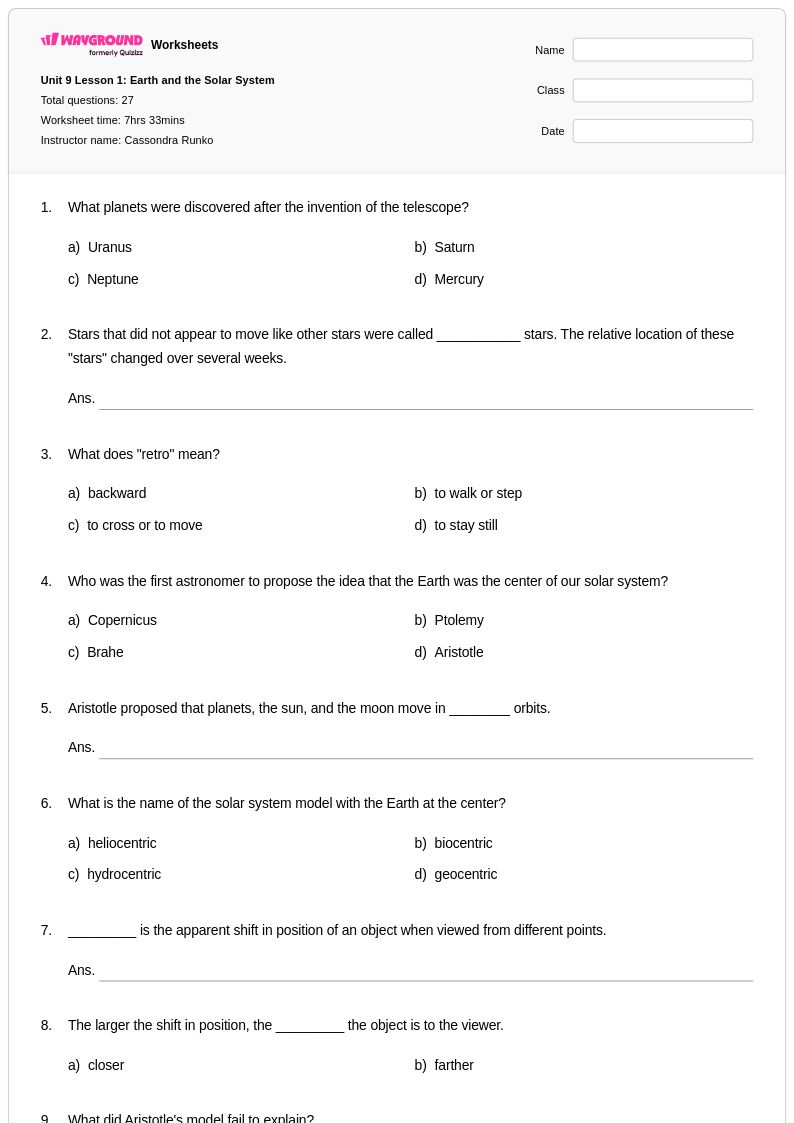
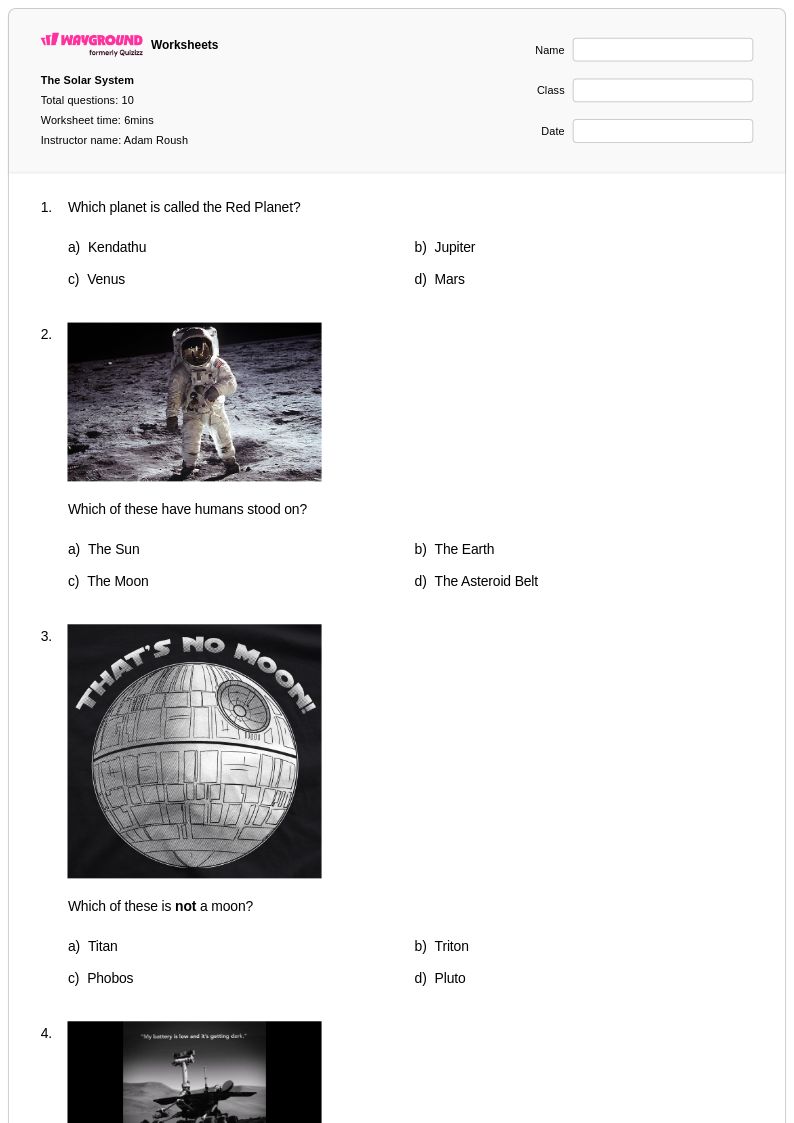
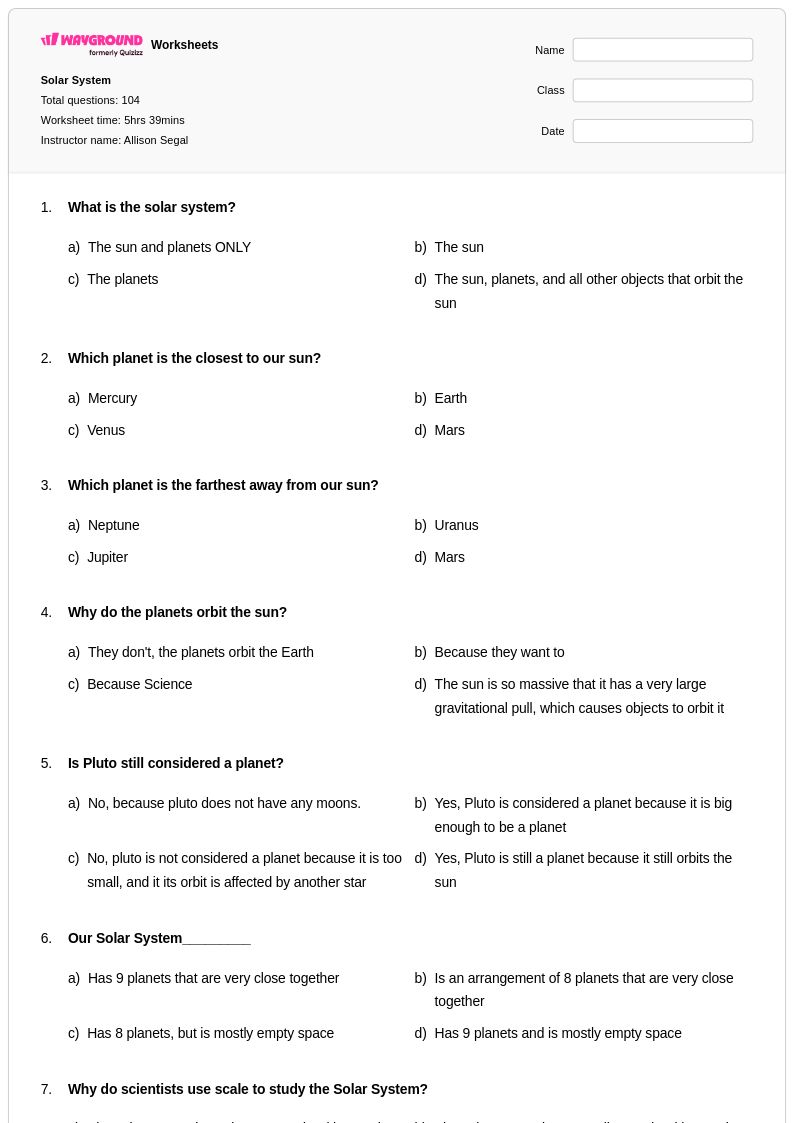
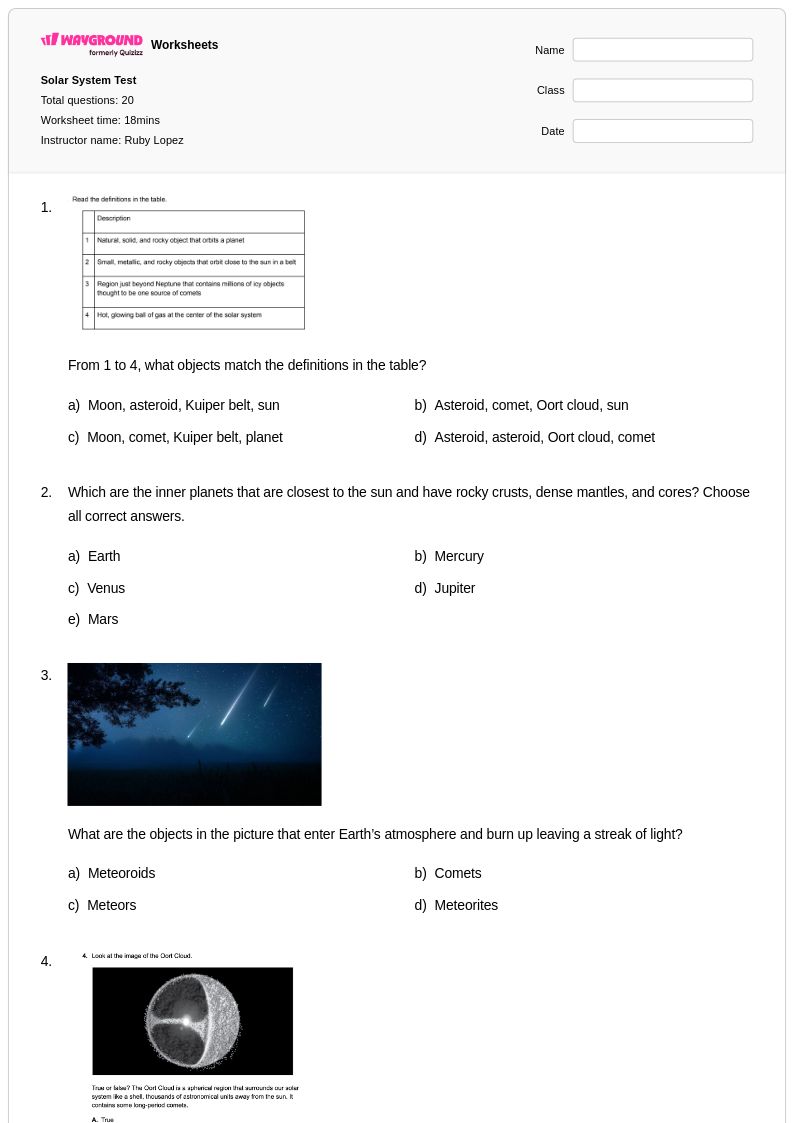
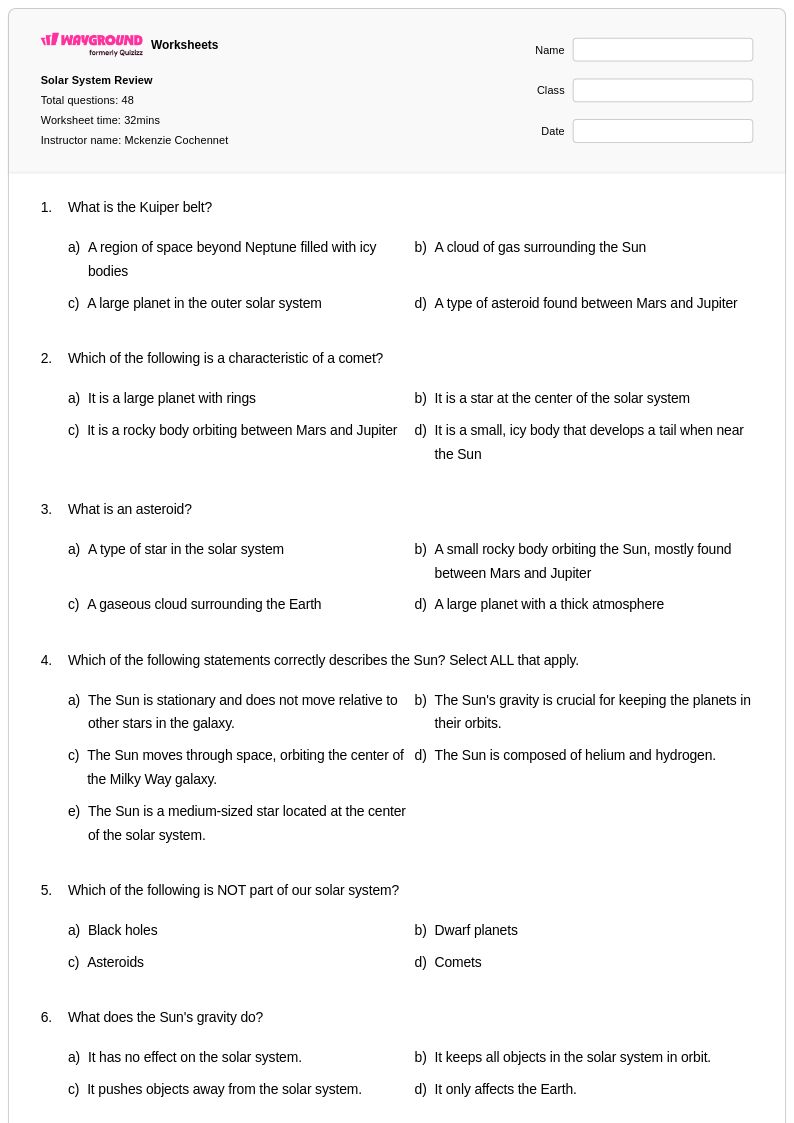
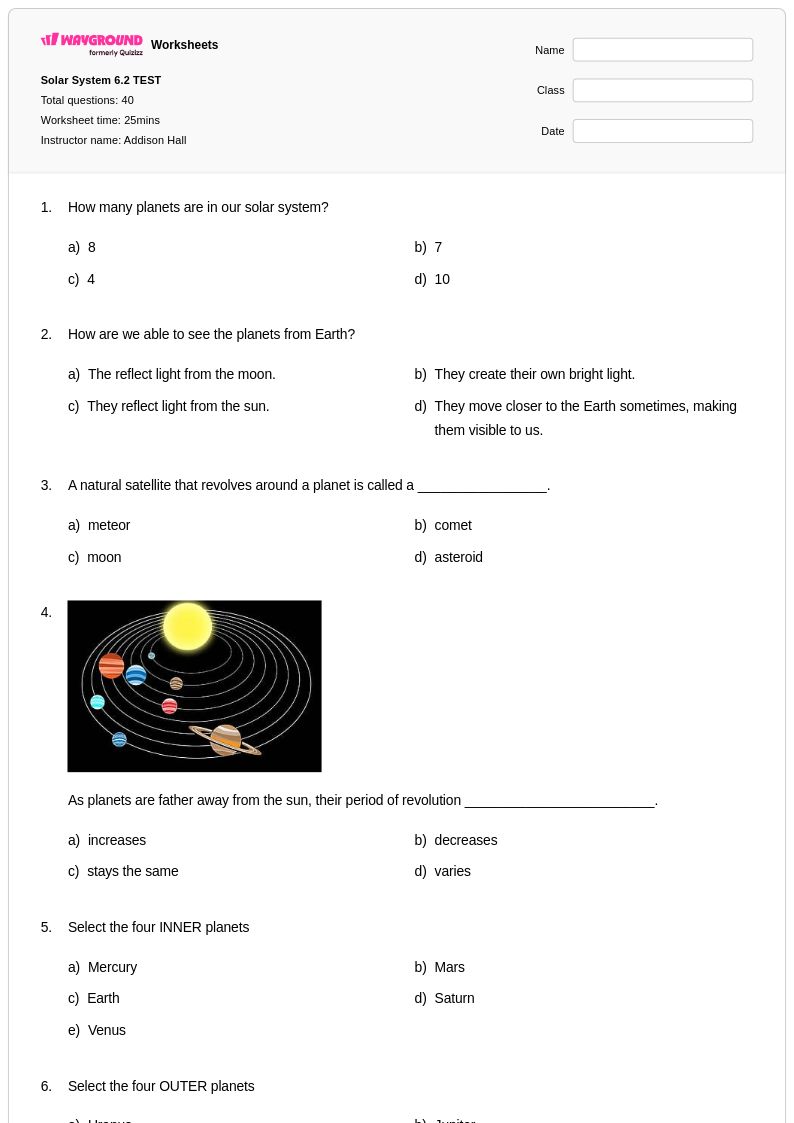
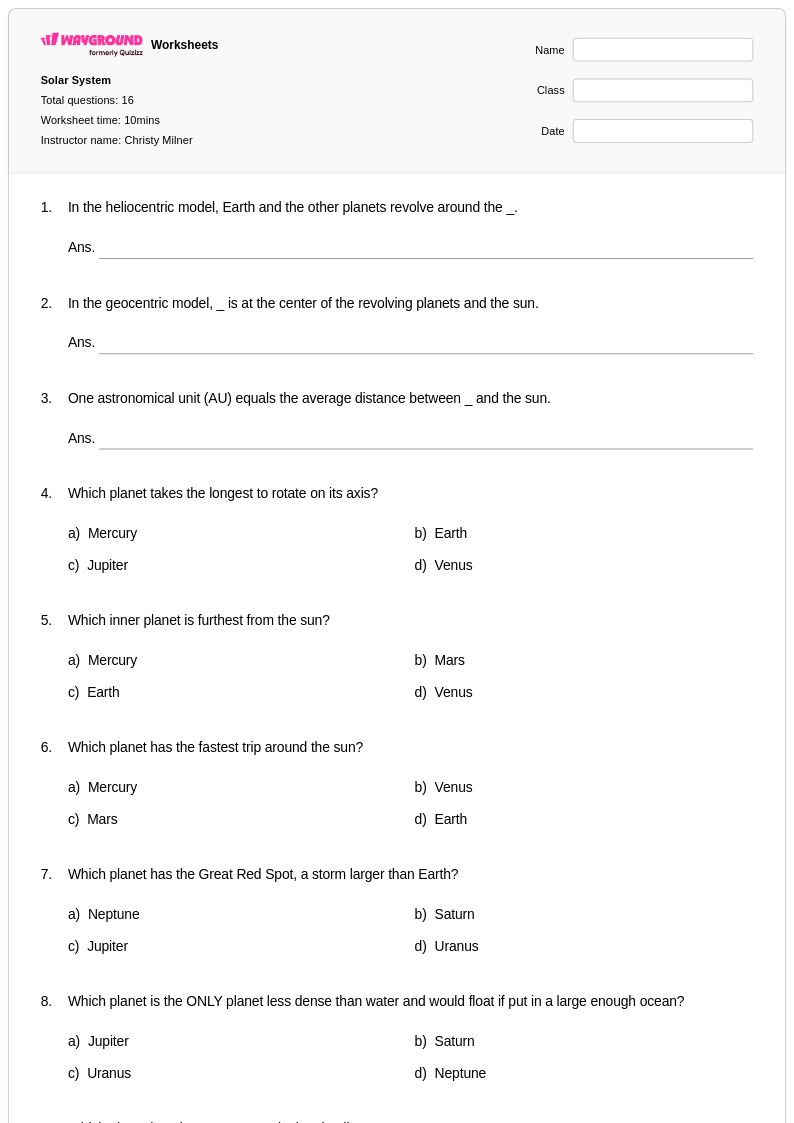
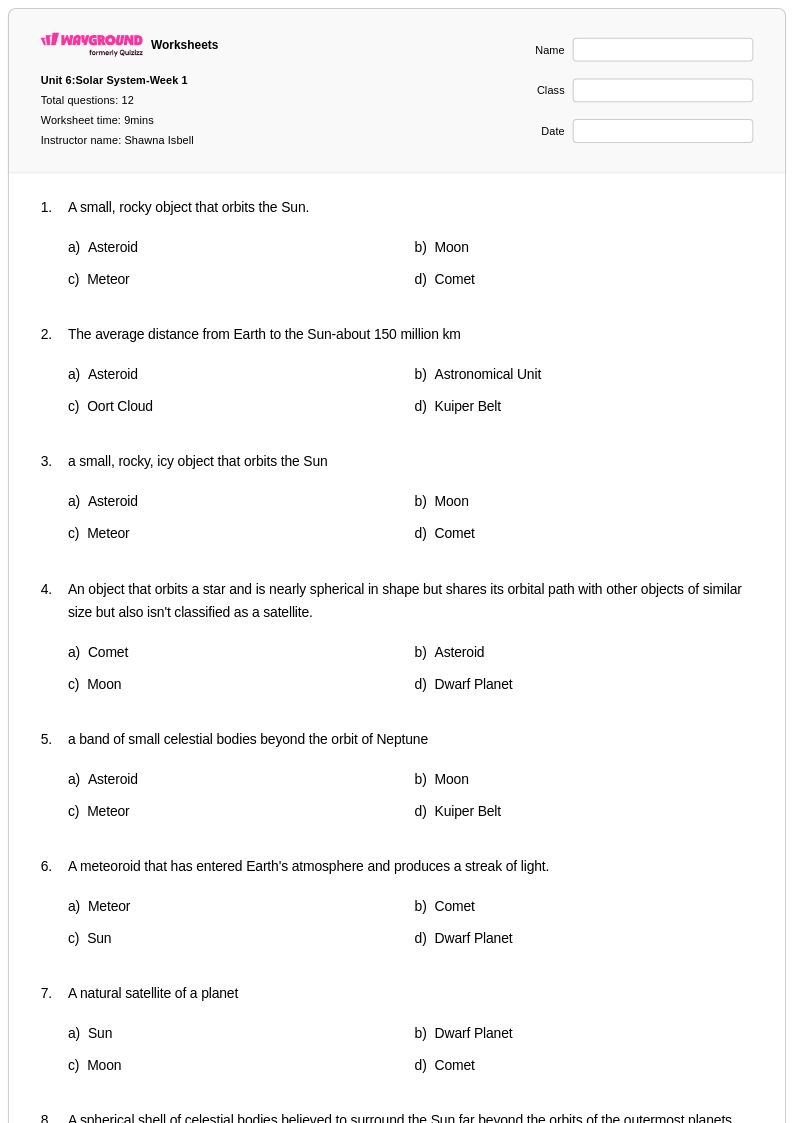
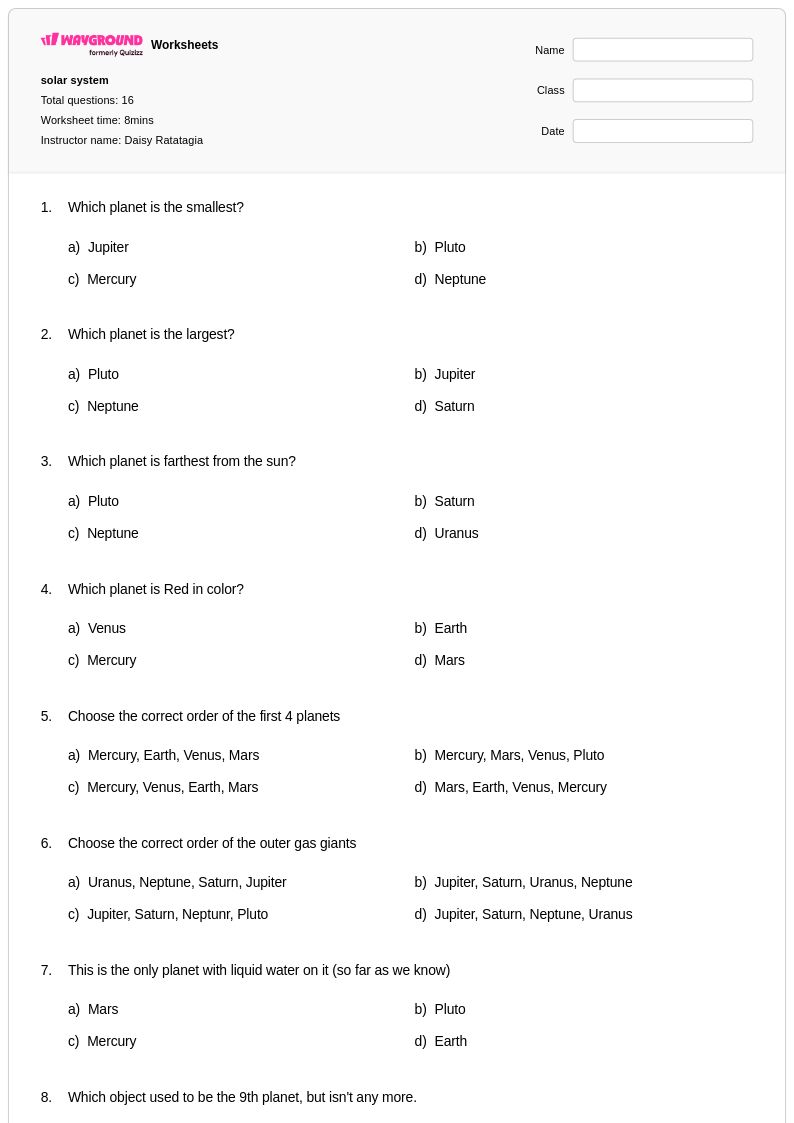
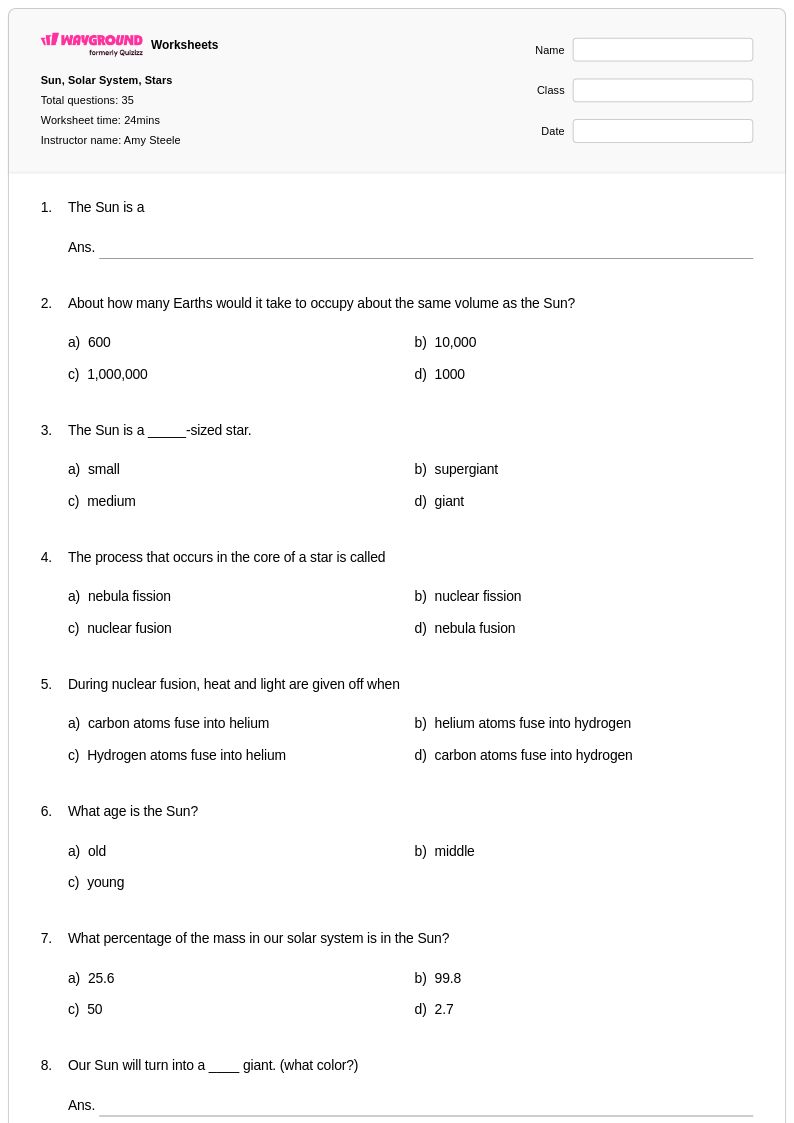
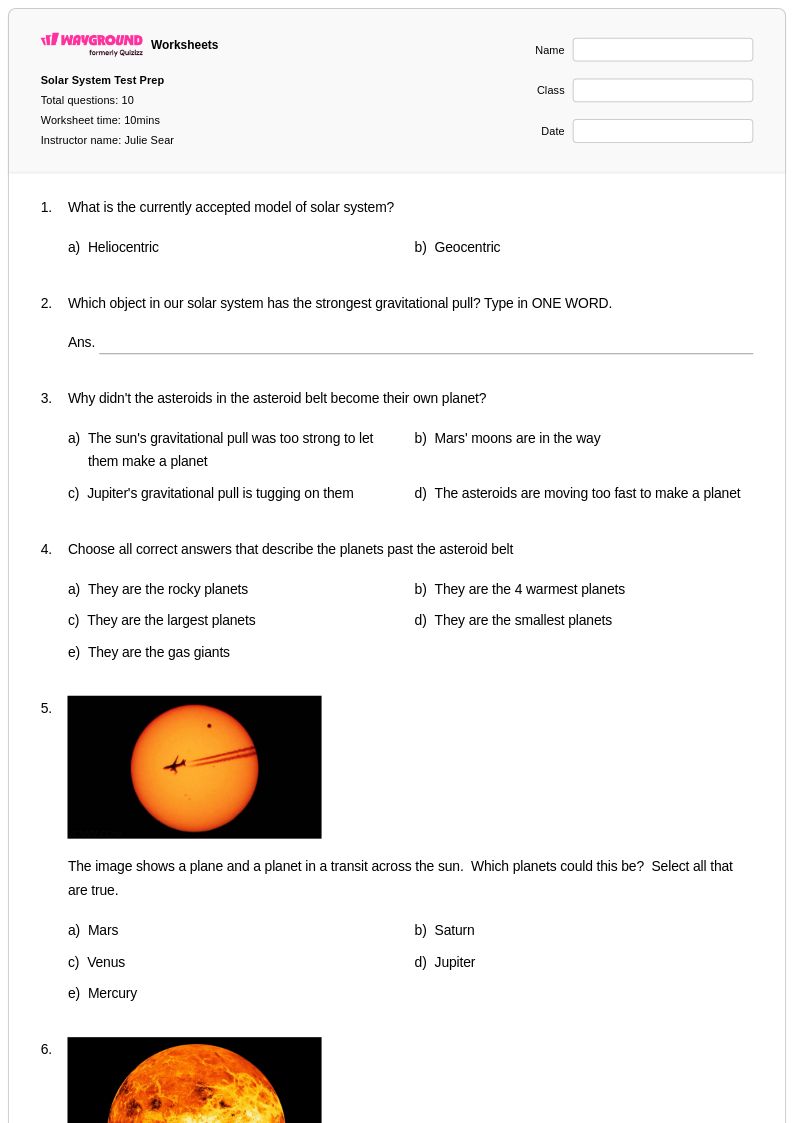
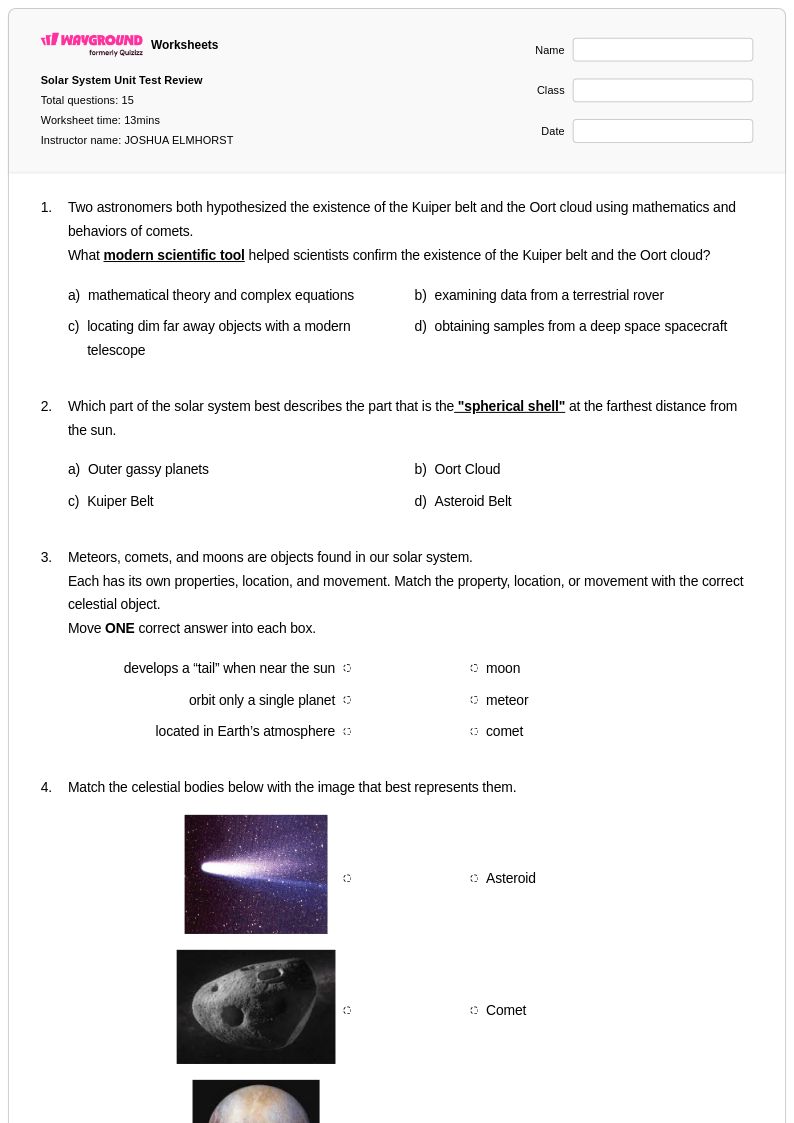
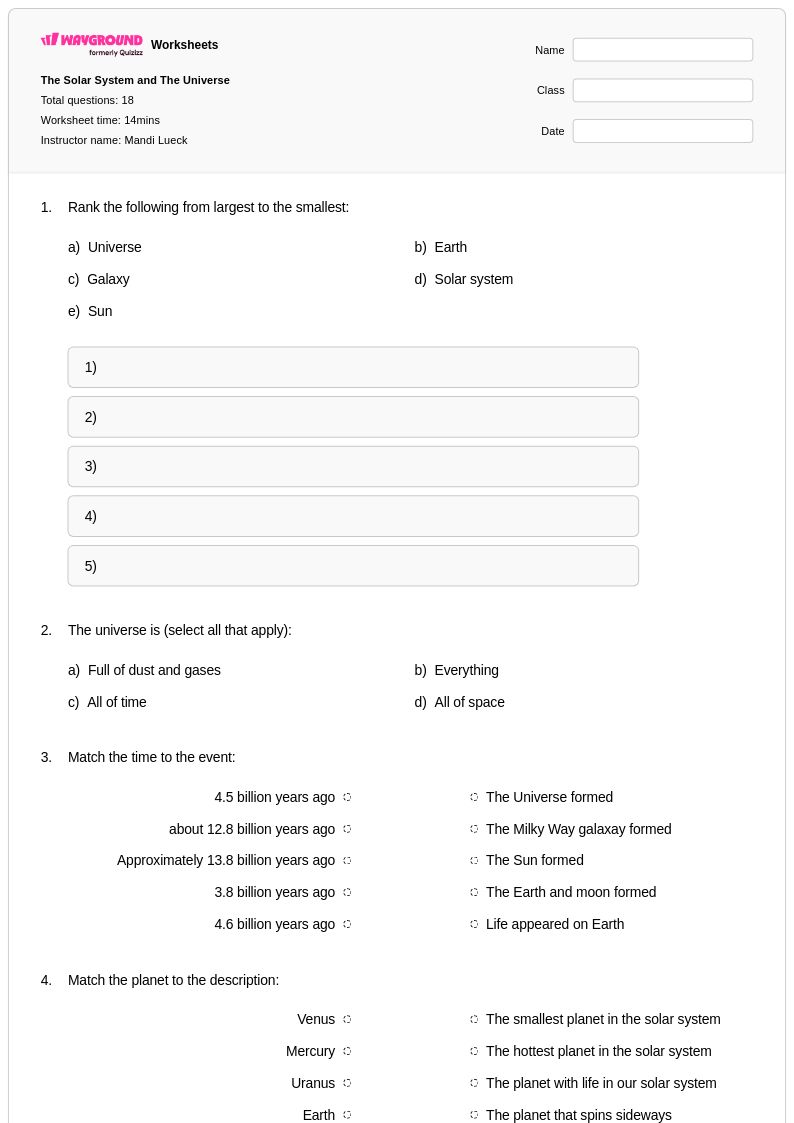
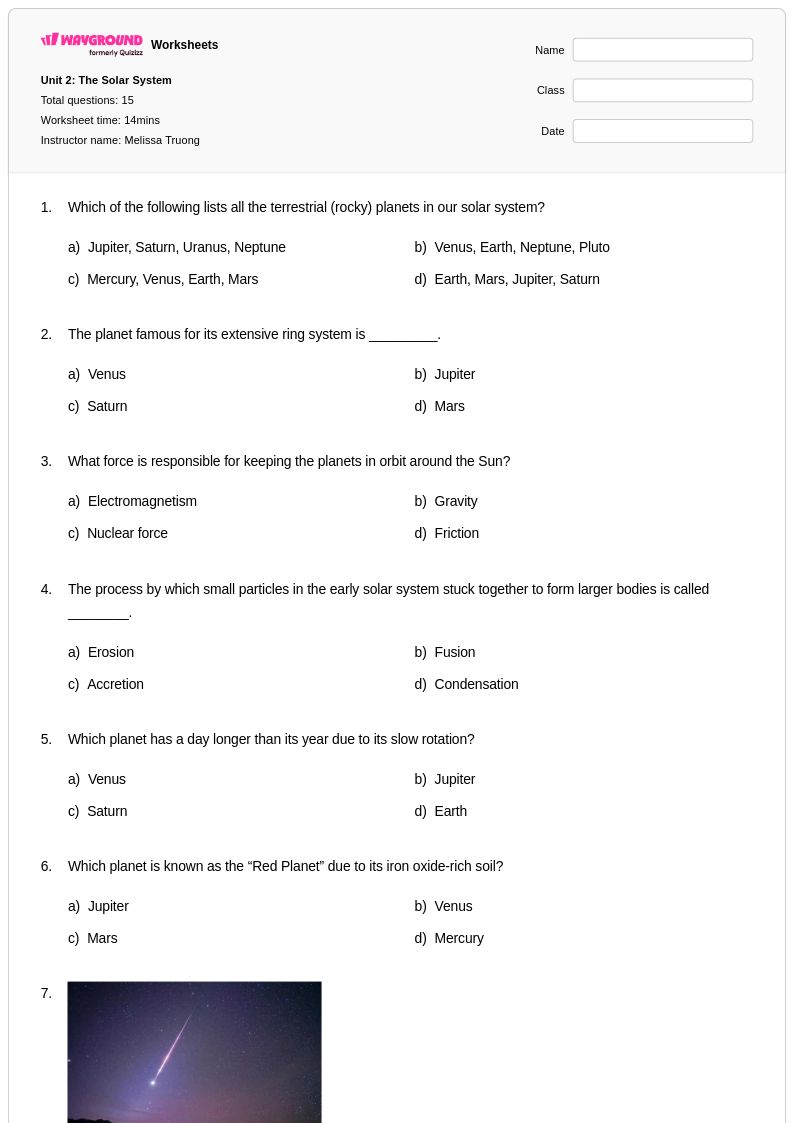
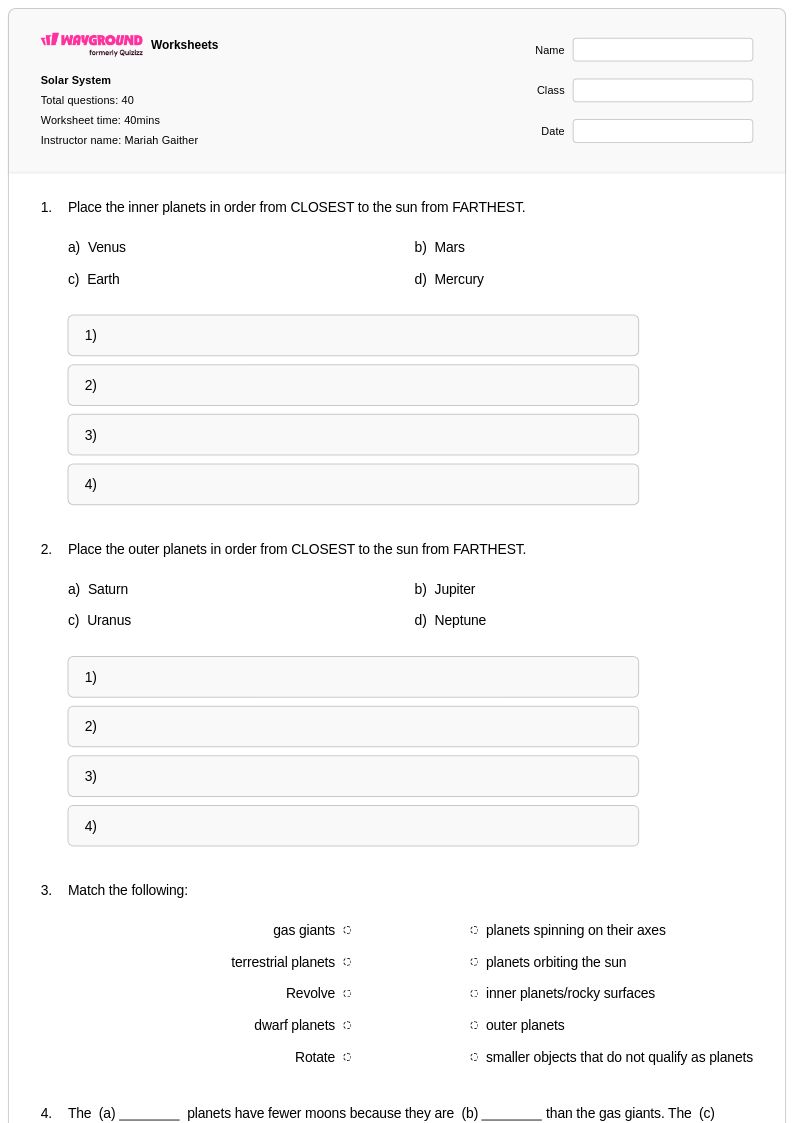
Year 7 Solar System worksheets and printables help students explore planets, moons, and celestial bodies through engaging practice problems with comprehensive answer keys available as free PDF downloads.
Explore printable Solar System worksheets for Year 7
Solar System worksheets for Year 7 students available through Wayground (formerly Quizizz) provide comprehensive coverage of our planetary neighborhood and the celestial bodies that comprise it. These educational resources strengthen students' understanding of planetary characteristics, orbital mechanics, gravitational forces, and the scale relationships within our solar system. The worksheet collection includes practice problems that challenge seventh graders to analyze planetary data, compare and contrast different celestial bodies, and explore concepts such as asteroid belts, moon phases, and the formation of our solar system. Each printable resource comes with a corresponding answer key, making it easy for educators to facilitate independent learning and provide immediate feedback. These free materials support students in developing critical thinking skills about space science while building foundational knowledge about Earth's place in the broader cosmic context through engaging pdf worksheets and interactive printables.
Wayground (formerly Quizizz) empowers educators with access to millions of teacher-created Solar System resources that can be seamlessly integrated into Year 7 Earth and Space Science instruction. The platform's robust search and filtering capabilities allow teachers to quickly locate materials that align with specific curriculum standards and learning objectives, whether focusing on inner planets, outer planets, or comparative planetology. Teachers benefit from sophisticated differentiation tools that enable customization of worksheet difficulty levels to meet diverse student needs, supporting both remediation for struggling learners and enrichment opportunities for advanced students. The flexible format options, including both printable pdf versions and digital interactive worksheets, accommodate various classroom environments and teaching preferences. These comprehensive tools streamline lesson planning while providing educators with reliable resources for skill practice, formative assessment, and reinforcement of key Solar System concepts that prepare students for more advanced astronomy studies.
FAQs
How do I teach the solar system to elementary and middle school students?
Teaching the solar system effectively starts with anchoring students to scale and relative distance, since most students dramatically underestimate how vast space actually is. Using visual models, ordered planet mnemonics, and comparative size activities helps make abstract astronomical relationships concrete. From there, layering in planetary characteristics like composition, atmosphere, and orbital mechanics builds a more complete conceptual picture. Connecting these concepts to real space exploration missions gives students meaningful context for why planetary science matters.
What exercises help students practice identifying planets and their characteristics?
Effective practice exercises include labeling diagrams of the solar system in order from the sun, matching planets to their key characteristics such as number of moons, ring systems, or atmospheric composition, and completing compare-and-contrast tasks between terrestrial and gas giant planets. Fill-in-the-blank passages about orbital mechanics and scale relationships reinforce vocabulary alongside conceptual understanding. Repeated low-stakes practice with these formats builds both recall and the ability to reason about planetary science questions.
What common mistakes do students make when learning about the solar system?
One of the most persistent misconceptions is that the planets are evenly spaced from the sun, when in reality the distances increase dramatically as you move outward. Students also frequently confuse the cause of Earth's seasons, attributing them to distance from the sun rather than axial tilt. Another common error is conflating asteroids, comets, and meteoroids, treating them as interchangeable when each has distinct characteristics and origins. Targeted practice that explicitly addresses these misconceptions is more effective than general review.
How can I differentiate solar system worksheets for students at different skill levels?
For struggling learners, simplifying tasks to focus on basic planet identification and ordering builds foundational knowledge before introducing more complex content like orbital mechanics or scale relationships. Advanced students benefit from enrichment tasks that require analysis, such as comparing planetary data sets or interpreting scale models. On Wayground, teachers can apply accommodations at the individual student level, including reduced answer choices to lower cognitive load for students who need it and read-aloud support for students with reading barriers, while other students receive standard settings without interruption.
How do I use Wayground's solar system worksheets in my classroom?
Wayground's solar system worksheets are available as printable PDFs for traditional classroom distribution and in digital formats for technology-integrated or remote learning environments. Teachers can also host worksheets as a quiz directly on Wayground, enabling real-time student responses and built-in answer key support. The digital format makes it straightforward to assign materials to individual students or whole classes, and accommodation settings can be configured per student from the Students tab or session settings page to support diverse learners without disrupting the rest of the class.
How do I assess whether students understand solar system concepts before moving on?
Formative assessment for solar system units should probe both recall and reasoning. Questions that ask students to explain why a planet has certain characteristics, rather than simply name them, reveal deeper understanding. Common formative formats include short diagram labeling tasks, ordered sequencing of planets by distance or size, and error-correction exercises where students identify and fix a factual mistake. Answer-key-supported worksheets work well for quick checks that can be reviewed immediately after independent practice.