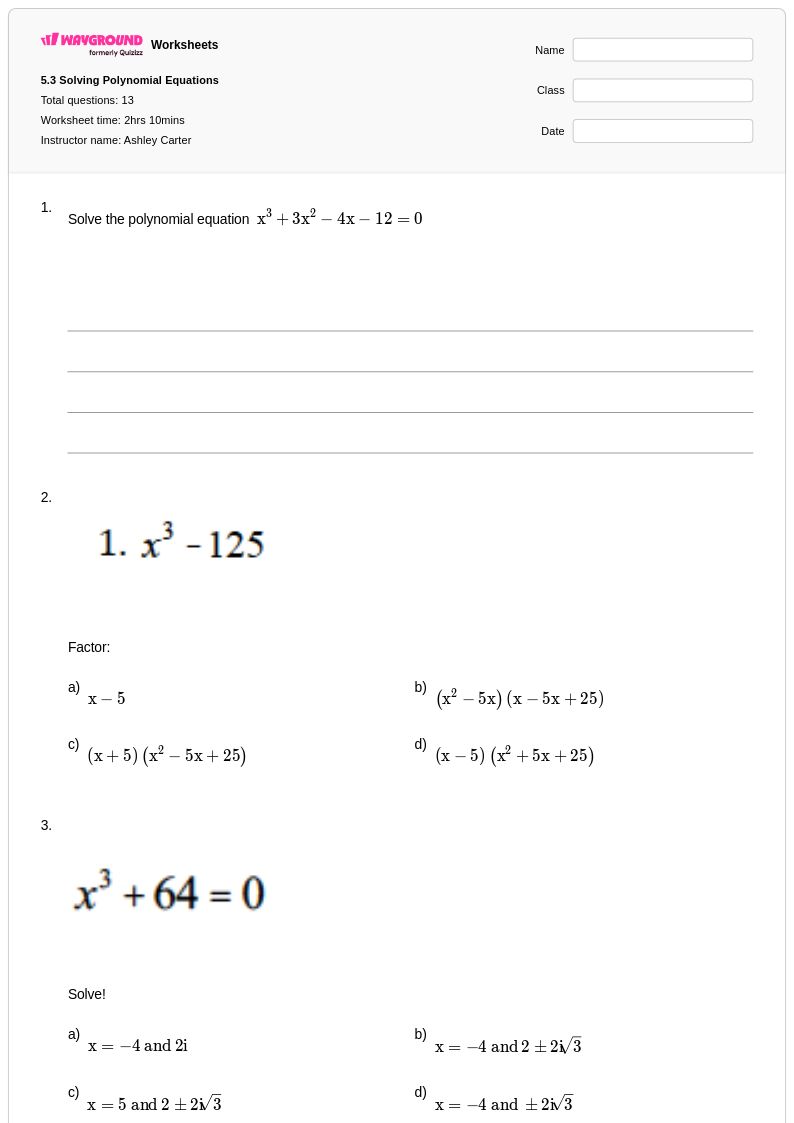
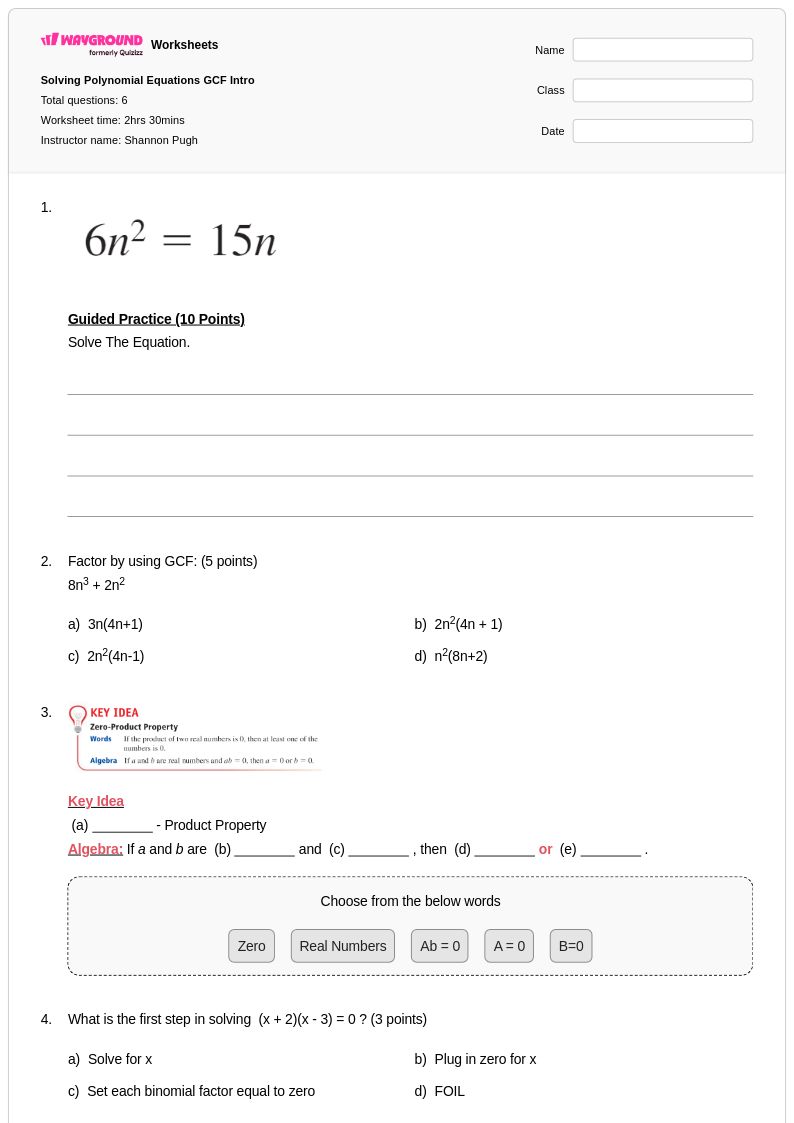
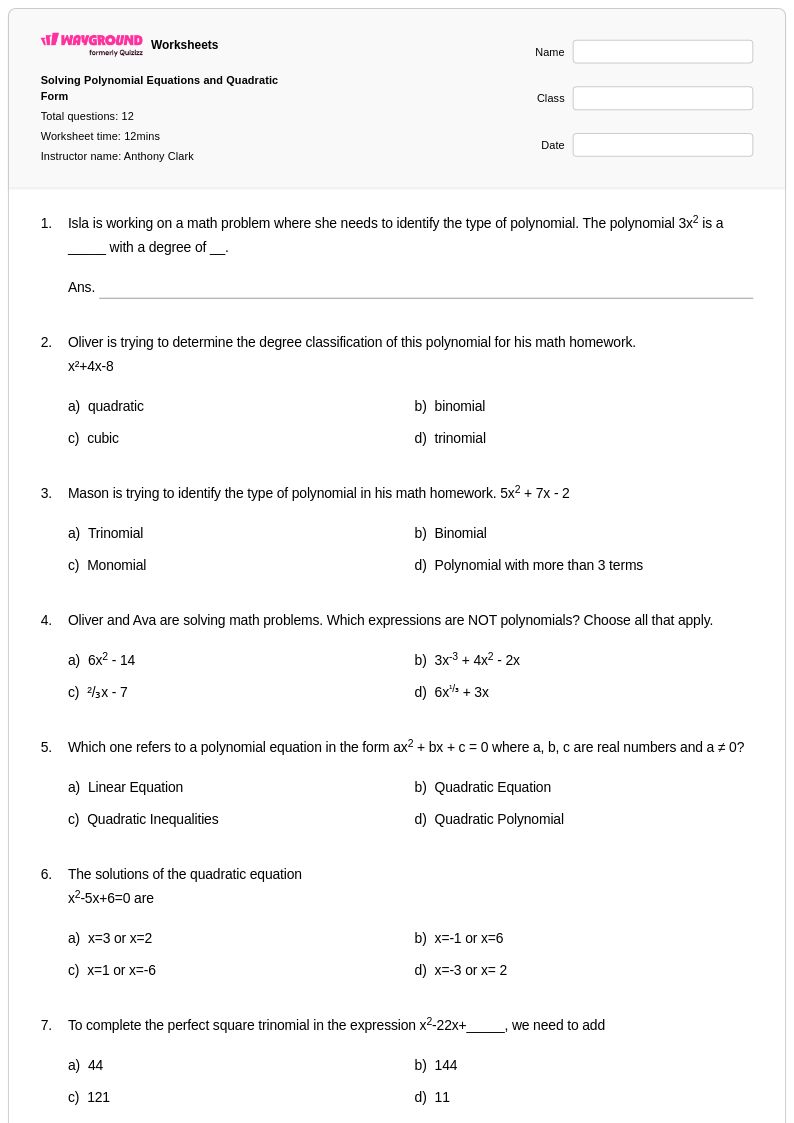
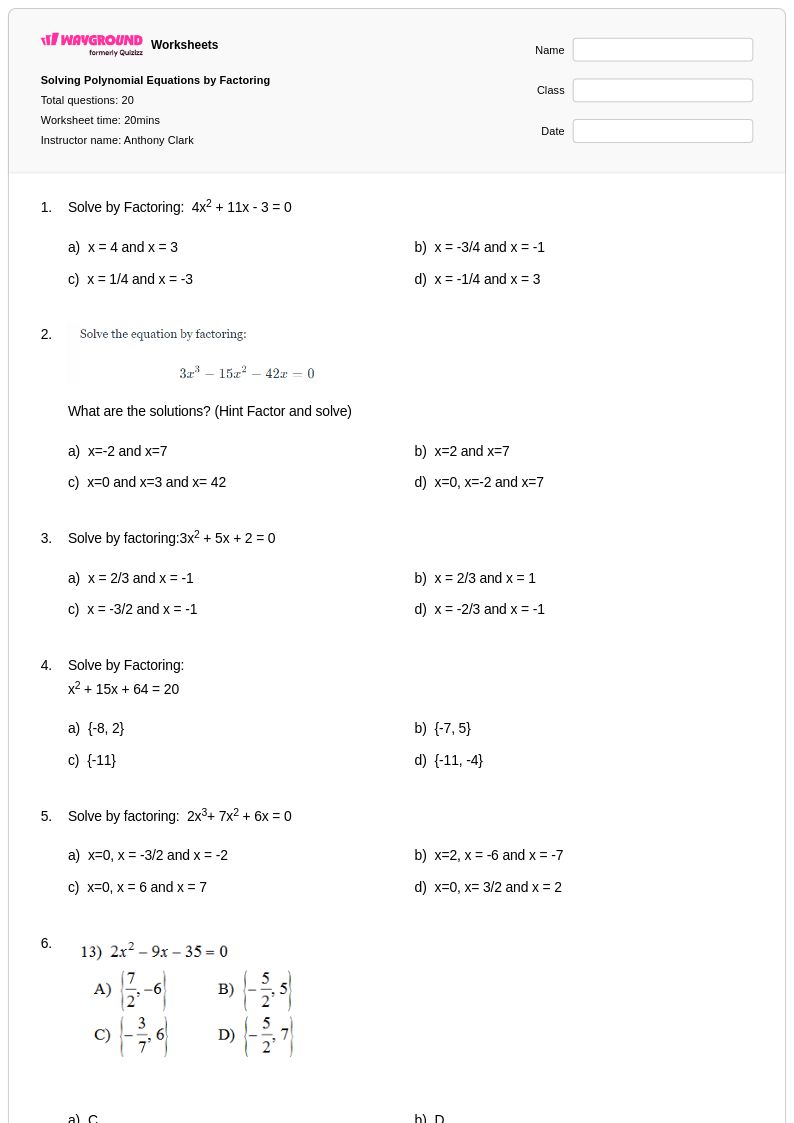
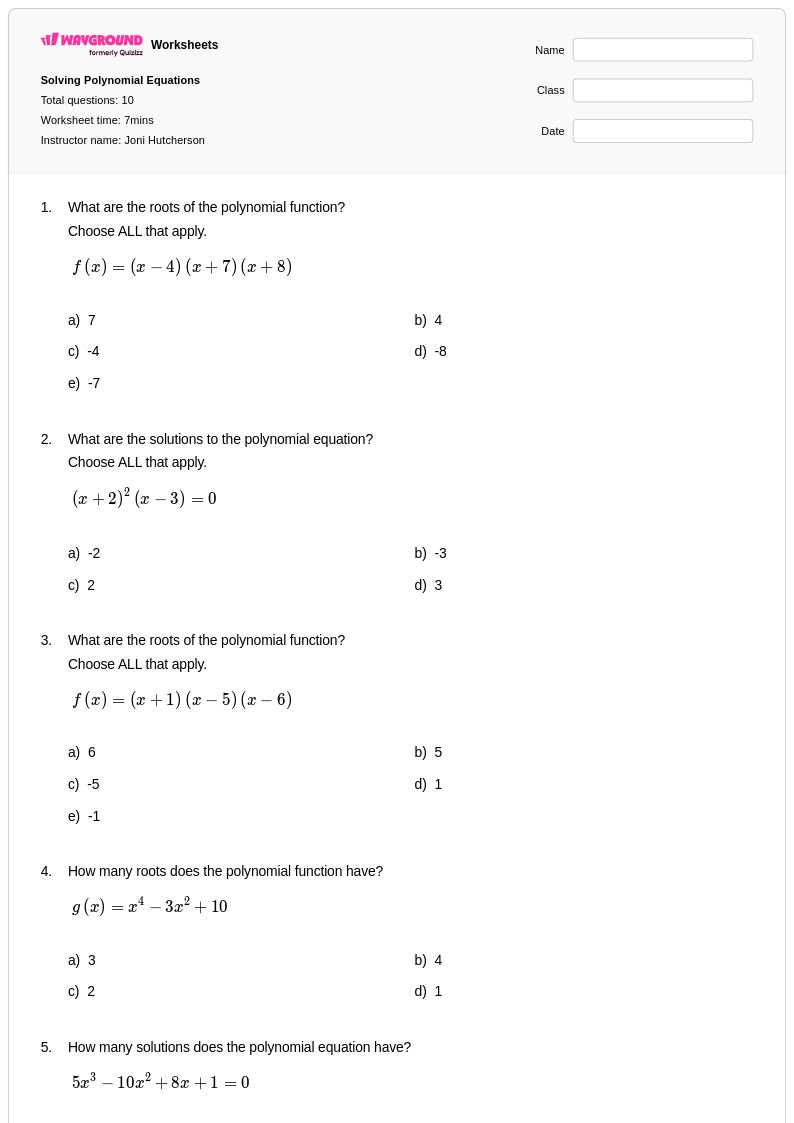
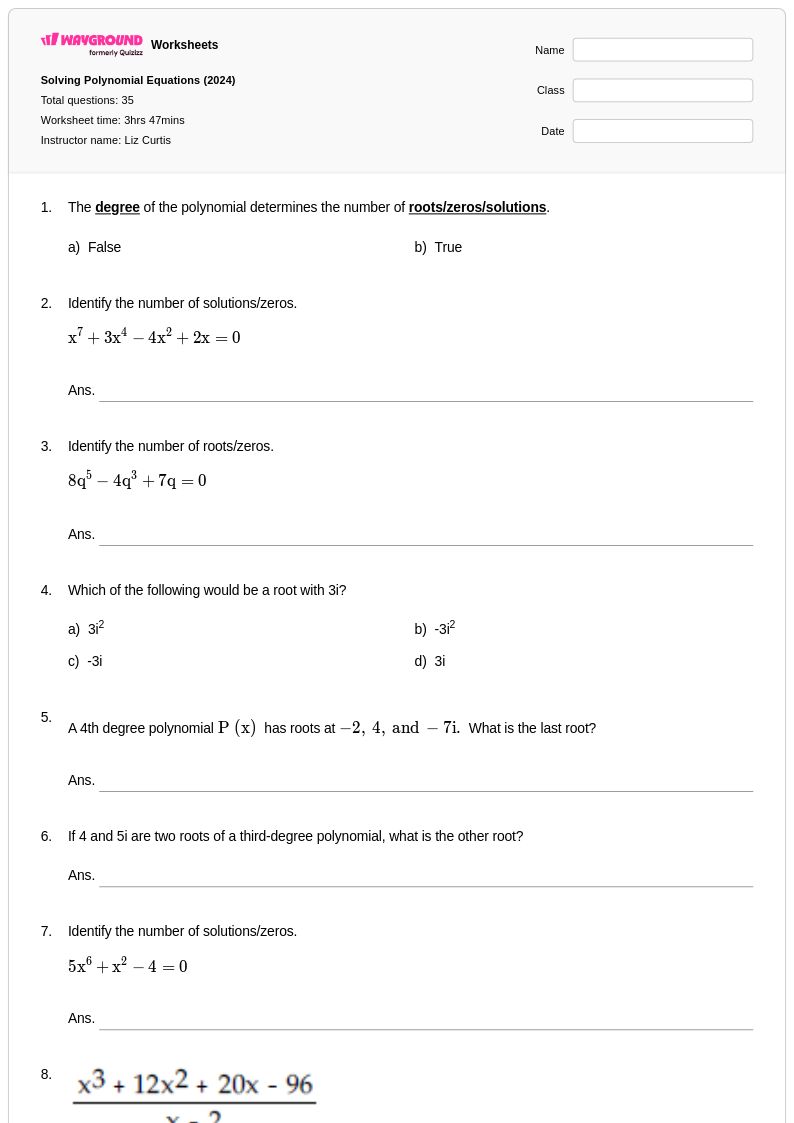
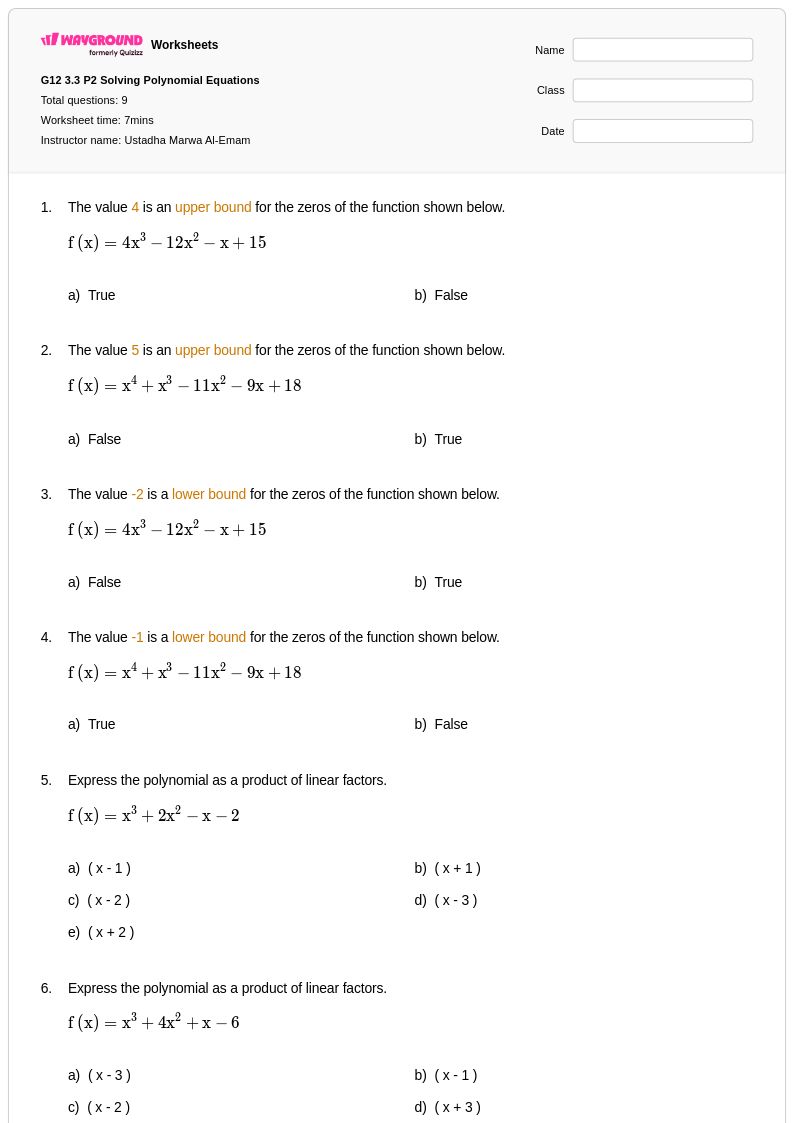
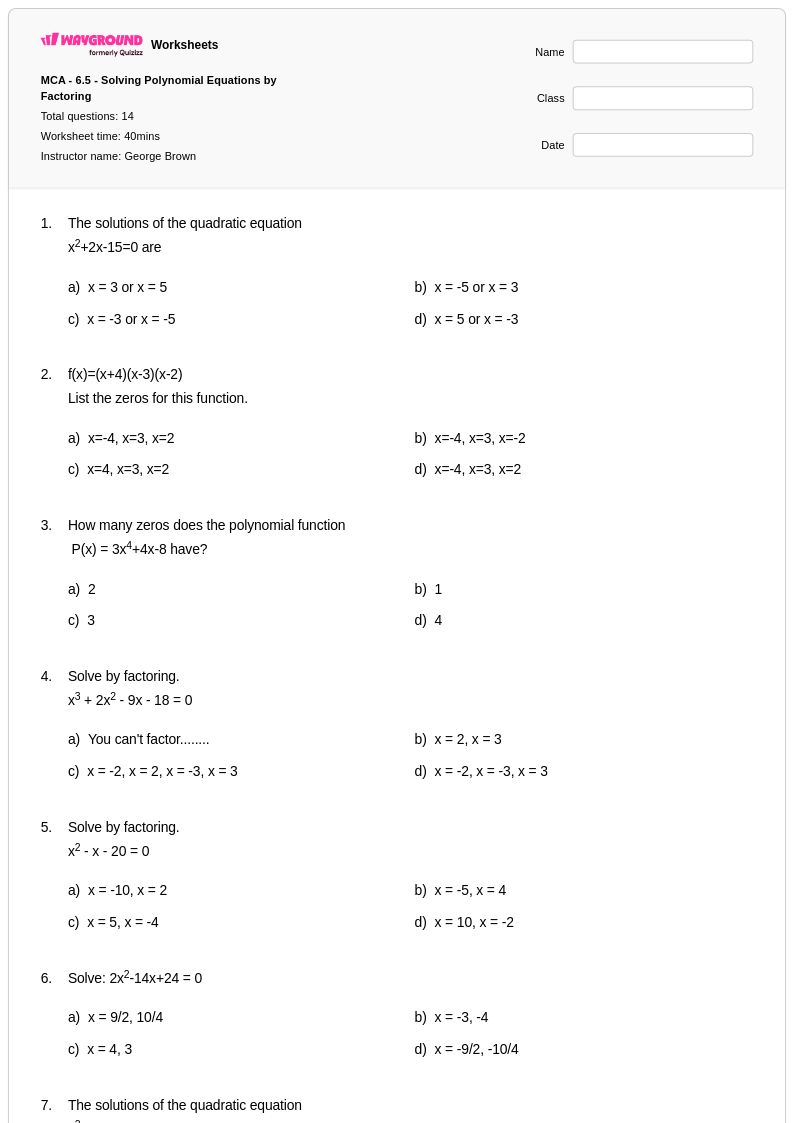
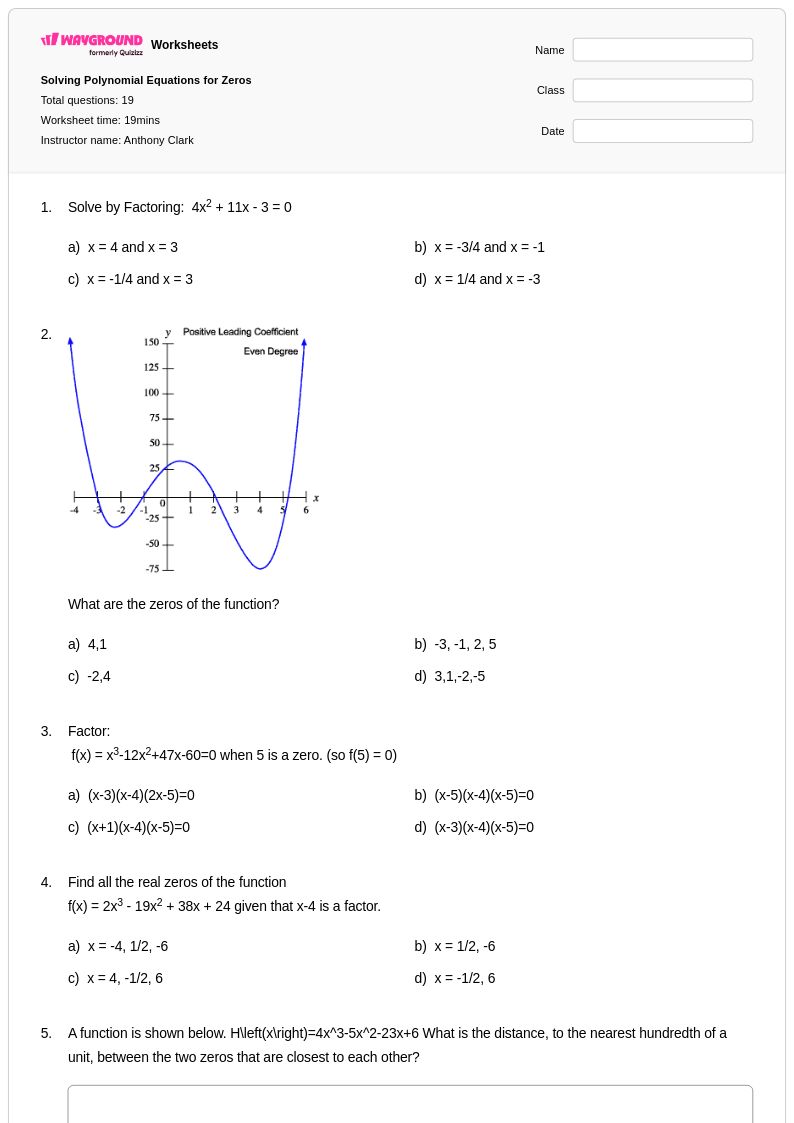
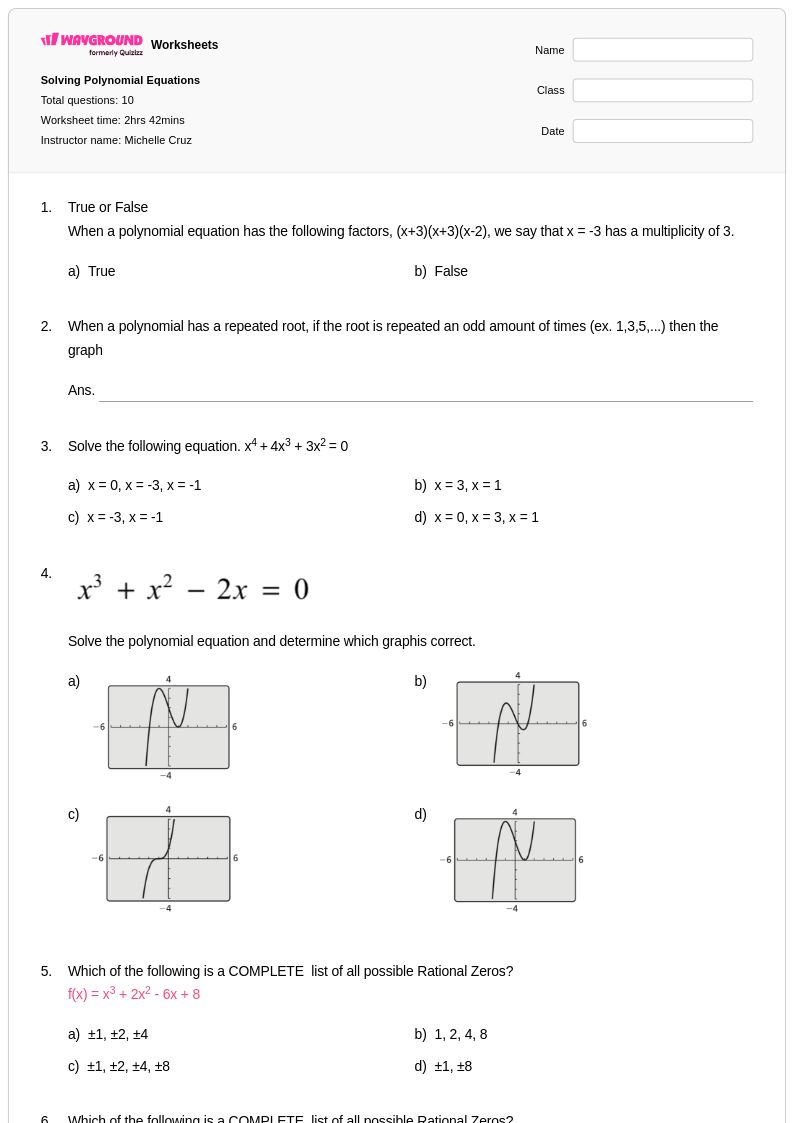
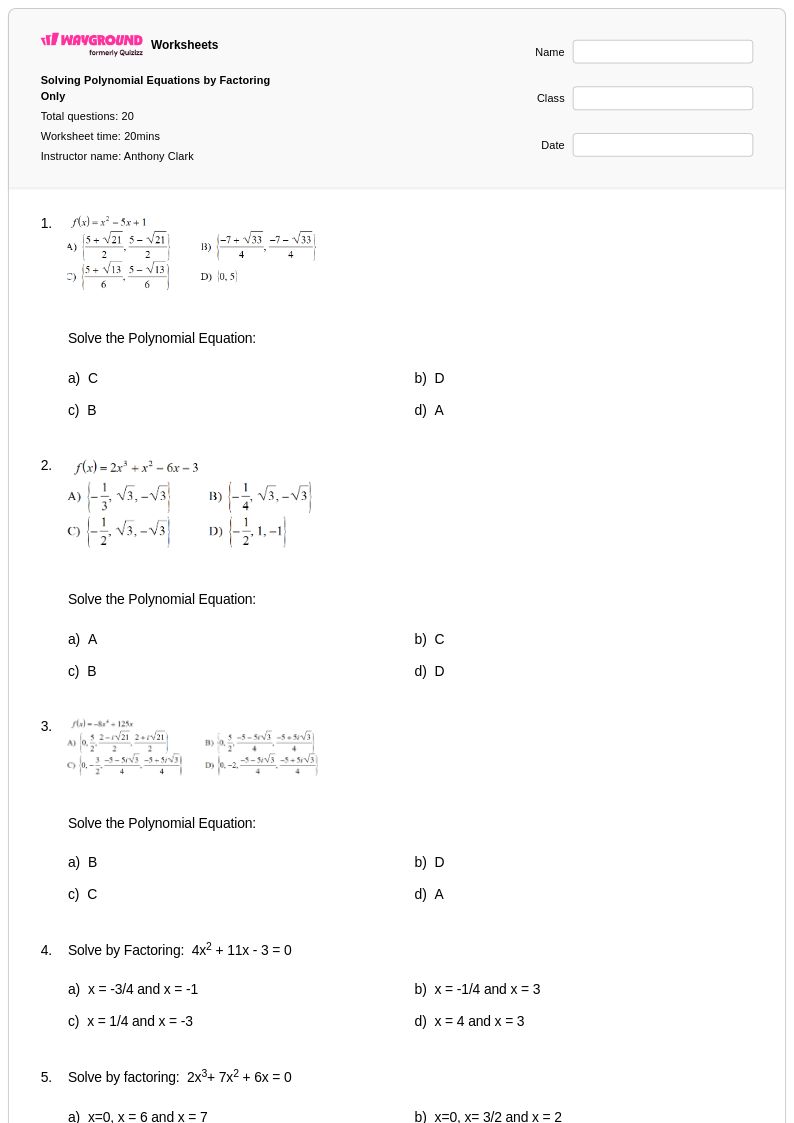
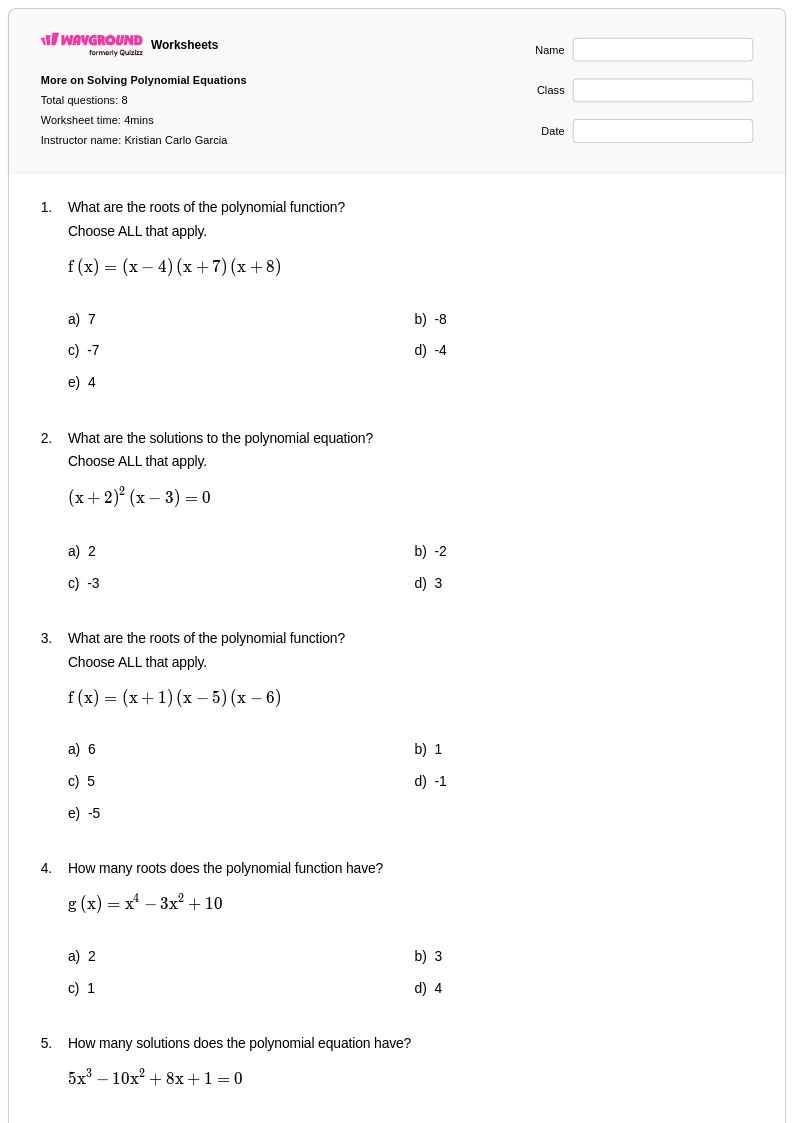
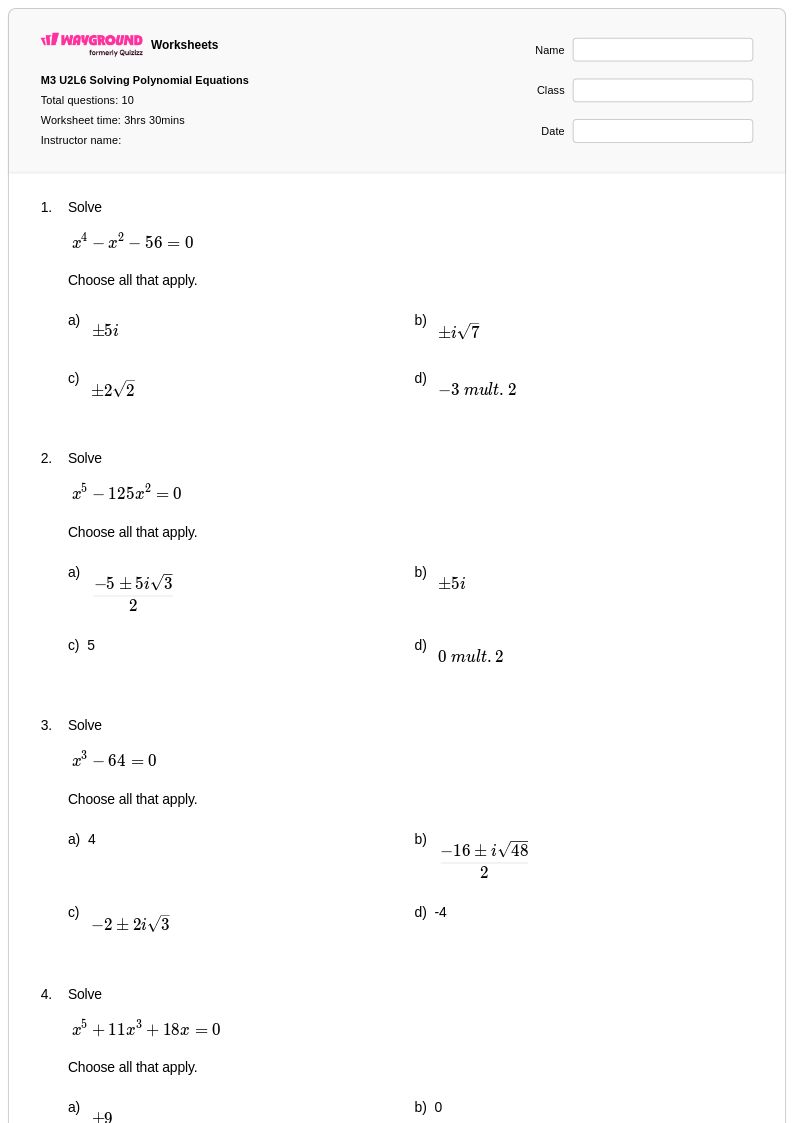
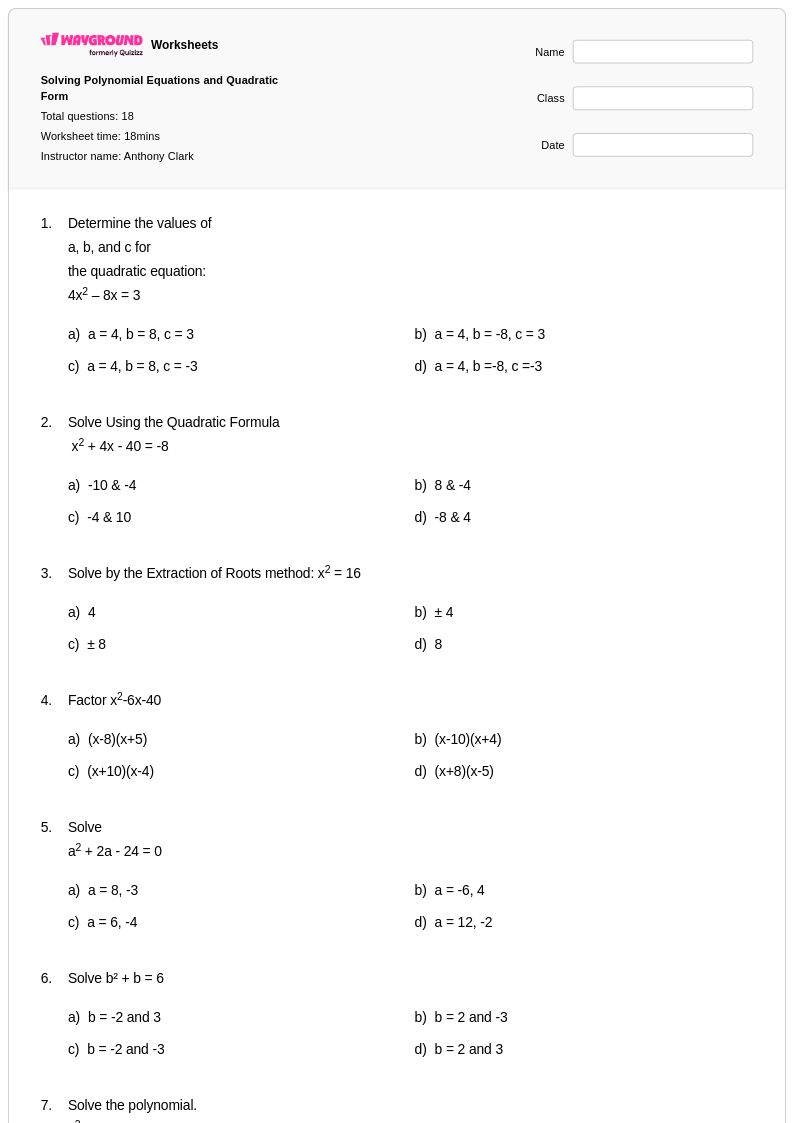
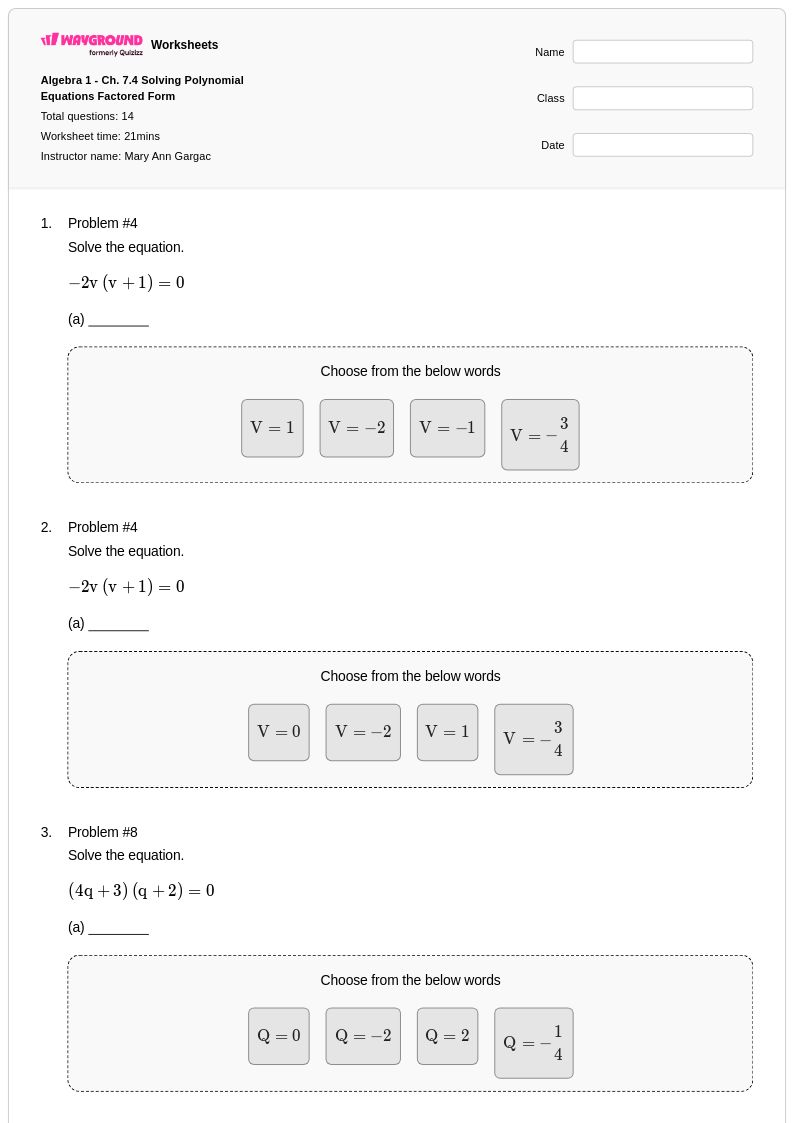
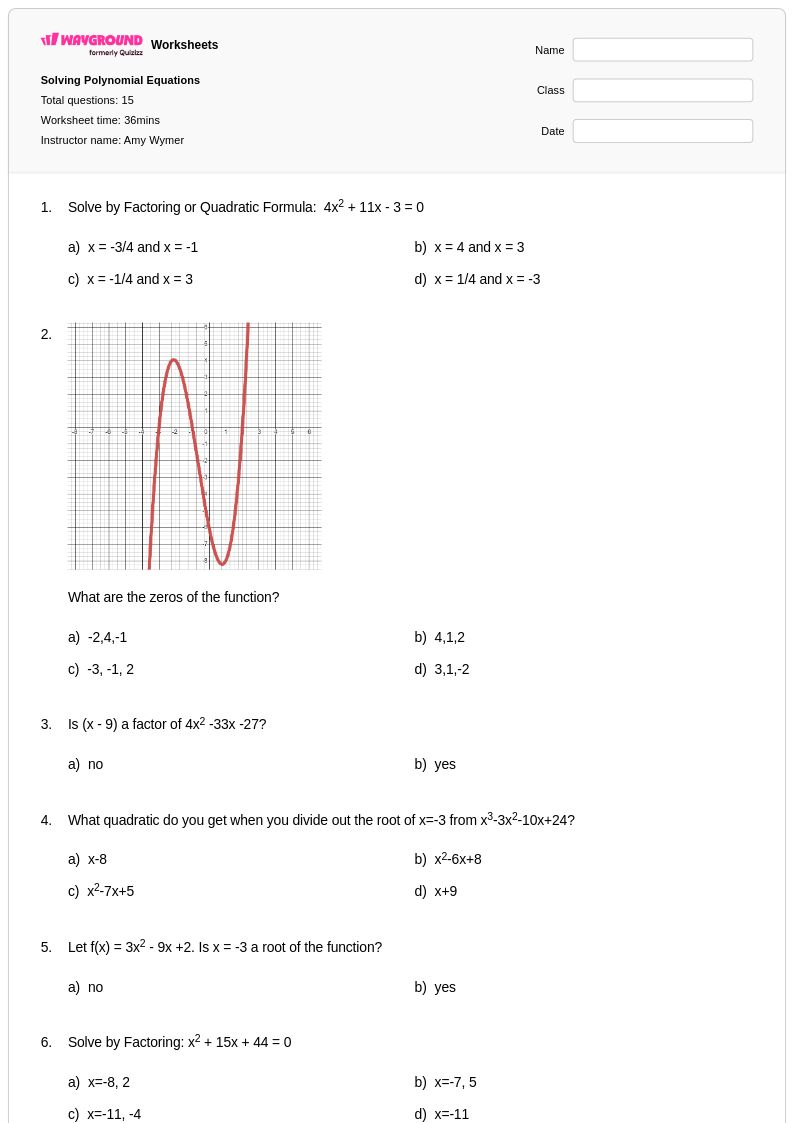
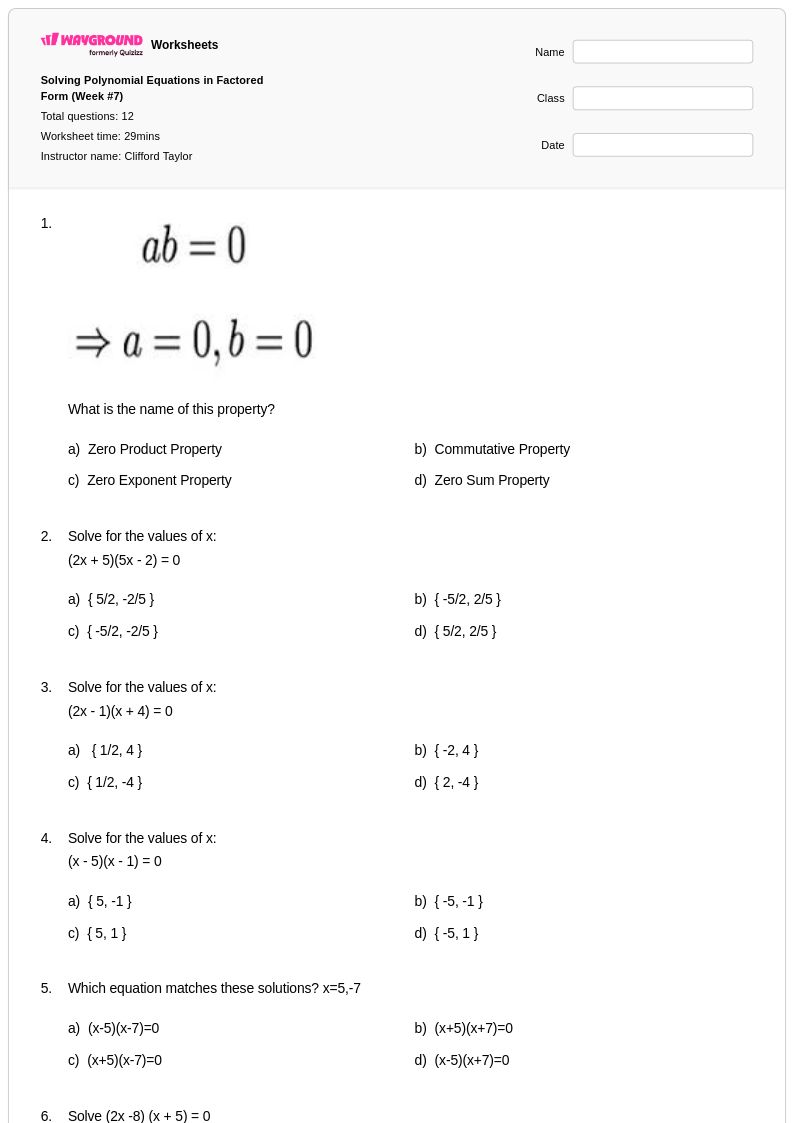
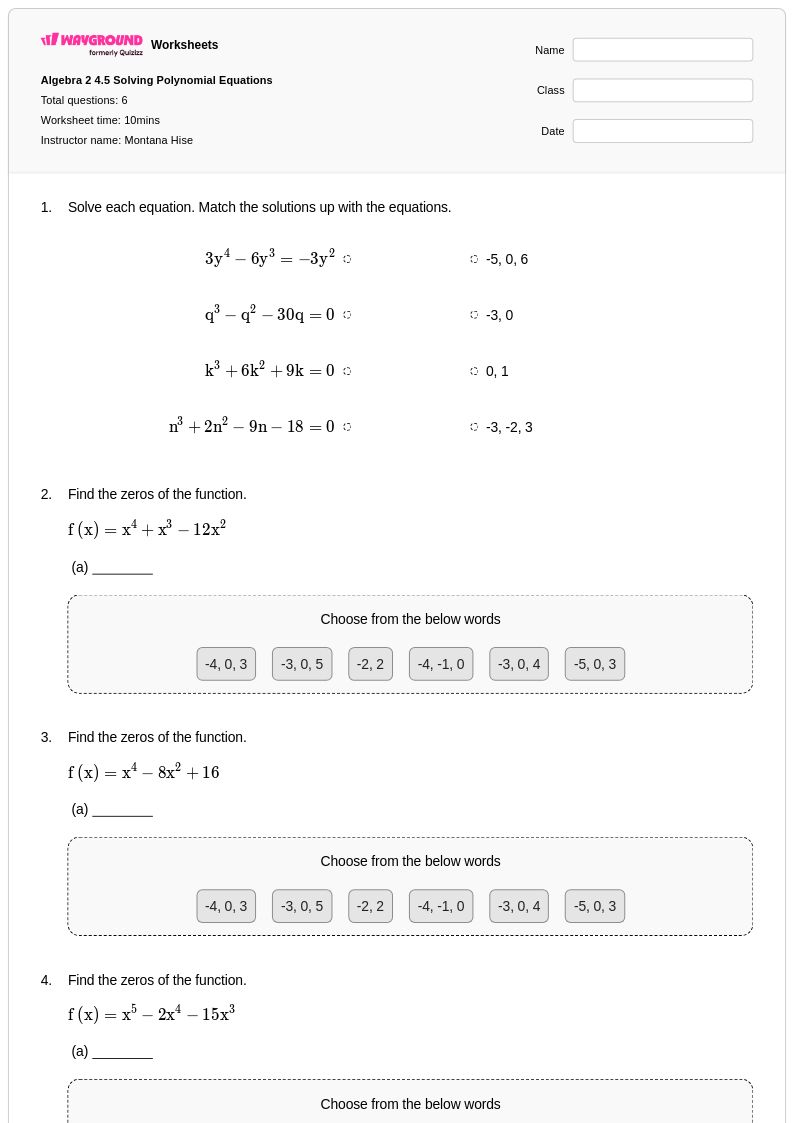
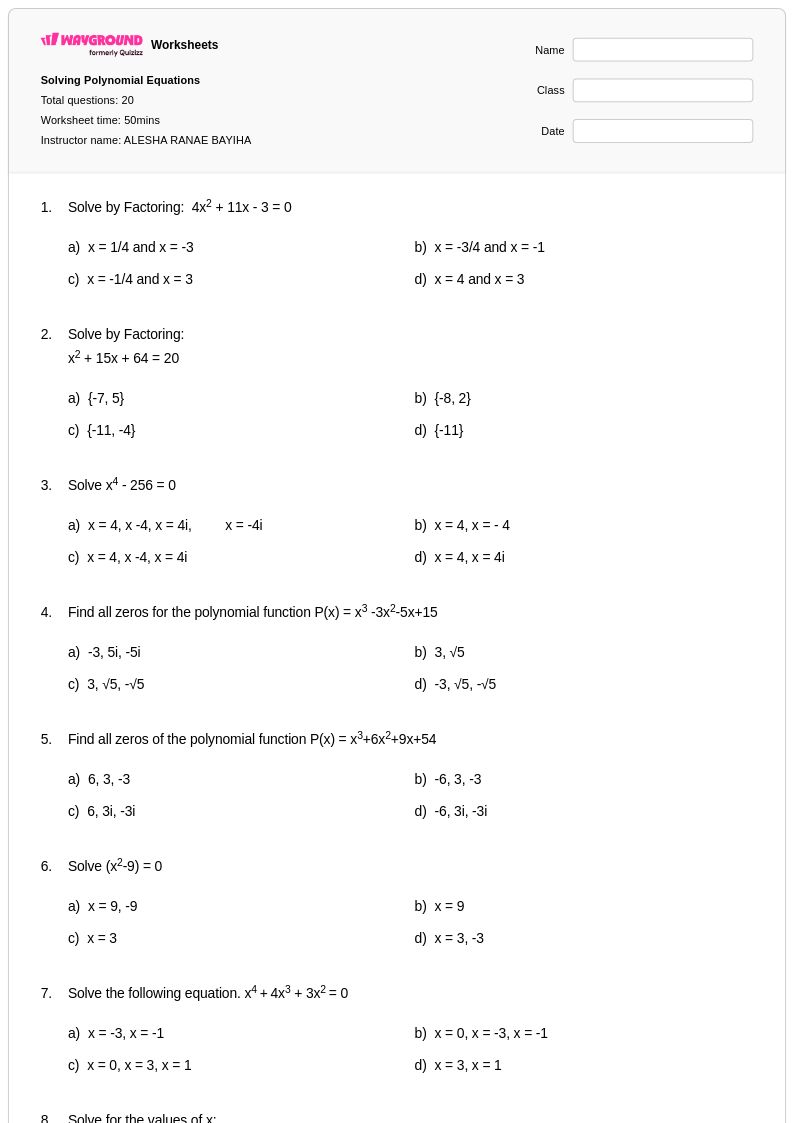
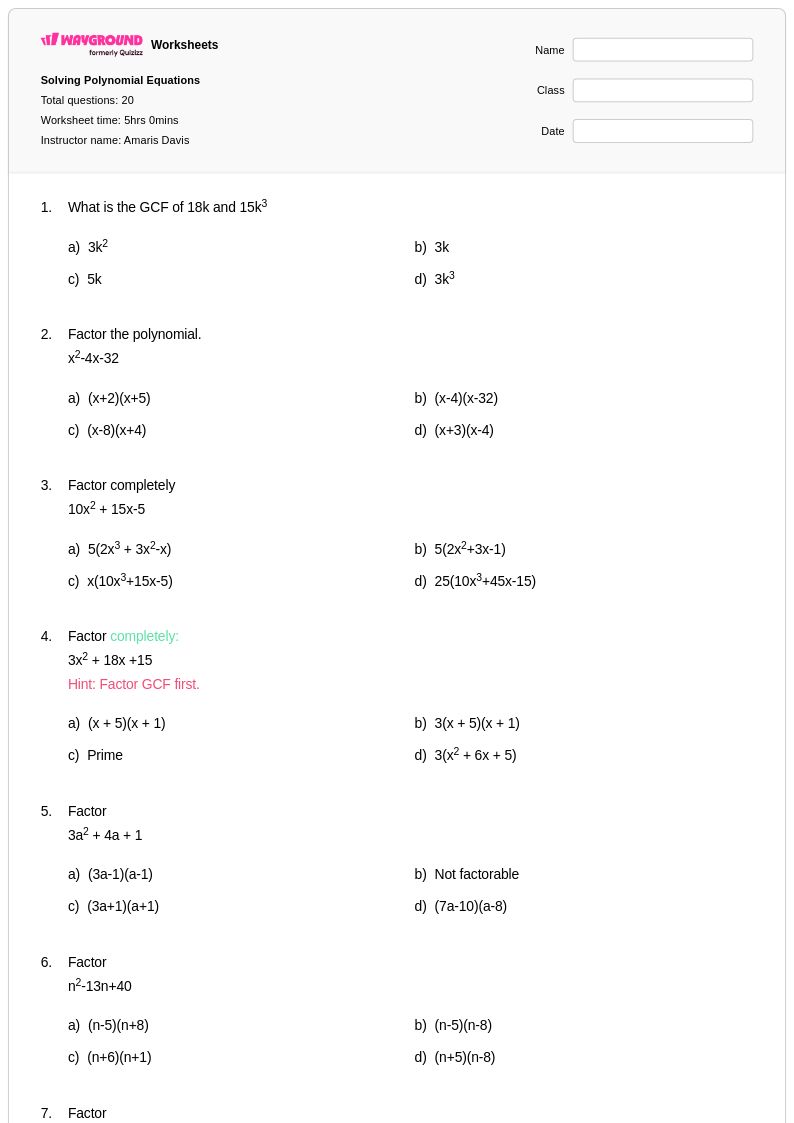
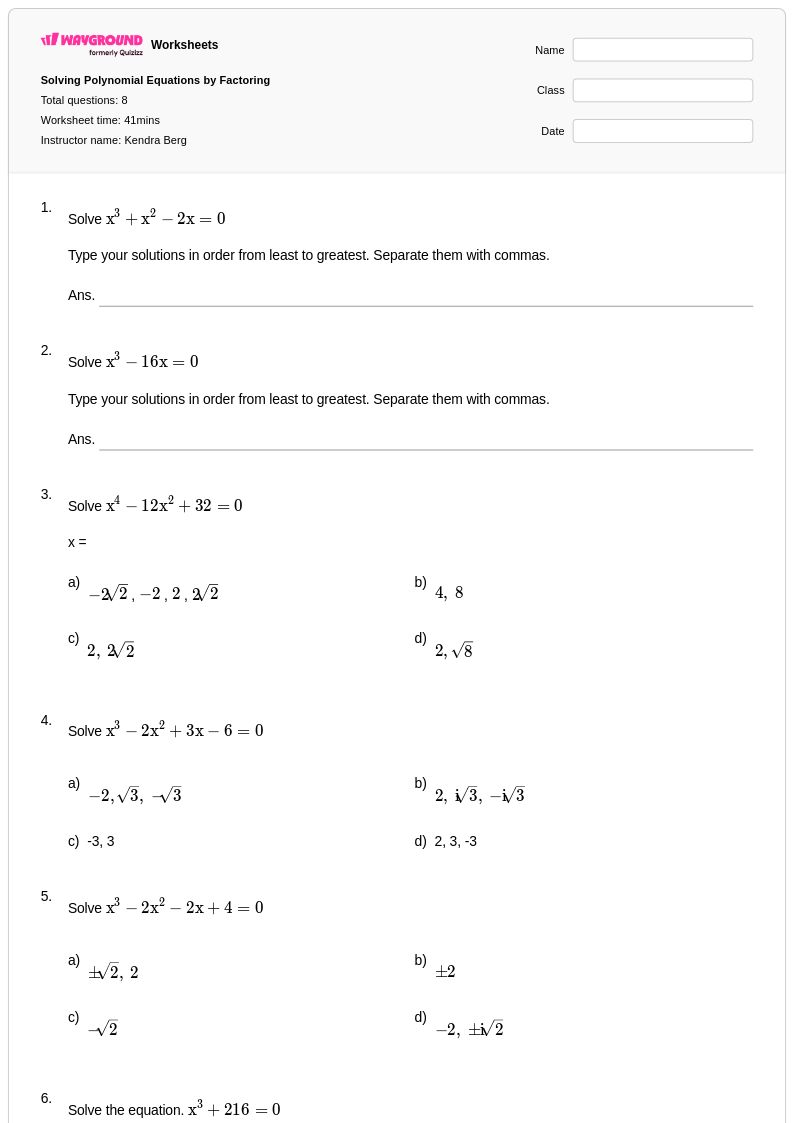
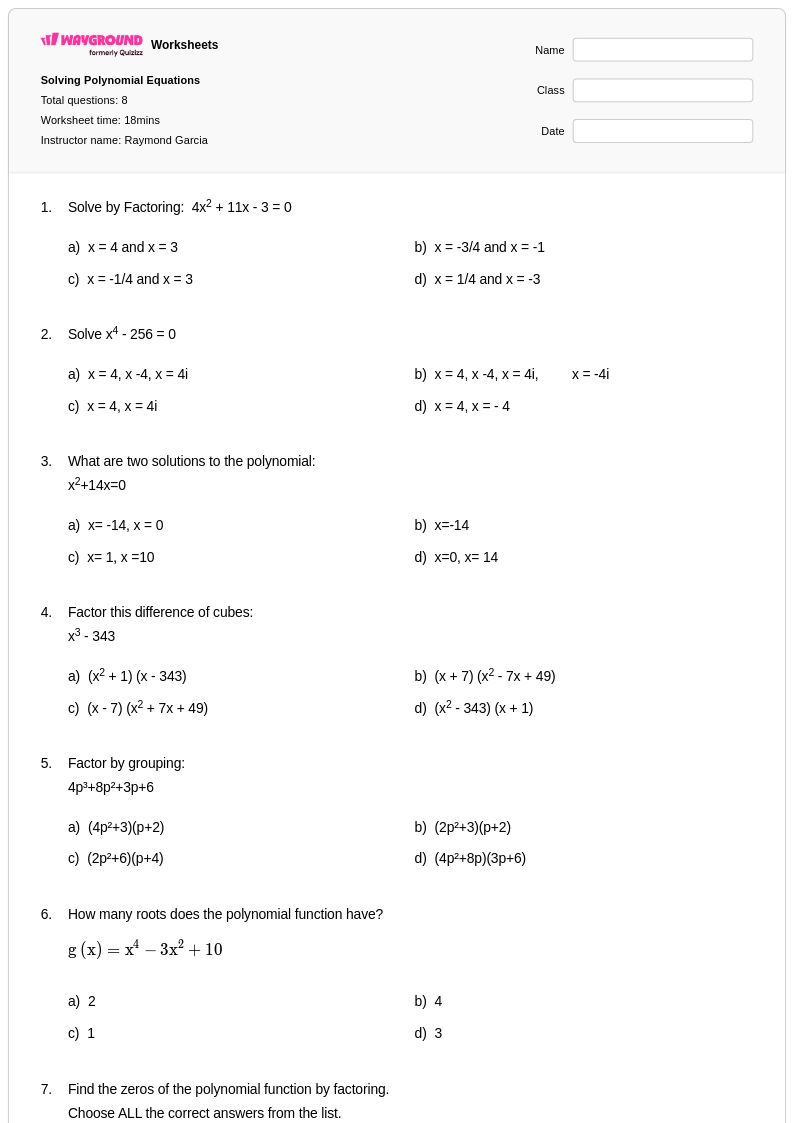
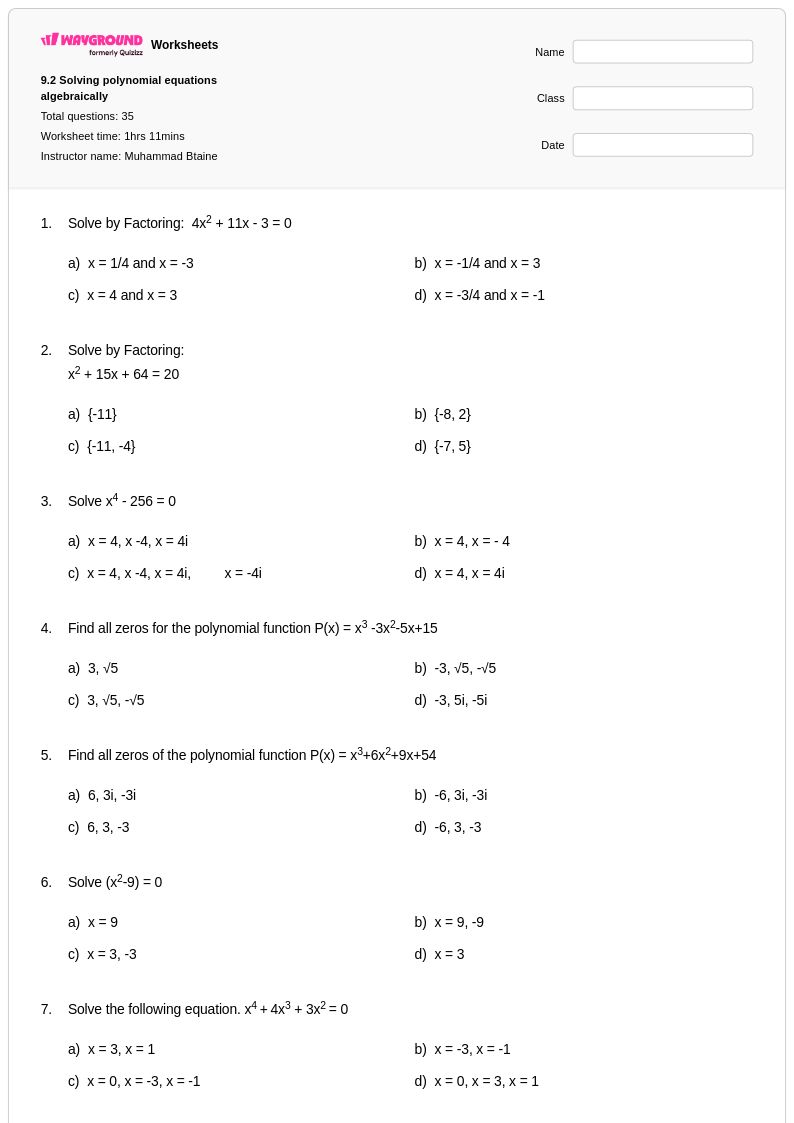
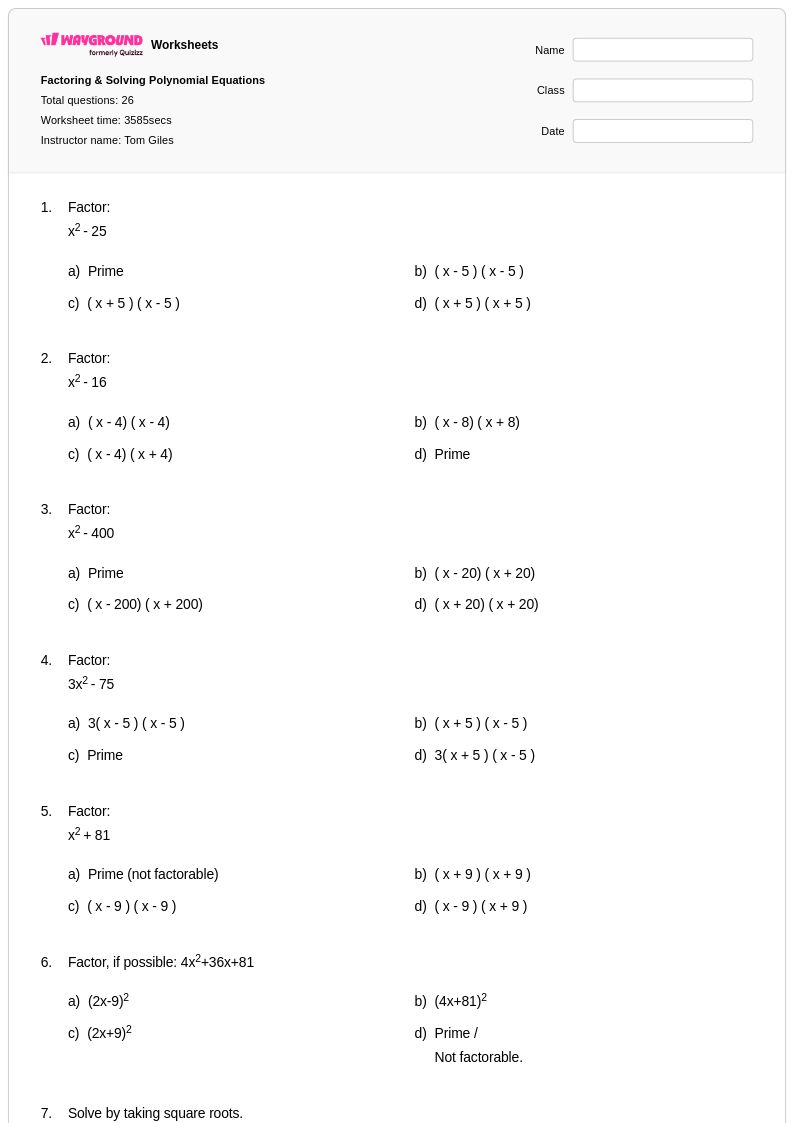
Wayground's free solving polynomial equations worksheets provide comprehensive practice problems and answer keys to help students master factoring, graphing, and algebraic solution methods through engaging printable PDFs.
Solving polynomial equations represents a fundamental milestone in algebraic thinking, requiring students to synthesize multiple mathematical concepts including factoring, graphing, and applying various solution methods. Wayground's comprehensive collection of solving polynomial equations worksheets provides structured practice opportunities that guide learners through progressively complex problems, from basic quadratic equations to higher-degree polynomials. These carefully crafted resources strengthen critical problem-solving skills by offering diverse practice problems that cover factoring techniques, the quadratic formula, synthetic division, and graphical analysis methods. Each worksheet includes a complete answer key to support independent learning and self-assessment, while the free printable format ensures accessibility for both classroom instruction and home study sessions.
Wayground, formerly Quizizz, empowers educators with an extensive library of millions of teacher-created resources specifically designed for polynomial equation instruction, featuring robust search and filtering capabilities that allow teachers to quickly locate materials aligned with their curriculum standards and student needs. The platform's sophisticated differentiation tools enable instructors to customize worksheets based on individual learning levels, while the flexible availability in both printable pdf format and interactive digital versions accommodates diverse classroom environments and teaching preferences. These comprehensive features streamline lesson planning by providing ready-to-use materials for initial instruction, targeted remediation for struggling learners, enrichment activities for advanced students, and ongoing skill practice that reinforces mastery of polynomial equation solving techniques across various mathematical contexts.
FAQs
How should I teach solving polynomial equations?
Start with factoring methods for quadratics, then introduce the quadratic formula. Progress to higher-degree polynomials by teaching students to find potential roots using the Rational Root Theorem and test them with synthetic division. Finally, connect these algebraic methods to graphical analysis by identifying x-intercepts as the real roots of the equation.
What types of practice problems are best for solving polynomial equations?
Effective practice includes a mix of problem types that build from foundational to complex skills. Start with factoring quadratics and simple cubic equations. Then, move to problems requiring the quadratic formula, synthetic division, and the Rational Root Theorem. Including problems that can be solved in multiple ways encourages students to think strategically about the most efficient method.
What are the most common student mistakes when solving polynomial equations?
Students often make sign errors during synthetic division or when applying the quadratic formula. Another common issue is incomplete factoring; for example, they might find one root of a cubic polynomial but forget to solve the remaining quadratic factor to find the other roots.
How can I use these polynomial equation worksheets in my class?
These worksheets are flexible for any classroom setup. Assign them as interactive digital quizzes on the Wayground platform for instant feedback, or download them as printable PDFs for offline practice. Every worksheet includes a complete answer key, which you can use for grading or to allow students to self-check their work.
How does solving polynomial equations fit into the high school math curriculum?
This topic is a cornerstone of high school algebra, directly aligning with Common Core standards on understanding the relationship between zeros, factors, and graphs of polynomial functions. Mastery builds a crucial foundation for Pre-calculus and Calculus, where students will analyze function behavior and solve more complex problems.
How can I support struggling students with solving polynomial equations?
For multi-step problems, provide extended time to reduce pressure. When using a digital quiz format, you can enable "Reduced answer choices" to help students focus on the correct solving process rather than getting lost in distractors. You can also create scaffolded versions of a worksheet by adjusting the font size and spacing to improve readability for complex equations.