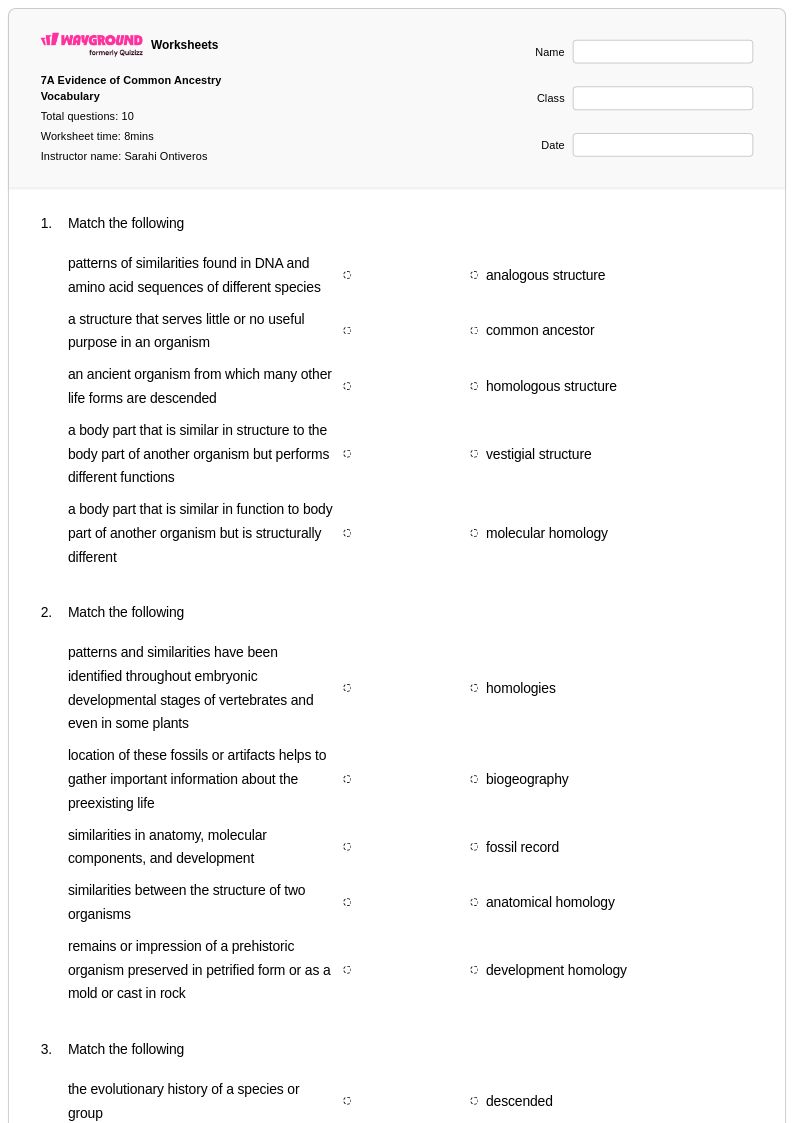
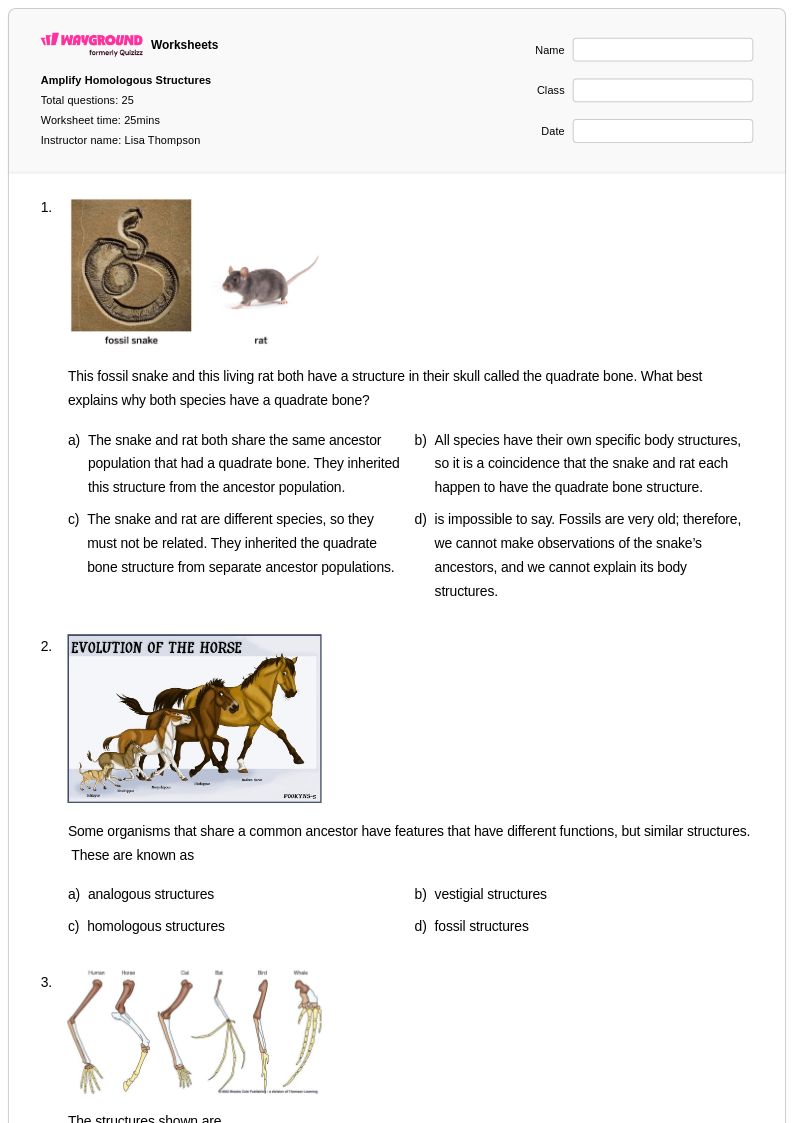
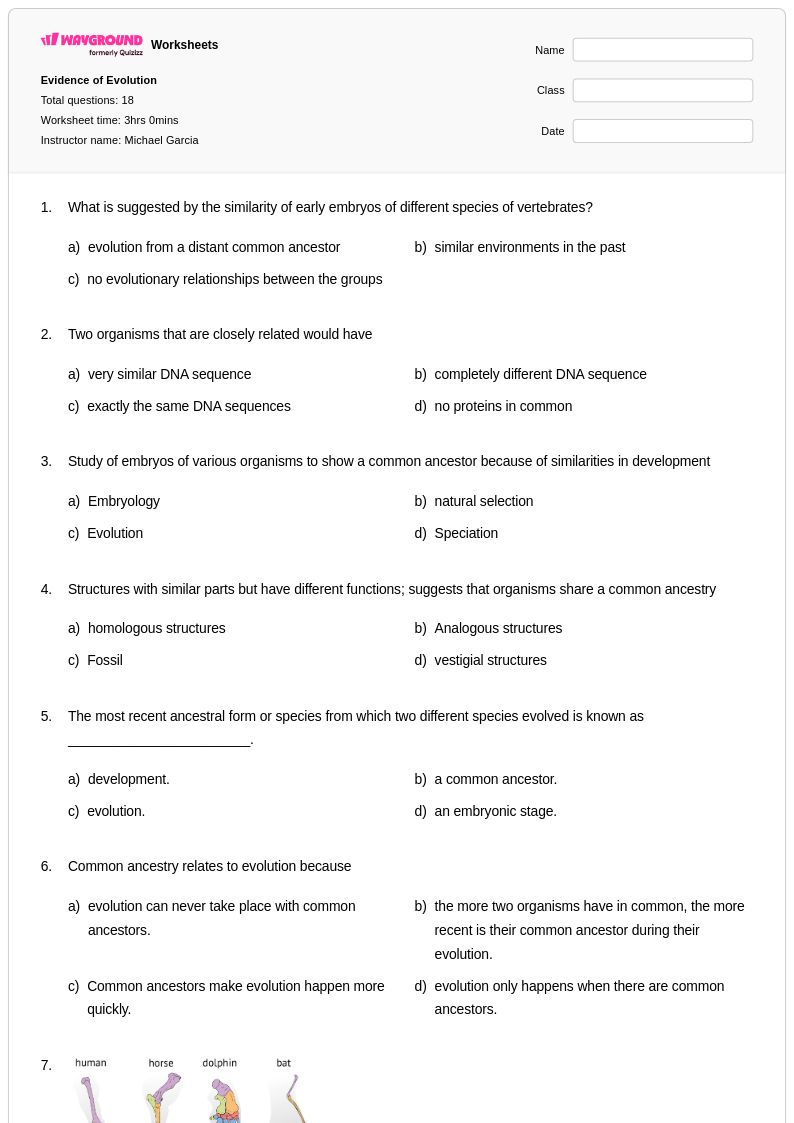
Free Printable Whale Anatomy Worksheets for Year 10
Year 10 whale anatomy worksheets from Wayground help students explore marine mammal body structures through detailed printables, practice problems, and comprehensive answer keys for effective biology learning.
Explore printable Whale Anatomy worksheets for Year 10
Whale anatomy worksheets for Year 10 biology students through Wayground (formerly Quizizz) provide comprehensive exploration of cetacean structural adaptations and physiological systems. These expertly designed educational materials guide students through detailed examination of whale skeletal modifications, respiratory adaptations, circulatory systems, and specialized organs that enable deep-sea survival. The worksheets strengthen critical biological analysis skills by challenging students to identify anatomical structures, compare whale anatomy to terrestrial mammals, and explain evolutionary adaptations through practice problems that connect form to function. Each worksheet includes detailed answer keys and is available as free printable pdf resources, allowing students to develop mastery of marine mammal biology through systematic study of whale morphology and physiological specializations.
Wayground (formerly Quizizz) empowers biology educators with access to millions of teacher-created whale anatomy resources that support diverse instructional needs across Year 10 classrooms. The platform's advanced search and filtering capabilities enable teachers to locate worksheets aligned with specific curriculum standards while offering differentiation tools to accommodate varying student ability levels. Teachers can customize existing materials or create new whale anatomy assessments using flexible digital tools, then distribute resources in both printable pdf format and interactive digital versions. This comprehensive worksheet collection facilitates effective lesson planning by providing ready-to-use materials for initial instruction, targeted remediation for struggling learners, enrichment activities for advanced students, and ongoing skill practice that reinforces understanding of complex cetacean anatomical systems and their evolutionary significance.
FAQs
How do I teach whale anatomy to students?
Start by distinguishing the two major whale groups — toothed whales and baleen whales — since their anatomical differences anchor most structural comparisons students will encounter. Use labeled diagrams to introduce key features like blubber layers, baleen plates, the melon organ, and blowholes before moving into function. Connecting each structure to a specific survival behavior, such as how baleen filtering supports feeding or how the melon focuses sound for echolocation, helps students build conceptual understanding rather than just memorizing part names.
What exercises help students practice identifying whale body parts?
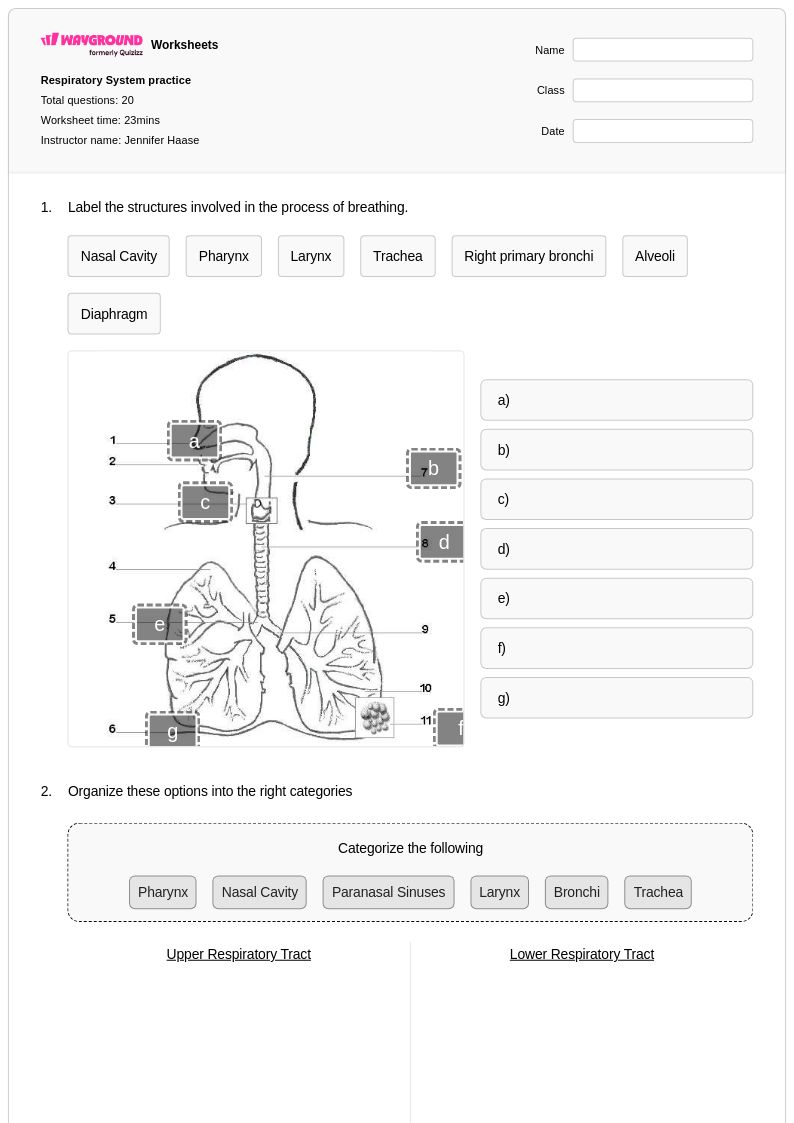
Label-the-diagram activities are the most effective starting point, requiring students to place terms like dorsal fin, flukes, rostrum, and blowhole on an unlabeled whale outline. From there, compare-and-contrast tasks that ask students to identify structural differences between odontocetes and mysticetes deepen their understanding of form and function. Practice problems that ask students to explain why a specific structure exists — for example, why thick blubber is critical for deep-sea thermoregulation — push beyond recall into applied reasoning.
What mistakes do students commonly make when learning whale anatomy?
The most common error is conflating whale anatomy with fish anatomy — students frequently assume whales have gills or that flukes move side-to-side like a fish tail, when in fact flukes move up and down, reflecting the whale's mammalian skeletal heritage. Students also confuse the melon with the blowhole, misattributing echolocation function to the breathing apparatus. Another persistent misconception is assuming all whales use echolocation, when this adaptation is specific to toothed whales; baleen whales rely on different sensory and feeding mechanisms entirely.
How can I use whale anatomy worksheets to support different learners in my class?
Whale anatomy worksheets work well for differentiation because the content naturally scales in complexity — from basic part identification for foundational learners to functional analysis and evolutionary reasoning for advanced students. On Wayground, teachers can apply individual accommodations such as read-aloud support for students who need audio assistance, reduced answer choices to lower cognitive load for struggling learners, and extended time settings configurable per student. These accommodations can be assigned without notifying other students, keeping the classroom experience consistent while ensuring each learner accesses the material appropriately.
How do I use Wayground's whale anatomy worksheets in my classroom?
Wayground's whale anatomy worksheets are available as printable PDFs, making them ready for traditional paper-based instruction, as well as in digital formats for technology-integrated classrooms. Teachers can also host the worksheets as an interactive quiz directly on Wayground, which allows for real-time student response tracking. The included answer keys make grading straightforward whether used as guided practice, independent review, or a formative assessment tool.
How does whale anatomy connect to broader life science standards?
Whale anatomy is a strong entry point for teaching evolutionary adaptation, since structures like vestigial hind limb bones and the positioning of the blowhole provide concrete evidence of cetacean evolution from land-dwelling ancestors. It also supports standards around ecosystems and food webs, as baleen and dentition directly determine feeding role and ecological niche. Teachers can use whale anatomy as a cross-cutting concept connecting cell biology, physiology, and environmental science within a single organism study.