Explore Class 7 body planes worksheets and free printables that help students master anatomical terminology and spatial relationships through engaging practice problems with complete answer keys.
Explore printable Body Planes worksheets for Class 7
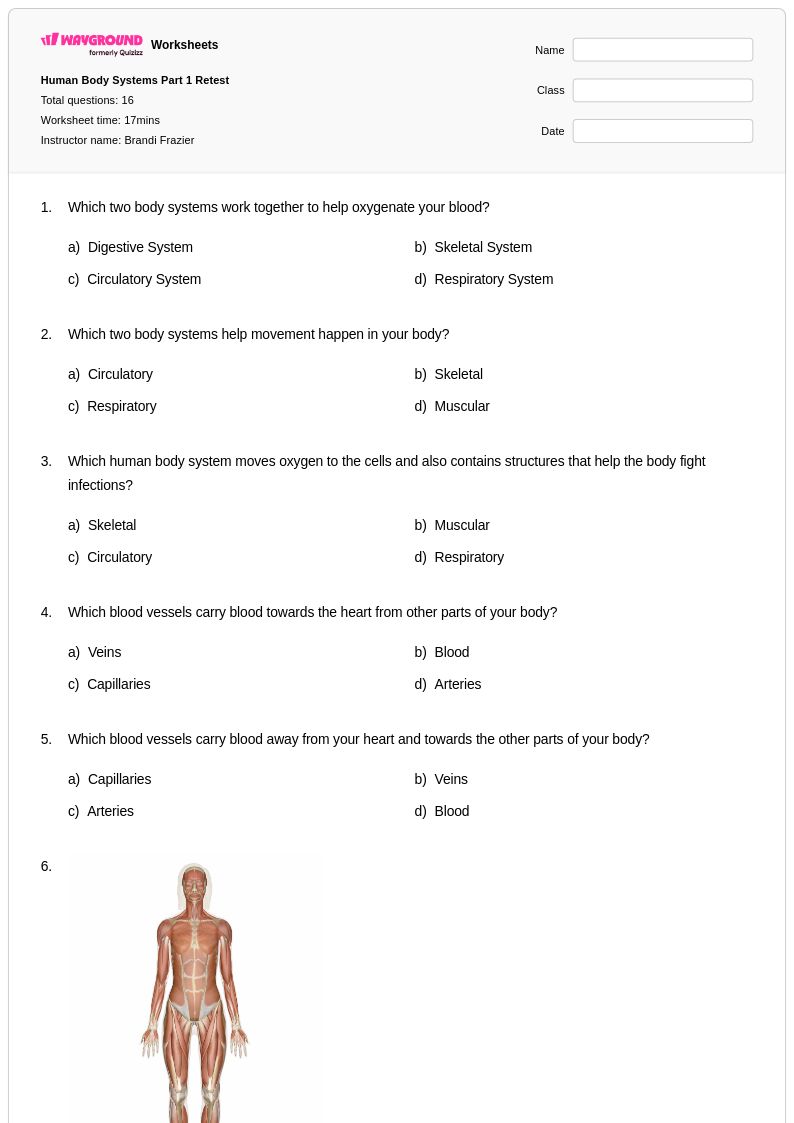
Body planes worksheets for Class 7 students available through Wayground (formerly Quizizz) provide comprehensive practice with the fundamental anatomical reference systems that divide the human body into sections for scientific study and medical analysis. These carefully designed educational resources help seventh-grade students master the three primary body planes—sagittal, frontal (coronal), and transverse (horizontal)—while developing essential spatial reasoning skills and anatomical vocabulary. The worksheets feature practice problems that challenge students to identify plane orientations, understand directional terminology like anterior, posterior, superior, and inferior, and visualize how these imaginary divisions help medical professionals describe locations within the body. Each worksheet collection includes detailed answer keys and is available as free printables in pdf format, enabling students to work through complex anatomical concepts at their own pace while building the foundational knowledge necessary for advanced biological studies.
Wayground (formerly Quizizz) supports educators teaching Class 7 body planes concepts through an extensive library of millions of teacher-created resources that can be easily accessed through powerful search and filtering capabilities. Teachers benefit from standards-aligned worksheet collections that can be customized to match specific curriculum requirements and differentiated to accommodate diverse learning needs within the classroom. The platform's flexible tools allow educators to modify existing worksheets or create entirely new practice materials, with seamless availability in both printable pdf formats for traditional paper-based learning and digital formats for technology-enhanced instruction. These comprehensive resources streamline lesson planning while providing targeted materials for remediation, enrichment, and ongoing skill practice, ensuring that all Class 7 students can develop a thorough understanding of anatomical body planes and their critical role in biological and medical sciences.
FAQs
How do I teach body planes to biology students?
Teaching body planes is most effective when students can connect abstract spatial concepts to a concrete reference point — the anatomical position. Start by introducing the three primary planes (sagittal, frontal/coronal, and transverse/horizontal) using a physical model or diagram, then have students practice applying each plane to real anatomical structures. Reinforcing with labeled diagrams and directional terminology exercises helps students build the spatial reasoning needed for advanced biology and medical coursework.
What exercises help students practice identifying anatomical planes?
Effective practice exercises include labeling diagrams that show cross-sections of the human body along each plane, matching directional terms (such as medial, lateral, superior, and inferior) to the correct plane, and answering scenario-based questions that ask students to identify which plane a given cut follows. Worksheets that progress from recognition tasks to application problems — such as describing how a specific organ is divided — help solidify spatial understanding incrementally.
What mistakes do students commonly make when learning body planes?
The most common errors include confusing the frontal (coronal) plane with the transverse plane, and misapplying directional terms when the body is not in anatomical position. Students also frequently struggle to visualize three-dimensional relationships on two-dimensional diagrams, leading to incorrect plane identification. Targeted practice with multiple diagram orientations and explicit instruction on the anatomical position as a fixed reference point helps correct these misconceptions.
How can I differentiate body planes instruction for students at different levels?
For students who are struggling, reduce the number of planes introduced at one time and use simplified diagrams with fewer structures. For advanced students, move quickly to application tasks that require identifying planes in clinical imaging contexts or describing how multiple planes intersect within a specific body region. On Wayground, teachers can apply accommodations such as read aloud, reduced answer choices, and extended time on a per-student basis, so each learner engages with body planes content at an appropriate level of challenge.
How do I use Wayground's body planes worksheets in my classroom?
Wayground's body planes worksheets are available as printable PDFs for traditional classroom use and in digital formats for technology-integrated environments, including the option to host them as a quiz directly on Wayground. Teachers can distribute printed versions for in-class practice or independent study, or assign the digital version for homework and remote learning. All worksheets include complete answer keys, making them practical for both guided instruction and self-paced review.
At what grade level are body planes typically taught in biology?
Body planes are most commonly introduced in high school biology, anatomy, and physiology courses, though they may also appear in advanced middle school life science curricula. The concept is foundational for students pursuing careers in healthcare, nursing, or biomedical sciences, and serves as prerequisite knowledge for understanding anatomical terminology in college-level coursework.