Free Printable Comparing Volume Worksheets for Kindergarten
Discover free kindergarten comparing volume worksheets and printables from Wayground that help young learners practice measuring and comparing different amounts through engaging activities, complete with answer keys and downloadable PDFs.
Explore printable Comparing Volume worksheets for Kindergarten
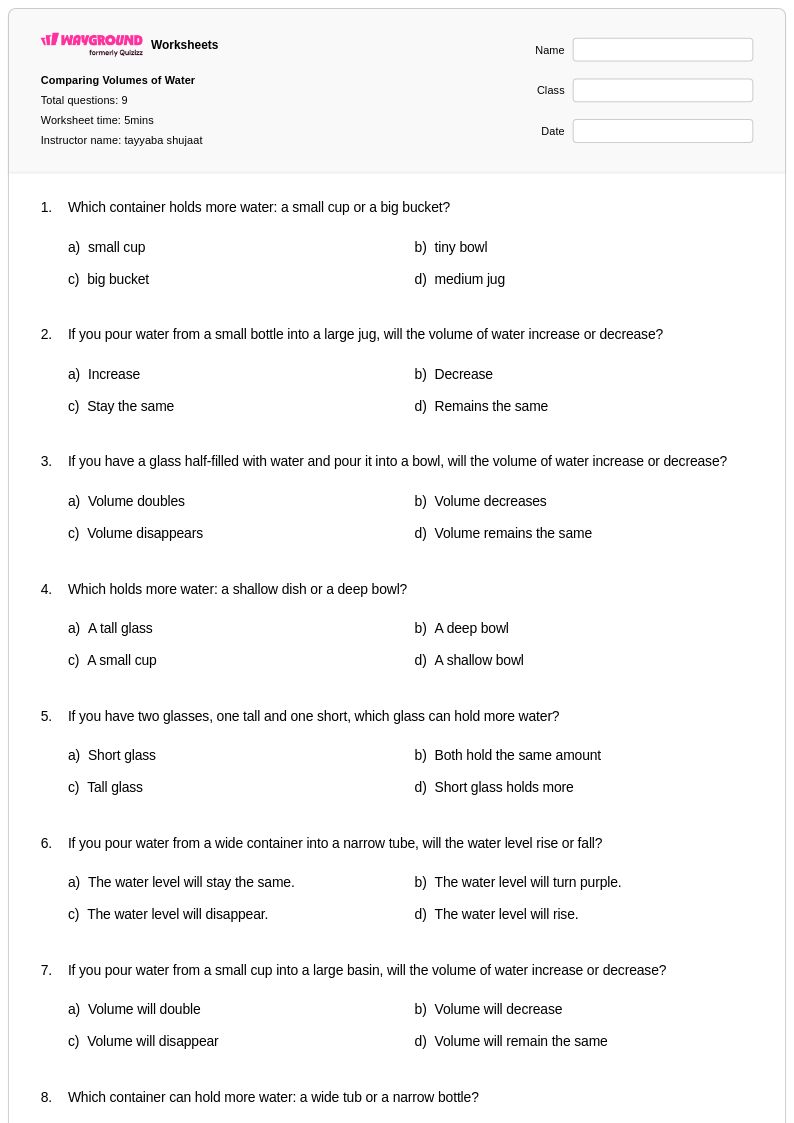
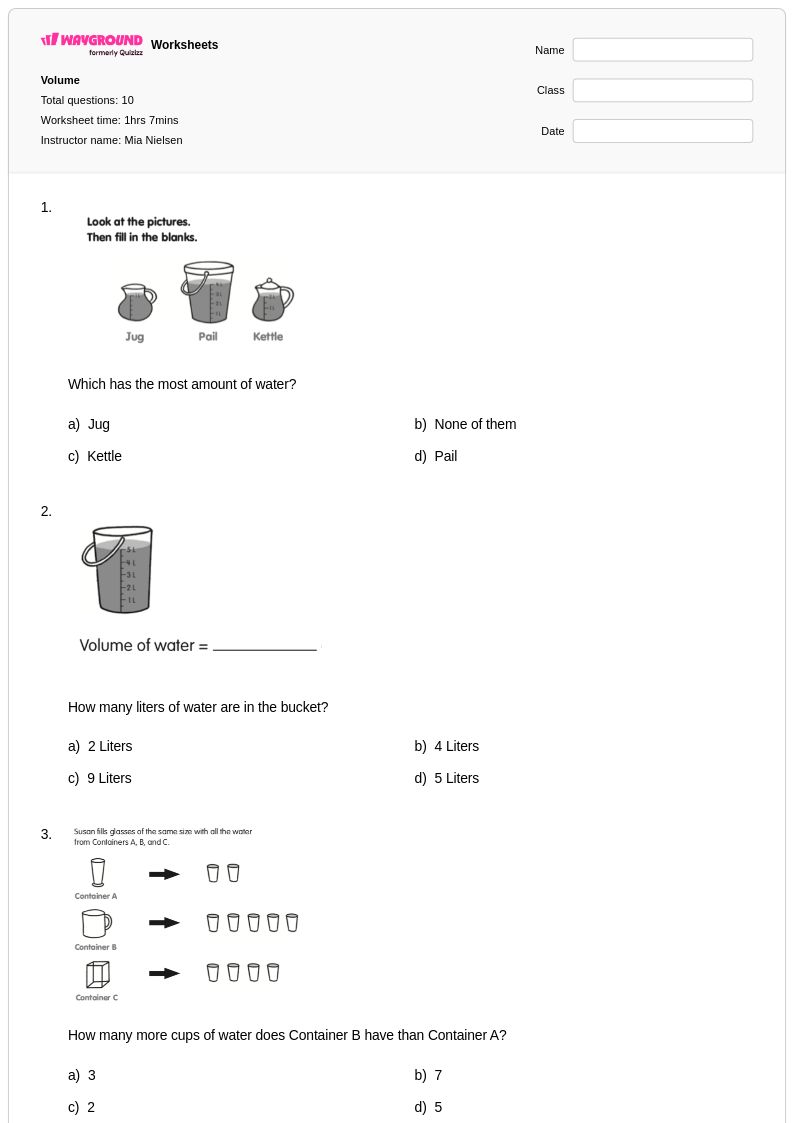
Comparing volume worksheets for kindergarten students available through Wayground (formerly Quizizz) provide essential foundational experiences for young learners to develop spatial reasoning and measurement concepts. These carefully designed printables introduce kindergarteners to the fundamental skill of determining which containers hold more or less liquid, using visual comparisons and hands-on activities that make abstract volume concepts concrete and accessible. The practice problems typically feature familiar objects like cups, bottles, and buckets, allowing students to build measurement vocabulary while strengthening their ability to make logical comparisons. Each worksheet comes with a comprehensive answer key to support accurate assessment, and the free pdf format ensures teachers can easily distribute materials for both classroom instruction and home practice.
Wayground (formerly Quizizz) empowers educators with access to millions of teacher-created comparing volume resources specifically tailored for kindergarten mathematics instruction. The platform's robust search and filtering capabilities allow teachers to quickly locate worksheets that align with specific learning standards and match their students' developmental needs. These differentiation tools enable seamless customization of materials for remediation and enrichment purposes, ensuring every kindergartener receives appropriately challenging volume comparison activities. Available in both printable and digital formats including downloadable pdf versions, these worksheet collections support flexible lesson planning while providing consistent skill practice opportunities that help young mathematicians build confidence with early measurement concepts through repeated exposure and varied problem-solving experiences.
FAQs
How do I teach comparing volume in kindergarten?
Use familiar containers such as cups, bottles, and buckets, and let children predict which holds more or less before testing with water, sand, or counters. Model precise language such as holds more, holds less, and holds the same, then connect the hands-on comparison to worksheet pictures.
What activities help kindergarteners practice comparing volume?
Useful activities include matching containers by capacity, circling the container that holds more, ordering three pictured containers, and checking predictions through pouring activities. Keep the focus on direct visual and hands-on comparisons rather than formulas or formal volume calculations.
What mistakes do kindergarteners make when comparing volume?
Kindergarteners often assume the tallest or widest container always holds the most, even when its other dimensions are smaller. Asking them to explain a prediction and then test it by transferring the same material between containers helps correct this misconception.
How can I use a Wayground kindergarten comparing volume worksheet?
Wayground worksheets are available as printable PDFs and digital formats, allowing teachers to host a digital quiz or print and assign the activity on paper; every worksheet includes a complete answer key. Teachers can scan or capture completed paper worksheets for grading in the Wayground for Teachers app, and offline practice can help limit screen use.
How does comparing volume fit into the Common Core kindergarten curriculum?
Common Core kindergarten measurement emphasizes describing and directly comparing measurable attributes of objects, including capacity-related ideas such as which container holds more or less. Comparing volume worksheets reinforce that foundation through concrete objects, visual reasoning, and accurate measurement vocabulary.
What grade do students begin comparing volume?
Students commonly begin informal volume and capacity comparisons in kindergarten through hands-on work with familiar containers. At this stage, they identify which object holds more or less and explain their reasoning without using volume formulas.
How can I differentiate comparing volume practice for kindergarteners?
Provide concrete containers and two-choice comparisons for learners who need support, while asking advanced students to order several containers and justify their predictions. Wayground can add Read Aloud, extended time, reduced answer choices, or reading mode for individual students, and teachers can adjust worksheet font size, spacing, language, or use a dyslexia-friendly font.

![1B [ALGEBRA] - Printable Comparing-volume Worksheets Kindergarten - Quizizz](https://quizizz-static.s3.amazonaws.com/_media/worksheets-new/65537326f156037efea0b1b3-1b-algebra)