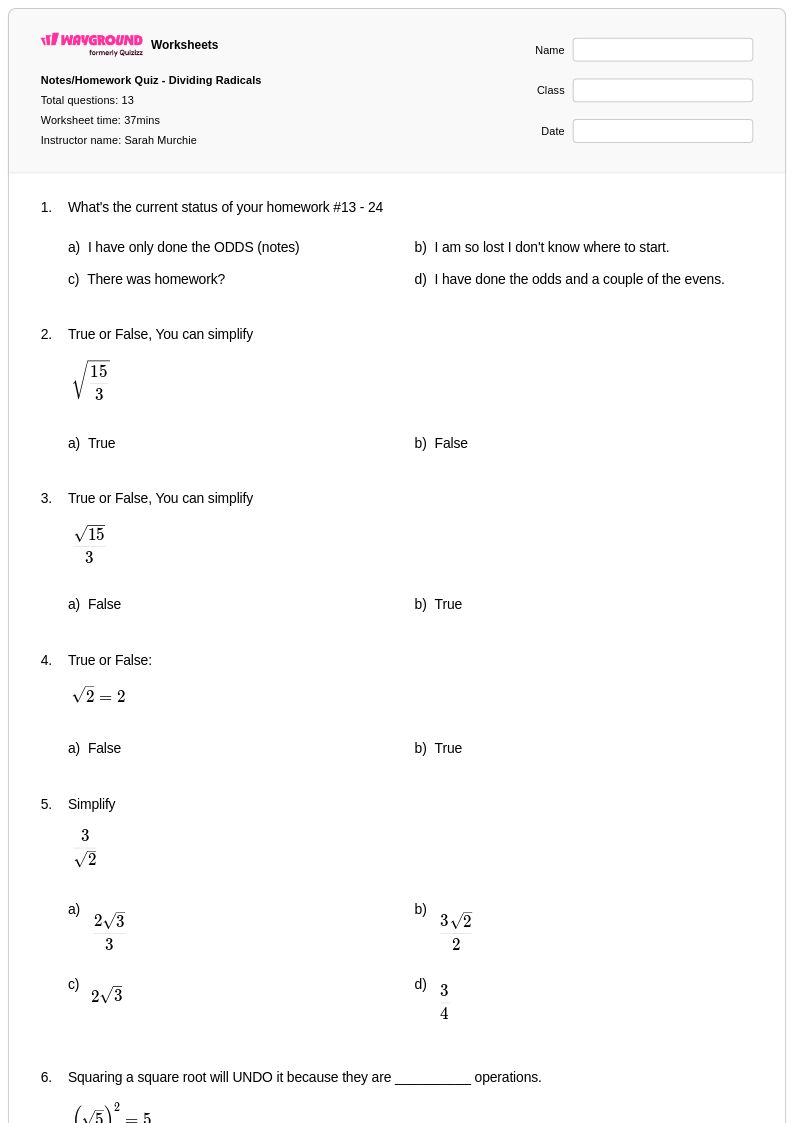
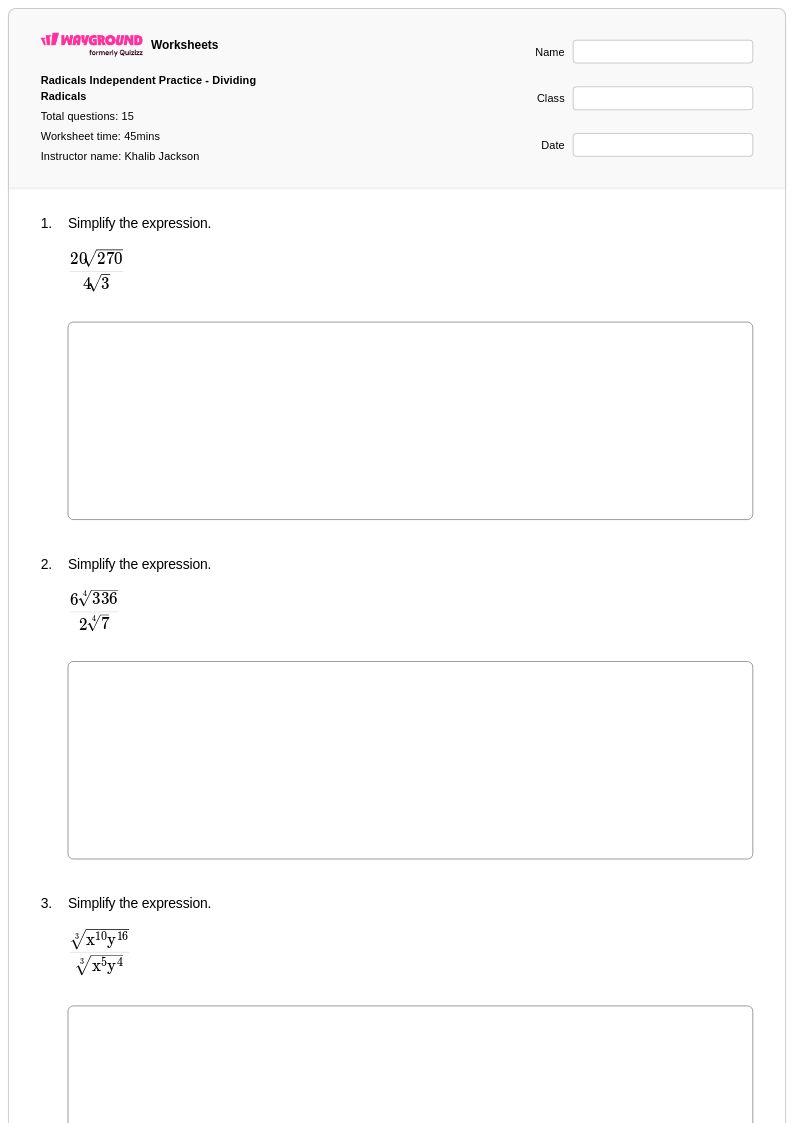
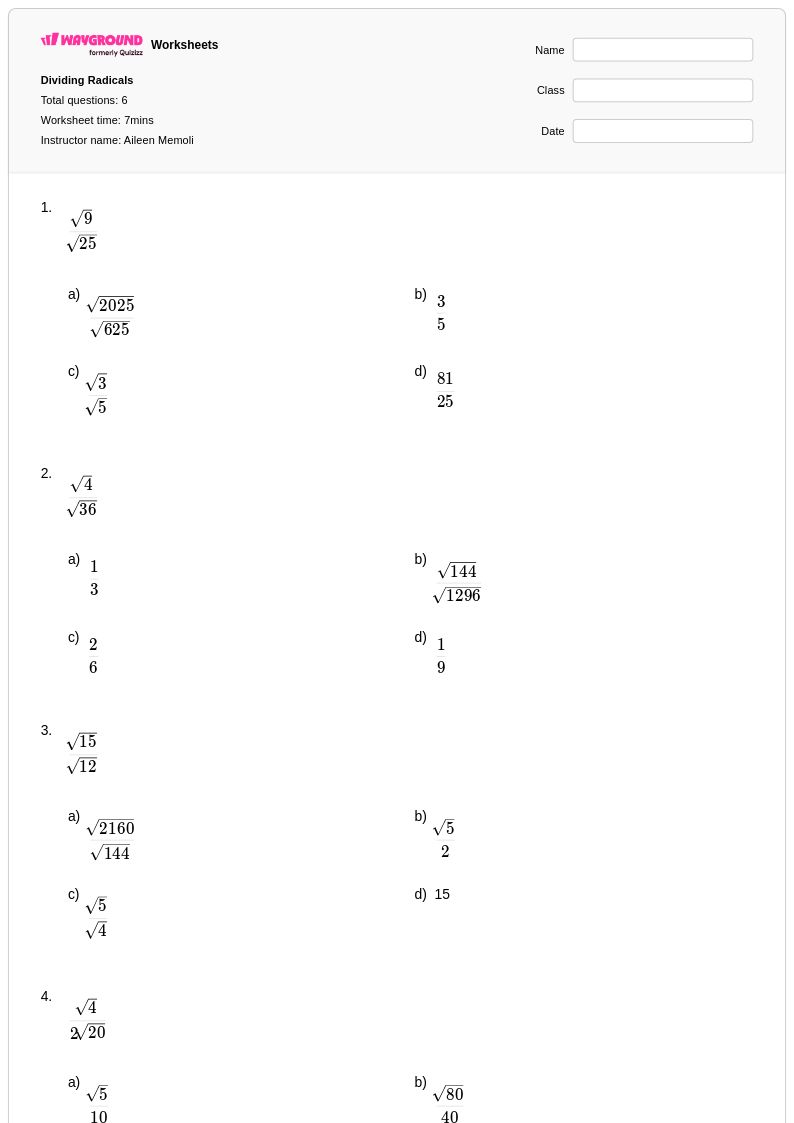
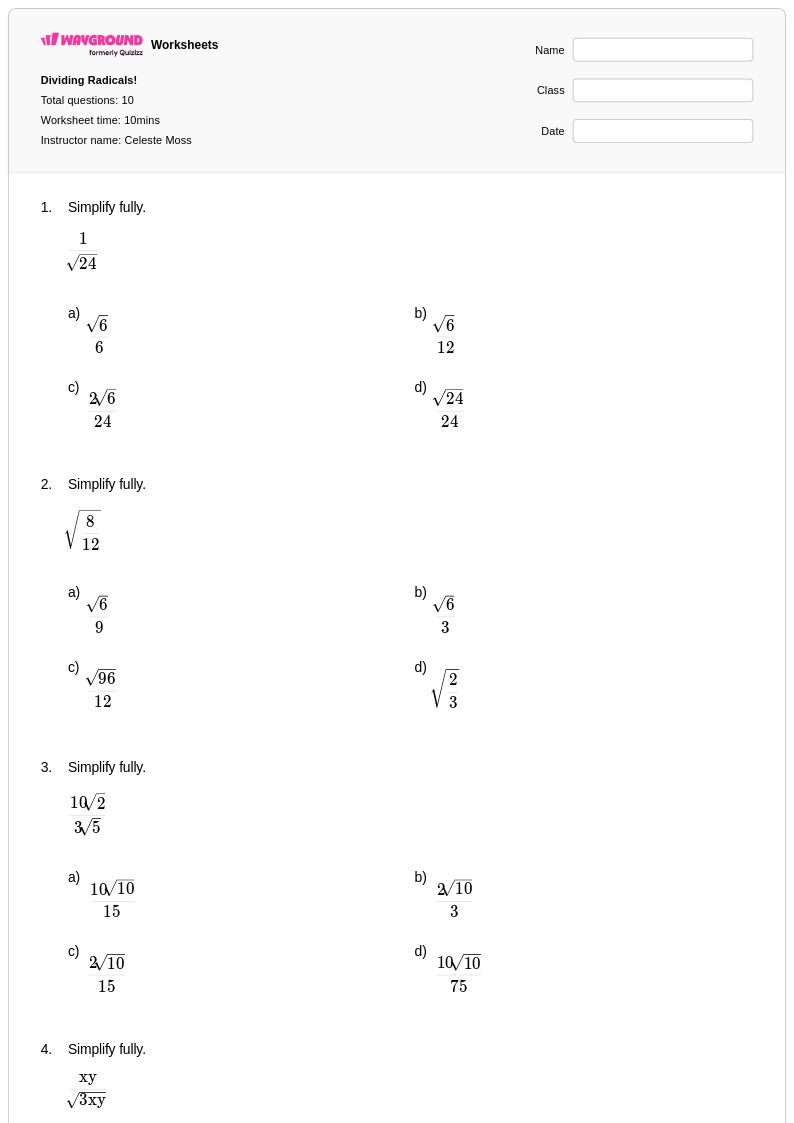
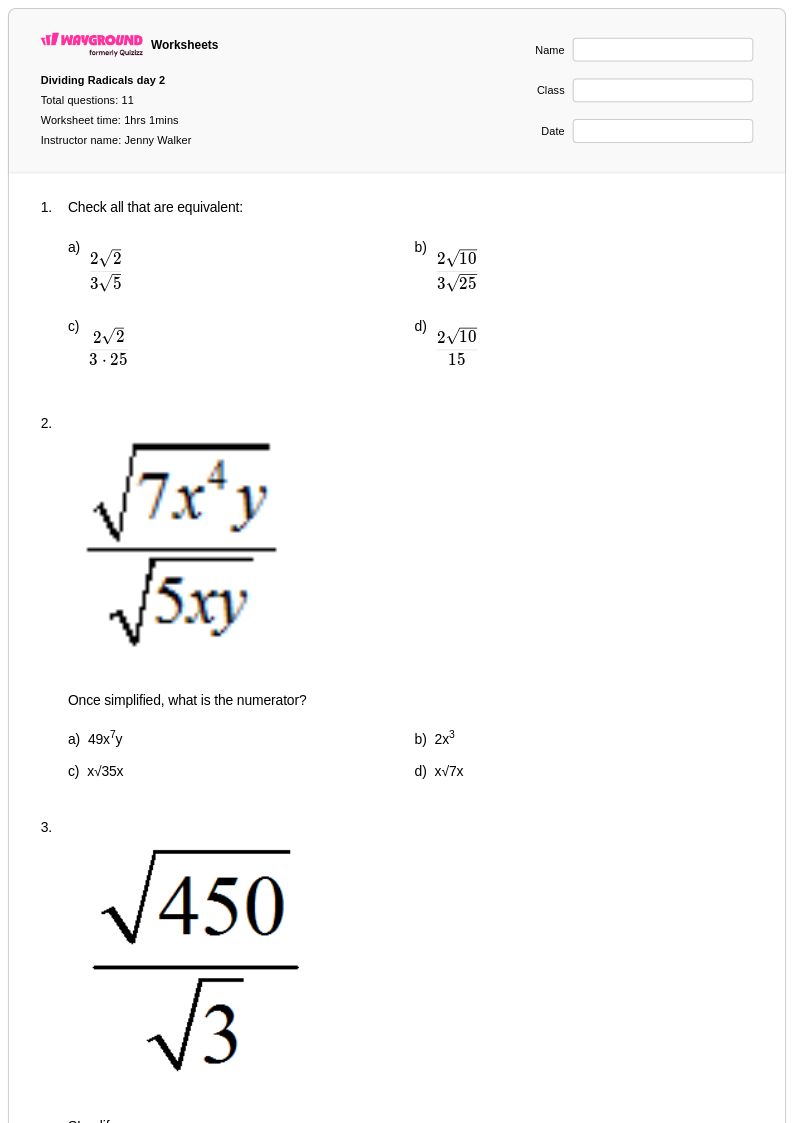
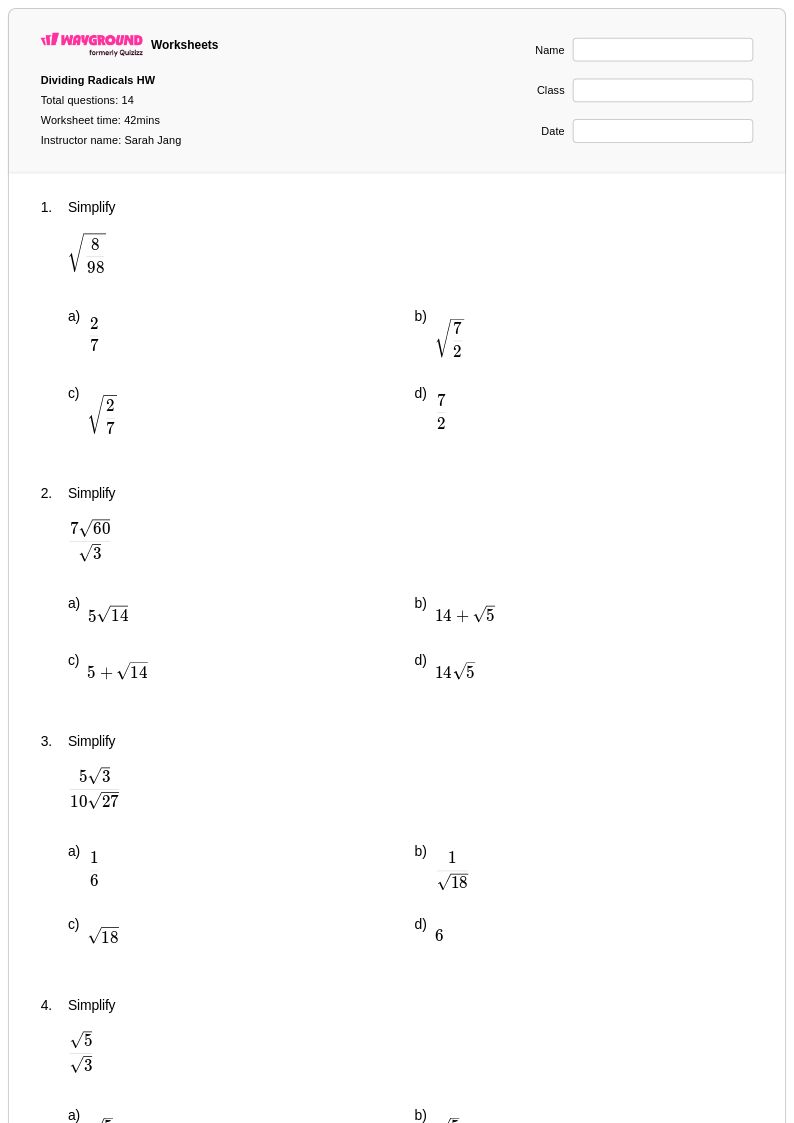
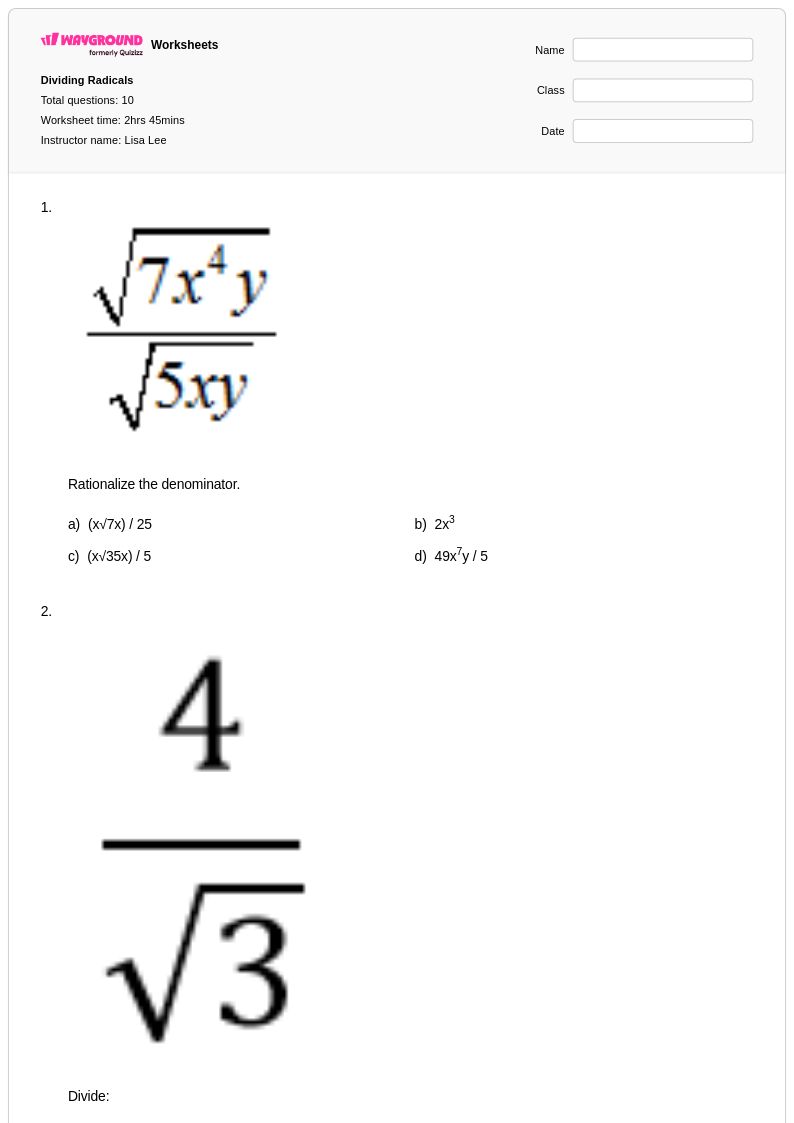
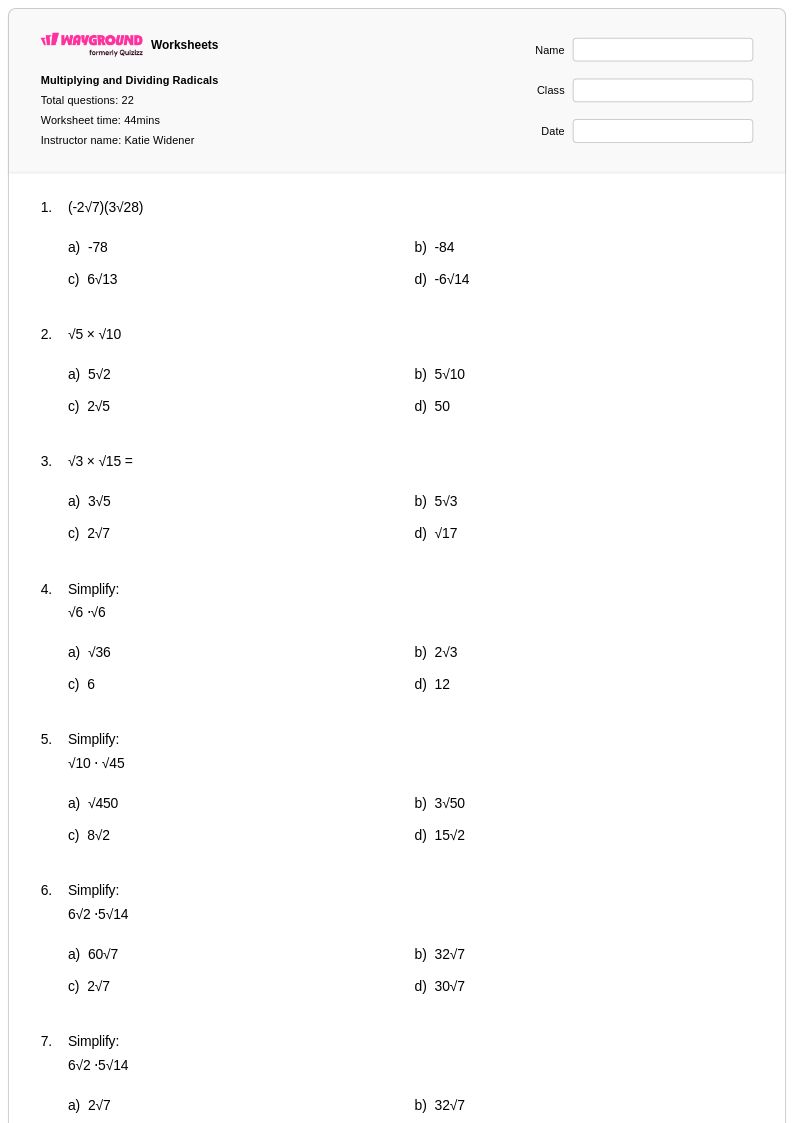
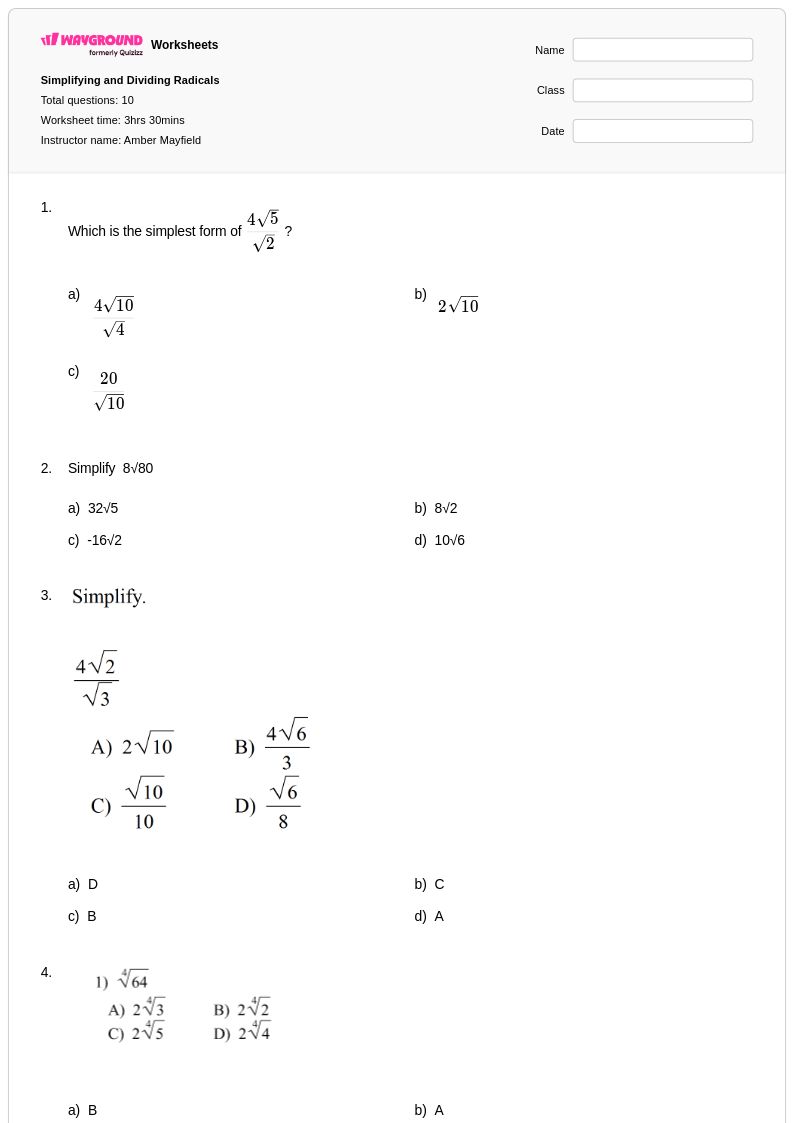
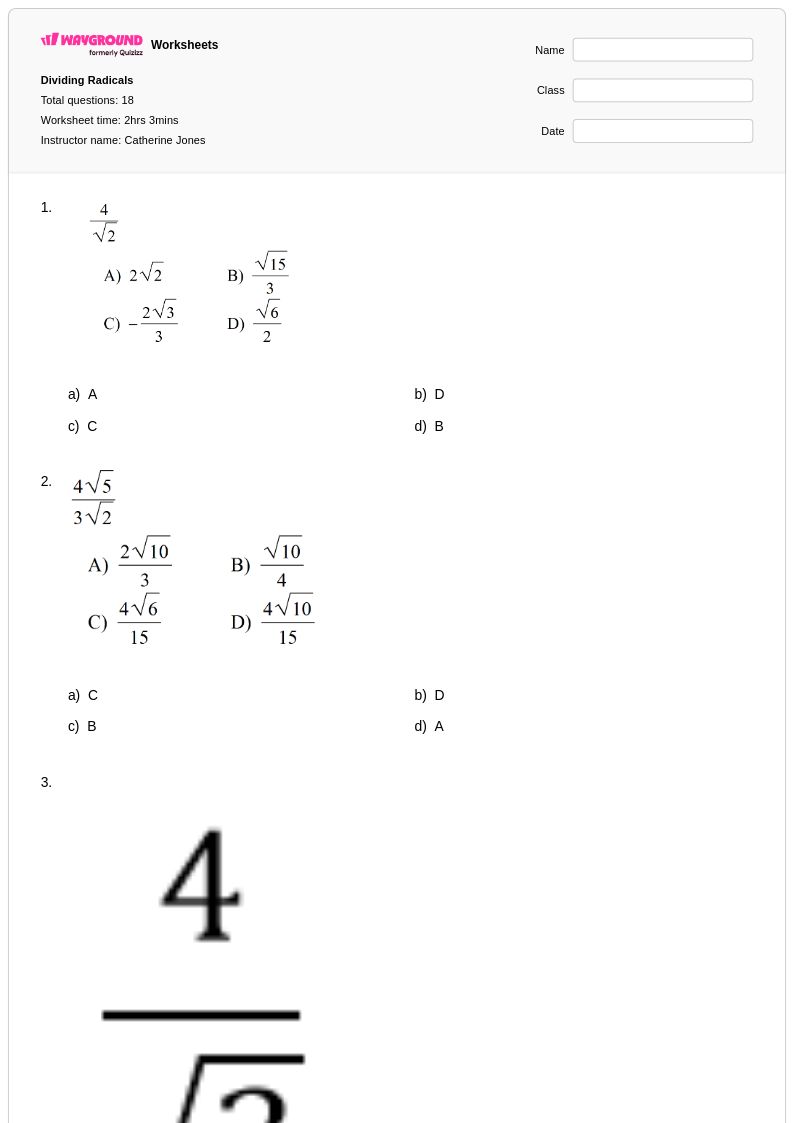
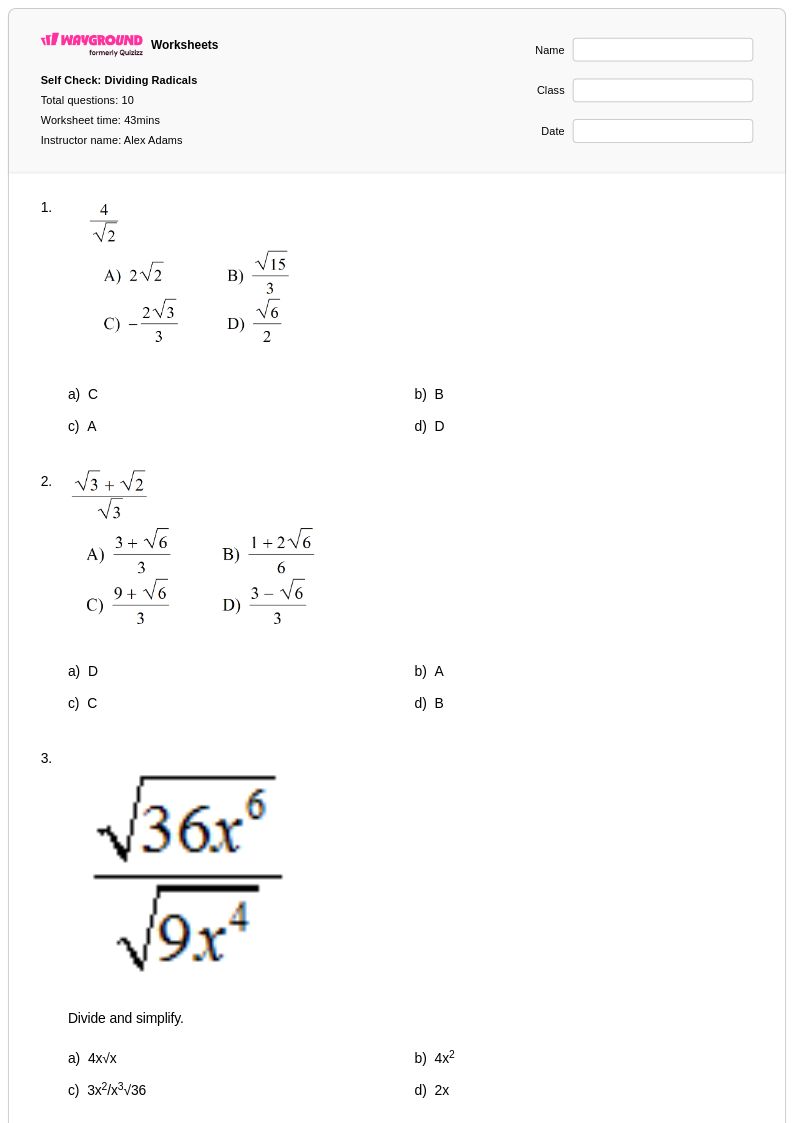
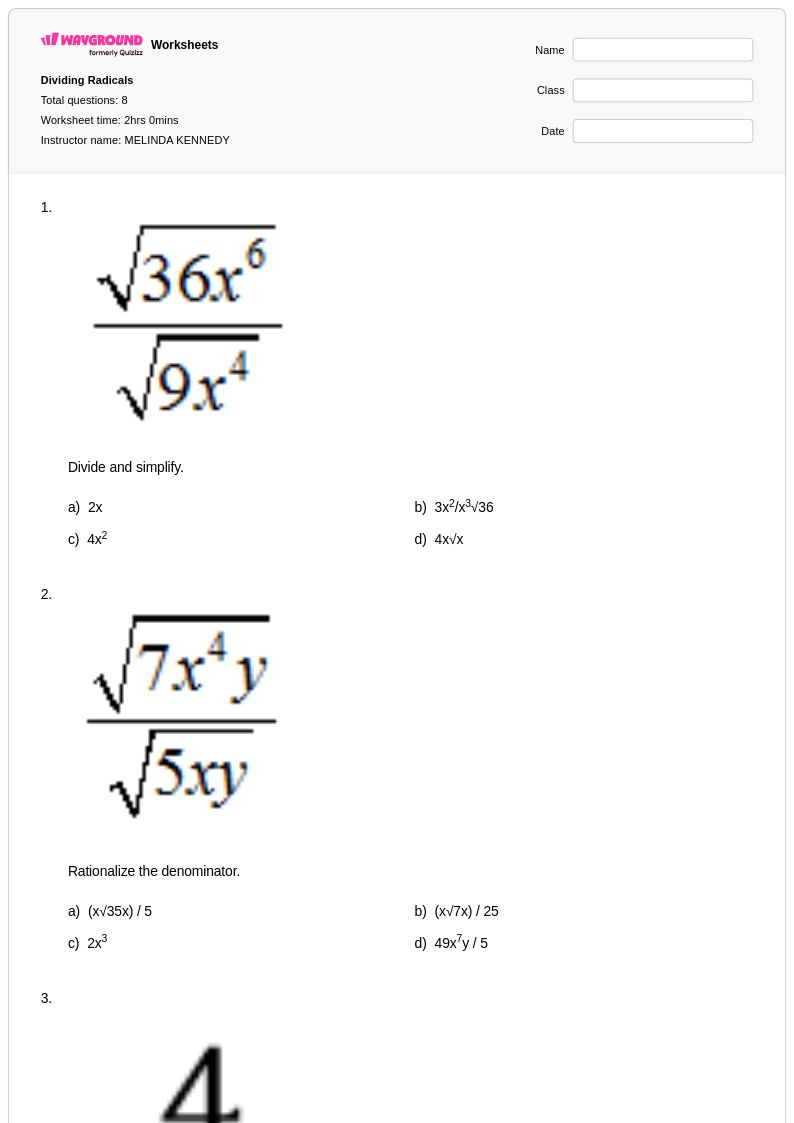
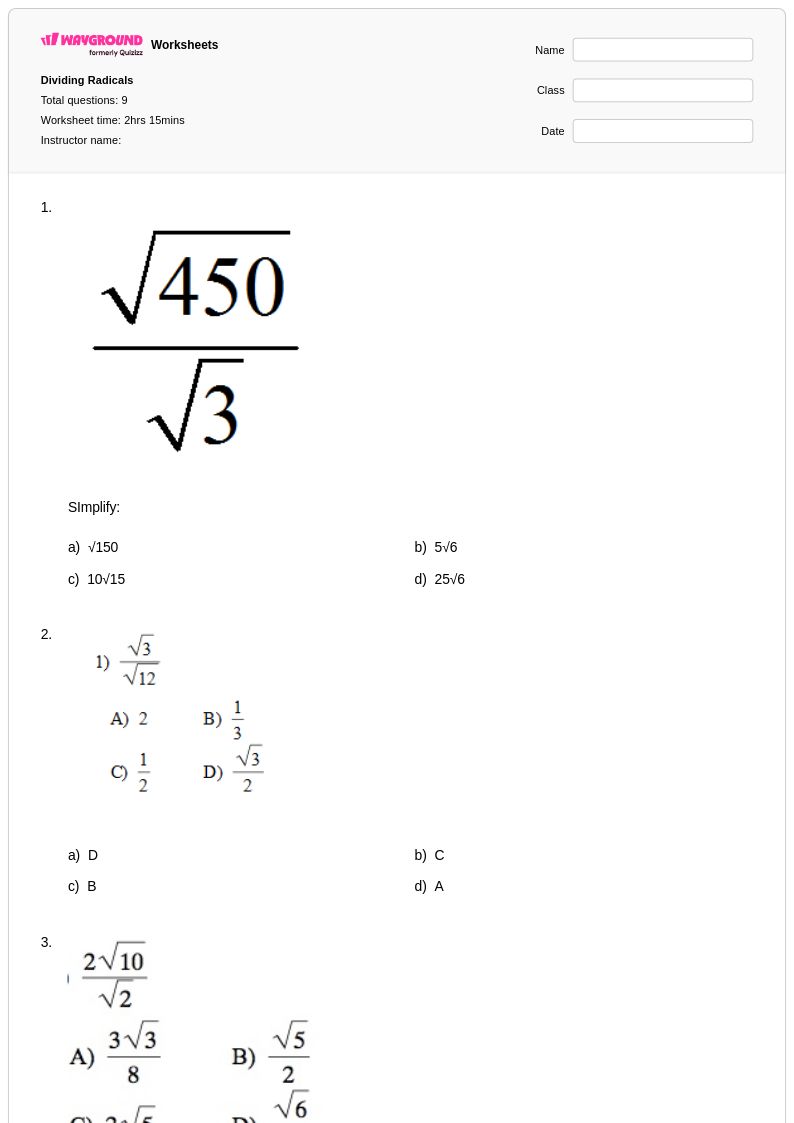
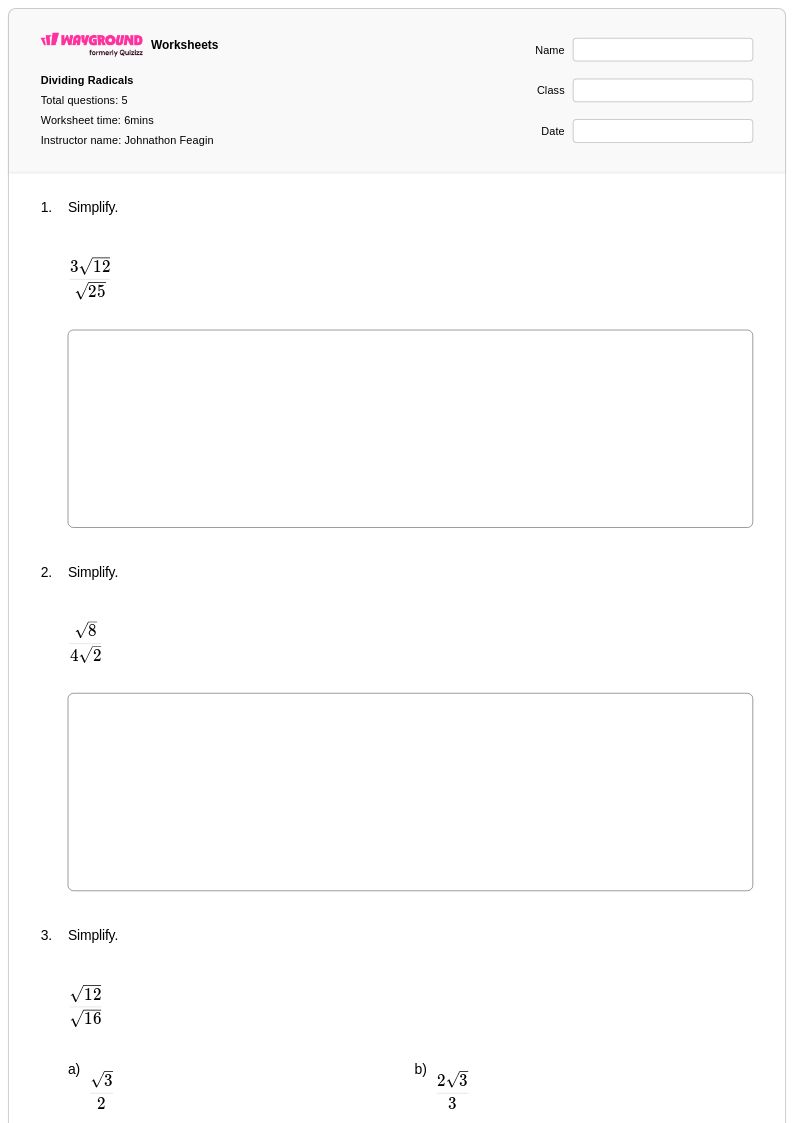
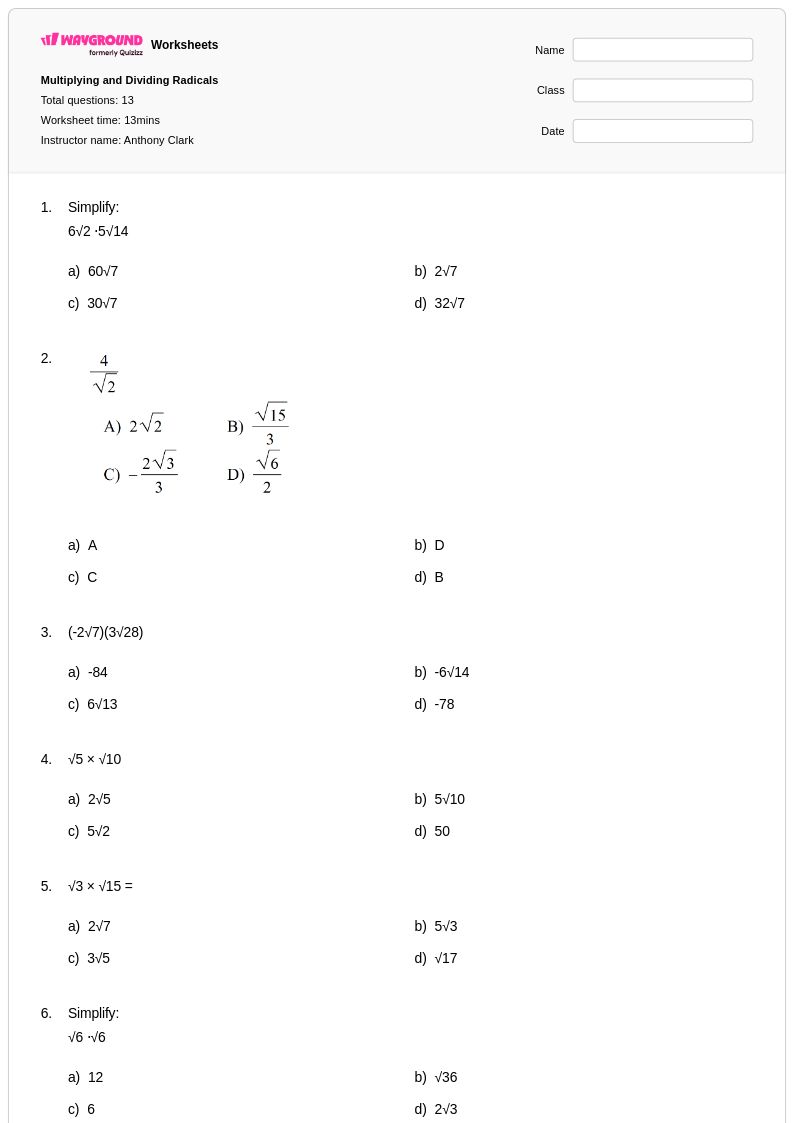
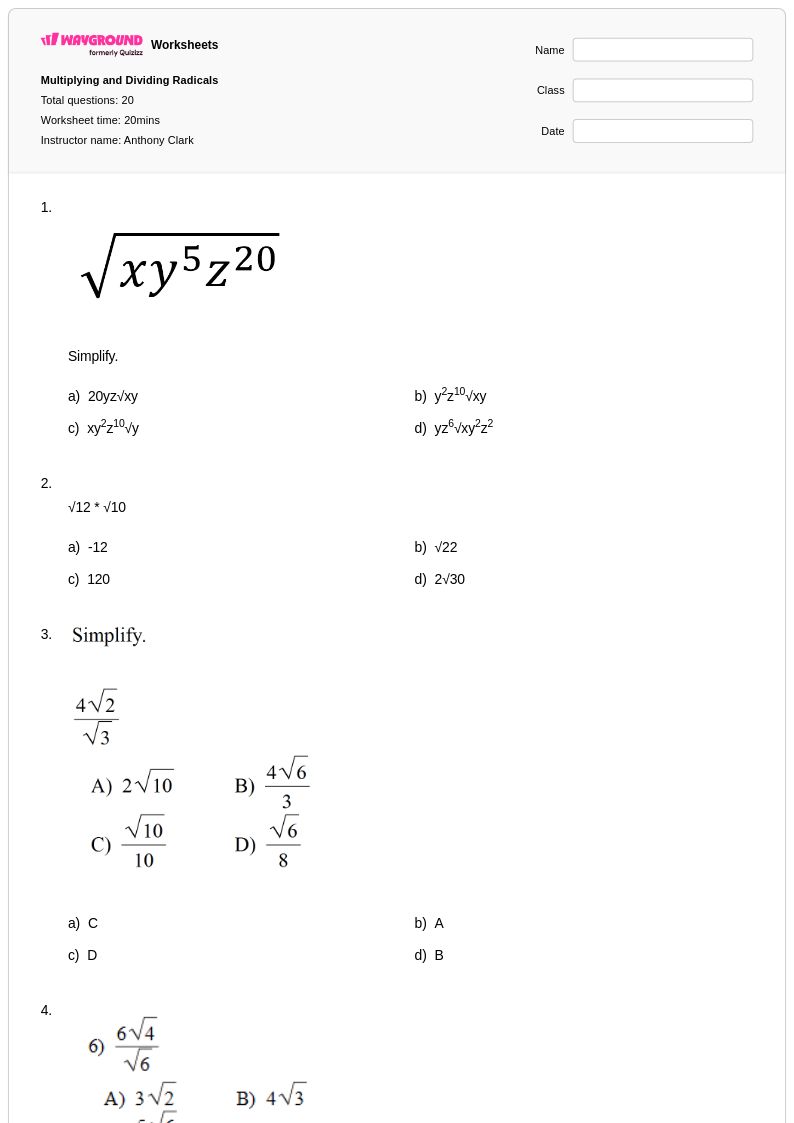
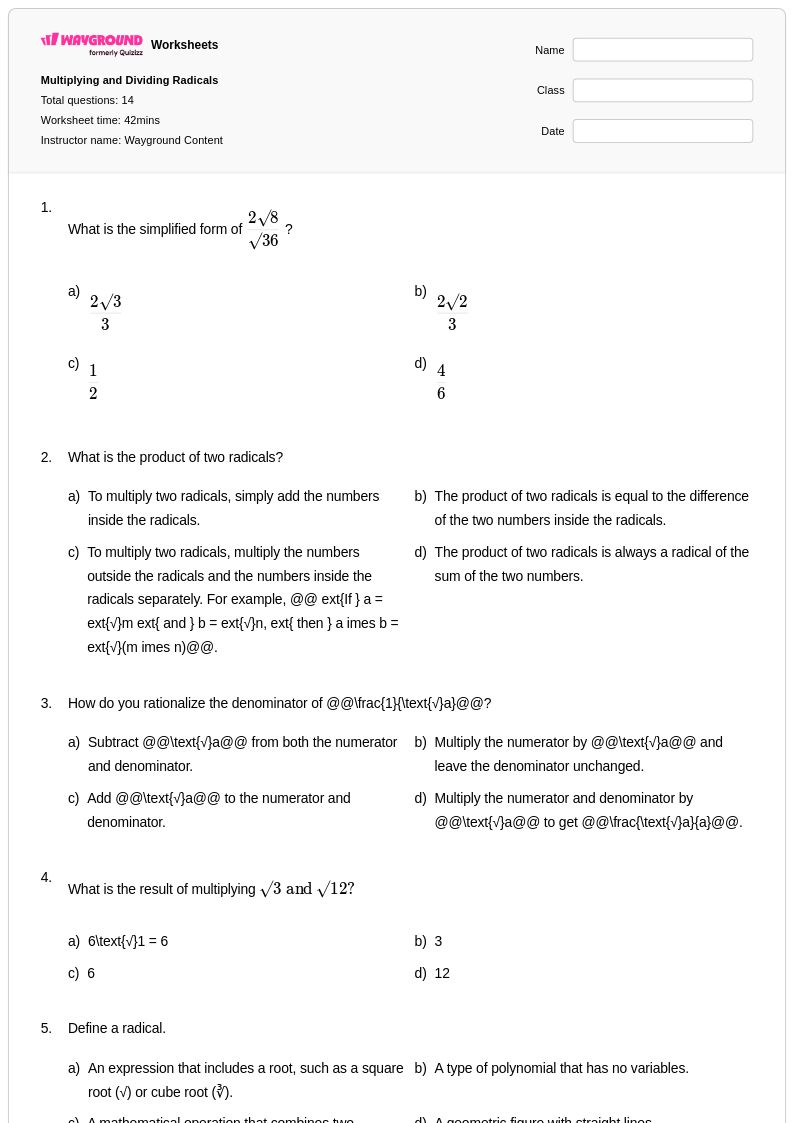
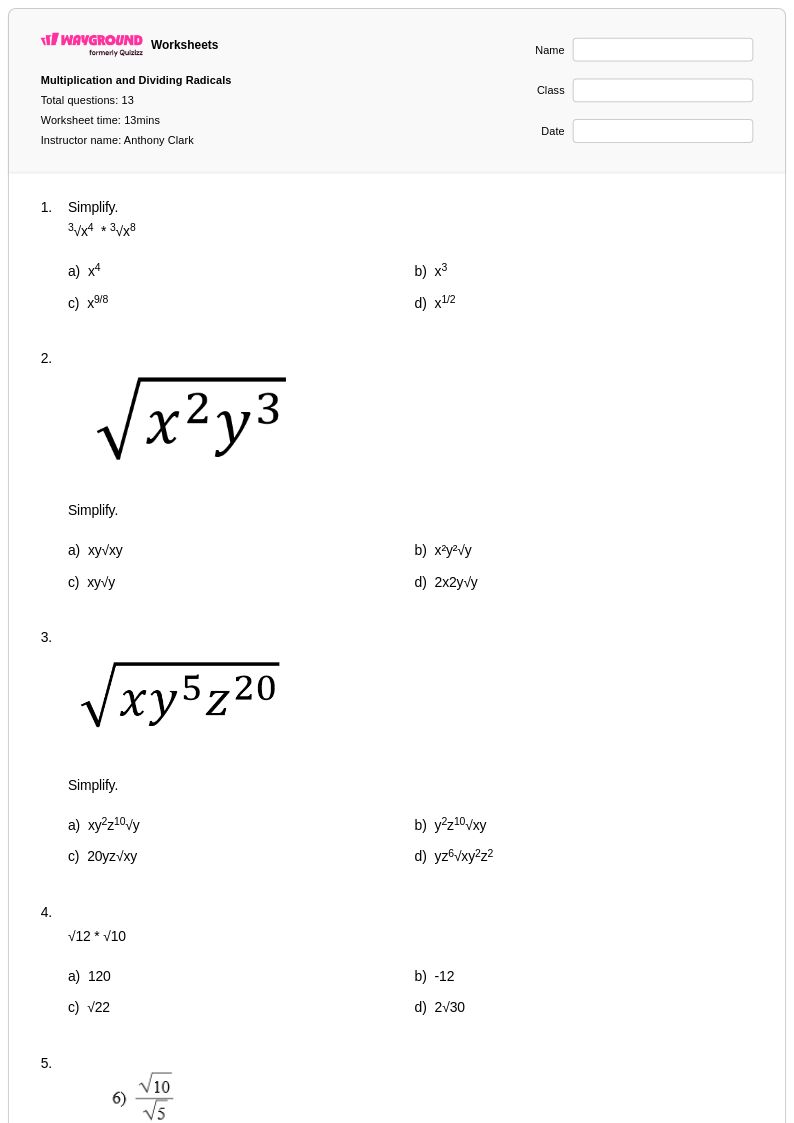
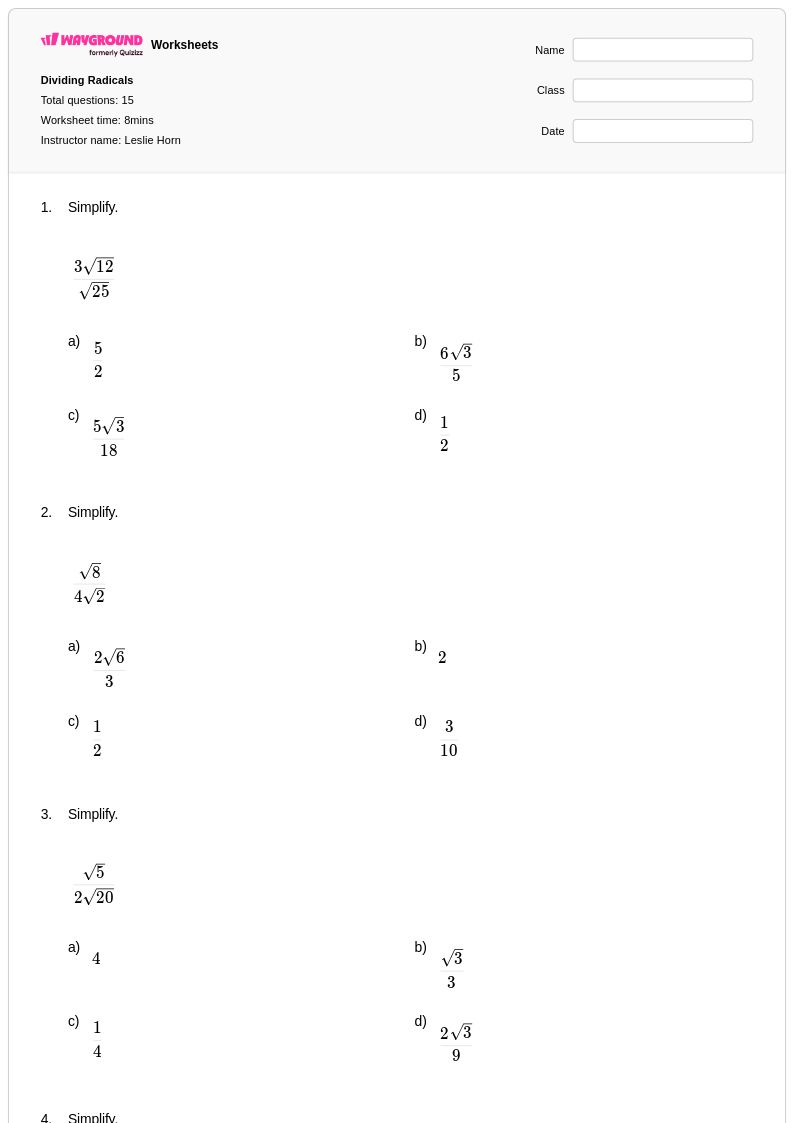
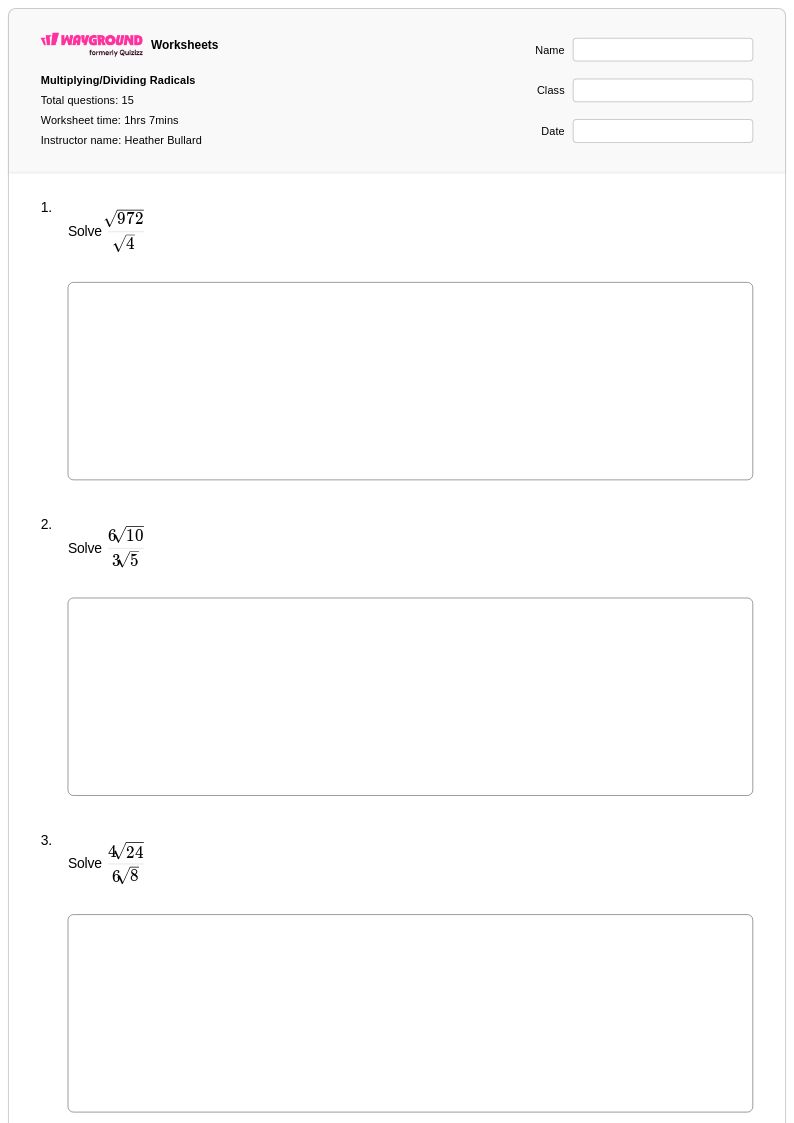
Wayground's free dividing radicals worksheets provide comprehensive practice problems and answer keys to help students master simplifying and dividing radical expressions through structured printable PDF exercises.
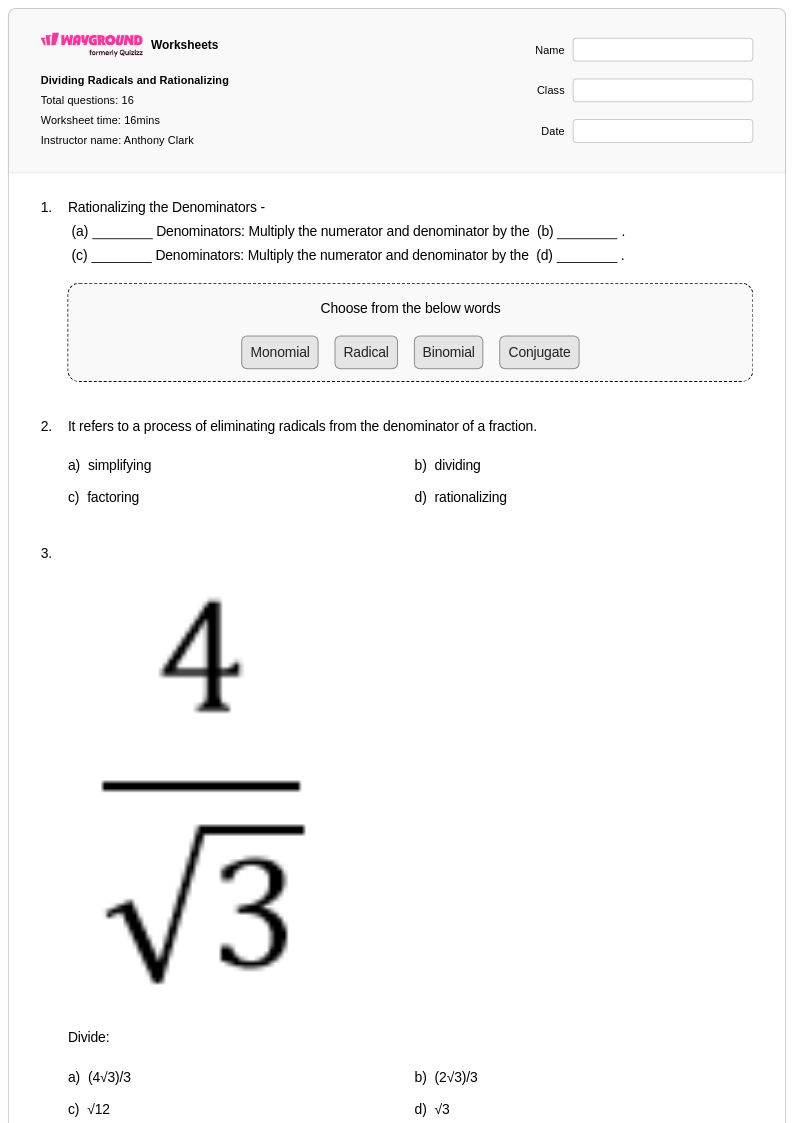
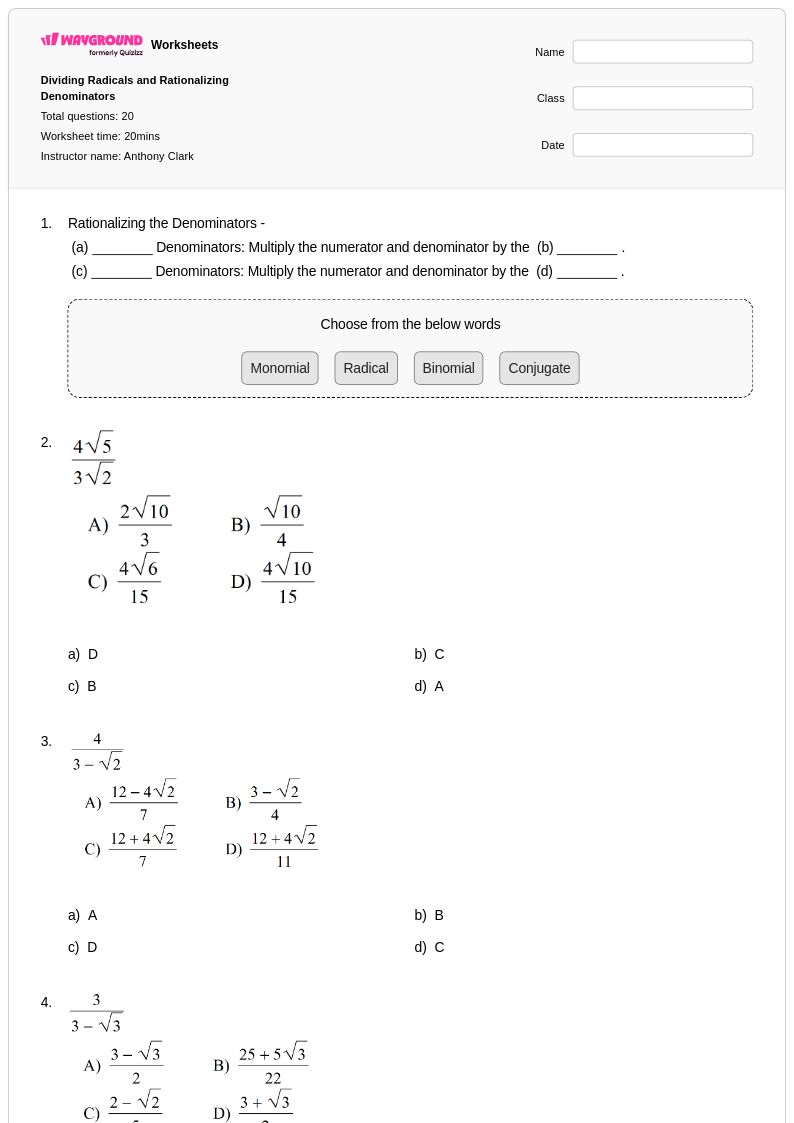
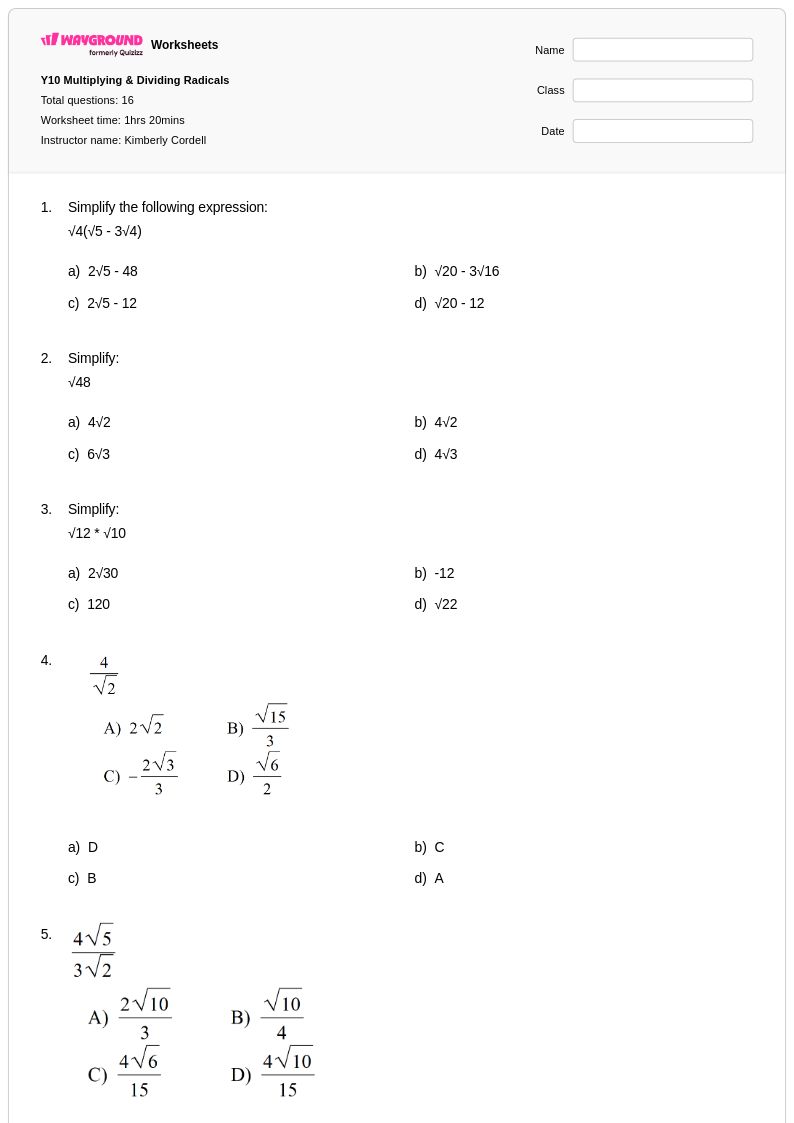
Dividing radicals worksheets available through Wayground (formerly Quizizz) provide comprehensive practice opportunities for students to master this fundamental algebraic skill. These carefully designed resources focus on essential techniques including rationalizing denominators, simplifying radical expressions with coefficients, and applying the quotient rule for radicals. Students work through systematic practice problems that progressively build their understanding of how to divide square roots, cube roots, and higher-order radicals while maintaining mathematical accuracy. Each worksheet collection includes detailed answer keys and step-by-step solutions, making these free printables invaluable for both independent study and classroom instruction in pdf format.
Wayground (formerly Quizizz) empowers mathematics teachers with an extensive library of millions of teacher-created dividing radicals worksheets that streamline lesson planning and differentiated instruction. The platform's robust search and filtering capabilities allow educators to quickly locate resources aligned with specific mathematical standards and skill levels, ensuring appropriate challenge levels for diverse learners. Teachers can seamlessly customize existing worksheets or create new variations to address individual student needs, whether for remediation of foundational radical concepts or enrichment activities involving complex radical expressions. These versatile resources are available in both printable and digital formats, enabling flexible implementation across traditional and technology-enhanced learning environments while supporting systematic skill development and assessment in algebraic problem-solving.
FAQs
How do I teach dividing radicals?
Start with the quotient rule — students need to see that dividing radicals follows the same logic as multiplying them, just in reverse. Once they're comfortable splitting a single radical into a quotient, move to rationalizing denominators, which is where most of the real work happens. A common sequencing that works: (1) divide simple square roots with no variables, (2) rationalize monomial denominators, (3) rationalize binomial denominators using conjugates. Keeping each stage distinct before combining them prevents the confusion that comes from introducing conjugates too early.
What exercises help students practice dividing radicals?
The most effective practice moves from narrow to broad: start with problems that isolate one skill (say, applying the quotient rule to numerical radicals only), then layer in coefficients, then variables, then rationalization. Mixed-format sets — where students don't know in advance whether they'll need to rationalize or just simplify — are especially useful for building the judgment to recognize which technique applies. Wayground's dividing radicals worksheets are structured with this kind of progressive difficulty, and they're available as printable PDFs or as digital quizzes hosted directly on the platform.
What mistakes do students commonly make when dividing radicals?
Three errors come up constantly. First, students try to cancel terms across a radical sign as if it were a fraction — for example, incorrectly simplifying √(4/9) by canceling the 4 and 9 separately before taking the root. Second, when rationalizing denominators, they multiply only the denominator by the conjugate and forget to apply it to the numerator too. Third, they stop too early — they rationalize the denominator but leave the numerator unsimplified, so the expression looks rationalized but isn't fully reduced. Targeted practice on each of these in isolation, before mixing problem types, helps students catch their own errors.
How do I use Wayground's dividing radicals worksheets in my class?
You have two main options. Run it as a digital quiz on Wayground — students work through the problems on their devices and results come back to you automatically, with a complete answer key built in. Or download the PDF, print it, and assign it on paper; if you go that route, the Wayground for Teachers app lets you scan or capture student work to grade it without re-entering anything manually. Both formats use the same problems, so the choice comes down to your classroom setup on a given day.
Is dividing radicals aligned to Common Core standards?
Yes. Under Common Core, radical expressions are addressed in the high school Number and Quantity domain, which expects students to extend their understanding of number systems to include irrational numbers and to rewrite expressions in equivalent forms. Dividing radicals — particularly rationalizing denominators — is a direct application of that expectation. It builds on earlier work simplifying square roots and feeds forward into rational exponent notation, where students learn that dividing radicals and dividing expressions with fractional exponents are the same operation written differently.
How can I differentiate dividing radicals practice for mixed-ability classes?
For students who are still shaky on the underlying concepts, Wayground's reduced answer choices accommodation lowers the cognitive load on individual problems so they can focus on the procedure rather than the answer space. The Read Aloud feature helps students who struggle with dense symbolic notation by having problem text read to them. For layout-based accessibility, you can generate an alternate version of the same worksheet with a dyslexia-friendly font or larger text — useful when the issue is reading the expressions rather than solving them. Students who are ready for more challenge can work through the same worksheet without any scaffolding while others receive these supports, and neither group sees what accommodations the other has.
What grade level covers dividing radicals?
Dividing radicals is typically introduced in Algebra 2, which most students encounter in grades 9 or 10, and revisited in Pre-Calculus (grades 11–12) in more complex forms involving variables and higher-order roots. Some accelerated Algebra 1 courses touch on basic radical division in grade 8, but full treatment — including rationalizing binomial denominators with conjugates — is a high school topic.