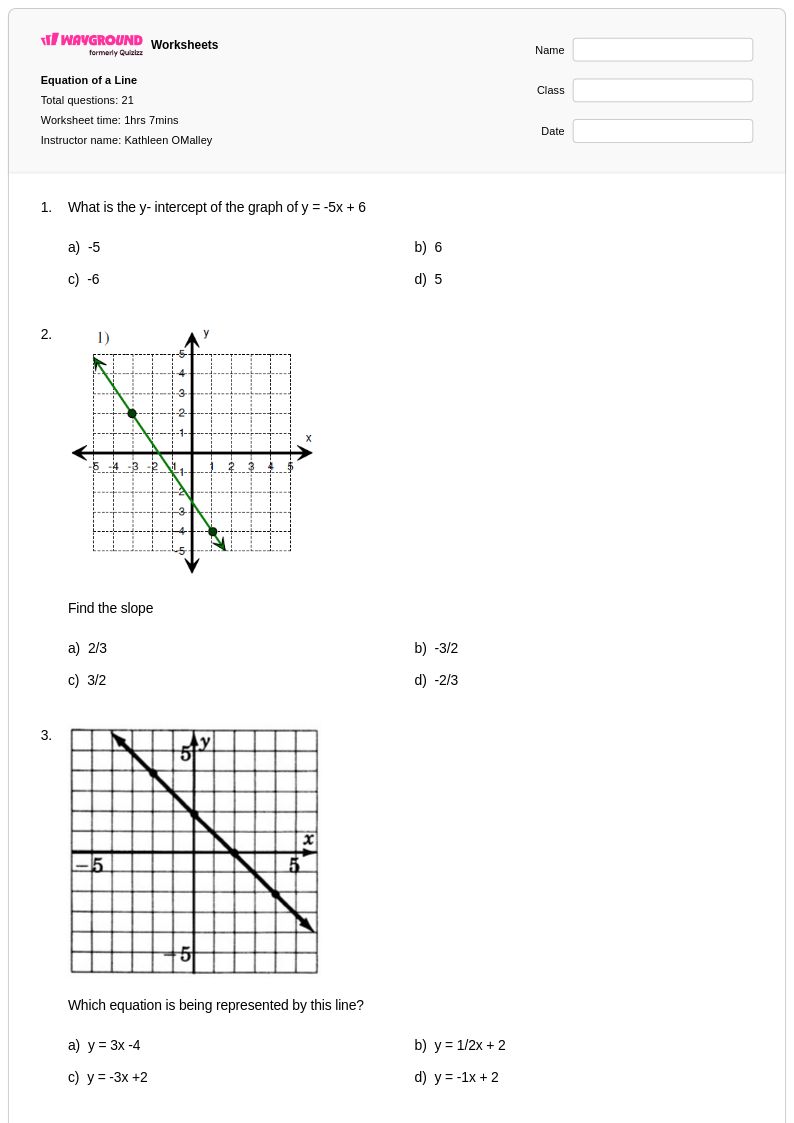
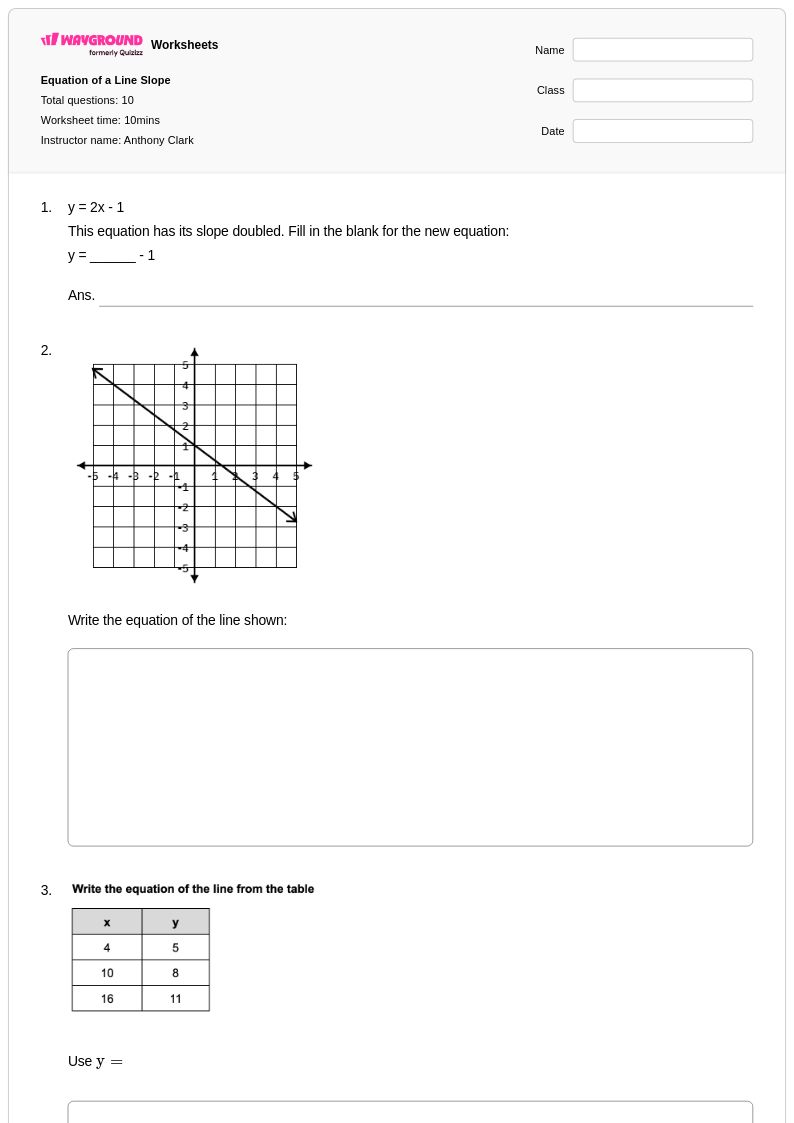
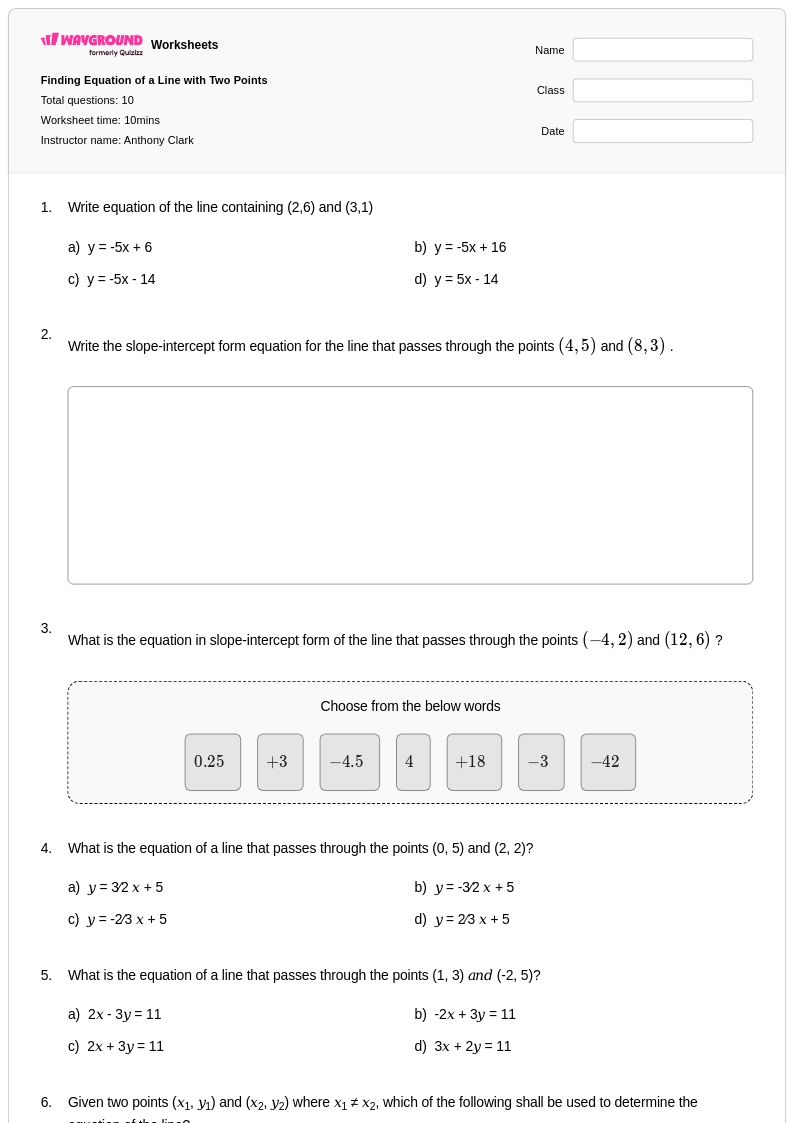
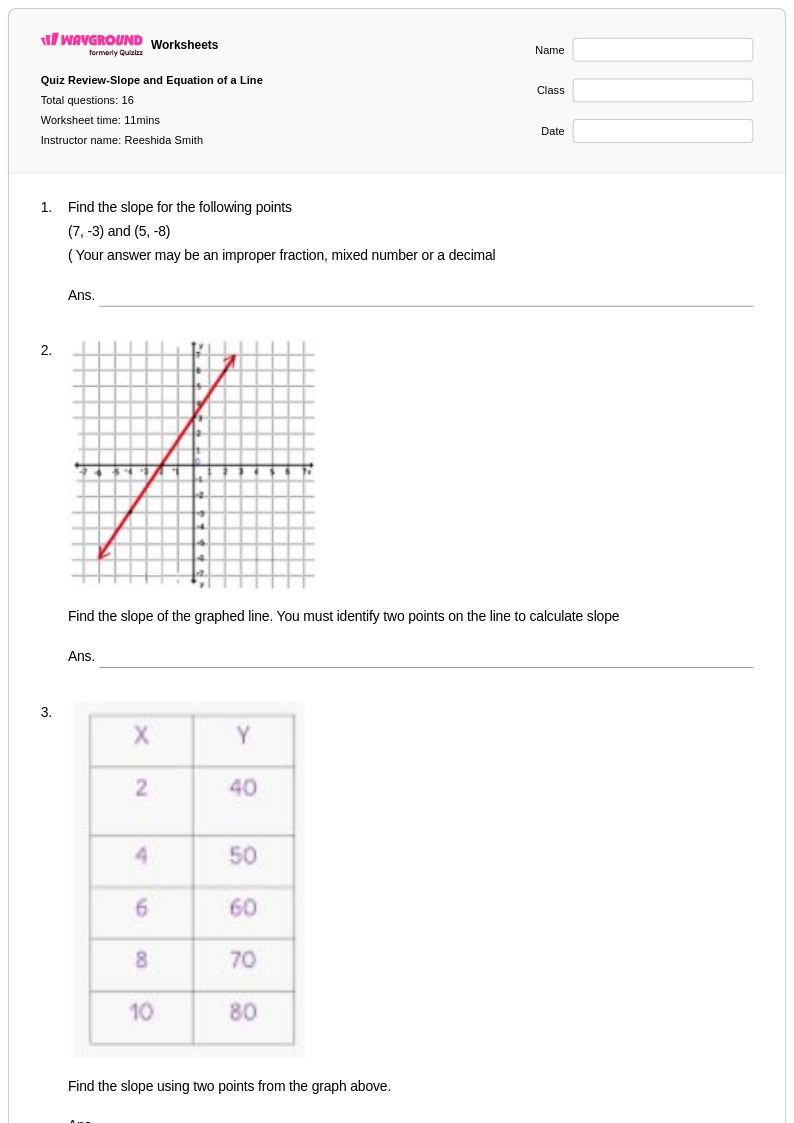
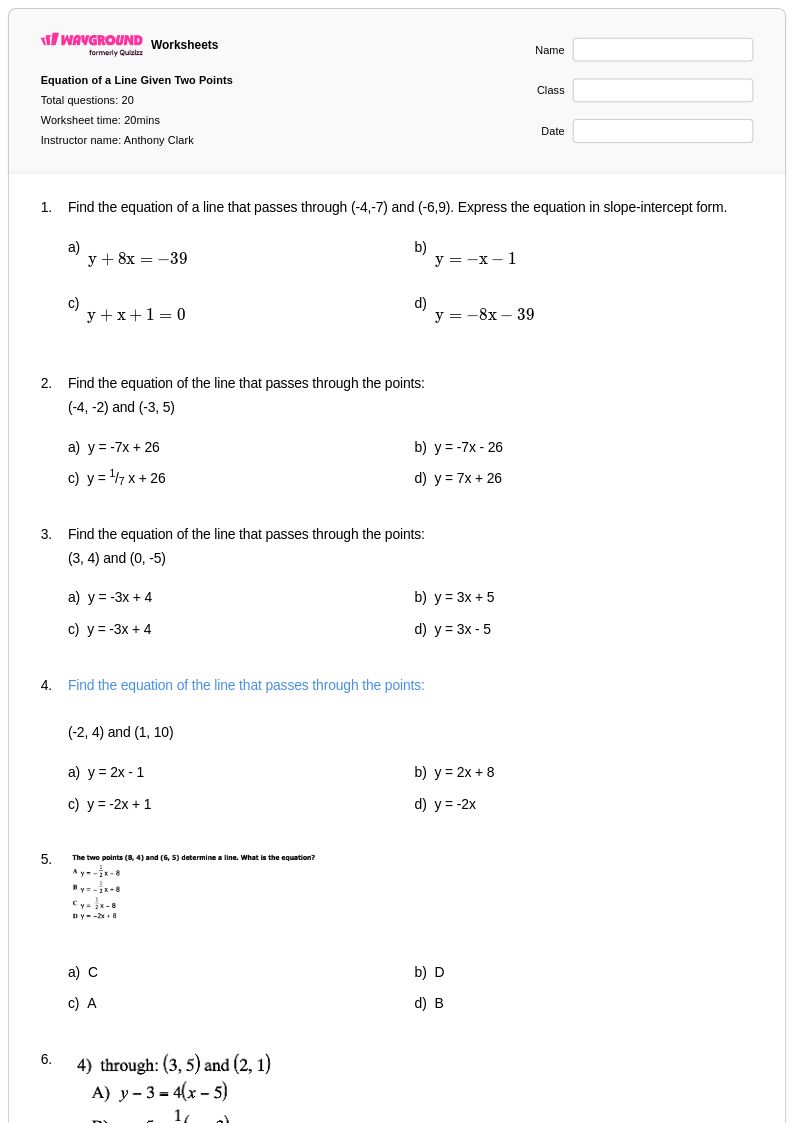
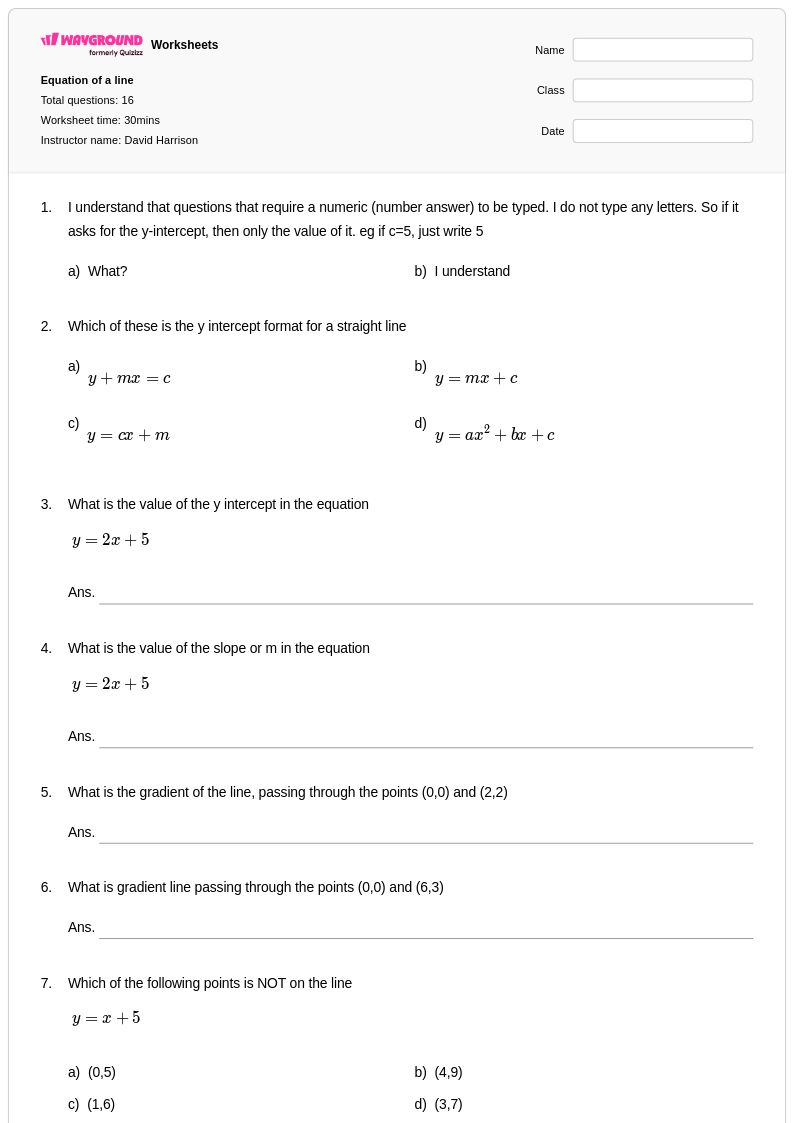
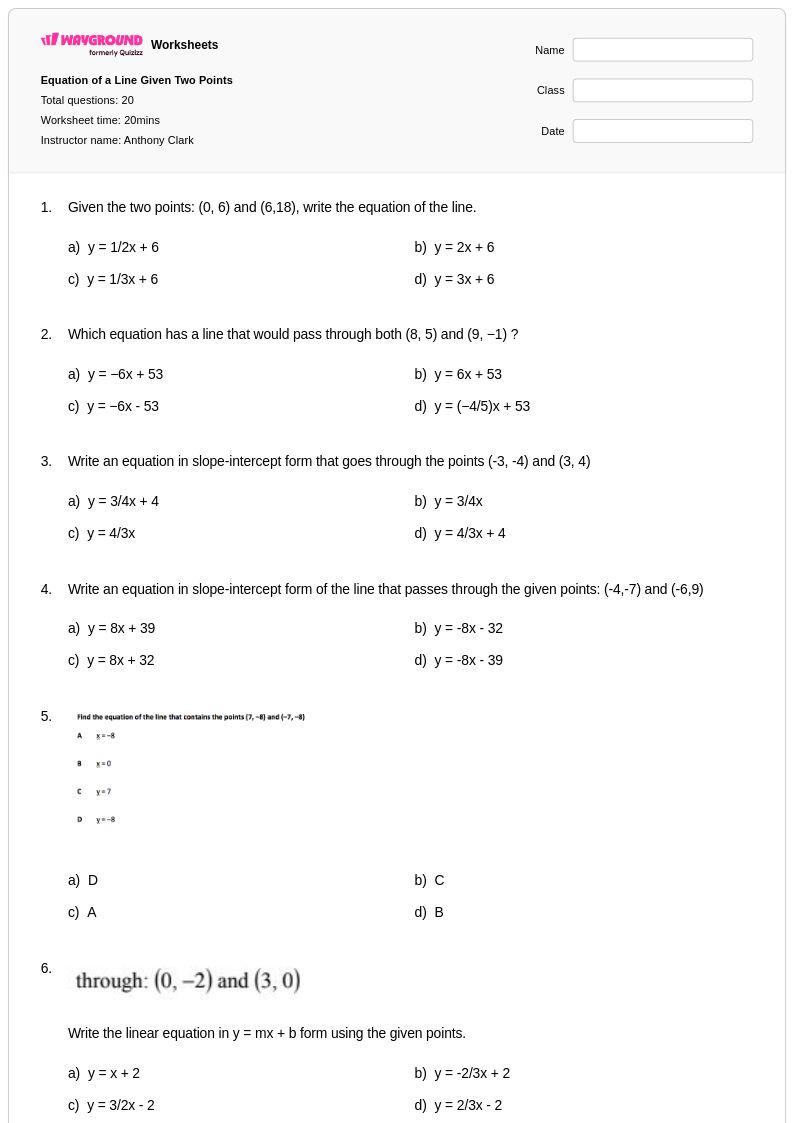
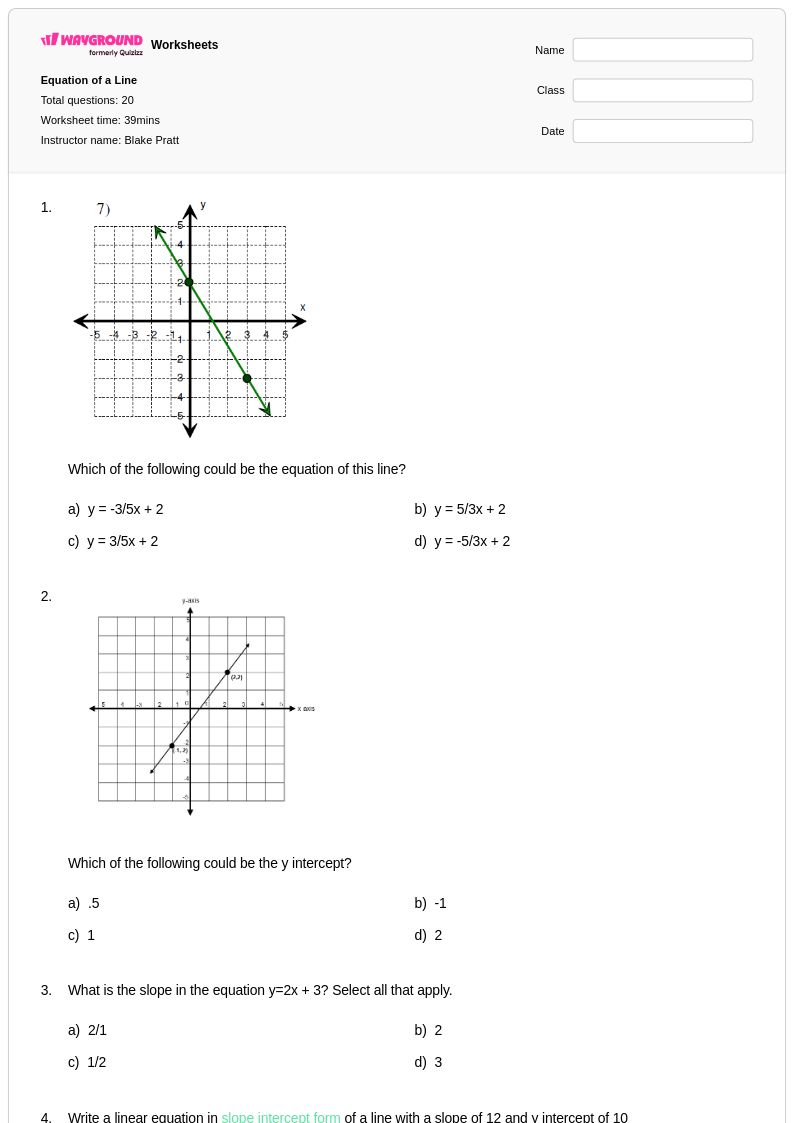
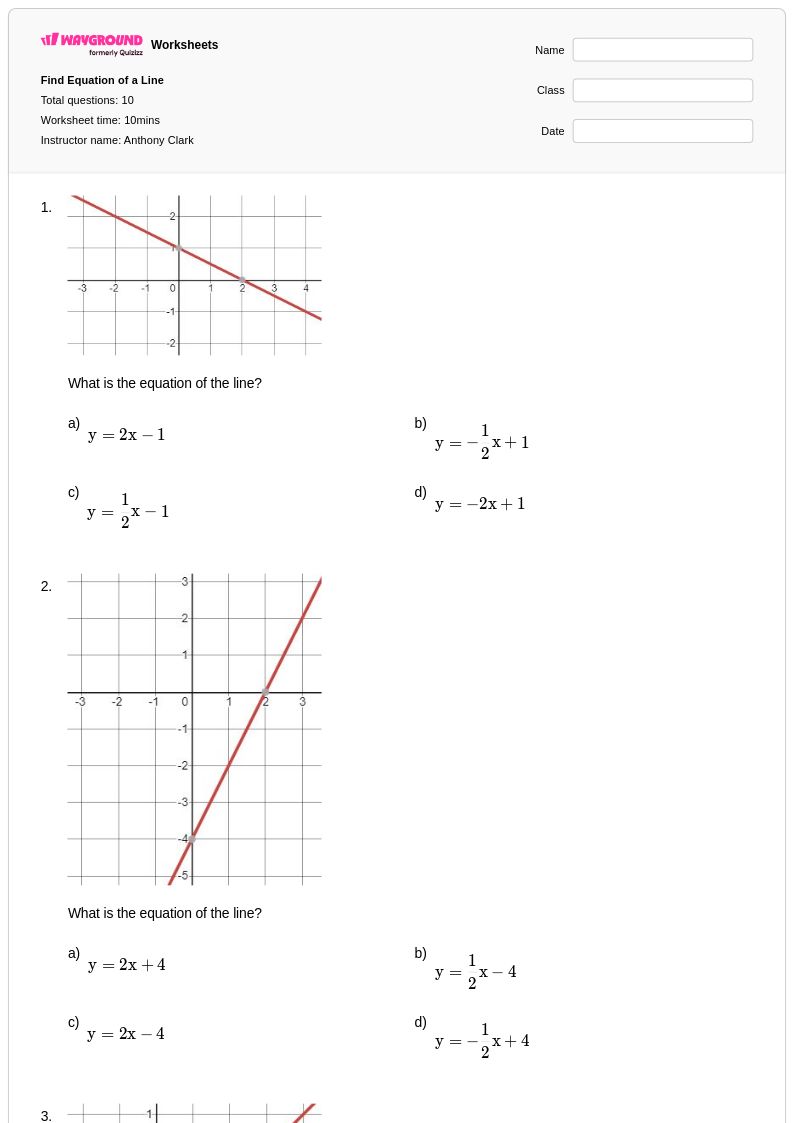
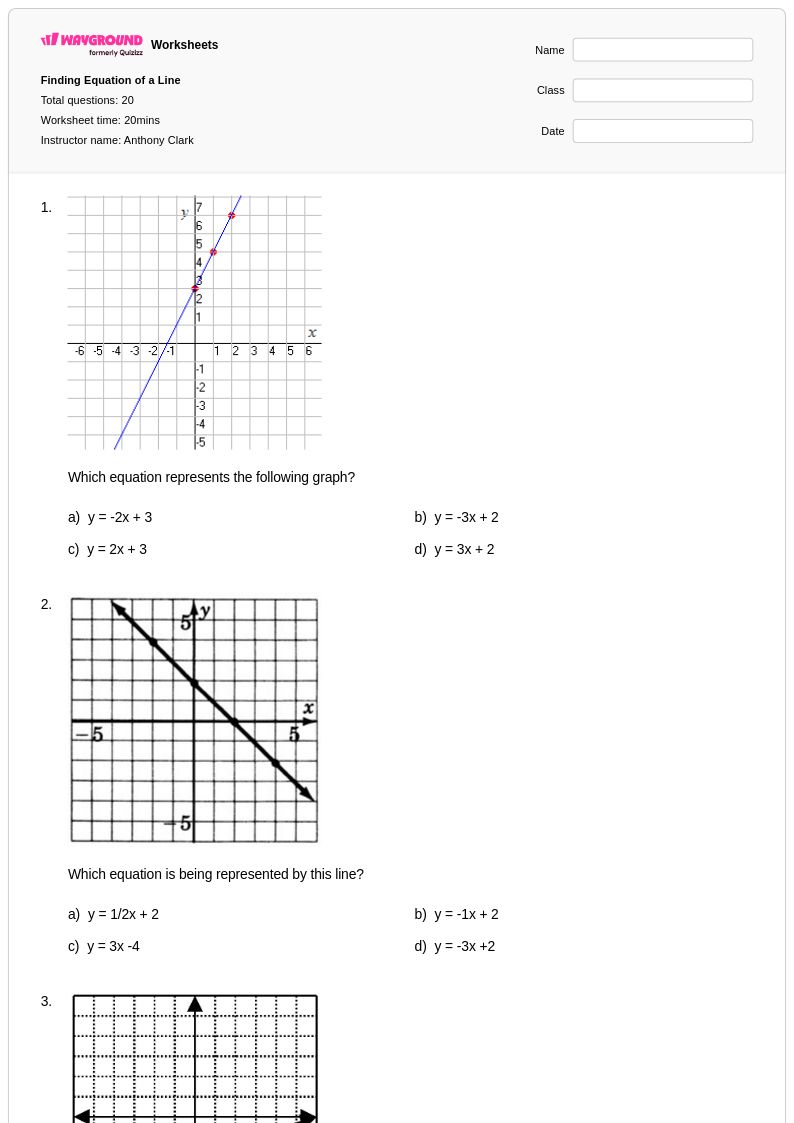
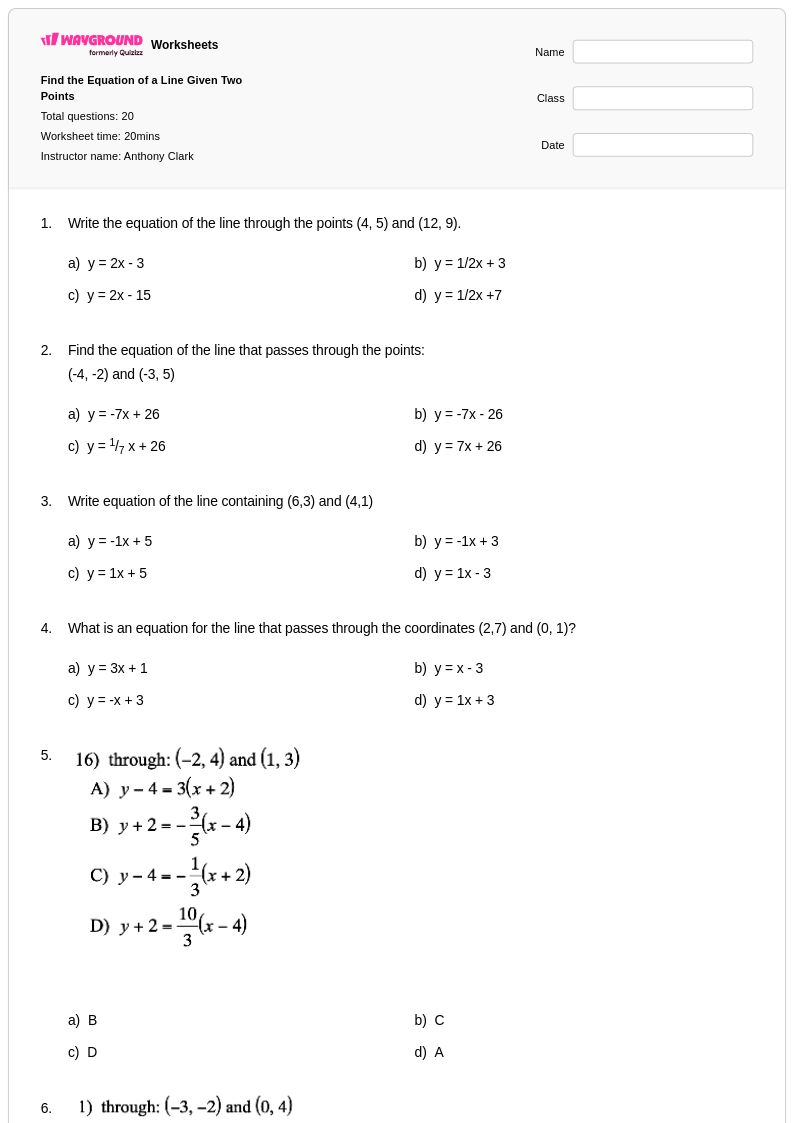
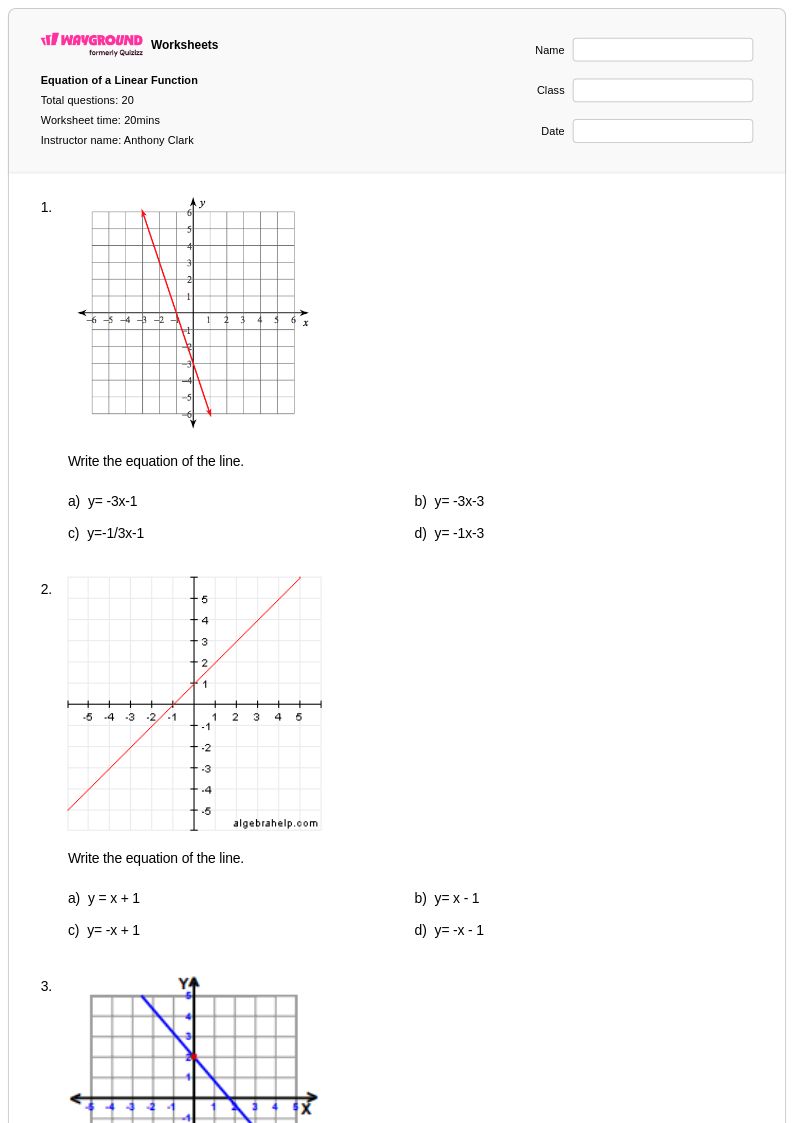
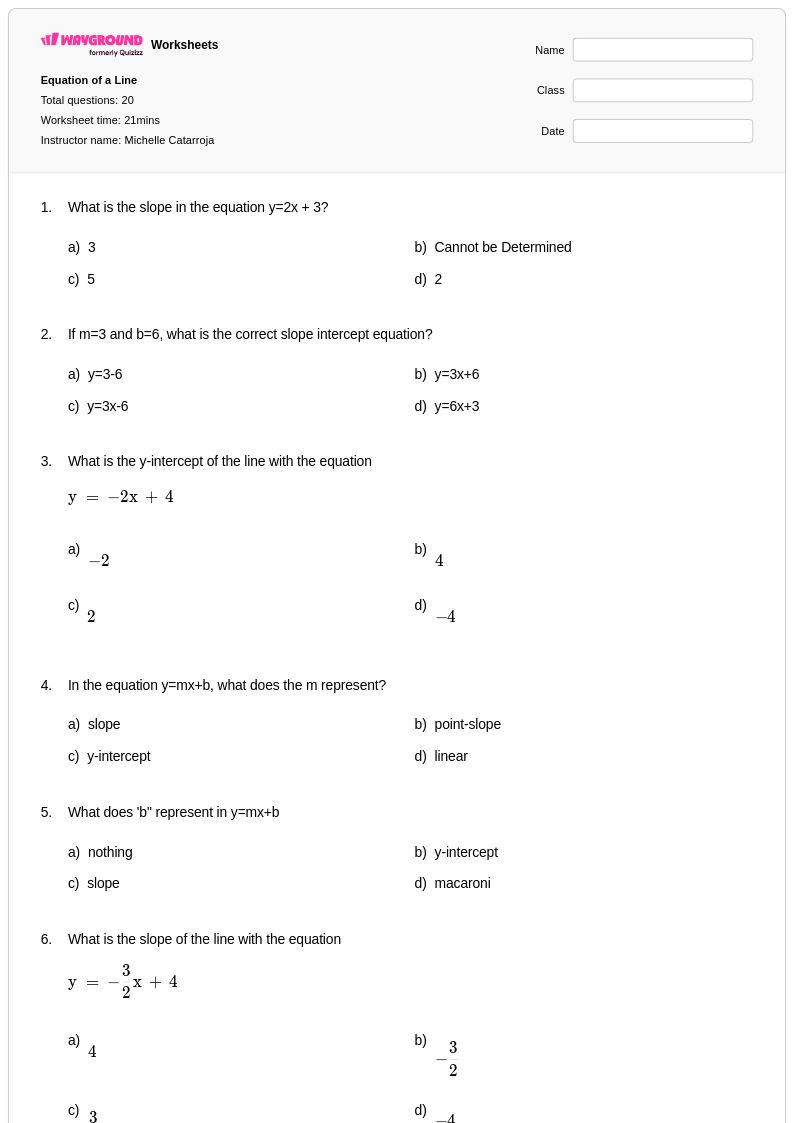
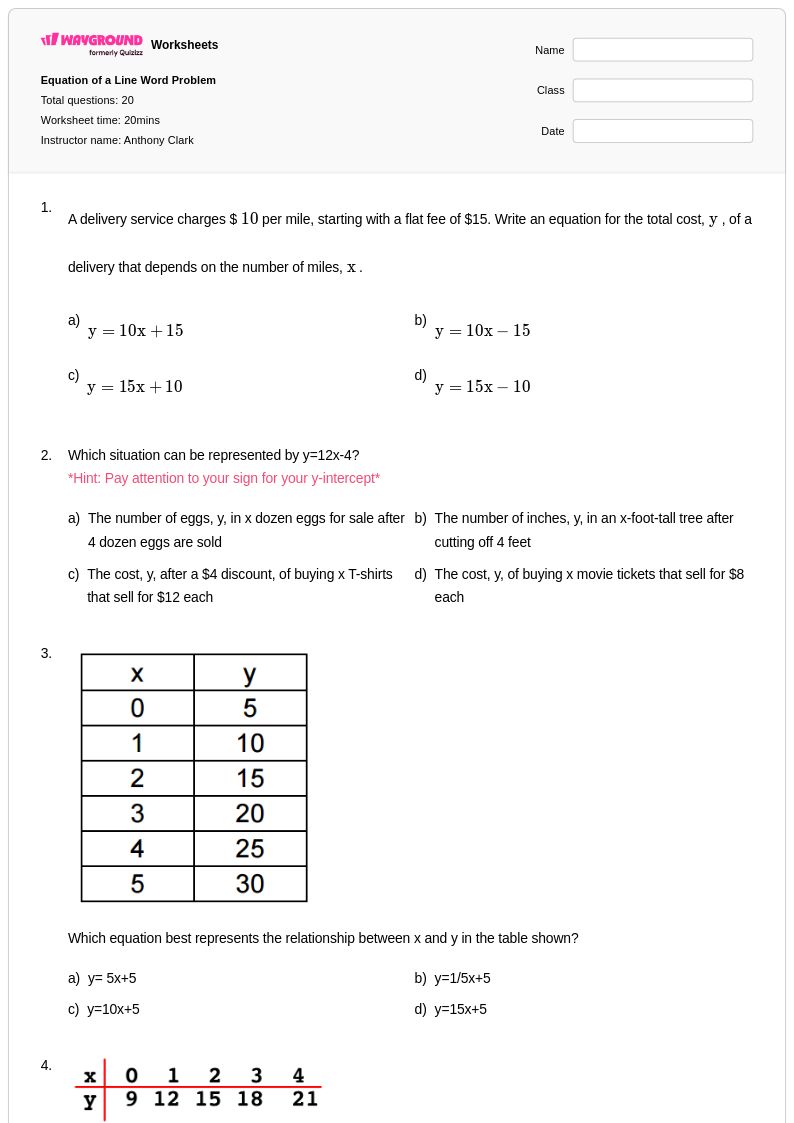
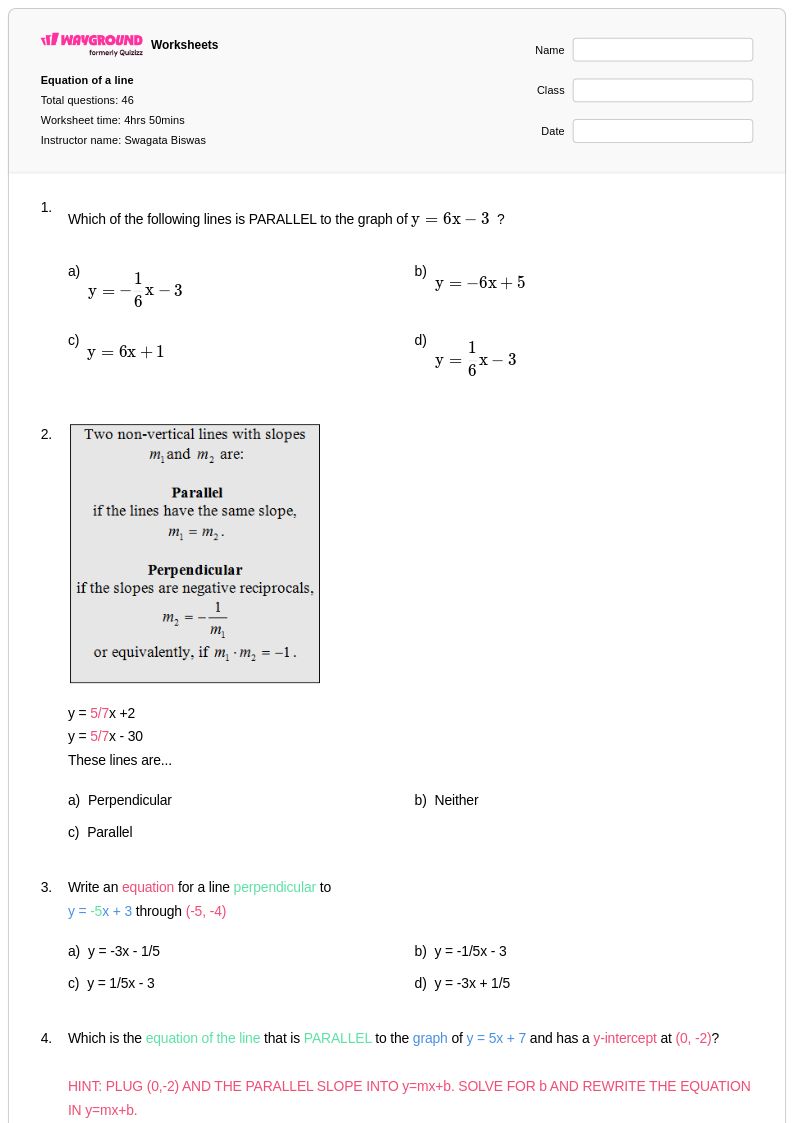
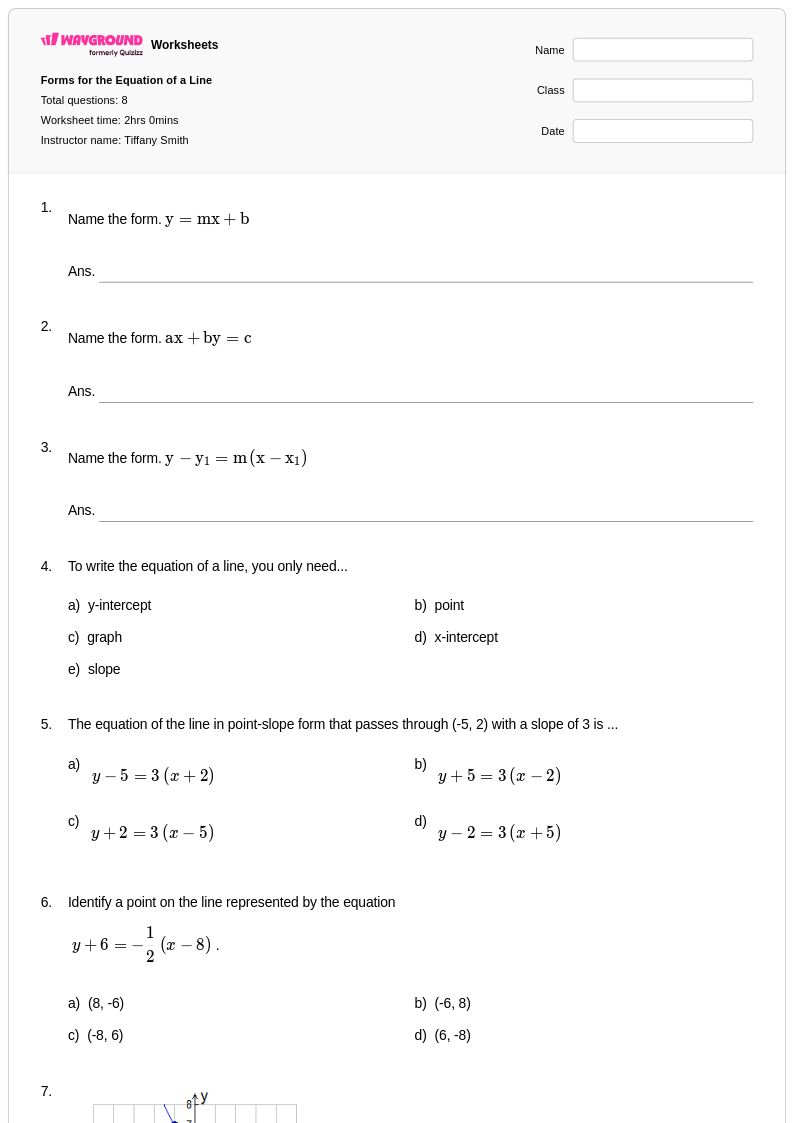
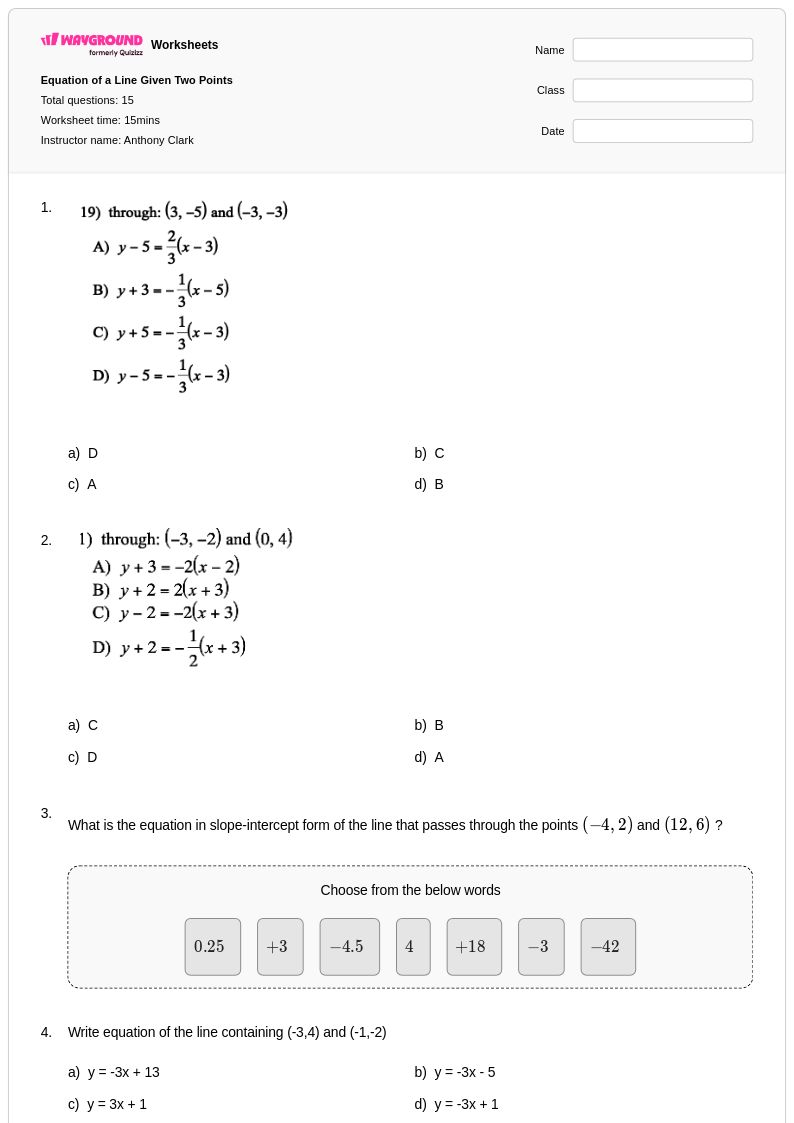
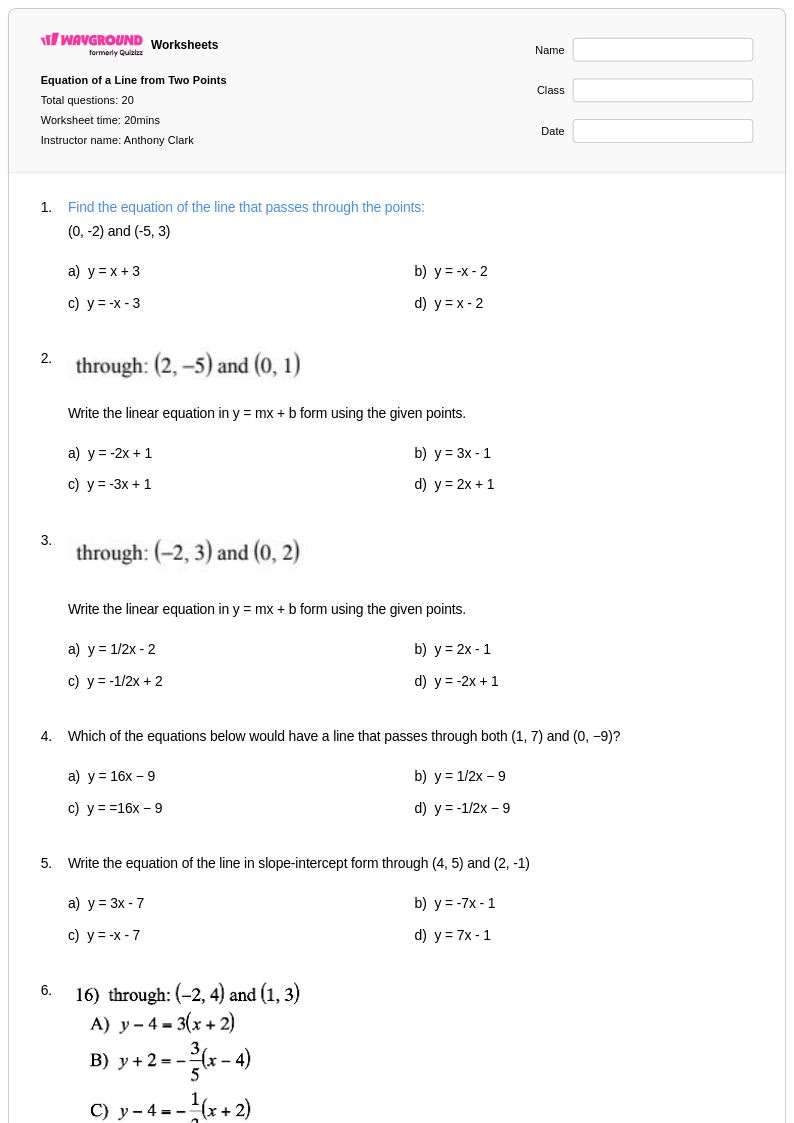
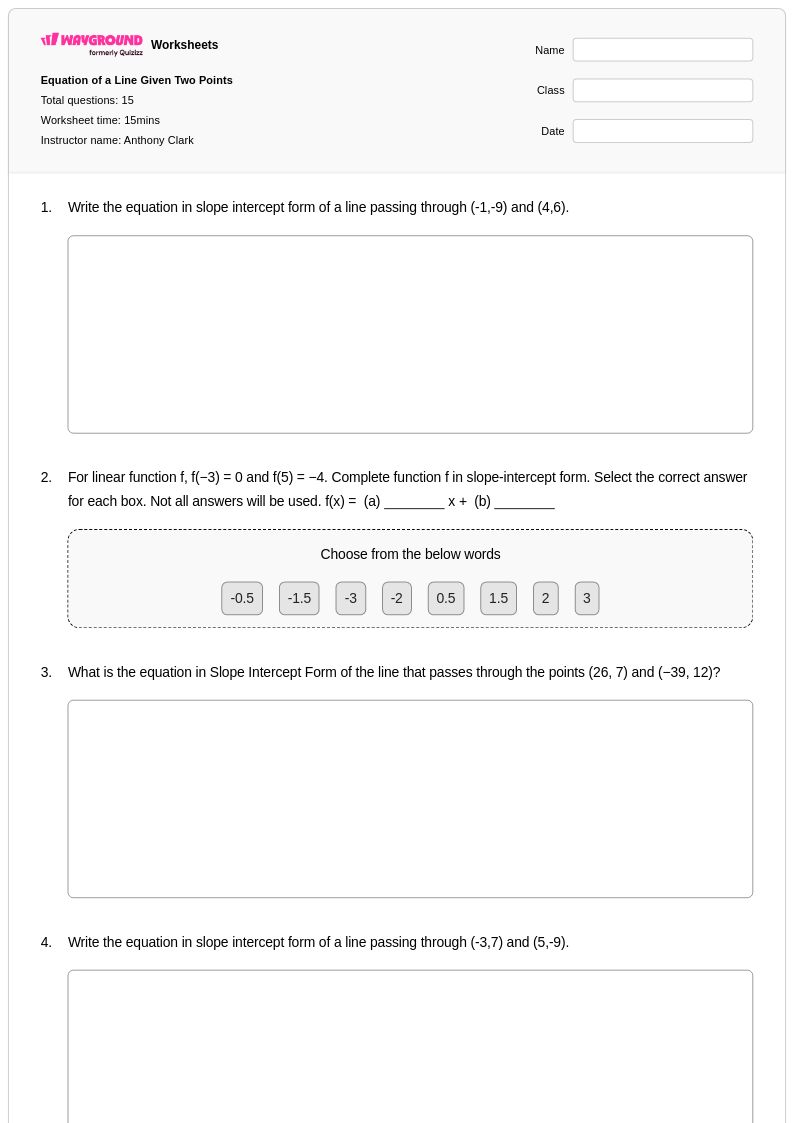
Access free equation of a line worksheets and printables through Wayground that help students master linear equations, slope-intercept form, and graphing techniques with comprehensive practice problems and answer keys.
Equation of a line worksheets available through Wayground (formerly Quizizz) provide comprehensive practice materials that strengthen students' understanding of linear relationships and coordinate geometry fundamentals. These expertly designed resources cover essential concepts including slope-intercept form, point-slope form, standard form, and the process of finding equations when given various combinations of points, slopes, and intercepts. Students work through systematic practice problems that build proficiency in graphing linear equations, interpreting slope and y-intercept values, and converting between different forms of linear equations. Each worksheet collection includes detailed answer keys that support independent learning and self-assessment, while the free printable format ensures accessible practice materials for all learning environments.
Wayground (formerly Quizizz) empowers educators with millions of teacher-created equation of a line worksheet resources that streamline lesson planning and differentiated instruction. The platform's robust search and filtering capabilities allow teachers to quickly locate materials aligned with specific curriculum standards and student proficiency levels, while built-in customization tools enable educators to modify existing worksheets or create targeted practice sets for remediation and enrichment purposes. These comprehensive collections are available in both printable pdf format and interactive digital versions, providing flexibility for classroom instruction, homework assignments, and independent study sessions. The extensive variety of problem types and difficulty progressions supports systematic skill development, helping teachers address diverse learning needs while reinforcing critical algebraic concepts through focused, purposeful practice.
FAQs
How do I teach the equation of a line?
Start with slope as a rate of change — students grasp it faster when tied to real contexts like cost per item or distance over time. From there, slope-intercept form (y = mx + b) is the natural entry point because both parameters are immediately visible on a graph. Once students are comfortable there, introduce point-slope form as a tool for when you don't have the y-intercept, and standard form last, framing it as a rearrangement rather than a new concept. The through-line across all three forms is that they describe the same line — keeping that idea front and center prevents students from treating each form as an isolated procedure.
What exercises help students practice writing equations of a line?
The most productive practice moves students through varied given information: a graph to read from, two points to work with, a slope and one point, and a table of values. Each scenario forces a slightly different entry into the problem, which builds flexibility rather than pattern-matching. Conversion exercises — rewriting the same equation in all three forms — are also high-value because they reinforce that the forms are equivalent, not separate skills.
What mistakes do students commonly make with equations of a line?
Three errors come up repeatedly. First, students confuse the slope formula's order of subtraction, writing (x₂ - x₁) in the numerator instead of (y₂ - y₁). Second, when using point-slope form, they forget to distribute the negative sign correctly when the x-coordinate is negative. Third, students treat slope-intercept form as the only valid answer and unnecessarily convert every equation, sometimes introducing arithmetic errors in the process. Targeted practice that asks students to leave answers in point-slope or standard form can break that last habit.
How do I use Wayground's equation of a line worksheets in my class?
Each worksheet is available as a printable PDF or as a digital quiz hosted on Wayground — same problems, your choice of format. For digital sessions, students work through the quiz online and results come back to you automatically. For paper practice, print the PDF and use the included answer key to review; you can also grade submitted work by scanning or photographing it with the Wayground for Teachers app. Both routes work well for homework, warm-ups, or end-of-unit review.
Is the equation of a line aligned to Common Core standards?
Yes. Common Core builds toward linear equations across middle and high school. Students first explore proportional relationships and unit rate in 6th and 7th grade, which lays the groundwork for slope. By 8th grade, the focus shifts to writing and interpreting equations of lines in multiple forms and understanding that two points determine a unique line. High school algebra then extends this to systems of equations and linear modeling. Wayground's worksheets span that progression, so you can find materials that fit wherever your students are in that sequence.
How can I differentiate equation of a line practice for mixed-ability classes?
The most common gap in a mixed class is between students who can graph a line but struggle to write its equation algebraically, and students who can manipulate the algebra but lose the geometric meaning. Wayground lets you create alternate worksheet versions with adjusted font size, spacing, or a dyslexia-friendly font for accessibility needs. For students who need more support during a digital session, you can enable reduced answer choices to lower cognitive load, or turn on Read Aloud so the question is read to them — without other students being aware of those settings.
What grade level is equation of a line typically taught?
The core instruction happens in 8th grade for most students, where writing and graphing linear equations is a central focus. Students begin building toward it in 6th and 7th grade through work with ratios, proportional relationships, and coordinate graphing. In 9th grade algebra, the concept is extended to include parallel and perpendicular lines, linear systems, and real-world modeling.