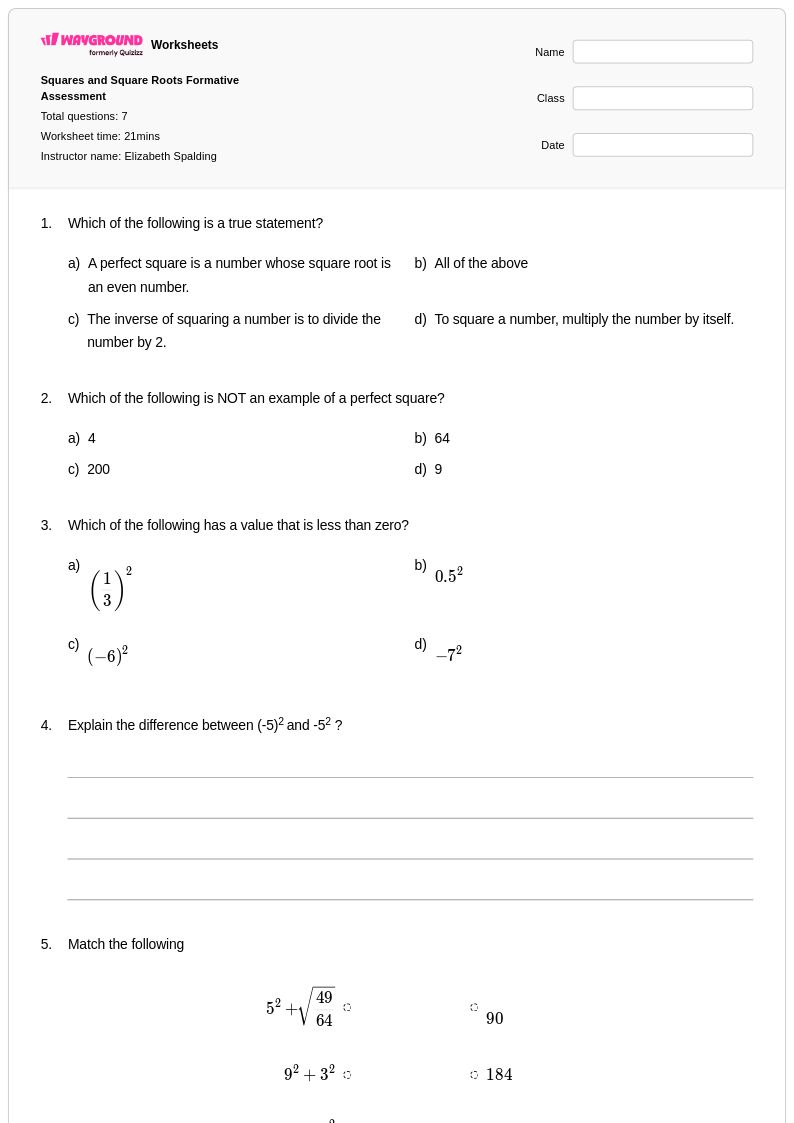
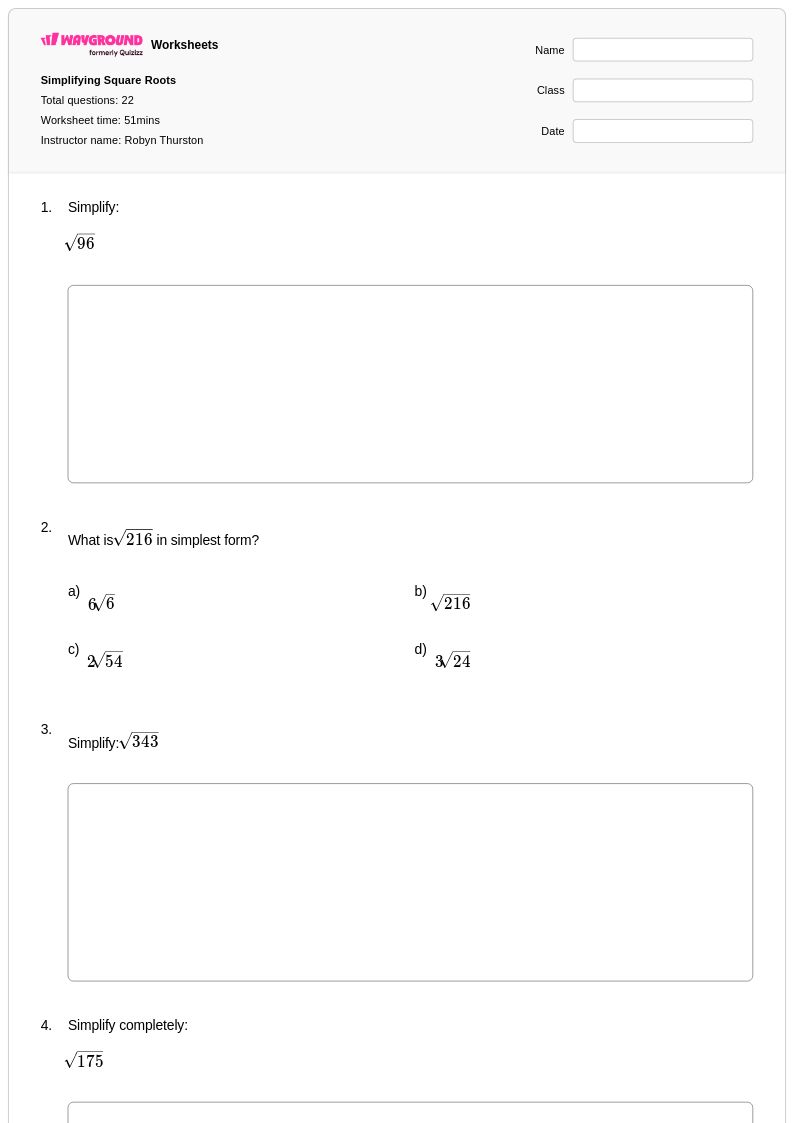
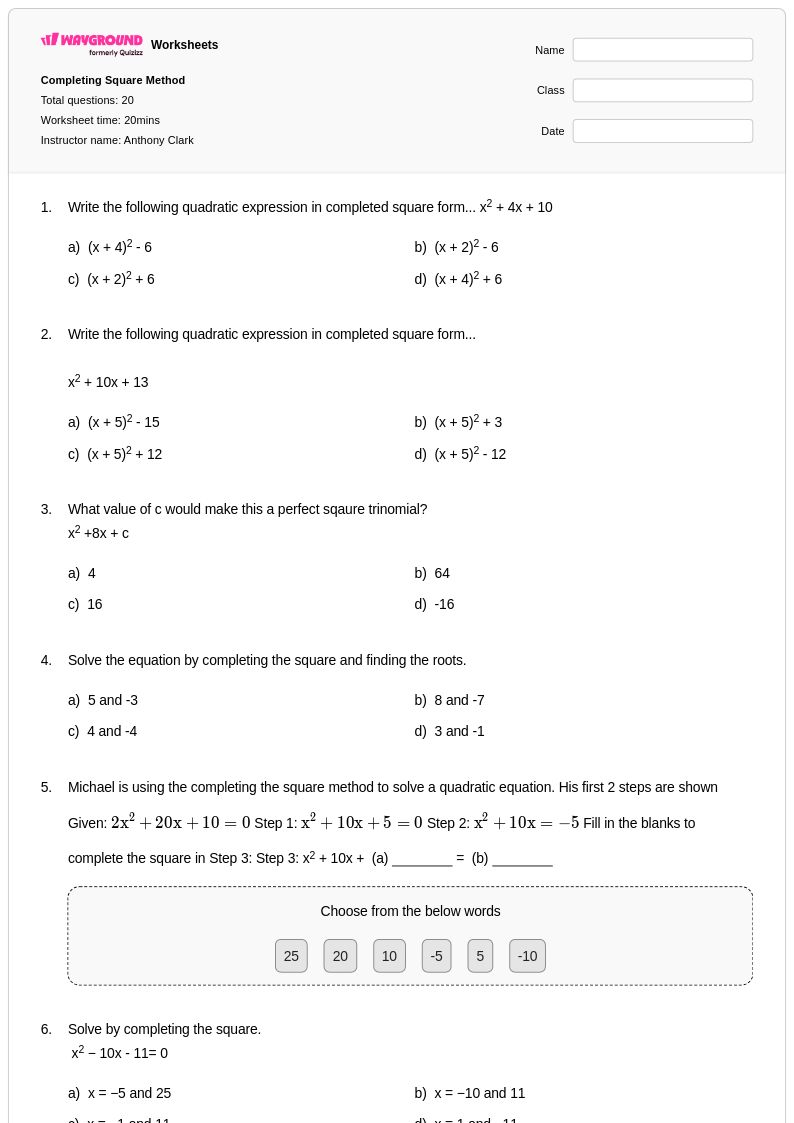
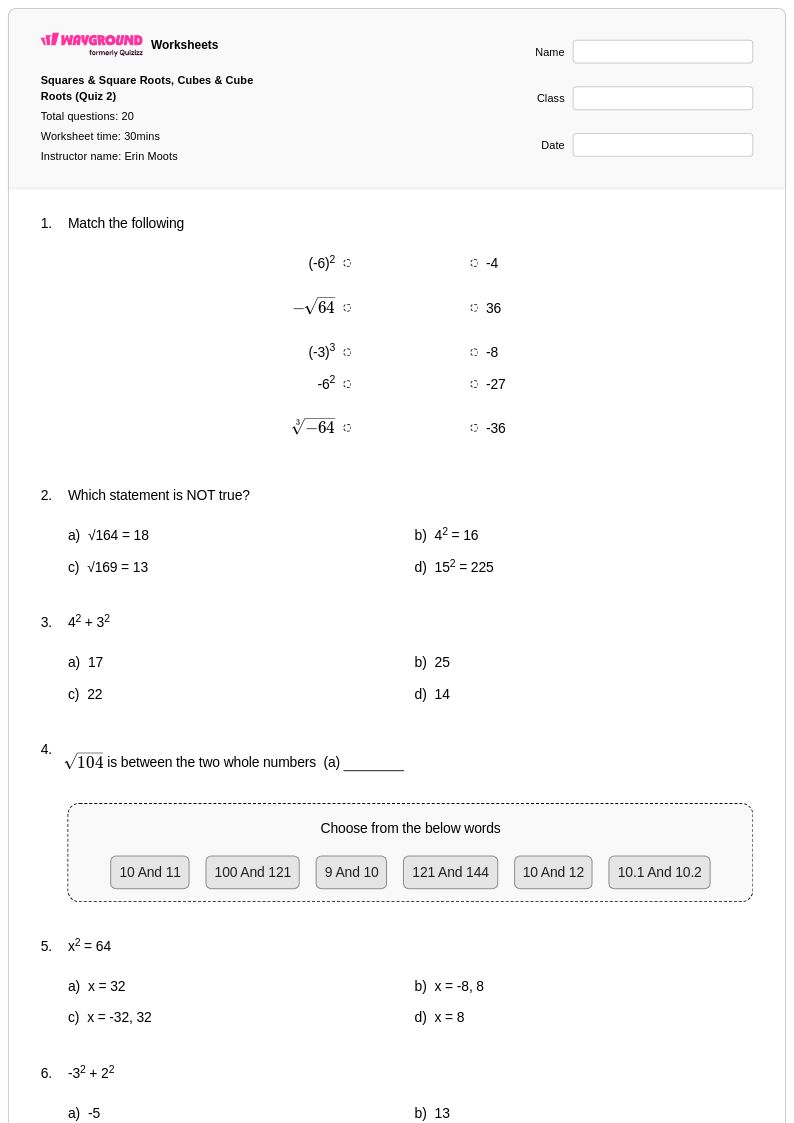
Explore Wayground's comprehensive collection of free Pearson Square Method worksheets and printables with answer keys, designed to help students master this essential algebra technique through engaging practice problems and step-by-step PDF exercises.
Pearson Square Method worksheets available through Wayground (formerly Quizizz) provide mathematics students with comprehensive practice in this essential algebraic technique used for solving mixture and alloy problems. These expertly designed worksheets strengthen critical problem-solving skills by guiding students through the systematic process of determining proportions when combining materials of different concentrations or values. Each worksheet includes carefully scaffolded practice problems that progress from basic two-component mixtures to more complex scenarios, complete with detailed answer keys that allow students to verify their calculations and understand the underlying mathematical reasoning. The free printable resources offer varied problem types that reinforce the visual representation of the Pearson Square diagram while developing algebraic thinking skills essential for advanced mathematics coursework.
Wayground's extensive collection draws from millions of teacher-created resources, providing educators with robust search and filtering capabilities to locate Pearson Square Method worksheets that align with specific curriculum standards and student needs. Teachers can easily differentiate instruction by selecting from worksheets of varying complexity levels, customizing problems to match individual learning objectives, or adapting existing materials to address specific skill gaps. The platform's flexible format options include both printable pdf versions for traditional classroom use and digital formats for interactive learning environments, making these resources ideal for lesson planning, targeted remediation, and enrichment activities. This comprehensive approach ensures that educators have access to high-quality materials that support effective mathematics instruction while providing students with multiple opportunities to master this fundamental algebraic problem-solving technique.
FAQs
How do I teach the Pearson Square method?
Introduce the Pearson Square as a visual tool for solving mixture problems. Start by drawing a square or tic-tac-toe grid. Place the concentrations of the two ingredients on the left side, and the desired mixture's concentration in the center. Guide students to subtract diagonally to find the required 'parts' of each ingredient, then use these parts to form a ratio.
What kinds of practice problems help students learn the Pearson Square?
Effective practice starts with simple, whole-number concentration problems and builds to more complex scenarios involving decimals or fractions. This worksheet includes a variety of mixture problems, such as combining solutions, creating feed blends, or mixing alloys, to help students apply the method in different contexts.
What are common mistakes students make with the Pearson Square?
Students often misplace the numbers on the square, putting the desired concentration on the side instead of in the middle. Another common error is subtracting in the wrong direction or forgetting that the results of the subtraction represent the 'parts' of the *opposite* ingredient. Finally, students may correctly find the ratio of parts but fail to calculate the final amount of each ingredient needed for a specific total volume.
How can I use this Pearson Square worksheet in my class?
This worksheet is available as a printable PDF for hands-on practice or as an interactive digital assignment on the Wayground platform. The printable version is great for offline work, and you can use the Wayground for Teachers app to quickly scan and grade paper submissions. Every worksheet includes a complete answer key for efficient grading.
How does the Pearson Square method fit into the math curriculum?
Aligned with Common Core principles, the Pearson Square method serves as a bridge between proportional reasoning and formal algebra. It provides a concrete, visual model for solving a class of problems that students will later solve using systems of linear equations. This builds on middle school ratio skills and prepares students for the abstract thinking required in Algebra 1.
How can I differentiate this topic for diverse learners?
For students who need support, use Wayground's digital accommodations like Read Aloud for word problems or Reduced Answer Choices to lower cognitive load. For scaffolding, you can create alternate versions of the worksheet with simpler numbers (e.g., whole percentages) before moving on to problems with decimals or fractions.