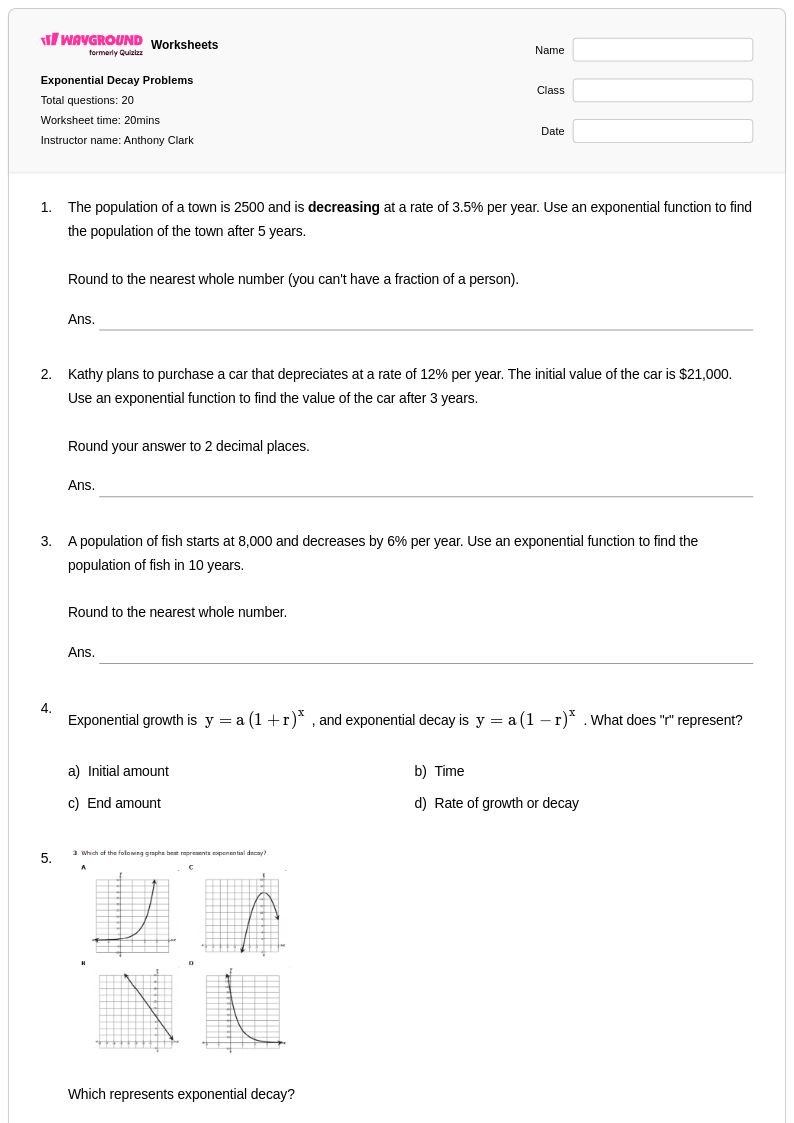
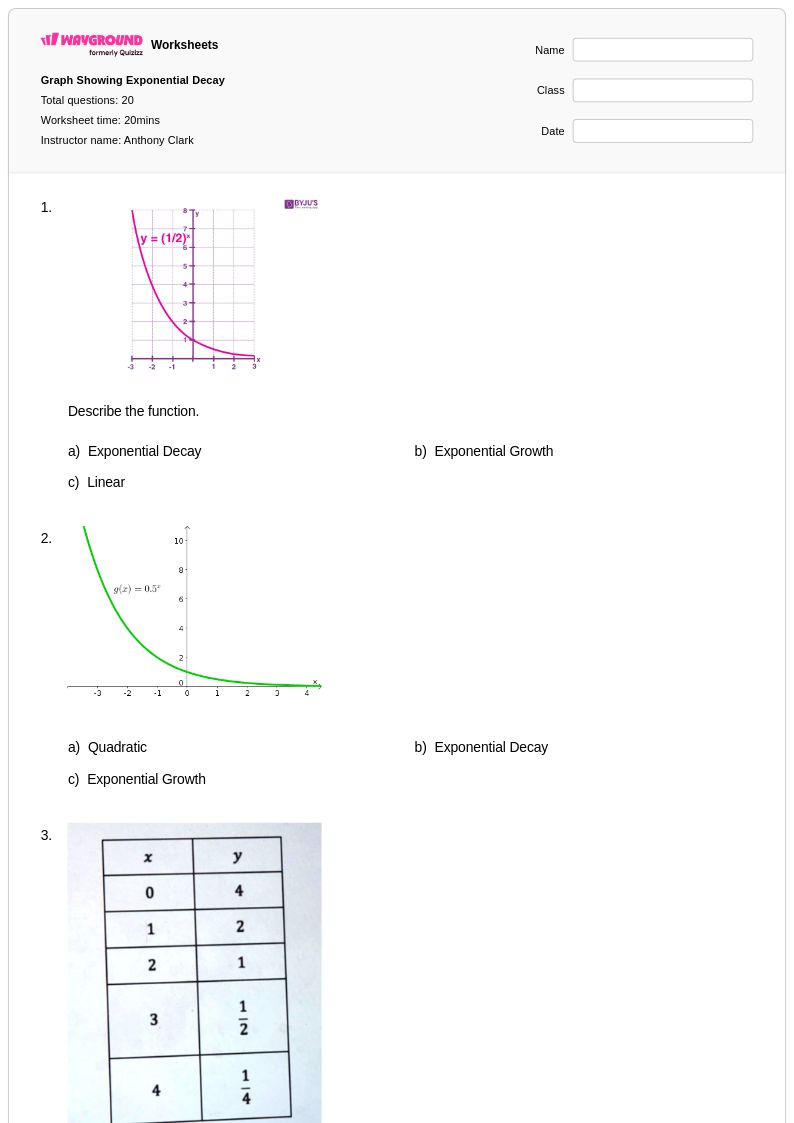
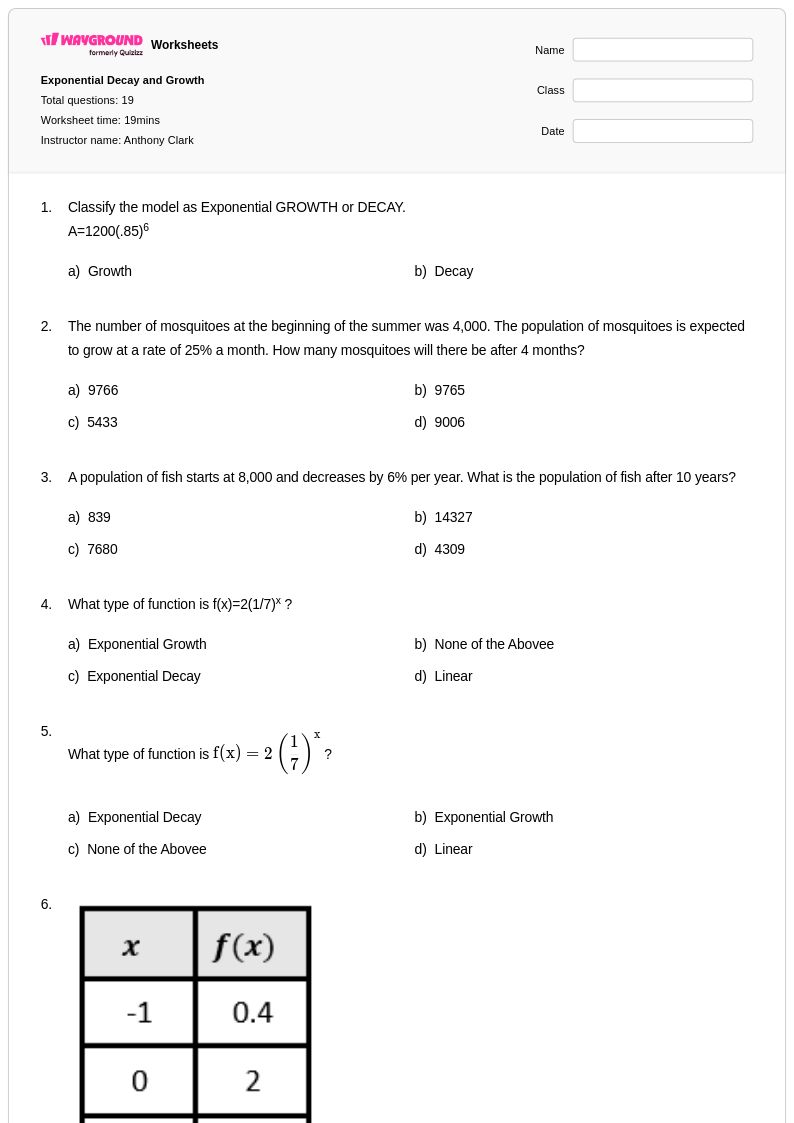
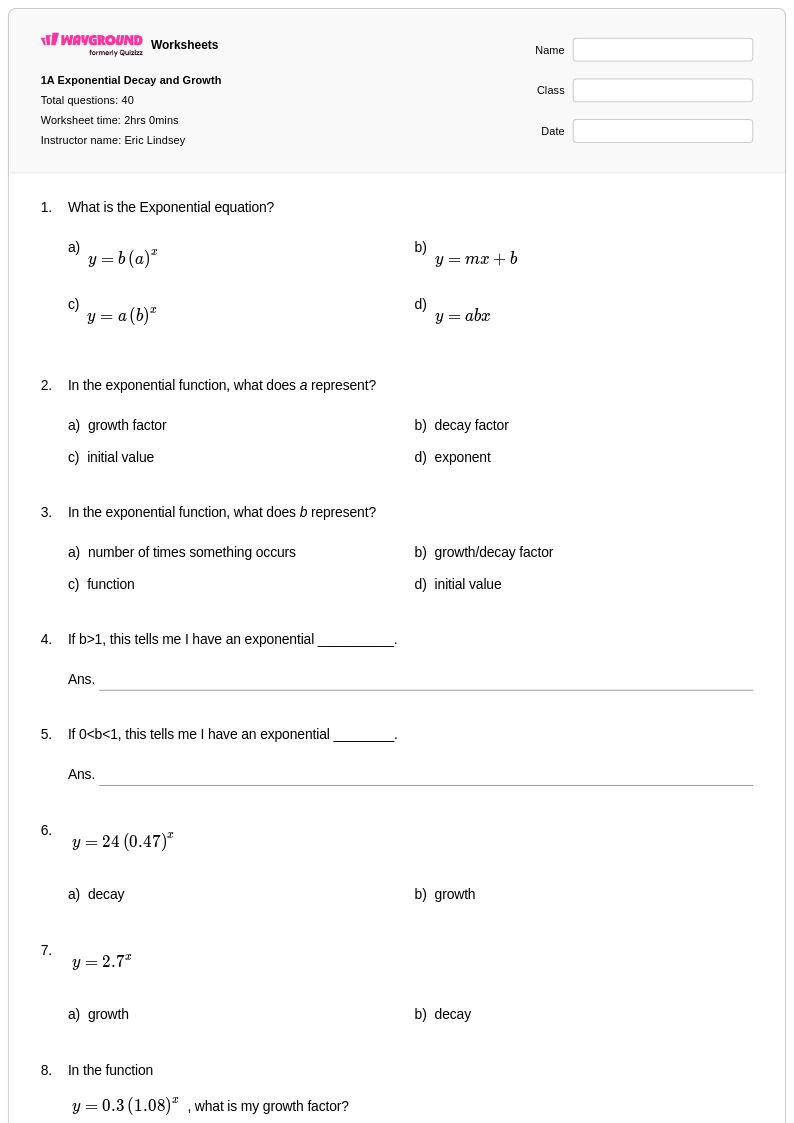
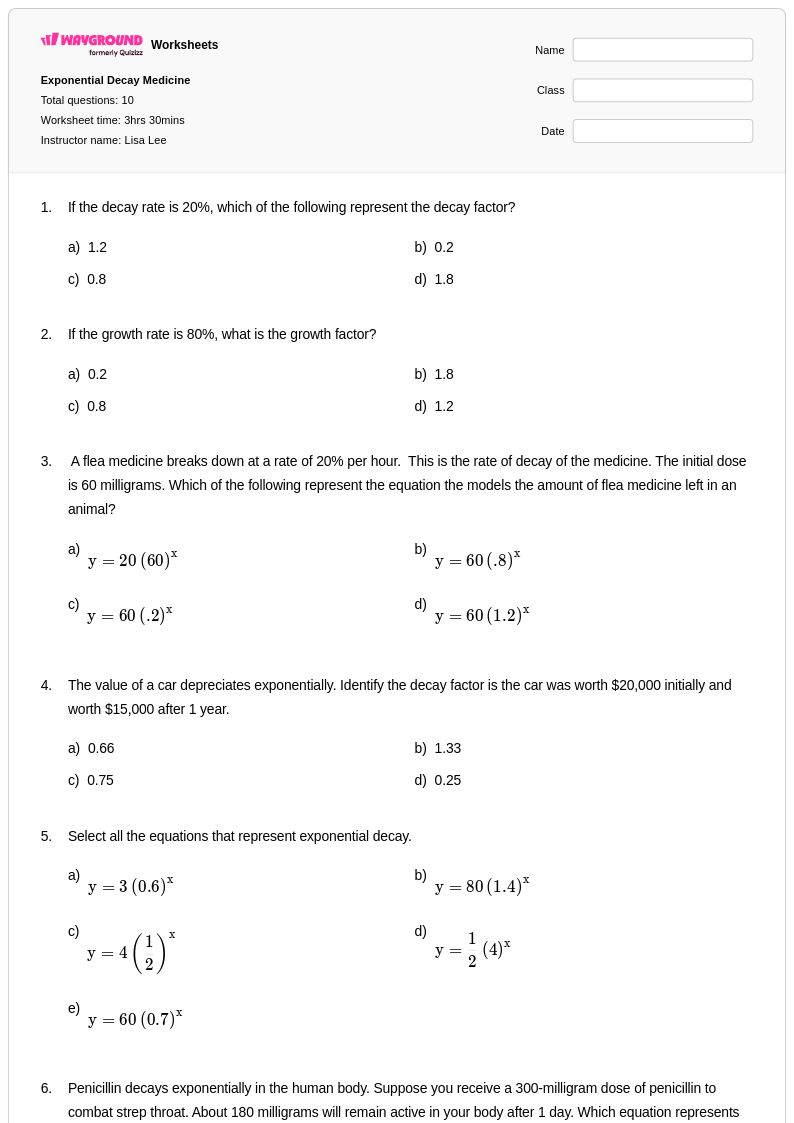
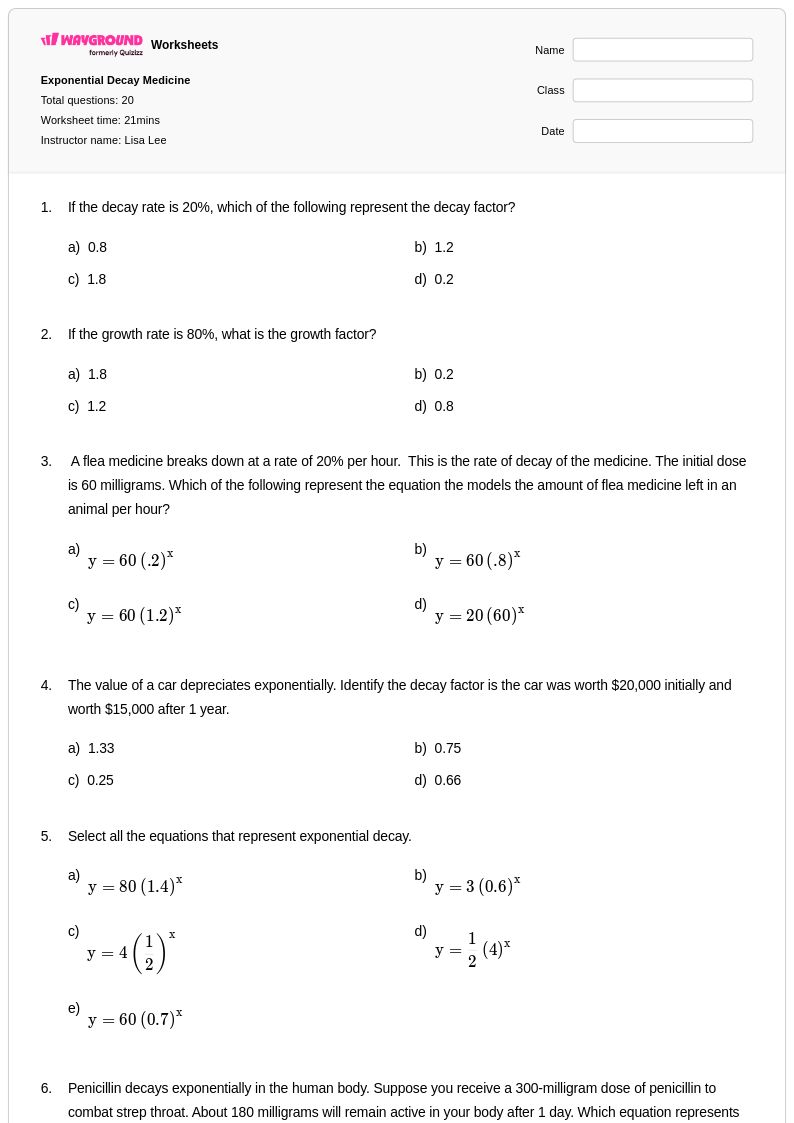
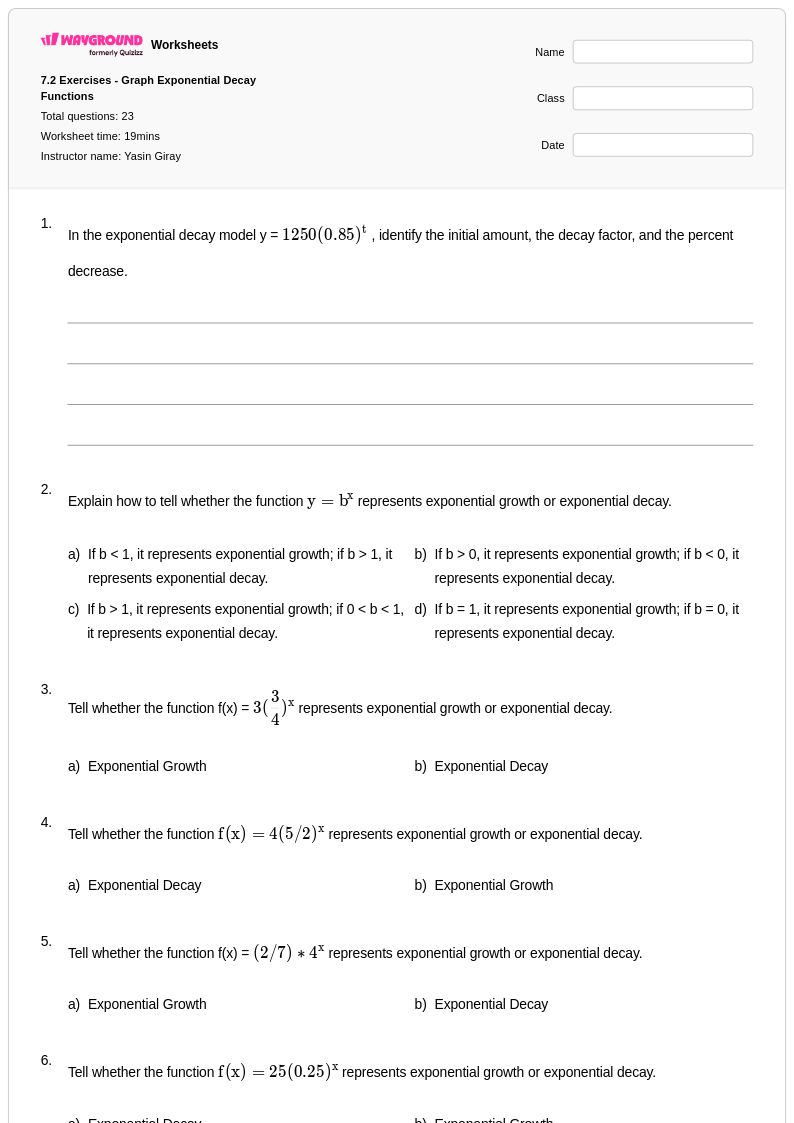
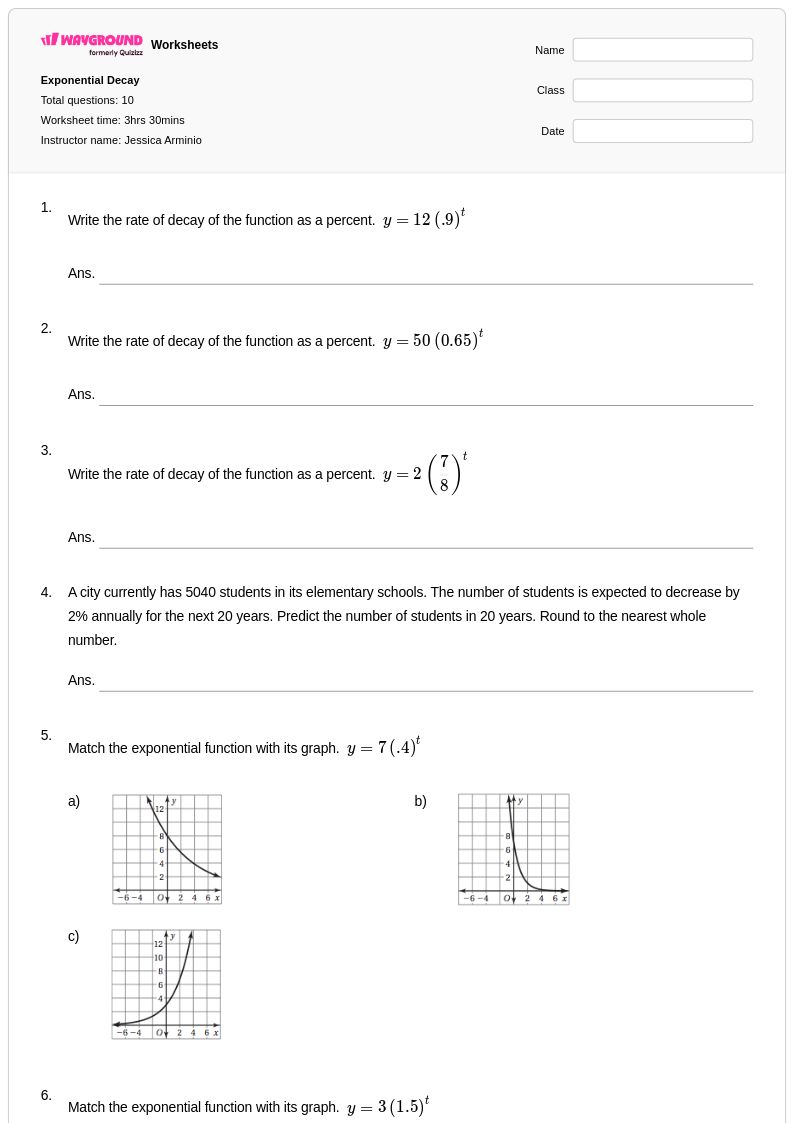
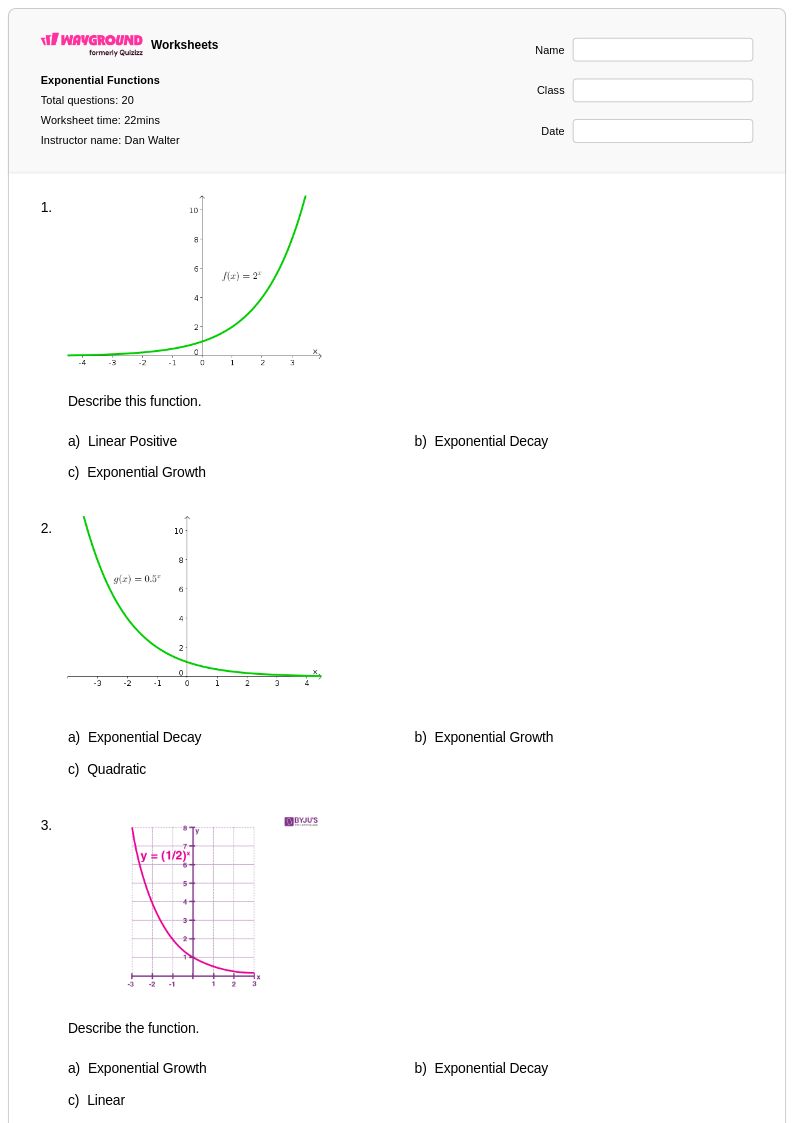
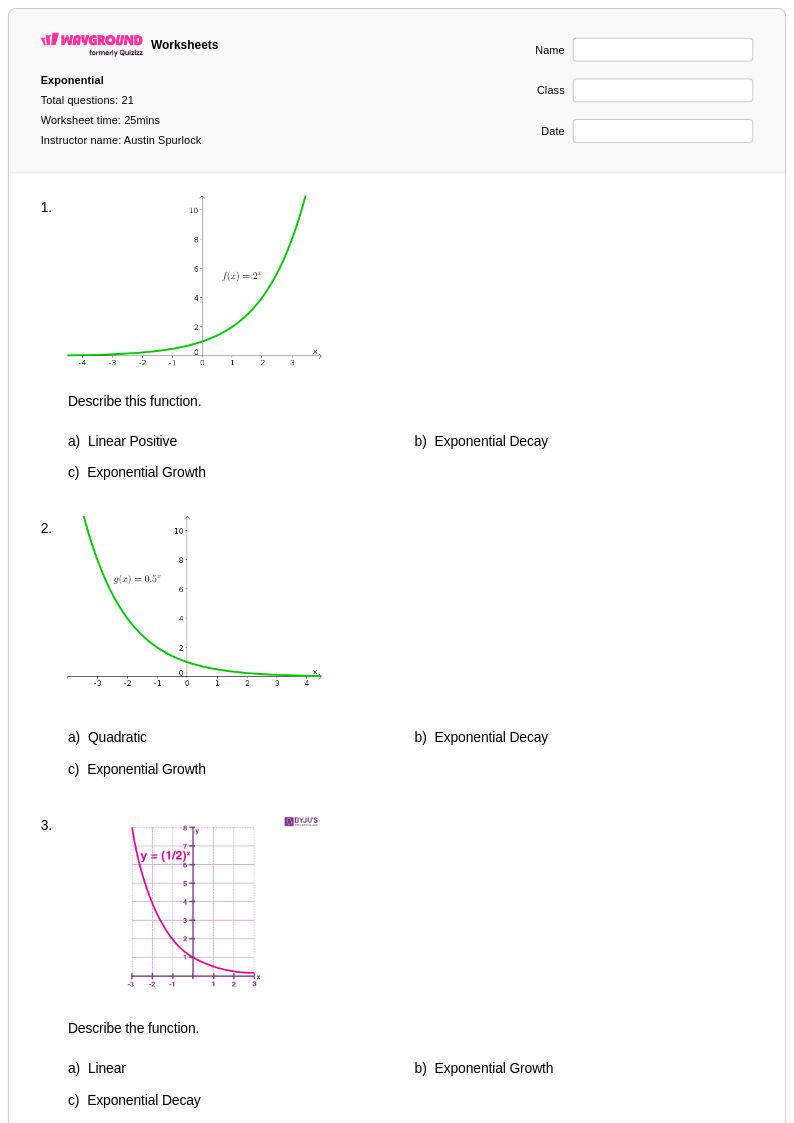
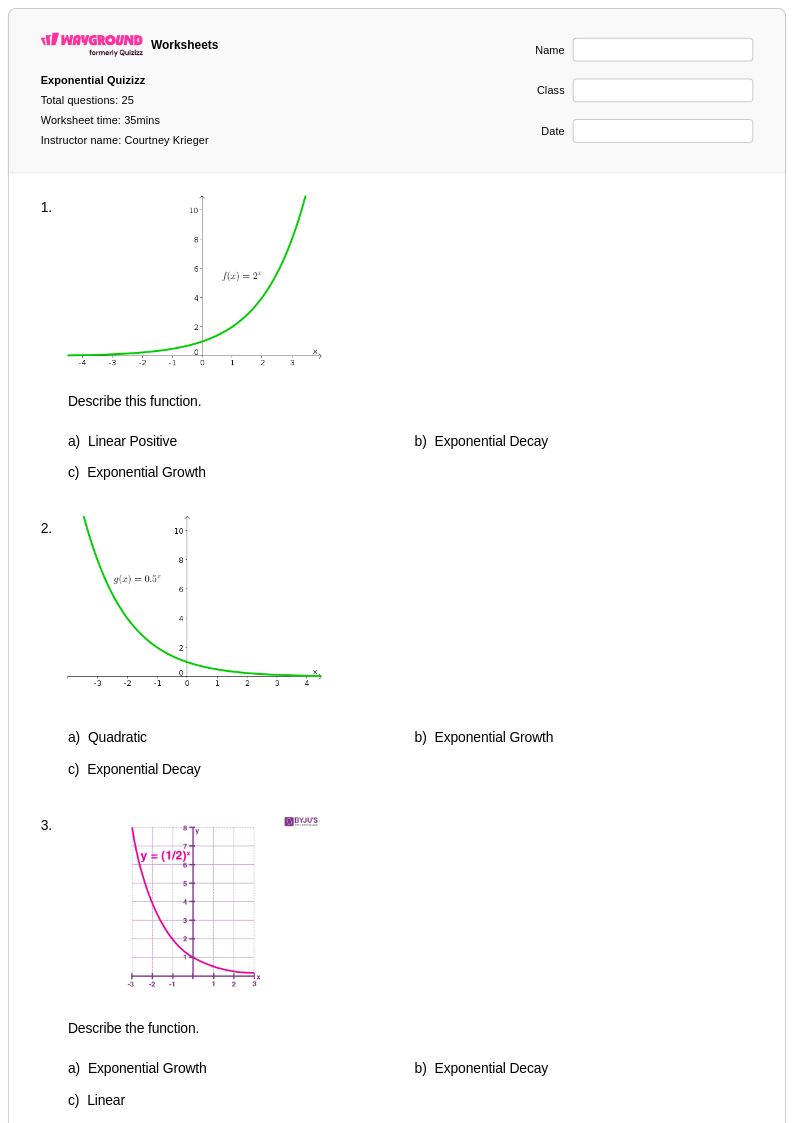
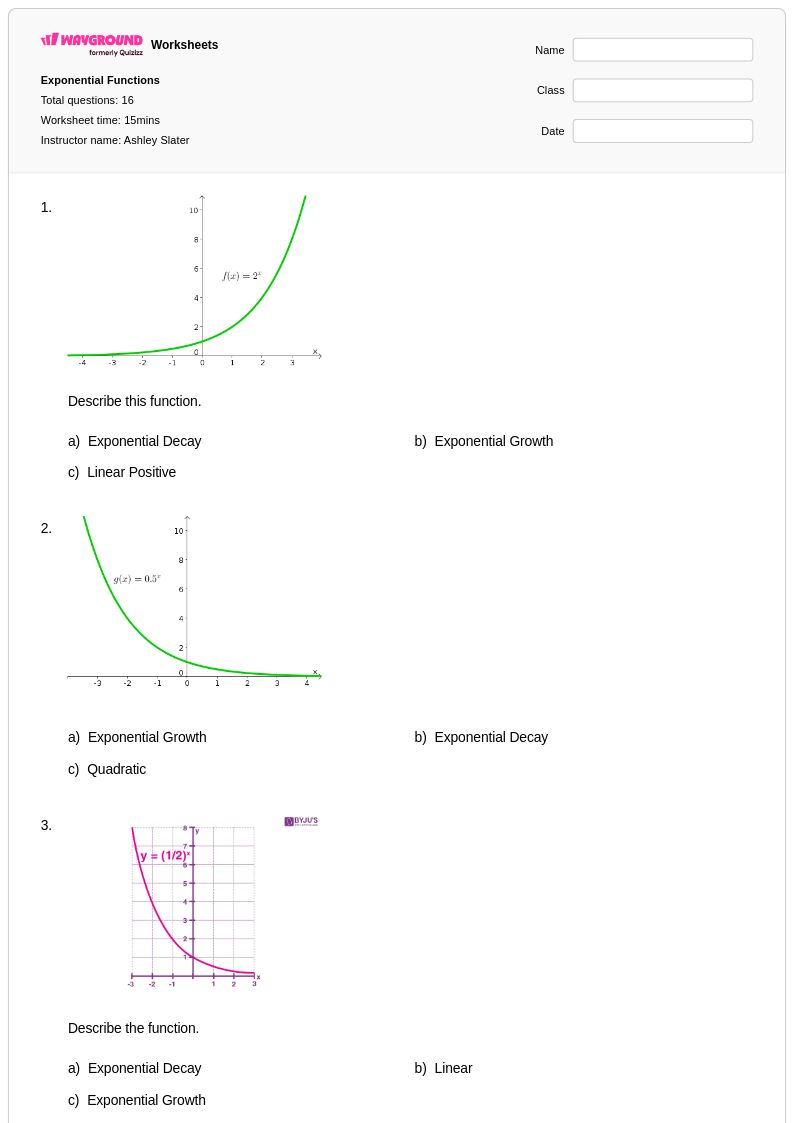
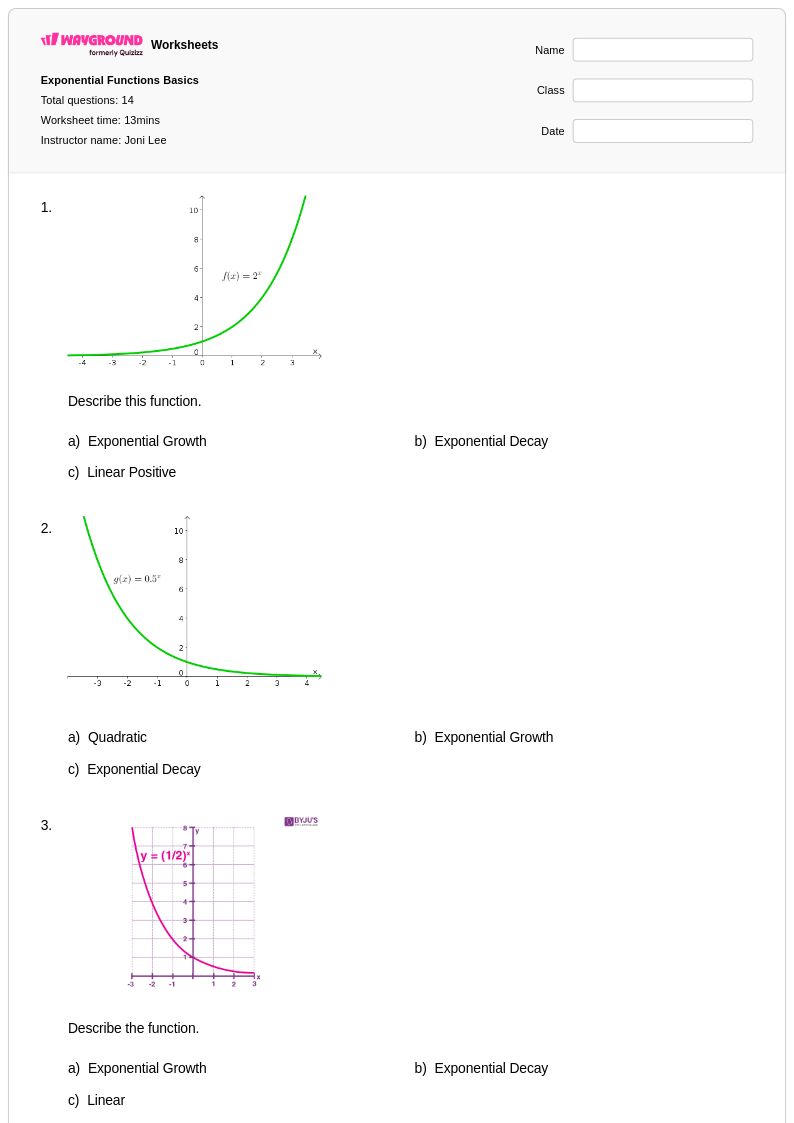
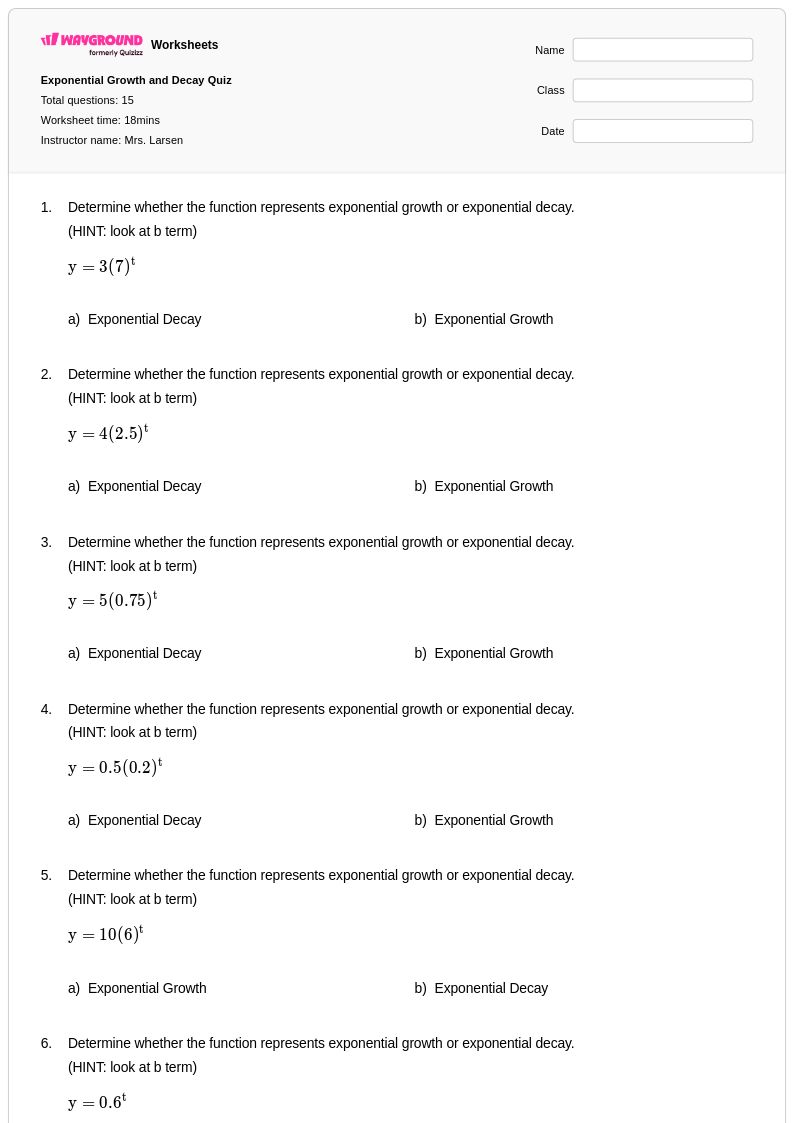
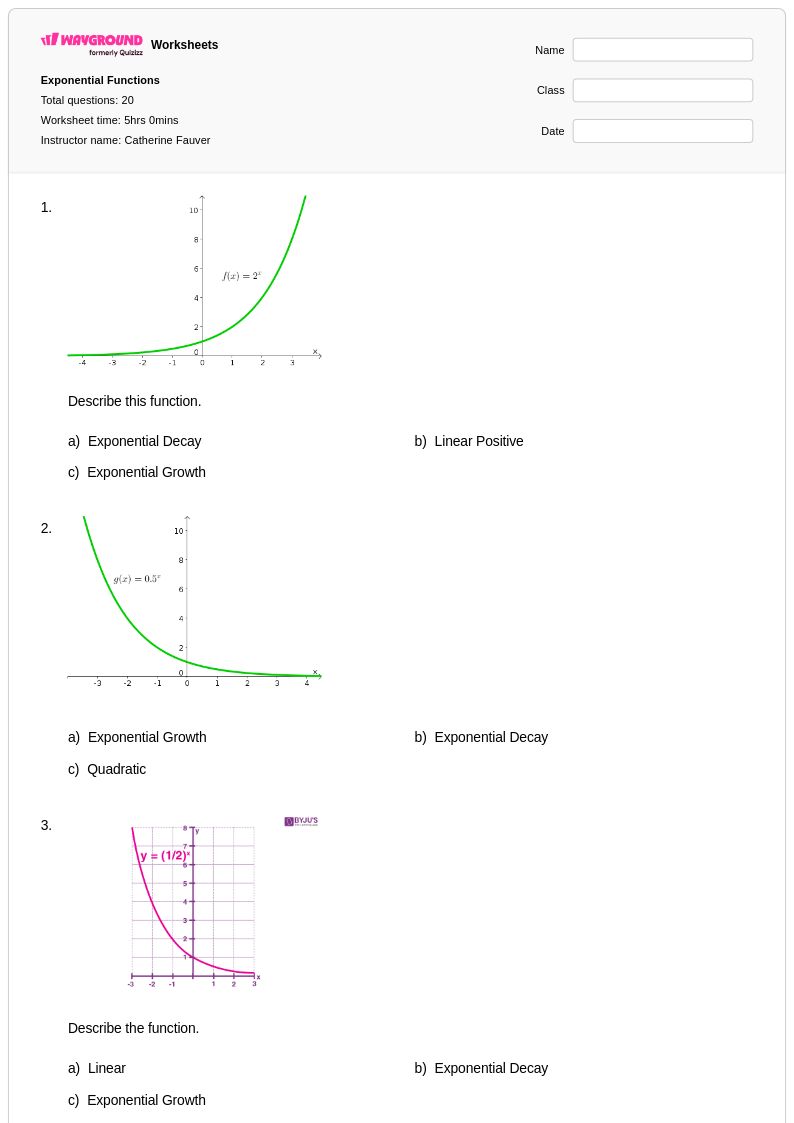
Wayground's free exponential decay worksheets provide algebra students with comprehensive printables and practice problems, complete with answer keys to master decay functions and real-world applications through structured PDF exercises.
Exponential decay worksheets available through Wayground (formerly Quizizz) provide comprehensive practice with one of algebra's most essential mathematical concepts, helping students master the analysis of quantities that decrease at rates proportional to their current value. These carefully designed practice problems guide learners through real-world applications including radioactive decay, population decline, depreciation of assets, and cooling temperatures, while reinforcing critical skills in identifying decay factors, calculating half-lives, and interpreting exponential models. Each worksheet collection includes detailed answer keys and step-by-step solutions, with free printables available in convenient pdf format to support both classroom instruction and independent study across various mathematical proficiency levels.
Wayground's extensive library draws from millions of teacher-created resources specifically focused on exponential decay concepts, offering educators powerful search and filtering capabilities to locate materials perfectly aligned with curriculum standards and student needs. The platform's differentiation tools enable teachers to customize worksheets for diverse learning styles and ability levels, while flexible formatting options provide both printable and digital versions including downloadable pdf files for seamless classroom integration. These robust features streamline lesson planning and support targeted remediation for students struggling with exponential concepts, while simultaneously offering enrichment opportunities for advanced learners ready to tackle more complex decay models and applications, ensuring comprehensive skill practice that builds mathematical confidence and conceptual understanding.
FAQs
How do I teach exponential decay?
Start with a concrete anchor — folding a piece of paper in half repeatedly works well to build intuition before any equation appears. Once students see that each step cuts the quantity by the same proportion (not the same amount), introduce the general form y = a(1 - r)^t and connect each parameter to the physical situation. From there, move to real contexts: radioactive half-life, car depreciation, and cooling temperatures all follow the same structure and give students something to reason about rather than just compute. The key conceptual hurdle is distinguishing proportional decrease from linear decrease — students who skip that step tend to misread graphs and misset up equations.
What exercises help students practice exponential decay?
The most productive practice moves through three stages: identifying whether a table or equation represents decay (versus growth), writing the equation from given conditions, and then solving application problems like half-life or depreciation scenarios. Word problems are especially valuable here because they force students to extract the initial value and decay rate from context rather than reading them off a pre-formatted equation. Graphing exercises — sketching the curve and labeling asymptotes — round out practice by connecting the algebra to the visual behavior of the function.
What mistakes do students commonly make with exponential decay?
Three errors come up repeatedly. First, students confuse the decay rate r with the decay factor (1 - r) and plug the percentage directly into the base, producing a base greater than 1 instead of less. Second, they treat exponential decay as linear — estimating that if a quantity drops by 20 units in the first interval, it will drop by 20 units in the next. Third, on half-life problems, students divide the total time by 2 instead of dividing the quantity repeatedly, which conflates the half-life period with the number of halvings.
How do I use Wayground's exponential decay worksheets in my class?
You can run these worksheets as a digital quiz hosted on Wayground — students work through problems on their devices and results come back to you instantly — or download the PDF and print it for paper-based practice, which works well for schools managing screen time. Either way, every worksheet includes a complete answer key. If you go the print route, the Wayground for Teachers app lets you scan or photograph student submissions to grade them without manual re-entry.
Is exponential decay aligned to Common Core standards?
Yes. Common Core treats exponential functions as a central thread in high school algebra, and exponential decay sits squarely within that progression. Students are expected to construct and interpret exponential models, distinguish between exponential and linear growth patterns, and connect the parameters of an equation to the behavior of a real-world situation — all of which decay problems directly address. The progression typically builds from recognizing exponential patterns in tables (introduced in middle school) toward writing, graphing, and applying decay models with fluency in high school.
How can I differentiate exponential decay practice for mixed-ability classes?
For students who are still shaky on the underlying structure, Wayground's reduced answer choices accommodation lowers the cognitive load on multiple-choice problems so they can focus on the decay concept rather than the process of elimination. The dyslexia-friendly font and adjustable font size options help students who struggle with dense algebraic notation. For the worksheet itself, scaffolded versions — where the equation template is partially filled in — bridge the gap for students who understand the concept but lose their footing during setup.
What real-world applications of exponential decay should I include in lessons?
Radioactive half-life and medication concentration are the two most instructionally rich contexts because they make the proportional-decrease logic unavoidable — students can't fake their way through with linear thinking. Depreciation (a car losing a fixed percentage of its value each year) is useful for connecting decay to personal finance. Cooling temperature (Newton's Law of Cooling) works well for advanced students because it introduces a non-zero horizontal asymptote, which pushes beyond the basic model.