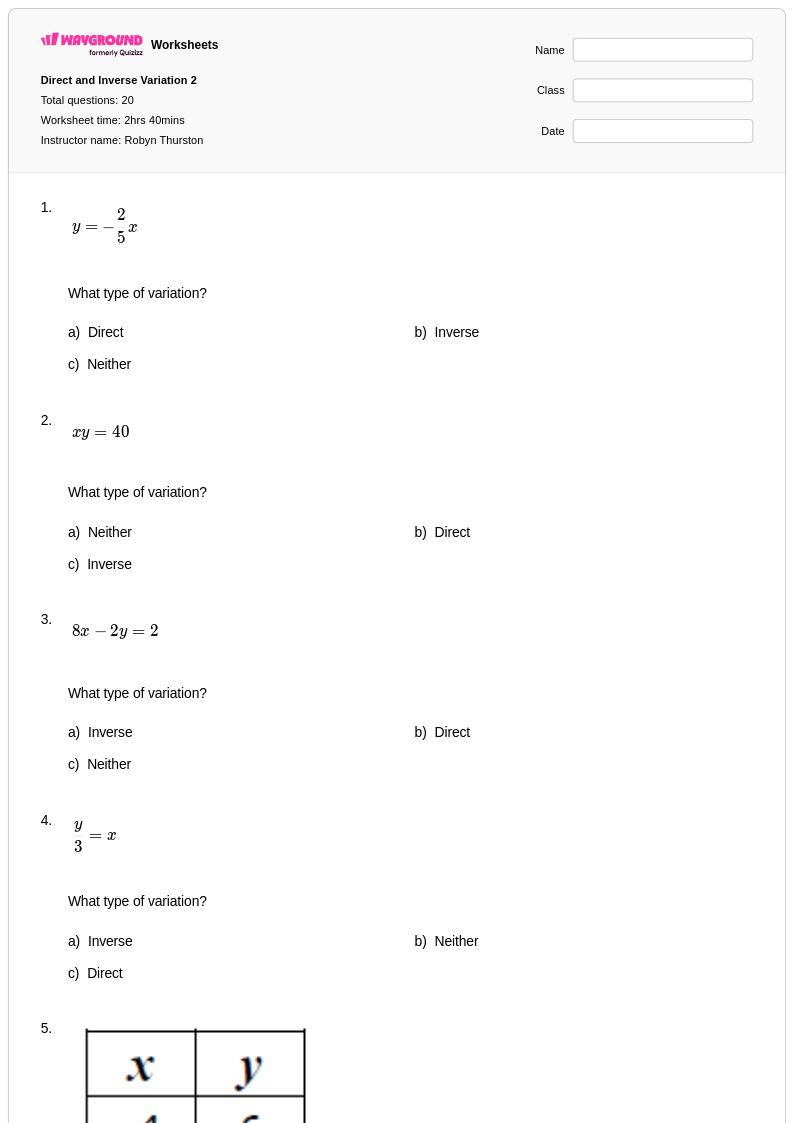
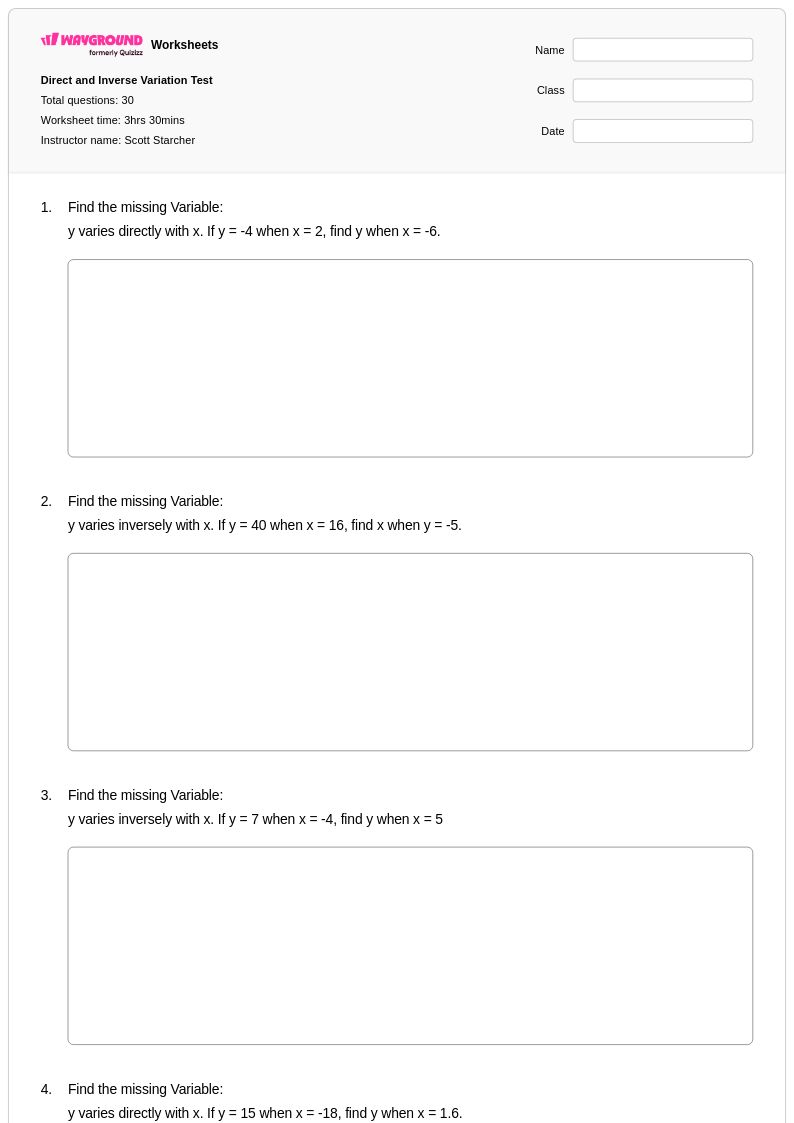
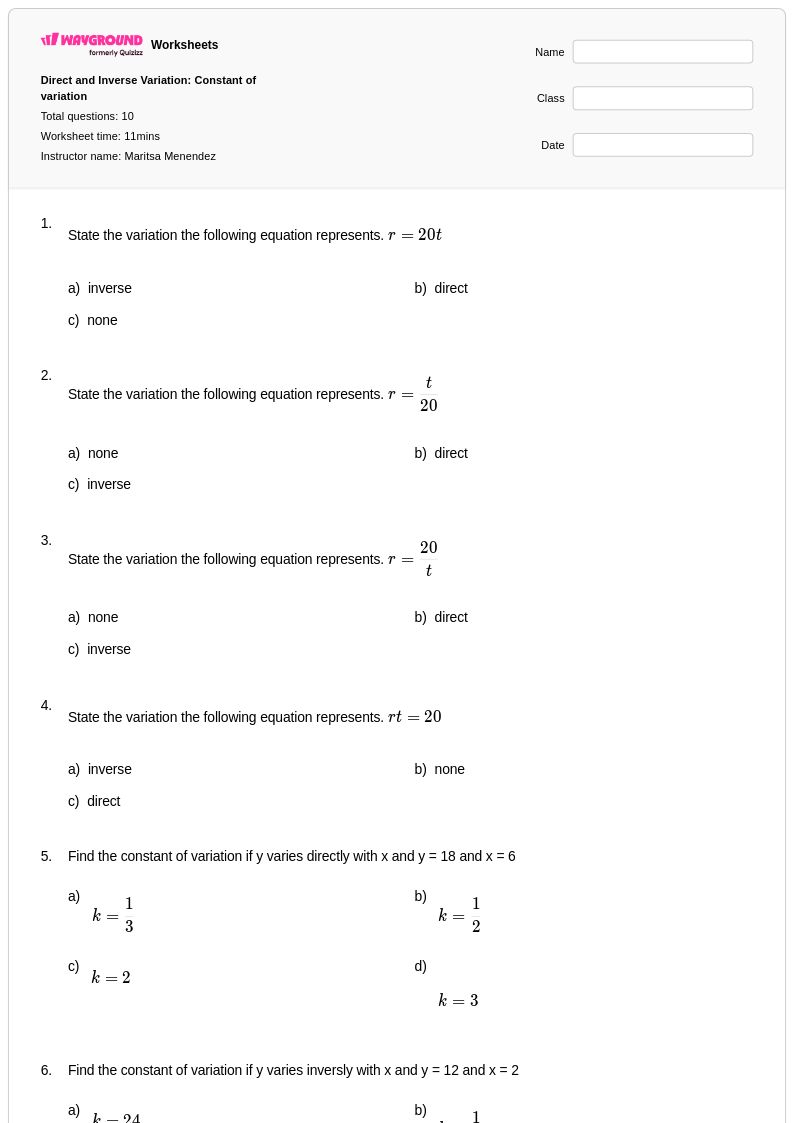
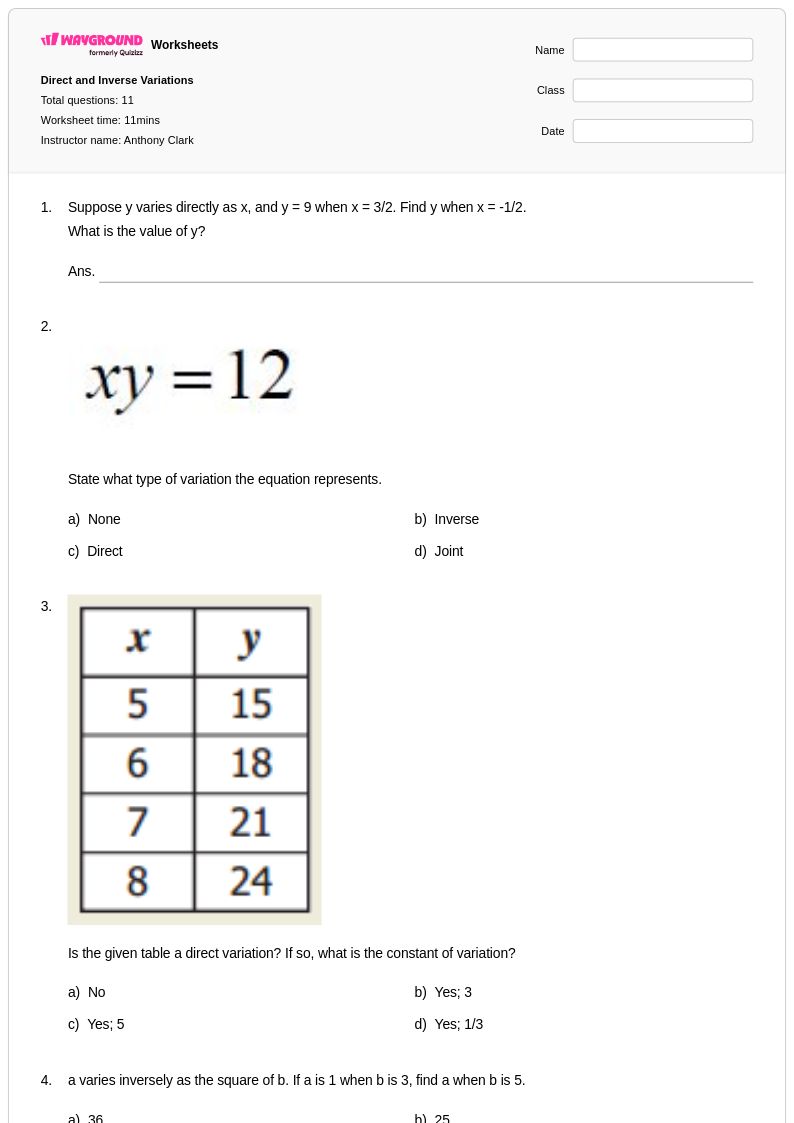
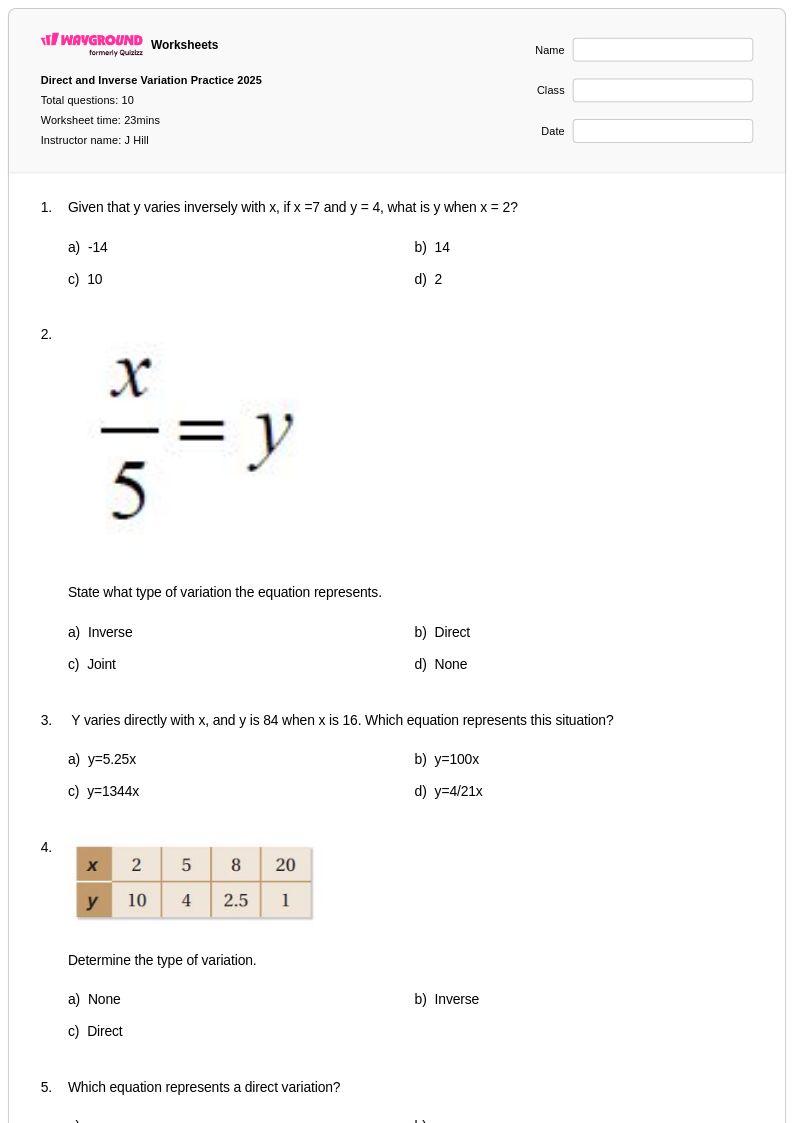
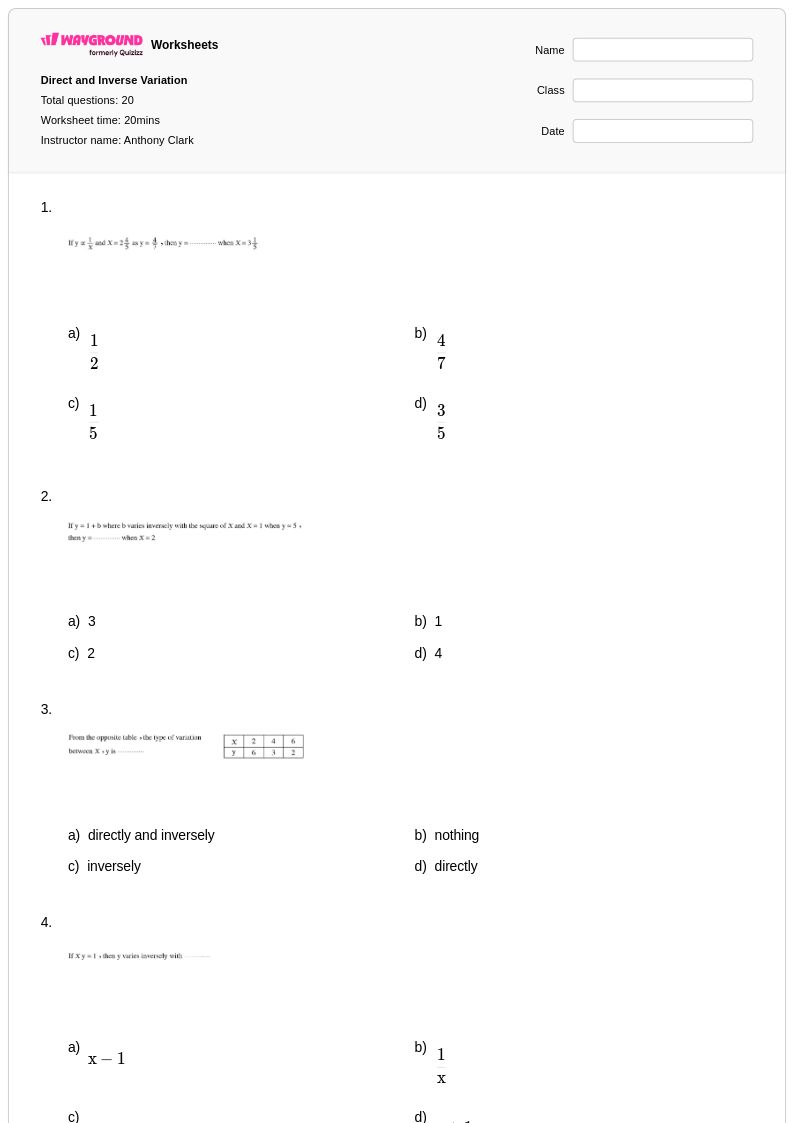
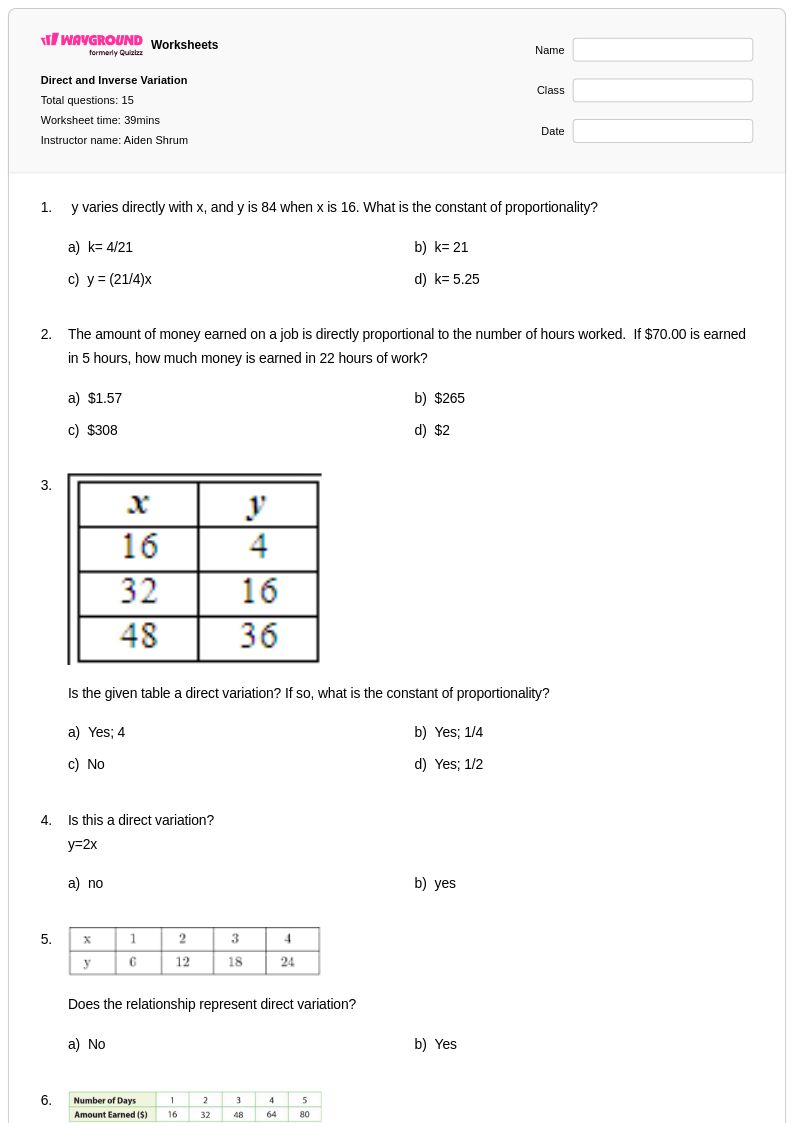
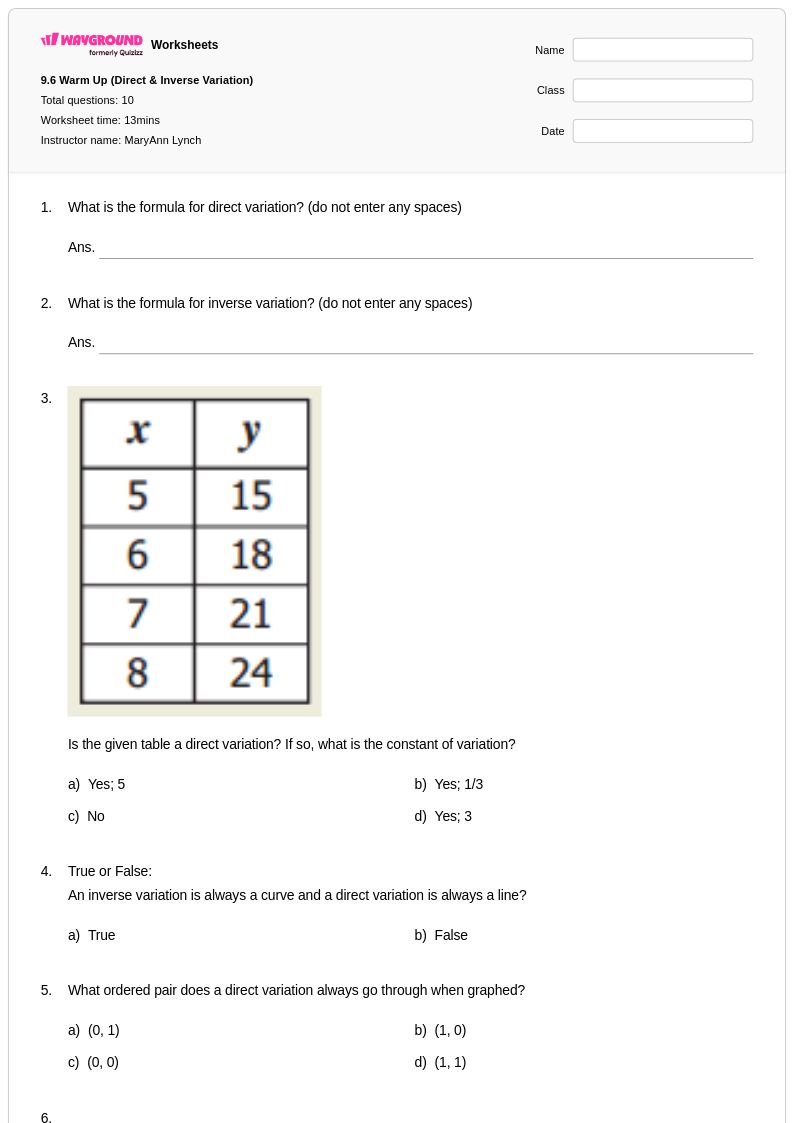
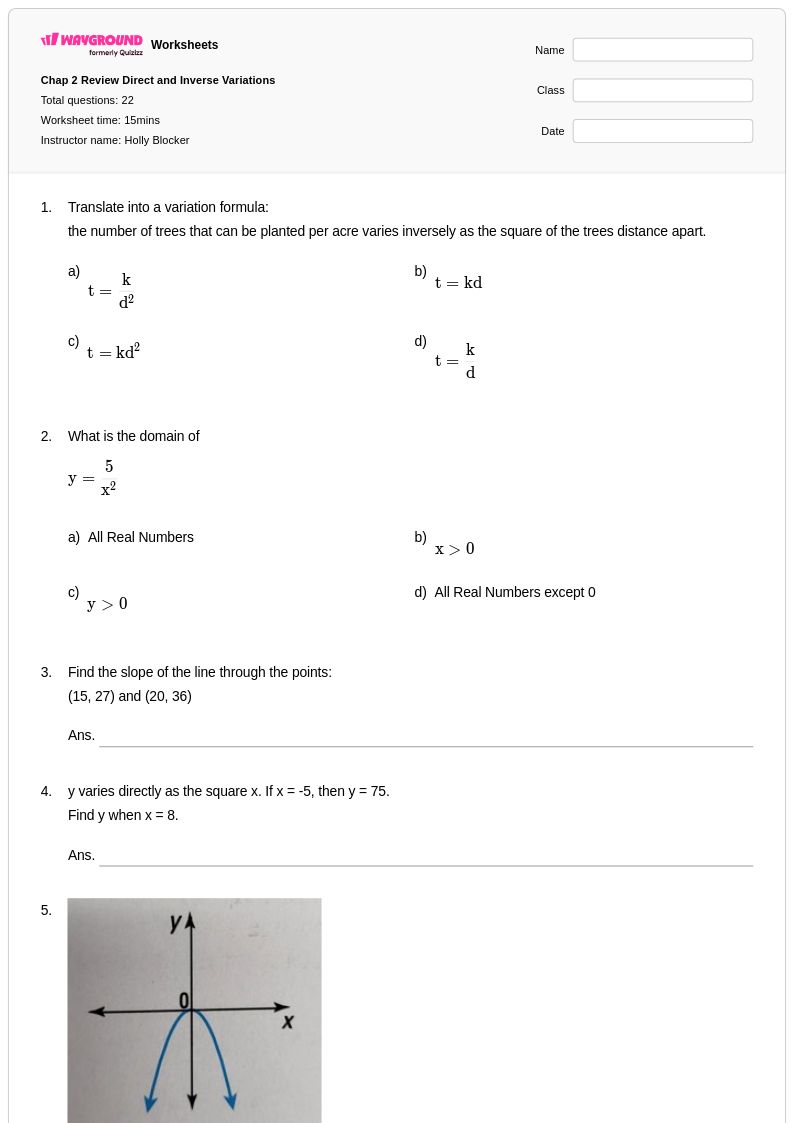
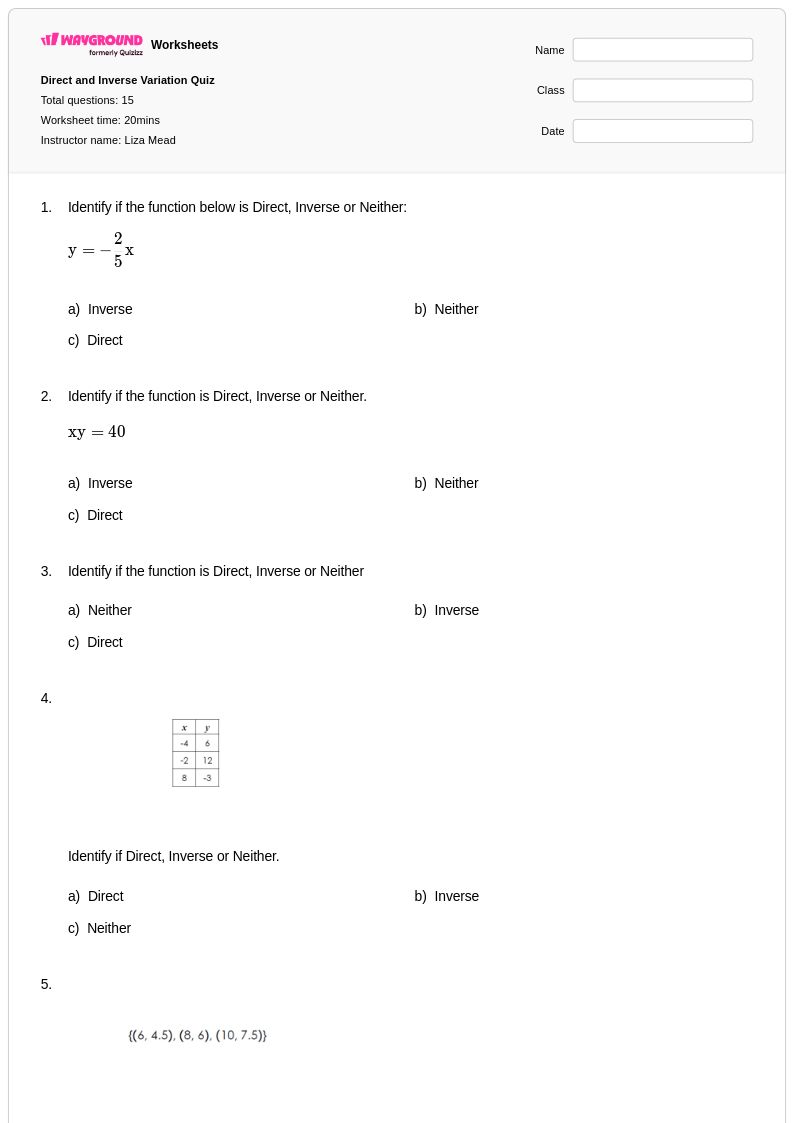
Free Printable Direct and Inverse Variation worksheets
Enhance algebra skills with Wayground's free direct and inverse variation worksheets featuring comprehensive practice problems, printable PDFs, and detailed answer keys to help students master proportional relationships and variation equations.
Explore printable Direct and Inverse Variation worksheets
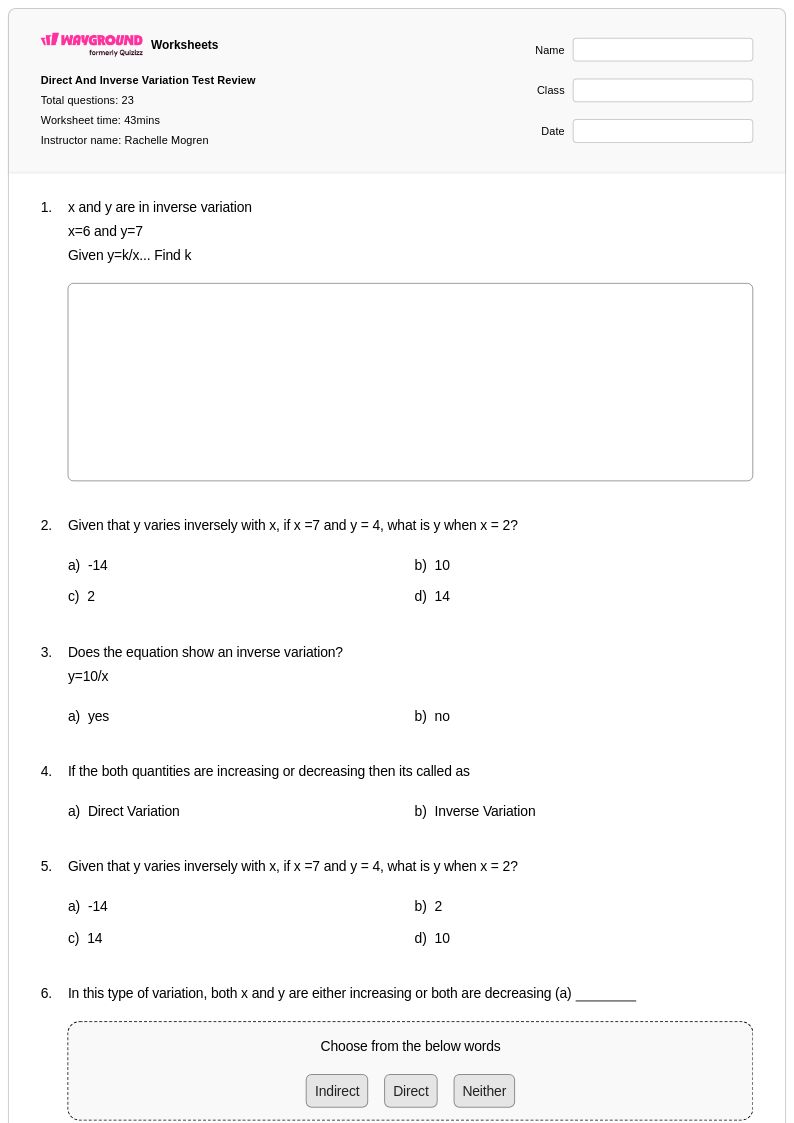
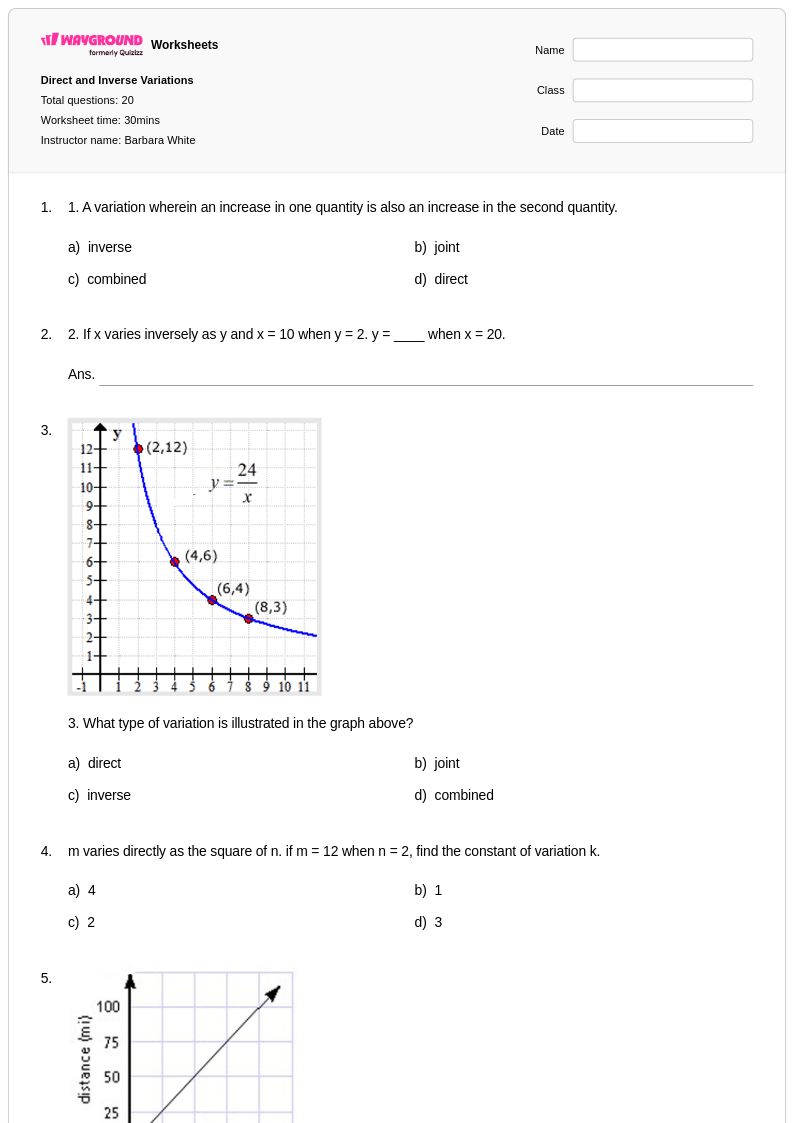
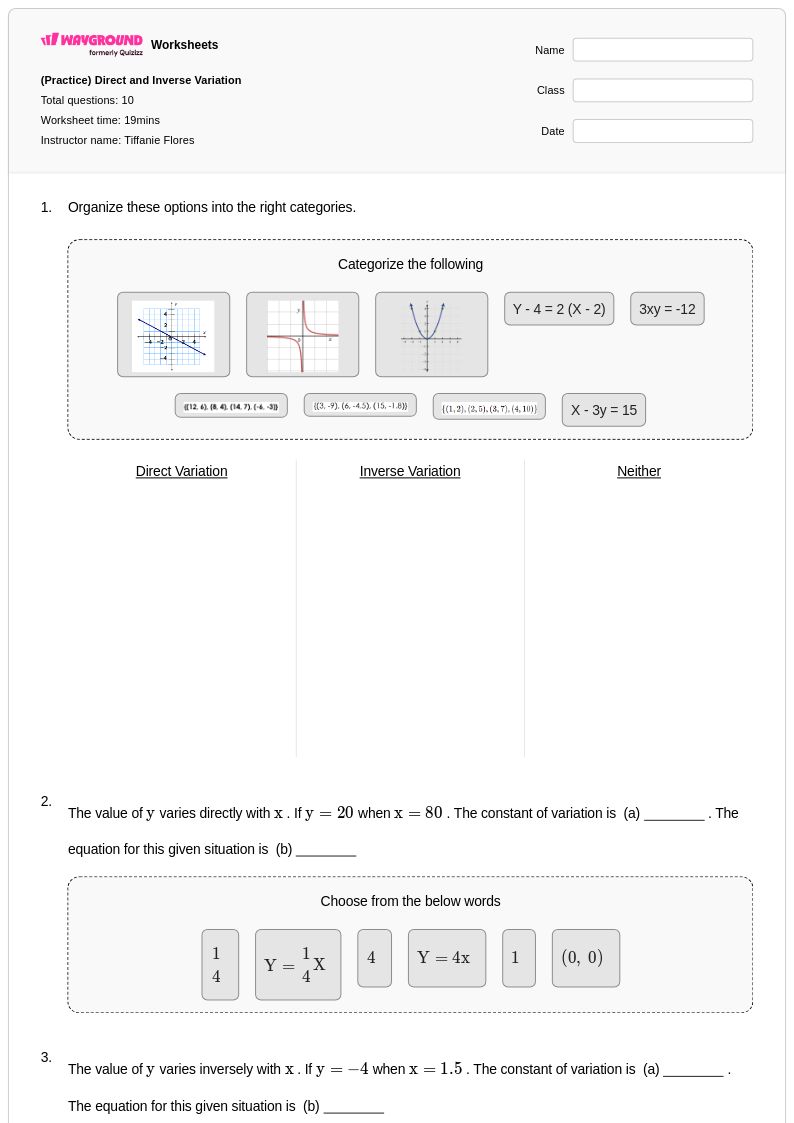
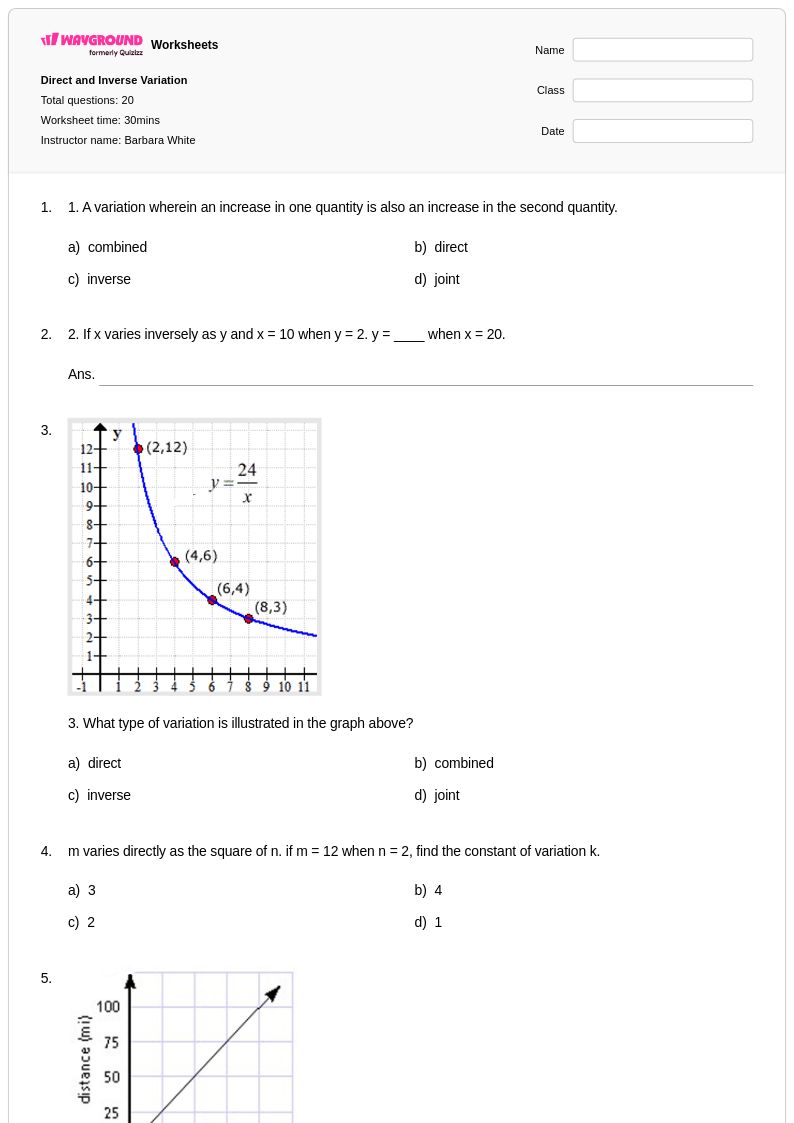
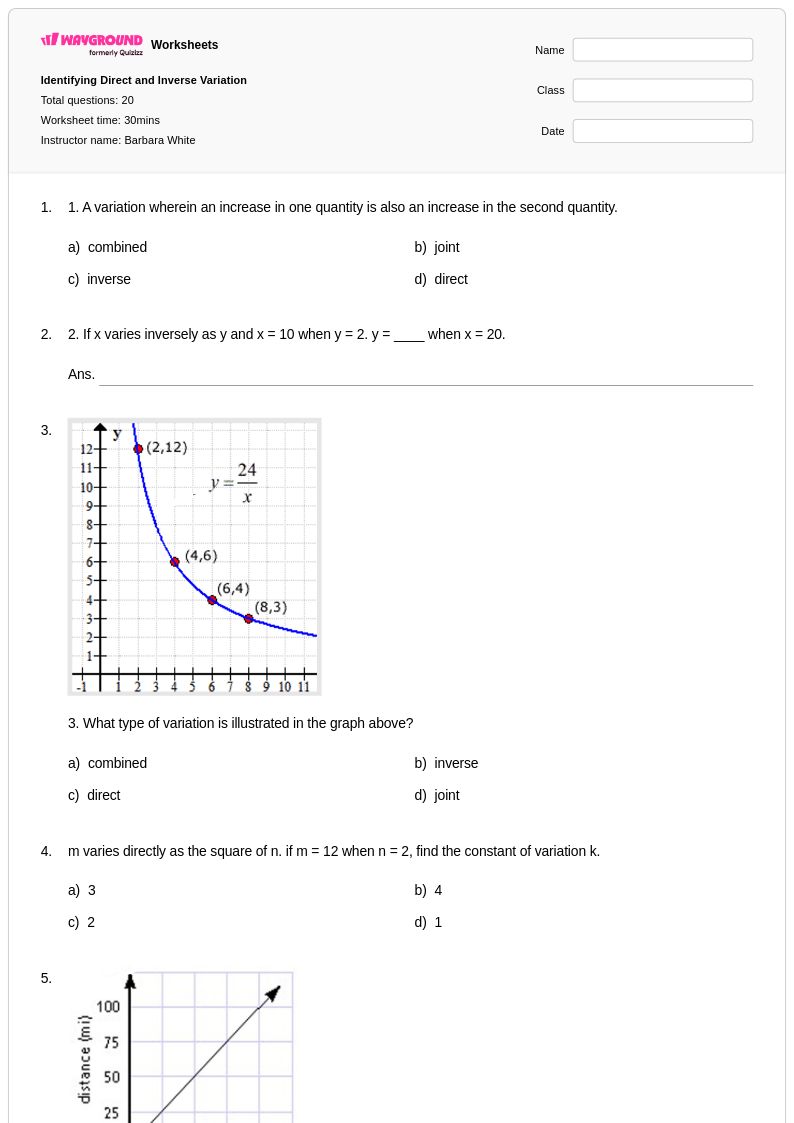
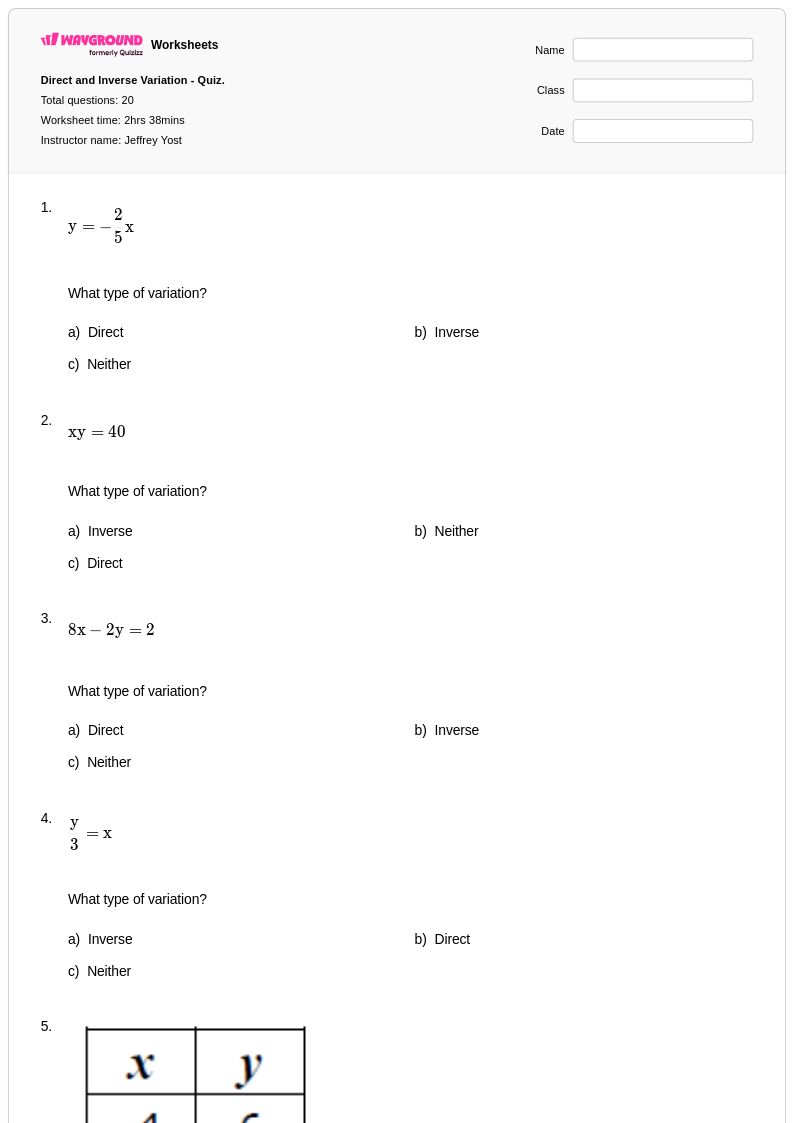
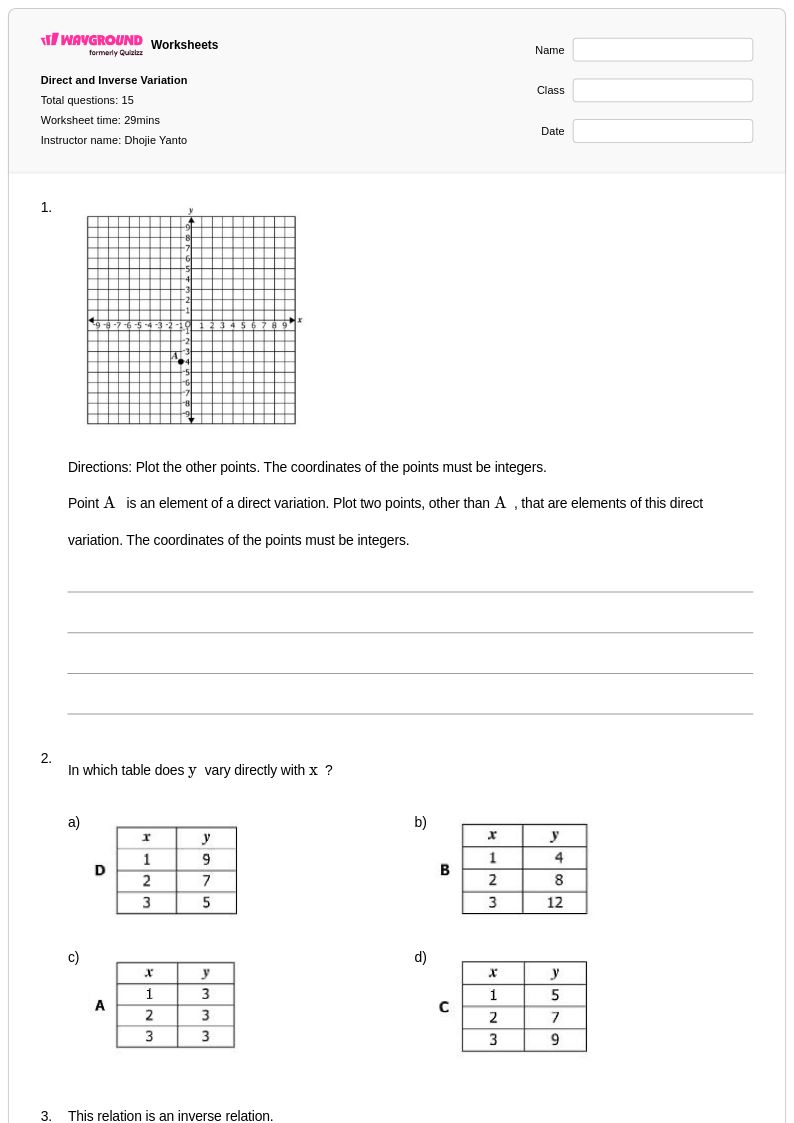
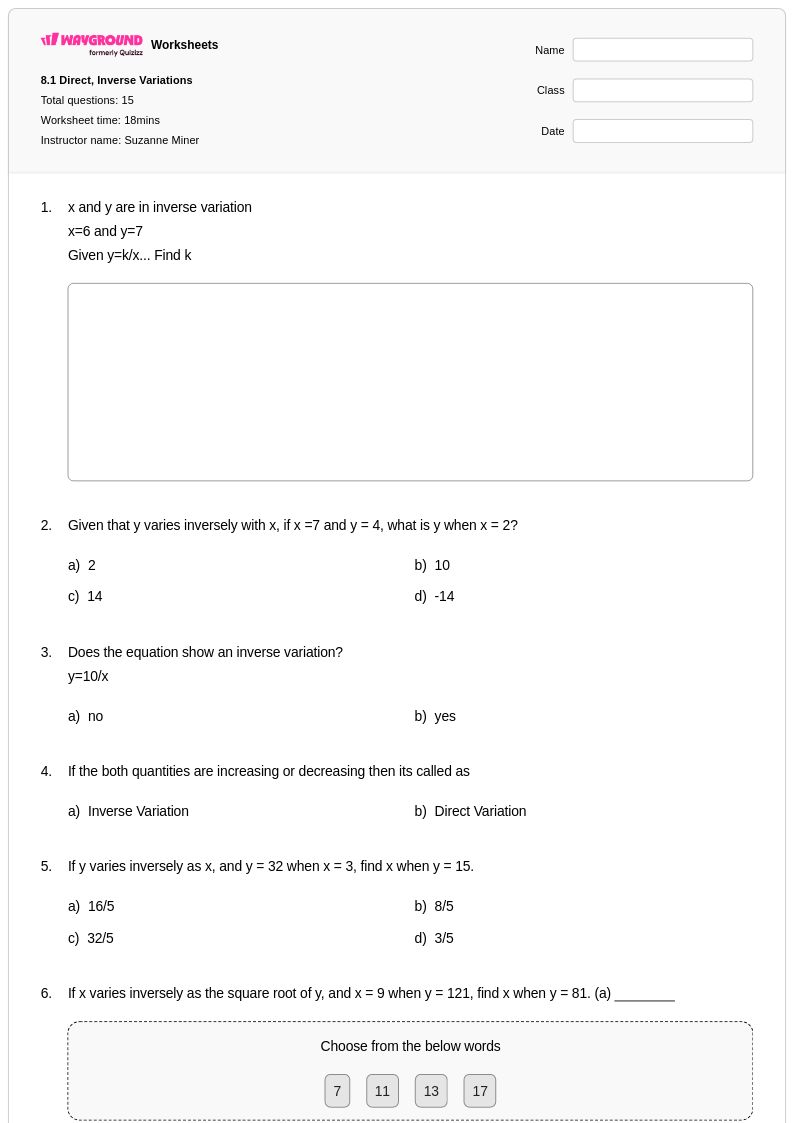
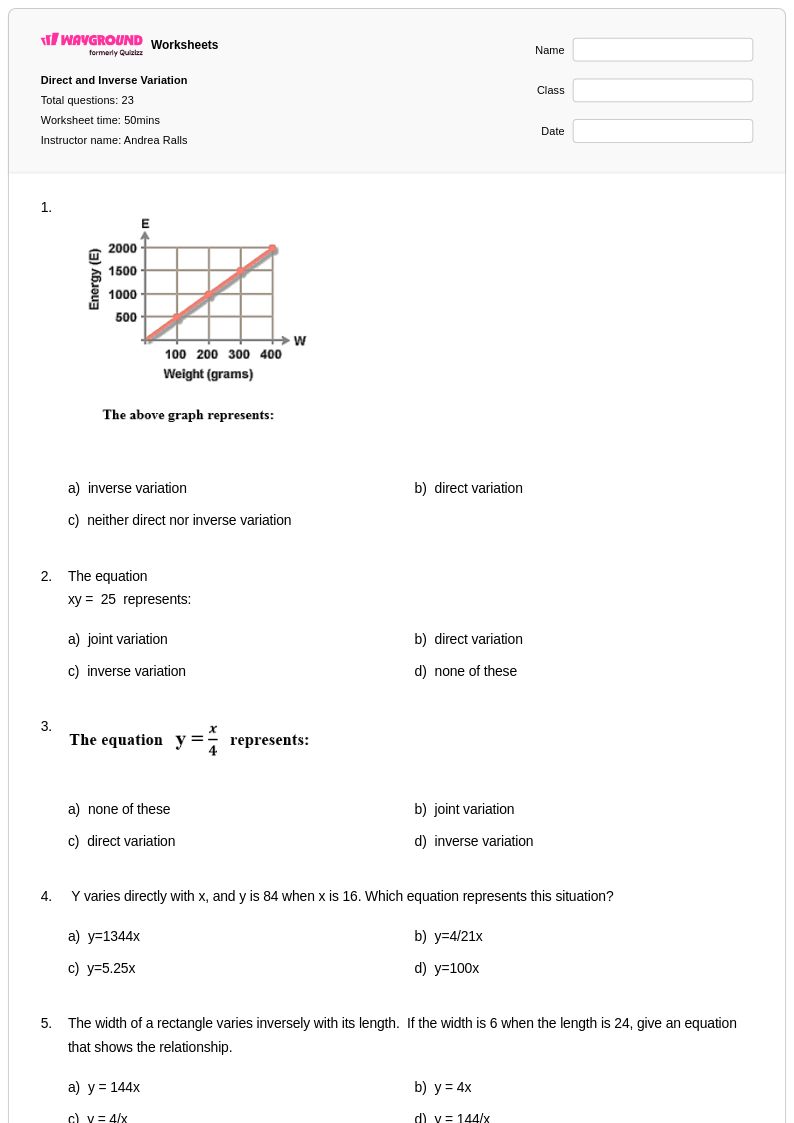
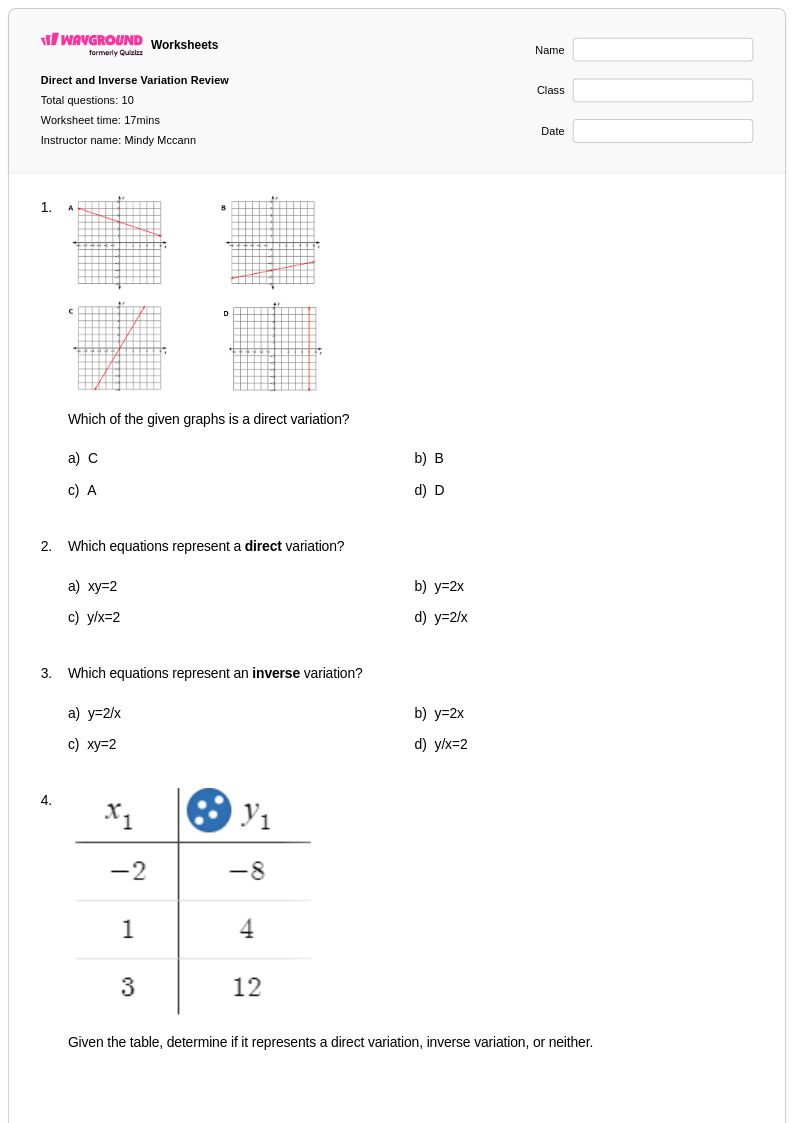
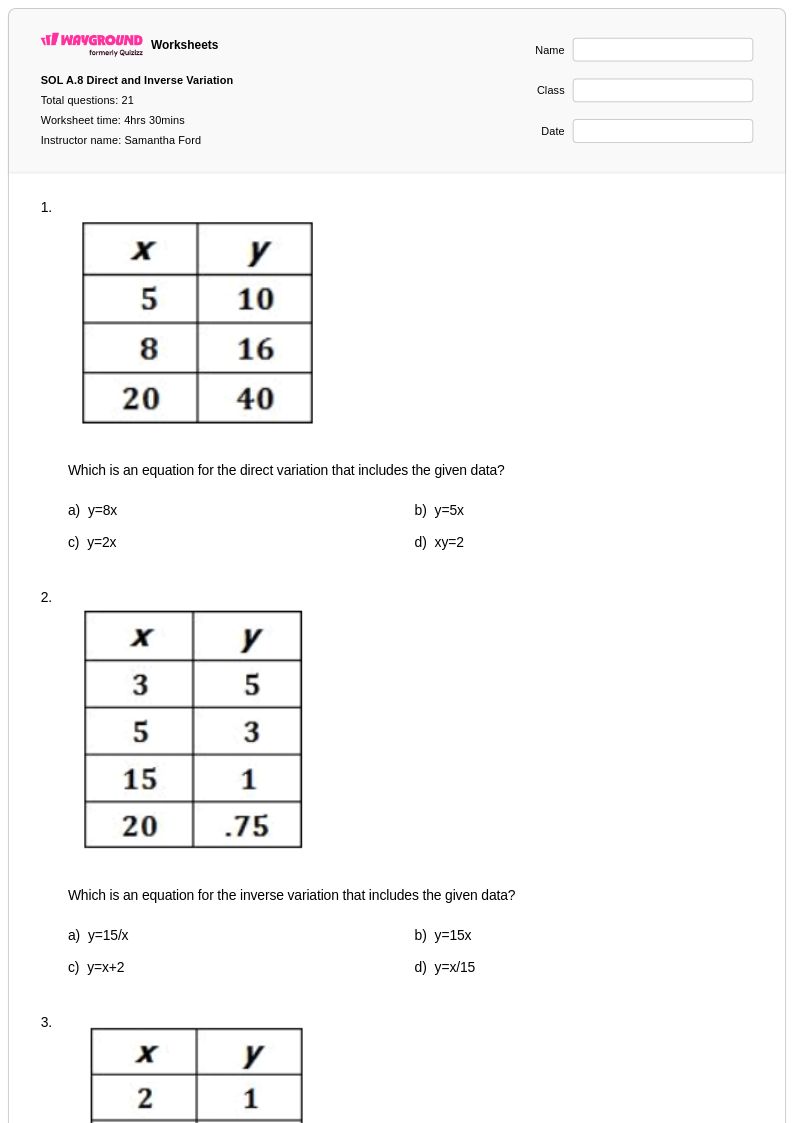
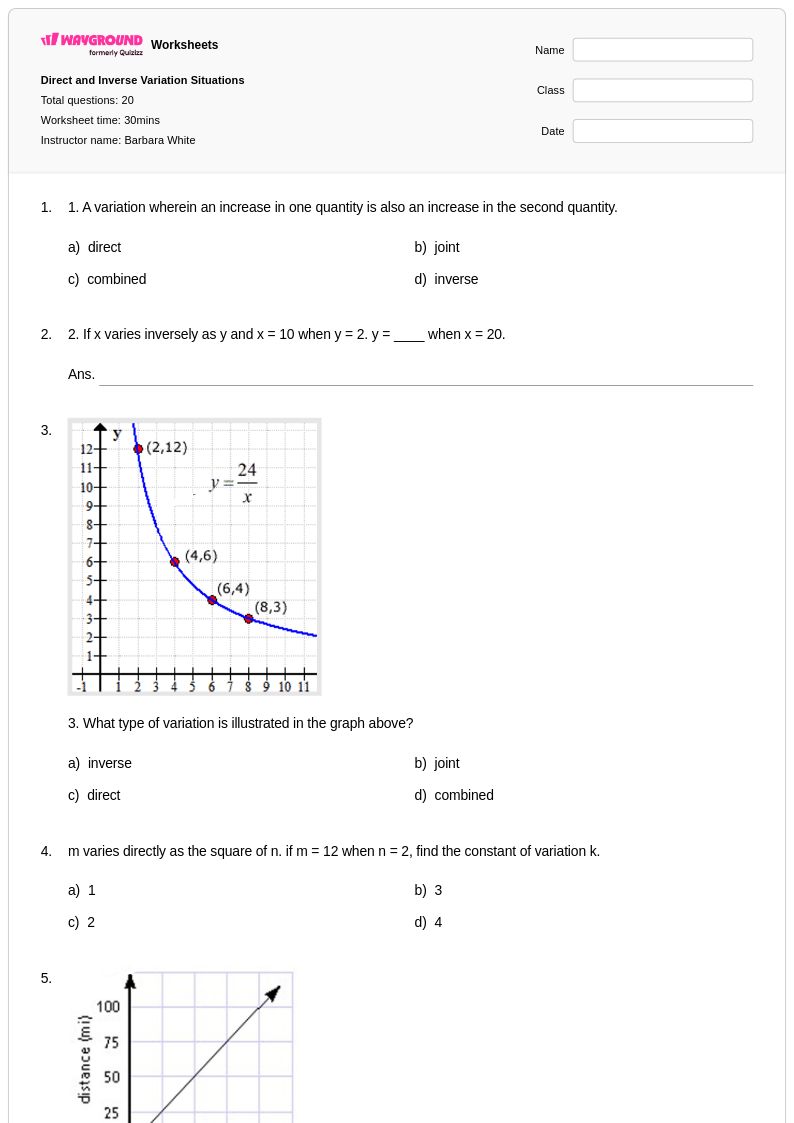
Direct and inverse variation worksheets available through Wayground (formerly Quizizz) provide comprehensive practice opportunities for students to master these fundamental algebraic relationships. These carefully designed resources help students understand how variables change in relation to one another, whether they increase and decrease together in direct variation or move in opposite directions in inverse variation. The worksheets strengthen critical mathematical skills including identifying variation patterns, writing variation equations, solving for constants of variation, and applying these concepts to real-world scenarios. Each practice problem set includes detailed answer keys and is available as free printable PDFs, making it easy for educators to implement targeted skill practice that builds algebraic reasoning and problem-solving confidence.
Wayground (formerly Quizizz) empowers teachers with millions of educator-created direct and inverse variation resources that streamline lesson planning and differentiated instruction. The platform's robust search and filtering capabilities allow teachers to quickly locate worksheets aligned with specific mathematical standards and tailored to diverse learning needs. These versatile materials are available in both printable PDF format for traditional classroom use and digital formats for interactive learning experiences. Teachers can easily customize existing worksheets or create new variations to support remediation for struggling students, provide enrichment challenges for advanced learners, or deliver consistent skill practice across different instructional contexts. This comprehensive collection ensures that educators have the flexibility to address individual student needs while maintaining focus on essential algebraic concepts.
FAQs
How do I teach direct and inverse variation?
Start with concrete examples before introducing equations. Direct variation clicks quickly when students see it in familiar contexts — speed and distance, or unit pricing. Inverse variation is trickier: students need to see that as one quantity doubles, the other halves, before the equation y = k/x makes intuitive sense. Once both types are grounded in context, move to identifying the constant of variation k, then to writing and solving equations. Keeping the two types in explicit contrast throughout the unit helps students avoid conflating them.
What exercises help students practice direct and inverse variation?
The most effective practice moves through three stages: identifying which type of variation a relationship represents, finding the constant k from a given pair of values, and then solving for an unknown variable. Real-world word problems — involving speed and travel time, gear ratios, or cost per item — are especially useful because they force students to set up the relationship themselves rather than just manipulate a pre-built equation. Wayground's worksheets cover this full progression, from basic identification to multi-step applications.
What mistakes do students commonly make with direct and inverse variation?
The most persistent error is confusing the two types: students often assume that any proportional-looking relationship is direct variation, even when the product xy is constant rather than the ratio y/x. A second common mistake is misidentifying k — students sometimes solve for k using the wrong operation (adding or subtracting values instead of dividing or multiplying). It also helps to watch for students who can solve a variation equation algebraically but can't recognize the relationship in a table or graph.
How do I use Wayground's direct and inverse variation worksheets in my class?
Each worksheet comes with a complete answer key, so it works well for independent practice or homework without extra prep on your end. You can run it as a digital quiz hosted on Wayground — useful for getting instant results — or download the printable PDF and assign it on paper. If you go the paper route, the Wayground for Teachers app lets you scan or capture student work to grade it without re-entering everything manually.
Is direct and inverse variation aligned to Common Core standards?
Yes. Common Core builds toward variation relationships through its progression on ratios, proportional reasoning, and functions. By the time students reach algebra, they're expected to recognize and represent proportional relationships — direct variation being the linear case where y = kx passes through the origin. Inverse variation extends this into non-linear territory, connecting to Common Core's emphasis on analyzing functions and interpreting their behavior. Mastery here directly supports later work with rational functions and modeling.
How can I differentiate direct and inverse variation practice for mixed-ability classes?
For students who struggle with the abstract equations, Wayground's Read Aloud accommodation helps when word problems are the sticking point rather than the math itself. Reducing answer choices is useful for students who understand the concept but get overwhelmed by similar-looking options for k. For layout-based accessibility, you can generate an alternate version of the same worksheet with larger font or a dyslexia-friendly font — same problems, adjusted presentation — without creating a separate assignment for the rest of the class.
What grade level covers direct and inverse variation?
Direct variation is typically introduced in Grade 7 or 8 as an extension of proportional reasoning, while inverse variation is usually formalized in Grades 8–9 within an algebra course. Both concepts appear again in Grades 10–11 in the context of rational functions and real-world modeling problems.