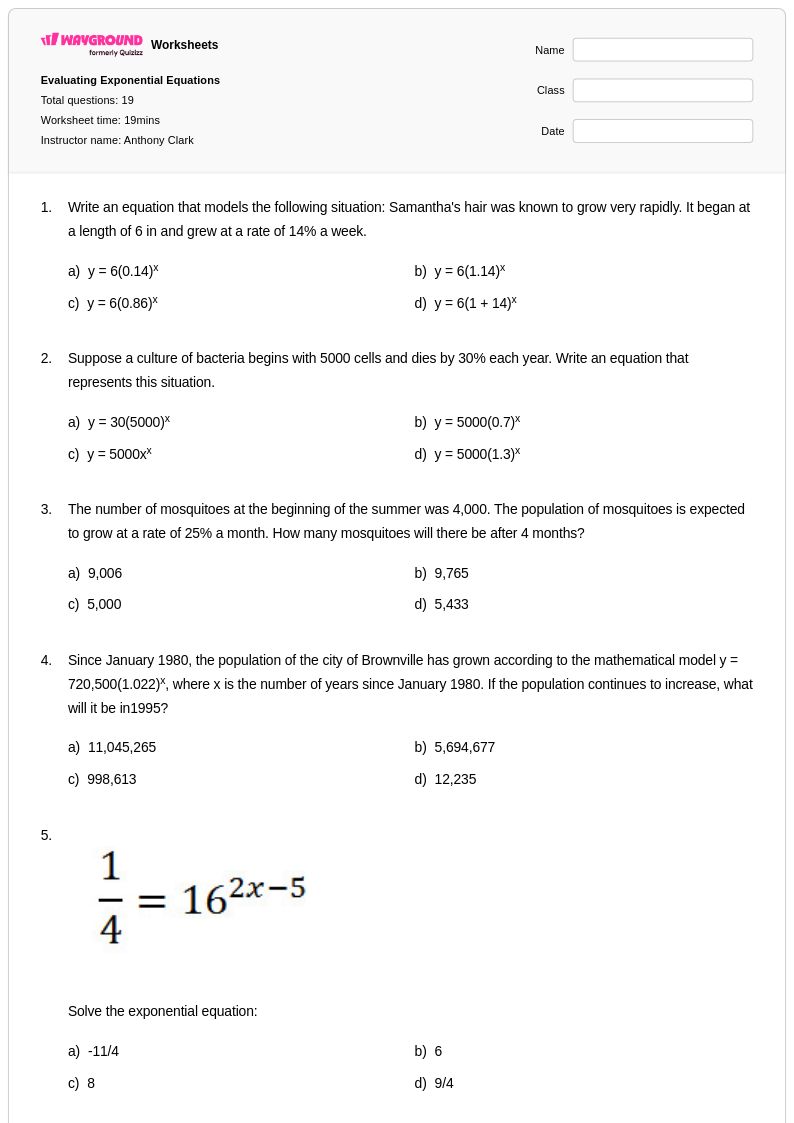
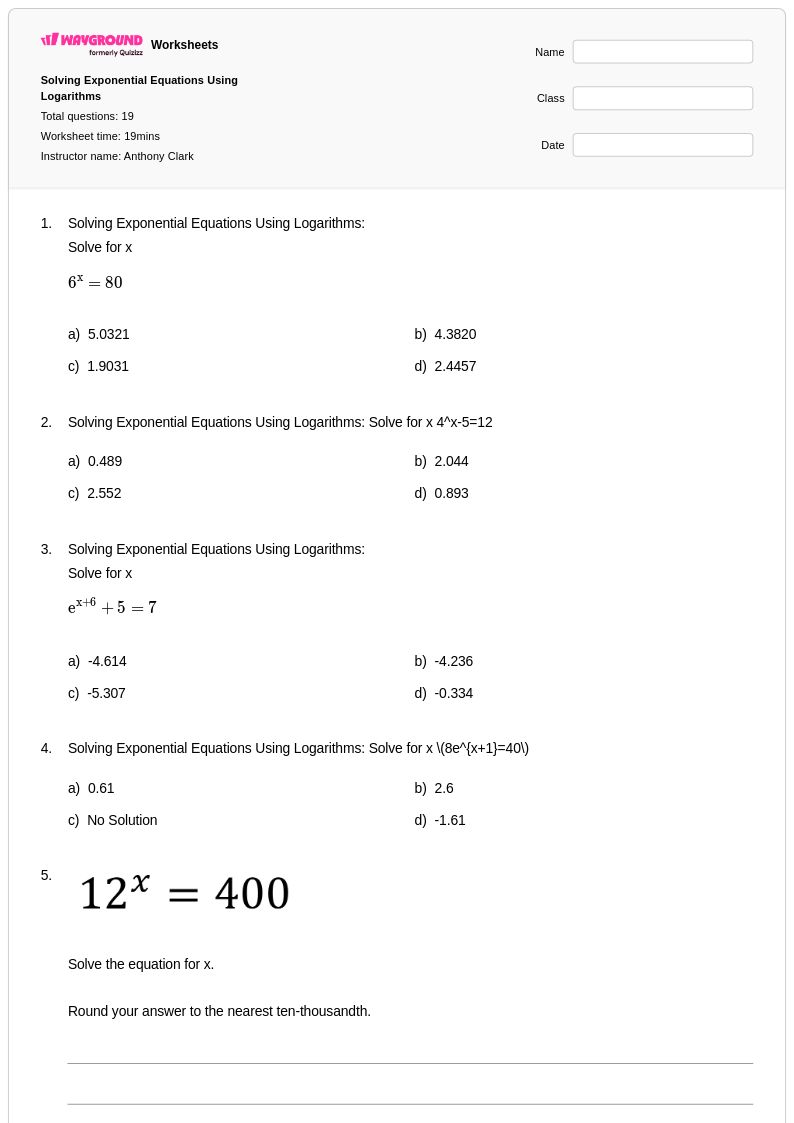
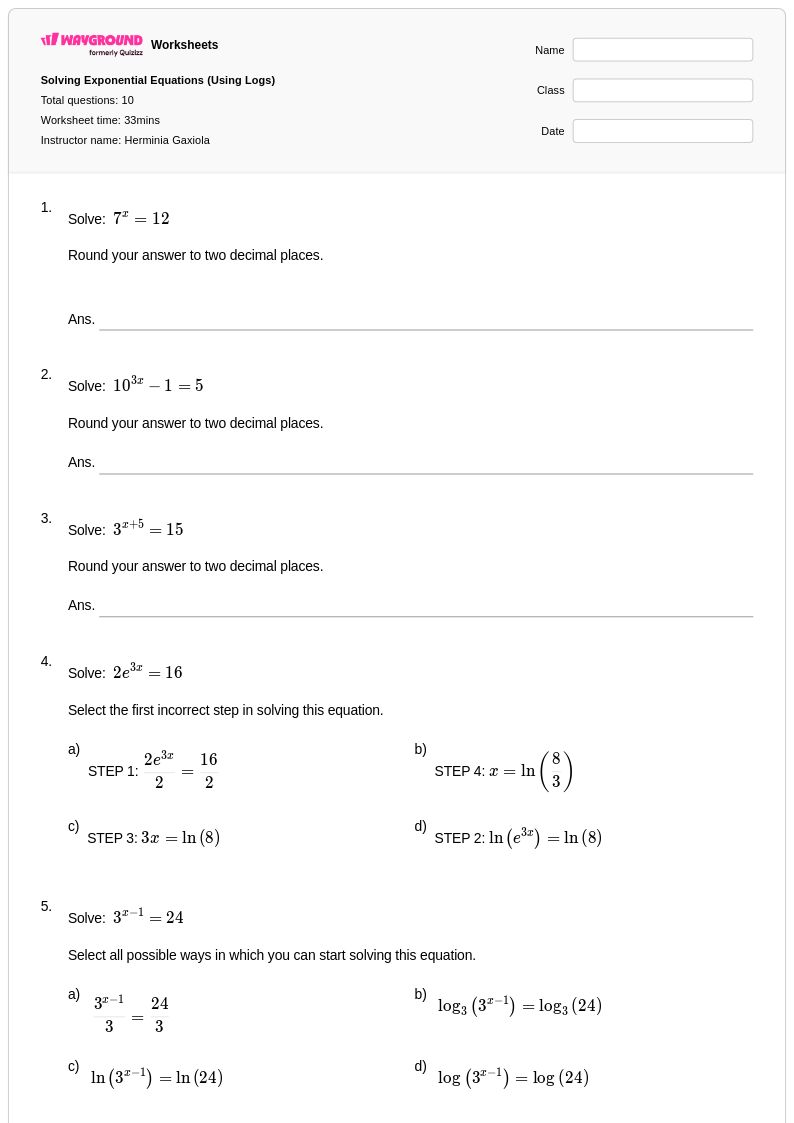
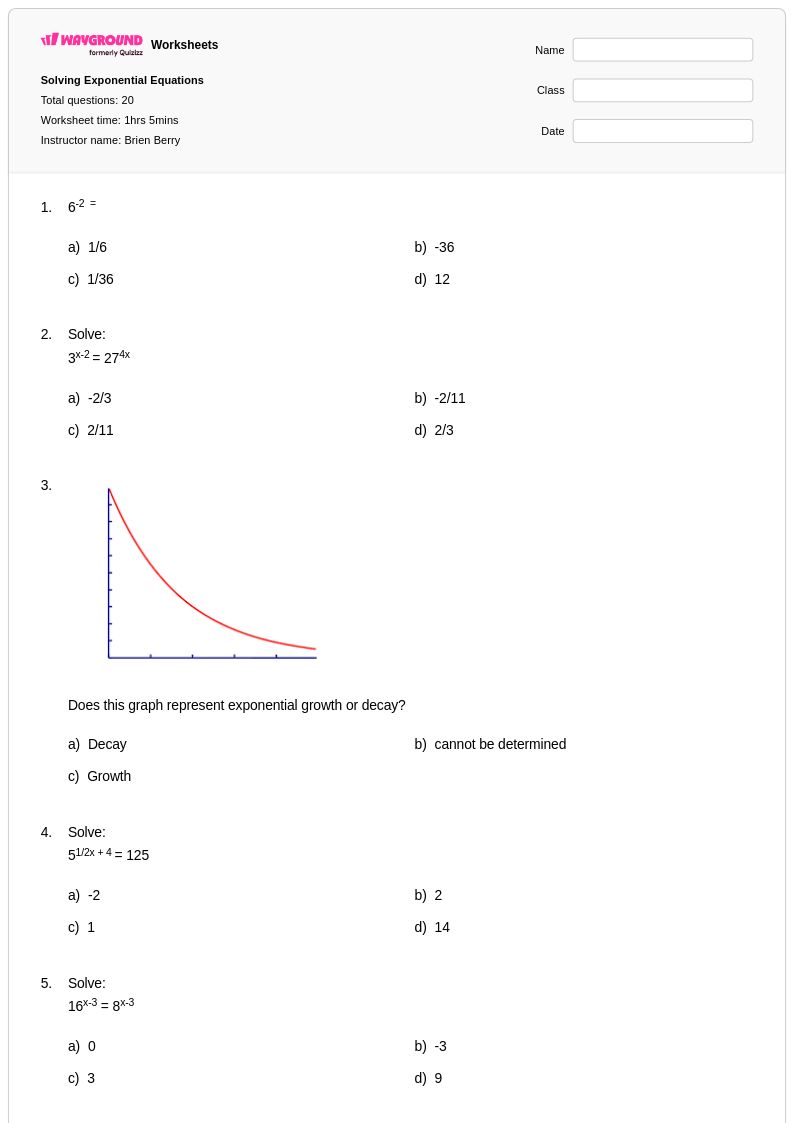
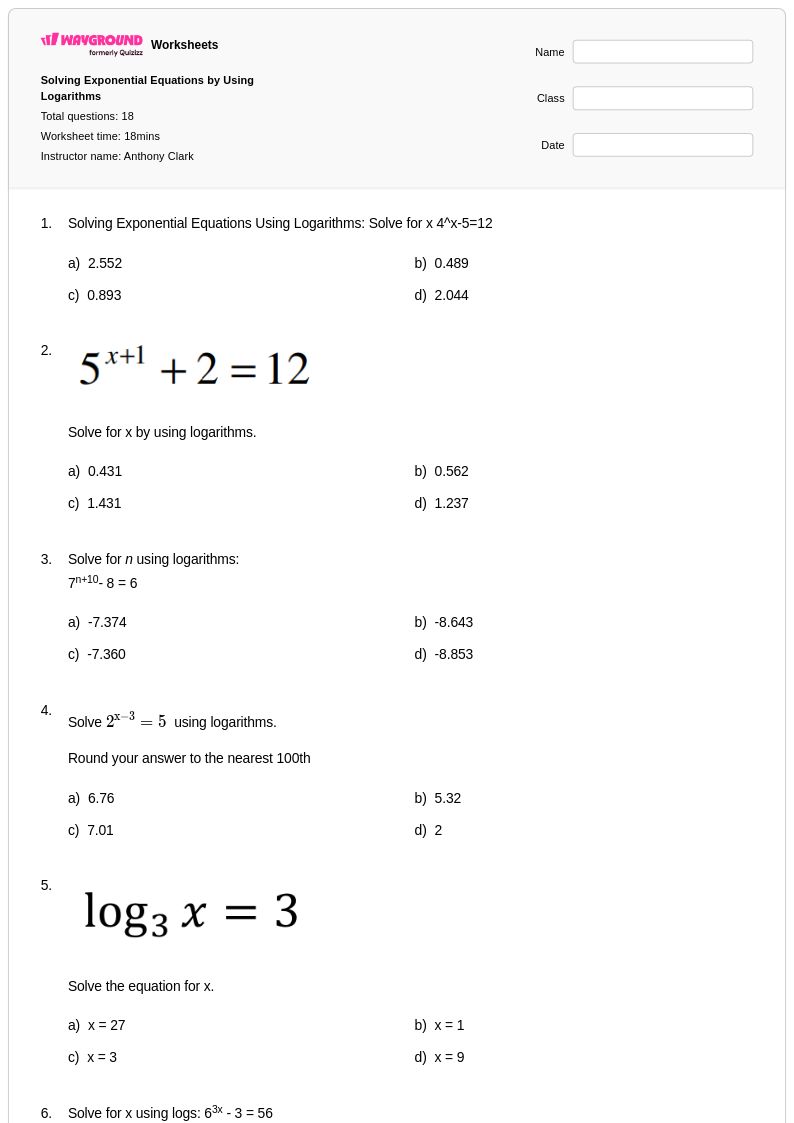
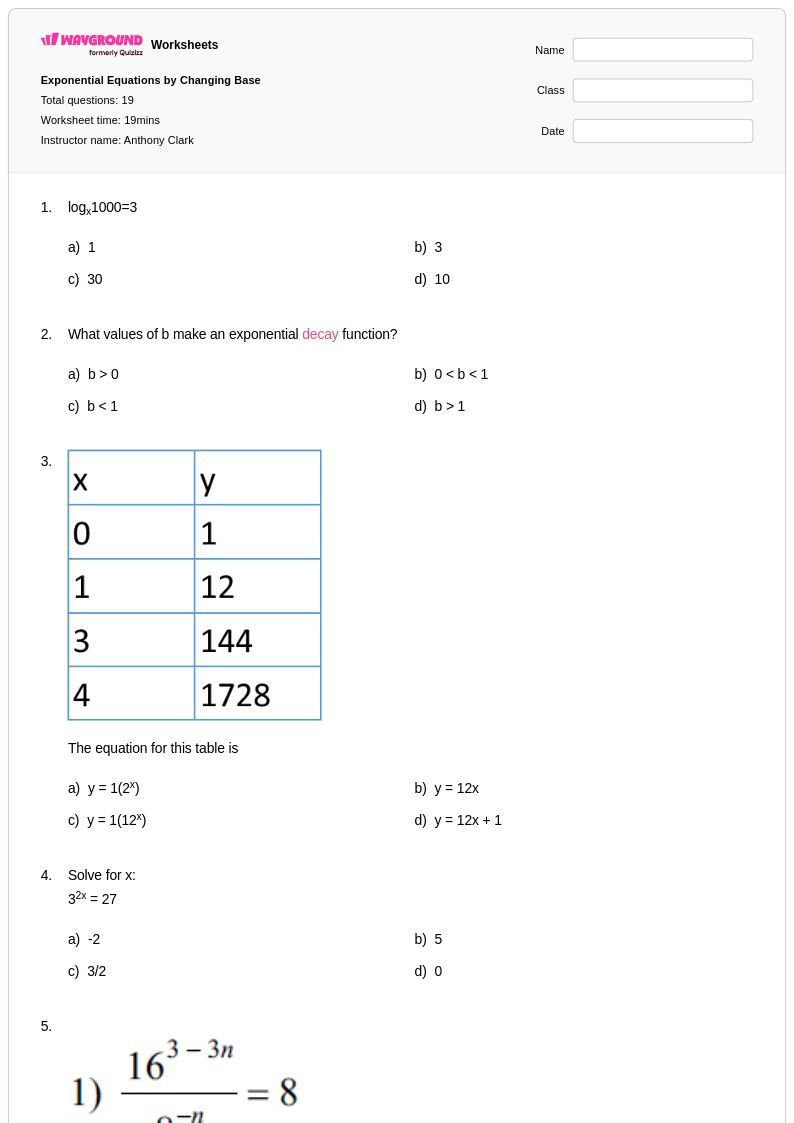
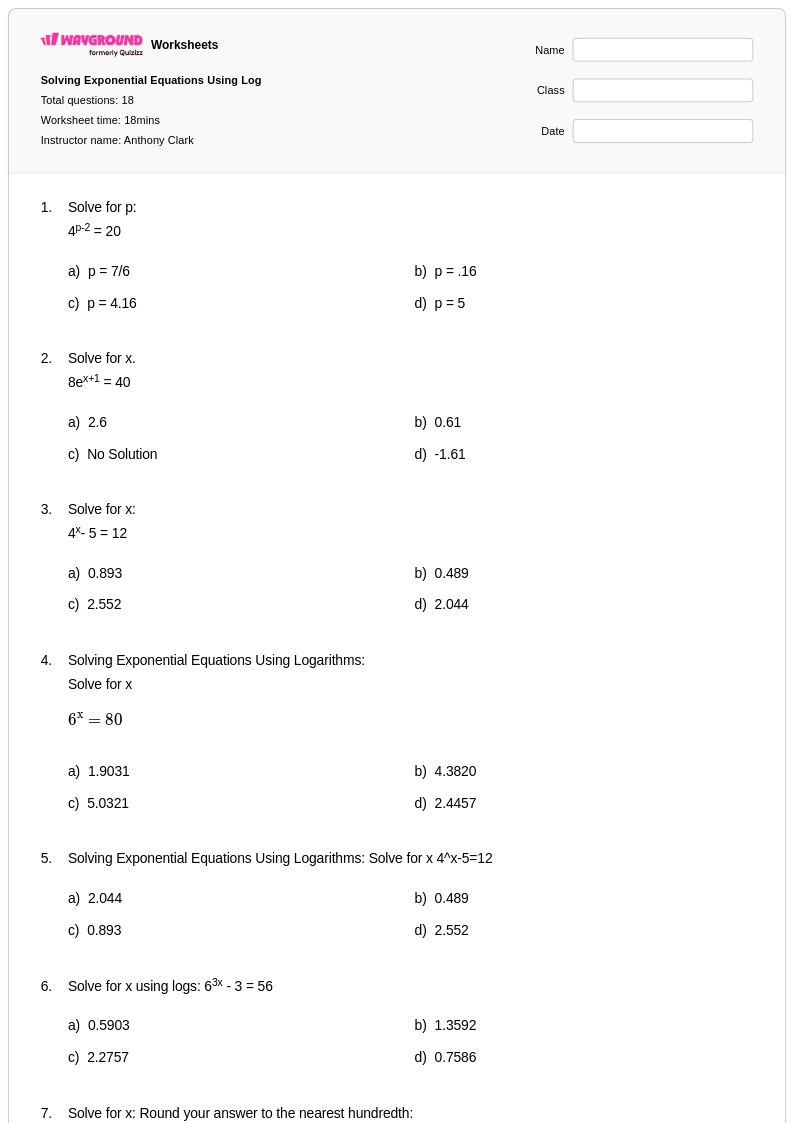
Wayground's free exponential equations worksheets provide comprehensive practice problems and answer keys to help students master solving exponential functions, with printable PDFs featuring step-by-step solutions and varied difficulty levels.
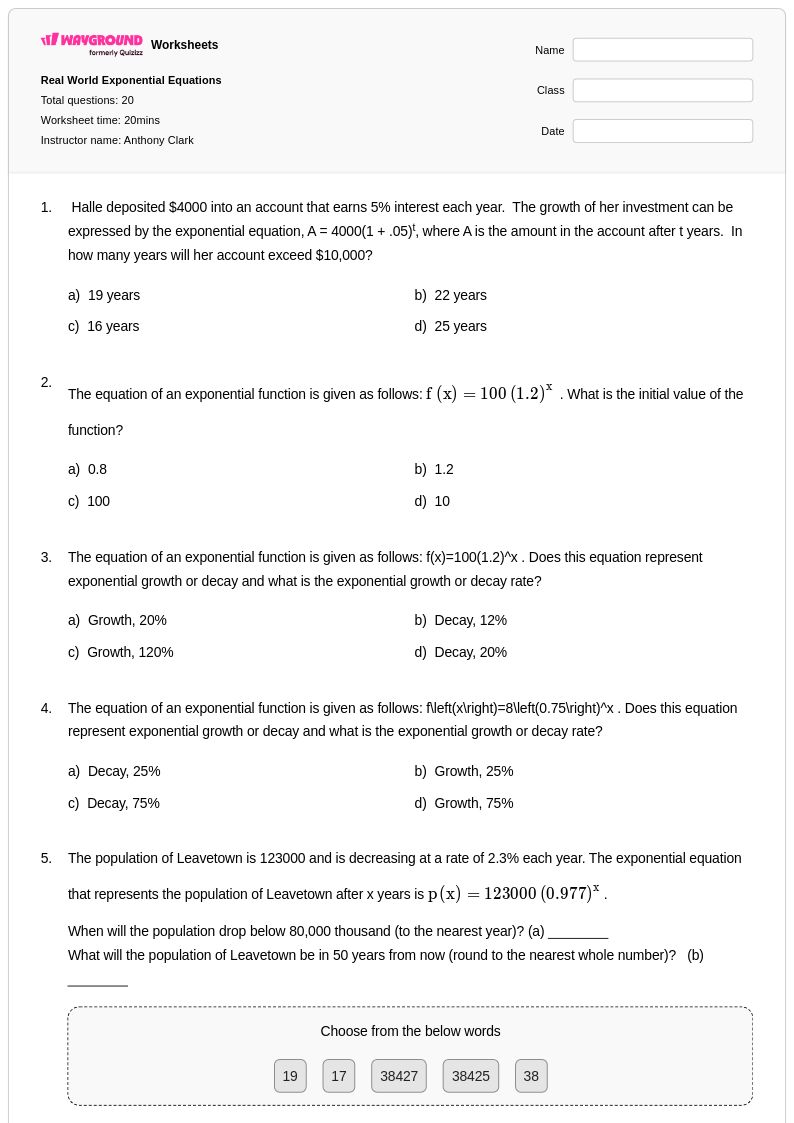
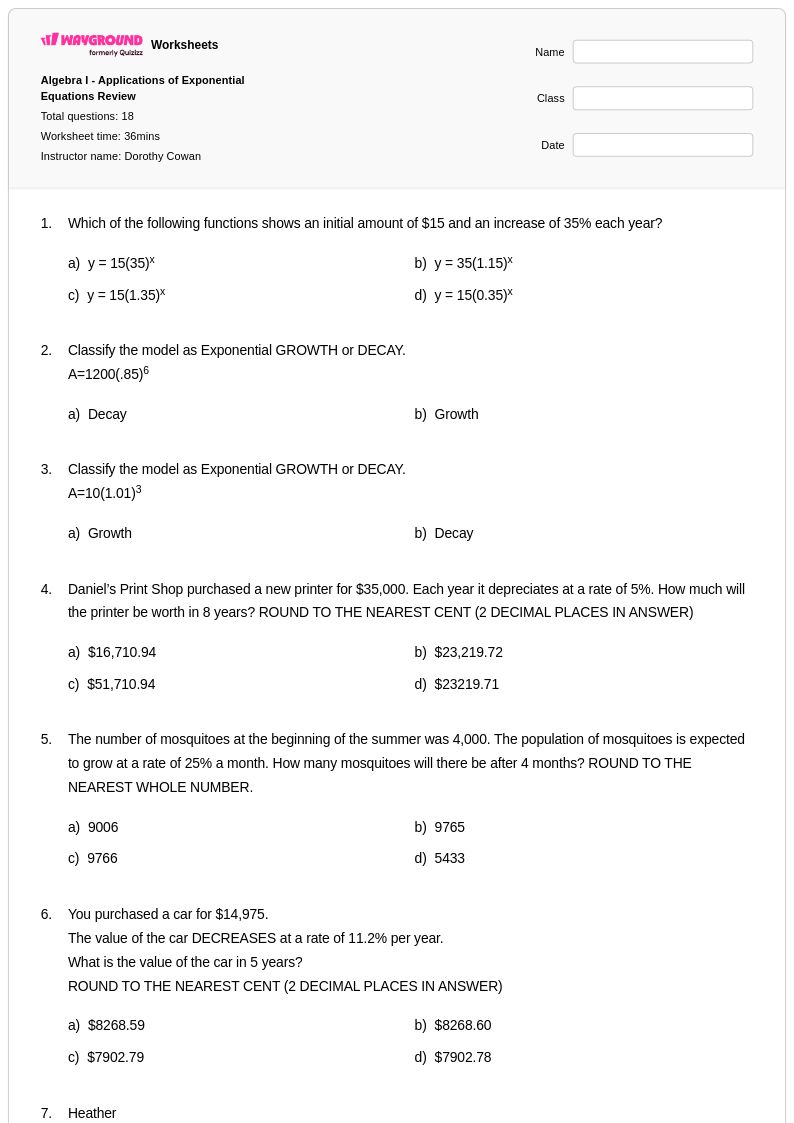
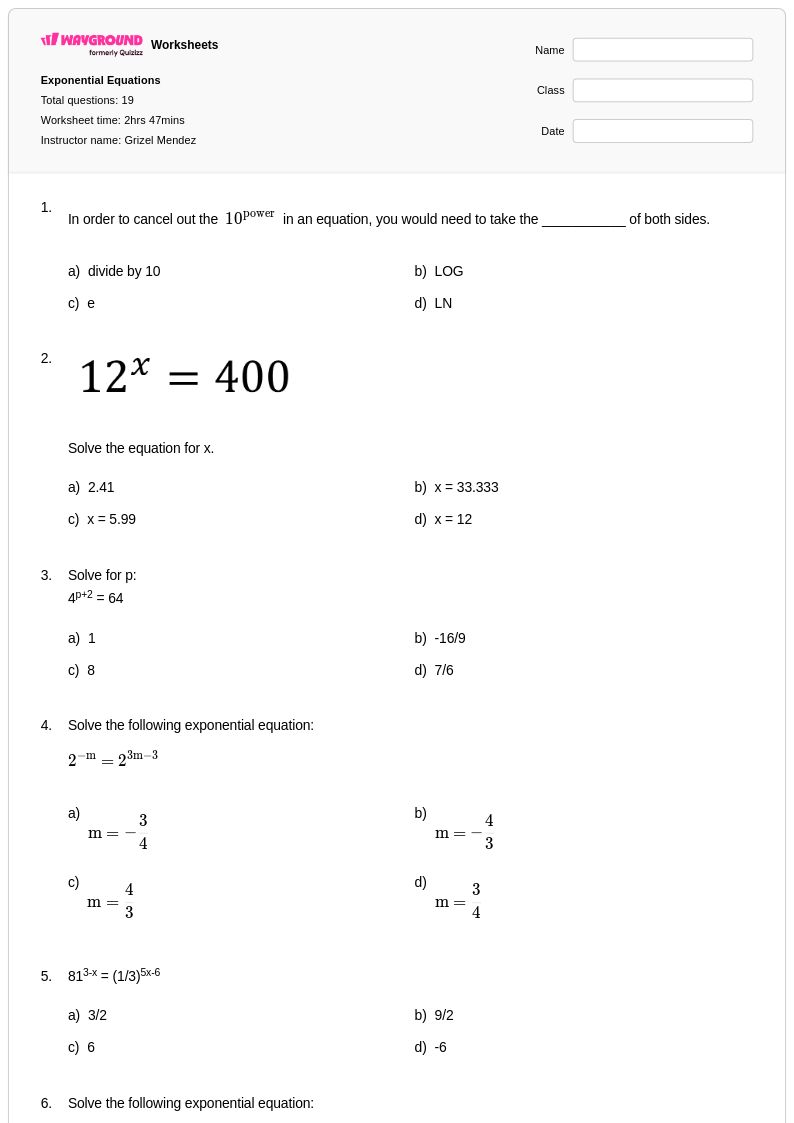
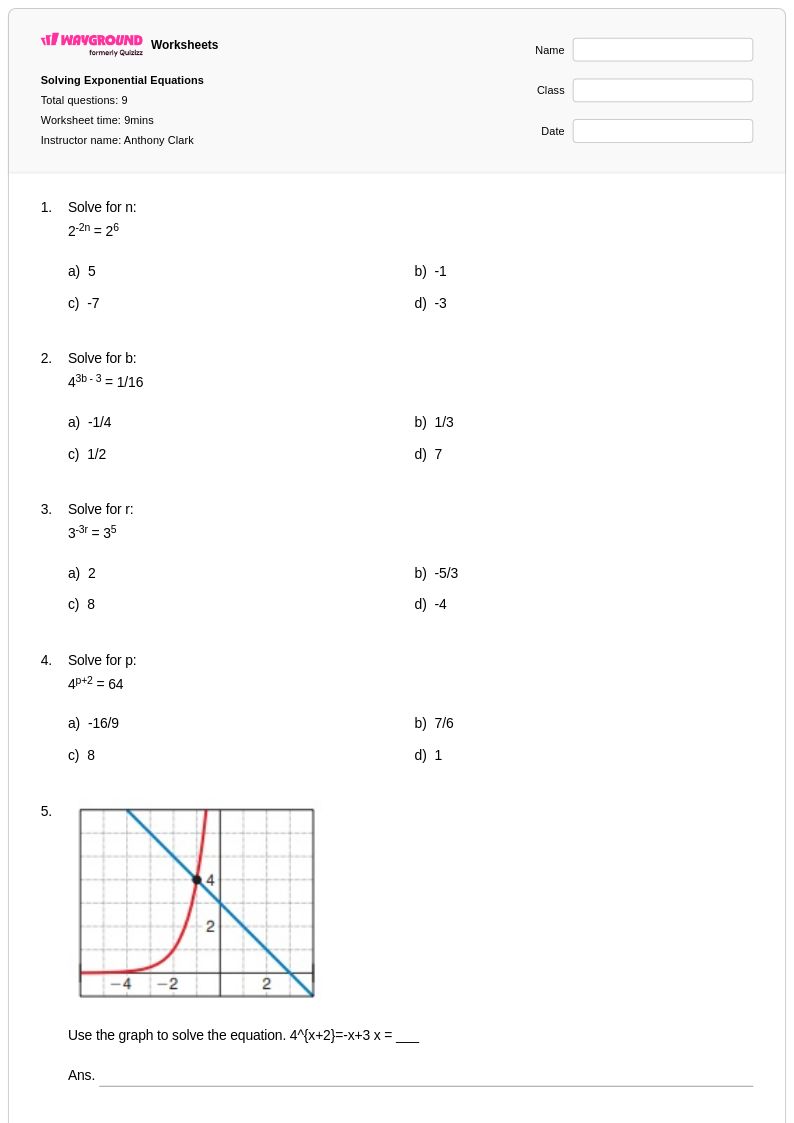
Exponential equations worksheets available through Wayground (formerly Quizizz) provide comprehensive practice materials designed to strengthen students' ability to solve equations involving exponential expressions and logarithmic relationships. These carefully crafted worksheets focus on essential skills including solving exponential equations using properties of exponents, applying logarithms to isolate variables, and working with both natural and common logarithmic functions. Students develop proficiency in recognizing when to use substitution methods, graphical approaches, and algebraic manipulation techniques to find solutions. The collection includes practice problems ranging from basic exponential equations with matching bases to more complex scenarios involving compound interest, population growth, and radioactive decay applications. Each worksheet comes with a detailed answer key and is available as a free printable pdf, making it easy for educators to implement immediate feedback and assessment strategies.
Wayground (formerly Quizizz) supports mathematics educators with an extensive collection of teacher-created exponential equations resources, featuring millions of worksheets that can be easily located through advanced search and filtering capabilities. The platform's robust standards alignment ensures that worksheets meet curriculum requirements while providing differentiation tools that allow teachers to customize difficulty levels and problem types based on individual student needs. These resources are available in both printable pdf format and interactive digital versions, giving educators flexibility in delivery methods for classroom instruction, homework assignments, or remote learning environments. Teachers can efficiently plan targeted skill practice sessions, design remediation activities for struggling learners, and create enrichment opportunities for advanced students, all while accessing high-quality materials that have been developed and refined by experienced mathematics educators across diverse educational settings.
FAQs
How do I teach exponential equations?
Start by making sure students are solid on exponent properties before introducing equations. From there, teach base-matching first — if both sides can be written as powers of the same base, no logarithms are needed. Once students hit equations like 2^x = 10 where bases can't be matched, introduce logarithms as the tool that brings the variable out of the exponent. Grounding new techniques in real contexts (compound interest, population growth) helps students see why the algebra matters, not just how to execute it.
What exercises help students practice exponential equations?
A good practice sequence moves from simple to complex: start with base-matching problems (e.g., 4^x = 64), then move to equations requiring logarithms, then multi-step problems with real-world setups like compound interest or radioactive decay. Mixing problem types within a single worksheet — rather than drilling one type at a time — builds the judgment students need to choose the right approach on their own.
What mistakes do students commonly make with exponential equations?
Three errors come up repeatedly. First, students try to apply logarithms before checking whether base-matching would work — it's a slower route when a simpler one exists. Second, when taking the log of both sides, students often forget to apply the power rule correctly and write log(a^x) as x · log(a) inconsistently. Third, on application problems, students confuse exponential growth and decay setups, plugging values into the wrong model entirely.
How do I use Wayground's exponential equations worksheets in my class?
Each worksheet comes with a complete answer key, so students can self-check or you can use it for quick grading. For in-class or homework use, download the printable PDF and distribute on paper — if you're grading physical submissions, the Wayground for Teachers app lets you scan or capture student work to grade it digitally. If you're running a digital session, you can host the same worksheet as an interactive quiz on Wayground, which works well for remote learning or 1:1 classrooms.
Are exponential equations aligned to Common Core standards?
Yes. Common Core sequences exponential equations as a natural extension of the exponent rules students learn in middle school. By high school, students are expected to solve exponential equations both algebraically — using logarithms to isolate variables — and graphically, and to interpret solutions in context (growth, decay, interest). The progression moves from recognizing exponential patterns to fluently applying logarithmic methods, setting students up for precalculus and beyond.
How can I differentiate exponential equations practice for mixed-ability classes?
For students who struggle with multi-step problems, Wayground's reduced answer choices accommodation lowers cognitive load while they're still building confidence with logarithmic methods. For students with reading challenges, the Read Aloud feature ensures the problem setup — especially word problems involving compound interest or population growth — doesn't become a barrier to the math itself. You can also generate alternate worksheet versions with larger font sizes or a dyslexia-friendly font without creating a separate assignment for the rest of the class.
What real-world applications are covered in these exponential equations worksheets?
The worksheets include problems built around compound interest, population growth, and radioactive decay — the three contexts students encounter most often in both math and science courses. These aren't just window dressing: each requires students to set up the exponential model correctly before solving, which is a distinct skill from pure algebraic manipulation.