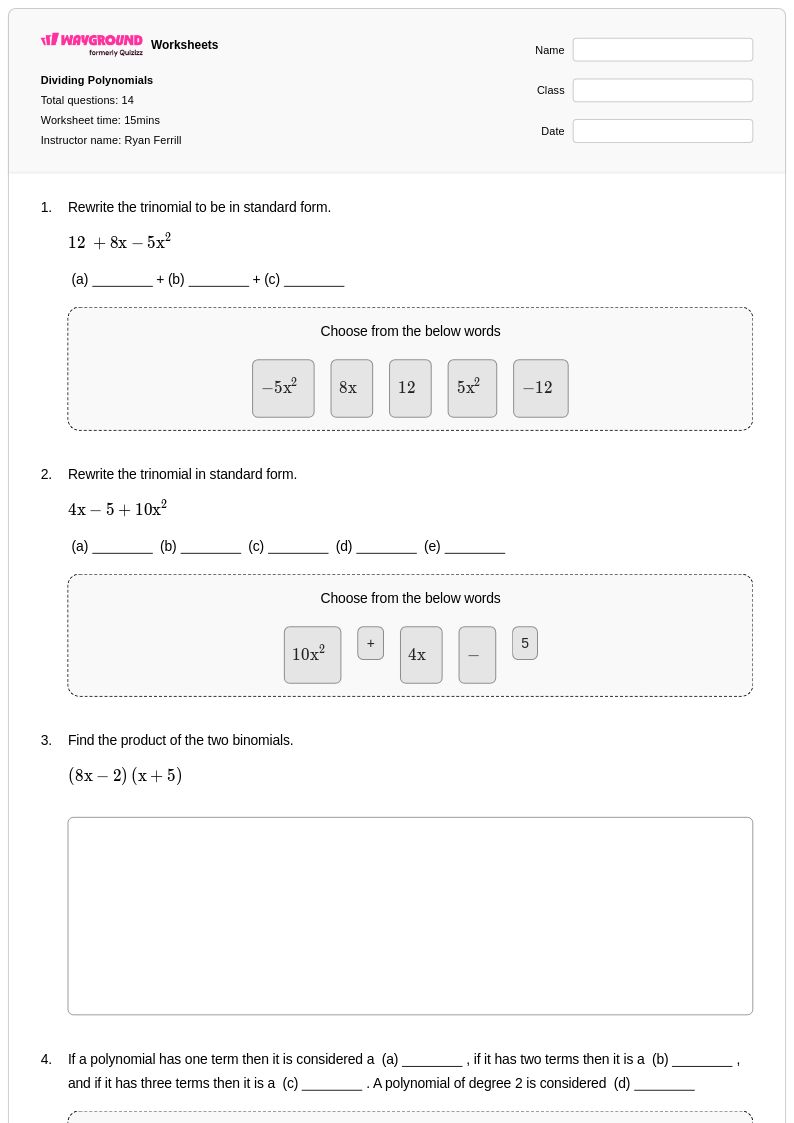
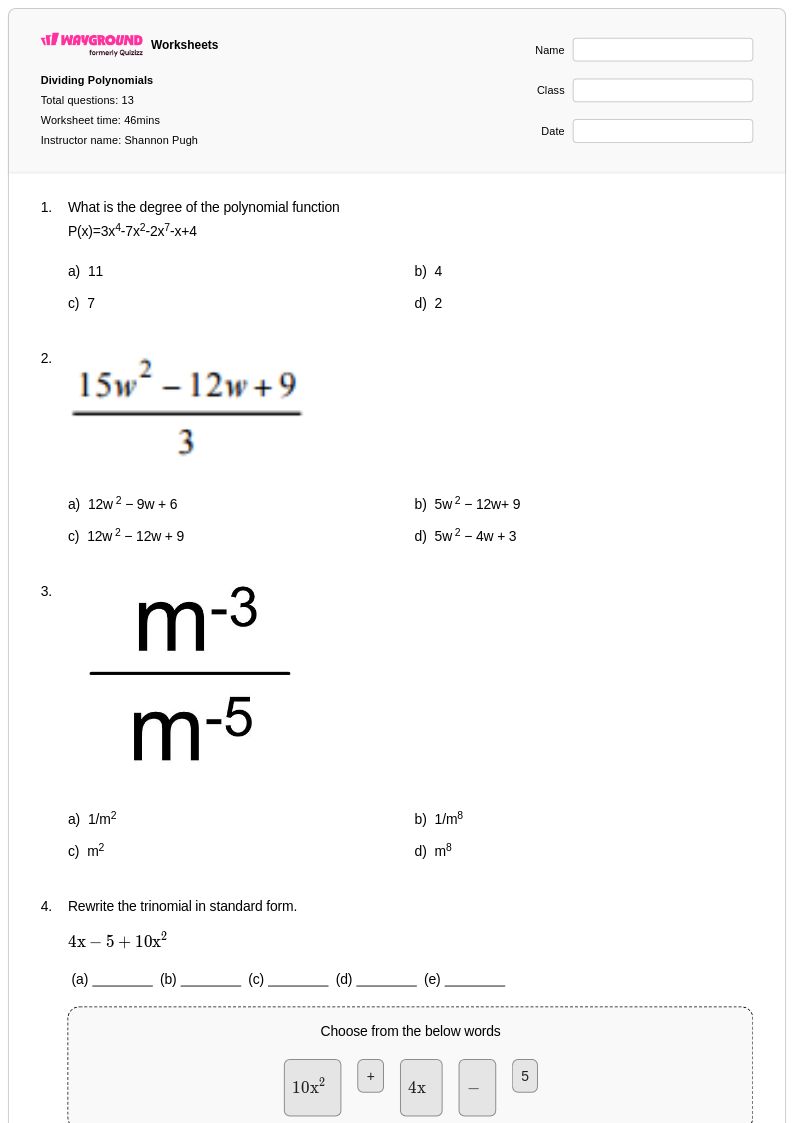
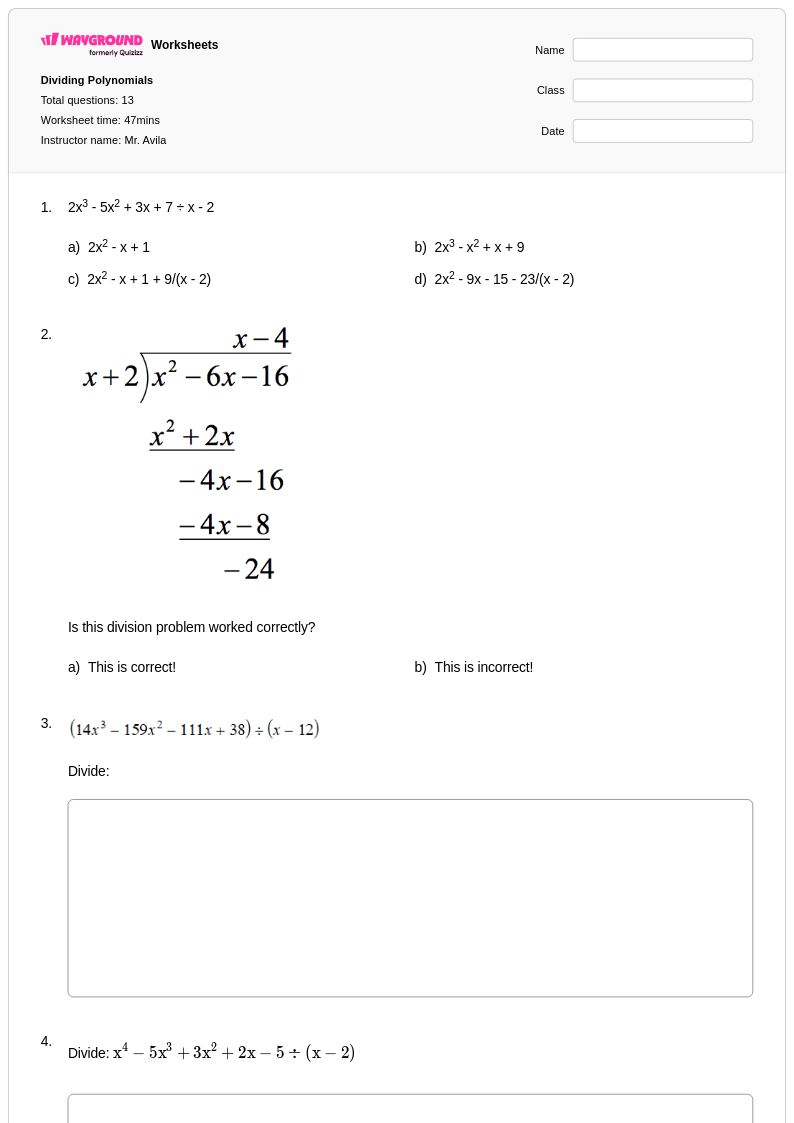
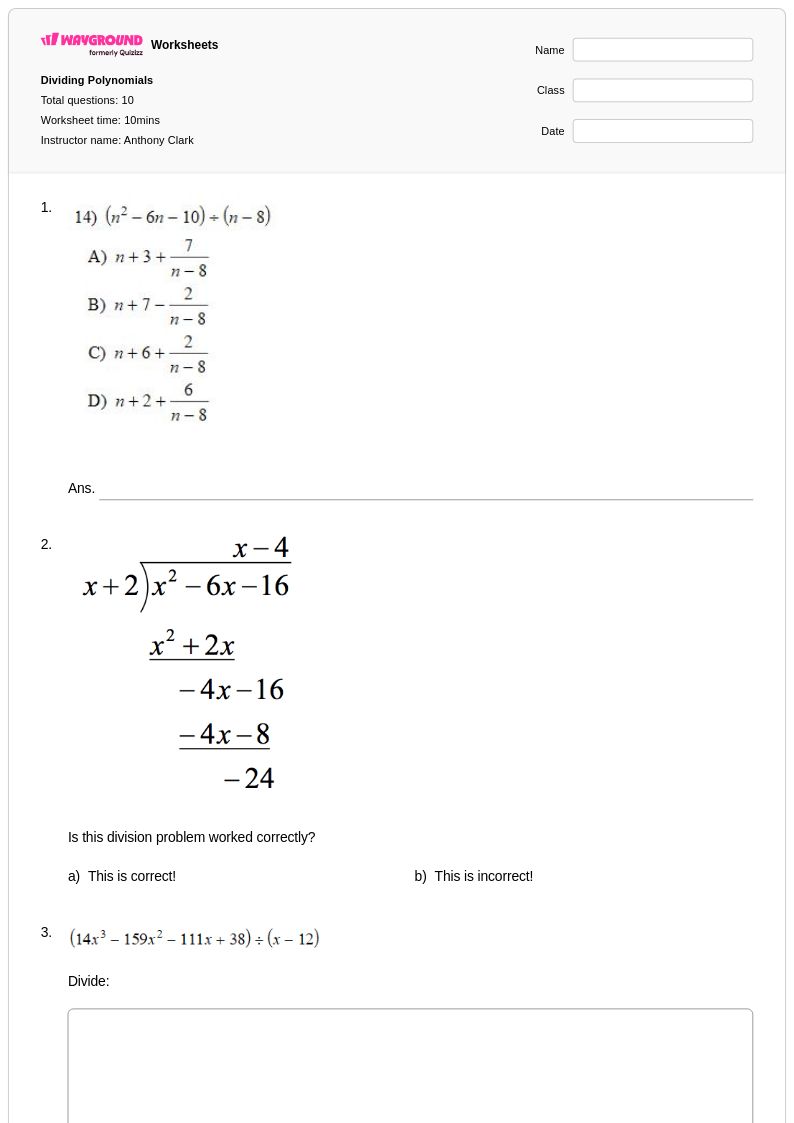
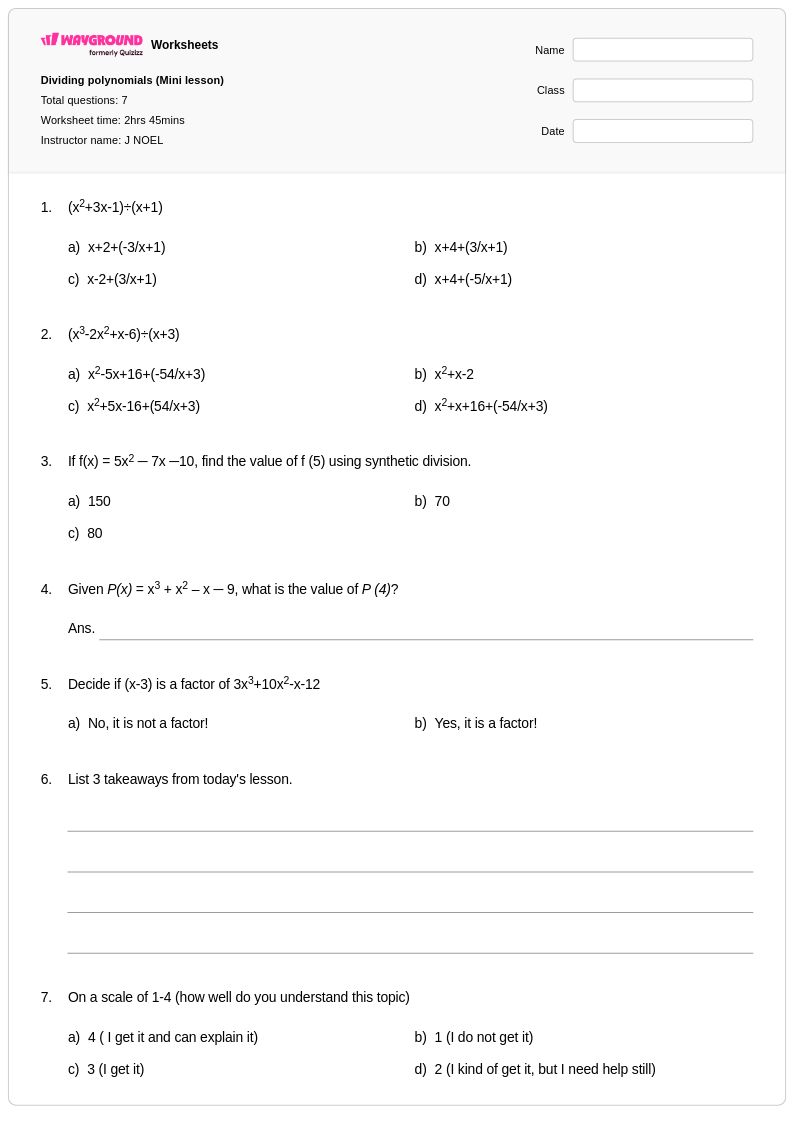
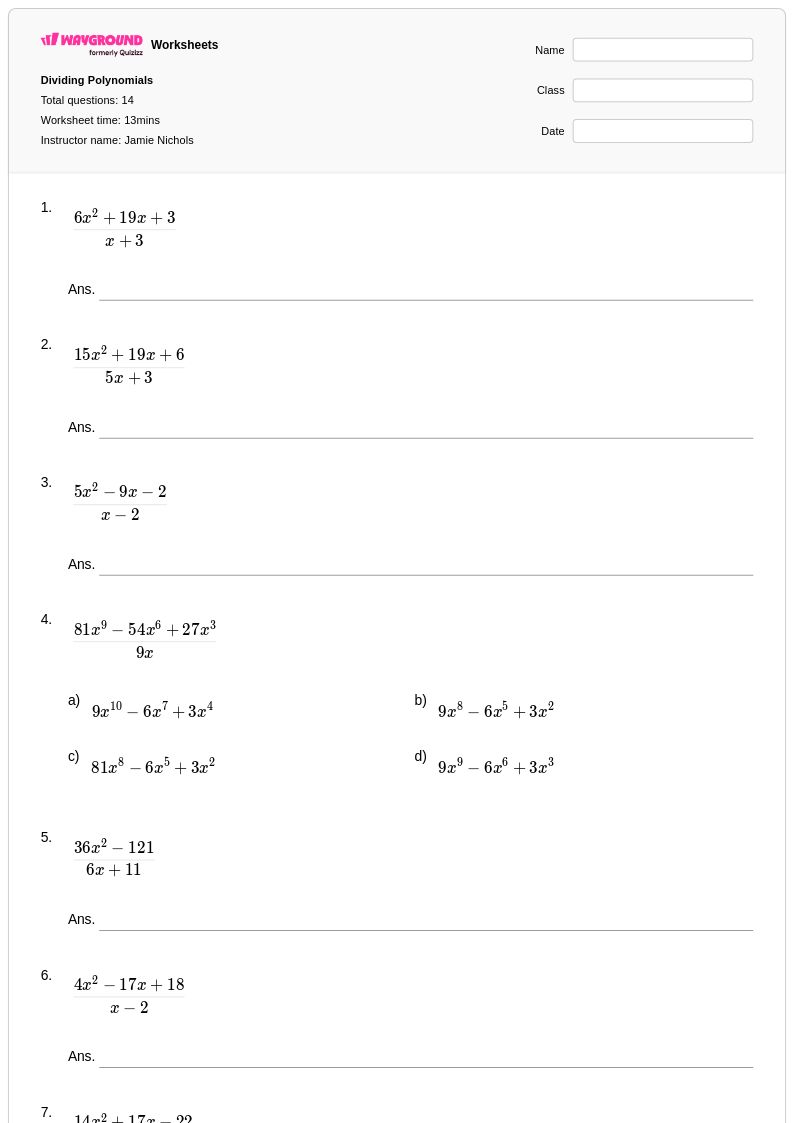
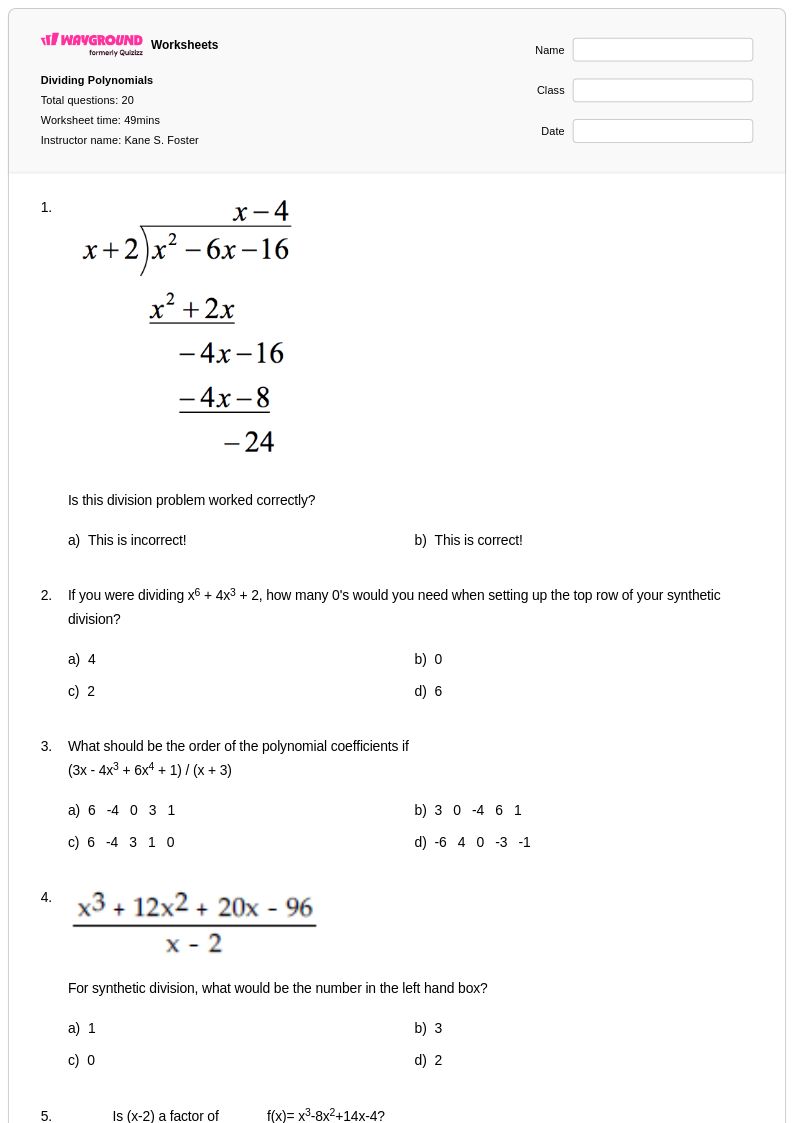
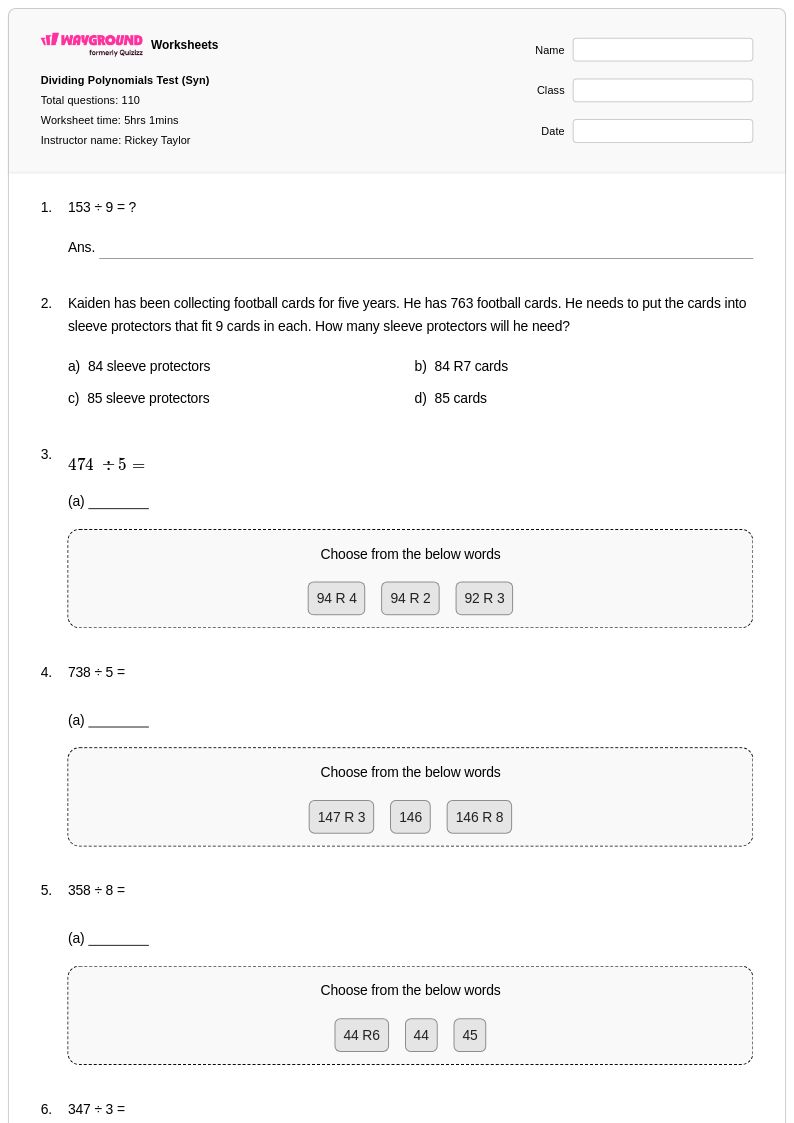
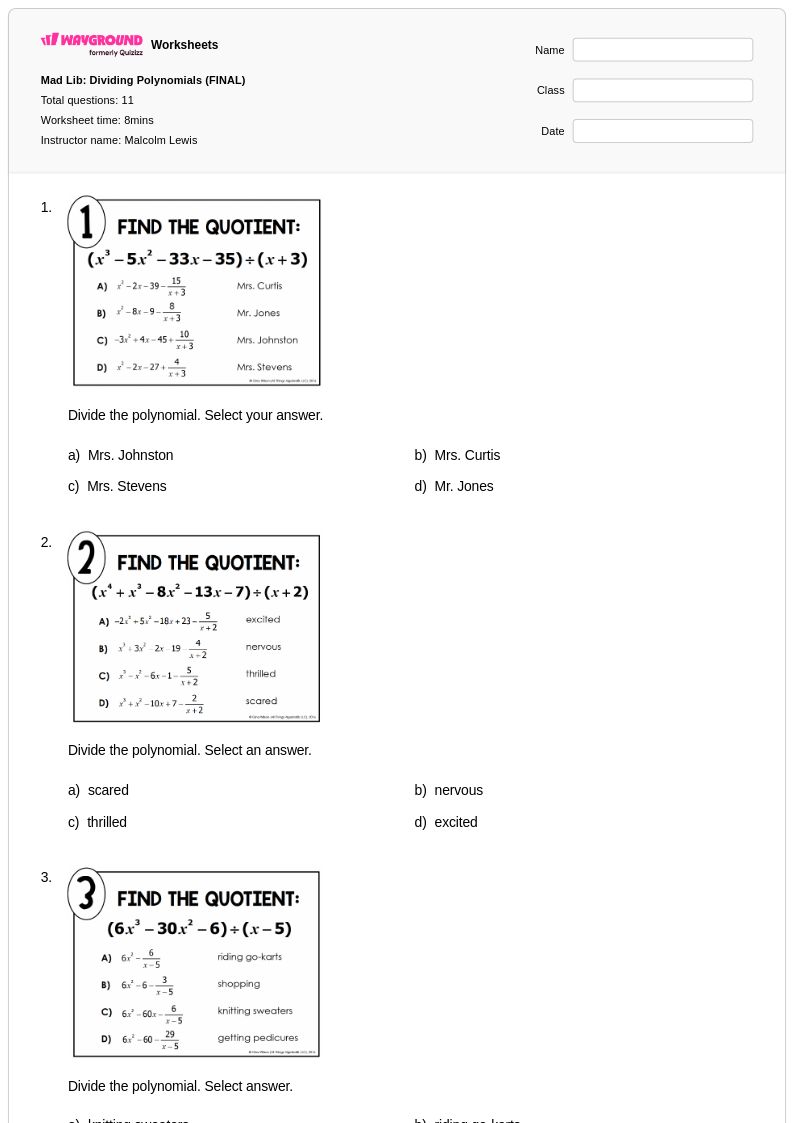
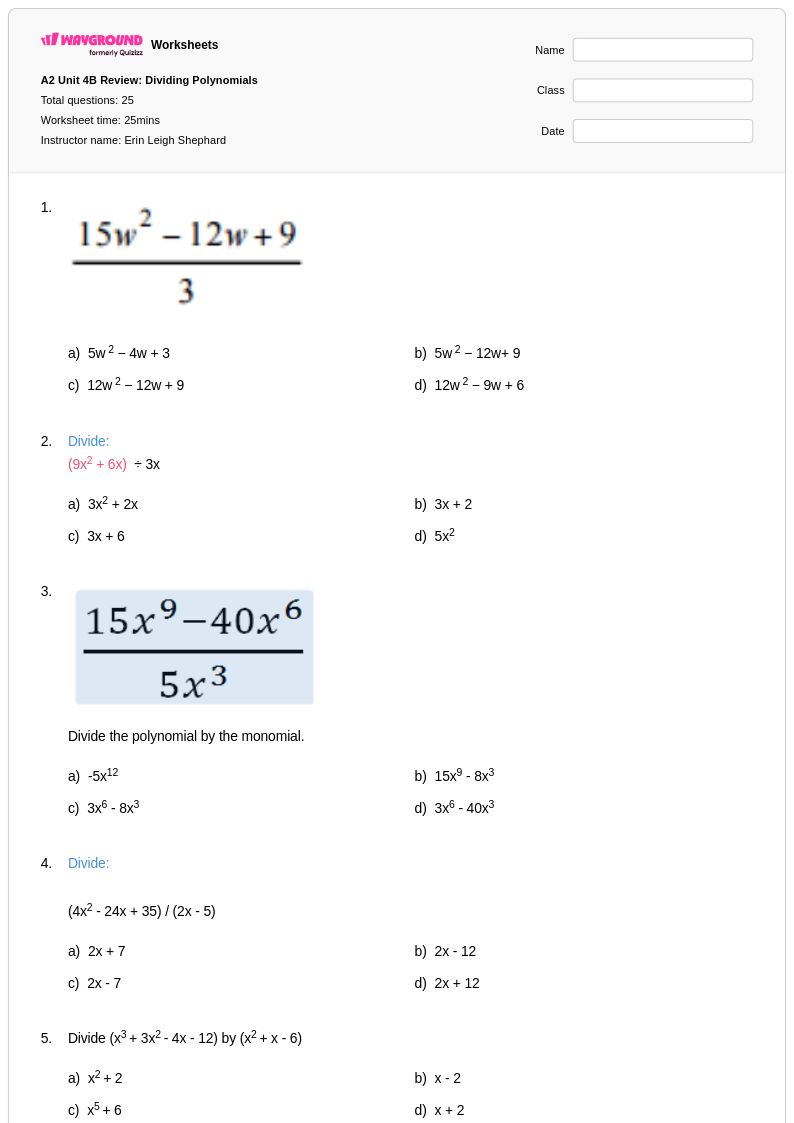
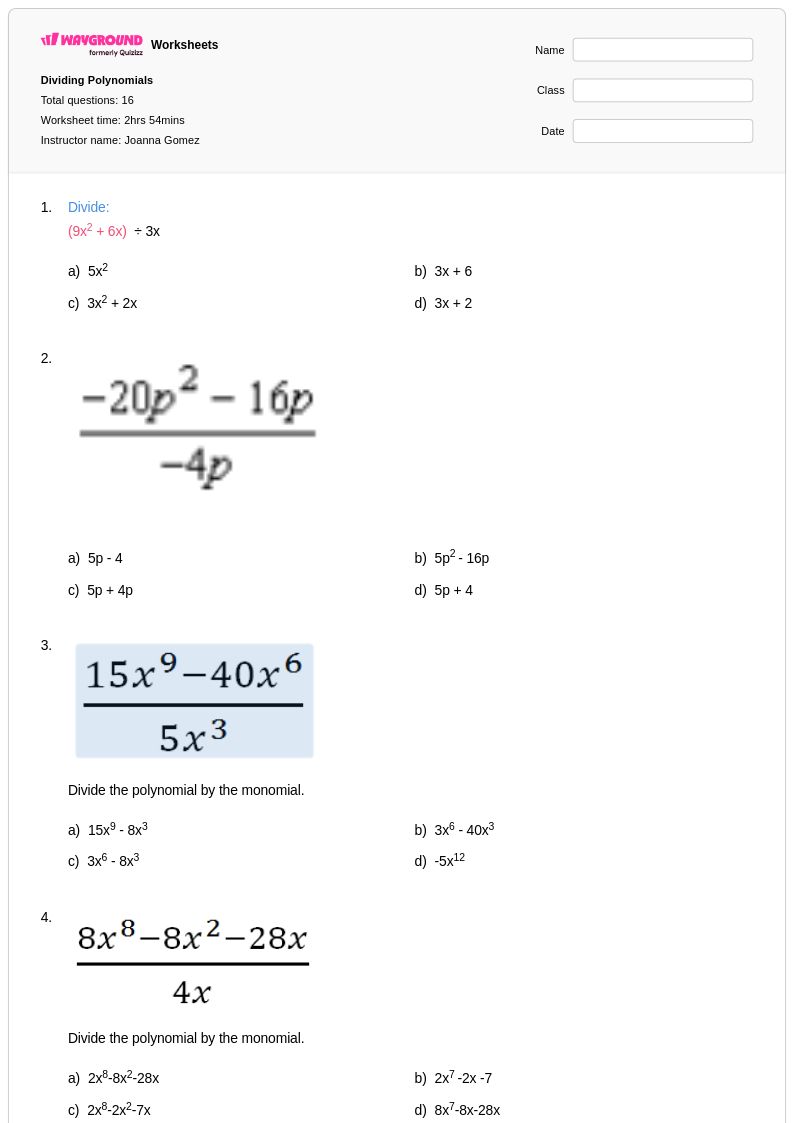
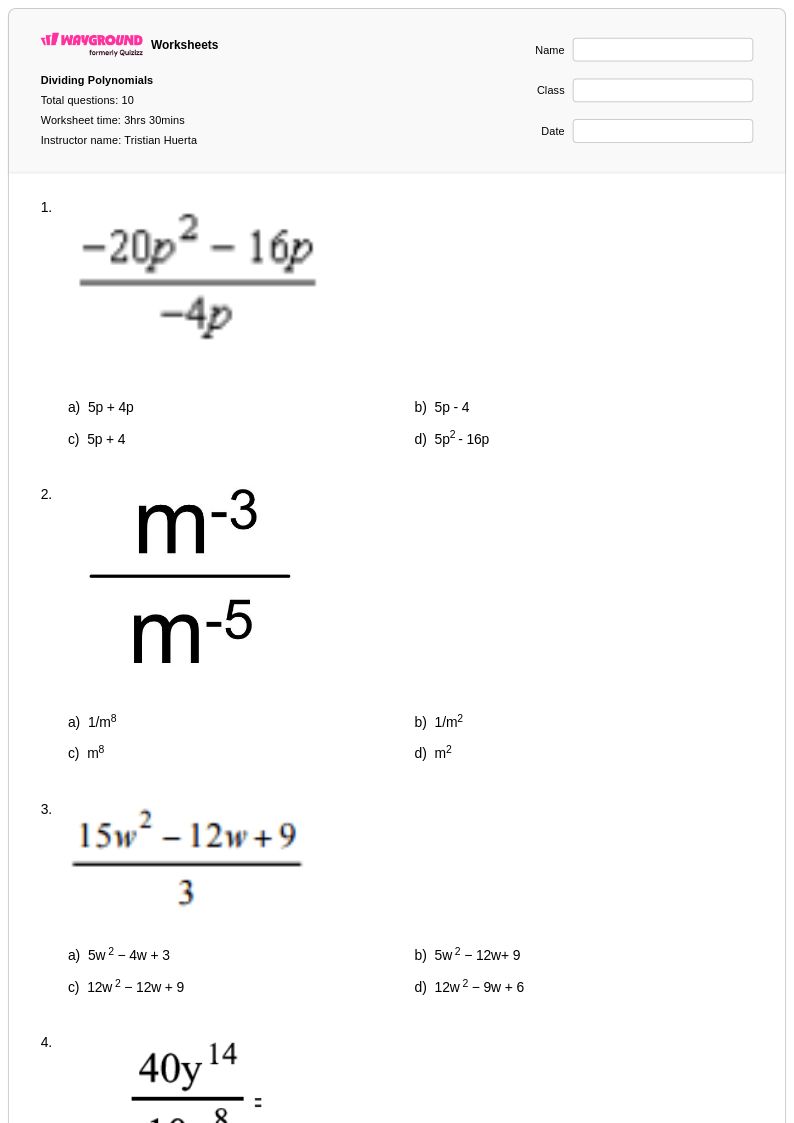
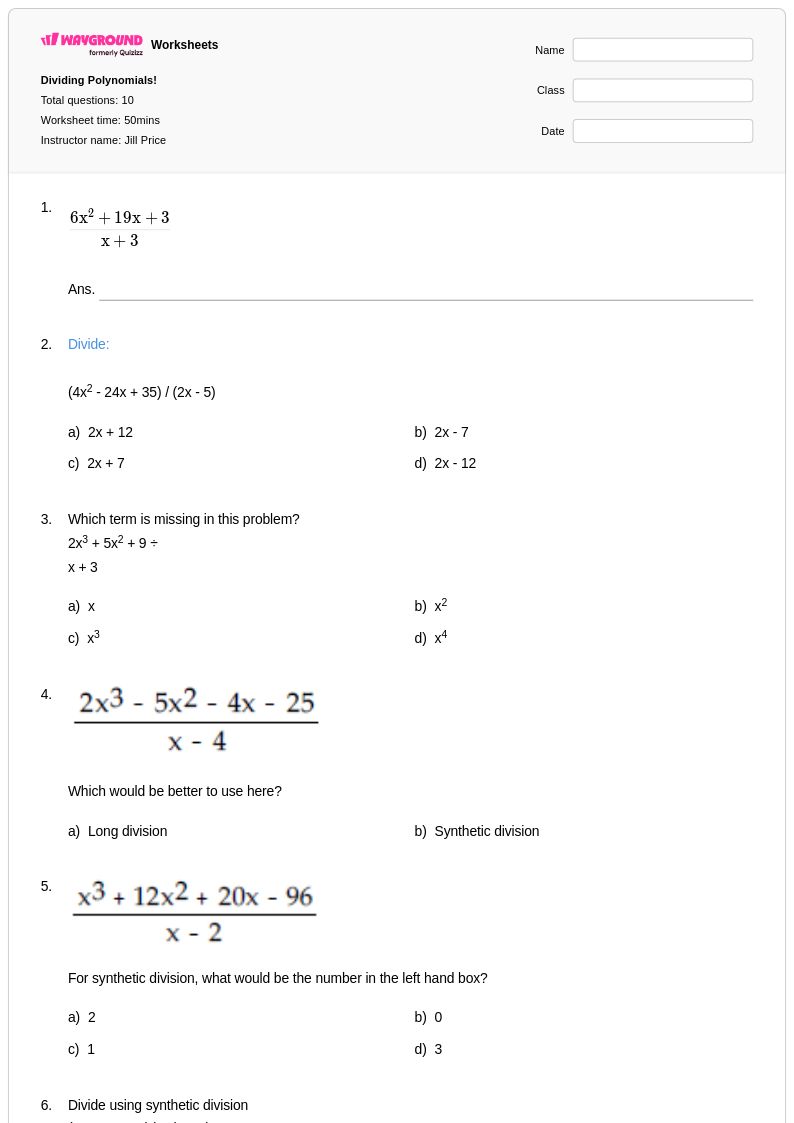
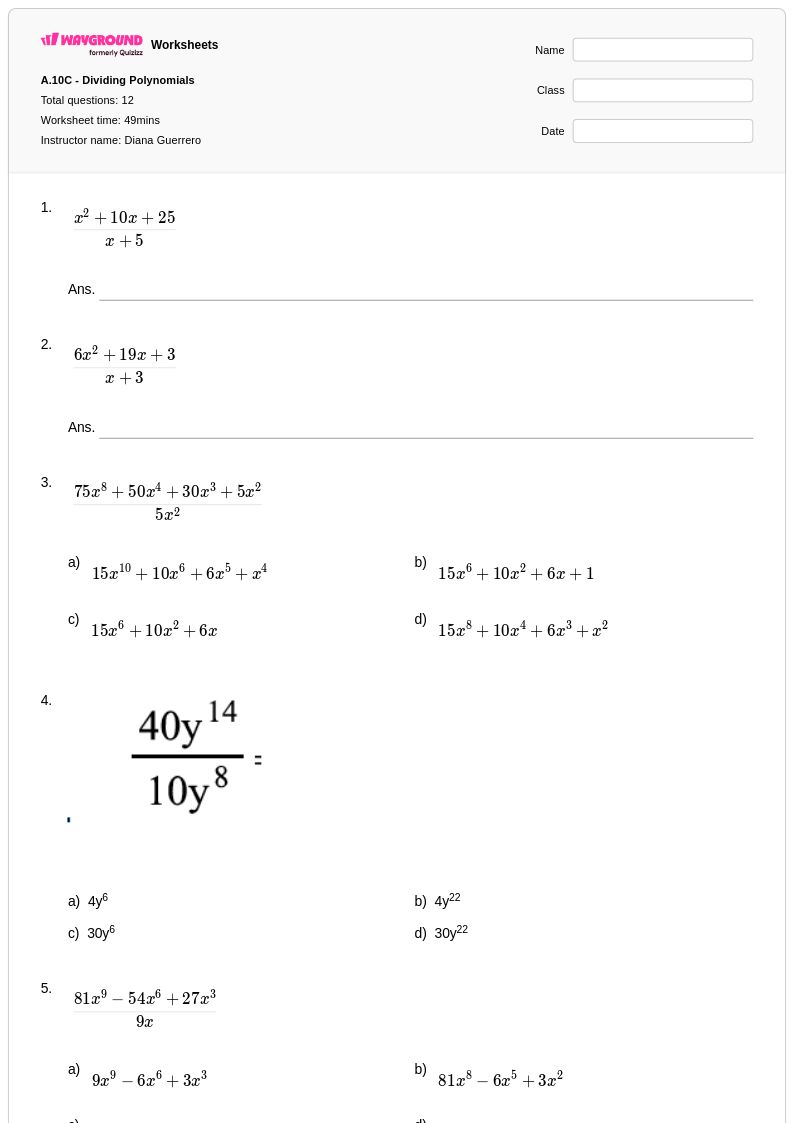
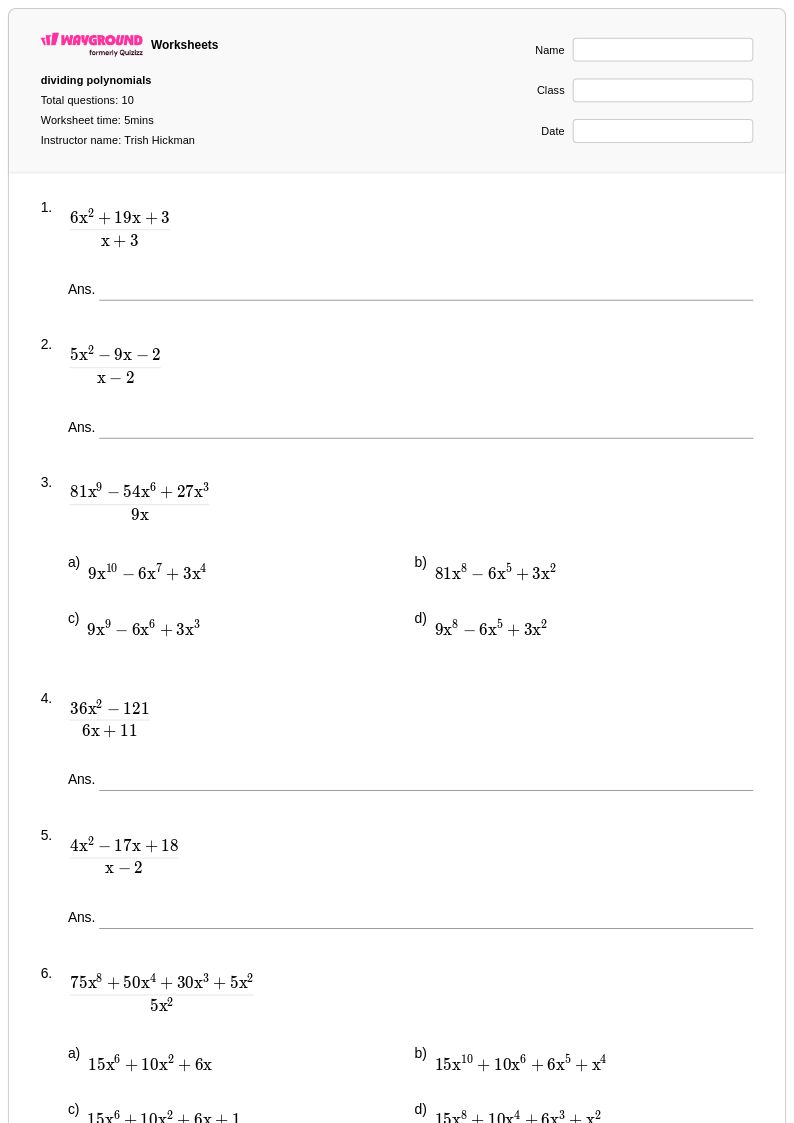
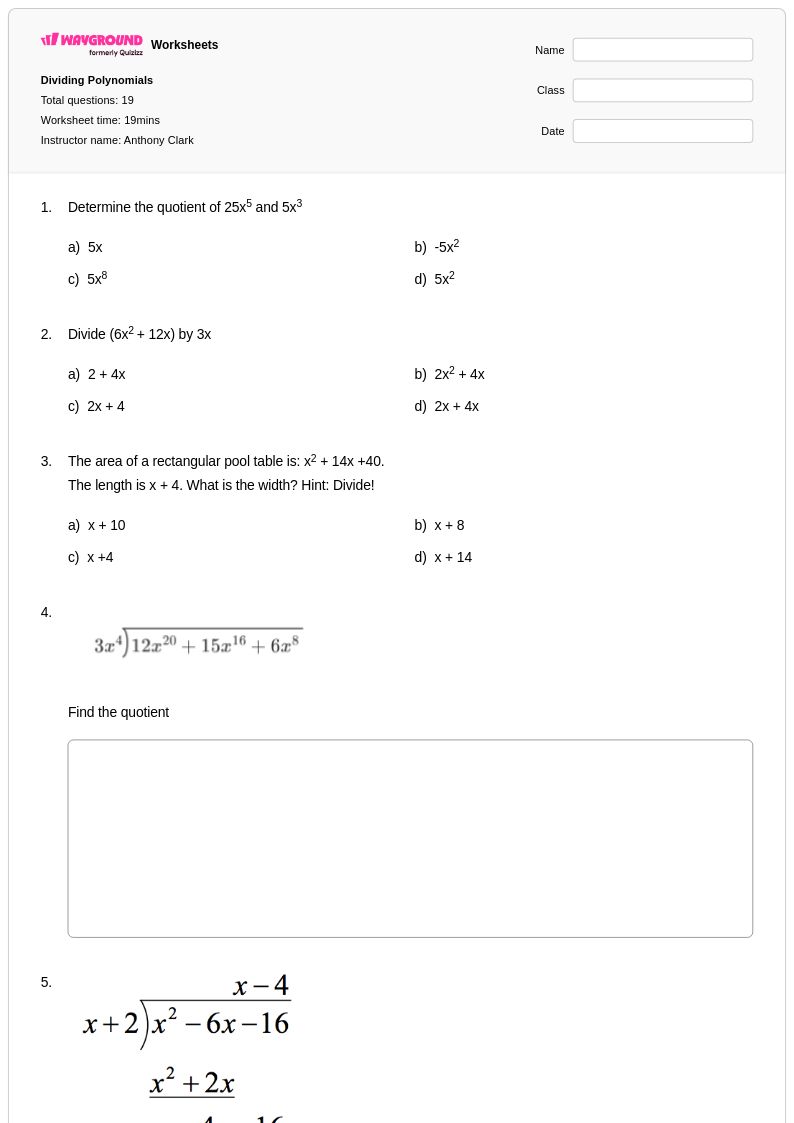
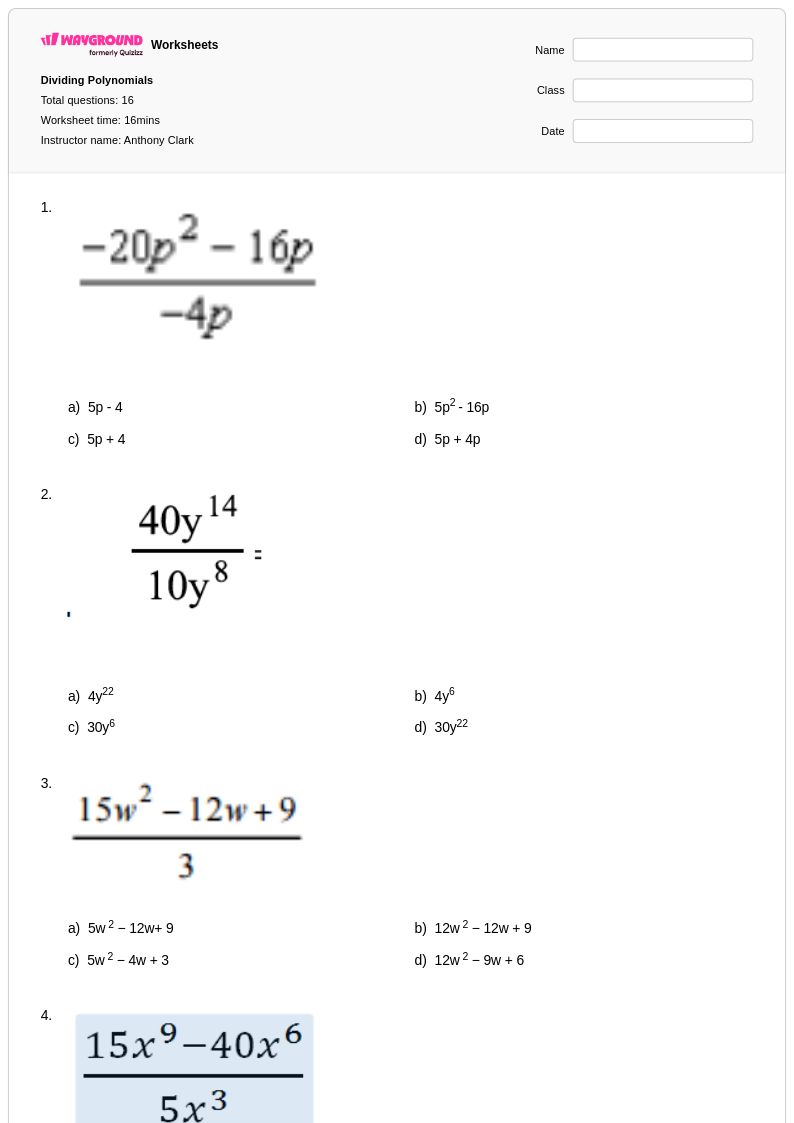
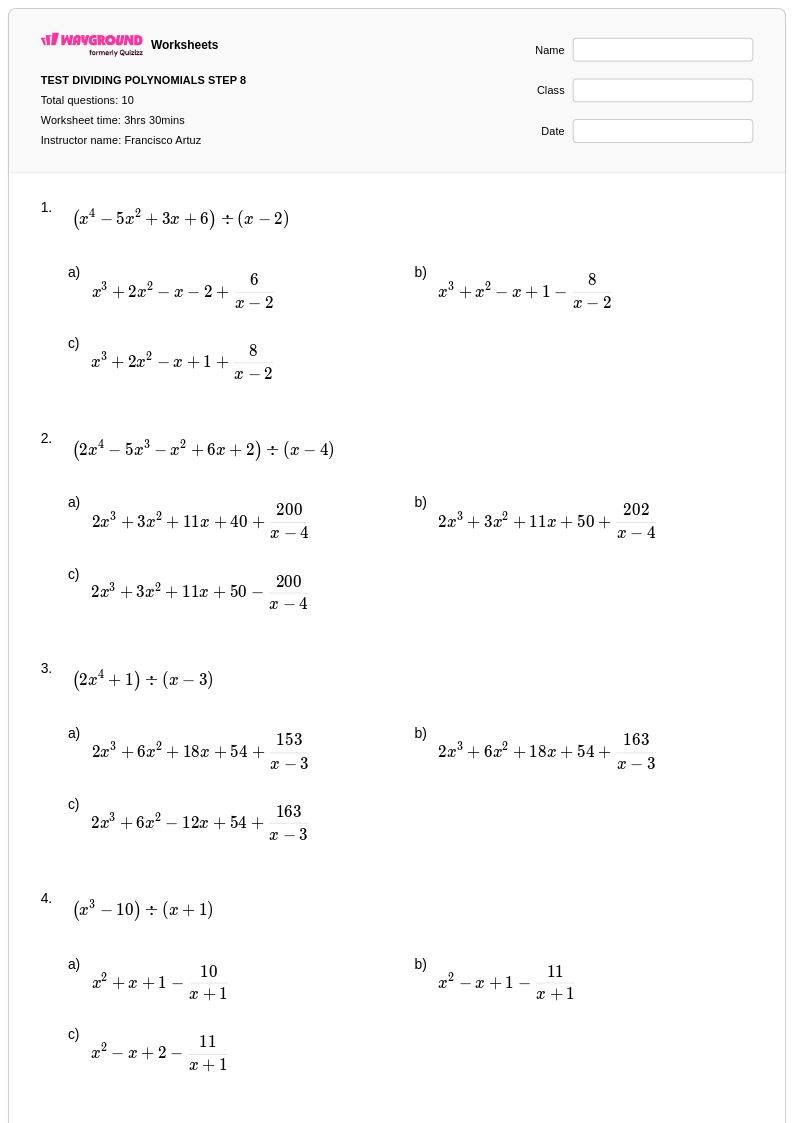
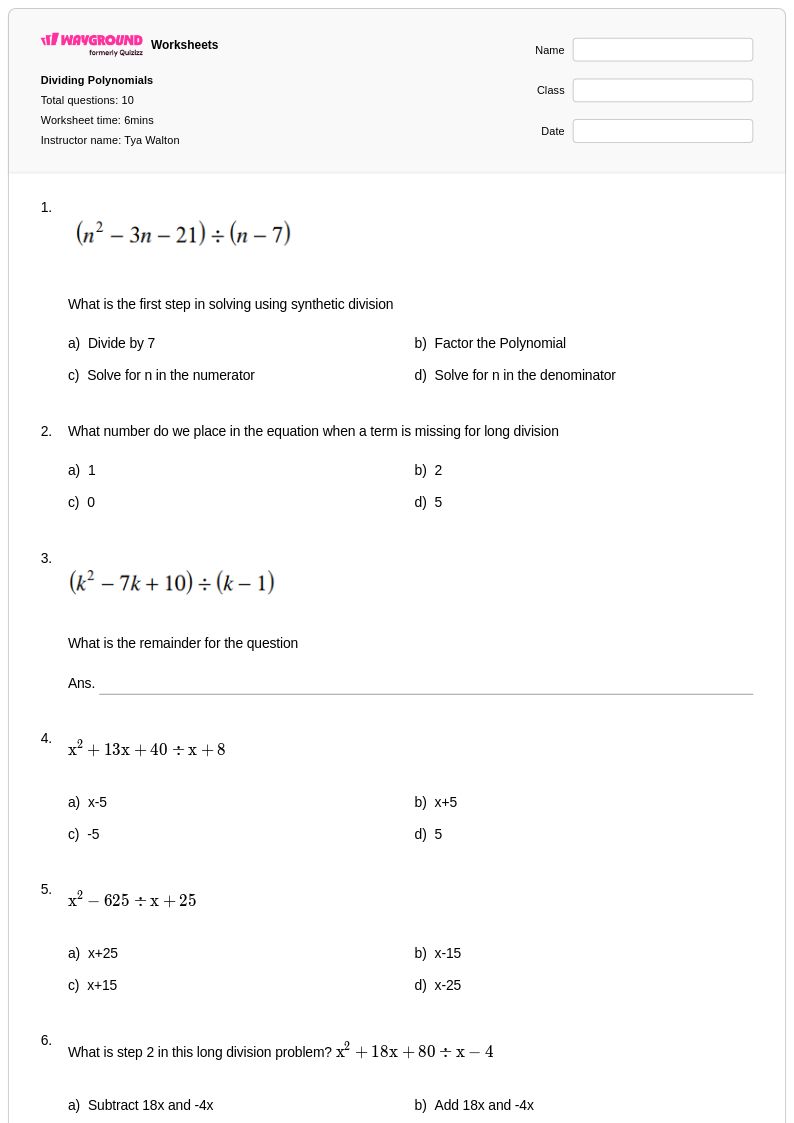
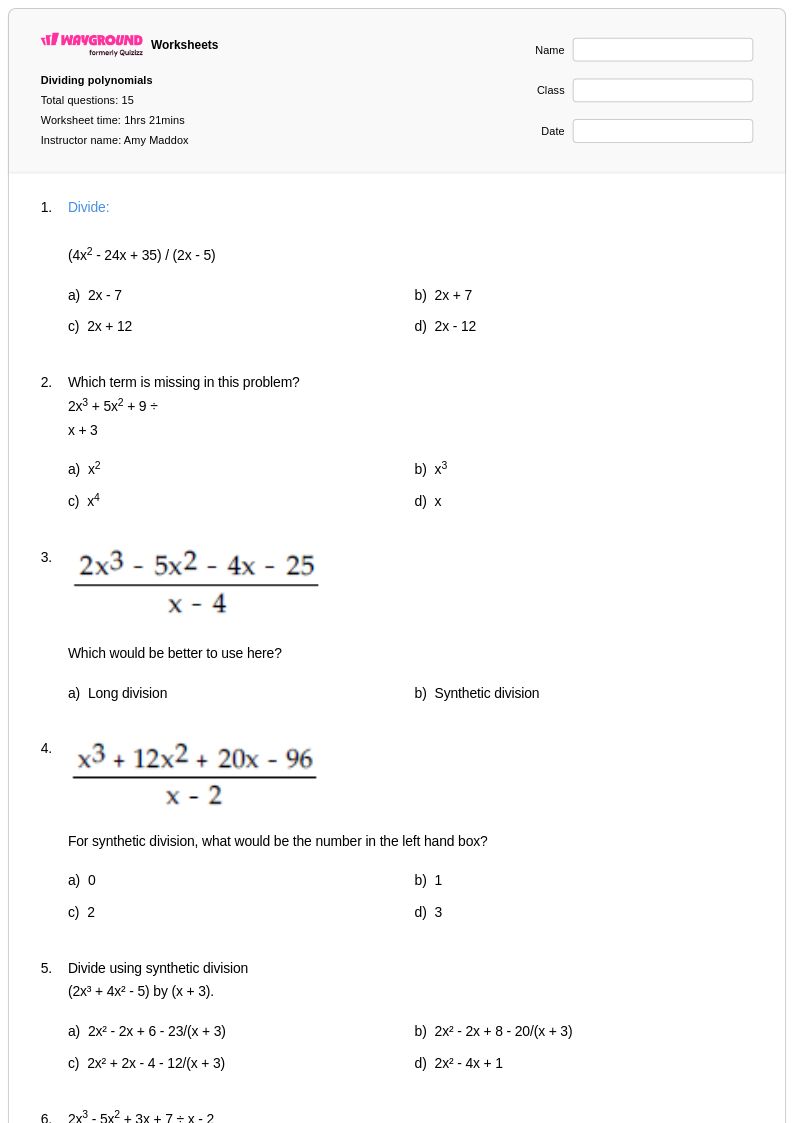
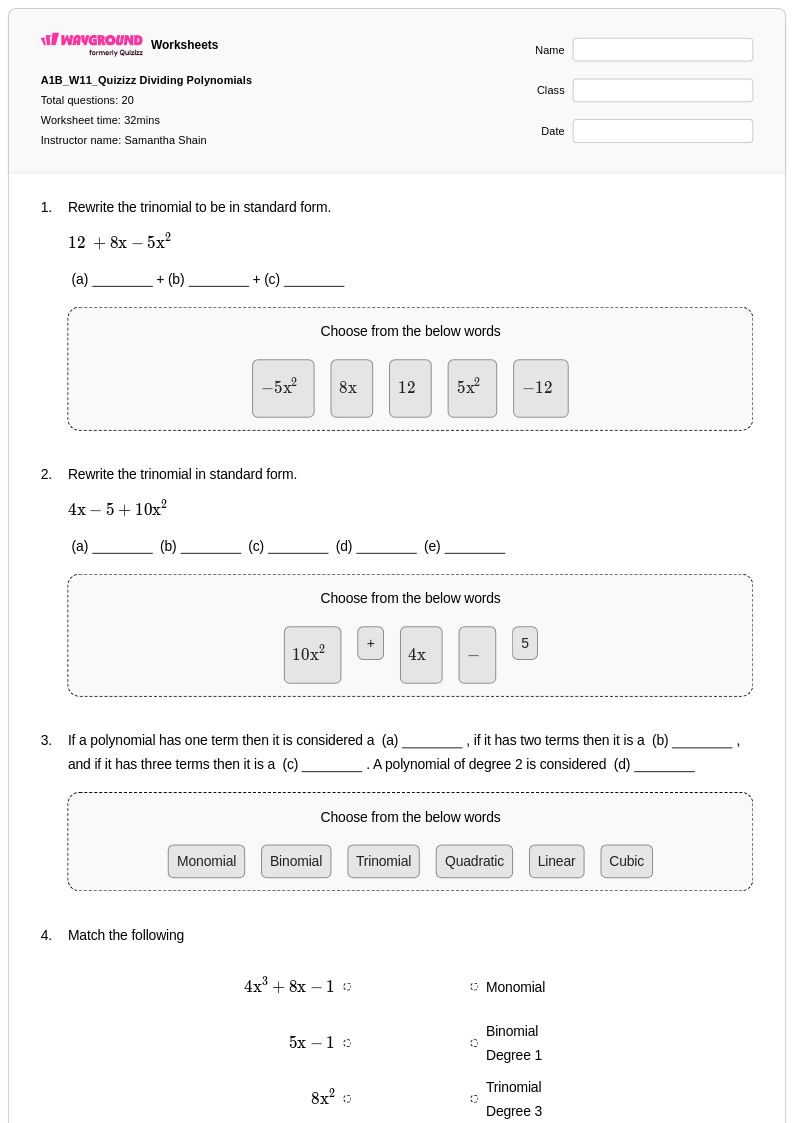
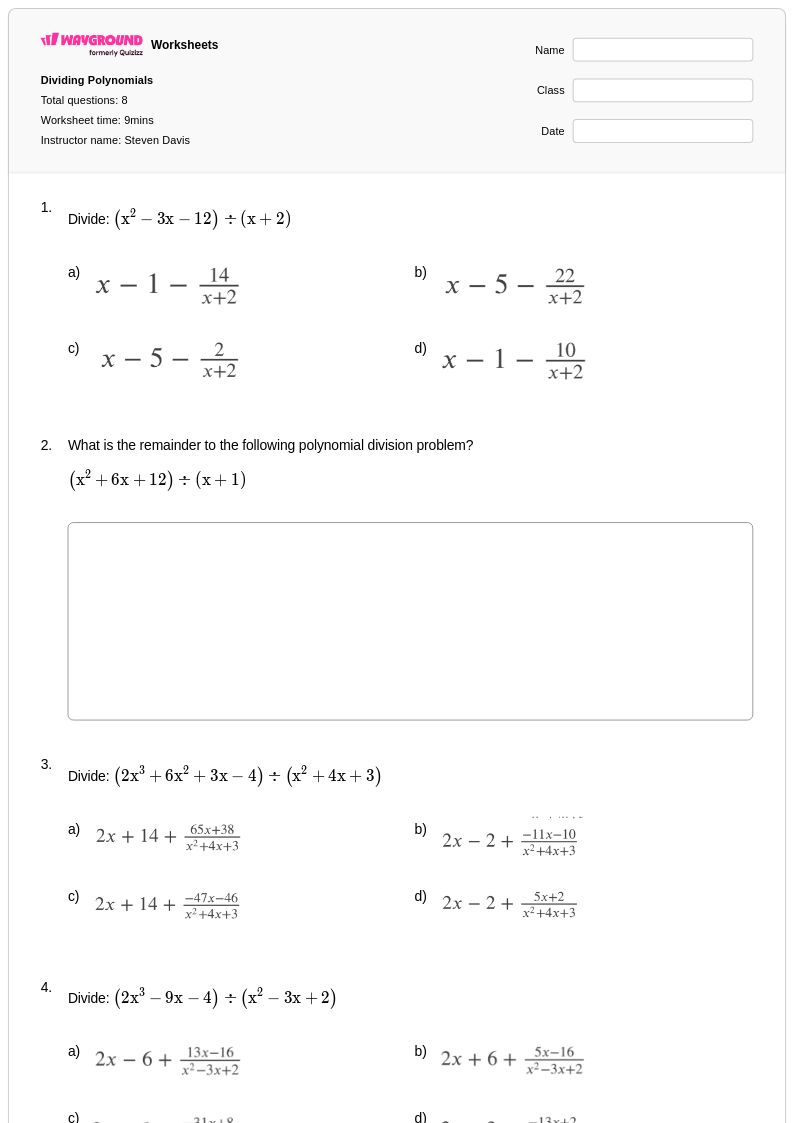
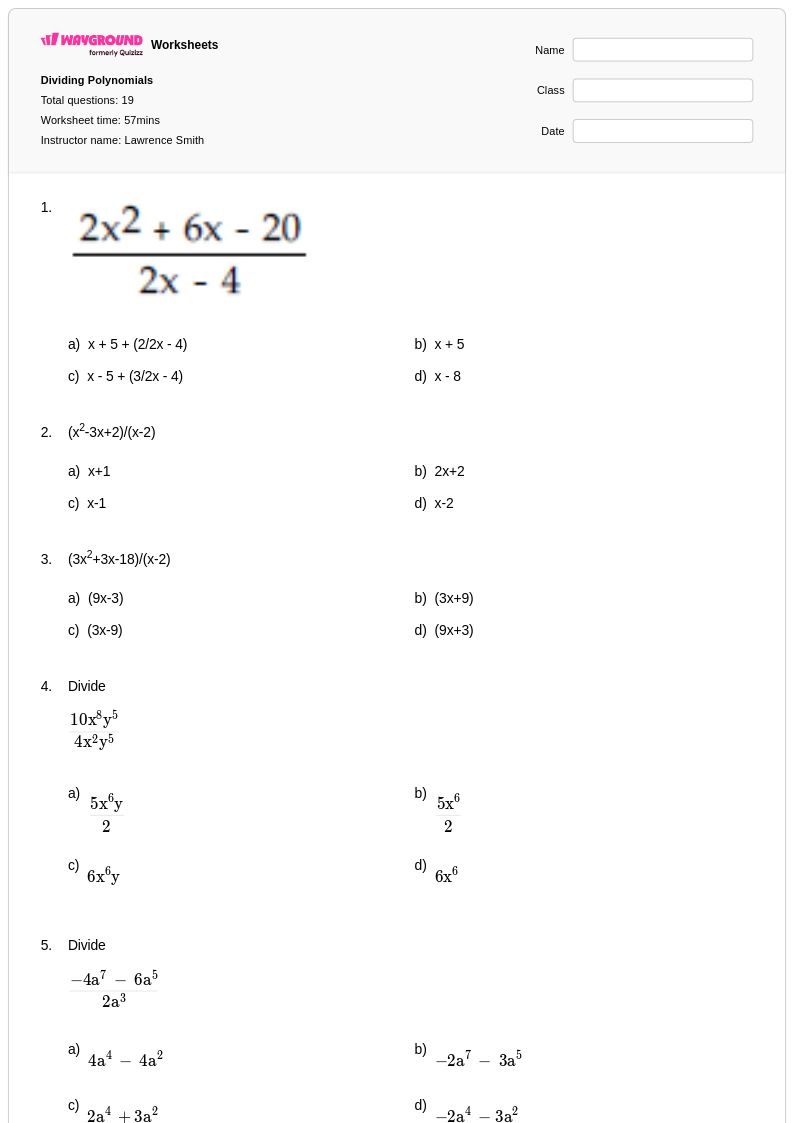
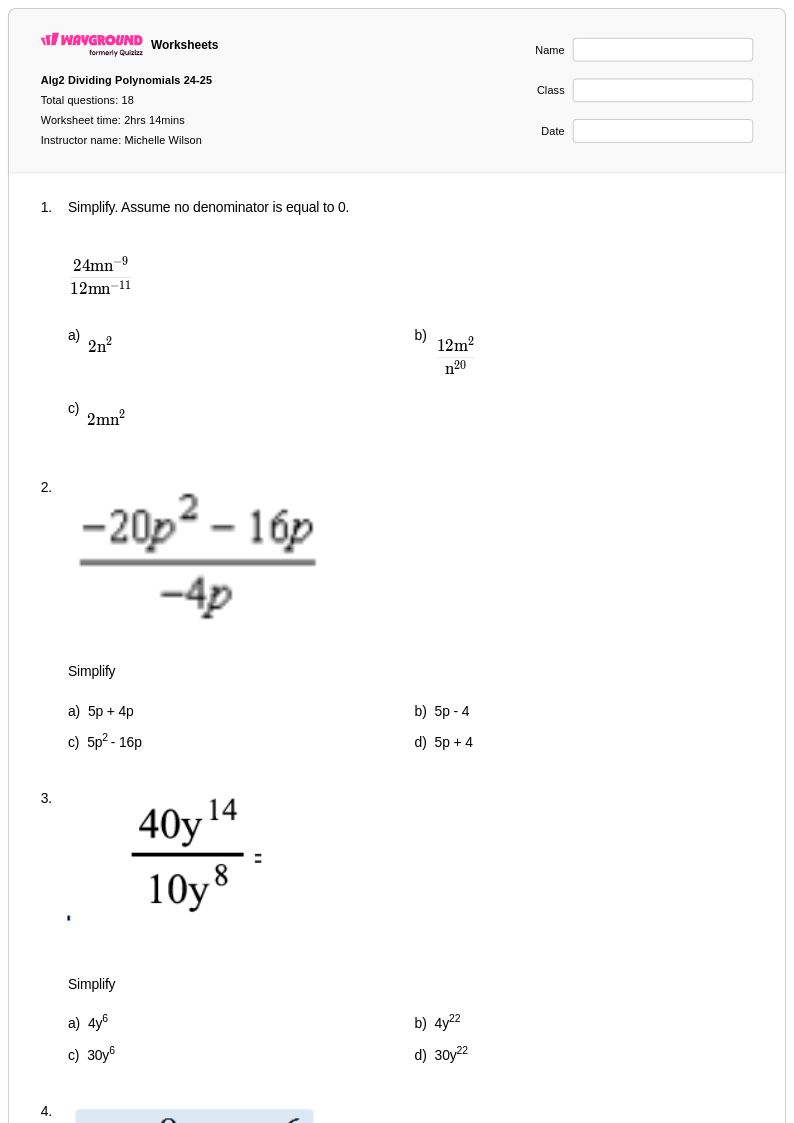
Master dividing polynomials with Wayground's comprehensive collection of free worksheets and printables, featuring step-by-step practice problems and detailed answer keys to help students confidently tackle polynomial division techniques.
Dividing polynomials represents a fundamental algebraic skill that builds upon students' understanding of polynomial operations and prepares them for advanced mathematical concepts including rational functions and calculus. Wayground's comprehensive collection of dividing polynomials worksheets provides structured practice opportunities that guide students through essential techniques such as long division, synthetic division, and factoring methods. These carefully designed resources strengthen students' ability to break down complex polynomial expressions systematically, develop procedural fluency with division algorithms, and recognize patterns that simplify the division process. Each worksheet includes detailed answer keys that support independent learning and self-assessment, while the free printable format ensures accessibility for diverse classroom environments. Practice problems range from basic monomial division through challenging polynomial long division scenarios, allowing students to build confidence progressively while mastering this critical algebraic foundation.
Wayground's extensive mathematics resource library, built from millions of teacher-created materials, empowers educators to locate precisely targeted dividing polynomials worksheets that align with their instructional goals and curriculum standards. The platform's advanced search and filtering capabilities enable teachers to quickly identify resources by difficulty level, specific division techniques, or polynomial complexity, streamlining lesson planning and resource selection. These versatile worksheet collections support differentiated instruction through varied problem sets that accommodate diverse learning needs, from remediation activities for struggling students to enrichment challenges for advanced learners. Available in both printable pdf format and interactive digital versions, these resources offer flexible implementation options that integrate seamlessly into traditional classroom instruction, homework assignments, or independent study programs, ensuring that students receive consistent, high-quality practice with polynomial division concepts across multiple learning contexts.
FAQs
How do I teach dividing polynomials?
Start with polynomial long division before introducing synthetic division — students who understand the long-division algorithm grasp why synthetic division works, rather than treating it as a memorized shortcut. Use monomial division as a warm-up to activate prior knowledge of exponent rules, then build toward binomial divisors. A common sequencing that works well: (1) divide by a monomial, (2) long division with a linear divisor, (3) synthetic division as an efficiency tool for the same problem type, (4) cases with remainders and what they mean. Connecting the remainder to the Remainder Theorem gives students a conceptual anchor that pays off later in factoring and graphing.
What exercises help students practice dividing polynomials?
The most effective practice moves students through increasing complexity: start with dividing a polynomial by a monomial, then progress to long division with a linear binomial divisor, then synthetic division, and finally problems with non-zero remainders. Mixing problem types on a single worksheet — rather than drilling one method in isolation — helps students decide which technique to apply, which is the skill that actually transfers to tests and higher-level courses.
What mistakes do students commonly make when dividing polynomials?
Three errors come up repeatedly. First, students forget to insert placeholder terms for missing degrees (e.g., omitting the x² term when it has a zero coefficient), which throws off alignment in long division. Second, when using synthetic division, they apply it to divisors that aren't linear — synthetic division only works when dividing by (x − c). Third, sign errors during subtraction steps in long division are extremely common; students subtract the first term correctly but forget to distribute the negative to the entire partial product.
How do I use Wayground's dividing polynomials worksheets in my class?
You can run these worksheets as digital quizzes hosted on Wayground — useful for getting instant results without collecting paper — or download the printable PDF and assign them on paper, which works well for in-class practice or schools managing screen time. Every worksheet includes a complete answer key, so students can self-check after independent work. If you go the print route, the Wayground for Teachers app lets you scan or capture student submissions for grading, so you're not manually marking every problem.
Is dividing polynomials aligned to Common Core standards?
Yes. Under Common Core, polynomial arithmetic — including division — is addressed in the high school Algebra strand, where students are expected to understand polynomials as a system analogous to integers and perform operations on them. Dividing polynomials builds directly from students' earlier work with factoring quadratics and connects forward to rewriting rational expressions and understanding the structure of polynomial functions. The emphasis is on recognizing when a divisor is a factor (zero remainder) versus when it produces a remainder, which ties into the Remainder and Factor Theorems used in polynomial graphing and root-finding.
How can I differentiate dividing polynomials practice for mixed-ability classes?
For students who struggle with multi-step procedures, Wayground's reduced answer choices accommodation lowers the cognitive load on individual questions, letting them focus on the division process rather than managing too many options at once. The Read Aloud feature helps students who have difficulty parsing dense algebraic notation in written form. On the worksheet itself, you can apply wide font spacing and a larger font size for students who lose their place across long-division steps — a small formatting change that makes a real difference in a procedure this layout-dependent.
What topics does dividing polynomials prepare students for?
Polynomial division is a direct prerequisite for simplifying rational expressions, finding oblique asymptotes of rational functions, and applying the Factor and Remainder Theorems to locate polynomial roots. In calculus, it comes up when integrating rational functions — rewriting an improper rational expression via long division before integrating is a standard technique. Students who are shaky on polynomial division tend to hit a wall in those later topics, so fluency here has compounding value.