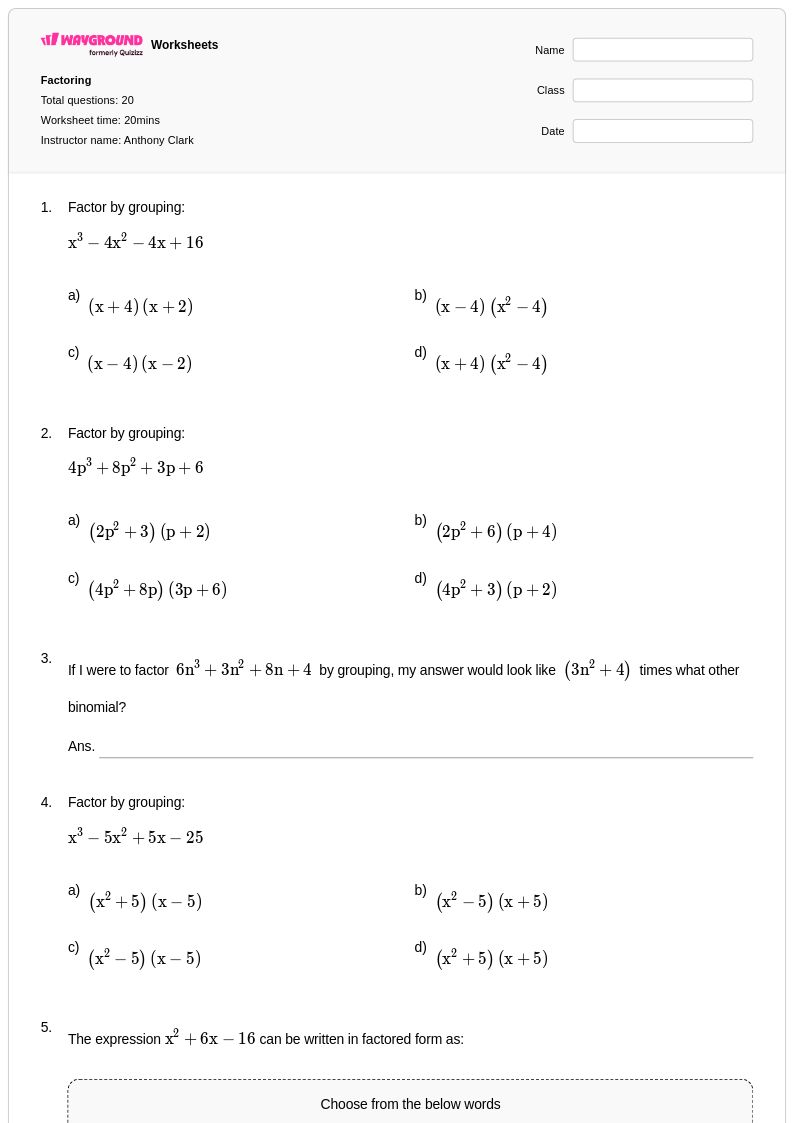
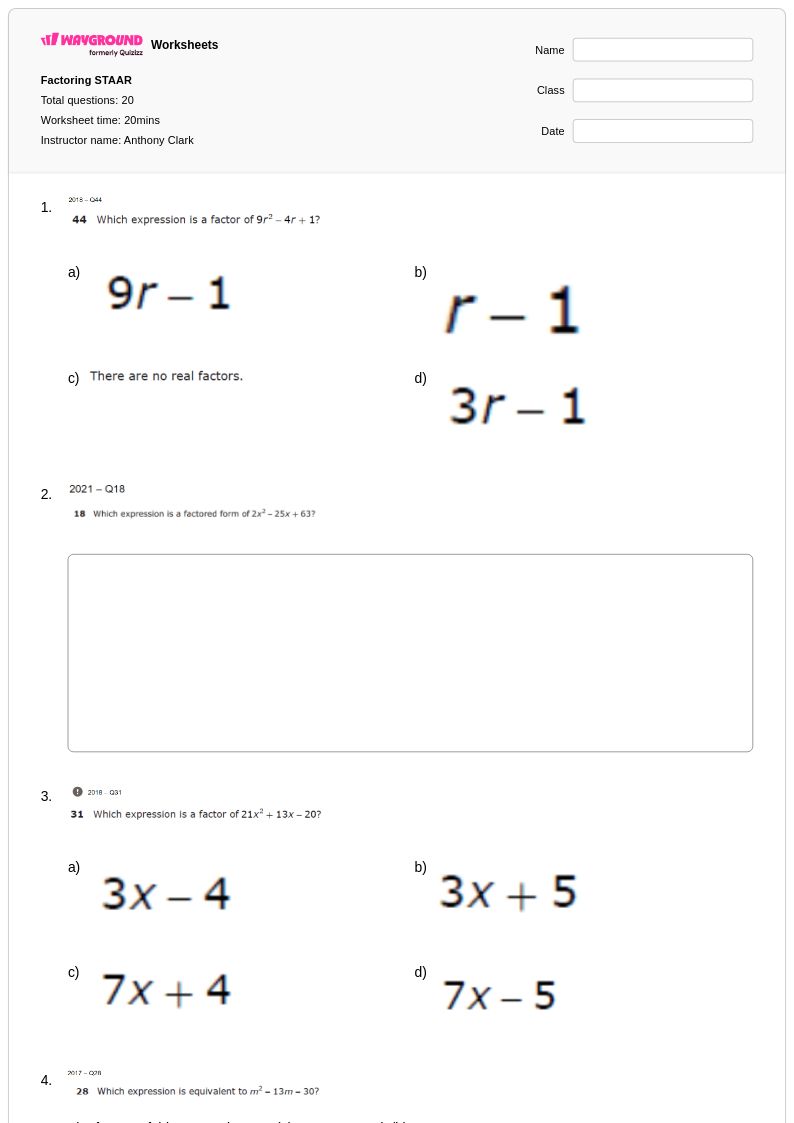
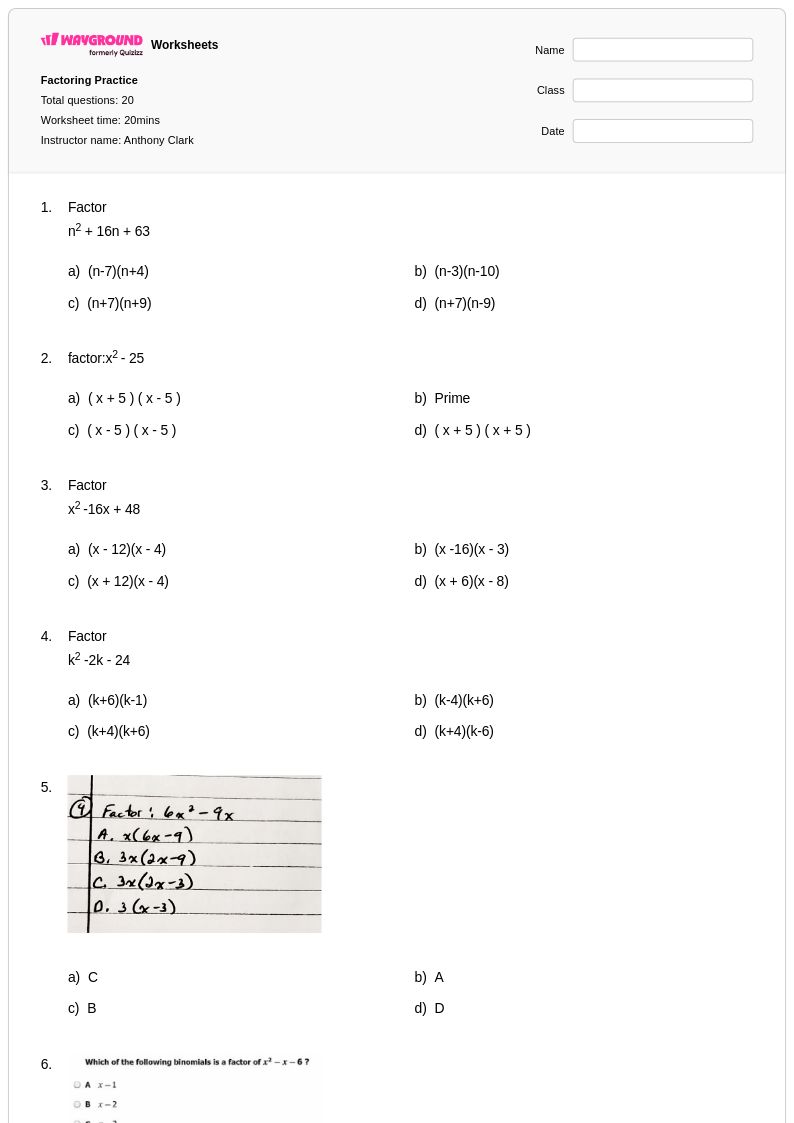
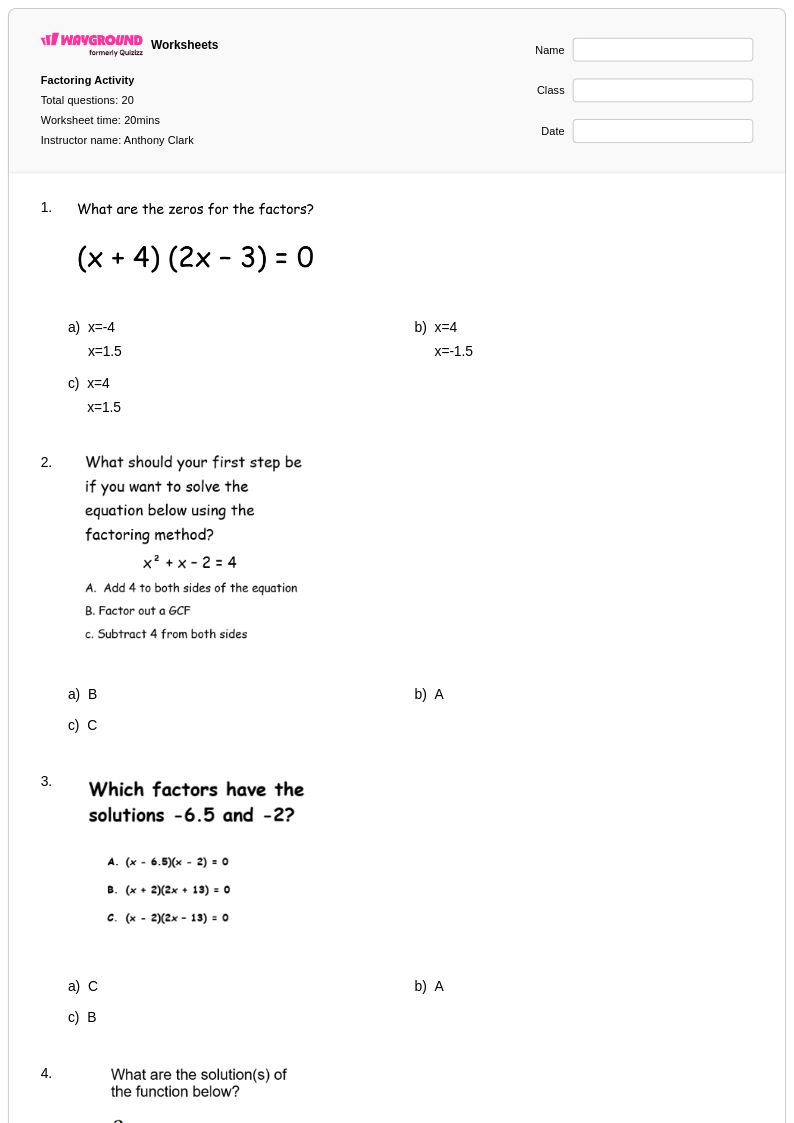
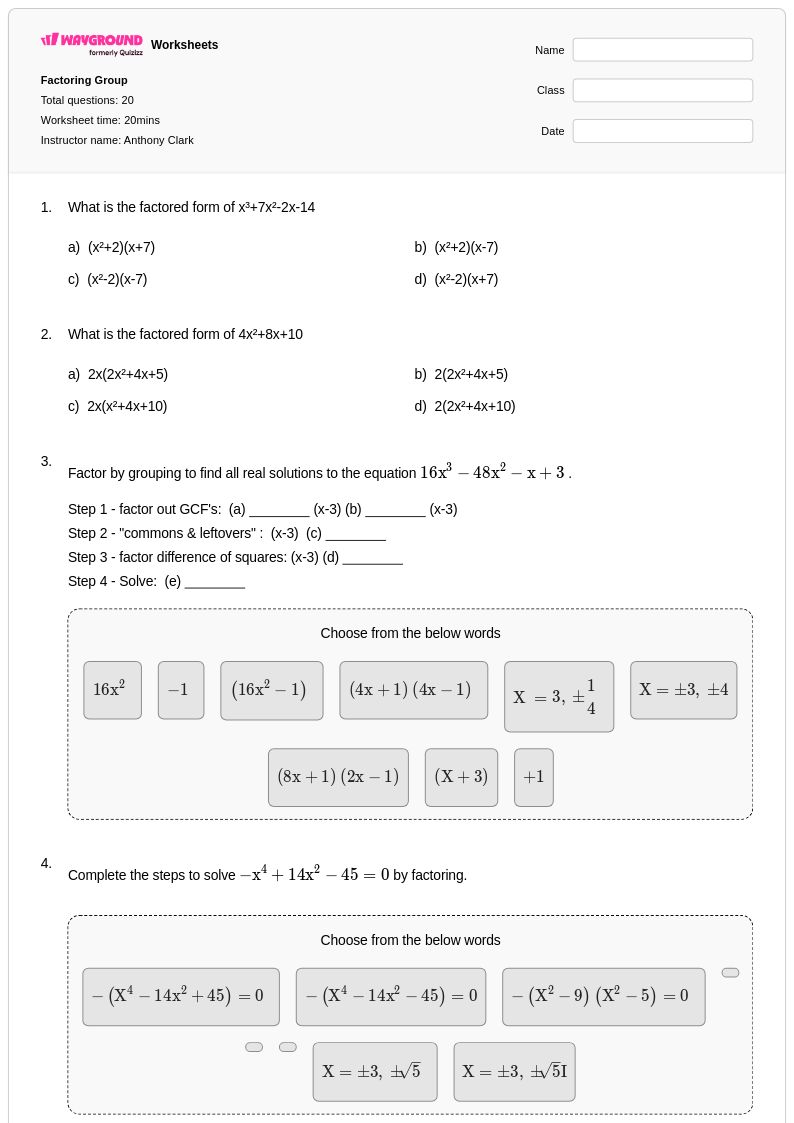
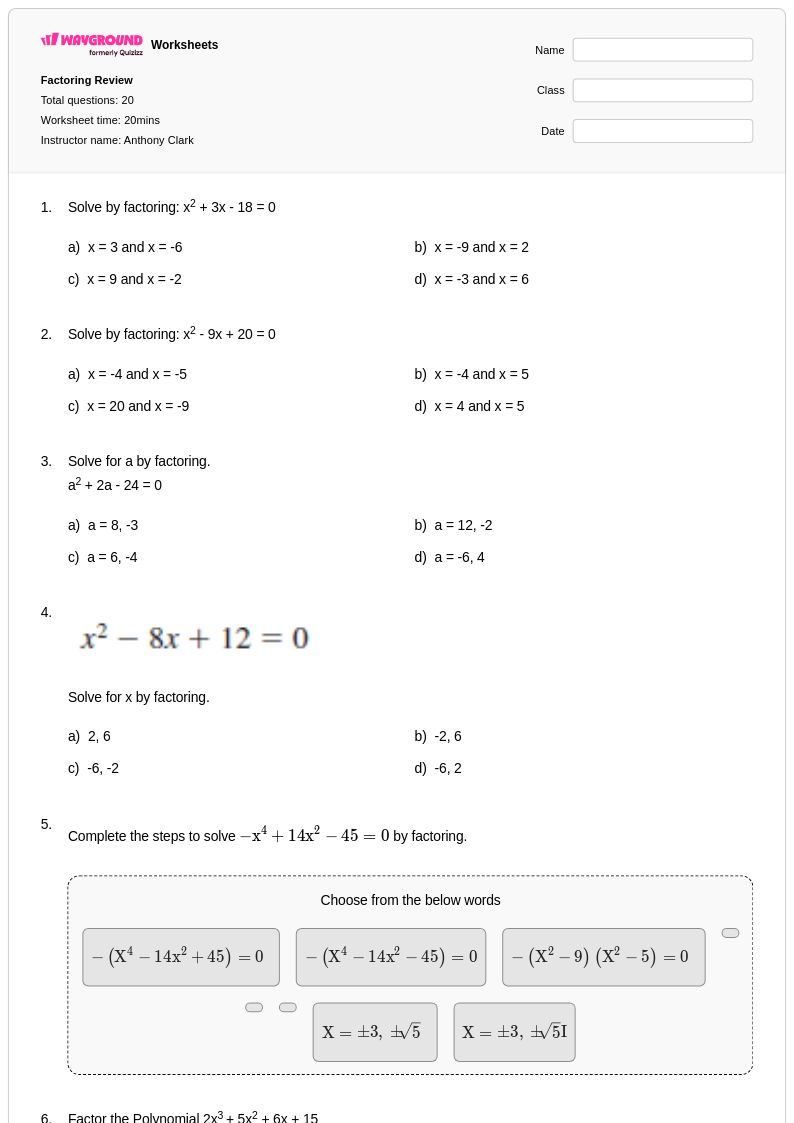
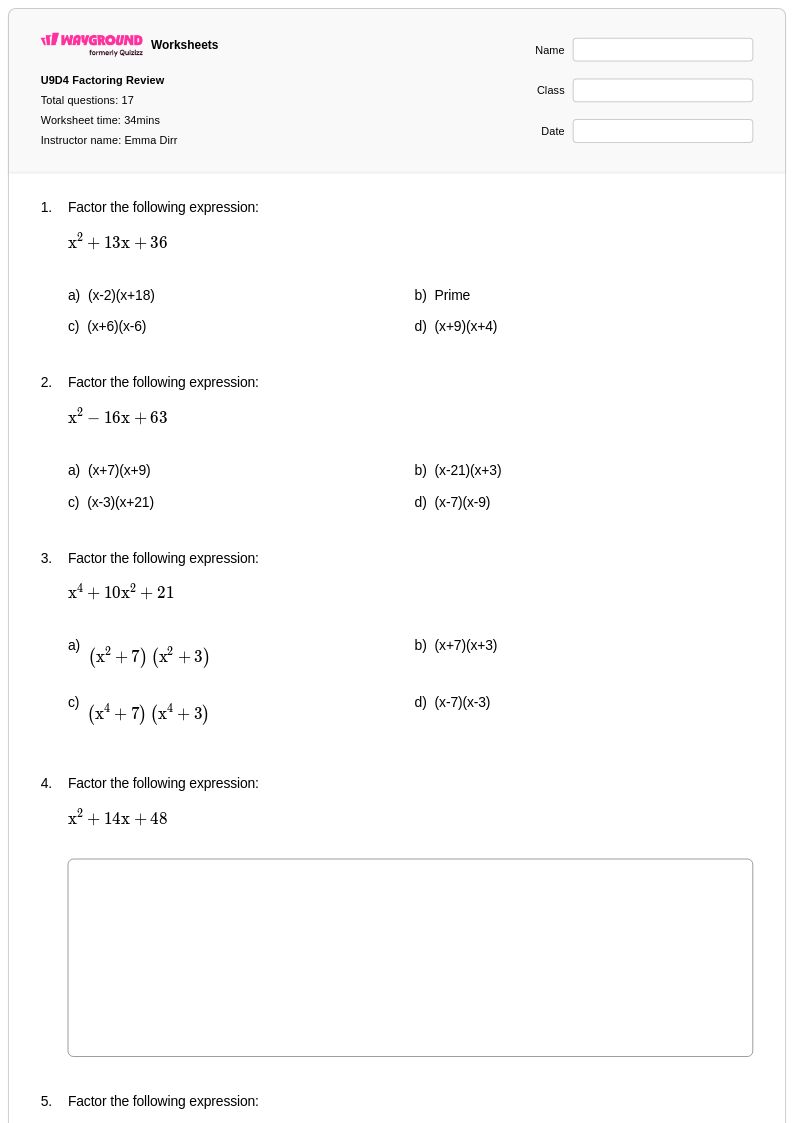
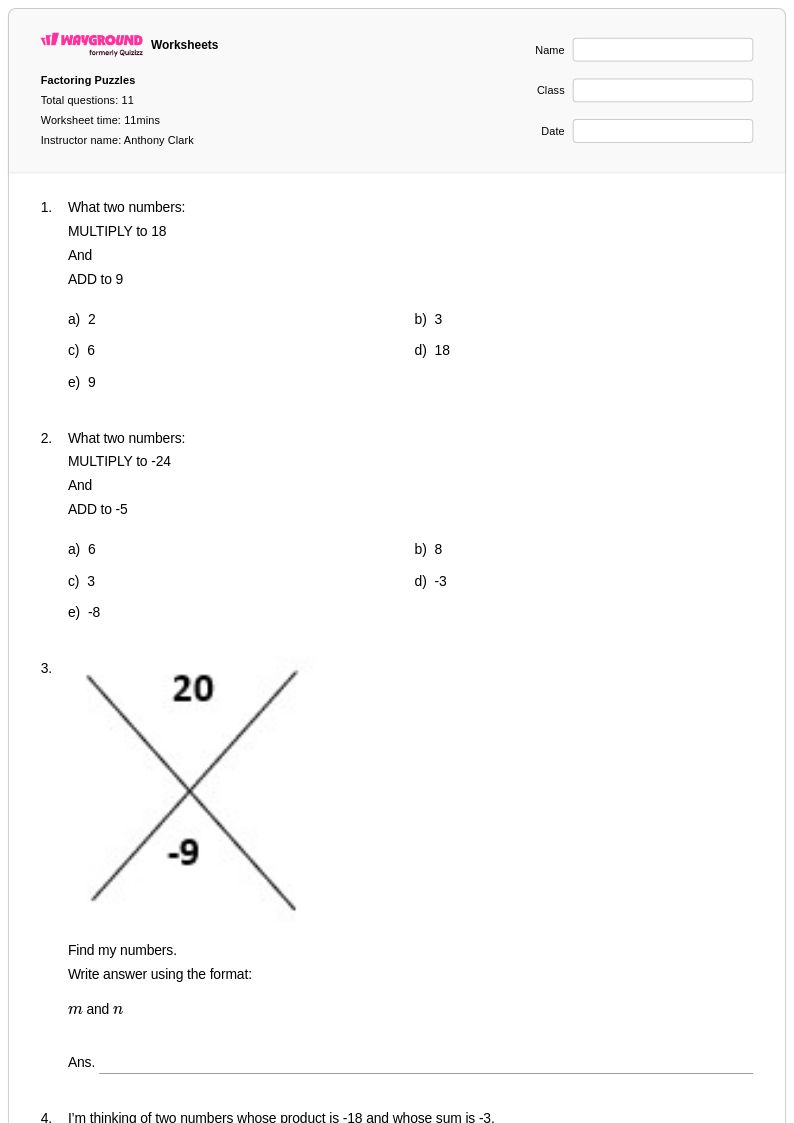
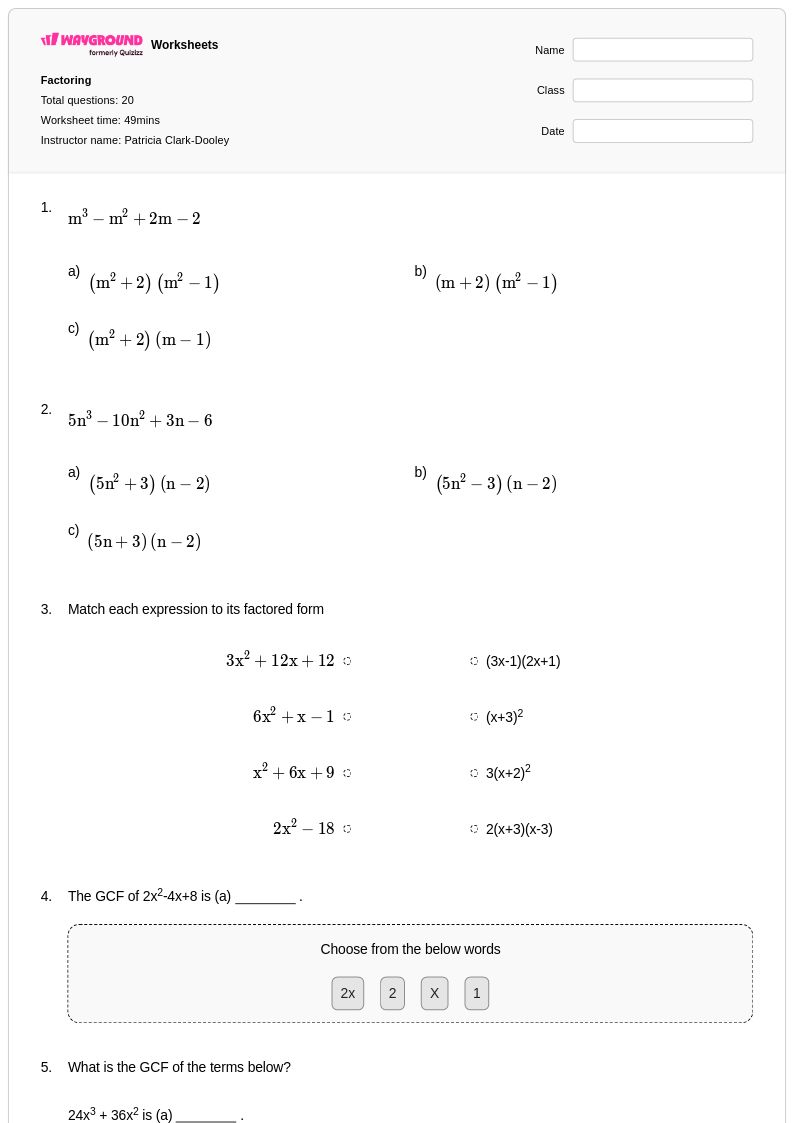
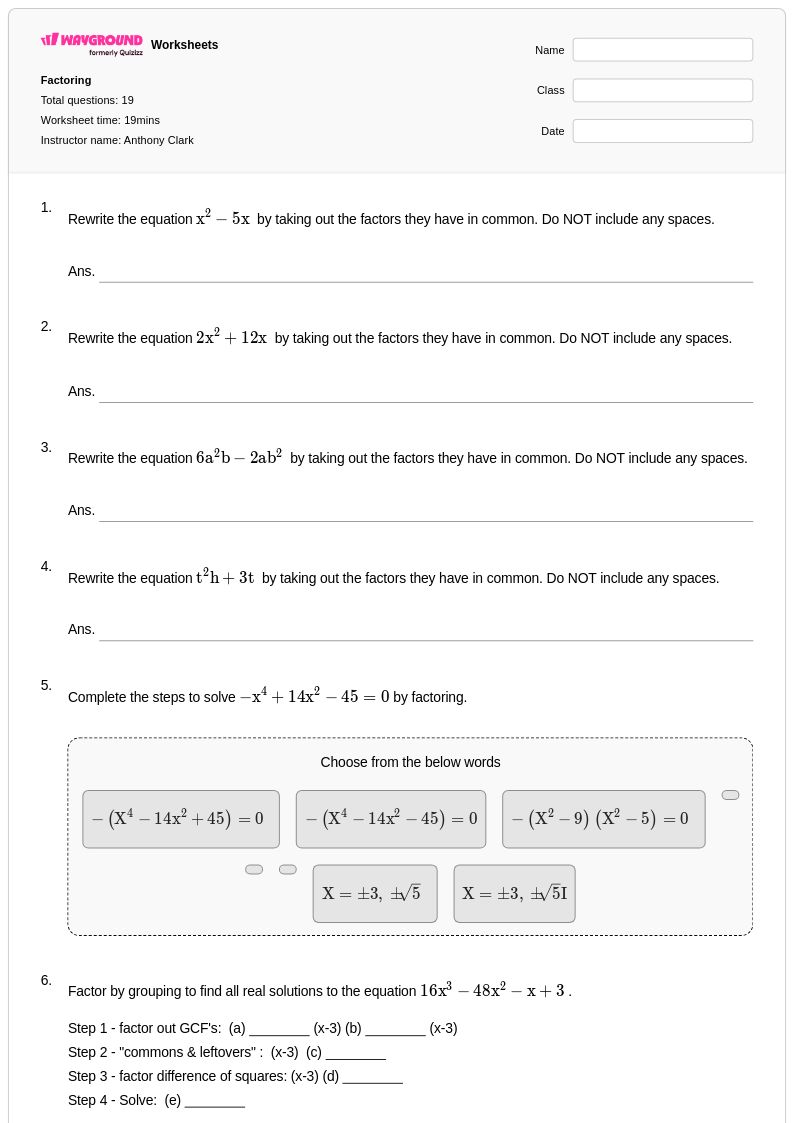
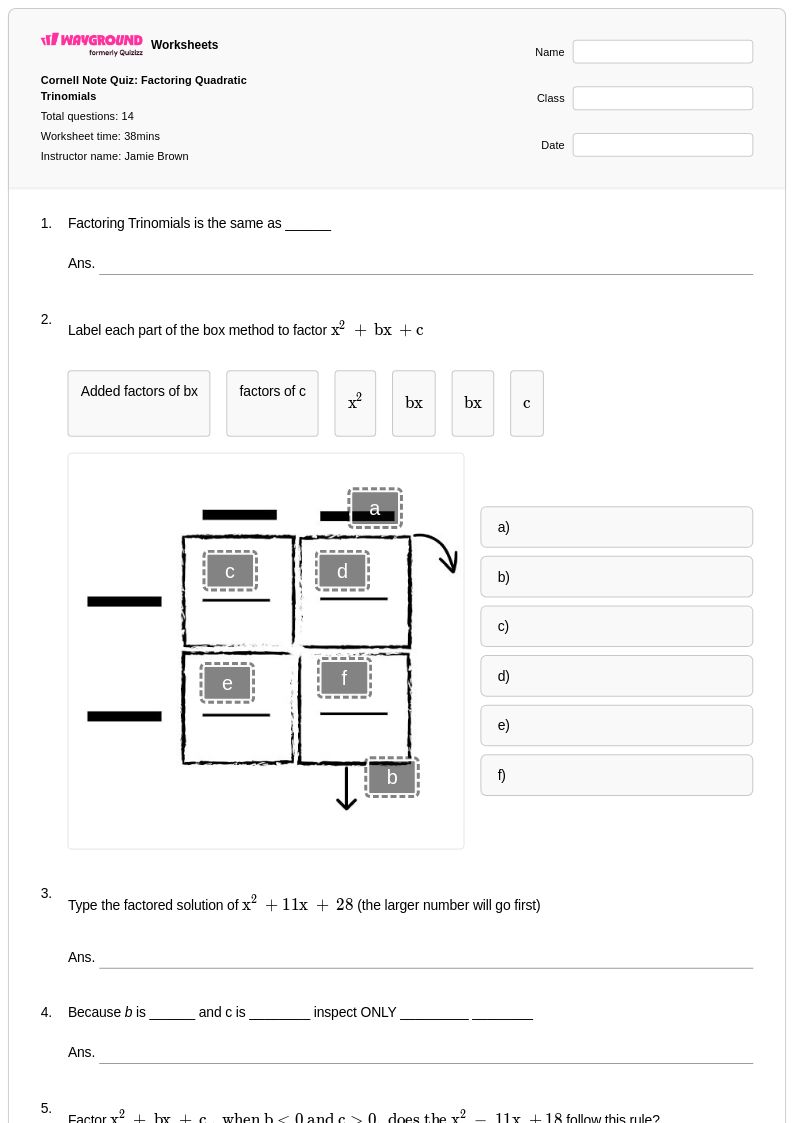
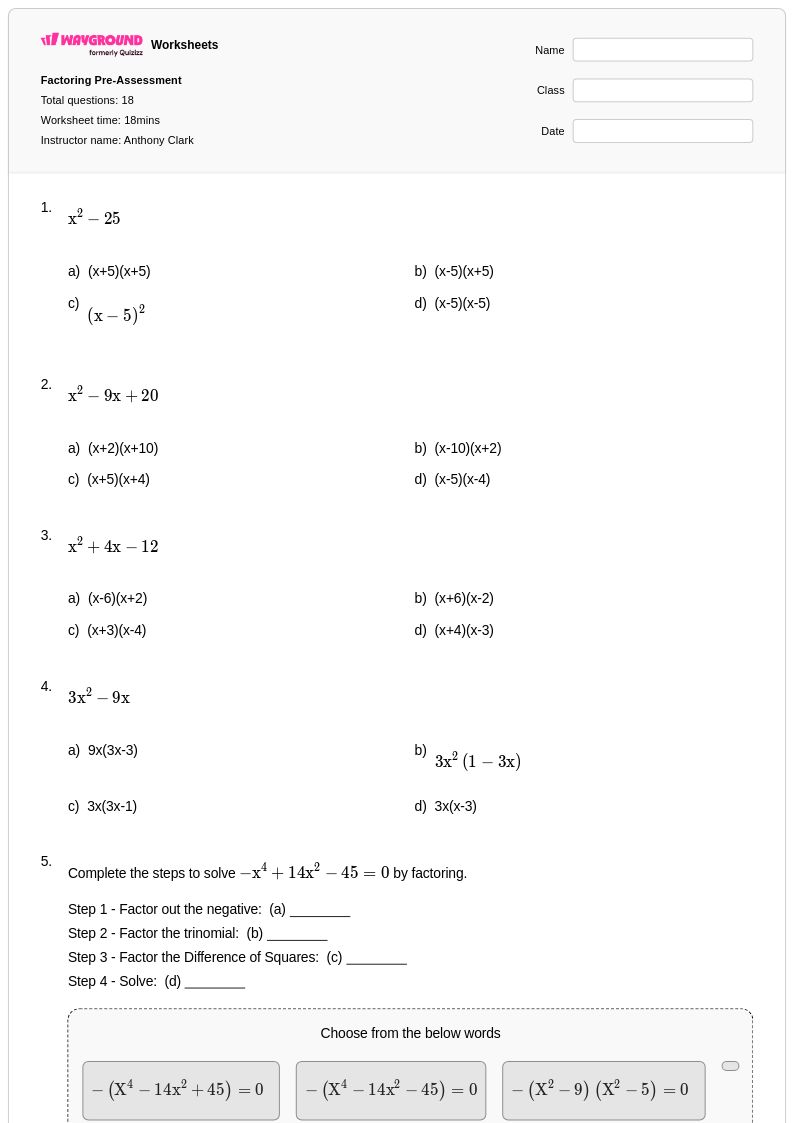
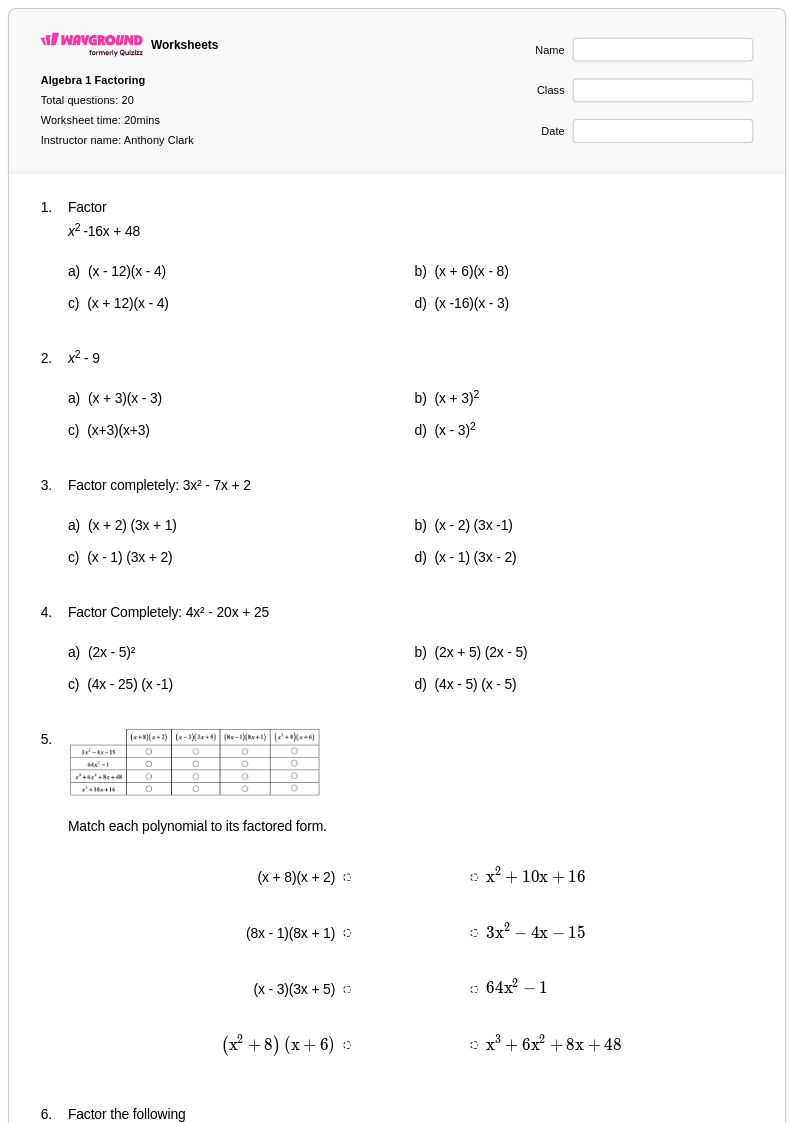
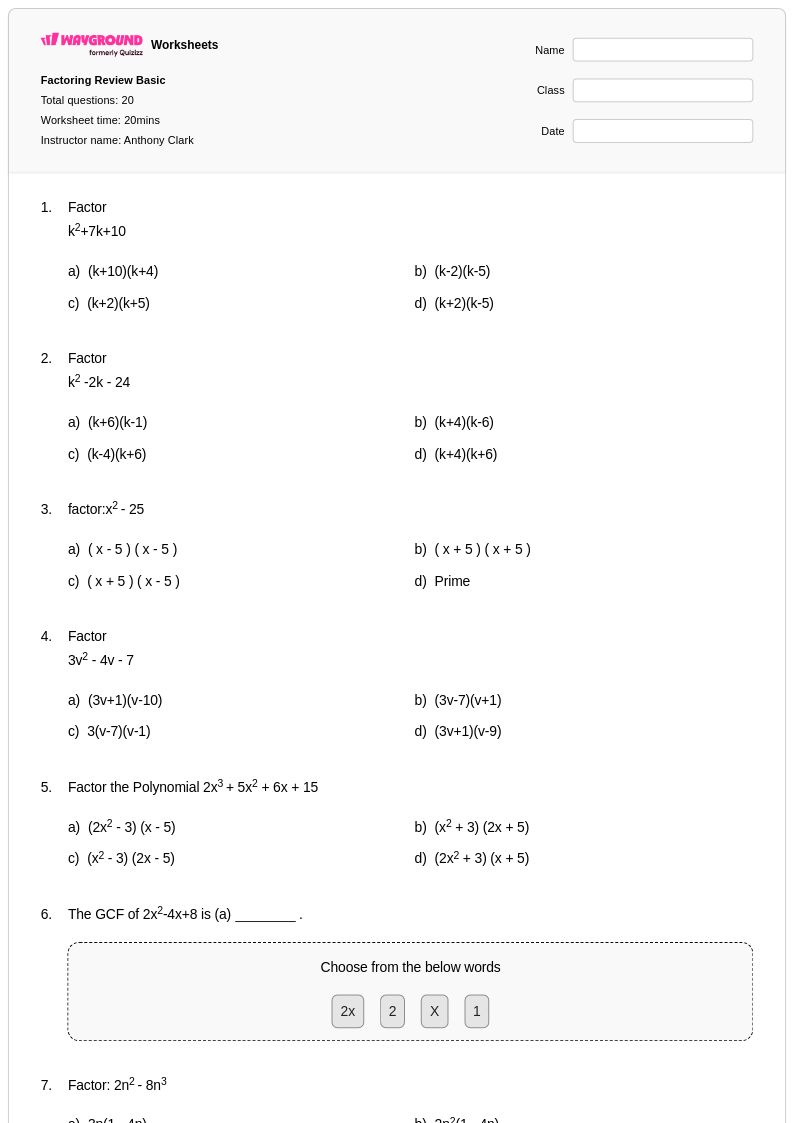
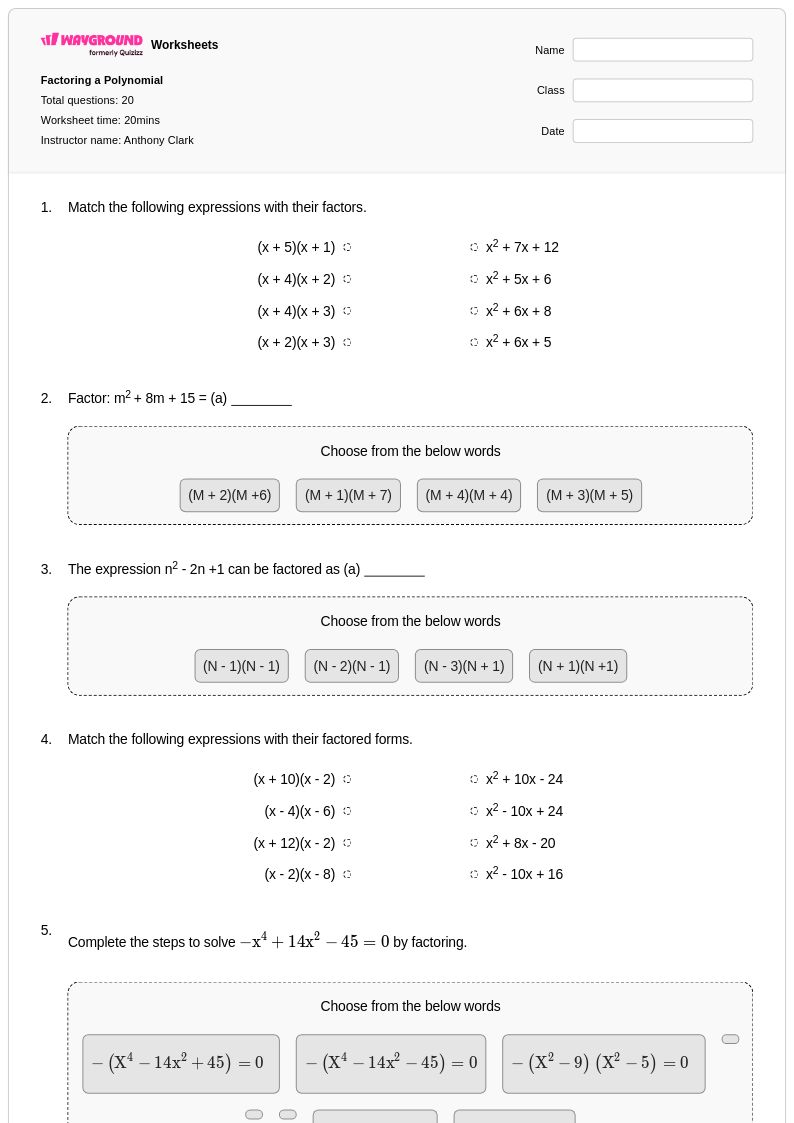
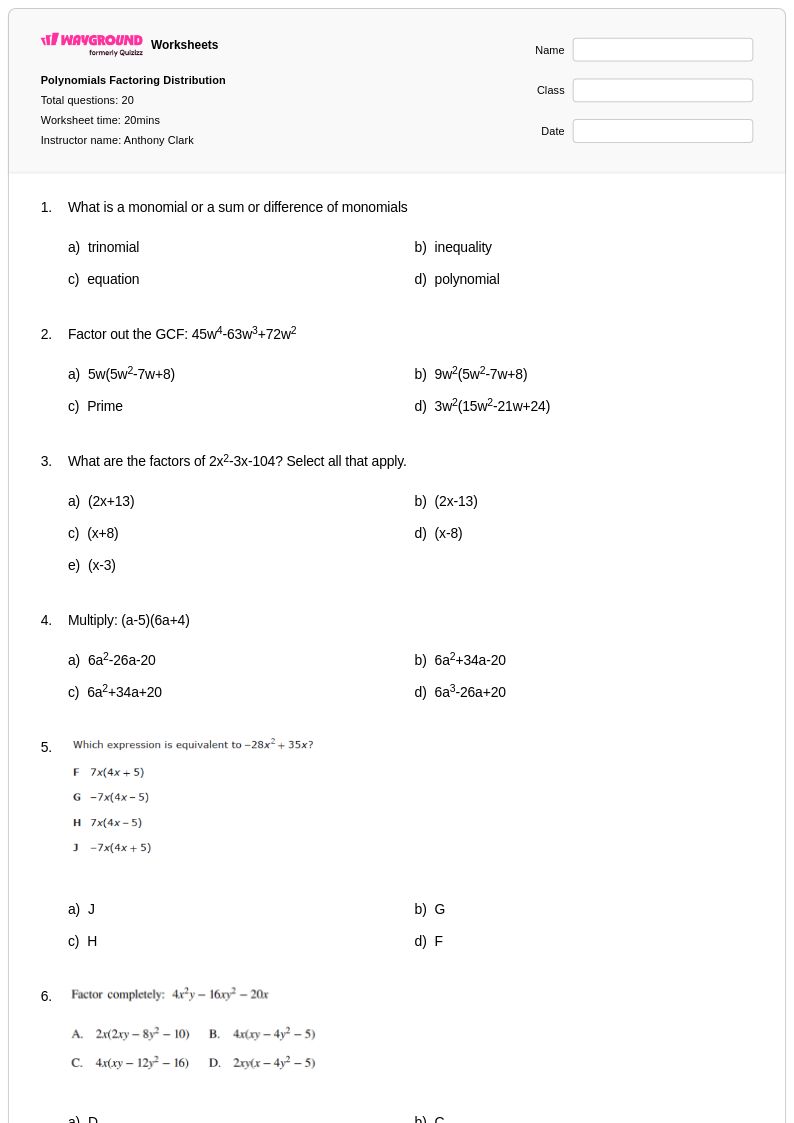
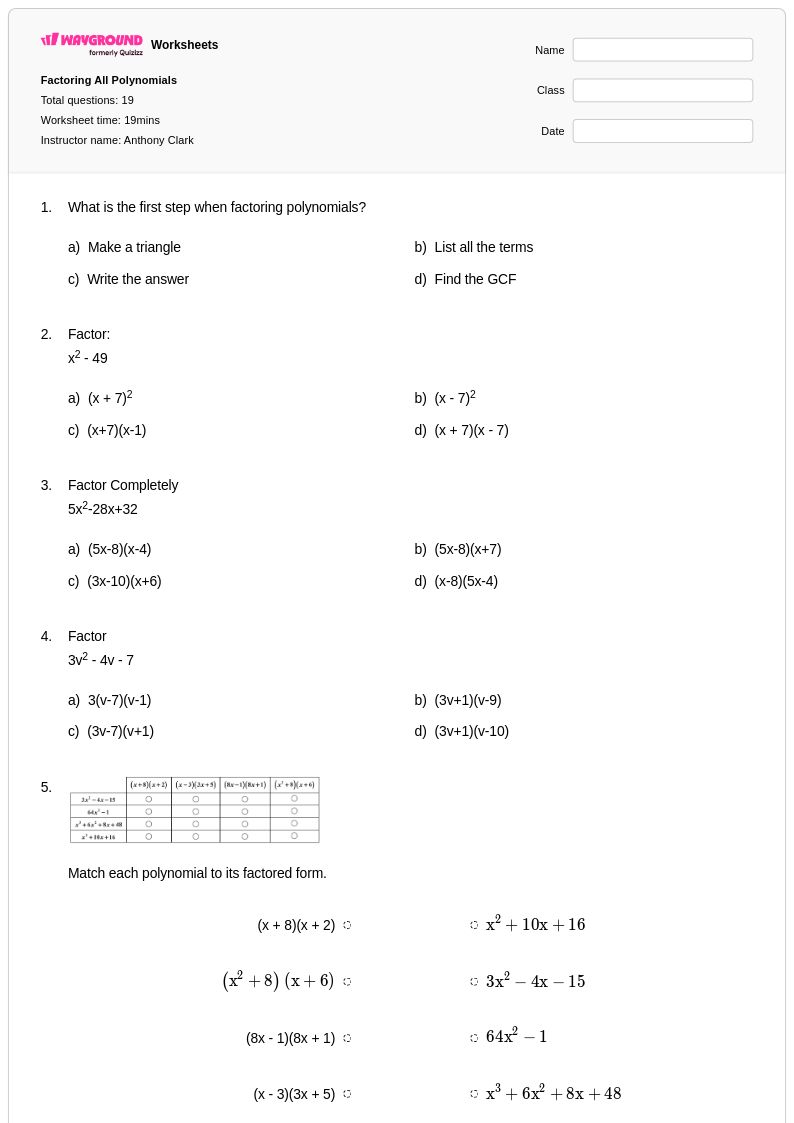
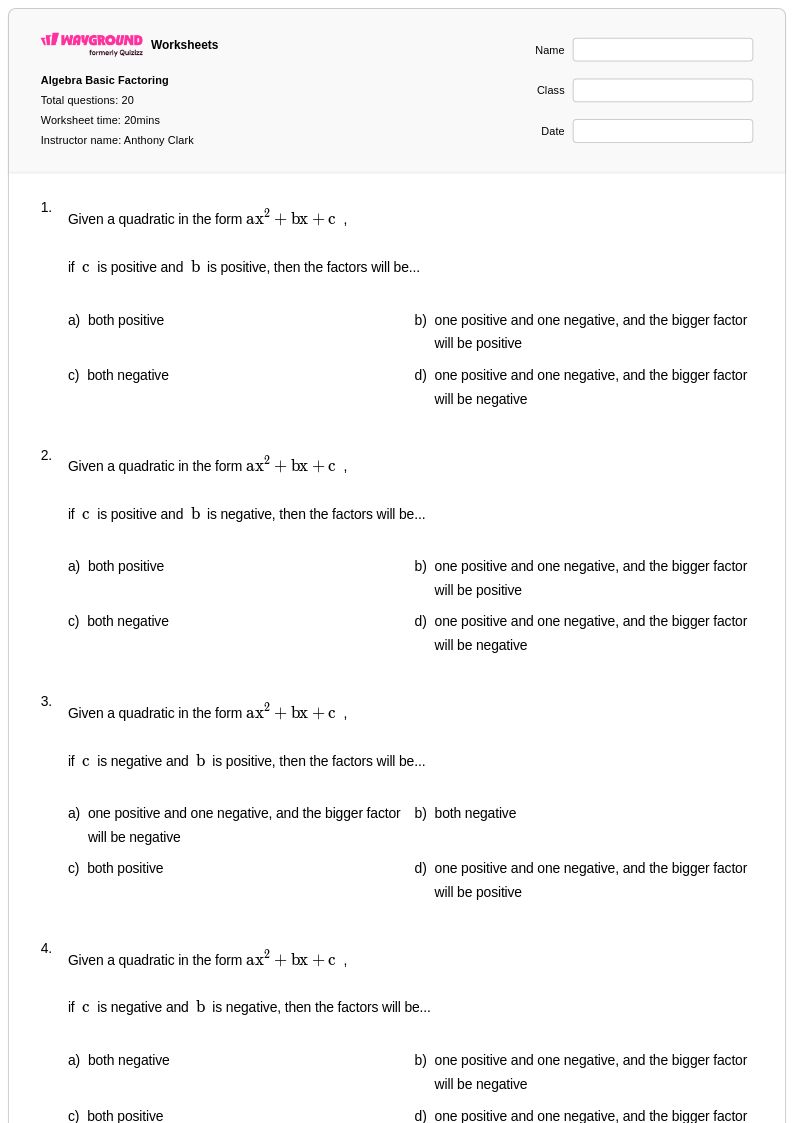
Explore Wayground's free factoring worksheets and printables with comprehensive practice problems and answer keys to help students master polynomial factoring techniques and algebraic expressions through engaging PDF exercises.
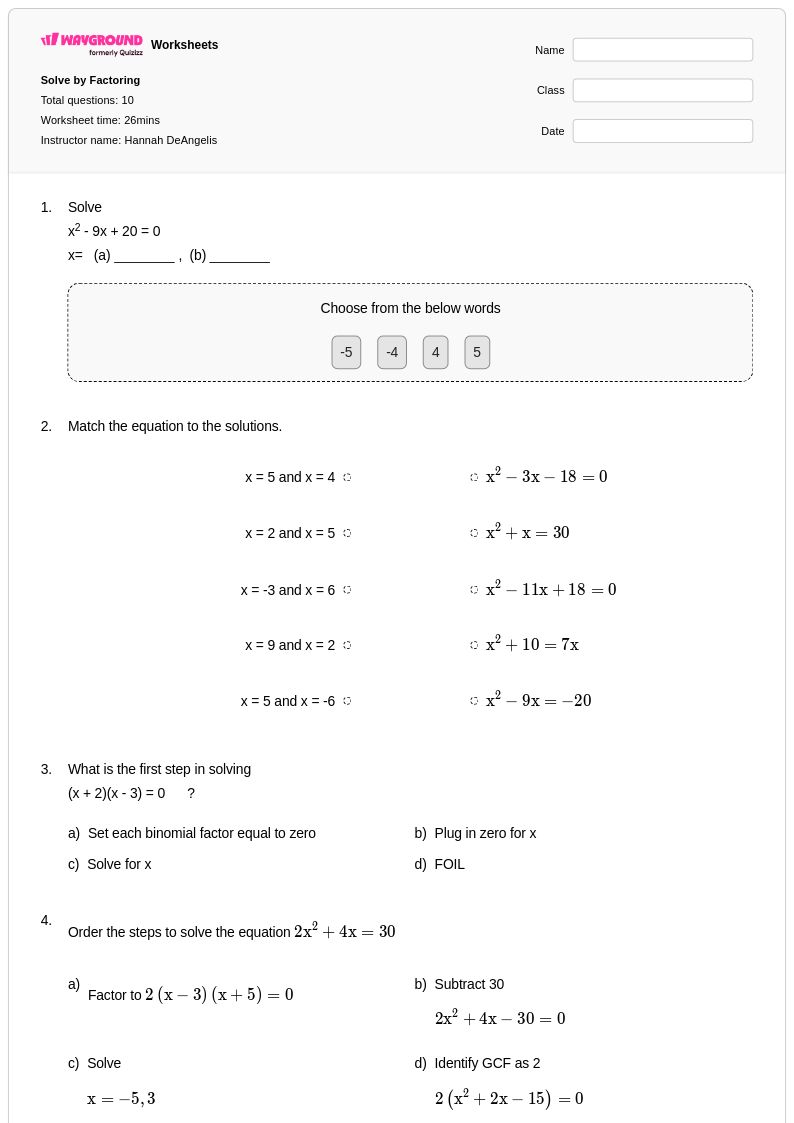
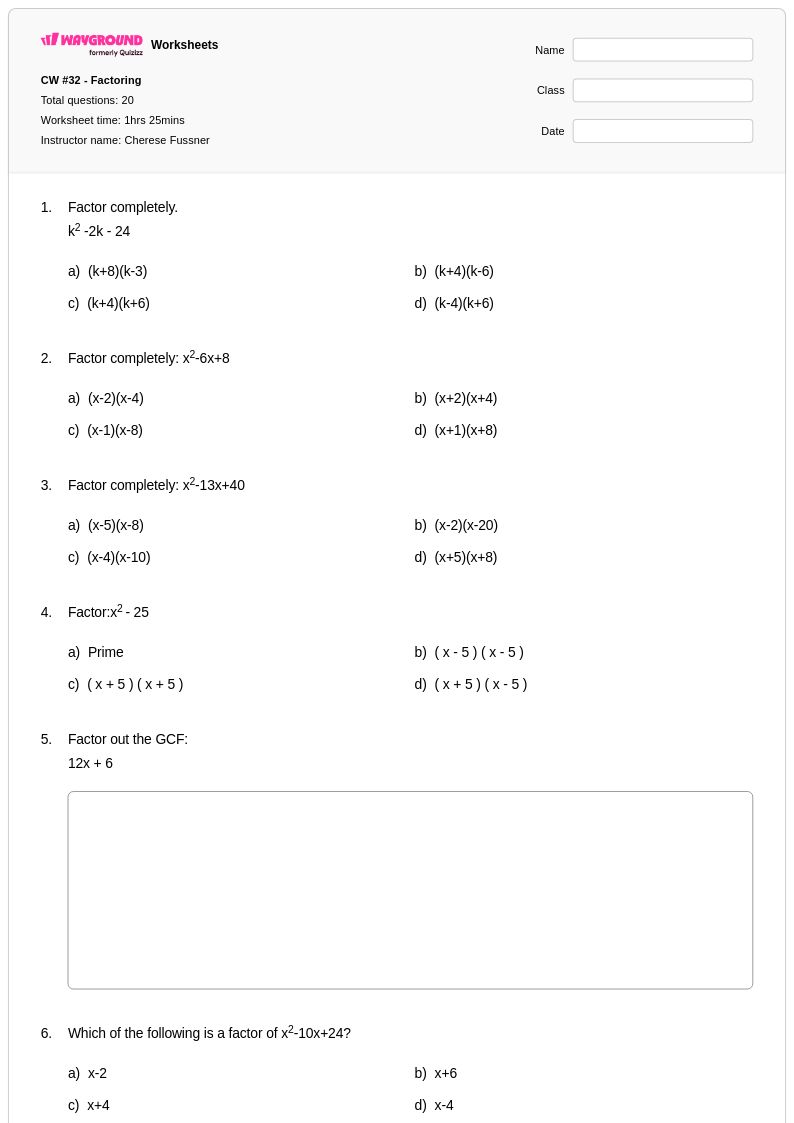
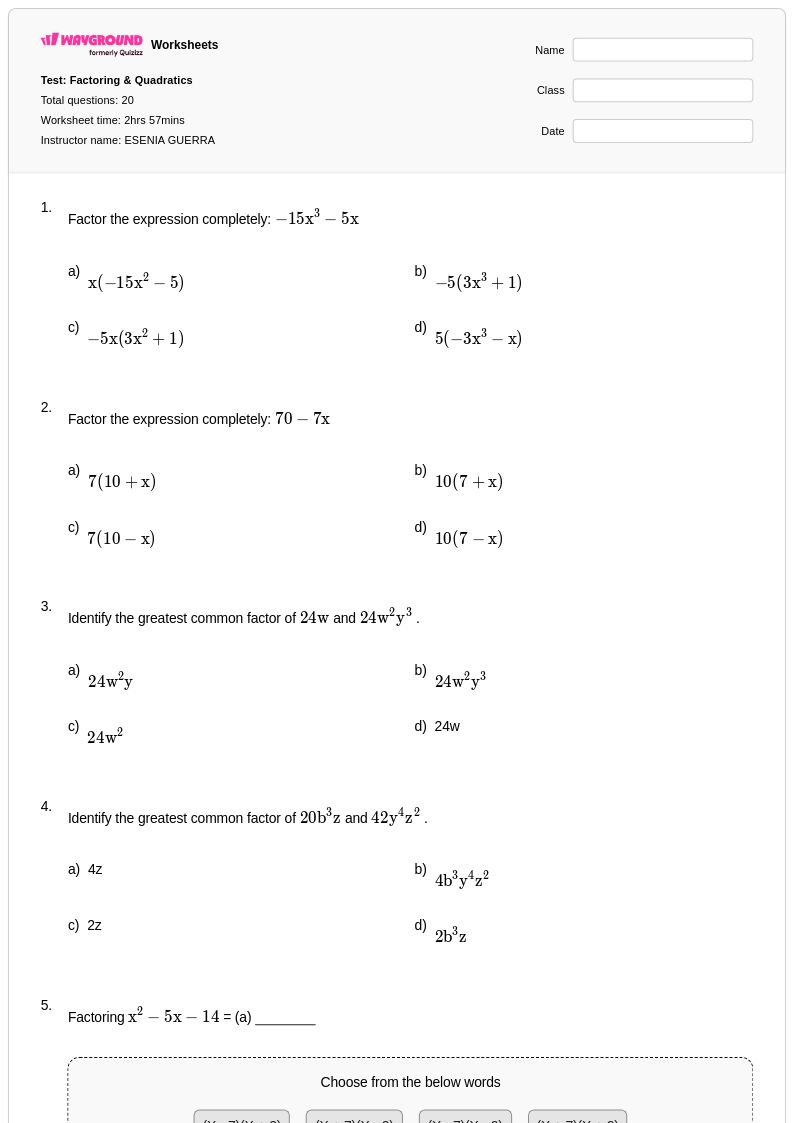
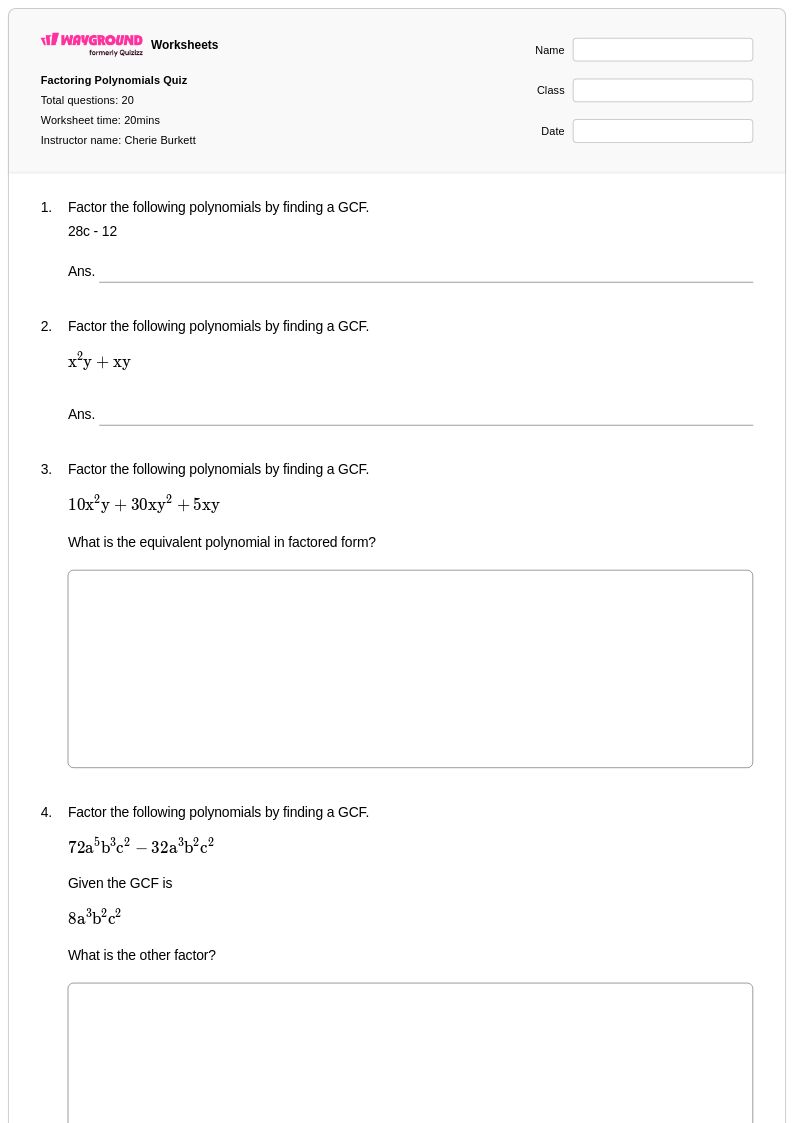
Factoring worksheets available through Wayground (formerly Quizizz) provide comprehensive practice opportunities for students to master one of algebra's most fundamental skills. These carefully designed resources help students develop proficiency in recognizing patterns, breaking down polynomial expressions, and applying various factoring techniques including greatest common factor extraction, difference of squares, and trinomial factoring. Each worksheet collection includes detailed answer keys that enable students to check their work independently, while the free printables offer educators flexible options for classroom instruction, homework assignments, and assessment preparation. The practice problems progress systematically from basic factoring concepts to more complex multi-step expressions, ensuring students build confidence while strengthening their algebraic reasoning abilities.
Wayground (formerly Quizizz) supports mathematics educators with millions of teacher-created factoring resources that streamline lesson planning and differentiated instruction. The platform's robust search and filtering capabilities allow teachers to quickly locate worksheets aligned with specific curriculum standards and tailored to varying skill levels within their classrooms. These versatile materials are available in both printable pdf formats for traditional paper-based learning and digital versions that integrate seamlessly with online instruction, providing educators the flexibility to customize content based on individual student needs. Teachers can efficiently use these comprehensive worksheet collections for targeted remediation sessions, enrichment activities for advanced learners, and regular skill practice that reinforces factoring concepts throughout the academic year.
FAQs
How do I teach factoring in algebra?
Start with greatest common factor (GCF) before introducing trinomial factoring or difference of squares — students who skip GCF first tend to miss it as a first step later. From there, build toward factoring trinomials by having students work backward from multiplication: if they expanded (x + 3)(x + 2) yesterday, factoring x² + 5x + 6 today feels like reversing a known process rather than learning something new. The AC method is worth introducing once students are comfortable with simple trinomials, since it gives them a reliable procedure for cases where the leading coefficient isn't 1.
What exercises help students practice factoring polynomials?
Mixed-method practice is more effective than drilling one technique at a time — students need to recognize which method applies before they can execute it. Good exercise sets start with GCF problems, move into difference of squares and simple trinomials, then layer in multi-step expressions that require combining techniques. Wayground's factoring worksheets progress systematically from basic to complex, so students build fluency before hitting the harder problems.
What mistakes do students commonly make when factoring?
Three errors come up constantly: forgetting to factor out the GCF first (leading to unnecessarily messy trinomials), sign errors when factoring expressions like x² − 5x + 6 (students often mix up which sign combination produces a positive constant), and declaring a polynomial "fully factored" when one factor can still be factored further. A quick check habit — expanding the factored form to verify it matches the original — catches most of these before they become ingrained.
How do I use Wayground's factoring worksheets in my class?
Each worksheet comes with a complete answer key, so students can check their own work during independent practice or you can use it for quick grading. If you're going paper-based, print the PDF and grade submissions using the Wayground for Teachers app, which lets you scan or capture student work directly. Prefer a digital format? You can host the same worksheet as an online quiz on Wayground, which works well for homework or stations where students are already on devices.
Is factoring aligned to Common Core standards?
Yes. Common Core treats factoring as a core algebraic skill introduced in middle school through GCF and simple expressions, then extended in high school algebra to include factoring trinomials, difference of squares, and factoring by grouping. The progression is deliberate: students are expected to factor as a tool for solving quadratic equations, not just as an isolated manipulation skill. That means factoring practice should always connect forward to equation-solving, not stop at "rewrite this expression."
How can I differentiate factoring practice for mixed-ability classes?
For students who struggle with multi-step problems, Wayground's reduced answer choices accommodation lowers the cognitive load on recognition tasks while they build confidence. The worksheet-level tools let you create an alternate version with larger font and wider spacing — useful for students who lose their place in dense polynomial expressions. For language learners, the translation feature means the same problem set can go home in a student's first language without you building a second worksheet from scratch.
What is the AC method for factoring?
The AC method is a systematic approach for factoring trinomials of the form ax² + bx + c when a ≠ 1. Multiply a and c, find two numbers that multiply to that product and add to b, then use those numbers to split the middle term and factor by grouping. It's especially useful because it works for any factorable trinomial — students don't have to rely on trial and error when the leading coefficient makes guessing impractical.