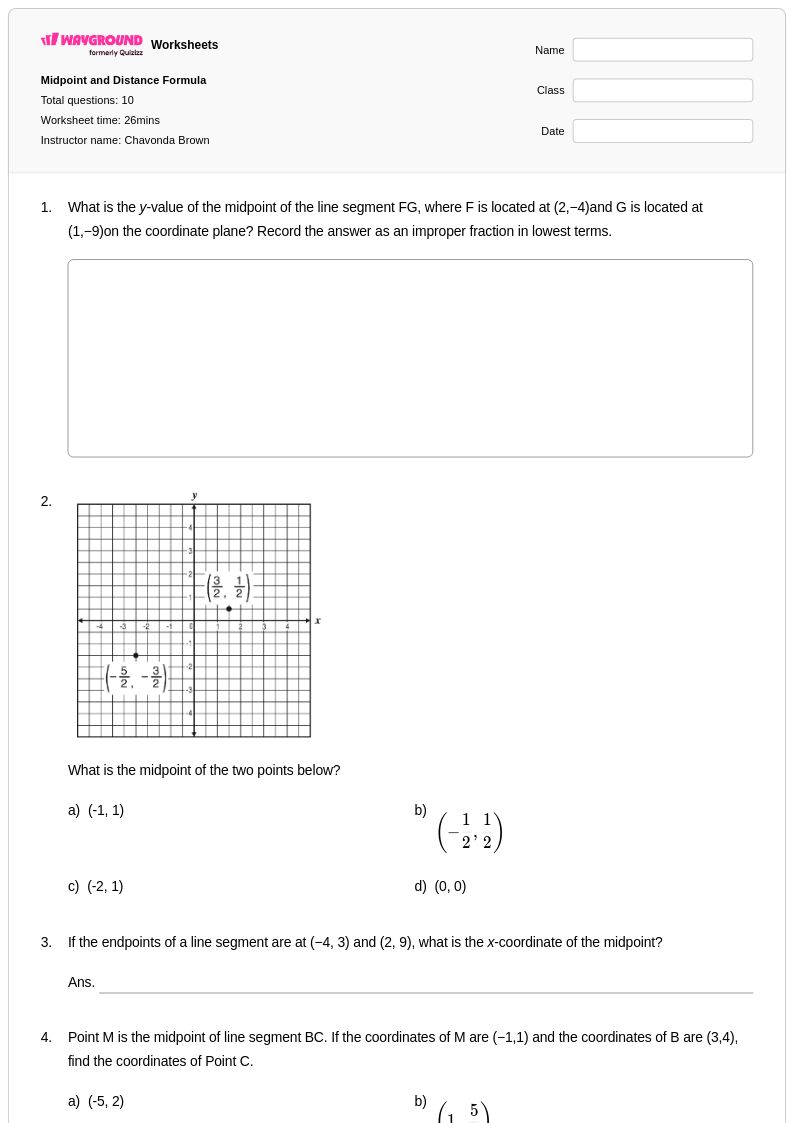
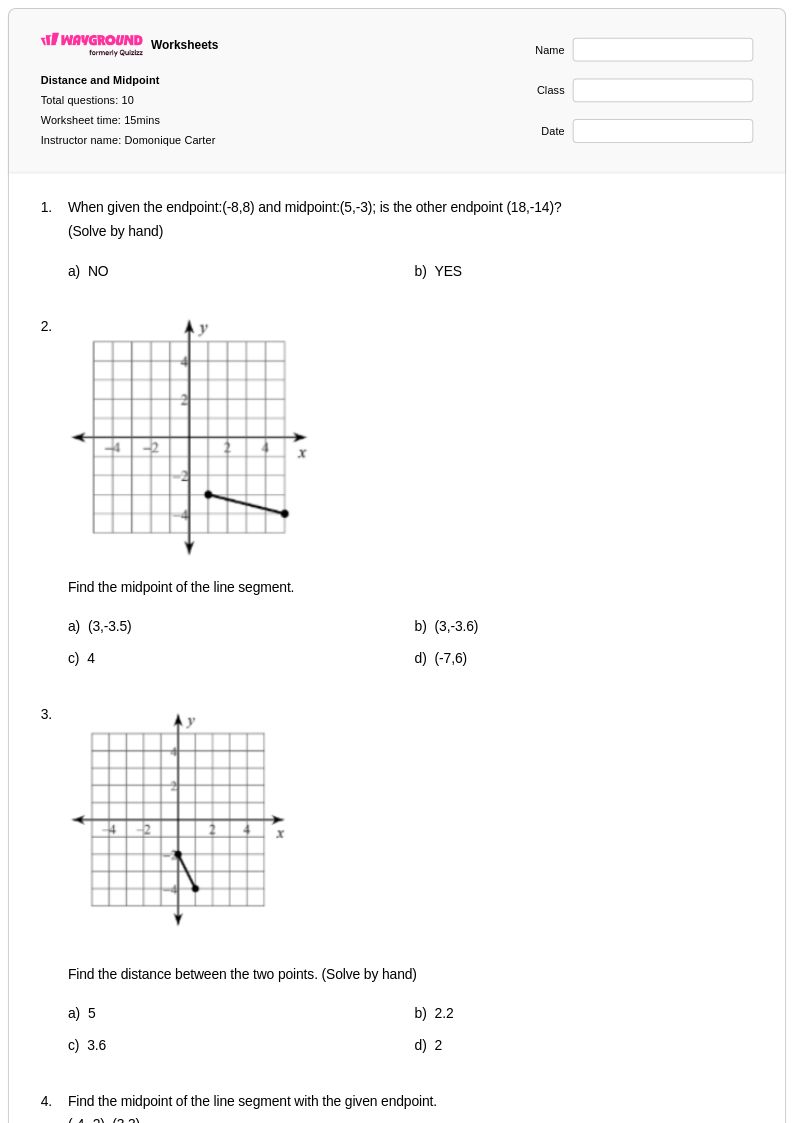
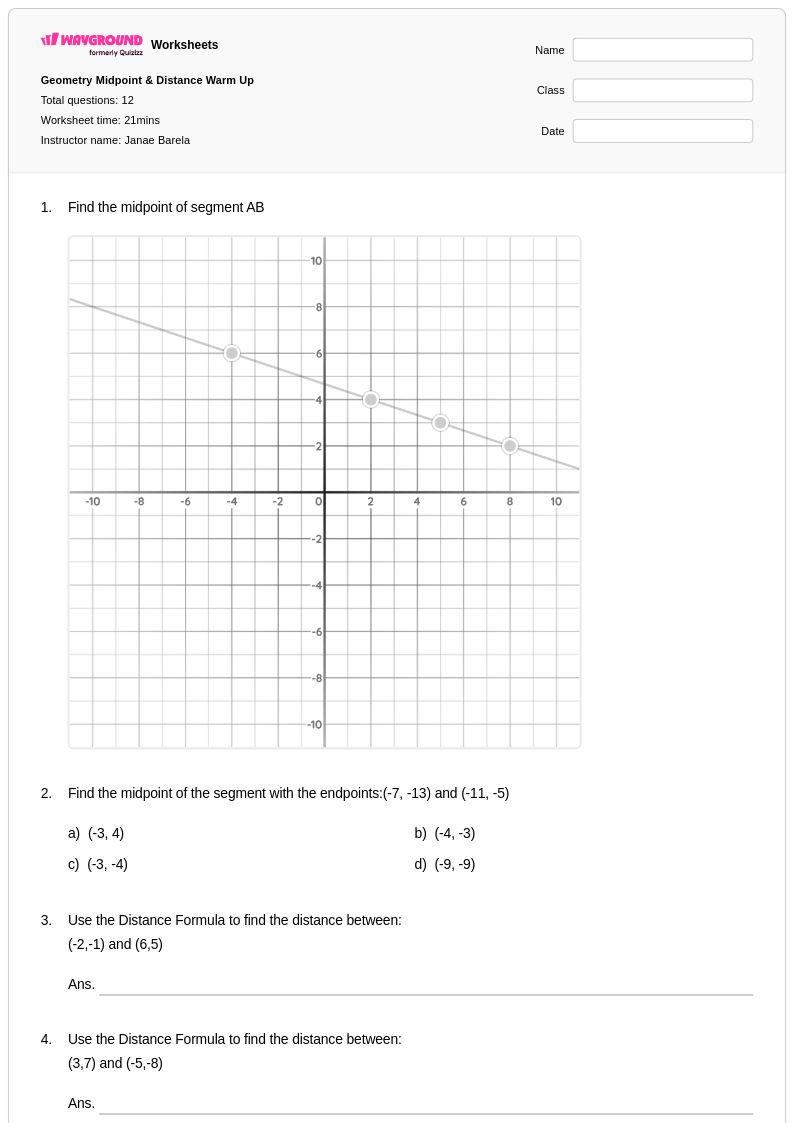
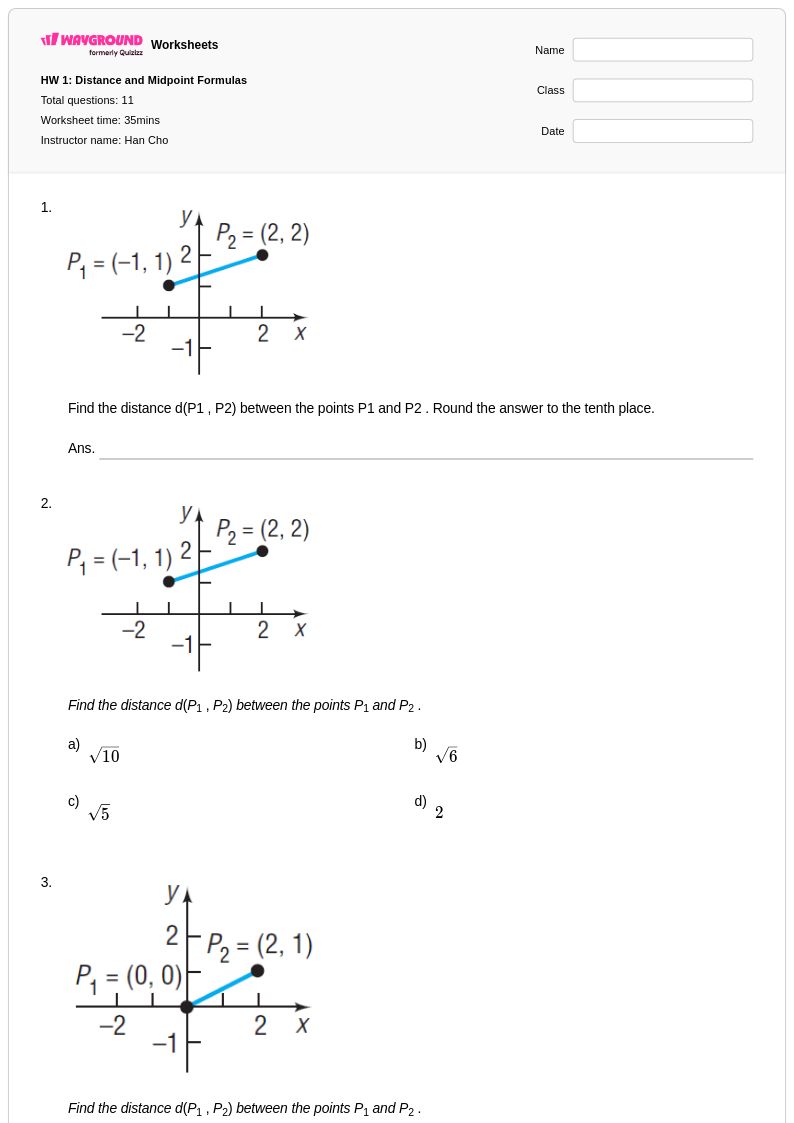
Explore Wayground's free distance and midpoint worksheets featuring comprehensive practice problems and answer keys to help students master coordinate geometry calculations and spatial relationships through engaging printable PDF exercises.
Explore printable Distance and Midpoint worksheets
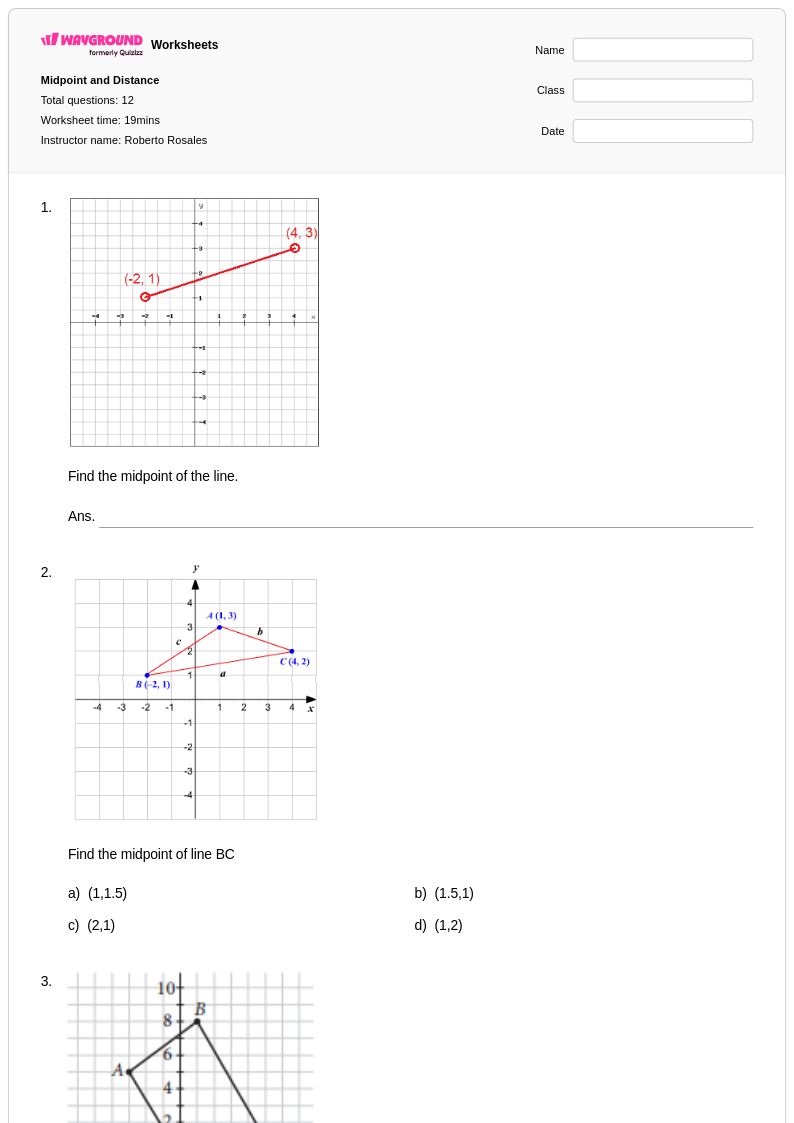
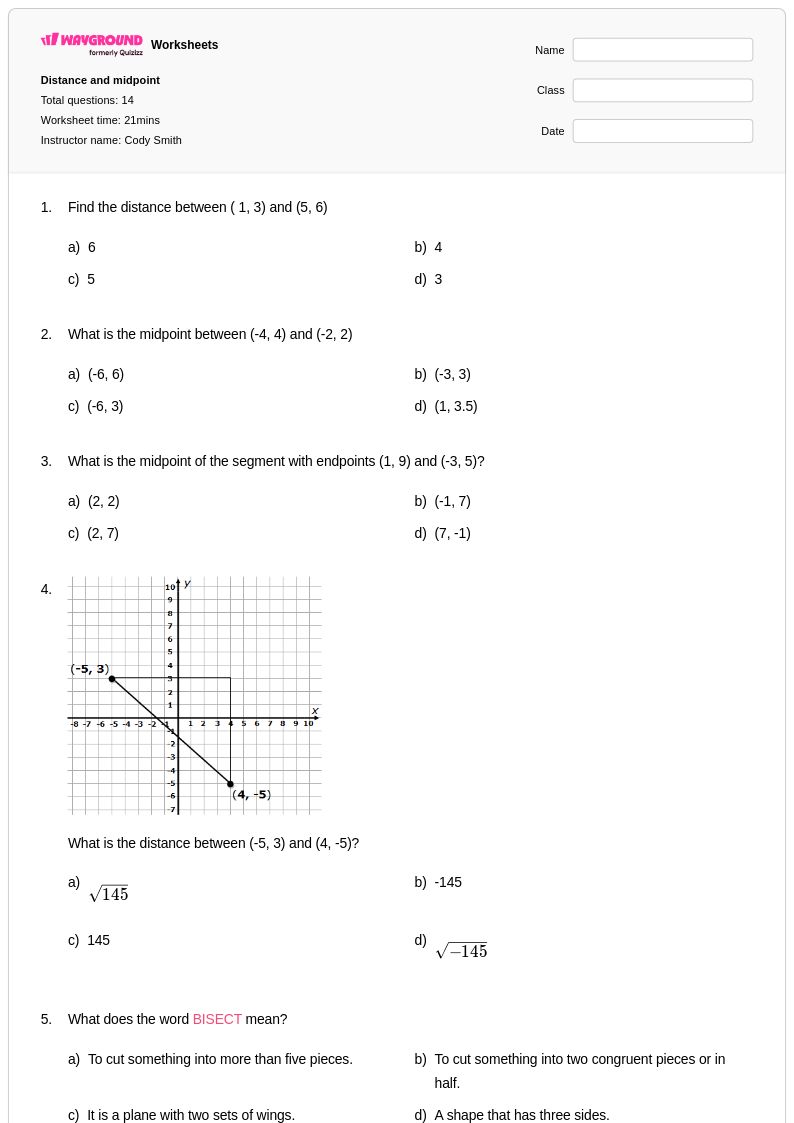
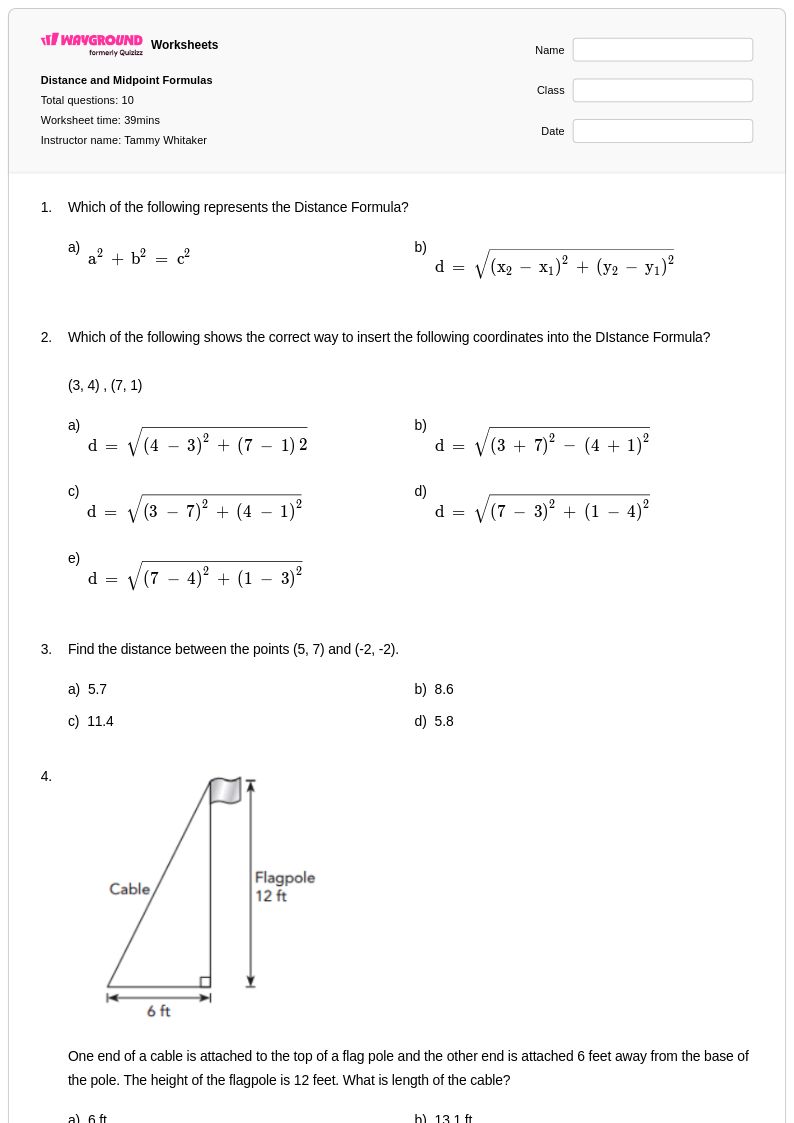
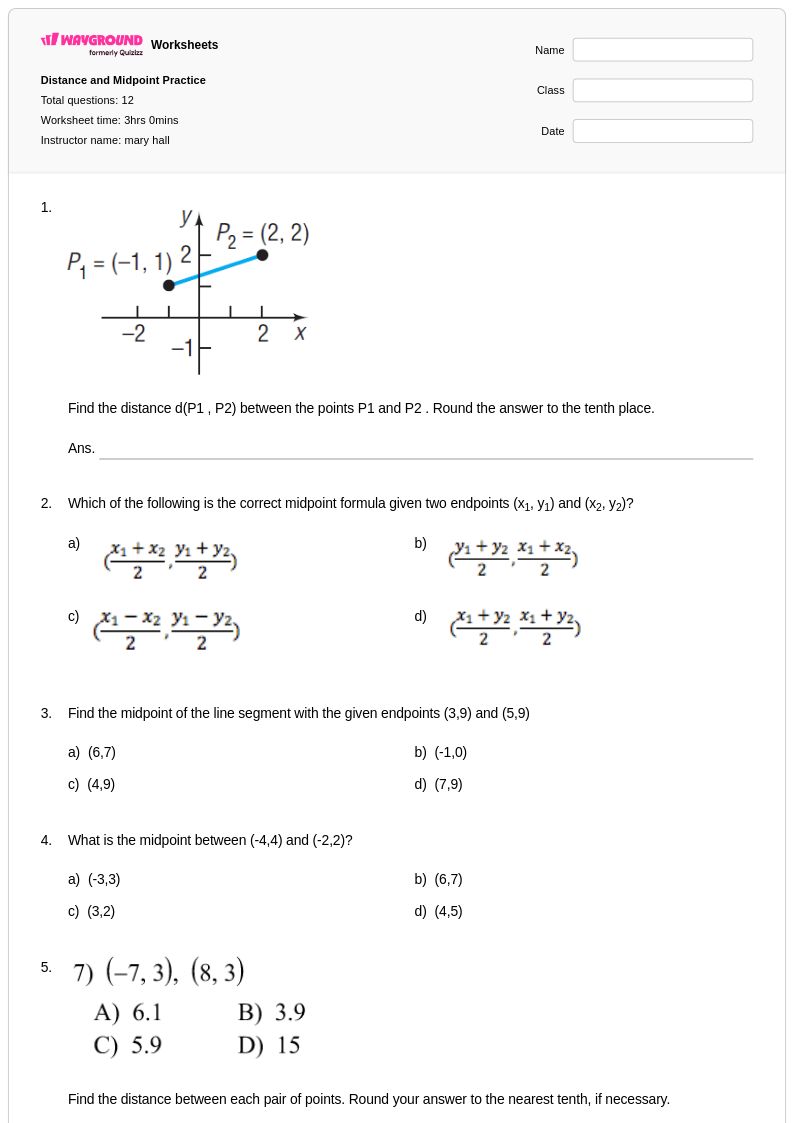
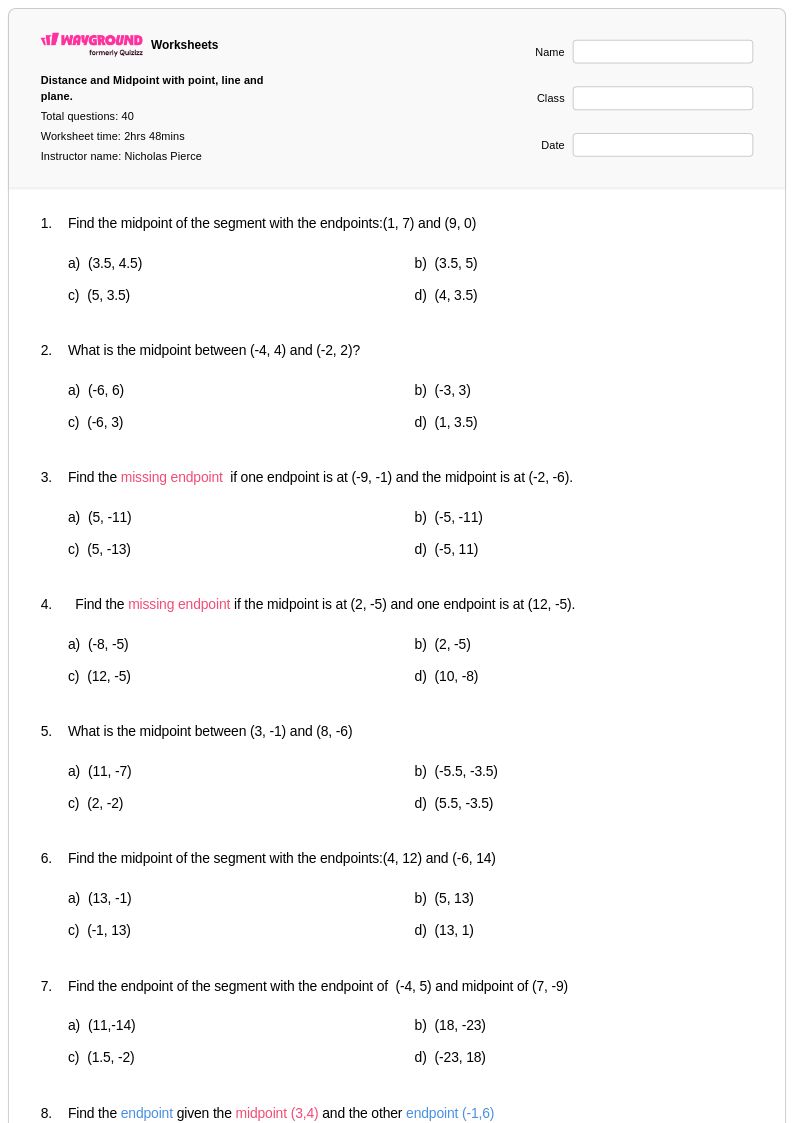
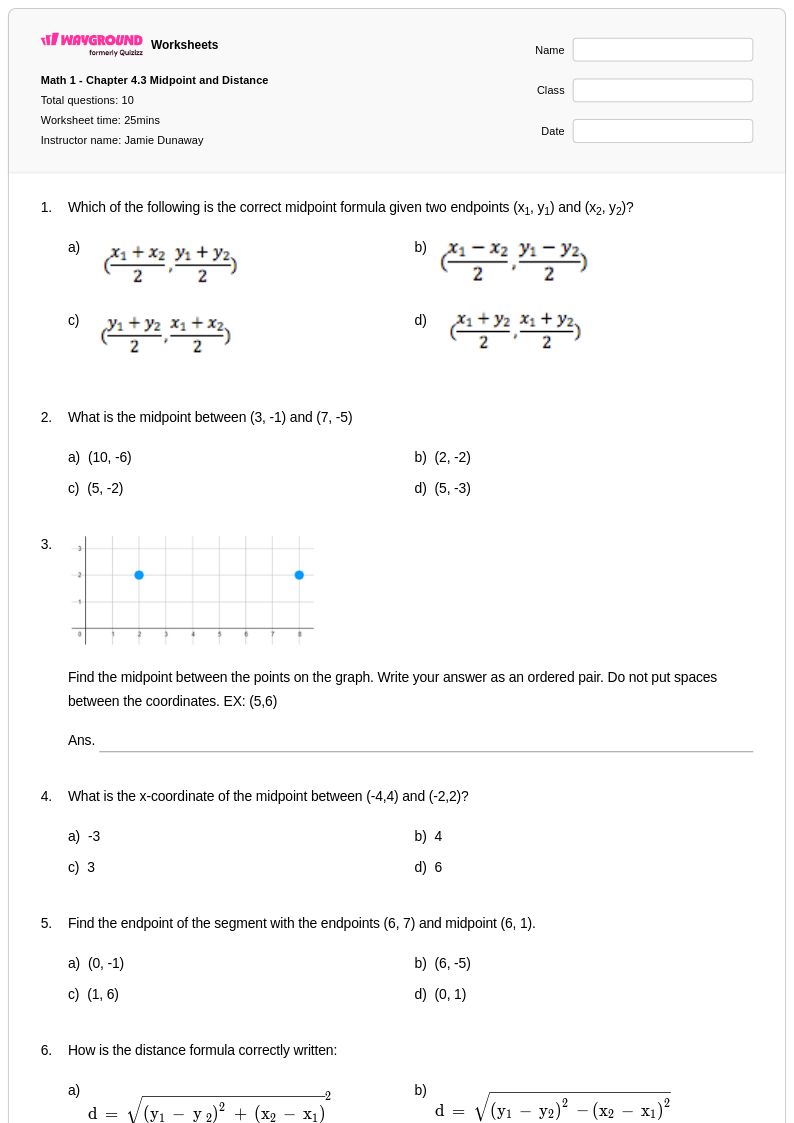
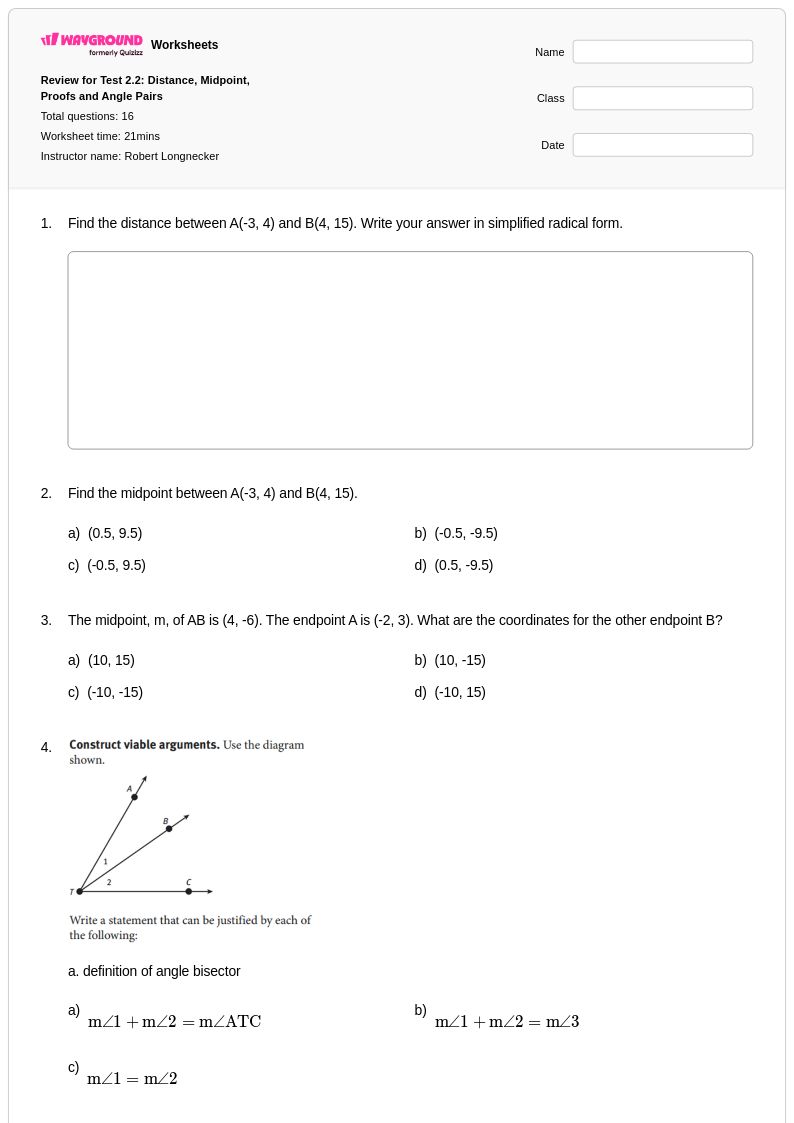
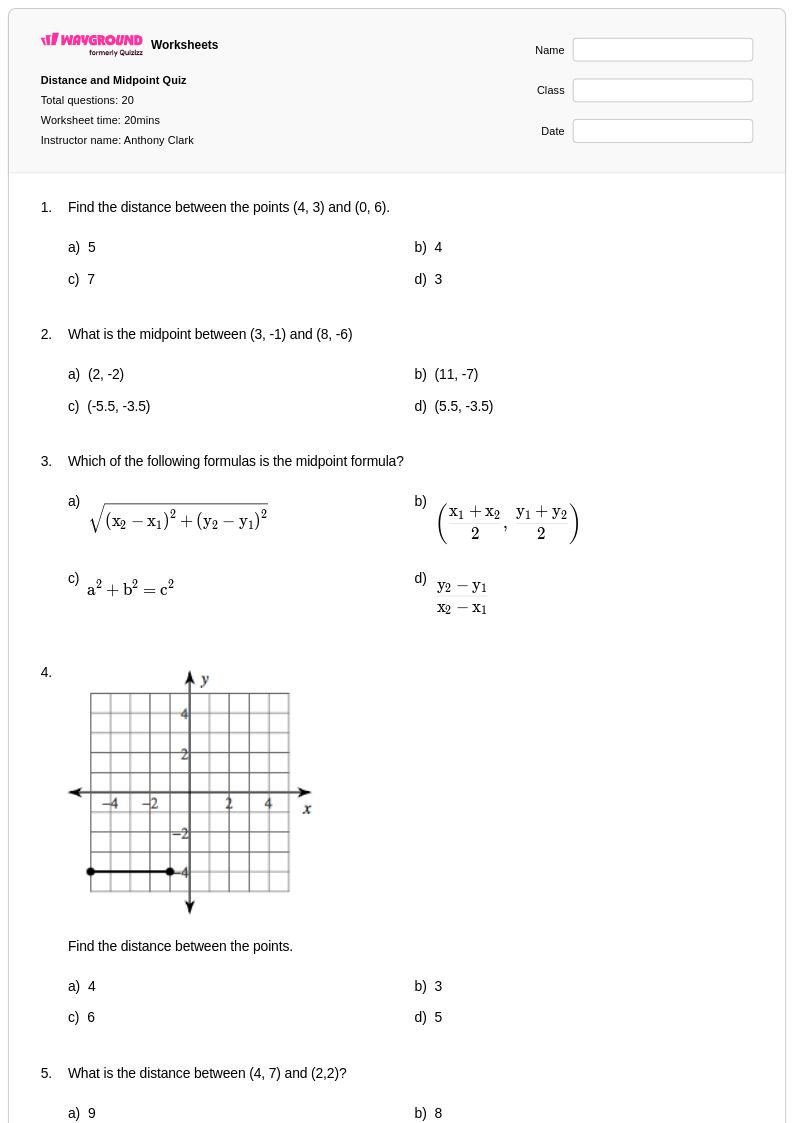
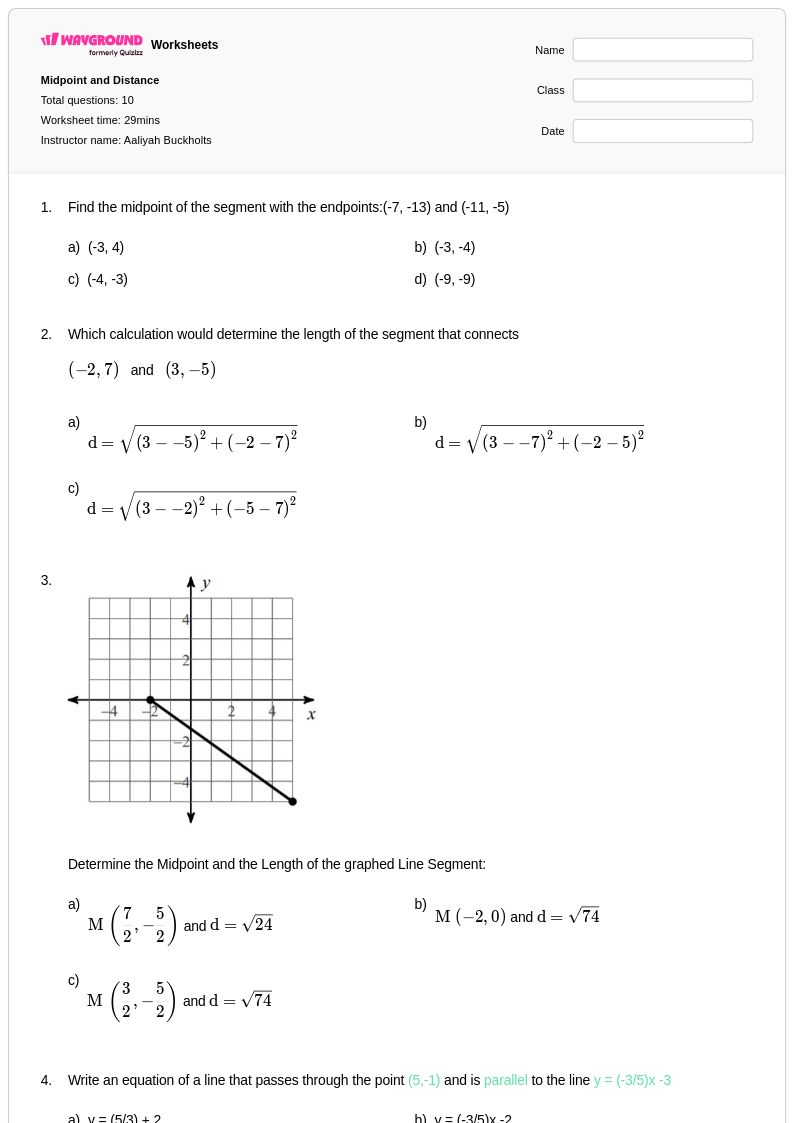
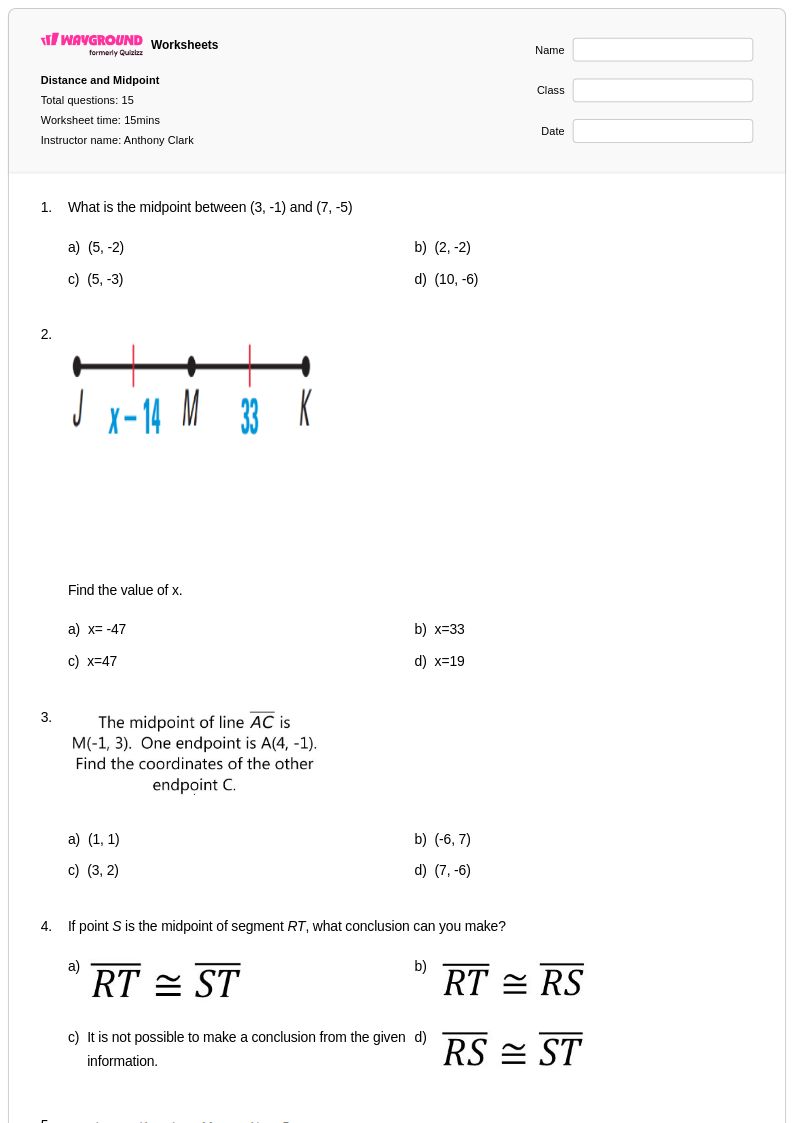
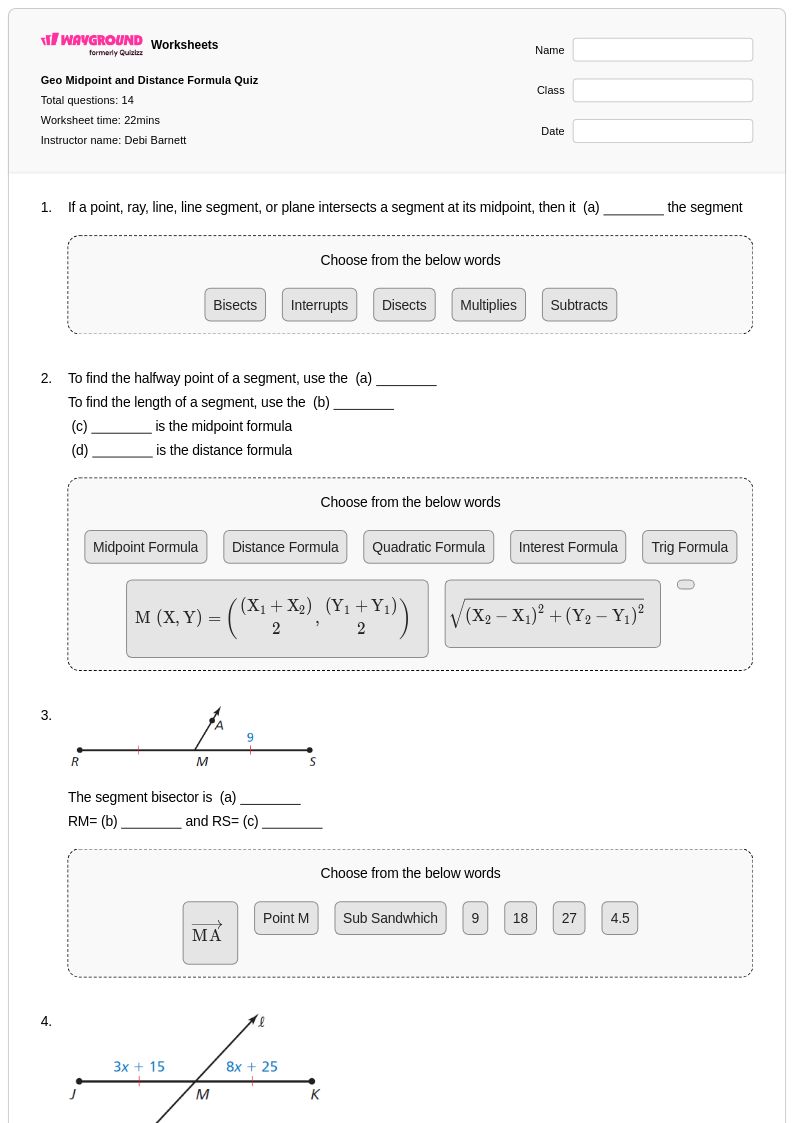
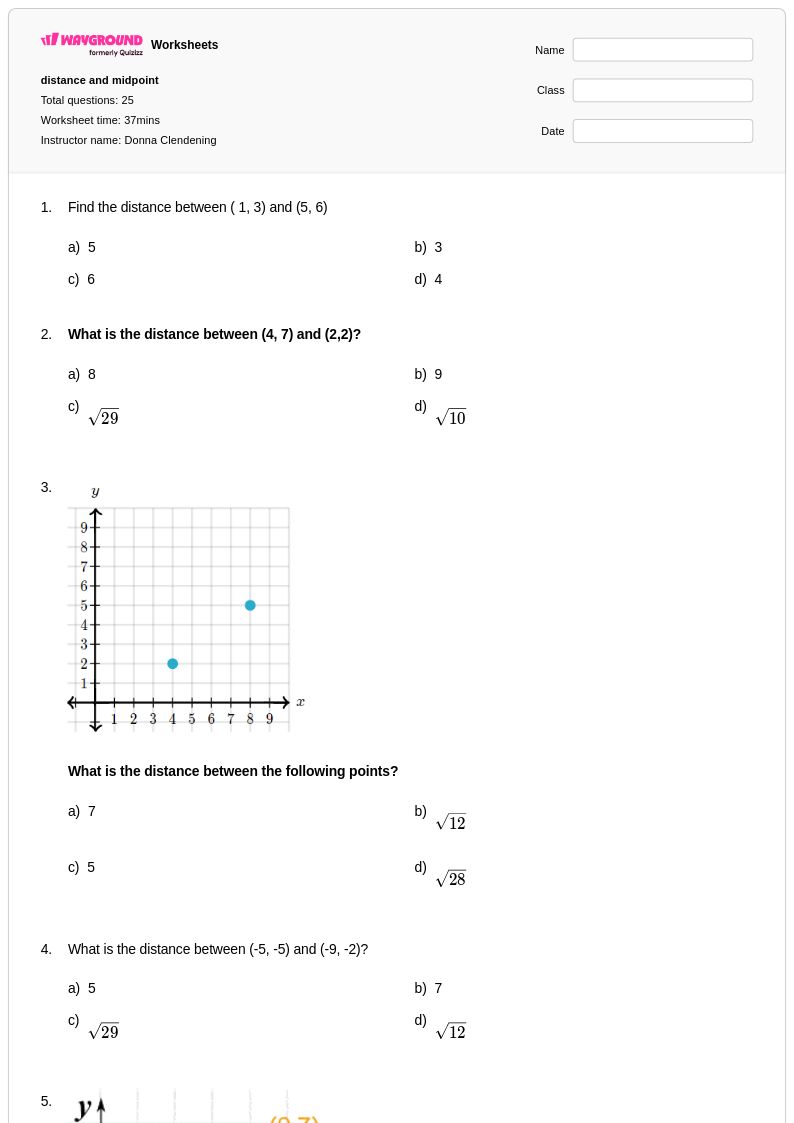
Distance and midpoint worksheets available through Wayground (formerly Quizizz) provide comprehensive practice opportunities for students to master essential coordinate geometry concepts. These expertly crafted resources focus on calculating distances between points using the distance formula, finding midpoints of line segments, and applying these skills to solve real-world problems involving coordinate planes. The worksheets strengthen critical mathematical reasoning abilities including algebraic manipulation, coordinate plotting, and geometric visualization while building fluency with fundamental formulas. Each collection includes detailed answer keys and is available as free printables in convenient PDF format, allowing students to work through practice problems systematically while receiving immediate feedback on their mathematical accuracy and problem-solving approaches.
Wayground (formerly Quizizz) supports mathematics educators with an extensive library of millions of teacher-created distance and midpoint resources that streamline lesson planning and student assessment. The platform's robust search and filtering capabilities enable teachers to quickly locate worksheets aligned with specific curriculum standards and tailored to diverse learning needs. Comprehensive differentiation tools allow educators to customize difficulty levels, modify problem types, and adjust content complexity to support both remediation for struggling learners and enrichment for advanced students. These versatile resources are available in both printable and digital formats, including downloadable PDFs, making them ideal for traditional classroom instruction, homework assignments, test preparation, and targeted skill practice sessions that reinforce coordinate geometry mastery.
FAQs
How do I teach the distance and midpoint formulas?
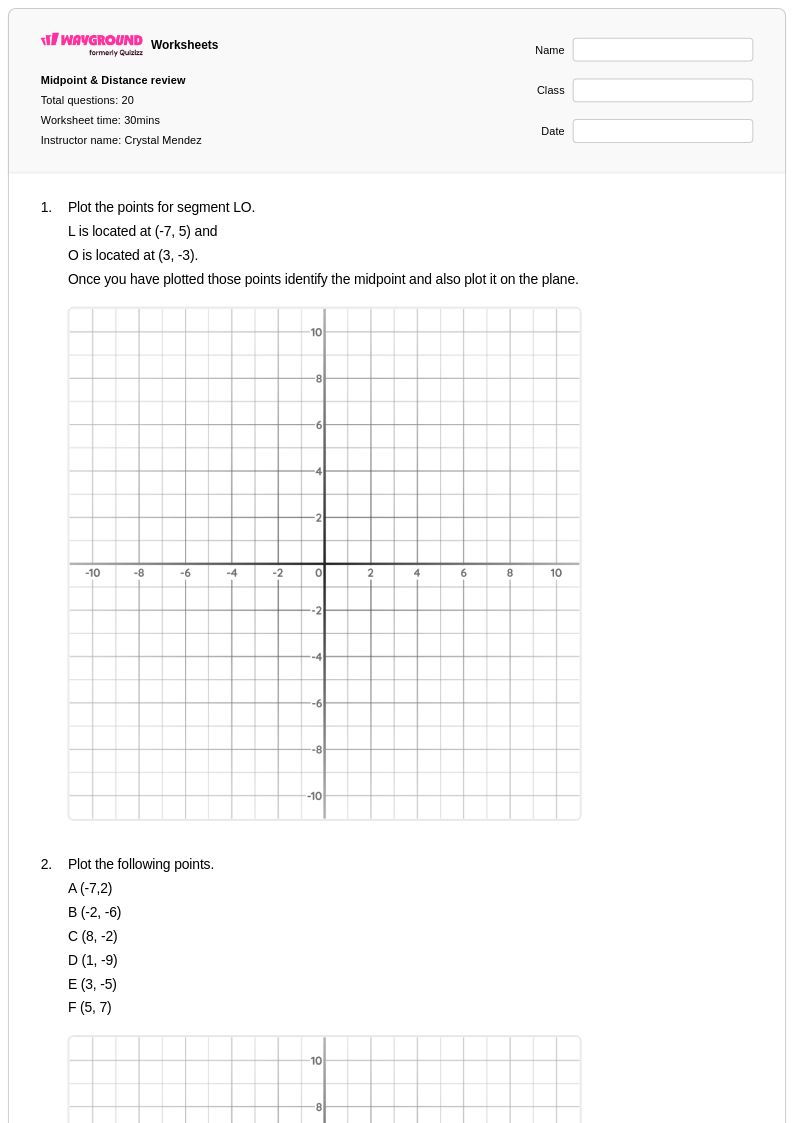
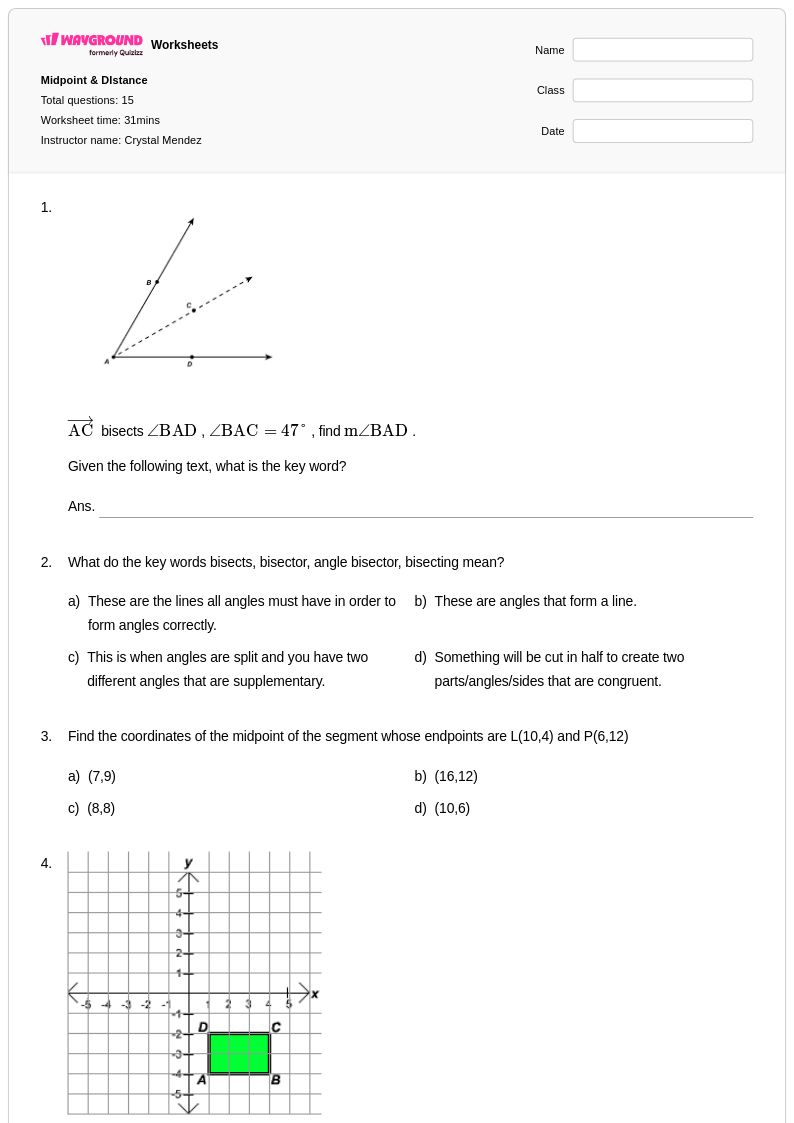
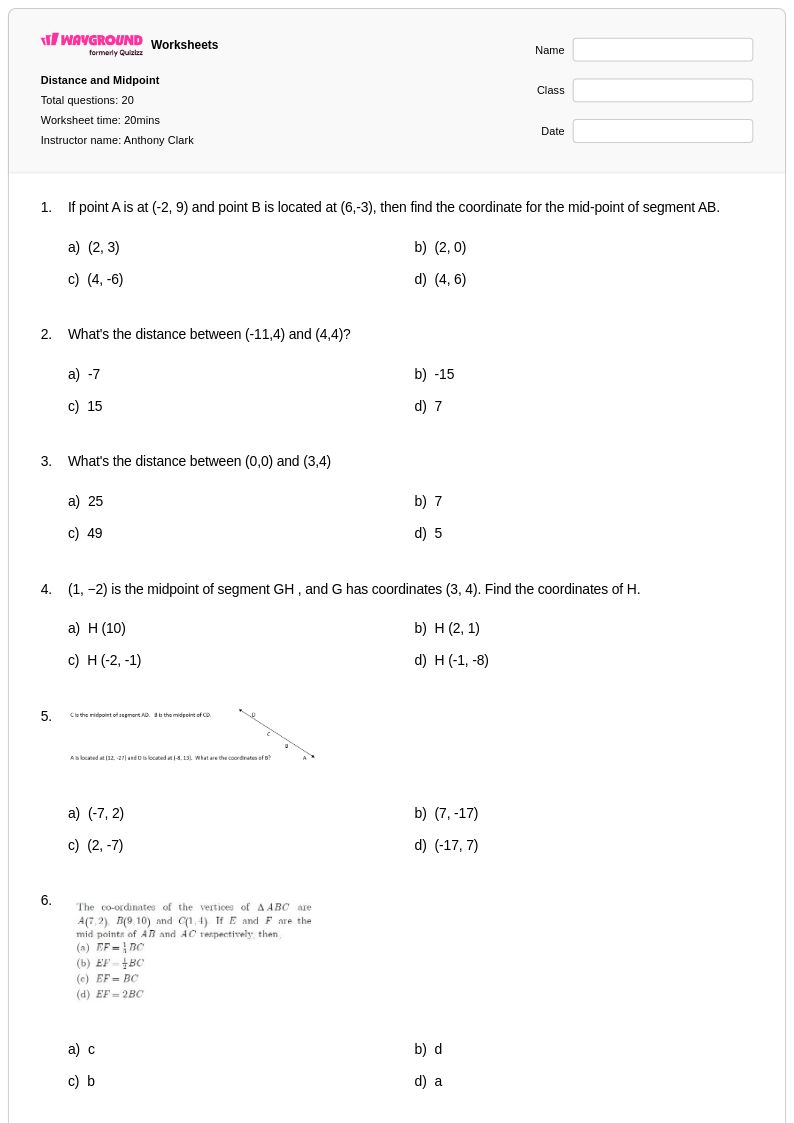
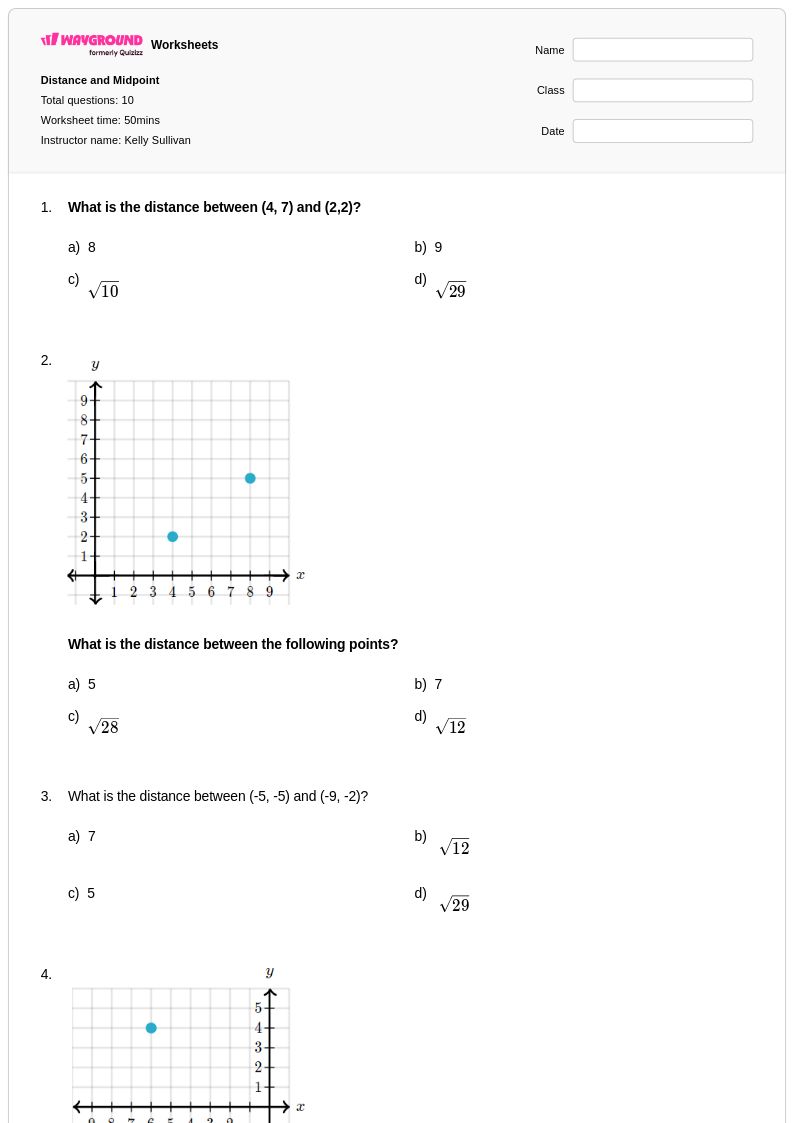
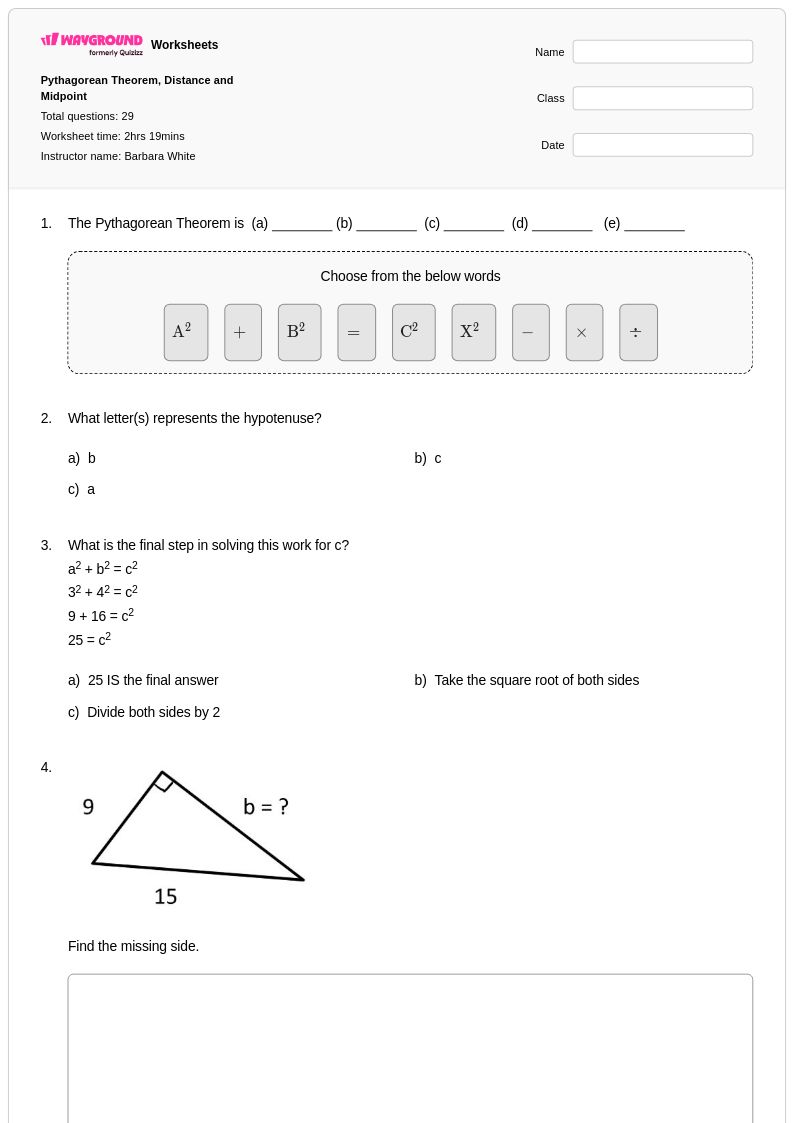
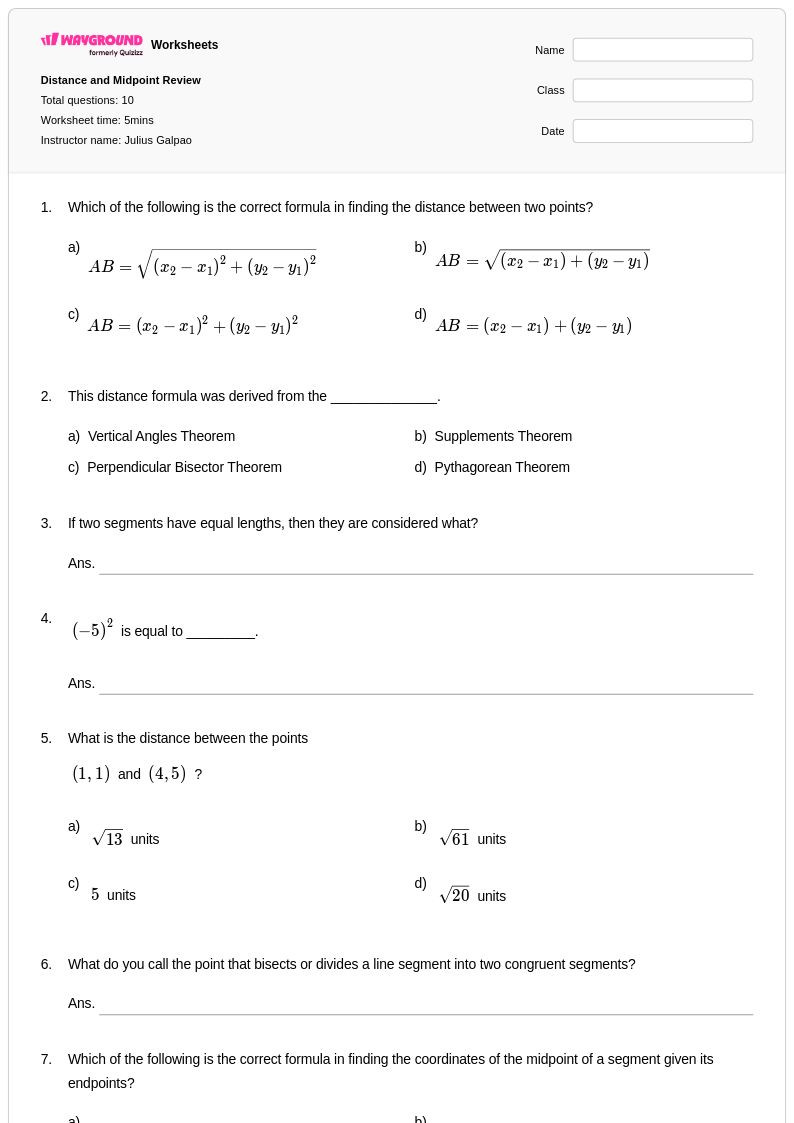
Start by grounding both formulas in something students already know. The distance formula comes directly from the Pythagorean theorem — draw the right triangle on the coordinate plane so students see why it works, not just how to use it. The midpoint formula is easier to motivate: ask students where the halfway point between two numbers on a number line is, then extend that idea to both x and y. Once the logic is clear, move to procedural practice with increasingly complex coordinate pairs.
What kinds of practice problems help students get comfortable with distance and midpoint?
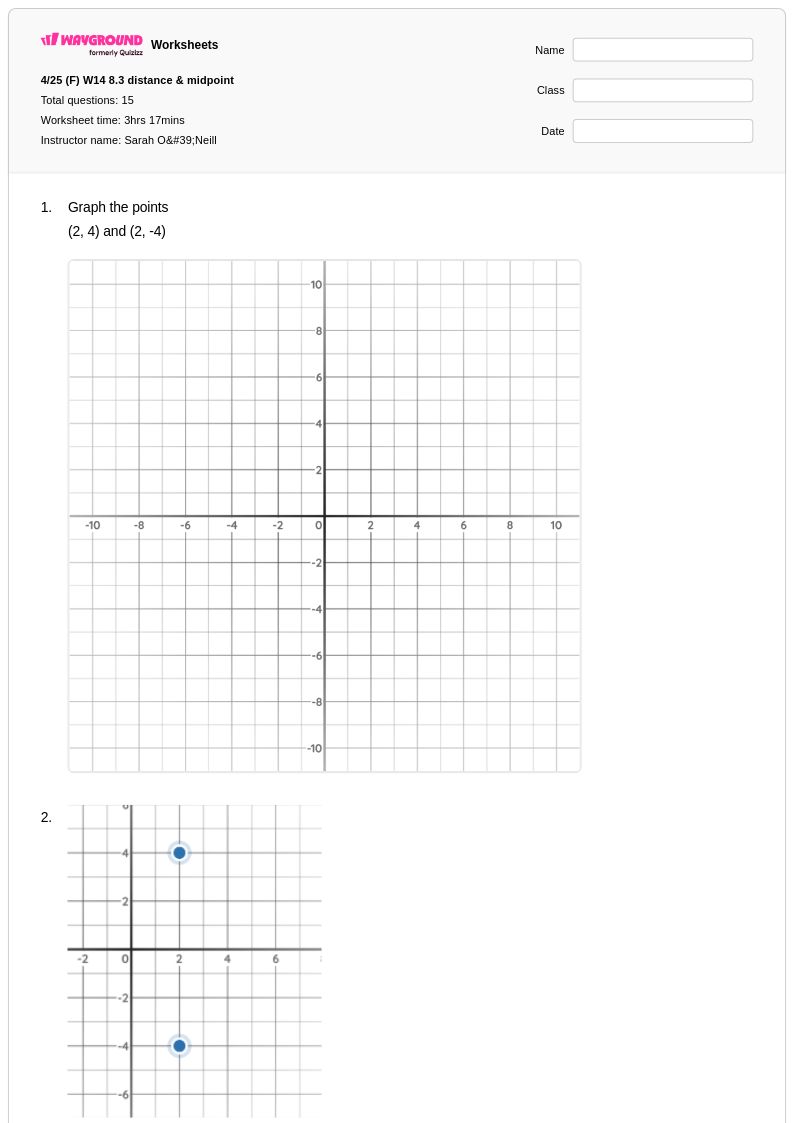
The most effective progression moves from single-step calculations (find the distance between two given points) to problems that embed the formulas in context: finding the length of a segment on a coordinate plane, locating the center of a segment, or verifying whether a point is equidistant from two others. Real-world setups — like finding the straight-line distance between two locations on a grid map — help students see why the formulas matter beyond the textbook.
What mistakes do students commonly make with the distance and midpoint formulas?
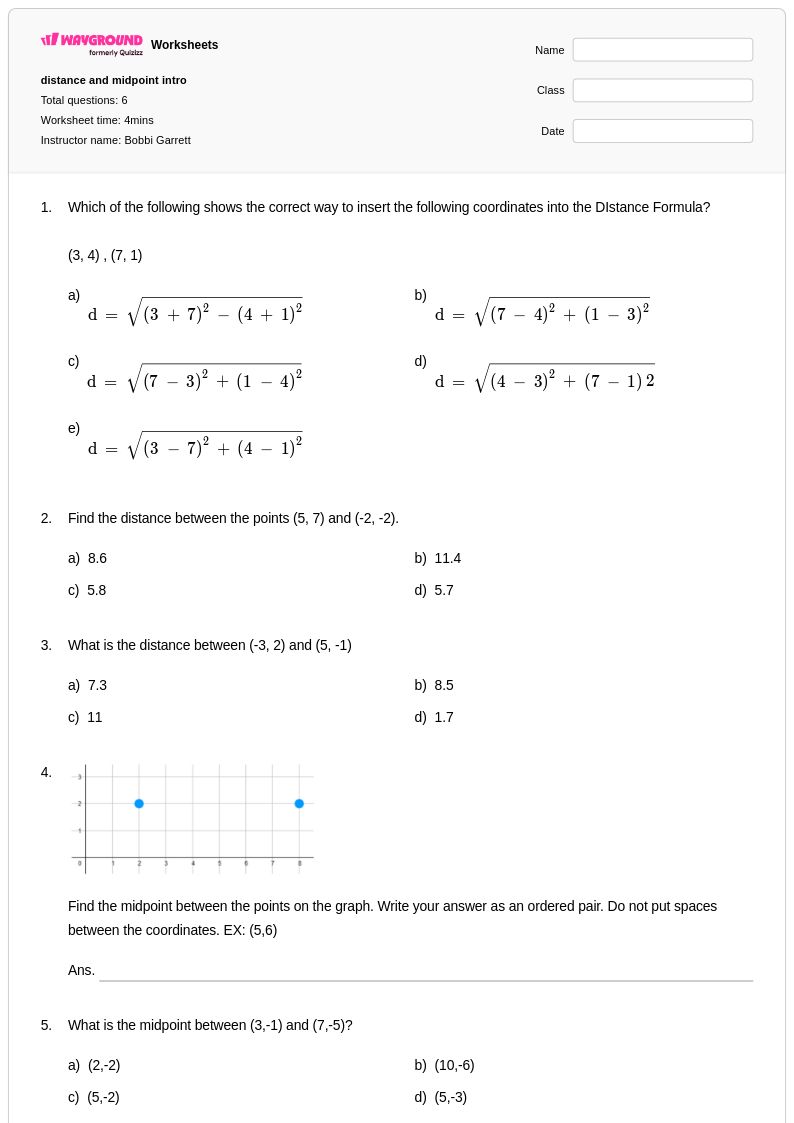
Three errors come up repeatedly. First, students subtract coordinates in the wrong order inside the distance formula, then panic when they get a negative — forgetting that squaring eliminates the sign. Second, they average only the x-coordinates for the midpoint and forget to do the same for y. Third, when coordinates include negatives, students mishandle the subtraction (e.g., treating 3 − (−2) as 3 − 2). Targeted practice with negative-coordinate problems catches that last error early.
How do I use Wayground's distance and midpoint worksheets in my class?
Each worksheet comes with a complete answer key, so students can check their own work during independent practice or you can use it for quick grading. If you prefer paper, download the printable PDF — offline practice is a good fit for classes reducing screen time — and grade submissions using the Wayground for Teachers app, which lets you scan or capture student work directly. Prefer a digital route? Host the worksheet as an interactive quiz on Wayground and students complete it on any device.
How does Common Core sequence distance and midpoint in the math curriculum?
Common Core builds toward distance and midpoint through a deliberate progression. Students first work with the coordinate plane and absolute value in middle school to find distances between points that share a coordinate. By high school geometry, they apply the Pythagorean theorem to derive the distance formula for any two points, and use the midpoint formula to explore segment bisectors and properties of geometric figures. From there, the skills feed directly into proving triangle congruence, classifying quadrilaterals, and writing equations of circles on the coordinate plane.
How can I differentiate distance and midpoint practice for mixed-ability classes?
For students who struggle with the algebra, Wayground's reduced answer choices accommodation lowers the cognitive load on multiple-choice problems, letting them focus on setting up the formula correctly rather than managing too many options at once. The dyslexia-friendly font and adjustable font size options help students who find dense coordinate notation hard to parse. For the worksheet itself, you can generate an alternate version with wider font spacing so the coordinate pairs are easier to read at a glance — a small change that makes a real difference for students who lose their place mid-calculation.
What grade level covers distance and midpoint?
Distance and midpoint are typically introduced in 8th grade as part of coordinate geometry, often tied to the Pythagorean theorem. They're reinforced and formalized in high school geometry (Grade 9–10), where students apply them to proofs and polygon properties. Some accelerated Grade 6–7 courses introduce coordinate distance informally using absolute value before the full formula appears.