Free Printable Enthalpy of Formation Worksheets for Grade 9
Grade 9 enthalpy of formation worksheets from Wayground offer comprehensive printables and practice problems with answer keys to help students master calculating energy changes in chemical reactions and understand thermodynamic principles effectively.
Explore printable Enthalpy of Formation worksheets for Grade 9
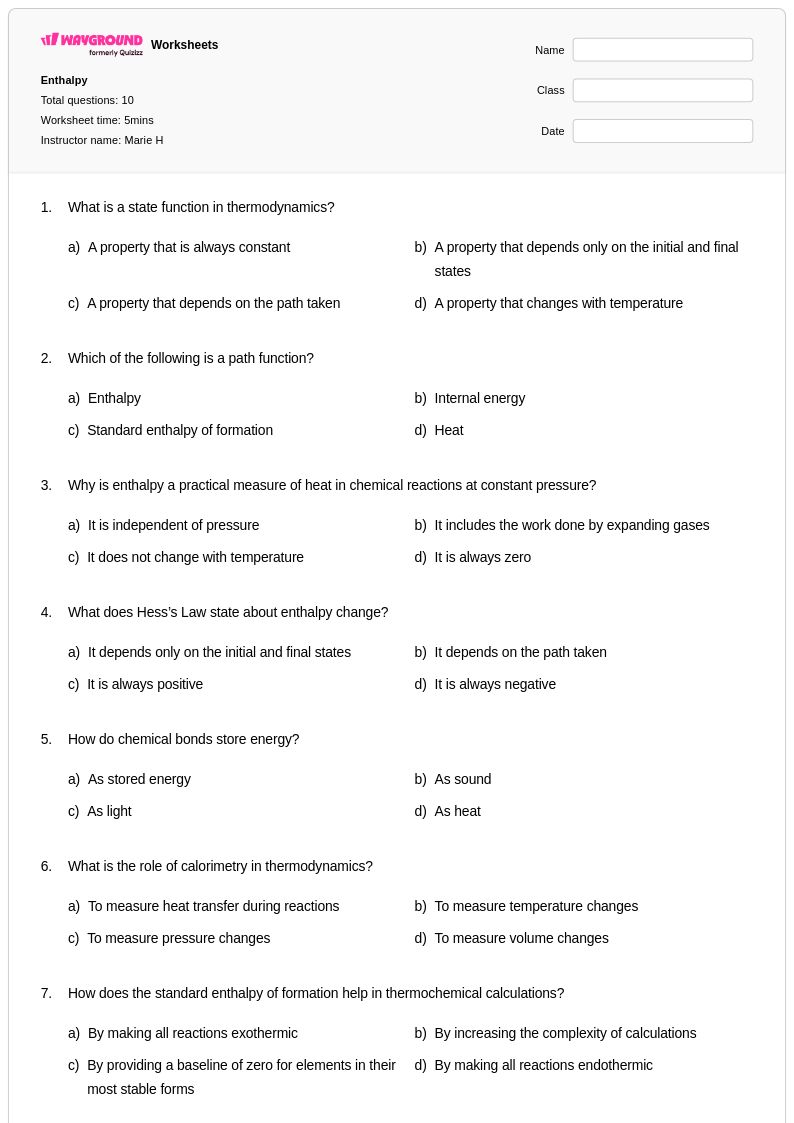
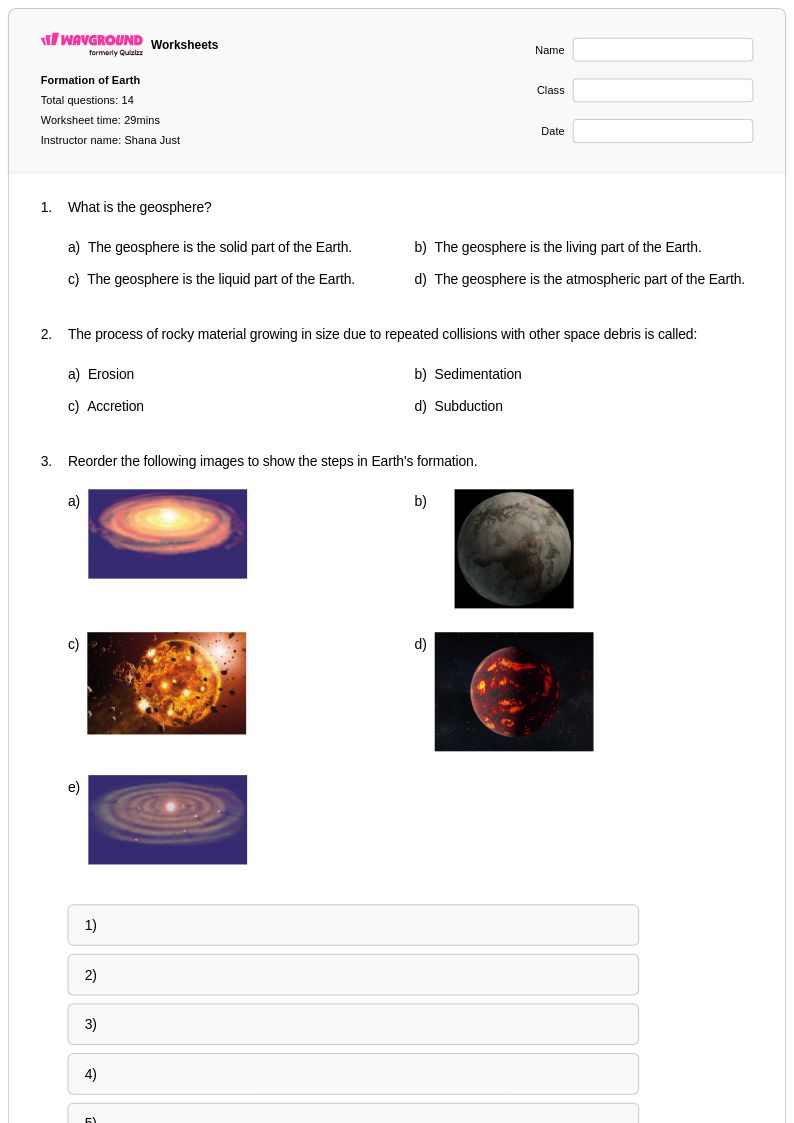
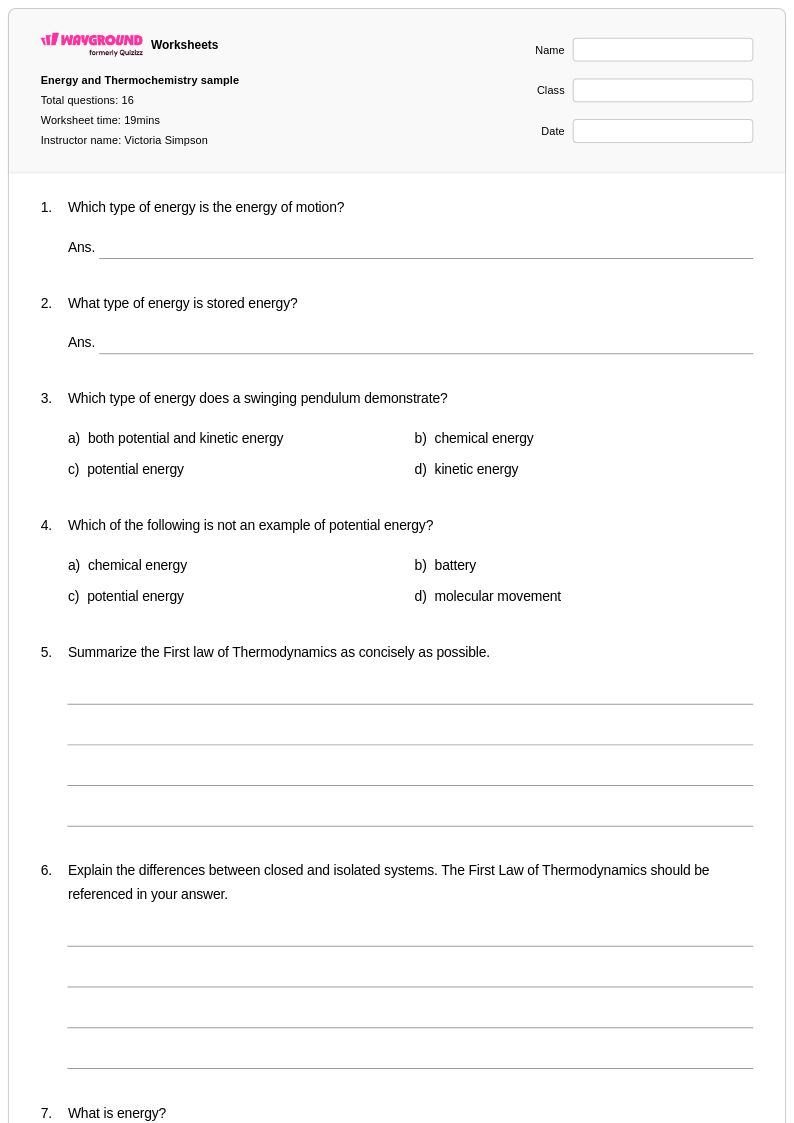
Enthalphy of formation worksheets for Grade 9 students available through Wayground (formerly Quizizz) provide comprehensive practice with calculating and understanding the energy changes involved when compounds form from their constituent elements in their standard states. These expertly designed resources strengthen students' abilities to interpret thermochemical equations, apply Hess's law principles, and solve complex energy calculations that are fundamental to advanced chemistry concepts. The worksheets feature systematic practice problems that guide students through determining standard enthalpy values, balancing formation equations, and connecting molecular structure to energy requirements, with complete answer keys provided to support independent learning and self-assessment. Available as free printables and downloadable pdf resources, these materials offer structured skill-building exercises that help students master the quantitative aspects of chemical thermodynamics.
Wayground (formerly Quizizz) empowers chemistry educators with access to millions of teacher-created enthalpy of formation worksheet collections that can be easily searched, filtered, and customized to match specific classroom needs and curriculum standards. The platform's robust differentiation tools allow teachers to modify problem complexity, adjust mathematical rigor, and scaffold learning progressions to accommodate diverse student ability levels within Grade 9 chemistry courses. These flexible resources are available in both printable and digital formats, including pdf downloads, enabling seamless integration into lesson planning, targeted remediation sessions, and enrichment activities that extend beyond basic formation energy concepts. Teachers can efficiently locate standards-aligned materials that support systematic skill practice while building students' confidence with thermochemical calculations and conceptual understanding of energy relationships in chemical reactions.
FAQs
How do I teach enthalpy of formation to chemistry students?
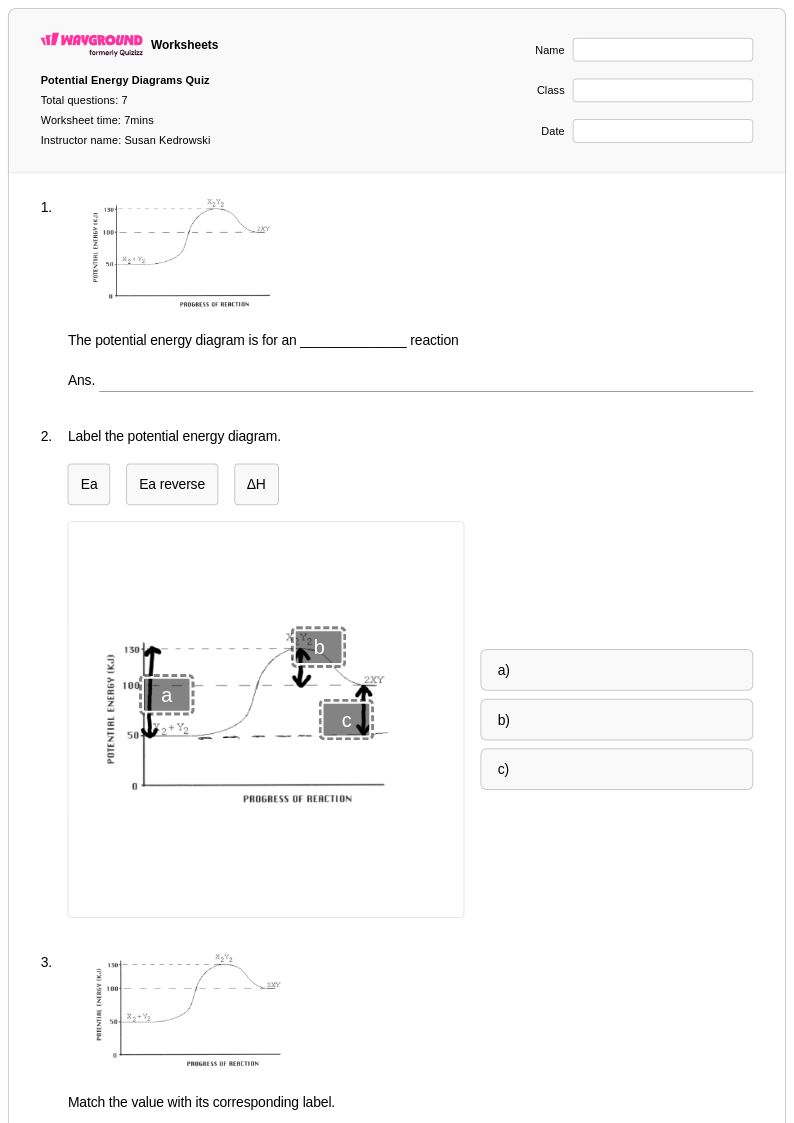
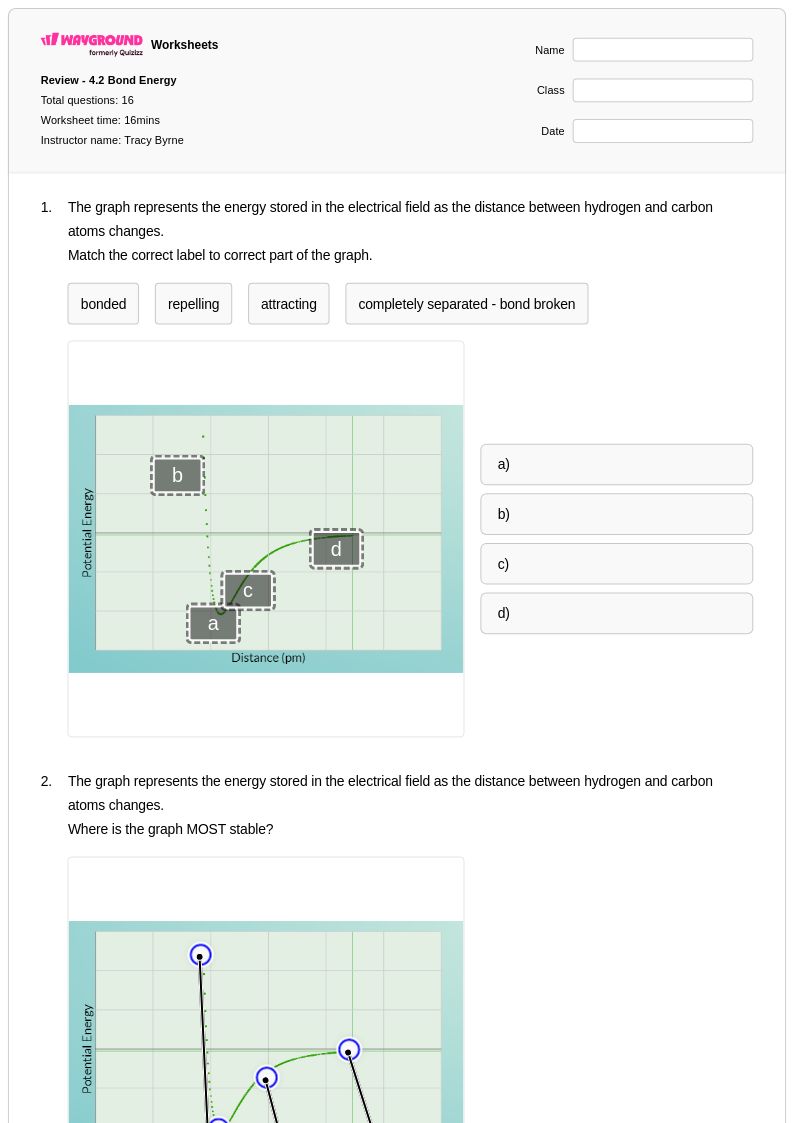
Start by grounding students in the concept of a reference state — standard enthalpy of formation is always measured from elements in their standard states, so students need to be comfortable interpreting thermodynamic data tables before attempting calculations. From there, introduce Hess's law as the primary tool for determining overall energy changes in reactions, using worked examples that break multi-step reactions into manageable components. Visual representations of bond formation and breaking help students connect molecular structure to energy content before moving to numerical problem sets.
What practice problems help students get better at enthalpy of formation calculations?
Students benefit most from a scaffolded progression: begin with single-step formation reactions using a data table, then move to applying Hess's law across two- and three-step reaction sequences. Problems that require students to identify which species are in their standard states and which are not are especially effective at exposing gaps in conceptual understanding. Including problems that ask students to calculate both heat released and heat absorbed reinforces sign convention, which is a frequent stumbling block.
What mistakes do students commonly make with enthalpy of formation?
The most common error is misapplying sign conventions — students often forget to reverse the sign of ΔHf when a formation reaction is written in the reverse direction. A second frequent mistake is treating compounds that are not in their standard state as if they were, leading to incorrect baseline values. Students also regularly confuse enthalpy of formation with enthalpy of combustion, so explicitly contrasting the two with side-by-side examples is worth the instructional time.
How do I use enthalpy of formation worksheets to support students with different skill levels?
Differentiation is straightforward when worksheets include a range of problem types, from basic single-reaction calculations to complex multi-step Hess's law analyses. On Wayground, teachers can apply student-level accommodations such as reduced answer choices to lower cognitive load for students who need additional support, or enable Read Aloud for students who benefit from audio delivery of problem text. Extended time settings can be configured per student, so advanced learners work under standard conditions while others receive the support they need — all without disrupting the rest of the class.
How do I use Wayground's enthalpy of formation worksheets in my classroom?
Wayground's enthalpy of formation worksheets are available as printable PDFs for traditional classroom use and in digital formats for technology-integrated environments, making them flexible for homework, in-class practice, or lab follow-up activities. Teachers can also host worksheets as a quiz directly on Wayground, enabling real-time student responses and immediate feedback. The included answer keys provide step-by-step solutions, which makes them equally effective for independent student review and teacher-led instruction.
How does Hess's law connect to enthalpy of formation problems?
Hess's law states that the total enthalpy change of a reaction is independent of the pathway taken, which means formation reactions can be combined algebraically to calculate the enthalpy of reactions that cannot be measured directly. In practice, students use tabulated standard enthalpies of formation to apply the formula ΔH°rxn = ΣΔHf°(products) − ΣΔHf°(reactants). Mastering this relationship is the central skill in most enthalpy of formation problem sets and a prerequisite for advanced thermodynamics coursework.